
Businesses seeking a telecom installation company in Chicago are often under pressure. A lease is turning over, a floor is being renovated, a warehouse needs better connectivity, or an aging phone and network setup is starting to fail at the wrong time.
Installation companies often focus on the visible part of the job. New cabling, new racks, new switches, cleaner Wi-Fi coverage, carrier handoff, test results. The harder part is managing the full lifecycle without creating downtime, permit delays, messy change orders, and a closet full of retired gear nobody planned to remove. In Chicago, that operational discipline matters as much as the technology choice.
Defining Your Project Scope and Technical Needs
A strong telecom project starts before you call a single vendor. If your request is vague, every installer will price a different version of the job, and you'll end up comparing numbers that don't match the same scope.
The first task is to convert business intent into field requirements. “We need better connectivity” isn't a scope. “We need a new IDF on the second floor, upgraded structured cabling for staff seating, fiber uplink between closets, and clean cutover windows outside business hours” is.
Start with business operations, not cable types
McKinsey notes that in similar transformations, about 70% of the effort should focus on redesigning workflows, with 10% on algorithms and 20% on the tech stack, which is a useful reminder that telecom work succeeds when the operating model is defined first, not last (McKinsey on telecom transformation).
That means your internal brief should answer practical questions before anyone quotes the work:
- Who uses the site: Office staff, production teams, warehouse scanners, classrooms, clinics, and guest users create different density and uptime requirements.
- What must stay live: Some sites can tolerate an overnight cutover. Others need phased migration because phones, access control, point-of-sale, or building systems can't go dark.
- How many spaces are involved: A single floor refresh is different from a downtown headquarters plus suburban branch locations.
- What is changing: New carrier entry, rack cleanup, Wi-Fi redesign, VoIP migration, MDF/IDF work, outside plant runs, or all of them together.
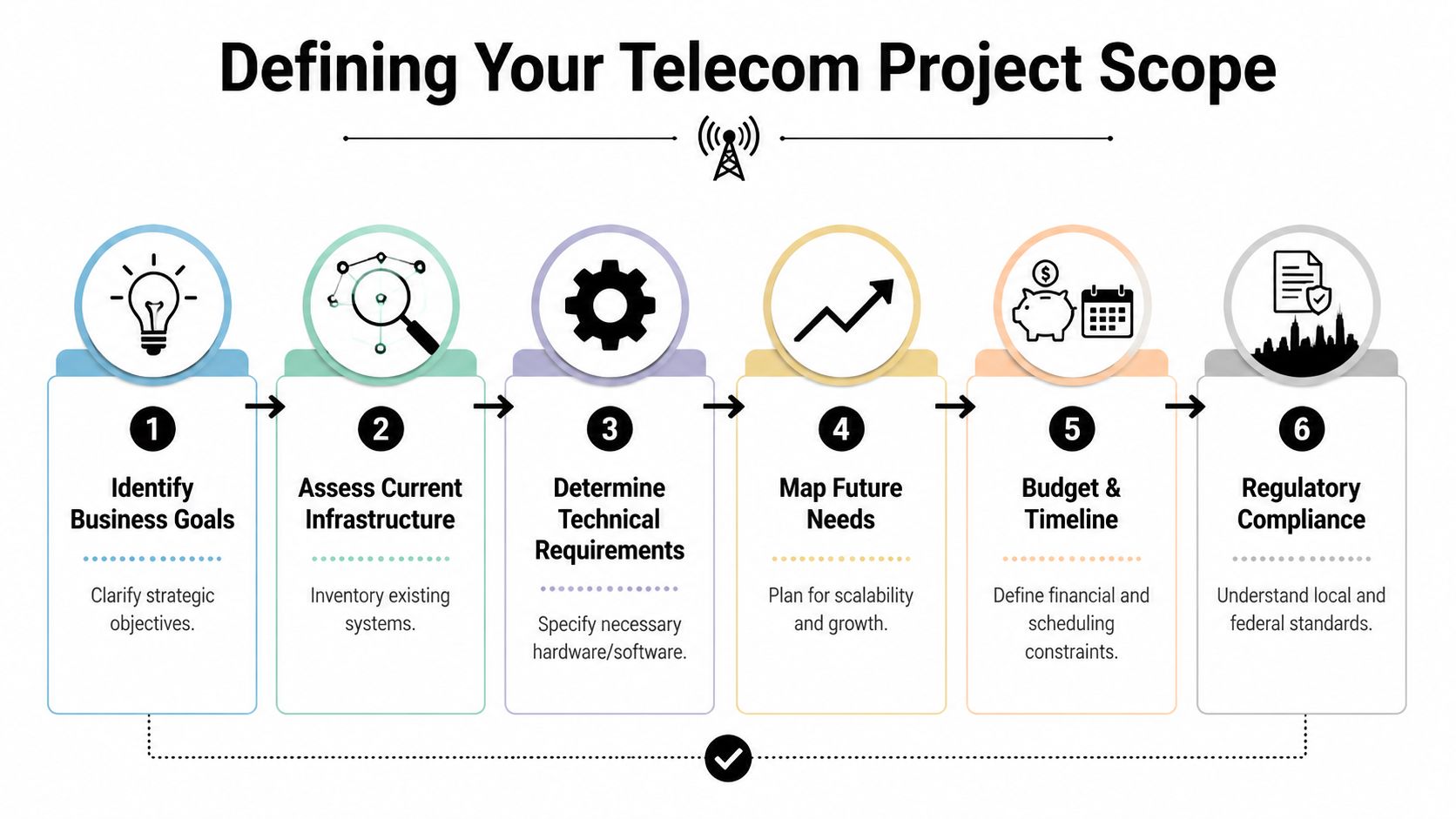
A useful internal reference point is to outline what belongs to facilities, what belongs to IT, and what requires joint signoff. Pathways, ceiling access, core drilling, and closet power often sit with facilities. Switch configuration, VLAN design, cutover sequence, and acceptance testing sit with IT. If no one owns the overlaps, they become project delays.
Write down the technical choices that affect cost
Many telecom installation company Chicago searches go sideways because buyers ask for “network cabling” when they need specific decisions around copper, fiber, pathways, termination, testing, and handoff.
Use a brief like this:
Structured cabling standard
Decide whether the site needs Cat5e, Cat6, Cat6A, fiber, or a mix. Higher-performance copper and fiber affect material cost, termination time, and future capacity.Inside plant vs outside plant
Inside plant work covers risers, closets, workstations, and patching inside the building. Outside plant work includes campus runs, underground paths, and building-to-building links. These are not interchangeable scopes.Wireless support
If you're adding access points, don't treat them like generic drops. Access point placement, ceiling conditions, and power requirements need to be coordinated early.Carrier and demarc requirements
New circuits often fail because no one planned the handoff path from building entry to the network room.
Practical rule: If a vendor can't price from a written room-by-room or closet-by-closet requirement set, you're still in discovery, not procurement.
A concise scope document should include floor plans, preliminary device counts, closet locations, working-hour constraints, testing expectations, labeling standards, and a punch-list process. If you want a local baseline for the kind of work many businesses request, review telecom installation services near Chicago and compare that list against your actual environment before bids go out.
Navigating Chicago's Permitting and Regulatory Landscape
A Chicago telecom project can stall before day one if permit ownership, building rules, and inspection steps are fuzzy. I have seen well-scoped installs lose a week because the vendor assumed the landlord would approve ceiling access, while the landlord was waiting for permit documents and certificates of insurance.
The city is only part of the approval chain. In many buildings, especially downtown high-rises, the practical gatekeepers are the property manager, building engineer, and security desk. Each may control a different part of site access, shutdown windows, freight elevator use, and after-hours work. If your installer cannot map that chain early, the field crew ends up waiting on the curb with material.
Before mobilization, get clear written answers on four points:
- Permit responsibility: Who files, who pays fees, and who owns revisions if field conditions change.
- Code and inspection basis: Which code requirements apply to pathway work, penetrations, grounding, supports, and firestopping, and whether an inspection or signoff is expected.
- Building approvals: Who authorizes ceiling access, riser use, loading dock reservations, badge setup, and work-hour restrictions.
- Cross-trade coordination: Whether electricians, fire alarm contractors, access control vendors, or building engineering staff must be scheduled before cable can be installed.
Site conditions matter as much as paperwork. In occupied offices, hospitals, schools, and mixed-use properties, crews need a real plan for dust control, containment, ladder access, staging, and end-of-day cleanup. Those details affect tenant complaints, safety exposure, and whether building management keeps approving the next work window.
Chicago adds another layer because the work environment changes block by block. A Loop tower may require night work, certificate review, and tight freight schedules. A suburban campus may be easier to enter but still require landlord approval for riser pathways or carrier demarc extensions. Industrial sites often add lift coordination, lockout procedures, and routing limits above active production areas.
One question separates prepared vendors from crews that only know cabling in the abstract. Ask for a recent Chicago-area example where permit timing, property management, or another trade changed the install sequence. The answer should include what changed, who approved the revision, and how the team protected the cutover date.
This phase also affects the end of the project more than buyers expect. If old racks, legacy cabling, retired phones, or access equipment are coming out, the removal plan should be reviewed alongside installation approvals, not after turnover. That is especially true when telecom work overlaps with user-facing systems such as Securitec Security intercom solutions, where device replacement can trigger separate building coordination and disposal requirements.
For teams building vendor questions around local conditions, Chicago telecommunications project support is a useful reference point for how business telecom work and related asset removal are handled across different property types.
How to Vet Vendor Qualifications and Credentials
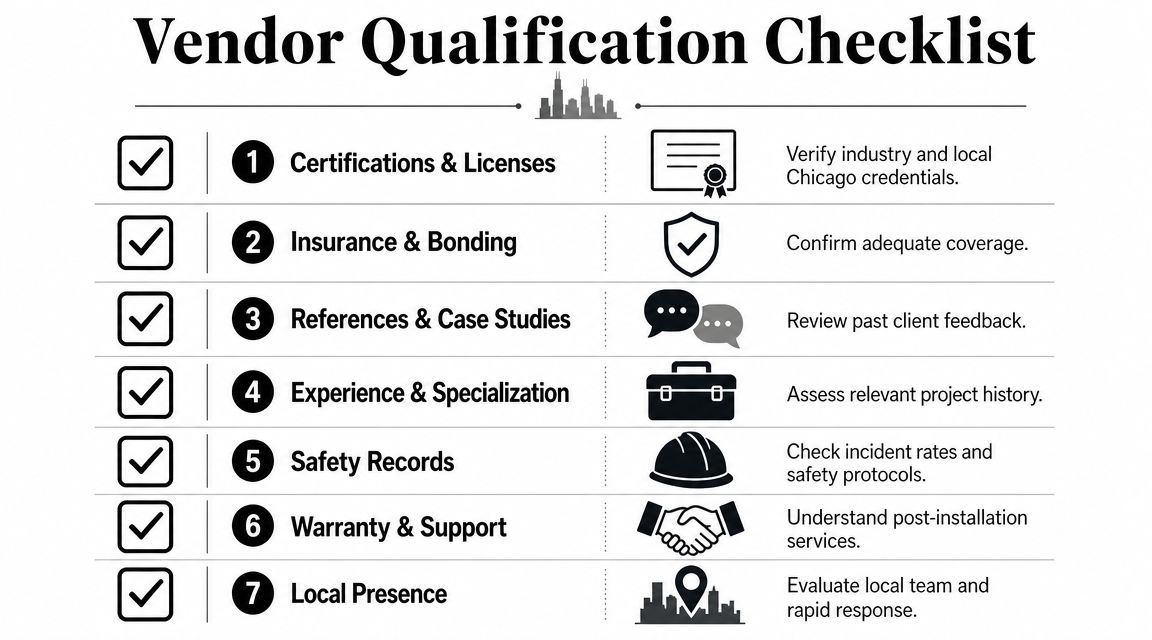
A polished proposal is easy to produce. A vendor that can deliver inside a live business environment is harder to find. The safest hiring process checks three things together: legal readiness, technical credibility, and evidence that the company has worked at Chicago scale before.
Look for proof, not reassurance
Start with paperwork. Ask for current licensing information where applicable, proof of general liability coverage, workers' compensation coverage, and the legal entity name that will perform the work. Then ask whether the firm is bonded and whether subcontractors will be used for any part of the installation.
That baseline matters because telecom work touches ceilings, pathways, equipment rooms, and occupied areas. If there's an incident, you need clean documentation before the first day onsite, not during a dispute.
Then move to technical fit. A company can be competent and still wrong for your job. VoIP cutovers, structured cabling, fiber work, intercom systems, and converged low-voltage environments require different habits in the field. If your project includes tenant communication or entry workflow, it helps to compare how installers think about adjacent systems like Securitec Security intercom solutions, because those jobs reveal whether a vendor can coordinate user-facing devices with network infrastructure instead of treating them as separate silos.
Track record matters in this market
One established Chicagoland provider says it has completed thousands of successful installations since 2004, covering Cat5e, Cat6, Cat6A, and fiber-optic cabling for businesses across Chicago and surrounding suburbs, which is a meaningful signal of sustained experience in a mature low-voltage market (Complete Low Voltage structured cabling background).
That kind of history doesn't guarantee your project will go well. It does tell you the market rewards firms that can execute repeatedly across different building types and technical scopes.
Use that insight as a filter. Ask shortlisted vendors for evidence in these categories:
- Similar environments: Office tower, warehouse, school, healthcare site, mixed-use campus, or municipal building.
- Technical overlap: Fiber backbone, Cat6 or Cat6A distribution, VoIP, camera integration, or demarc extension.
- Closeout quality: Sample test results, labeling format, as-builts, and turnover package.
- Support model: Who owns punch-list items, service tickets, and warranty calls after cutover.
A good shortlist has fewer names than most teams expect
If a firm checks every technical box but struggles to provide insurance documents, project references, or a named project manager, that's a risk signal. If another firm has cleaner operations but less experience in your building type, that may still be the better choice.
Due diligence test: Ask for a sample closeout package before award. Teams that finish well usually document well long before final invoice.
If you're comparing vendors that claim enterprise telecom capability, a useful local benchmark is enterprise telecom project support in Chicago. Review it against your checklist and look for gaps in field execution, not just scope language.
Comparing Pricing Models and Budgeting for Your Project
Pricing gets messy when the scope is loose. One installer assumes standard work hours. Another assumes after-hours labor. A third excludes permit handling or patching materials. On paper, all three look like bids for the same project. In practice, they're not.
The model changes the risk
Fixed-bid pricing works best when the site is well documented and the work can be measured clearly. Time-and-materials works better when demolition, discovery, or legacy conditions are still being uncovered. Neither model is always superior. The right one depends on how much uncertainty remains.
Here's a side-by-side view.
| Model | Best For | Pros | Cons |
|---|---|---|---|
| Fixed bid | Well-defined office buildouts, standard cabling packages, repeatable site scopes | Easier to budget, easier to compare, fewer surprises if scope is tight | Change orders can add up quickly if the original scope missed field conditions |
| Time and materials | Legacy environments, partial renovations, uncertain pathways, cleanup-heavy work | Flexible when discovery is ongoing, useful for troubleshooting and phased work | Final cost is harder to predict, requires stronger owner oversight |
| Not-to-exceed T&M | Projects with uncertainty but firm budget pressure | Preserves flexibility while limiting runaway spend | Requires clear assumptions and active review of scope drift |
| Unit pricing | Multi-site rollouts with repeatable drop, rack, or device work | Good for branch consistency, easier to forecast by quantity | Less effective when each building has unique constraints |
Read the quote line by line
A serious quote should separate labor, materials, project management, permits, testing, and assumptions. If the bidder rolls all of that into a single lump sum, ask them to break it back out.
Look closely at these line items:
- Labor windows: Standard hours versus night or weekend cutovers.
- Materials: Cable category, fiber type, patch panels, racks, ladder tray, supports, labeling supplies.
- Testing and closeout: Certification, documentation package, and remediation of failed tests.
- Exclusions: Core drilling, electrical work, painting, patching, circuit charges, or permit revisions.
A telecom installation company in Chicago that prices transparently is easier to manage after award because the same discipline usually carries into change orders and billing.
Cheap telecom bids often hide expensive assumptions. The fastest way to find them is to ask what the proposal excludes.
If you need a starting point for bid normalization, request a telecom service quote for your project area and use the resulting categories as a checklist for every competing proposal.
Structuring Your RFP and Vendor Interview Process
A solid RFP doesn't need legal theater. It needs enough detail that every bidder prices the same job, names the same risks, and responds to the same acceptance standard.
Put operating outcomes into the RFP
The state of Illinois documented more than $210 million in FY04 to FY05 savings and an ROI of $6.08 per dollar spent after consolidating datacenters, email systems, applications, operating systems, and help desks, which is a reminder that infrastructure work should be evaluated by the operational simplicity and support gains it creates, not just by equipment installed (Illinois IT rationalization report).
That principle belongs in your RFP. Don't ask only what a vendor will install. Ask how they will help you reduce disruption, simplify support, and document the environment after cutover.
A usable RFP usually includes:
Site context
Address, building type, access hours, occupancy conditions, and any landlord constraints.Scope of work
Quantities if known, closet locations, cable types, rack requirements, carrier handoff expectations, and removal assumptions.Technical standards
Labeling rules, testing criteria, documentation format, and approval process for substitutions.Schedule requirements
Mobilization window, milestone dates, blackout periods, and cutover constraints.Commercial response format
Require bidders to separate labor, materials, assumptions, alternates, and exclusions.
Use interviews to expose process maturity
Interviews shouldn't repeat the proposal. They should test how the team thinks under pressure.
Ask questions like these:
- When field conditions conflict with the drawing, who documents the issue and who approves the change?
- What does your weekly status report include?
- What has to be true before you call a site ready for cutover?
- How do you handle failed test results or mislabeled legacy cabling?
- What does your final closeout package look like?
Then listen to the structure of the answer. Strong vendors talk about ownership, approvals, sequencing, and documentation. Weak vendors answer with confidence but not process.
Score the interview, don't just remember it
Use a simple scoring sheet with categories such as project management, technical fit, communication quality, documentation standards, and post-install support. Keep procurement, IT, and facilities in the same review meeting if possible. Each group catches different risks.
Good interviews sound operational. If the discussion stays at the sales level, you still haven't met the team that will run your project.
One more useful test is to ask the proposed project manager, not just the salesperson, how they would stage a cutover in an occupied Chicago site with limited after-hours access. That answer usually tells you whether the company can execute the scope it bid.
The Overlooked Final Step Secure IT Decommissioning
Most telecom projects celebrate too early. The new environment is live, the phones work, the network passes traffic, and everyone moves on. Then the old switches, patch panels, routers, handsets, UPS units, and cabling stay behind in storage rooms, closets, and loading areas.
That isn't harmless cleanup. It's unfinished project risk.

A major gap in the market is what happens after installation. Many Chicago-area providers advertise fiber, Cat6, low-voltage, and end-to-end telecom installation, but they rarely explain how they handle retiring legacy networks, even though replacement and migration are common parts of real-world upgrades (outside plant and replacement project context).
What should happen to legacy telecom gear
Decommissioning needs its own workstream. That means inventorying what comes out, separating data-bearing equipment from scrap, documenting chain of custody, and deciding what can be reused, donated, recycled, or destroyed.
At minimum, the closeout plan should identify:
- Data-bearing devices: Firewalls, servers, storage appliances, phones with retained data, and certain network devices.
- Reusable assets: Equipment with remaining value or internal redeployment potential.
- Physical removal scope: Racks, old patch panels, abandoned cabling, batteries, and accessories.
- Final disposition path: Recycling, donation, remarketing, or product destruction where appropriate.
In such cases, many businesses need a separate partner from the installer. The installation company may be excellent at cable plant and cutover, but that doesn't mean it runs secure IT asset disposition workflows.
Why this belongs in the original project plan
If decommissioning isn't scoped early, you get all the usual problems. Surprise labor charges for removal. Old gear left onsite. Unclear responsibility for storage media. Sustainability reporting that can't be completed because no one documented final disposition.
A more disciplined approach treats retirement work as part of the upgrade itself. If you're replacing closet hardware, the removal and secure handling plan should be approved before the first new rack goes in.
For teams formalizing that process, a server decommissioning checklist is a practical planning tool. It helps align IT, facilities, and disposal partners before equipment starts leaving the site.
A company such as Reworx Recycling can fit into this final phase as an ITAD and electronics recycling partner for retired telecom and network hardware, especially when the project also involves secure data destruction, office cleanout, facility cleanout, or donation-based recycling.
Retired equipment is still part of the project until it's documented, secured, and removed through the right channel.
That last step also affects sustainability reporting. Businesses increasingly want to show that upgrades didn't just improve performance. They also reduced disposal risk and supported responsible end-of-life handling. Done right, decommissioning closes both the operational and environmental side of the project.
Your Final Decision Checklist for a Chicago Partner
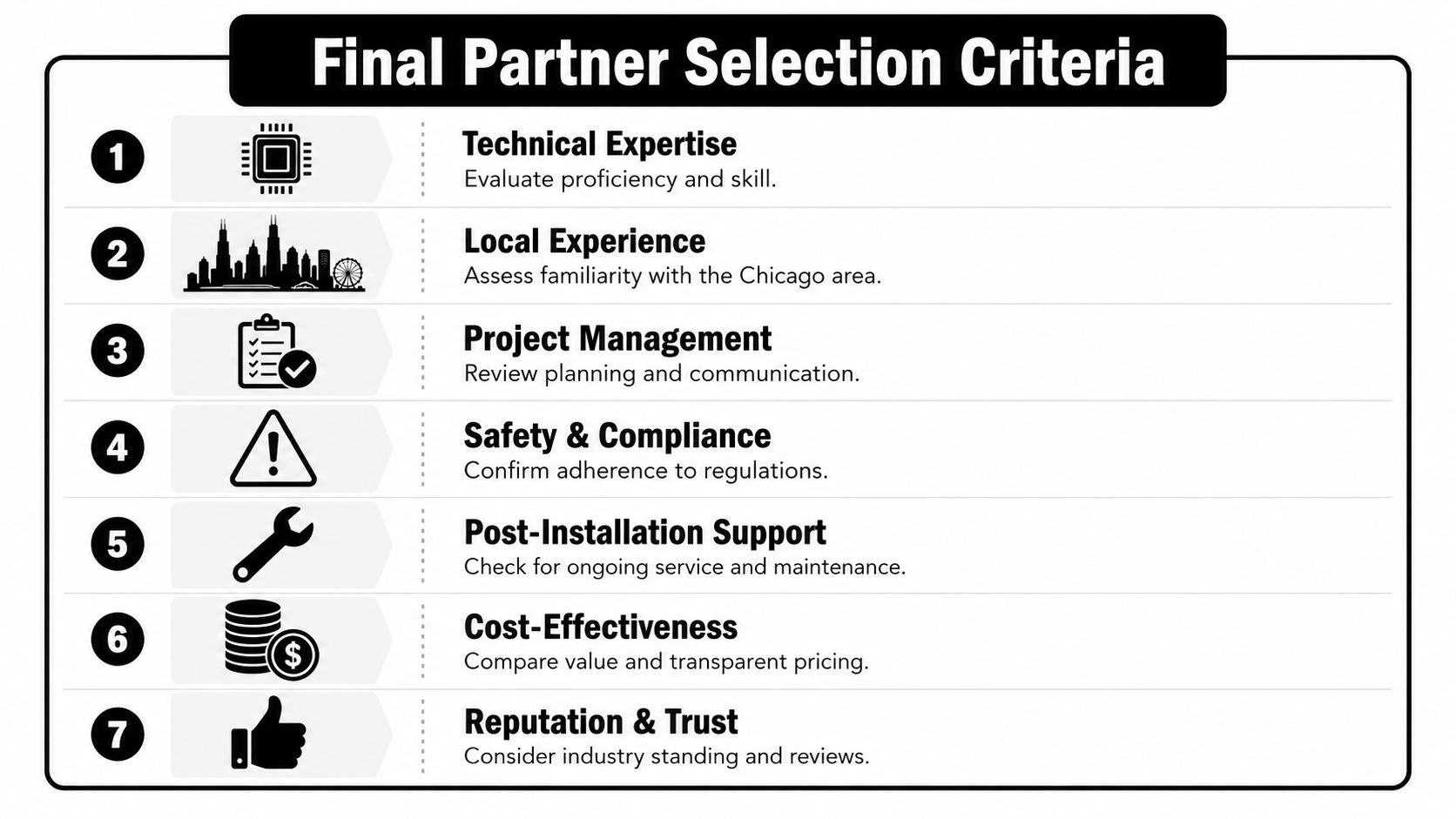
A final selection usually comes down to execution risk. By this stage, every serious bidder can install cable and terminate connections. The better choice is the firm that can keep the project on schedule, work cleanly inside your buildings, document the job properly, and close out the old equipment without leaving loose ends for IT or facilities.
Use a scorecard and force the team to rate each finalist against the same criteria. That keeps the decision tied to project outcomes instead of personality, sales polish, or a low number that grows later through change orders.
Key areas to score:
Technical fit
Does the installer regularly handle your actual scope, whether that means copper, fiber, VoIP, Wi-Fi backhaul, MDF and IDF buildouts, or mixed low-voltage environments?Chicago delivery discipline
Can the team explain how they handle access windows, union or landlord constraints where applicable, freight elevator scheduling, occupied-floor work, and coordination across city and suburban sites?Commercial clarity
Does the proposal spell out assumptions, exclusions, allowance limits, warranty terms, and the process for approving added work?Project leadership
Have they identified the project manager and field lead who will run the job, not just the salesperson who won it?Closeout quality
Will you receive test results, as-builts, labeling standards, and a defined punch-list process before final payment?Legacy equipment handling
Have they assigned responsibility for removing, staging, documenting, and transferring retired hardware for secure disposition?
A red, yellow, green review works well because it exposes risk fast.
| Area | What Green Looks Like | What Yellow Looks Like | What Red Looks Like |
|---|---|---|---|
| Scope alignment | Proposal matches site conditions and acceptance standards | A few assumptions still need confirmation | Major gaps, vague inclusions, or unclear handoffs |
| Compliance readiness | Building coordination and approval responsibilities are clearly assigned | Some permitting or access questions remain open | No clear owner for approvals or site coordination |
| Delivery team | Named PM and field lead with relevant project history | PM is promised but not yet assigned | No clear delivery ownership after contract award |
| Documentation | Sample test reports, labeling conventions, and closeout package shown | Documentation is described but not demonstrated | No defined standard for turnover |
| Decommissioning plan | Retired gear handling, chain of custody, and pickup flow are defined | Removal is mentioned but not operationalized | Legacy equipment is left for the client to sort out |
If two firms are close on price, pick the one with fewer yellow boxes. In infrastructure work, unresolved details turn into delay, rework, and internal cleanup.
That last line item deserves more weight than it usually gets. A Chicago telecom upgrade is not finished when the new network comes online. It is finished when the replaced switches, phones, servers, UPS units, and rack components are removed, accounted for, and sent through the right disposal channel. If that scope is split between installer, IT, facilities, and an ITAD vendor, assign ownership before award.
If your project includes retired electronics, Reworx Recycling can be added as the downstream partner for electronics recycling, secure data destruction, IT equipment disposal, and donation-based recycling support. That gives the project a cleaner closeout path, especially during office cleanouts, facility cleanouts, and larger data center decommissioning efforts.