
A Houston company usually starts its telecom search after something breaks in a visible way. Sales calls drop in the middle of a proposal. The ERP slows down every afternoon. Staff in a warehouse get one bar of signal near the loading docks and no signal deeper inside the building. What looked like a minor IT annoyance turns into delayed work, frustrated employees, and leadership asking why the business has outgrown its current setup.
That's why choosing a telecom solutions provider in Houston shouldn't be handled like a simple carrier swap. It's an infrastructure decision tied to operations, customer experience, resilience, security, and the cleanup that follows when old phones, switches, firewalls, and network gear come out of service. A smart upgrade plan covers both sides: what you're bringing in and what you're retiring.
Starting Your Search for a Telecom Partner in Houston
A familiar Houston scenario goes like this. A growing logistics firm adds a second facility, rolls out more cloud apps, and pushes more calls through VoIP. The old connection worked when everyone sat in one office and the phone system was lightly used. It doesn't work anymore.
The symptoms show up before the root cause is obvious:
- Voice quality drops during client calls
- Cloud applications lag when multiple teams are active
- Carrier invoices get harder to decode as add-ons pile up
- Support tickets bounce between internet, voice, and hardware vendors
That's when many businesses start searching for a telecom solutions provider in Houston. Some ask only for lower monthly cost. That's usually the wrong starting point. A cheaper circuit won't fix poor LAN design, weak Wi-Fi coverage, flawed failover logic, or phone provisioning problems. It also won't help if your current estate includes aging equipment you need to remove securely once the migration is done.
A better approach is to treat the telecom project as an operational reset. Review voice, broadband, mobility, cloud connectivity, cabling dependencies, indoor wireless coverage, branch connectivity, and support expectations together. In Houston, that matters because many firms operate across office towers, industrial sites, medical spaces, schools, or large warehouses where network behavior varies sharply from one part of the property to another.
For companies that want a localized starting point, Houston telecom service options can help frame what types of services typically come into scope during a modernization effort.
Poor telecom decisions usually come from defining the project too narrowly. The business asks for faster internet when it really needs a cleaner operating model.
Assessing Your Organization's True Telecom Needs
The strongest buying position comes from doing your homework before any vendor presentation. If your internal team can describe the current state with precision, providers have less room to oversell or to hide weak fit behind polished demos.

Map what you have before discussing what you want
Start with a basic infrastructure inventory. It doesn't need to be fancy, but it does need to be complete enough to support real decisions.
Create a working record of:
- Internet circuits and carriers. Note primary, backup, contract status, demarc locations, and recurring issues.
- Voice environment. List PBX or UC platforms, handsets, call queues, fax dependencies, and analog lines that still serve alarms, elevators, or legacy systems.
- Network hardware. Capture routers, switches, firewalls, access points, and any end-of-life concerns.
- Physical layout. Mark signal dead zones, MDF and IDF locations, and parts of the building where connectivity complaints are concentrated.
Houston supports this level of planning because the market isn't limited to small local coverage. Cogent says it serves more than 116,809 customer locations worldwide and has multiple Houston offices, while Houston-headquartered Meriplex publicly cites 600+ employees and about $120 million in revenue in 2023. Those figures indicate a local market where businesses can buy from providers with both broad backbone reach and substantial regional delivery capacity, which matters for multi-site organizations and staged rollouts (Cogent Houston market presence).
Identify pain points in business terms
Don't stop at “the network is slow.” Pin down when, where, and who gets affected.
A useful internal review asks:
- Which workflows fail first during peak demand?
- Which departments lose the most time when voice or connectivity degrades?
- Do remote and in-office users experience the same issues?
- Are current outages caused by the carrier, by local network design, or by aging hardware?
This is also the point where security and compliance move from side issue to core requirement. Healthcare, legal, finance, and industrial firms often need documented controls around traffic handling, access, and resilience. If your team needs a plain-English refresher on the building blocks of secure network infrastructure, that resource is useful for framing what should be discussed before a provider starts proposing solutions.
Forecast the next version of the business
A telecom contract often lasts longer than your current org chart. Plan for growth, hybrid work, acquisitions, facility moves, and heavier cloud use. If you expect new collaboration tools, more cameras, more IoT endpoints, or expanded warehouse operations, include that now.
A short planning table helps.
| Area | Current need | Near-term change |
|---|---|---|
| Voice | Desk phones and softphones | More mobile and remote users |
| Internet | Business broadband or fiber | Higher cloud dependency |
| Site coverage | Basic office coverage | Expansion into warehouse or multi-floor footprint |
| Security | Standard firewalling | Stronger segmentation and policy control |
If you're evaluating cloud voice or hybrid connectivity, cloud telecom planning in Houston is a practical reference point for narrowing scope before you issue requirements to providers.
Evaluating Providers on Technical and Commercial Grounds
Once your needs are documented, build a scorecard. Without one, teams get distracted by polished sales reps, teaser pricing, or one feature that sounds impressive but won't matter in daily use.
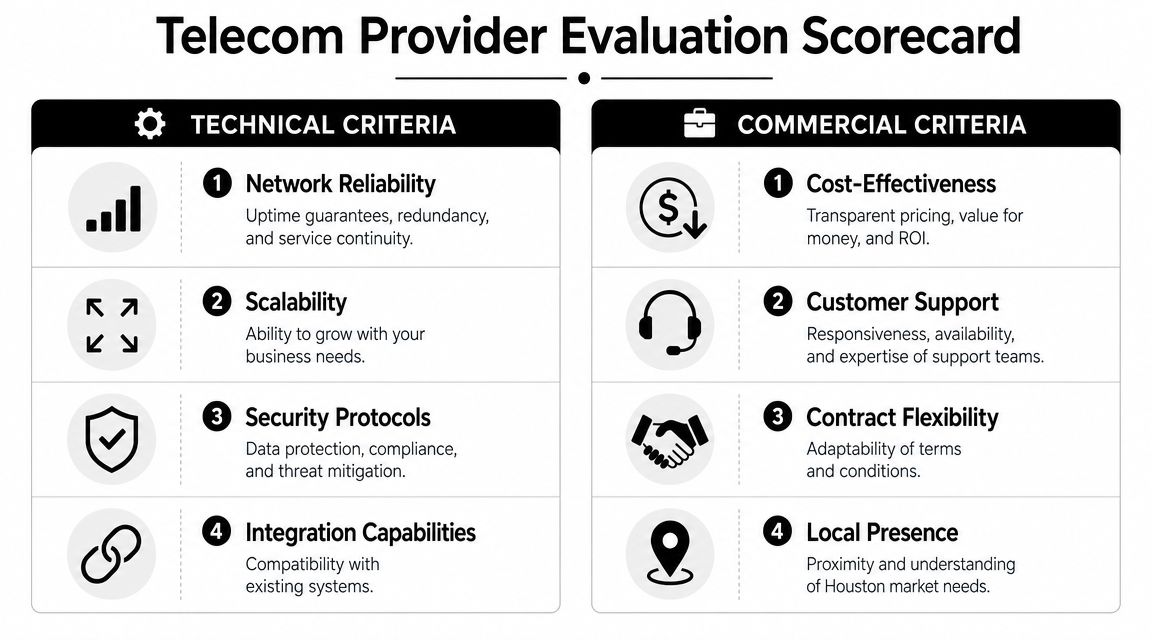
Technical criteria that deserve close scrutiny
Technical fit starts with network design, not marketing language. Ask how the provider handles primary connectivity, failover, QoS for voice, firewall handoff, and site-to-site traffic if you have more than one location.
Use a scorecard for these areas:
- Reliability design. Look for redundancy options, escalation paths, and realistic support coverage.
- Scalability. Ask how quickly circuits, seats, or locations can be added without forcing a redesign.
- Security posture. Review segmentation, managed firewall options, logging visibility, and responsibility boundaries.
- Integration. Confirm compatibility with Microsoft Teams, contact center tools, CRM workflows, and existing switches or firewalls where relevant.
For many Houston properties, there's another issue that gets ignored in telecom buying conversations. Indoor cellular performance. Existing Houston telecom pages often focus on internet, VoIP, and dark fiber, but say little about in-building wireless coverage, even though distributed antenna systems, or DAS, are designed to amplify outside cellular signal and redistribute it throughout a building or site. That's especially relevant for offices, warehouses, schools, and public buildings with stubborn indoor dead zones (Houston dark fiber and DAS gap analysis).
Field note: If your executives complain about dropped mobile calls inside the building, don't assume a new internet provider will fix it. That's often a DAS or indoor wireless design problem, not a bandwidth problem.
The physical layer matters too. A provider can promise excellent service, but poor patching, bad terminations, overloaded closets, or undocumented runs will still undermine performance. For a grounded view of how structured cabling choices shape downstream reliability, Networking2000 data cabling insights are worth reviewing before site work begins.
Commercial terms that separate good deals from expensive mistakes
Many buyers compare only monthly recurring charges. That leaves out install costs, support model differences, term commitments, equipment obligations, and change-order exposure.
Focus your commercial review on these questions:
| Commercial issue | What to check |
|---|---|
| Pricing model | Are fees transparent, or spread across bundles and surcharges? |
| Contract flexibility | Can you add or remove services as sites change? |
| Support | Is support local, centralized, outsourced, or tiered? |
| Exit risk | What happens if service underperforms or you move locations? |
A lower monthly fee can still produce a worse result if the provider requires proprietary hardware, limits support scope, or locks you into terms that no longer match the business after a facility expansion.
Businesses comparing local options may also find telecom solution options near Houston operations helpful when building a shortlist across multiple service categories.
Mastering the RFP and Contract Negotiation
A weak RFP invites weak proposals. If you ask providers for “internet and phones pricing,” they'll give you shallow quotes that are impossible to compare cleanly. A stronger RFP forces specificity around implementation, support, service boundaries, and failure scenarios.
Ask questions that reveal operational maturity
Your RFP should test how the provider works when things go wrong, not just how they sell when things are going right.
Include questions such as:
- Hurricane readiness. How does the provider handle continuity planning, rerouting, and field support during severe weather events?
- Onboarding method. What is the migration sequence, who owns each step, and what customer resources are required?
- Escalation path. Who gets involved after the first support tier, and how are chronic issues managed?
- Local references. Can the provider describe similar Houston deployments involving offices, industrial sites, healthcare facilities, or multi-site organizations?
Houston businesses benefit from a provider environment tied to national and multi-state reach. The Greater Houston business directory highlights AT&T as a leading provider with the nation's largest 4G network, while Spectrum Business says it serves small businesses across 41 states and Consolidated Communications reports service across more than 20 states. That broad service reach makes Houston a useful hub for firms that need network, voice, and broadband options with enterprise-grade infrastructure beyond one metro footprint (Greater Houston telecom directory overview).
Negotiate the SLA like it affects revenue, because it does
A contract isn't complete when the monthly price looks acceptable. The SLA determines whether service failure becomes your problem or the provider's.
Watch for these red flags:
- Auto-renewal language that kicks in before your team has time to evaluate performance
- Ambiguous install fees or charges tied to moves, adds, and changes
- Vague response commitments that sound strong but don't define actual remediation timelines
- Credits that are too small to matter when outages affect operations
Don't accept SLA language that sounds precise but lacks enforcement. If the provider misses service levels, the contract should define what happens next.
This is also the stage to ask about equipment ownership. If a future migration leaves you with surplus phones, switches, or edge devices, you'll want a clean retirement path. For organizations anticipating decommissioned telecom gear, telecom equipment liquidation in Houston is part of the planning conversation, not an afterthought.
Planning a Seamless Migration and Onboarding
The contract signature isn't the finish line. Most telecom pain appears during migration, when number porting stalls, hardware arrives late, VLAN assumptions turn out to be wrong, or users learn too late that familiar call flows are changing.
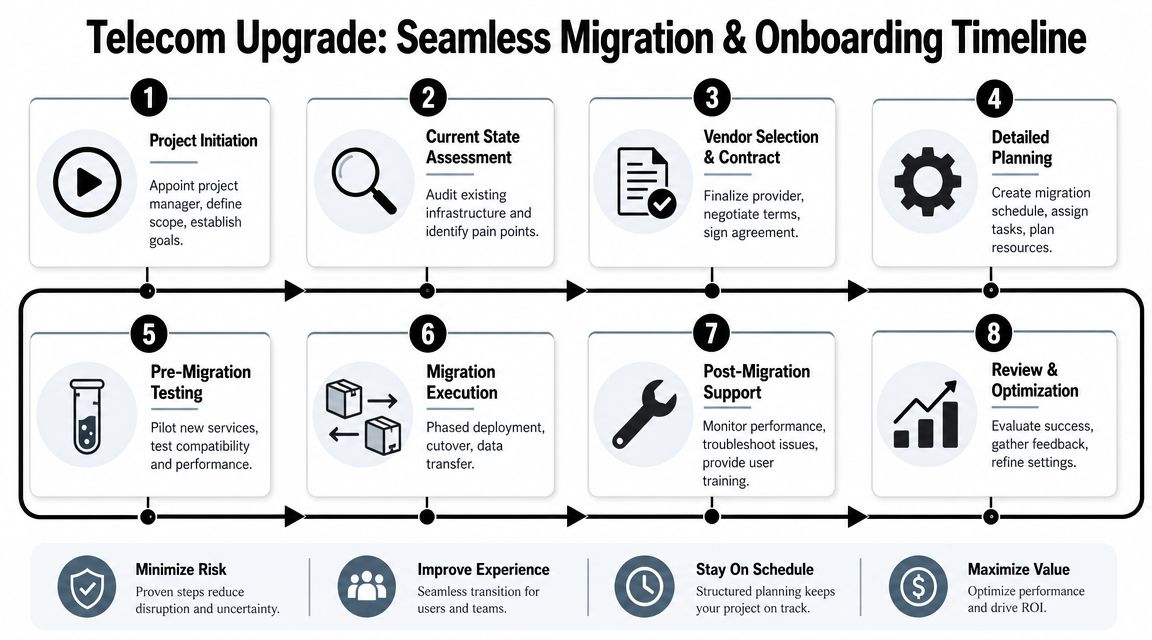
Build a migration plan with named owners
Every major telecom upgrade needs one internal project lead. That person doesn't need to configure every device, but they do need authority to coordinate vendors, facilities, security, and department heads.
A practical migration checklist includes:
- Assign ownership for telecom, LAN, security, facilities, and executive sign-off.
- Confirm inventory for phones, firewalls, switches, circuits, and any analog dependencies.
- Set the cutover method. Big-bang changes are sometimes necessary, but phased rollout is often safer.
- Schedule number porting carefully and verify every dependency tied to inbound and outbound calling.
- Create rollback criteria so the team knows when to pause rather than force a failing cutover.
Change management deserves more attention than most firms give it. One telecom case study on process mapping reported a 30% reduction in service deployment time, 20% operational cost savings in the first year, and 15% improvement in customer satisfaction after optimizing outdated process maps. It also cited a 60% greater success rate for process-optimization initiatives in organizations with a strong continuous-improvement culture (telecom process mapping case study).
Prepare people, not just systems
The technical plan can be solid and still fail if staff don't know what's changing. Reception, sales, support teams, and executives all experience telecom changes differently.
Use a communication plan that covers:
- What changes. New phones, softphone apps, login steps, voicemail handling, or mobile call routing.
- When it changes. Give dates, time windows, and what users should expect during cutover.
- Who to contact. Publish one support path during migration so employees don't guess.
A migration succeeds when users know what to do on day one. Silence from the IT team creates its own outage.
Validate before signing off
After cutover, test the things that matter to the business. Don't limit testing to “the phone rings.”
Run post-migration validation across:
| Test area | What to confirm |
|---|---|
| Voice | Inbound, outbound, hunt groups, voicemail, call transfer |
| Network | Internet performance, failover behavior, VPN access |
| Mobility | Softphones, mobile app behavior, remote user experience |
| Coverage | Wi-Fi handoff, warehouse zones, known weak areas |
Formal sign-off should happen only after these checks are complete and documented.
Integrating Telecom Upgrades with Sustainable IT Asset Disposition
A telecom upgrade creates a second project whether you plan for it or not. Old desk phones come off desks. Routers and switches get boxed up. Retired firewalls, access points, servers, handsets, and storage devices start collecting in closets, staging rooms, and IT workspaces. That equipment isn't just clutter. It can hold data, create compliance exposure, and undermine sustainability goals if it's handled casually.
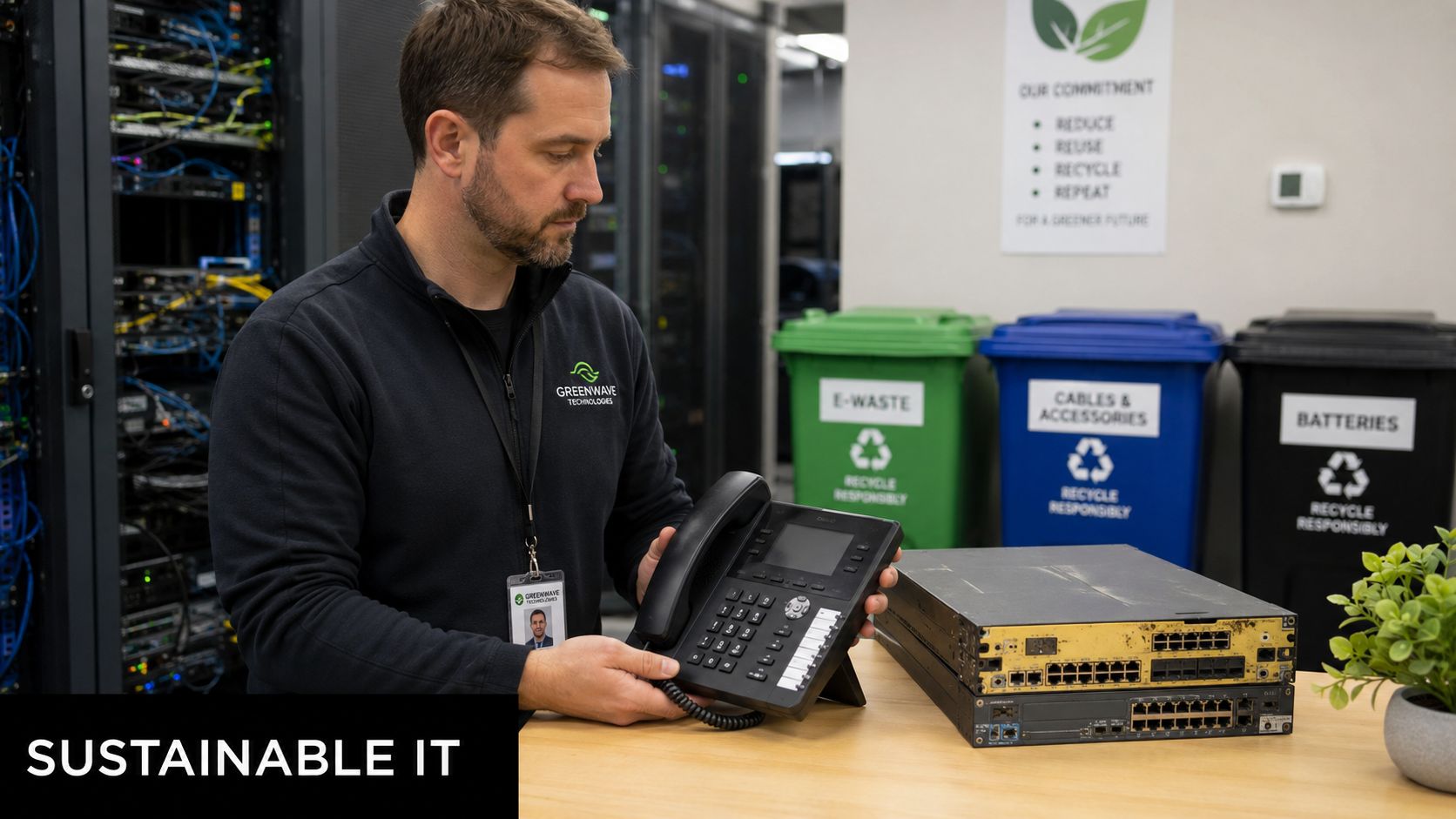
Treat retirement planning as part of the upgrade scope
Many projects encounter drift. The new provider finishes implementation, but nobody owns end-of-life handling for the removed hardware. Devices sit for months. Asset records go stale. Drives and flash storage remain in circulation longer than they should.
A disciplined IT asset disposition process should cover:
- Asset identification so every retired item is logged against the migration project
- Secure data destruction for devices that may retain credentials, logs, call records, or configuration data
- Chain of custody during pickup, storage, and processing
- Sustainable recycling or reuse decisions that support internal ESG and waste-diversion objectives
The business case for discipline here matches the logic of the telecom upgrade itself. McKinsey notes that telco leaders see digital technologies, organizational rethinking, and investment sharing as key levers for future value creation, while Bain reports that successful challengers can improve EBITDA by about 60% within three to five years through lean execution, targeted focus, and disciplined capital deployment (McKinsey telecom operating model analysis). In practice, that same lean discipline should extend to what you remove from the environment, not just what you deploy into it.
Link telecom modernization to corporate responsibility
For many organizations, this is the moment where IT, facilities, legal, and sustainability teams finally align. The telecom team wants decommissioned gear gone quickly. Security wants documented destruction. Sustainability leaders want responsible recycling and reuse. Finance wants a clean project closeout.
One option for companies retiring telecom-related hardware is IT equipment recycling for Houston telecom assets, where Reworx Recycling fits as a factual service partner offering electronics recycling, secure data destruction, and donation-based recycling tied to community benefit. That matters when a telecom refresh also triggers office cleanout, laptop disposal, data center decommissioning, or broader ITAD activity across multiple departments.
A well-run retirement plan can support several goals at once:
- Risk reduction by removing unmanaged legacy devices from offices and storage rooms
- Environmental responsibility through sustainable recycling instead of informal disposal
- Community impact when appropriate equipment is routed into donation-based programs
- Cleaner project accounting because the upgrade includes a full lifecycle closeout
Telecom procurement and ITAD are usually handled as separate conversations. They shouldn't be.
Your Next Step Toward a Better Connected Business
A telecom upgrade in Houston touches more than bandwidth and phone service. It affects uptime, staff productivity, customer interactions, security, procurement discipline, and how quickly your team can adapt as the business changes. The strongest outcomes come from a structured process: define real requirements, evaluate providers with a scorecard, negotiate terms that protect the business, and run migration like an operational project instead of a vendor handoff.
The final step is easy to overlook and expensive to ignore. Every upgrade leaves something behind. Old VoIP phones, network appliances, storage devices, and cabling-room hardware need a documented path out of the business. If you don't assign ownership, those assets become security risk, storage burden, and missed sustainability opportunity.
A responsible closeout plan should include secure data destruction, electronics recycling, and a realistic approach to reuse where appropriate. For businesses trying to connect telecom modernization with corporate responsibility, that's where a donation-based recycling model can make the project more useful internally and externally.
If your Houston business is replacing telecom hardware, cleaning out network closets, or planning a broader IT refresh, Reworx Recycling can help you turn that transition into a cleaner end-of-life process. Use their resources to explore secure data destruction, schedule a pickup for retired equipment, or build a corporate donation program that supports digital inclusion while keeping old devices out of landfills.