Atlanta's technology startup ecosystem is valued at $40 billion, with $23 billion in exits between 2021 and 2025. Atlanta startups also raised approximately $1.2 billion across 82 venture-capital rounds in 2025 alone, showing that the city has become a serious technology market rather than a peripheral Southern hub.
That momentum matters to more than founders and investors. As Atlanta startups move from prototypes to enterprise deployments, they create demand for offices, servers, networking equipment, laboratory assets, mobile devices, and secure technology retirement. The rise of Atlanta's technology startup ecosystem is therefore both a financial story and an operational one. Capital creates companies, but responsible infrastructure helps those companies scale without accumulating unnecessary security, compliance, and environmental risk.
How Atlanta Became a Top-30 Global Startup Hub
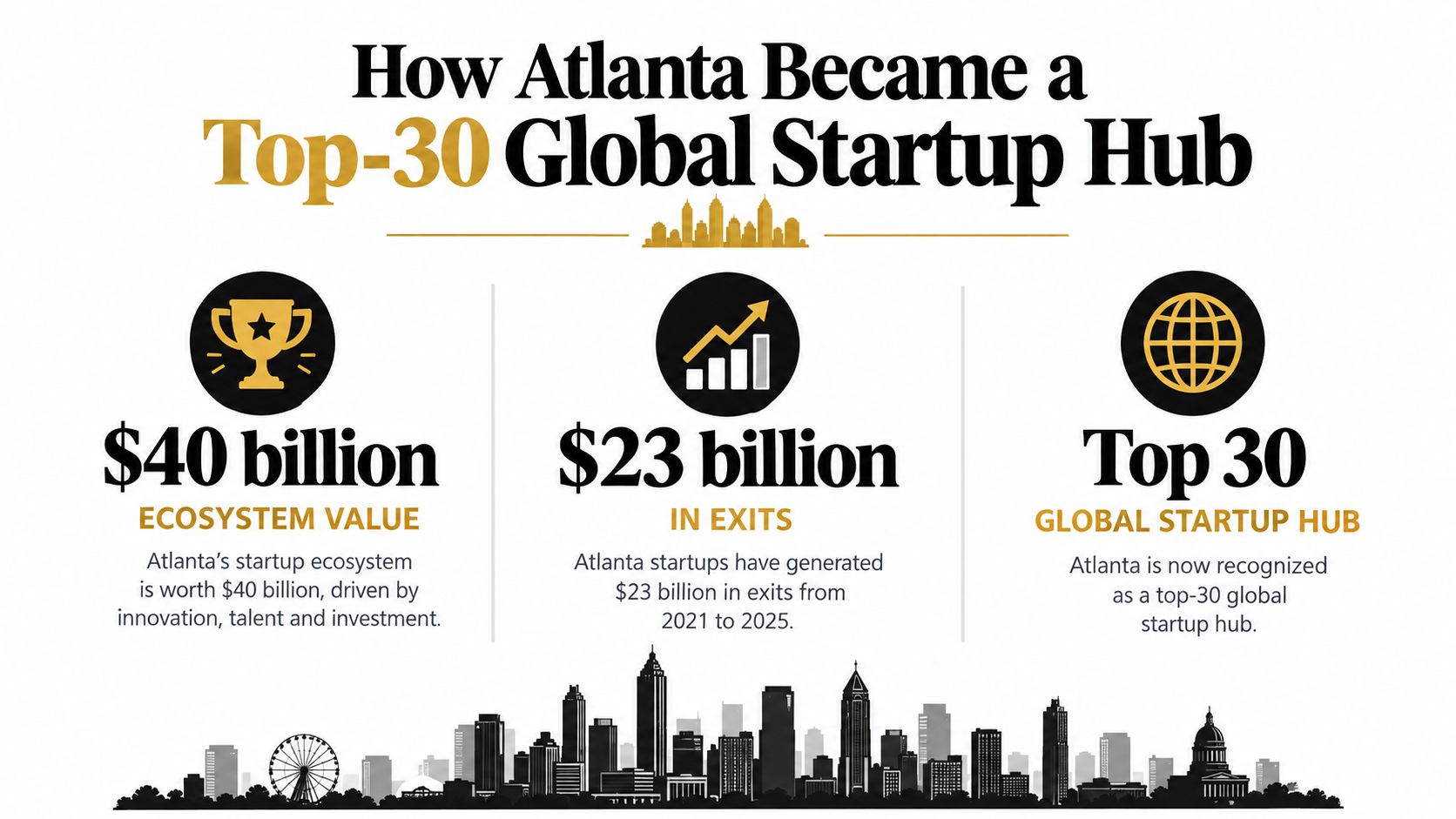
Atlanta ranked 28th globally in 2025, placing its startup economy within the world's leading markets rather than limiting it to the category of a regional innovation center. The Startup Genome data compiled by BIP Ventures also places that ranking alongside a $40 billion ecosystem valuation and $23 billion in exits between 2021 and 2025. The figures matter because they show accumulated company value and investor outcomes, not only current enthusiasm around new ventures.
The ranking is a result of long-term capacity. Atlanta's technology base grew through company formation, technical employment, university research, and founders who moved between firms. Earlier technology-intensive businesses developed managers, engineers, sales leaders, and operators who later transferred practical knowledge to younger companies. Venture capital accelerated that process, but it did not create the underlying talent network.
A market with accumulated institutional memory
Atlanta combines historical depth and modern momentum. Georgia Tech supplies engineering and research talent, while the metro area's corporate base gives startups potential customers in logistics, payments, cybersecurity, communications, and enterprise software. Founders can therefore test products against demanding business requirements, not only refine them inside an investor network.
Location decisions also depend on operating conditions. Resources such as a first office for SF startups show how workspace and practical infrastructure influence early company formation. Atlanta's advantage is the connection among workspace, universities, corporate buyers, and startup programs.
That network creates a physical requirement alongside its financial growth. Scaling companies purchase workstations, servers, test devices, and network components, then must retire those assets securely and responsibly. Research on why Atlanta is becoming the South's tech hub should therefore include reverse logistics. Reworx gives growing startups a way to document equipment retirement, protect data, and keep electronics out of unmanaged disposal channels.
From Retail Credit to Tech Square Labs
Atlanta's technology DNA predates the modern language of accelerators and venture rounds. In the late 1800s, Atlanta-based businesses such as Retail Credit, later known as Equifax, and telecommunications companies helped establish an early foundation for technology-intensive commerce. That history gave the region experience with information, systems, communications, and business processes long before today's startup vocabulary emerged. Atlanta's technology history shows how that foundation developed over successive generations.
The software generation
The ecosystem expanded significantly during the 1970s, when Management Science America, Peachtree Software, and American Software became important software companies. MSA was among Atlanta's earliest technology companies to reach an initial public offering. After severe financial difficulty, it was revived under CEO John Imlay, a Georgia Tech graduate, beginning in 1970.
The important consequence wasn't only MSA's corporate recovery. Former MSA employees later founded or strengthened other software businesses, creating a local network of experienced technical managers, entrepreneurs, and investors. Talent moved between companies, carrying product knowledge, hiring practices, customer relationships, and lessons about scaling technology businesses.
Practical rule: A startup ecosystem becomes durable when employees from one generation of technology companies become founders, executives, mentors, and early-stage backers for the next.
That pattern helps explain why Atlanta's startup economy has more continuity than a simple funding-cycle narrative suggests. A founder trained inside an established software company can approach hiring, enterprise sales, and product delivery differently from someone building without regional precedents. Investors also gain local context when they've seen operators develop across multiple companies.
Tech Square Labs and the modern layer
By the 2010s, Georgia Tech and Midtown's technology district provided a more formal innovation infrastructure. Tech Square Labs, launched in 2014 by Paul Judge and Allen Nance, combined incubation, seed investing, and coworking near Georgia Tech. Its stated ambition was to help build billion-dollar companies.
This progression, from Retail Credit to MSA and then to Tech Square Labs, reveals a repeatable mechanism. Atlanta didn't replace its older technology base with a startup culture. It layered incubation, seed capital, university talent, and coworking onto a network built by earlier technology companies.
Venture Capital and the Scale-Up Financing Gap
The difficult middle for Atlanta founders begins after seed funding. A company may prove customer demand yet struggle to finance repeatable enterprise deployment, compliance work, implementation, support, infrastructure, and sales capacity. That gap separates early validation from a durable operating model.
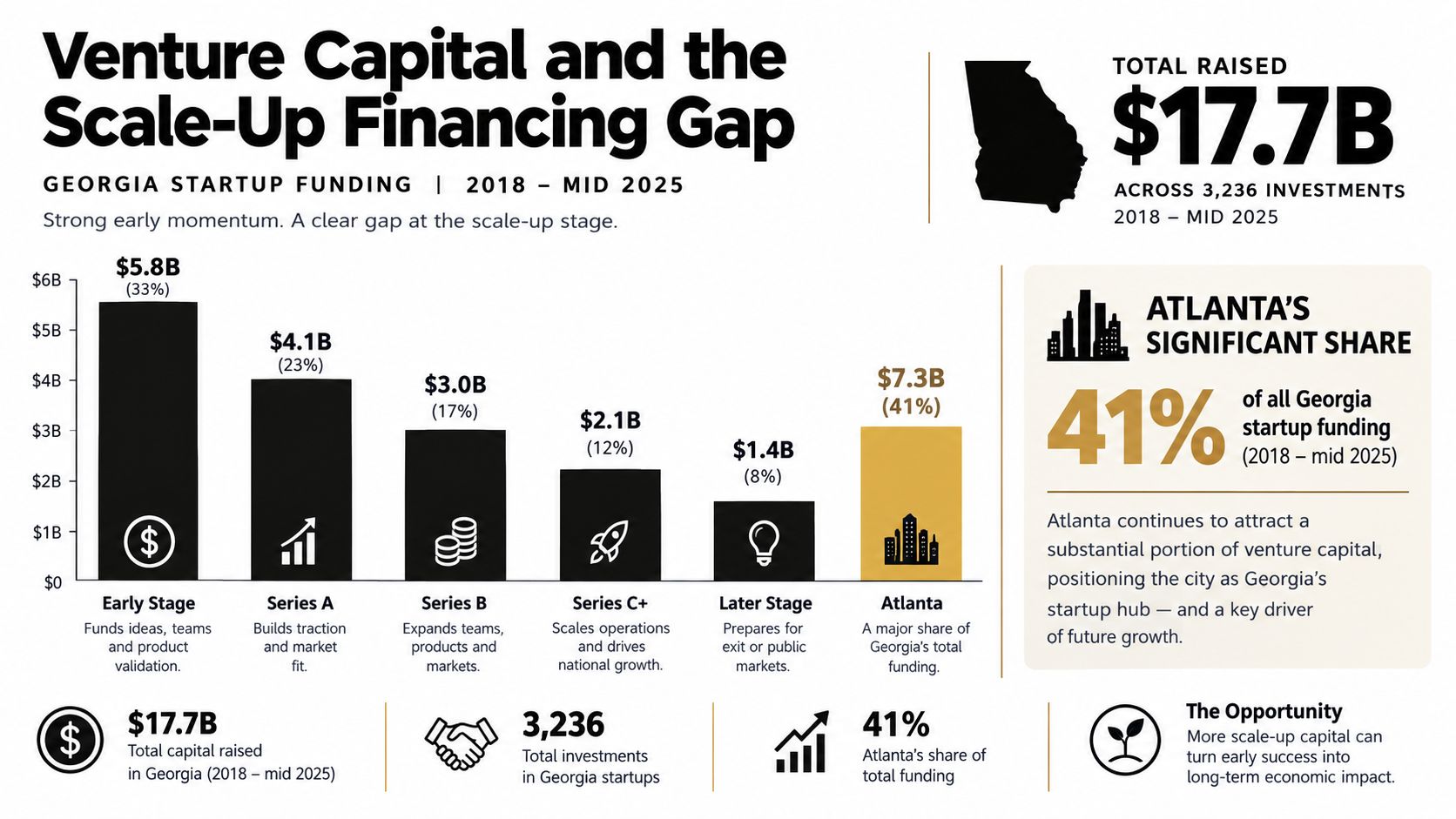
Georgia's venture market provides the broader context. Startups received $17.7 billion across 3,236 investments from 2018 through mid-2025, according to PitchBook data compiled by BIP Ventures. The same compilation projected approximately 244 Georgia deals and $1.5 billion in startup investment during 2025. The Georgia venture market data shows sustained activity across multiple cycles rather than dependence on one unusually strong year.
Atlanta's founders can connect Georgia Tech's engineering pipeline with corporate demand in logistics, payments, cybersecurity, and enterprise software. Those relationships can support pilots and early customers, but they do not remove the financing required to turn a pilot into a repeatable sales and delivery system.
The difficult middle
The scale-up constraint becomes clearer in Atlanta's financing record. The BCG analysis found that Atlanta attracted approximately $1.9 billion in venture capital in 2022, a figure that had fallen more than 40% from 2021 and placed Atlanta 12th among the 14 largest U.S. entrepreneurial hubs studied. BCG's analysis of Atlanta entrepreneurship describes meaningful activity alongside financing volatility.
Founders preparing for Series A or Series B therefore need an operating plan that extends beyond product development.
| Growth challenge | Practical response |
|---|---|
| Expensive enterprise pilots | Keep pilots capital-efficient and define deployment requirements early |
| Longer procurement cycles | Build relationships with design partners and strategic customers |
| Financing concentration | Cultivate investors outside Georgia before a Series A or Series B event |
| Operational expansion | Track hardware, facilities, security, and disposal obligations alongside revenue |
For regulated or infrastructure-heavy companies, unit economics include more than cloud costs and payroll. Equipment procurement, data center decommissioning, secure data destruction, office cleanout, and IT asset disposition can affect cash planning and compliance. The operational demands associated with Atlanta's fastest-growing industries make responsible electronics recycling and IT asset disposition a practical scale-up requirement. Reworx can help growing startups manage those assets as they expand without leaving disposal obligations until the end of a funding cycle.
Sector Strengths in Fintech Healthtech and Logistics
Atlanta's sector advantages come from the relationship between startups and established corporate demand. Fintech, healthtech, and logistics each offer a different route to market, and each creates a different technology asset profile.
Fintech benefits from Atlanta's payments and financial-services heritage. A startup building fraud detection, payment infrastructure, compliance software, or financial operations tools can develop against buyers that understand transaction systems and risk management. The same environment also raises the standard for data governance. Customer devices, storage media, and network equipment may contain sensitive financial information, so laptop disposal and secure data destruction need to be part of the operating model.
Healthtech draws on Atlanta's academic, medical, and research capabilities. Health-focused companies may handle regulated information while operating across offices, clinics, laboratories, or remote-care environments. Their asset inventory can include workstations, mobile devices, diagnostic technology, testing equipment, and laboratory hardware. Medical equipment disposal and laboratory equipment disposal require planning that distinguishes reusable assets from equipment requiring specialized handling.
Logistics technology aligns with Atlanta's transportation and distribution role. Supply-chain startups may deploy scanners, tablets, sensors, rugged computers, warehouse systems, and communications equipment across multiple facilities. Those assets move through field operations more quickly than office equipment and can be difficult to track when a customer relationship ends.
Atlanta's comparative advantage
Compared with Southern hubs that specialize more narrowly in finance, healthcare, manufacturing, or software, Atlanta offers a broader customer environment. A logistics startup can learn from transportation operators, a fintech company can sell into payments expertise, and a healthtech business can access research and clinical networks without leaving the same metro ecosystem.
The comparison also exposes a shared constraint. Sector specialization creates valuable domain knowledge, but it can produce more complicated hardware lifecycles. A pure software company may focus on laptops and servers. An industrial or health technology company may need chain-of-custody procedures for sensors, test devices, storage media, and product prototypes.
That makes Atlanta's transportation technology and smart mobility landscape relevant to IT managers as well as economic development professionals. The sector that generates revenue also determines how a company should plan equipment tracking, facility cleanout, product destruction, and responsible retirement.
Accelerators and Public Financing Programs
Atlanta's support infrastructure combines private incubation, university commercialization, and public financing. Founders should treat these resources as complementary rather than interchangeable. An accelerator can improve product-market fit and investor readiness, while a public loan may help finance physical assets that venture investors don't prioritize.
Start with the commercialization pipeline
Georgia's Advanced Technology Development Center demonstrates how Atlanta connects to a statewide commercialization pipeline. ATDC's 2025 impact reporting stated that its active portfolio included 149 companies at year-end, after 39 new companies joined during the year. Those active companies raised $161 million in capital in 2025. ATDC's 2025 impact report also reported that, across its 45-year history, active companies and graduates collectively created 15,585 jobs, raised nearly $8 billion in capital, and held 82 lifetime patents founded by ATDC entrepreneurs.
The center also delivered introductory federal SBIR and STTR funding sessions in five Georgia cities, showing that commercialization support extends beyond central Atlanta. For founders, that matters because technical validation, federal funding, patents, and company formation often develop on different timelines.
A practical sequence looks like this:
- Use incubation to clarify the problem. Tech Square Labs provides incubation, seed investing, and coworking near Georgia Tech. Founders can use that proximity to recruit technical talent and test assumptions.
- Use accelerator support to prepare for repeatability. Private programs can help companies refine enterprise sales, customer discovery, hiring plans, and investor materials.
- Use public financing for eligible physical needs. The City of Atlanta's Startup Growth Loan Program is part of a $1 million initiative and allows eligible startups to apply for direct loans of up to $150,000. The City of Atlanta's program details state that applicants generally must have been incorporated within the previous five years, hold a City of Atlanta business license, and demonstrate a scalable, high-impact technology solution.
- Build an end-of-life plan before purchasing equipment. Eligible loan uses include technology, inventory, machinery and equipment, furniture and fixtures, commercial-space acquisition or renovation, and related facility improvements. Those purchases should have documented retirement, resale, recycling, and data-security procedures.
The program was created through Invest Atlanta and United Way of Greater Atlanta as part of the Atlanta Open for Business Fund, supported by Wells Fargo. Financing can help a startup acquire the tools it needs, but responsible growth also requires a plan for what happens when those tools become obsolete.
The Hidden Cost of Hardware in Scaling Startups
Startup narratives often focus on software, talent, and funding. The balance sheet tells a broader story. Growth adds workstations, servers, networking equipment, mobile devices, storage media, testing tools, and eventually data center capacity.
Each asset creates an obligation at the end of its useful life. A retired laptop can contain company credentials or customer information. A server can hold databases that remain sensitive after the system leaves production. A prototype or testing device may contain intellectual property, while an office closure can leave facilities teams with mixed loads of electronics, furniture, packaging, and storage media.
Growth creates a reverse logistics problem
The procurement process is visible because employees need equipment to do their jobs. The reverse process is less visible because it begins when a device is replaced, a product line changes, or a facility closes. Without a documented process, equipment can move into closets, unmanaged storage rooms, employee homes, or informal resale channels.
The operational risks fall into three categories:
- Security risk: Data-bearing devices need verified erasure or physical destruction.
- Financial risk: Surplus equipment may retain recoverable value through buyback or reuse.
- Environmental risk: Electronics contain materials that shouldn't be handled as ordinary trash.
For fintech and healthtech companies, the first risk carries particular weight because sensitive information may remain on devices long after employees stop using them. For logistics and industrial software companies, the challenge is often distributed inventory. Equipment may sit at warehouses, customer sites, field locations, or temporary project offices.
A clear IT asset disposition process connects asset tracking, secure data destruction, equipment decommissioning, transportation, resale, donation-based recycling, and final material recovery. IT managers should involve facilities, security, finance, and sustainability leaders before a major deployment begins. That cross-functional planning turns disposal from an emergency task into a controlled part of the technology lifecycle.
Why Sustainable IT Disposal Matters for Atlanta Startups
Atlanta's startup growth creates a physical question that funding announcements rarely answer: what happens to the equipment after a company hires, relocates, pivots, or replaces its technology? The answer affects information security, operating costs, environmental responsibility, and community impact.
The city's Office of Technology and Innovation reported that supported companies created 1,155 new technology jobs, generating more than $69 million in local salaries. The same reporting stated that Atlanta startups raised approximately $1.2 billion across 82 venture-capital funding rounds in 2025. The State of the ATL Tech Ecosystem reporting connects capital formation with employment growth, but the operational implication is equally important. More technology workers and more funded companies create recurring demand for equipment procurement, replacement, decommissioning, and secure retirement.
Disposal can support growth objectives
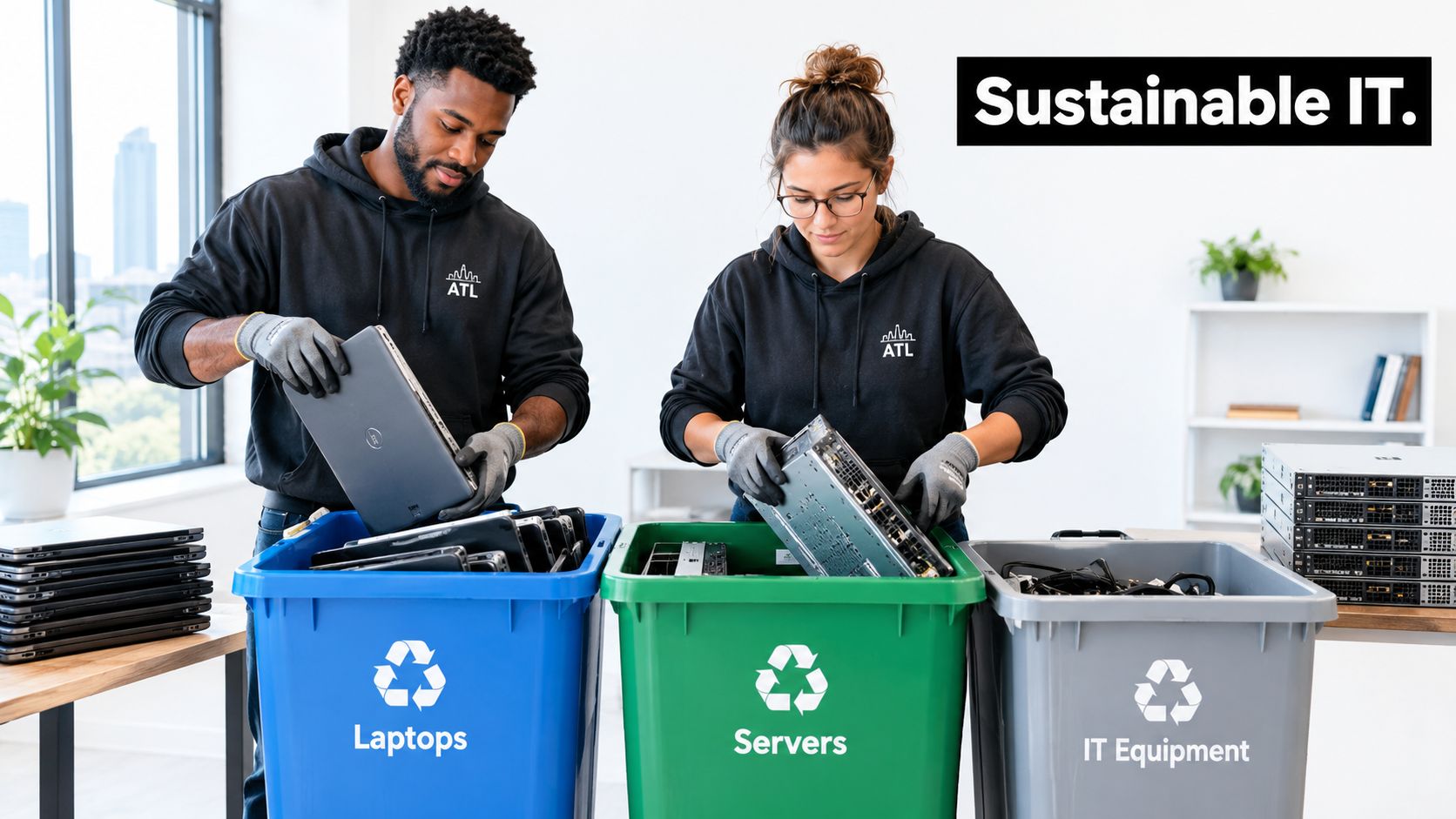
A startup's disposal policy should match its business model. A fintech company may prioritize chain of custody and hard-drive shredding. A healthtech company may need documented handling for clinical or laboratory assets. A logistics company may need scheduled pickups across several operating locations. A scaling software company may need office cleanout, laptop disposal, server retirement, and equipment buyback during a move.
A responsible program can combine:
- Secure data destruction for storage media and retired computers.
- IT asset disposition, or ITAD, with inventory records and documented outcomes.
- Equipment buyback when surplus hardware retains market value.
- Donation-based recycling that redirects usable technology toward community access.
- Sustainable recycling for equipment that can't be reused.
- Corporate donation programs that connect technology retirement with digital inclusion and workforce development.
Reworx Recycling, based in Smyrna, Georgia, operates as a donation-based electronics recycling and IT asset disposition partner for organizations retiring outdated technology. Its services include business pickups, equipment decommissioning, recycling consultations, secure hard-drive shredding with data destruction, equipment buyback options, and support for technology donations. The organization's social enterprise recycling model links environmental stewardship with community benefit instead of treating disposal as a one-way transaction.
Atlanta startups can make this part of their scale-up discipline by assigning ownership before a hardware refresh begins, separating data-bearing assets from general electronics, and retaining records for every disposition. Businesses reviewing responsible electronics recycling for Atlanta businesses can use that process to align security, sustainability, facilities management, and community impact.
Reworx Recycling helps Atlanta-area businesses manage electronics recycling, secure data destruction, equipment pickups, ITAD, office cleanouts, and responsible technology donations. Visit Reworx Recycling to learn how to donate old equipment, schedule a business pickup, or build a sustainable end-of-life program for your growing company.