A Denver technology refresh usually looks efficient on the spreadsheet and chaotic in the back room. New laptops are deployed, old monitors pile up, a few servers sit on carts waiting for instructions, and someone asks whether facilities can just “get rid of it this week.” That’s the point where retired equipment stops being a storage problem and becomes a compliance, security, and sustainability issue.
For Denver businesses, that issue shows up across office cleanouts, data center decommissioning, medical equipment disposal, laboratory equipment disposal, and everyday laptop disposal after normal upgrade cycles. The hard part isn’t finding someone willing to haul electronics away. The hard part is building a process that protects data, satisfies Colorado rules, documents chain of custody, and keeps usable equipment in circulation when donation, remarketing, or responsible computer recycling makes more sense than simple destruction.
The Growing E-Waste Challenge for Denver Businesses
A common Denver scenario goes like this. An aerospace supplier in the metro area replaces engineering workstations. A healthcare group retires endpoint devices from multiple clinics. A growing startup in LoDo clears a floor before a move. By the end of the week, IT has decommissioned the gear, but nobody has finalized secure pickup, data destruction, or downstream recycling.
That gap creates risk fast. Hard drives can still hold regulated information. Asset tags still point back to your organization. And because Colorado bans electronics from landfills, “just toss it in the dumpster” isn’t a workaround. It’s a failure of process.
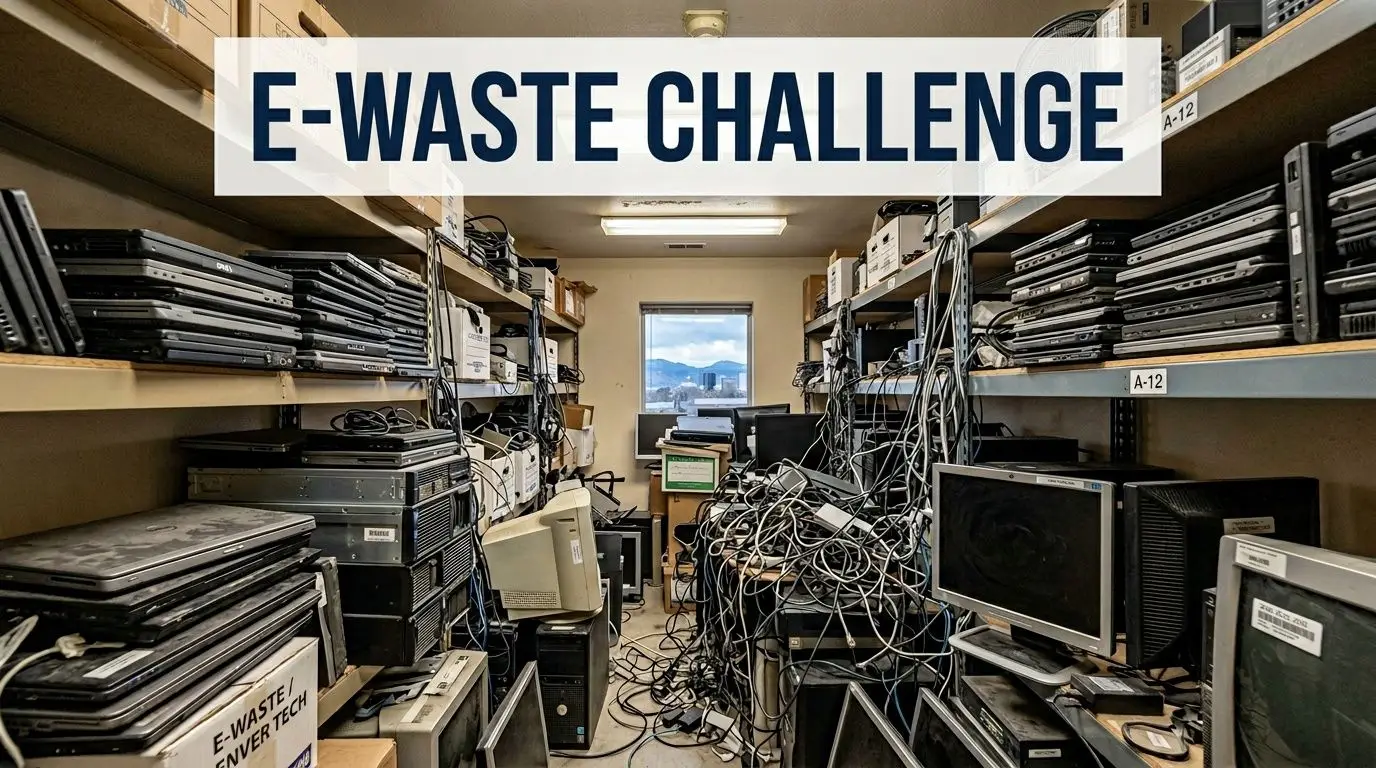
Colorado’s recent numbers show why this matters. In 2023, Colorado diverted almost 12,000 tons of electronics from landfills, down from roughly 17,000 tons in 2018, according to Rocky Mountain PBS reporting on Colorado electronic recycling. That decline matters in a market like Denver, where businesses, schools, and public institutions replace equipment constantly.
What old equipment really represents
Retired electronics are rarely “junk” in a business setting. They usually fall into four categories:
- Data-bearing assets like laptops, desktops, servers, and network gear that need secure data destruction before anything else happens.
- Reusable assets that may still be eligible for refurbishment, corporate donation programs, or IT asset disposition.
- Commodity recovery assets such as broken monitors, peripherals, and mixed electronics better suited for dismantling and material recovery.
- Special handling equipment including medical devices, lab systems, and product destruction items that require tighter documentation.
A facilities manager usually sees space pressure first. An IT manager sees data risk first. A sustainability lead sees diversion and reporting. All three are right.
Practical rule: If your team can’t tell you who has custody of retired devices, whether drives were sanitized, and where the equipment is going next, the recycling project isn’t under control.
Why Denver companies need a stronger process
Denver has an active local recycling ecosystem, including providers such as Blue Star Recyclers and METech, plus the city’s resident-focused E-cycle Coupon program. But business electronics recycling services in Denver need more than a consumer drop-off mentality. Business projects involve inventory control, secure transportation, audit-ready documentation, and downstream accountability.
That’s why the environmental side and the security side have to stay connected. A recycler can’t be judged only by whether it picks up quickly. The standard is whether it can move assets through a documented chain of custody and keep end-of-life materials out of the wrong channels. Denver organizations trying to tighten their own sustainability reporting should also understand the broader environmental impact of electronic waste, because disposal choices affect far more than storage space.
Understanding Full-Service Business Electronics Recycling
Residential e-cycling and business IT equipment disposal are not the same service. Denver’s E-cycle Coupon program is useful for residents handling occasional devices, but it doesn’t solve what a business faces during an office cleanout, a lease exit, a fleet refresh, or a data center shutdown.
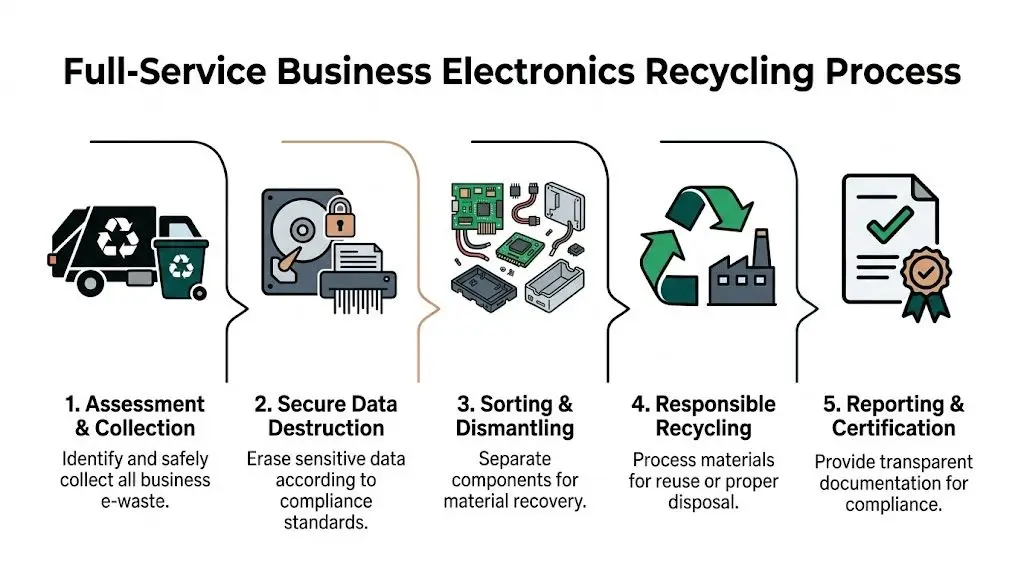
A full-service process starts before pickup day. Someone needs to assess volume, identify data-bearing devices, separate resale candidates from scrap, and determine whether on-site packing, palletization, or serialized inventory is required. If you skip that step, projects drift. Equipment gets mixed, labels get lost, and reporting becomes unreliable.
Certified providers can also do much more with the material once it leaves your site. According to this Denver electronics recycling overview, certified providers can achieve zero-landfill outcomes and recover over 95% of a device’s weight back into supply chains through refining and reprocessing. The same source notes that Denver is trying to improve its 15% material diversion rate toward the U.S. average of 34%.
What full-service actually includes
The practical workflow usually looks like this:
Project scoping
A business recycler reviews asset types, pickup conditions, loading access, security requirements, and whether the job includes a facility cleanout, computer recycling, or a phased decommission.Secure collection
Devices are packed, labeled, and transported under documented custody. For larger jobs, this may involve pallets, sealed gaylords, or dedicated pickup windows.Data handling
Data-bearing media is separated immediately for wiping, shredding, or another approved destruction method based on policy and compliance needs.Testing and triage
Equipment with reuse potential is evaluated for refurbishment, donation-based recycling, resale, or parts harvesting.Recycling and downstream processing
Non-repairable material is dismantled into streams such as metals, plastics, boards, and glass for responsible processing.Reporting
The client receives records that support internal controls, sustainability reporting, and audits.
What works and what doesn't
A lot of Denver businesses still use a basic haul-away model. That works only when the equipment has no meaningful data, no residual value, and no reporting expectation. In most business settings, that’s rare.
What works better is a decision framework tied to asset type:
| Asset type | Best handling approach | Common mistake |
|---|---|---|
| Laptops and desktops | Inventory, sanitize, evaluate for reuse or donation | Treating all units as scrap |
| Servers and storage | Serialized tracking, secure destruction, ITAD review | Removing from racks without chain-of-custody controls |
| Monitors and peripherals | Consolidate for efficient recycling | Paying premium handling rates for unsorted loads |
| Medical or lab electronics | Compliance review and documented disposition | Sending specialized devices through a generic office cleanout stream |
Full-service electronics recycling is really reverse logistics plus compliance plus downstream accountability. If one piece is weak, the whole program gets harder to defend.
For companies comparing vendors, the useful question isn’t “Do you recycle electronics?” The useful question is “What happens to each asset class after pickup, and what proof will you give me?” That’s the standard a business should bring to any electronics recycling service.
Navigating Data Security and Colorado Compliance Rules
For most organizations, the most dangerous part of retired equipment isn’t the hardware. It’s the leftover data and the lack of a defensible process. A factory reset doesn’t create an audit trail. Deleting files doesn’t satisfy legal review. And sending mixed pallets of devices to a recycler without documented instructions leaves too much open to chance.
Denver businesses often operate under multiple layers of obligation at once. A healthcare practice may care about HIPAA. A contractor may have CMMC or customer security flow-downs. A school system may have strict internal records requirements. Colorado adds another layer, especially for organizations that generate enough electronic waste to trigger more formal handling responsibilities.
The risk is not theoretical. This Colorado-focused compliance discussion notes that many Denver businesses don’t know their obligations under Colorado’s Large Quantity Handler of Universal Waste designation, and that non-compliance tied to new 2025 e-waste legislation can lead to fines of up to $10,000 per violation.
What secure data destruction should look like
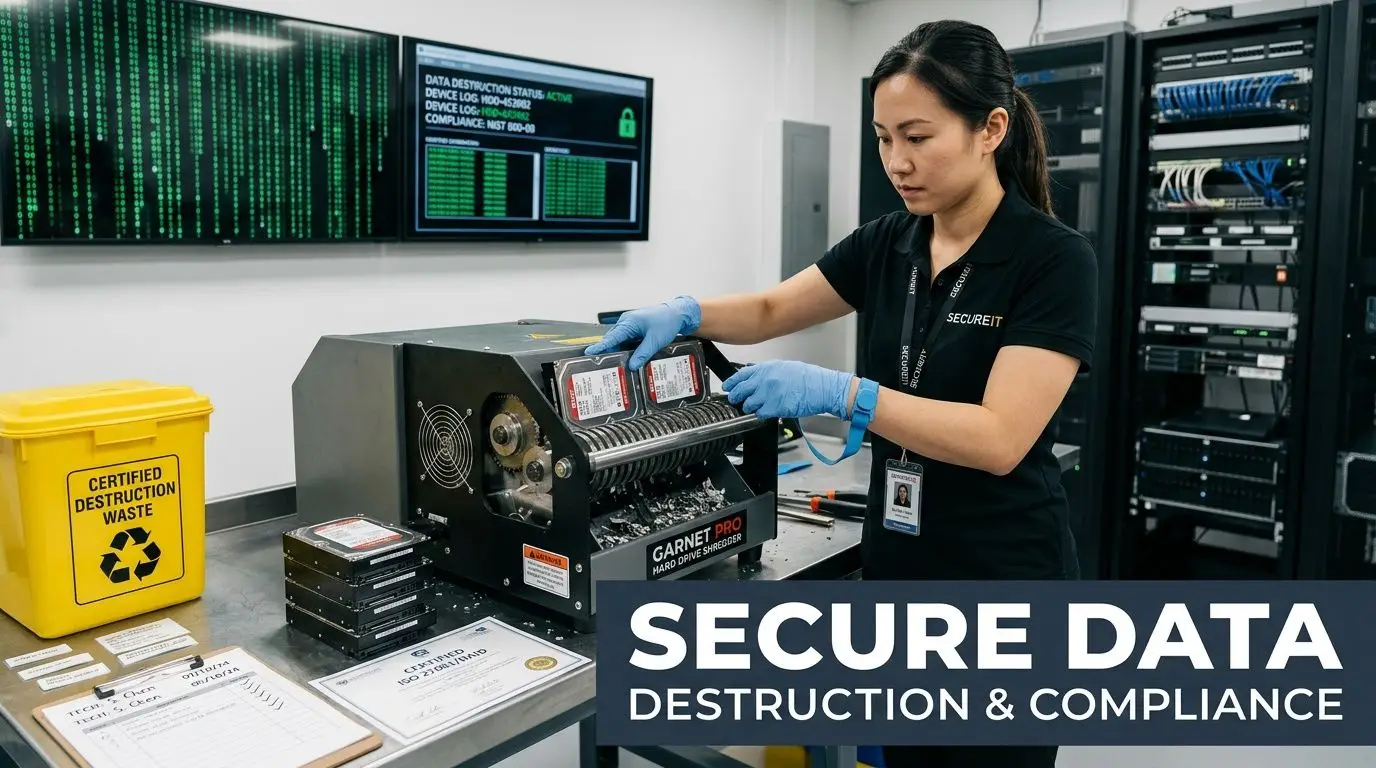
A sound process usually includes more than one control. The recycler or ITAD partner should be able to explain which method applies to which device and why.
- Software sanitization works when devices remain functional and reuse is possible. The key is standards-based wiping and proof that the process completed successfully.
- Physical shredding is often the right choice for failed drives, high-risk media, or assets covered by strict internal destruction rules.
- Segregation at intake matters because mixed handling creates mistakes. Drives awaiting wipe shouldn’t sit in the same flow as scrap-bound boards and cables.
Documents that matter during an audit
A credible electronics recycling provider should be able to produce more than a pickup receipt. For business electronics recycling services in Denver, these records usually matter most:
- Chain-of-custody records that show who handled the assets from pickup through processing.
- Certificates of data destruction tied to the relevant batch, device list, or serial set.
- Certificates of recycling or comparable disposition reporting for sustainability and internal controls.
- Asset inventories when the project involves IT asset disposition, buyback, or donation review.
A certificate only helps if it connects back to the actual equipment you released. Generic paperwork without asset detail doesn't solve much.
Colorado-specific judgment calls
Many businesses get tripped up when they rely on federal buzzwords and never map them to Colorado operating realities. If your team handles large volumes of electronics, generates recurring e-waste across sites, or manages institutional equipment with batteries, screens, or specialized components, you need someone to identify whether state-specific handling rules affect packaging, transport, storage time, or reporting.
That’s also why “free recycling” can become expensive later. A no-cost pickup sounds attractive until legal, compliance, or procurement asks for evidence you never collected. At that point, the missing paperwork costs more than the original service ever would have.
A stronger vendor review usually includes questions like these:
| Question | Why it matters |
|---|---|
| How do you document custody from our dock to final processing? | This is the backbone of audit defense |
| Do you issue destruction certificates tied to actual assets? | General statements don't satisfy many reviews |
| Can you separate reuse candidates from shred-only devices? | Security and value recovery often need different paths |
| How do you support Colorado clients with state-specific e-waste handling concerns? | Local compliance gaps are where problems usually surface |
For Denver organizations that need a practical combination of pickup logistics, secure destruction, and ITAD support, Colorado ITAD services are the kind of offering to compare against local options.
Turn Surplus Tech into Value with IT Asset Disposition
Too many companies still budget for retired equipment as a disposal cost only. That’s understandable when a closet is full of broken monitors and obsolete accessories. It’s the wrong mindset when the load also includes current-model laptops, usable networking gear, late-life servers, or deployable spare equipment.
IT asset disposition, or ITAD, changes the question. Instead of asking only how to remove equipment, it asks what should be wiped and resold, what should be refurbished and donated, what should be harvested for parts, and what belongs in commodity recycling. That distinction matters because mixed-value loads are where many organizations lose money.
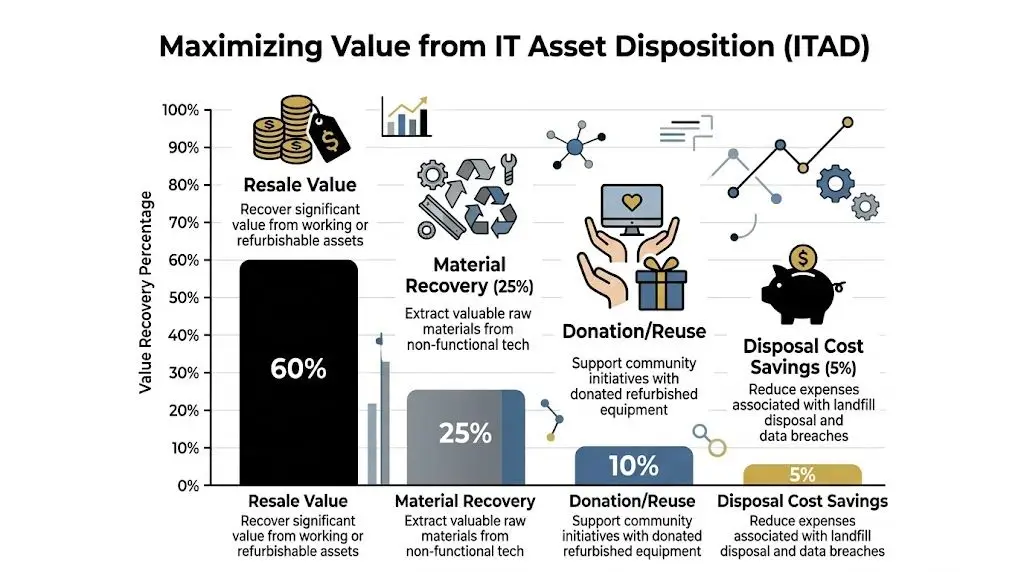
The market signal is strong. According to Techbros’ Denver page, demand for refurbished electronics has risen 40% since 2025. The same source cites NIST ITAD benchmarks showing possible server recovery of $0.15 to $0.50 per pound, and notes that full cost recovery on large projects is possible.
Where businesses usually miss value
The biggest mistake is treating all retired assets the same. Working laptops shouldn’t enter the same process as damaged keyboards and cracked displays. Rack servers with resale potential shouldn’t be crushed by default. Phones, tablets, and specialty equipment also need separate evaluation because secondary markets move differently.
A better triage model looks like this:
- Remarket devices with useful service life left after data sanitization and testing.
- Donate equipment that has community use but modest resale value, especially when CSR goals matter.
- Harvest parts from devices that won’t justify full refurbishment.
- Recycle only after the higher-value paths have been considered.
The trade-off between speed and return
There’s a real trade-off here. Fast bulk liquidation is easier operationally. Detailed asset-level testing and resale produce better recovery, but require more discipline. Denver companies with frequent refresh cycles usually benefit from deciding in advance which categories deserve full ITAD handling and which can move directly to recycling.
If every retired asset goes straight to shred, you're buying simplicity with lost value.
A national partner can help on mixed-location projects because valuation, remarketing channels, reporting, and pickup standards stay more consistent across sites. That matters for companies with Denver operations and equipment spread across remote offices, clinics, campuses, or warehouse locations. Reworx Recycling offers IT asset disposition guidance that aligns with that model, including pickup, secure processing, and options for buyback or donation-based recycling depending on asset condition.
The Social Enterprise Difference A Partner with Purpose
There’s another decision factor that doesn’t show up cleanly on a disposition spreadsheet. It’s what your recycling program does for people after the equipment leaves your building.
A conventional recycler focuses on compliance, scrap value, and processing efficiency. Those things matter. A social enterprise recycling model adds another outcome. It looks for equipment that can be refurbished, redeployed, or donated in ways that support digital inclusion, community access, and workforce development instead of reducing every device to commodity value immediately.

Why this matters to Denver organizations
Denver businesses often talk about sustainability and corporate responsibility in separate buckets. In practice, retired IT can serve both. A thoughtful donation-based recycling program can support your environmental goals by extending equipment life, and support your social goals by channeling viable devices toward schools, nonprofits, or families that need them.
That’s especially useful for:
- Sustainability directors who need a stronger story than “we recycled a pallet of electronics”
- HR and community relations teams building local volunteer and donation initiatives
- Procurement and finance leaders trying to balance reuse, reporting, and responsible disposition
- Schools and public agencies that care about both budget discipline and community impact
What purpose changes in the decision process
A social enterprise approach often changes how assets are classified. Instead of the usual binary of resale or scrap, there’s a third route for devices that still function but may deliver more value through community use than through secondary market recovery.
That doesn’t mean lowering standards. Data still has to be destroyed properly. Chain of custody still matters. Equipment still needs evaluation. The difference is that the disposition strategy includes mission value, not just commodity value.
Good ITAD policy asks two questions at once. Is this device secure to release, and what is the highest responsible use left in it?
For many companies, that also helps internal adoption. Employees usually respond better to office cleanouts and laptop disposal programs when they know working equipment may support community technology access rather than going straight into a shred bin.
How Denver Businesses Can Partner with Reworx Recycling
The best electronics recycling programs don’t start with a truck. They start with a clean inventory and a clear internal decision about what outcome you need. Some Denver companies need a one-time office cleanout. Others need recurring pickups for distributed sites. Some need secure hard drive shredding only. Others need full data center decommissioning with serialized reporting.
If you’re planning a project, keep the first pass simple. Group the equipment by asset type, note whether it contains storage media, and flag anything specialized, such as medical devices, lab equipment, networking gear, or recalled product that may need product destruction.
A practical rollout for your team
Use this sequence if you want fewer surprises:
Build the inventory
Count broad categories first. Laptops, desktops, servers, monitors, printers, phones, networking gear, and loose drives. You can refine serial-level detail later if the project needs ITAD reporting.Separate by disposition path
Divide assets into likely reuse, likely recycling, and shred-only categories. This makes pickup planning and downstream handling cleaner.Confirm site logistics
Note dock access, elevator constraints, packing needs, security rules, and whether pickups have to happen after hours or in phases.Set documentation requirements
Decide what your legal, compliance, IT, and sustainability teams need before the equipment leaves. That usually includes a certificate of data destruction, recycling documentation, and inventory reporting.
What to ask before you schedule pickup
A vendor conversation goes better when your questions are specific:
- How do you handle mixed loads? Ask how laptops, loose drives, monitors, and specialty gear are separated.
- What reporting do you provide? Make sure the answer matches your audit and sustainability needs.
- Do you support donation, buyback, and recycling in one program? A single-path answer often leaves value on the table.
- Can you manage multi-site work? Important if your Denver operation connects to regional or national facilities.
For companies that want Denver-specific pickup and ITAD support, IT asset disposition in Denver, Colorado is the logical place to start the conversation.
What a mature program looks like
The strongest business electronics recycling services in Denver share a few habits:
| Practice | Why it helps |
|---|---|
| Standard intake checklist | Reduces missed devices and surprise handling issues |
| Defined data destruction policy | Keeps IT, legal, and facilities aligned |
| Reuse-first evaluation | Improves donation and buyback outcomes |
| Scheduled refresh cycles | Prevents storage room buildup and rushed pickups |
If your current process begins only when a closet is full, you’re reacting. A better program turns electronics recycling, secure data destruction, and corporate donation planning into a repeatable operating practice.
Frequently Asked Questions About Denver E-Waste Services
How do businesses handle a full office cleanout or facility cleanout?
Start with a room-by-room inventory and separate data-bearing equipment from non-data items. That sounds basic, but it’s what prevents the usual confusion when facilities, IT, and movers all touch the same assets. For larger projects, assign one internal owner who approves pickup windows, staging areas, and documentation requirements.
A cleanout also goes more smoothly when you avoid mixing office furniture removal with electronics processing. Keep computers, monitors, phones, printers, and server gear in a dedicated workflow so the recycler or ITAD provider can maintain clear custody and reporting.
What equipment is usually accepted?
Most business recyclers accept standard office electronics such as laptops, desktops, monitors, docking stations, printers, servers, storage hardware, phones, and networking gear. Many also handle medical equipment disposal, laboratory equipment disposal, and product destruction, but those categories usually need advance review because handling and documentation can differ.
If you’re unsure about a specific item, send a detailed list with photos. That’s faster than making assumptions, especially for specialty gear, battery-containing devices, or equipment with embedded storage.
What’s the difference between computer recycling and ITAD?
Computer recycling usually means material recovery. The asset is dismantled, sorted, and processed into downstream commodity streams. ITAD includes secure data destruction, testing, valuation, remarketing, donation review, and reporting before recycling becomes the final path.
That difference matters most for laptops, servers, and mobile devices. Those assets may still hold value or support community reuse if they’re handled correctly.
Recycling is one end-of-life option. ITAD is the decision framework that determines whether recycling is even the right first option.
Do businesses need secure data destruction for every device?
If the device stores data, assume yes until proven otherwise. That includes obvious items like laptops and servers, but also many printers, multifunction devices, phones, tablets, and some medical or lab systems. Internal storage is easy to overlook during office moves and facility cleanouts.
The right method depends on the asset and your policy. Some equipment is suitable for standards-based sanitization. Other media should be physically shredded. What matters is that your organization can prove what happened.
Can buyback or resale offset project costs?
In many cases, yes. The exact outcome depends on asset age, condition, brand, specs, and market demand. Newer laptops, enterprise networking equipment, and certain servers often deserve evaluation before they’re classified as scrap. Mixed loads usually produce the best results when reusable equipment is separated from obvious end-of-life material early in the project.
This is also why businesses should avoid asking only for a recycling quote. Ask for a disposition review that considers buyback, donation, resale, and commodity recycling together.
Is donation-based recycling practical for businesses, or is it just a nice idea?
It’s practical when it’s built into the disposition process from the start. Business-grade equipment often has a second life after secure wiping, testing, and refurbishment. Donation works especially well for organizations with recurring laptop refreshes, school partnerships, community grants, or ESG programs that want measurable social impact from retired equipment.
The key is process discipline. Donation should never bypass security review or recordkeeping. It should sit inside the same custody and reporting framework as any other disposition path.
What should we look for in reporting after pickup?
At minimum, expect documentation that tells you what was collected, how data-bearing devices were handled, and what final disposition path was used. Depending on the project, that may include serialized inventories, certificates of data destruction, certificates of recycling, and summaries for sustainability or internal audit teams.
If a vendor can’t explain its reporting before pickup, that usually means the reporting is weak after pickup too.
How often should a Denver business schedule electronics recycling?
That depends on how quickly your environment changes. A fast-growing company may need recurring pickups tied to onboarding and refresh cycles. A manufacturer or healthcare group may need event-based pickups after upgrades, relocations, or decommissions. The important thing is not letting retired devices accumulate without a decision.
Once storage rooms become holding zones for undefined assets, risk goes up and recovery value tends to go down.
If your Denver team is planning laptop disposal, secure data destruction, a facility cleanout, or a broader IT asset disposition program, Reworx Recycling is worth reviewing as part of your vendor shortlist. The company supports business pickups, electronics recycling, donation-based recycling, and IT equipment disposal workflows designed to help organizations retire equipment responsibly while supporting community reuse.