Your new laptops are deployed. The old gear is still sitting in a back room.
For a Miami business owner, that usually starts as a space problem. Then it turns into a security problem, a compliance problem, and sometimes a public relations problem. Old servers, employee laptops, retired networking gear, and storage devices still hold records, credentials, customer information, and internal files long after the devices stop being useful.
That’s why Corporate IT Asset Disposal Services in Miami matter so much. In a city shaped by finance, healthcare, logistics, hospitality, international trade, and fast-moving tech upgrades, retired equipment needs a controlled exit. Not a guess. Not a weekend cleanout. Not a call to a generic junk hauler.
A proper IT asset disposition plan lets you retire hardware with proof, accountability, and a realistic path for reuse, recycling, or recovery. It also fits Miami’s reality. Many companies here operate in regulated industries, manage distributed offices, or maintain equipment in environments where storm risk and business continuity planning are always in the background.
Your Miami Business Needs a Secure IT Asset Disposal Plan
A common Miami scenario looks like this. A company finishes a refresh across its Brickell office, warehouse location near Doral, or regional operations hub near the airport. The new machines are online, but the old ones remain stacked on shelves, under desks, or in a locked room only a few people remember exists.
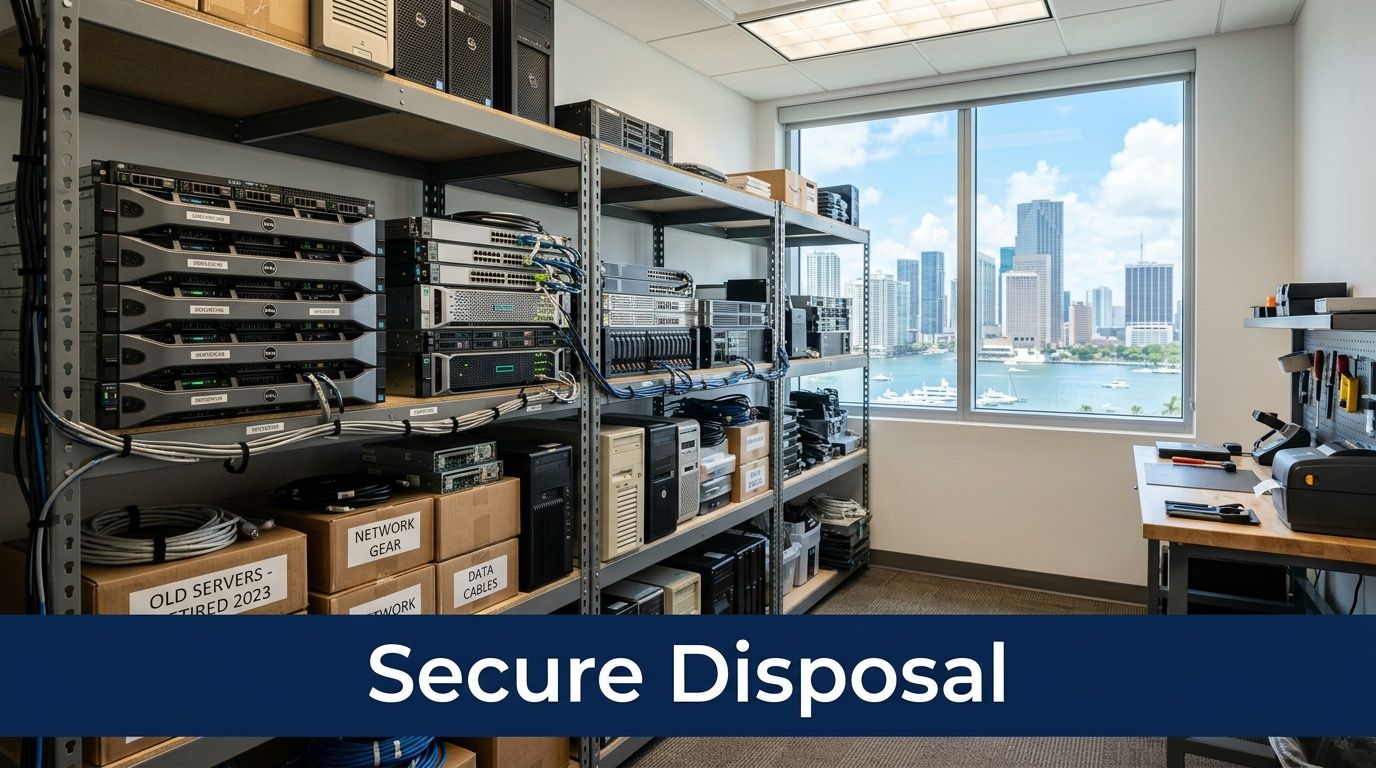
At that point, the equipment hasn’t become harmless. It has become unmanaged. That’s the moment risk starts building unnoticed. A discarded laptop may still contain payroll files. A retired firewall may still store configurations. An old server may still carry customer records, archived emails, or protected health information.
Old equipment creates three business problems fast
The first problem is data exposure. Deleting files or reformatting a drive isn’t the same as documented destruction. If your team can’t prove what happened to each asset, you’re relying on trust instead of process.
The second problem is environmental liability. Electronics contain materials that shouldn’t be tossed into the normal waste stream. Miami businesses already face enough operational complexity. You don’t want retired IT equipment adding another avoidable issue.
The third problem is lost value. Some devices still have resale, reuse, or donation potential. If they sit too long, that window shrinks.
A storage room full of retired devices isn’t neutral inventory. It’s unresolved risk.
IT asset disposition, often shortened to ITAD, is a management discipline, not just a cleanup task. Think of it as the controlled retirement of business technology. The goal is simple. Protect data, document every handoff, recover usable value where possible, and recycle the rest responsibly.
Miami businesses have another reason to take this seriously. The city’s mix of data-heavy industries and coastal vulnerability makes delayed disposal a bad habit. Equipment may already be outdated when a storm event, office move, merger, or lease expiration forces a rushed decision. Rushed decisions usually create the very gaps auditors and legal teams worry about.
Why this matters locally
If you operate in Miami, you may be dealing with branch offices, field teams, medical devices, point-of-sale systems, back-office computers, or data center hardware spread across multiple sites. That complexity makes chain-of-custody more important, not less.
For organizations looking at broader electronics recycling and Florida-specific options, this overview of Florida electronics recycling services helps frame the bigger picture.
A secure disposal plan gives your business a repeatable playbook. That means fewer last-minute decisions, cleaner audits, better space management, and less anxiety every time the next upgrade cycle hits.
Understanding the Core Components of ITAD
IT asset disposition is best understood as a reverse supply chain for business technology. Instead of bringing equipment into your company, it moves retired equipment out through a documented process designed for security, compliance, and responsible material handling.
The category keeps growing because the need keeps growing. The global enterprise ITAD market is projected to rise from $8.67 billion in 2026 to $21.51 billion by 2034, and a key U.S. segment was valued at $2.66 billion in 2022, with computers, laptops, and data center equipment dominating disposals, according to Fortune Business Insights on the enterprise IT asset disposition market.
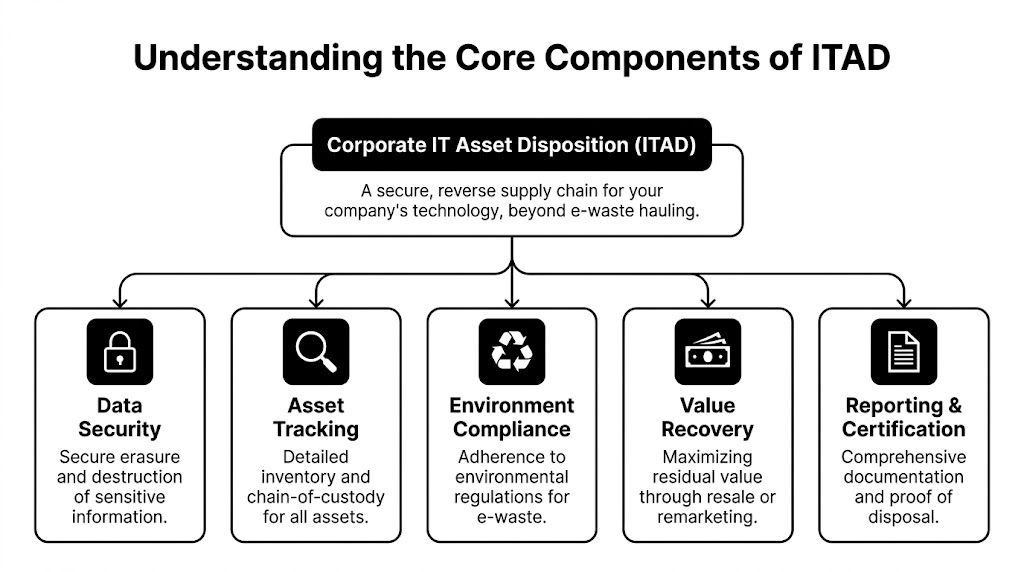
Secure logistics
A professional ITAD program starts before a single device leaves your office. Assets need to be identified, packed, and transferred under documented control. That can include servers from a data center suite, laptops from a downtown office, or networking gear from a warehouse or clinic.
If this first handoff is sloppy, the rest of the process won’t save it. You need to know what left your building, who handled it, and where it went next.
Secure data destruction
Many business owners get confused when they assume a hard drive is safe once a user deletes files, resets the device, or removes visible folders. It isn’t.
Proper ITAD uses approved sanitization methods based on the media type. A spinning hard drive may be wiped, degaussed, or shredded. A solid-state drive may require physical destruction or another method appropriate for that device. The point is proof, not assumption.
Practical rule: If a device ever stored business data, treat it as sensitive until you have written evidence of sanitization or destruction.
Value recovery
Not every retired asset belongs in the scrap stream. Some still have useful life. A strong ITAD program sorts equipment by condition, age, demand, and reuse potential. Functional laptops, servers, or enterprise-grade components may be refurbished, remarketed, or directed into approved reuse channels.
That matters for finance teams because it changes the conversation. Disposal no longer looks like pure expense. In some cases, it becomes a way to offset part of the refresh cycle.
Responsible recycling
Some assets are too old, damaged, incomplete, or obsolete to reuse. Those need material recovery through a qualified downstream recycling process. Environmental handling is vital. Your business should know that nonviable equipment won’t disappear into an opaque chain.
Responsible recycling is especially important for office cleanouts, facility cleanouts, medical equipment disposal, laboratory equipment disposal, and product destruction projects where mixed asset conditions are common.
Reporting and certification
The final component is documentation. This is what turns a physical activity into a defensible business process. A mature provider issues inventories, chain-of-custody records, and certificates tied to the work performed.
If you want a broader primer on the discipline itself, this guide on what IT asset disposition means for organizations is a useful companion.
Without reporting, you have a pickup. With reporting, you have an auditable ITAD program.
The Critical Business Drivers for Professional ITAD
Most companies don’t invest in professional disposal because old hardware is annoying. They do it because unmanaged equipment creates business consequences that can be expensive and hard to unwind.
In Miami, those consequences tend to hit three pressure points first. Security, compliance, and reputation.

Data security is the first non-negotiable
Every retired device is a record of past activity. Laptops may contain saved credentials, browser sessions, tax files, HR documents, and internal chat histories. Servers may hold backups, customer databases, and application data. Even devices you think are obsolete can expose current risk.
This is why secure data destruction sits at the center of Corporate IT Asset Disposal Services in Miami. Regulated organizations already understand this, but smaller firms often underestimate it. They assume risk applies only to hospitals, banks, or large enterprises. That’s not how breaches work. If your business stores employee records, payment information, legal files, or client communications, disposal mistakes can hurt you.
A mature ITAD process reduces that exposure by using controlled handling and documented destruction methods rather than informal wiping or ad hoc resale.
Compliance failures can become very expensive
The best cautionary example is the Morgan Stanley matter. The need for certified ITAD processes is underscored by the 2016 to 2019 Morgan Stanley incident, which resulted in over $163 million in penalties for data destruction failures, as summarized by Grand View Research in its IT asset disposition market analysis.
That case gets attention because the brand is well known, but the lesson applies far beyond Wall Street. Miami companies in healthcare, finance, education, legal services, and government contracting all face versions of the same underlying problem. If a retired asset still contains sensitive data and your controls fail, “we meant to dispose of it properly” won’t help much after the fact.
Good intentions don’t satisfy auditors. Records do.
That’s why vendor selection matters. Businesses need procedures they can point to, not vague assurances. If a regulator, insurer, client, or internal audit team asks what happened to a retired device, your answer should include item tracking, method of destruction, and final documentation.
Environmental responsibility is now part of business credibility
The third driver is broader, but it’s no less real. Miami companies are under visible pressure to operate responsibly. Customers notice. Employees notice. Procurement teams notice. Investors and board members notice too.
Electronics recycling is one of the clearest operational choices a company can make because the evidence is tangible. You either have a controlled program for laptop disposal, computer recycling, and sustainable recycling, or you don’t. This is especially relevant during office moves, facility consolidations, and data center decommissioning projects where large volumes of hardware leave service at once.
Here’s where strategic thinking helps. A strong ITAD approach isn’t just about avoiding harm. It can support ESG reporting, simplify internal policy, and align end-of-life handling with corporate donation programs or broader social impact goals.
Why strategic disposal beats reactive cleanup
Reactive disposal usually happens when a lease ends, a storeroom fills up, or a storm prep checklist forces action. Strategic disposal happens on a schedule, with approved workflows, documented providers, and asset categories already mapped.
That difference changes everything:
- Security teams get fewer unknowns.
- Facilities teams reclaim space.
- Finance teams can evaluate recovery potential.
- Compliance teams get paperwork that stands up in review.
- Leadership teams avoid the embarrassment of preventable disposal failures.
For businesses evaluating what recovered assets might contribute financially or operationally, this explanation of IT asset recovery options adds useful context.
Professional ITAD isn’t overkill. It’s what responsible operations look like once a business grows beyond a handful of devices and occasional laptop swaps.
Navigating the ITAD Journey with a Miami Partner
Many companies delay action because they assume the process will be disruptive. In practice, a well-run ITAD project is methodical. It should feel more like an organized logistics operation than a cleanup day.
The key is visibility. You should know what happens at each stage and what evidence you’ll receive at the end.
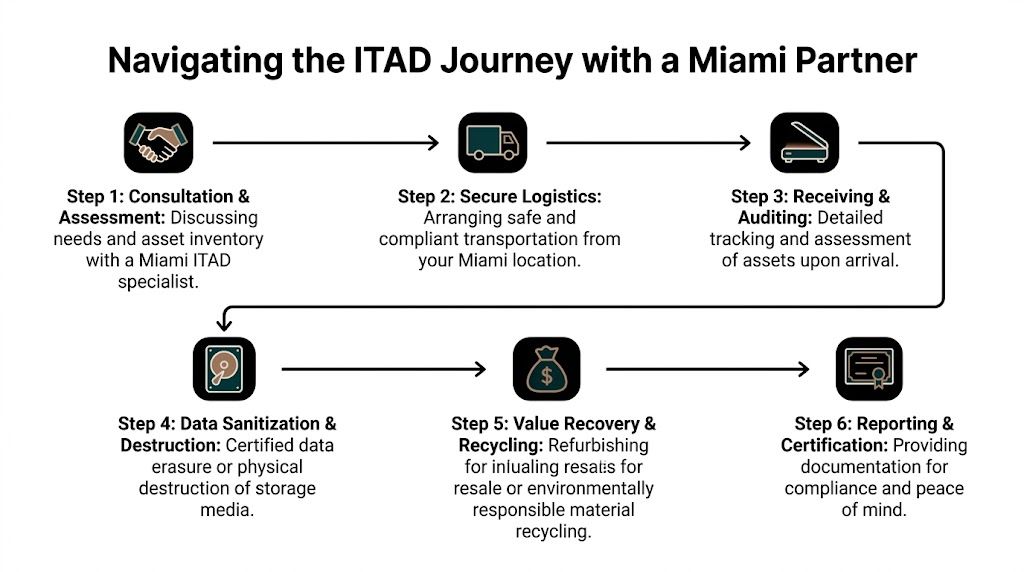
Step one through step three
The first stage is assessment. Your provider identifies the asset types involved, the site conditions, and any special requirements. A small office cleanout is very different from a regional infrastructure refresh or medical equipment disposal project.
Next comes on-site handling. Staff prepare the equipment for removal, document what is collected, and establish custody from the point of pickup. For a Miami business, this matters because many projects involve busy commercial buildings, loading dock restrictions, shared facilities, or multiple departments releasing assets at once.
Then comes transport and intake. Assets move to the processing facility under controlled logistics. Once received, they’re checked in, reconciled against the pickup records, and sorted for downstream handling.
Step four through step six
The fourth stage is data sanitization or destruction. According to STS Electronic Recycling’s Miami ITAD overview, leading providers use serialized inventory tracking so every asset is tagged, undergoes data sanitization to NIST 800-88 standards using tools like Blancco, and receives a certificate of destruction, maintaining an auditable chain-of-custody.
That sentence captures the heart of the process. Each device becomes an accountable record, not a loose object in a pile.
After that comes disposition routing. Working assets may be tested for reuse, refurbishment, or donation eligibility. Nonworking assets move into approved electronics recycling streams. Specialized items may require separate handling depending on the media, component type, or condition.
The final stage is reporting. Your business should receive records showing what was collected, what was destroyed, what was remarketed or recycled, and what certifications support the outcome.
If your vendor can’t explain the chain-of-custody in plain language, don’t assume the paperwork will be strong enough later.
What this looks like in a real Miami setting
Consider a regional company relocating one office and consolidating another. It may need laptop disposal from administrative staff, server retirement from a communications room, product destruction for branded devices, and pickup coordination across several dates. A professional partner turns that complexity into a project plan.
That plan usually includes:
- Asset scoping based on device type and location
- Pickup scheduling around business operations
- Serialized intake for accountability
- Data destruction routing for storage media
- Reuse or recycling decisions based on condition
- Final documentation for internal records and audit support
If you’re comparing vendors, this kind of transparency matters more than polished marketing. The safest partner is usually the one that can walk you through the process without hand-waving.
Your Checklist for Choosing the Right ITAD Vendor
Not all vendors offering electronics recycling or IT equipment disposal are built for corporate risk. Some are excellent for residential drop-offs and one-time recycling days. That’s not the same thing as handling enterprise laptops, healthcare hardware, data-bearing servers, or multi-site facility cleanouts.
A business owner in Miami should evaluate an ITAD vendor the same way they’d evaluate any high-stakes service provider. Start with controls, then documentation, then operational fit.
The short list of questions that matter most
First, ask about certifications and management systems. For enterprises, engaging R2/ISO 14001-certified partners is critical. These facilities report 95%+ landfill diversion rates and provide auditable compliance reports, with some achieving 15-30% value recovery through liquidation or refurbishment, according to Cascade’s Miami IT asset management guidance.
Second, ask how they handle data-bearing devices. Don’t settle for broad statements like “we wipe everything.” Ask what happens to hard drives, SSDs, backup media, and embedded storage in network gear, copiers, medical devices, and specialized systems.
Third, ask what reporting you’ll receive. A corporate vendor should be comfortable discussing inventories, chain-of-custody records, and certificates tied to serialized assets.
Vendor selection is less about who can pick up boxes fastest and more about who can defend your process months later.
Miami ITAD Vendor Evaluation Checklist
| Evaluation Criterion | What to Look For | Why It Matters |
|---|---|---|
| Certifications | R2 and ISO 14001 credentials, plus clear environmental controls | Shows the vendor operates with recognized standards for recycling and process discipline |
| Data destruction methods | NIST-aligned sanitization, shredding, degaussing where appropriate, and device-level documentation | Reduces the chance of data exposure and supports audits |
| Chain-of-custody | Tagged assets, intake reconciliation, transport controls, and clear custody records | Protects your business if questions arise later |
| Reporting quality | Serialized inventories, certificates of destruction, disposition summaries, and audit-ready records | Turns the project into provable due diligence |
| Value recovery model | Testing, refurbishment, resale channels, and transparent settlement terms | Helps finance teams recover part of the remaining asset value |
| Insurance and liability posture | Clear insurance coverage and contractual accountability | Important if devices are lost, damaged, or disputed in transit |
| Specialized asset experience | Familiarity with servers, medical devices, lab gear, and mixed office equipment | Reduces mistakes on unusual or regulated equipment |
| Social impact alignment | Donation pathways, corporate donation programs, and responsible reuse practices | Helps align ITAD with sustainability and community goals |
How to compare vendors without getting distracted
A polished pitch can hide weak operations. So can low pricing. Focus on evidence.
Use this practical filter:
- Ask for sample documentation: Request anonymized examples of destruction certificates, inventory reports, and chain-of-custody records.
- Test their explanations: If they can’t clearly explain what happens from pickup through final disposition, they may not run a mature process.
- Review downstream transparency: You want to know whether assets are reused, remarketed, dismantled, or recycled through documented channels.
- Check project fit: A vendor strong in computer recycling may not be equally strong in data center decommissioning or laboratory equipment disposal.
- Consider partner reliability: The same discipline used in vendor selection across operations applies here. This broader discussion on choosing the right business partner is useful because the core idea is transferable. Process quality beats promises.
For companies that want a more detailed framework specific to recycling and downstream accountability, this resource on selecting a reliable e-waste recycling partner is worth reviewing.
The right vendor should make your legal, IT, facilities, and sustainability teams more comfortable. If one of those groups leaves the meeting uneasy, keep looking.
Partnering for Profit and Purpose with Reworx Recycling
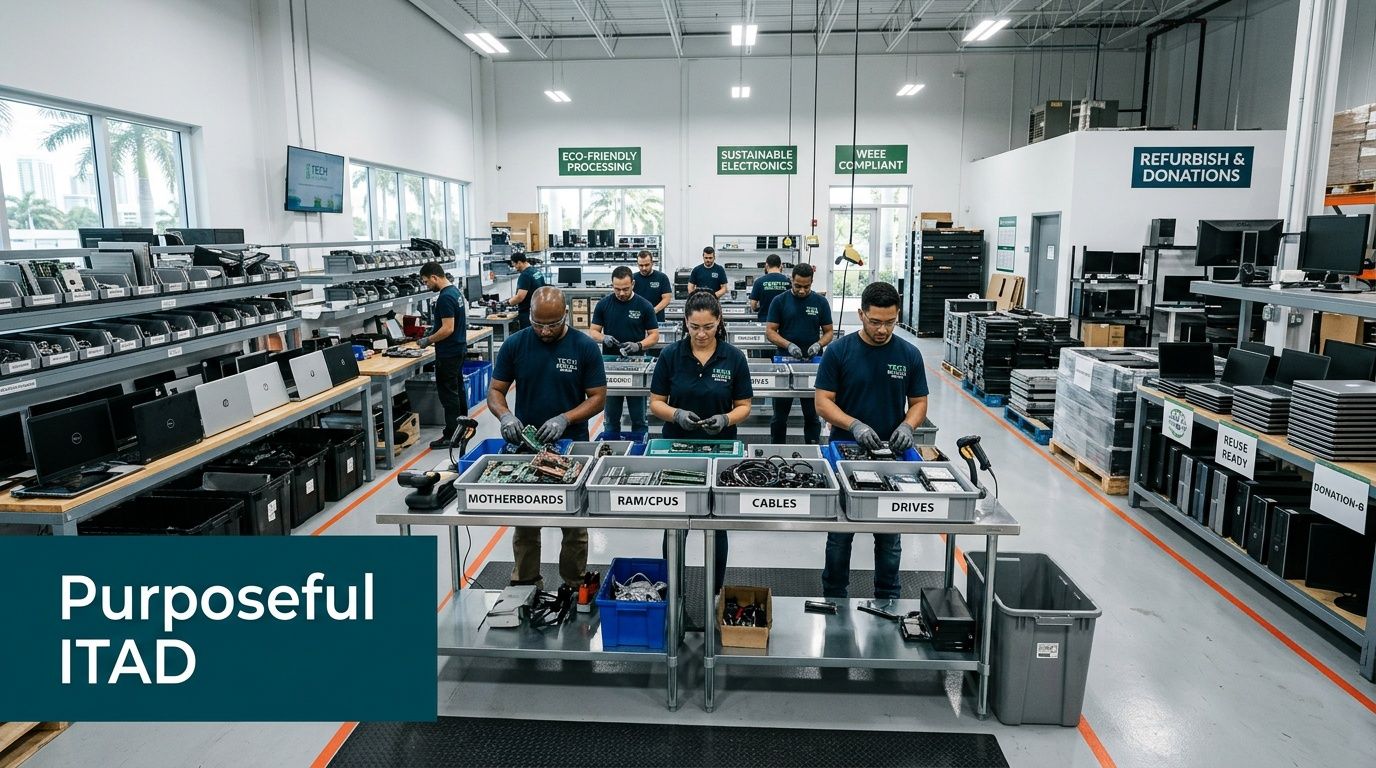
Many ITAD conversations stop at compliance. That’s understandable, but it’s incomplete. Retired technology can do more than exit your balance sheet safely. In the right model, it can also support community outcomes through reuse and donation-based recycling.
That idea matters in Miami because the city combines rapid business growth with visible inequality in digital access. A device that no longer fits your organization may still be valuable to a school, nonprofit, training program, or community initiative if it can be responsibly refurbished and redirected.
Why Miami businesses should think beyond basic disposal
A standard recycling-only model treats old hardware as a waste stream. A donation-based or social enterprise recycling model asks a better question. Which assets can still create value for people, not just commodity markets?
That shift changes how companies talk about office cleanouts, laptop disposal, computer recycling, and sustainable recycling. It creates a story that procurement teams, employees, and community partners can connect with.
It also fits Miami’s environmental reality. An emerging gap in the local market is climate-resilient ITAD. After recent hurricanes, Florida’s e-waste surged by 35%, yet few providers detail protocols for handling flood-damaged assets, creating unaddressed liability during disaster recovery, according to Alta Technologies’ Miami ITAD page.
Reuse strengthens resilience
That storm-related point is easy to overlook. When communities face disruption, digital access becomes more important, not less. People need functioning devices for school continuity, job applications, benefits access, telehealth, and communication.
A donation-based recycling model connects environmental responsibility with local resilience. Instead of treating every retired asset as scrap, businesses can support a chain that prioritizes safe reuse where appropriate and responsible recycling where reuse isn’t possible.
The strongest ITAD outcome isn’t always “nothing went wrong.” Sometimes it’s “something useful happened next.”
The business case still holds
Purpose doesn’t replace discipline. It sits on top of discipline. You still need secure data destruction, chain-of-custody, reporting, and clear asset triage. But when those basics are handled well, your organization can turn retired technology into part of its broader sustainability and social enterprise recycling story.
For businesses exploring that model, this overview of partnering for impact through responsible electronics reuse shows how disposal, donation, and community benefit can align.
That’s especially appealing for companies with ESG goals, community engagement programs, or corporate donation programs that want tangible outcomes instead of abstract commitments.
Answering Your Top ITAD Questions
How much do Corporate IT Asset Disposal Services in Miami usually cost
Pricing depends on the mix of assets, the level of on-site labor, transportation complexity, data destruction requirements, and whether equipment has reuse value. A pallet of obsolete monitors is different from a multi-floor office cleanout with serialized laptops and hard drive shredding. The right way to look at cost is total project risk, not pickup price alone.
Can a business get money back for old equipment
Sometimes, yes. The answer depends on model, age, condition, brand, and market demand. Devices with remaining life may qualify for asset recovery, refurbishment, or resale. Others won’t have resale value but can still be handled through responsible electronics recycling or donation-based recycling. Ask vendors to explain how they determine remarketing potential and how settlements are documented.
What about specialized assets like medical or lab equipment
These projects need more planning. Medical equipment disposal, laboratory equipment disposal, and product destruction often involve mixed materials, embedded storage, regulated workflows, or items that need physical destruction rather than resale. An experienced vendor should identify those exceptions early and document the handling path for each category.
How long does an ITAD project take
The timeline depends on asset volume, site access, internal approvals, and reporting requirements. A small laptop disposal pickup may move quickly. A larger project involving multiple locations, data center decommissioning, or facility cleanout work usually requires scheduling, inventory coordination, and post-processing documentation. The key question isn’t “How fast can you remove it?” It’s “How completely can you document it?”
What should we prepare before requesting pickup
You’ll make the project smoother if you gather basic information first:
- Asset types: Laptops, desktops, servers, switches, phones, drives, monitors, printers, and specialty devices
- Site details: Building access, loading areas, elevator rules, and pickup windows
- Sensitivity level: Which assets stored data and which business units owned them
- Internal contacts: IT, facilities, compliance, and finance stakeholders
- Outcome priorities: Secure data destruction, value recovery, sustainable recycling, donation, or a mix of all four
When businesses do that prep work, the project usually goes cleaner, the records come back stronger, and fewer surprises appear late in the process.
If your organization is planning electronics recycling, secure data destruction, laptop disposal, computer recycling, or a larger IT equipment disposal project, Reworx Recycling is worth considering as a partner that supports responsible recycling, technology donation, and community impact. Whether you need to schedule a pickup, retire old office equipment, or build a smarter corporate donation program, now is a good time to turn that back-room hardware into a documented, secure, and useful next step.