A San Diego business manager usually notices the problem late. The laptops from the last refresh are stacked in a locked room. A few old switches are sitting on a shelf. There’s a pallet of monitors from a facility cleanout, and someone from finance is asking whether any of it still has value. At the same time, legal wants retention discipline, IT wants secure data destruction, and sustainability wants proof the company didn’t just move risk off-site.
That mix of pressure is why Responsible Electronics Recycling in San Diego for Companies has to be treated as an operating process, not a one-time pickup. If you manage IT equipment disposal for a biotech lab, a defense-adjacent contractor, a medical office, a school, or a growing office portfolio, your exposure is usually hiding in plain sight. The devices look inactive. The risk isn’t.
A responsible plan has to handle five things at once: compliance, chain of custody, data security, cost control, and social impact. The companies that do this well don’t just clear storage space. They build a repeatable IT asset disposition (ITAD) workflow that supports audits, protects sensitive information, and creates options for reuse, donation-based recycling, product destruction, and sustainable recycling.
The Hidden Risks in Your IT Storage Closet
A common San Diego scenario looks like this. A biotech company finishes a workstation upgrade. A defense supplier retires test equipment. A growing office does a laptop disposal project after a remote work transition. The retired gear doesn’t leave immediately because nobody wants to guess which items need wiping, which need shredding, and which might still be reusable.
That delay creates two separate problems. First, the business still controls devices that may contain sensitive data. Second, the business is still responsible for how those devices are eventually handled.

San Diego’s scale makes this more than an internal housekeeping issue. San Diego generates over 44,000 tons of electronic waste annually, yet only approximately 15% is recycled through certified programs, a gap that raises compliance and liability concerns for companies, according to this San Diego electronic recycling guide for homes and business. When certified processing rates are that low, the practical takeaway is simple. A business can’t assume every hauler, drop-off site, or “free recycling” offer is built for corporate-grade controls.
Clutter becomes a risk register
Old hardware tends to get mislabeled as surplus. In practice, it often belongs on a risk register.
- Stored laptops may still hold user credentials, cached files, browser tokens, and local downloads.
- Retired servers can contain backups, logs, and database fragments.
- Lab and medical equipment may include embedded storage that gets overlooked during office cleanouts.
- Loose drives and tapes are easy to separate from the parent asset, which breaks the audit trail.
Practical rule: If your team can’t say where a retired device is, what data class it held, and what destruction method it needs, it isn’t ready for disposal.
This is also where weak process design shows up. Teams often wait until the storage room is full, then call whoever can pick up fastest. That might remove the clutter, but it doesn’t close the security or compliance loop.
What works and what doesn't
What works is a controlled handoff. Devices are inventoried, segmented by data sensitivity, and moved through a documented chain of custody. What doesn’t work is mixing office junk removal with electronics recycling and hoping the paperwork arrives later.
For companies that want to tighten internal handling before pickup, Reworx Recycling has a useful guide on mistakes to avoid when disposing old hard drives. It’s a good reminder that the risky part of computer recycling usually starts before the truck arrives.
A storage closet full of retired equipment isn’t dead inventory. It’s active liability until your company can prove otherwise.
Building Your E-Waste Playbook Starting with Inventory
Most disposal mistakes start with poor visibility. A manager asks for a quote, but nobody knows how many laptops are in the room, which servers still contain drives, or whether the networking gear belongs to IT, facilities, or a decommissioned tenant. Without an inventory, the recycler is guessing, finance is guessing, and compliance is exposed.
The fix isn’t complicated. It’s disciplined.
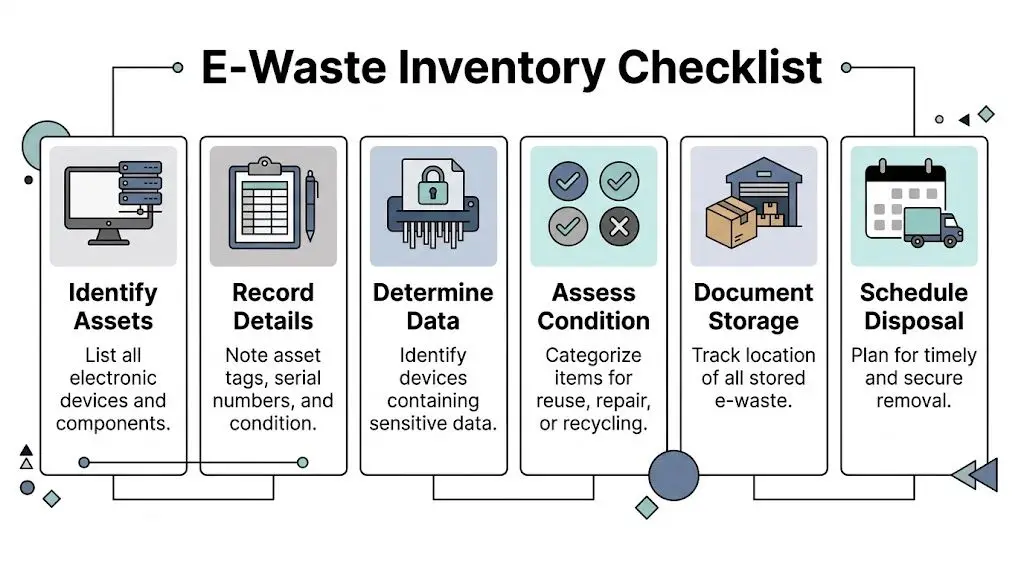
Start with an audit that supports disposal decisions
A useful inventory does more than count boxes. It tells your team what each asset requires next.
The fastest way to build one is a spreadsheet or asset log with fields that matter during ITAD:
| Inventory field | Why it matters |
|---|---|
| Asset type | Separates laptops, desktops, servers, phones, monitors, networking gear, lab devices, and accessories |
| Manufacturer and model | Helps the recycler assess reuse, recycling path, and handling needs |
| Serial number or asset tag | Supports chain of custody and certificate matching |
| Department or owner | Clarifies internal signoff and billing responsibility |
| Physical location | Prevents partial pickups and lost assets |
| Condition | Distinguishes reusable equipment from damaged scrap |
| Data-bearing status | Identifies whether the item needs wiping, degaussing, shredding, or no data treatment |
| Power/accessories included | Affects reuse and donation potential |
| Notes on special handling | Flags batteries, broken screens, medical equipment disposal, or laboratory equipment disposal needs |
For teams formalizing this process, Reworx Recycling has a practical resource on IT inventory audits before recycling that lines up well with corporate electronics recycling workflows.
Classify before you move anything
Not every retired device belongs in the same stream. That’s where companies lose value or create avoidable security work.
Use three broad buckets:
Reuse or donation candidates
These are working systems with a remaining service life. Laptops, desktops, and some peripherals may be suitable for corporate donation programs or refurbishment.Asset recovery candidates
This category includes newer gear with resale value. It often applies to standard business laptops, certain server components, and well-maintained networking hardware.Recycle or destroy candidates
Damaged equipment, obsolete units, mixed commodity loads, and items with no viable second life belong here. Data-bearing equipment in this group still needs secure handling before downstream recycling.
An inventory is not an admin exercise. It’s the document that determines your quote quality, your destruction scope, and your ability to defend your process later.
Mark data sensitivity, not just device type
A laptop from HR and a laptop from a warehouse office may look identical, but they shouldn’t automatically follow the same destruction path. The same goes for a server used in a development environment versus one used in production.
A practical internal rating system can be simple:
- High sensitivity for systems tied to regulated data, customer records, legal matters, R&D, defense work, or finance
- Moderate sensitivity for general office productivity systems with user accounts and local files
- Low sensitivity for displays, cables, docks, keyboards, and non-storage peripherals
That classification gives your recycler clear direction. It also helps your own team decide what can move through donation-based recycling, what belongs in secure product destruction, and what needs direct hard drive shredding.
Include specialty equipment early
San Diego companies often manage more than standard office devices. If you work in biotech, healthcare, research, or advanced manufacturing, your inventory needs room for:
- Laboratory equipment disposal
- Medical equipment disposal
- Data center decommissioning
- Facility cleanout and office cleanout projects
- Loose media and parts-only loads
Those categories usually involve different access issues, signoff requirements, and handling rules. If they get tacked on at the last minute, pickup day becomes slow, expensive, and error-prone.
A strong inventory provides significant advantages. It gives your company cleaner pricing, better logistics, faster approvals, and fewer surprises. More important, it turns electronics recycling from a reactive cleanup task into a controlled business process.
Navigating San Diego's E-Waste Compliance Maze
California doesn’t treat business electronics like ordinary trash, and San Diego companies shouldn’t either. If your team is disposing of old desktops, monitors, servers, printers, networking hardware, or other electronic devices, the legal baseline is stricter than many managers expect.
The core rule is straightforward. California’s Universal Waste Rule (CCR, Title 22, Division 4.5, Chapter 23) classifies electronic devices as universal waste, prohibiting their disposal in municipal solid-waste landfills. This framework is enforced by the Department of Toxic Substances Control and stems from the California Electronic Waste Recycling Act of 2003, as outlined in this overview of electronics recycling requirements in San Diego.
For a business, that means the old “just put it in the dumpster” habit is not a gray area. It’s the wrong process.
What the rule means in practical terms
Most companies don’t need to memorize code citations. They do need to understand how those rules change day-to-day operations.
Here’s the practical reading of the law:
- Electronics are a managed waste stream. They need controlled handling, not general trash disposal.
- Your responsibility doesn’t end when equipment becomes obsolete. End-of-life still requires compliant movement and processing.
- The landfill option is off the table for covered devices and other qualifying electronics.
- Documentation matters because disposal decisions may need to be defended internally, contractually, or during an audit.
This is why corporate electronics recycling and household drop-off behavior aren’t the same thing. City collection programs are useful for residents, but they aren’t designed to solve business-grade chain of custody, serialized reporting, or secure data destruction for bulk IT assets.
The compliance failures I see most often
The biggest mistakes are rarely dramatic. They’re operational shortcuts.
| Common mistake | Why it creates risk |
|---|---|
| Mixing e-waste with general junk during an office cleanout | Electronics may bypass compliant processing |
| Sending business devices to consumer-style channels | You may not get the records or destruction proof your company needs |
| Forgetting embedded storage in specialty equipment | Data-bearing components can leave without treatment |
| Using a hauler without checking downstream controls | Your company keeps exposure if the chain breaks later |
| Treating pickup as the finish line | Liability follows the asset until processing is documented |
A useful way to think about this is through the lens of the broader waste management industry. Mature waste programs separate streams, assign controls, and document outcomes. Electronics need the same discipline because they combine environmental handling issues with data security exposure.
Compliance starts before pickup. It begins when a company decides which channel an asset will enter and how that decision will be documented.
A business checklist that holds up better
If you want a workable internal standard, use this as your baseline:
Separate electronic waste from municipal waste
Don’t let facilities teams, movers, landlords, or cleanout vendors blend old electronics into a general debris stream. This is one of the easiest mistakes to make during relocations and facility closeouts.
Identify data-bearing equipment before release
A company can be fully committed to sustainable recycling and still create a breach if storage media is overlooked. Servers, copiers, lab devices, firewalls, and multifunction equipment deserve special attention.
Use certified channels with records
For California-specific handling guidance and service planning, Reworx Recycling maintains a page on California electronics recycling that’s useful when building internal policy. The operational point is simple. If the recycler can’t provide a clear process, downstream accountability, and destruction documentation, your company is taking on unnecessary risk.
Match the disposal path to the asset
Some devices should be reused. Some should move through IT asset disposition with value recovery. Some belong in product destruction. A compliant program doesn’t treat every item the same.
Keep procurement, IT, facilities, and legal aligned
Many failures happen in the handoff between departments. Procurement may care about vendor terms. IT cares about data. Facilities cares about space. Legal cares about defensibility. If those groups aren’t using the same workflow, assets slip through the cracks.
Why this matters beyond fines
Most managers first think about regulatory exposure. That’s fair, but it’s only part of the picture.
Poor electronics disposal can damage customer trust, weaken contract posture, and create internal audit findings that take far longer to fix than the original cleanup would have required. For defense contractors, healthcare groups, schools, and research-heavy businesses, the reputational consequences can matter as much as the legal ones.
The companies that handle this well don’t chase compliance at the end. They build it into inventory, vendor selection, logistics, and reporting from the start.
Selecting a Certified Recycler for Ironclad Data Security
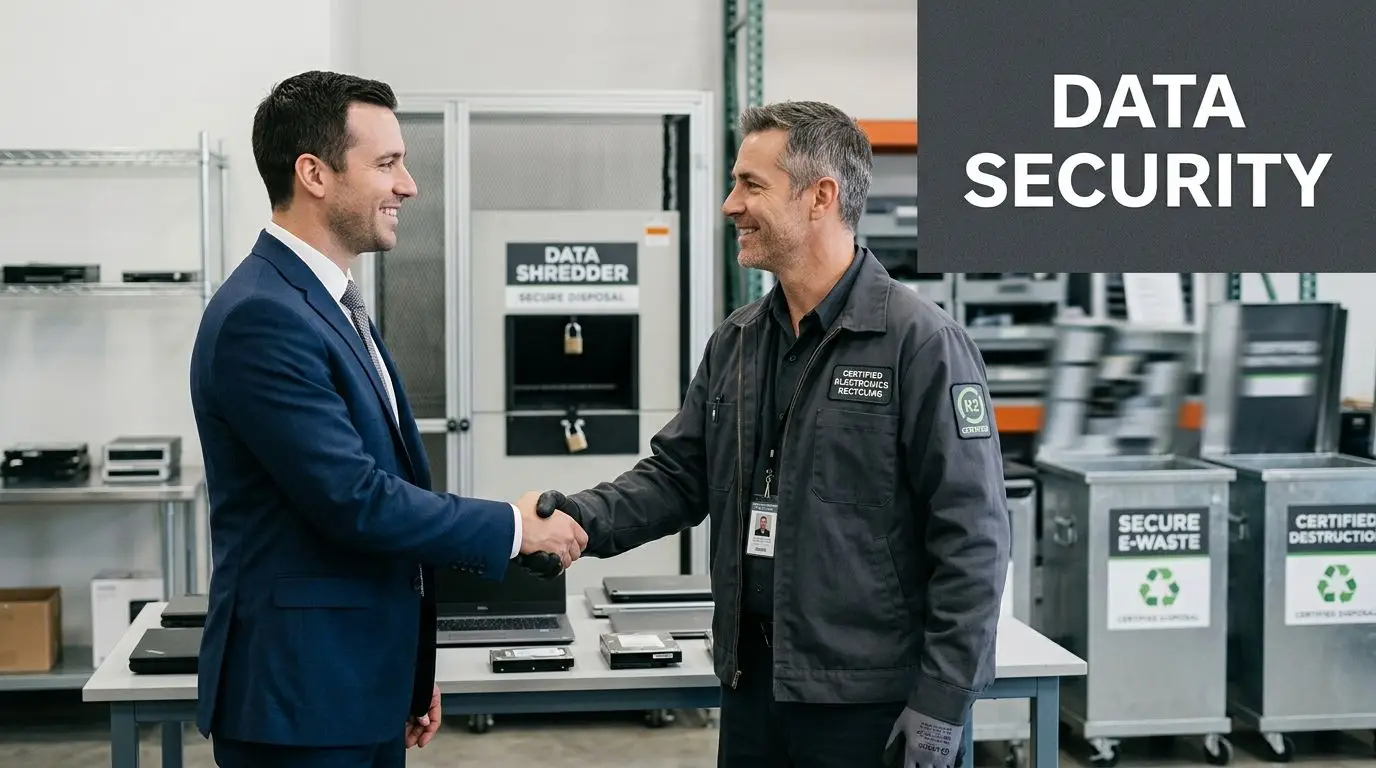
Choosing a recycler is not a hauling decision. It’s a risk transfer decision. Once your devices leave the building, your company is relying on someone else’s controls, documentation, employee training, and downstream discipline. If any part of that chain is weak, the exposure comes back to you.
That’s why certification matters. It’s not branding. It’s evidence that the operator has been measured against a recognized standard for process control, environmental handling, and secure disposition.
What to look for before you sign anything
For San Diego businesses, the most useful shorthand is to verify whether the provider operates with R2 and NAID AAA controls when secure electronics recycling and data destruction are involved. Those certifications matter because they point to process maturity, not just disposal capability.
When I review recyclers for corporate programs, I look for five things first:
- Documented chain of custody from pickup through final processing
- Clear data destruction options matched to asset type
- Serialized reporting when required by the client
- Certificates of destruction and recycling
- Downstream accountability for where materials and components go next
If any of those answers are vague, the company probably has a hauling service, not a full ITAD process.
Wiping, degaussing, and shredding are not interchangeable
A lot of companies ask for shredding because it sounds final. Sometimes that’s correct. Sometimes it destroys asset value unnecessarily.
Here’s the practical distinction:
| Method | Best use case | Main trade-off |
|---|---|---|
| NIST-compliant wiping | Reusable drives and systems that can be remarketed or donated | Requires reliable process control and verification |
| Degaussing | Magnetic media that won’t be reused and needs data neutralization | Media becomes unusable after treatment |
| Physical shredding | High-sensitivity media or damaged drives where reuse is off the table | Maximizes certainty, eliminates reuse potential |
The right answer depends on the device, the data class, and your organization’s policy. A mature provider should ask those questions before recommending a method.
If a recycler offers one destruction method for every device in every situation, they’re simplifying their operation, not protecting yours.
Chain of custody is the real product
Most data incidents tied to end-of-life hardware don’t come from complex failure. They come from ordinary sloppiness. Unlabeled gaylords. Mixed loads. Unsigned releases. Drives removed without matching them back to host assets. Equipment left in an unsecured dock area before processing.
That’s why chain of custody is more important than marketing language. You want a provider that can show:
- Who accepted the assets
- What was picked up
- How data-bearing devices were identified
- Which destruction or sanitization method was applied
- What certificate or report closes the event
This is especially important for data center decommissioning, office cleanout work, and multi-site pickups where the load composition changes quickly.
ESG reporting is changing the vendor conversation
Electronics recycling now shows up in board-level reporting more often than it used to. That changes what companies need from a recycler.
According to Recycle San Diego’s overview of business solutions, post-2025 California SB 54 amendments require businesses to report e-waste diversion metrics for ESG audits, and top-tier ITAD providers are adopting AI tools for real-time chain-of-custody; the same source notes a DTSC pilot found these systems diverted 15% more e-waste in Q4 2025. The practical implication isn’t that every company needs a flashy dashboard. It’s that reporting quality is becoming part of compliance quality.
A provider with strong tracking can help your team answer hard questions later:
- Which assets were destroyed versus reused?
- Which locations generated the most retired equipment?
- Which loads supported donation-based recycling?
- Which records can finance, legal, or sustainability rely on in an audit?
One option that fits the social enterprise model
If your company wants secure IT equipment disposal with community benefit layered in, Reworx Recycling’s certification-focused approach is one example of how a provider can combine electronics recycling, secure data destruction, pickup coordination, and donation-based recycling under a social enterprise model. That model can be useful for businesses trying to balance ITAD discipline with digital inclusion goals.
What a weak recycler sounds like
You can usually spot a poor fit quickly. Watch for responses like these:
- “We take pretty much everything, no need to itemize.”
- “You probably don’t need serial tracking.”
- “We can figure out destruction details after pickup.”
- “Our service is free, so we don’t usually provide much reporting.”
- “Certificates are available, but only if you ask later.”
Those answers signal process gaps. A strong recycler talks about intake controls, documentation, data-bearing asset segregation, and final reporting without being prompted.
For San Diego companies handling anything beyond a few low-risk peripherals, certified electronics recycling isn’t optional. It’s the control that turns disposal from a liability event into a managed business process.
Understanding Costs, Logistics, and Value Recovery
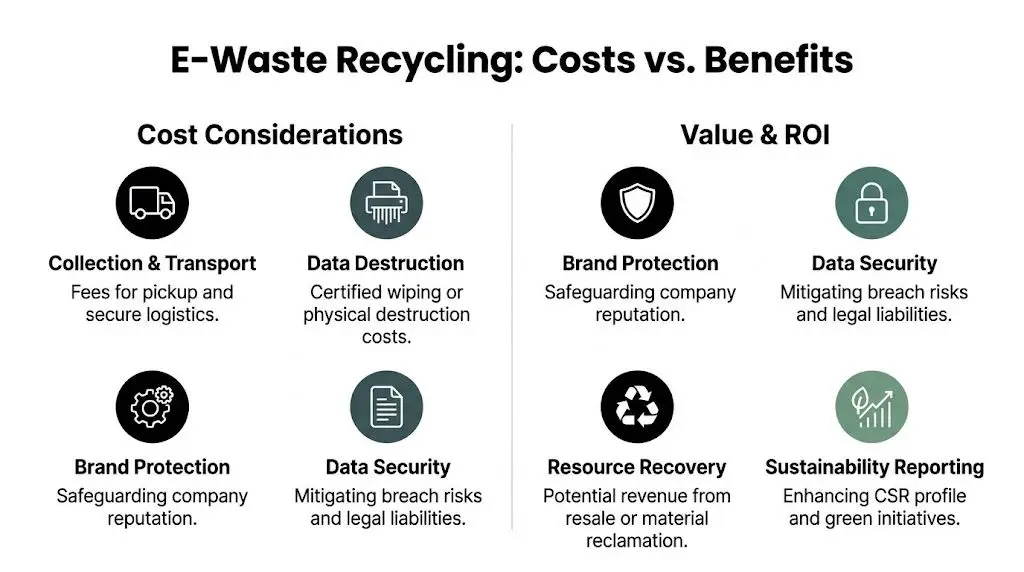
San Diego companies hear the word “free” a lot in electronics recycling. Free pickup. Free drop-off. Free computer recycling. Sometimes that offer is legitimate for a narrow set of items. Often it’s incomplete. The difference matters because cost surprises usually show up after the equipment is already staged and your timeline is tight.
A better question is not “Is it free?” It’s “What does this channel include, and what risk is it leaving with us?”
The real difference between pickup, drop-off, and full ITAD
Each disposal model solves a different problem.
| Model | Best fit | Main limitation |
|---|---|---|
| Business drop-off | Small loads, low urgency, minimal on-site handling needs | Usually weak for chain of custody and bulk corporate logistics |
| Scheduled pickup | Offices with moderate volume and limited transport capacity | Scope varies widely between vendors |
| Full ITAD project | Large refreshes, multi-site collections, data center decommissioning, secure data destruction | Requires more planning, but controls are much stronger |
| Donation-based recycling | Working equipment with reuse potential and community value | Not every asset qualifies |
Drop-off can work for low-volume, low-complexity situations. It usually breaks down when the company needs serialized reports, onsite packing, hard drive segregation, or formal certificates tied to an inventory.
Pickup is the middle ground most businesses need. But pickup alone doesn’t tell you whether the provider offers secure data destruction, asset recovery, product destruction, or social enterprise recycling. You have to ask.
Why “free” often gets expensive later
The hidden-fee issue is real. According to Terra E-Waste’s discussion of pricing transparency, industry benchmarks show per-pound fees of $0.20 to $0.50 per pound for non-free pickups, NIST-compliant shredding surcharges of $5 to $15 per drive, and transport minimums of $100+. The same source says a DTSC report found 40% of SMBs faced unexpected fees averaging $2,500 per year.
That doesn’t mean every recycler is inflating invoices. It means companies should stop assuming that “free electronics recycling” includes the services a business environment usually needs.
Common add-ons include:
- Drive destruction charges when the base pickup only covers commodity recycling
- Minimum haul fees for smaller local loads
- Packing or labor charges when assets aren’t ready at dock level
- Certificate fees if detailed reporting is treated as an extra
- Special handling charges for batteries, CRTs, or damaged equipment
Cheap quotes often exclude the exact controls your legal, IT, and audit teams care about most.
A smarter way to compare vendors
Don’t compare vendors on pickup price alone. Compare them on total program value.
Ask each provider the same set of questions:
- What’s included in the base pickup?
- Are data-bearing devices priced differently?
- Are certificates of destruction and recycling included?
- Is serial-level reporting standard or optional?
- Can you support laptop disposal, server retirement, office cleanout, and facility cleanout under one workflow?
- Do you offer asset recovery or buyback for reusable equipment?
- Can equipment be directed into donation-based recycling when appropriate?
That last point matters more than many companies realize. A straight scrap model can be the wrong answer for fleets of working laptops, monitors, and accessories. If the equipment still has service life, a donation or refurbishment channel may create more social value than commodity recycling, while asset recovery may return direct financial value on newer units.
Value recovery changes the economics
A well-run ITAD program doesn’t look at every retired asset as waste. It sorts for outcome.
Some equipment belongs in:
- Resale or buyback if age, condition, and market demand support recovery
- Corporate donation programs if the hardware is usable but not worth remarketing
- Material recycling when repair or reuse no longer makes sense
- Product destruction for branded items, prototypes, or restricted equipment
For companies trying to reduce net disposal cost, this matters. The best financial result often comes from mixing channels, not forcing all assets into one stream.
If you’re evaluating that mix, Reworx Recycling outlines its asset recovery solutions in a way that reflects this broader ITAD logic. The useful takeaway is the framework itself. Recover value where possible, donate where appropriate, and recycle responsibly when the asset has reached true end of life.
Logistics shape cost more than most teams expect
Two projects with the same number of devices can have very different economics.
Costs usually rise when:
- Assets are spread across multiple suites or floors
- Equipment isn’t sorted ahead of pickup
- Loose accessories are mixed with high-priority data-bearing assets
- Buildings have access restrictions or tight loading windows
- The business waits until the project becomes urgent
By contrast, costs tend to improve when inventory is clean, devices are grouped by handling type, and pickup can be planned as part of a refresh cycle rather than an emergency cleanout.
That’s why the cheapest option on paper is often not the lowest-cost option in practice. The strongest programs treat electronics recycling, secure data destruction, and value recovery as one coordinated process.
Closing the Loop with Reporting and Employee Engagement
A recycling program is only finished when the paperwork closes the loop. Until then, the company may have moved equipment, but it hasn’t fully documented what happened to it.
That distinction matters because corporate electronics recycling now intersects with audits, ESG reporting, contract requirements, internal security reviews, and community impact goals. A pallet leaving your site is an event. A certificate-backed, traceable disposition record is a finished process.

The documents your company should expect
According to the City of San Diego performance audit of trash, recycling, and organics collection and handling, certified partners provide cloud-based tracking, real-time order views, and Certificates of Recycling and Destruction, with optional serial or asset tags, and those records are essential for releasing businesses from liability under local, state, and federal laws.
That’s the operational standard to aim for.
At minimum, your team should expect:
- Certificate of Destruction for data-bearing assets processed through wiping, degaussing, or shredding
- Certificate of Recycling for the material disposition event
- Serialized detail when required for internal asset reconciliation
- Order-level visibility so stakeholders can see status without chasing emails
- Supporting reports for sustainability teams, facilities, procurement, or auditors
If your vendor treats this documentation as informal or optional, the process is incomplete.
Reporting turns disposal into usable business evidence
Good reporting has practical value across departments.
| Stakeholder | What they need from reporting |
|---|---|
| IT | Confirmation that data-bearing devices were sanitized or destroyed |
| Legal and compliance | Defensible records that support policy and regulatory obligations |
| Finance | Asset retirement support and possible write-off documentation |
| Sustainability | Evidence for waste diversion and responsible end-of-life handling |
| HR and leadership | A visible story about community impact and responsible operations |
The certificate is not paperwork for paperwork’s sake. It is the record that separates responsible disposal from an undocumented assumption.
Bring employees into the program
The strongest programs don’t stay hidden in the server room. They become part of company culture.
A practical approach is to pair corporate ITAD work with an employee-facing electronics collection effort. If your site policy allows it, a recycler can help structure a periodic drive for small personal devices while the company handles its own office equipment disposal through a separate chain of custody. That creates visibility without mixing business assets and personal electronics in an uncontrolled way.
A few rules make this work better:
- Keep corporate and personal streams separate
- Publish accepted items in advance
- Use a specific drop window, not an open-ended pile-up
- Explain data responsibility clearly for employee devices
- Share the results internally after the event
A social enterprise recycling model provides extra value. When employees know retired technology may support digital inclusion, reuse, or workforce development, the recycling program stops feeling like a compliance burden and starts feeling like a meaningful company initiative.
Use the story carefully
There’s a right and wrong way to communicate electronics recycling internally.
The wrong way is vague messaging about “going green” with no proof behind it. The right way is specific, documented, and modest. State that the company retired outdated devices through a controlled ITAD process, secured data destruction where required, and directed eligible equipment toward reuse, donation, or responsible recycling. If your partner provides cloud tracking and certificates, your communications team has real evidence to work from.
That’s how businesses turn laptop disposal, computer recycling, medical equipment disposal, and facility cleanouts into something larger than waste removal. They turn it into a credible operational and sustainability story.
Partner with Reworx for a Greener San Diego
A responsible electronics recycling program protects more than floor space. It protects data, supports compliance, reduces disposal mistakes, and gives your company a cleaner way to manage office cleanouts, secure data destruction, computer recycling, and broader IT asset disposition.
There’s also a city-level benefit. According to Inside San Diego’s reporting on zero waste progress, San Diego achieved a 71% overall waste diversion rate in 2022 and is progressing toward a 90% goal by 2035. The same source notes that every ton of e-waste diverted avoids approximately 2.72 tons of CO₂ equivalent emissions. For businesses, that makes electronics recycling a practical environmental action, not a symbolic one.
Reworx Recycling fits this conversation because its model combines IT equipment disposal, donation-based recycling, sustainable recycling, and social enterprise recycling. For companies that want a process with both risk control and community impact, that combination is worth evaluating.
If your San Diego business needs a cleaner way to handle retired laptops, servers, networking gear, medical devices, office electronics, or a larger facility cleanout, explore Reworx Recycling for guidance on donation-based recycling, secure data destruction, pickup planning, and socially responsible ITAD partnerships.