When your company retires old hard drives, you need more than a simple promise that the data is gone. You need verifiable, audit-proof documentation. That's precisely what an HDD destruction certificate provides.
Think of it as the official death certificate for your data. It’s a legal document confirming your hard drives were physically destroyed, rendering the information on them permanently unrecoverable. More than just a piece of paper, it’s a compliance shield that proves your business exercised due diligence in protecting sensitive information. Should a data breach investigation ever arise, this certificate is your first line of defense, demonstrating responsible IT equipment disposal.
The Critical Role of a Destruction Certificate
In an age where data is one of your most valuable—and vulnerable—assets, simply disposing of old hard drives is a recipe for disaster. An HDD destruction certificate is the final, crucial step in the IT asset disposition (ITAD) lifecycle. It transforms the act of office cleanouts and data center decommissioning from a massive potential liability into a documented, secure, and legally defensible process.
Without this proof, your business is exposed to regulatory fines, legal action, and the kind of reputational damage that’s difficult to overcome. This is where a social enterprise like Reworx Recycling provides critical value, ensuring every step, from facility cleanout to final certification, is handled with the utmost security and environmental responsibility.

This formal documentation isn't just a "nice-to-have." It’s essential for a few key reasons. The table below breaks down its core functions and why it's so important for different stakeholders in your business.
Why an HDD Destruction Certificate Matters
| Function | Business Benefit | Relevant Stakeholder |
|---|---|---|
| Proof of Compliance | Provides tangible evidence for auditors under HIPAA, GDPR, CCPA, and SOX, demonstrating secure data handling from creation to destruction. | Compliance Officers, Legal Teams |
| Liability Transfer | Officially shifts the legal responsibility for the destroyed media to the ITAD vendor, protecting the business from claims of negligence. | C-Suite Executives, IT Managers |
| Internal Accountability | Creates a clear, auditable trail for every retired data-bearing asset, closing the loop on internal security policies. | IT Asset Managers, Security Teams |
| Stakeholder Assurance | Offers concrete assurance that sensitive corporate, employee, and customer data has been permanently and responsibly eliminated. | Business Owners, Board of Directors |
Ultimately, this certificate gives you the peace of mind that comes from knowing you’ve handled your data responsibilities correctly from start to finish.
Why Documentation is a Non-Negotiable Step
Imagine trying to prove a specific drive was destroyed months or even years after an office cleanout. A verbal confirmation or a simple invoice for computer recycling just won't cut it. The certificate is your tangible evidence, packed with specific details like serial numbers, destruction methods, and authorized signatures. It closes the loop on your data security obligations, ensuring every single retired hard drive is accounted for.
The demand for this level of verification is only growing. The global Hard Drive Destruction Service market, valued at USD 1.65 billion in 2024, is expected to skyrocket to USD 5.05 billion by 2035. This surge is fueled by rising data security fears and the sheer number of data breaches, which impacted over 1.35 billion people globally in 2024 alone. A verifiable certificate is the main tool businesses have to prove they’re compliant in this high-stakes environment.
For a business, an HDD destruction certificate is not just a receipt. It's an insurance policy against data breaches, a testament to corporate responsibility, and the final lock on your data's lifecycle.
As a social enterprise dedicated to both security and community impact, Reworx Recycling ensures that every secure data destruction service is backed by a compliant, detailed certificate. This empowers our partners to meet their legal requirements confidently while supporting our mission of digital inclusion and environmental stewardship through donation-based recycling programs.
For any business looking to lock down its process, understanding what goes into these documents is the first step. You can review a comprehensive destruction certificate template to see exactly what information is needed for audit-proof documentation. It’s a simple step that can safeguard your organization’s future.
Decoding a Compliant Destruction Certificate
Not every document with "Certificate of Destruction" printed on it will stand up to real scrutiny. A truly compliant, audit-proof HDD destruction certificate is far more than a simple receipt. Think of it as a notarized legal record that tells the complete story of your data's final journey. It meticulously outlines every critical step to prove that sensitive information is gone for good.
This piece of paper transforms a routine electronics recycling service into a powerful legal safeguard. Its real strength is in the details, turning vague promises of security into concrete, verifiable facts. Without these specifics, a certificate is just that—a piece of paper. With them, it becomes a critical tool for managing risk and defending your compliance position.
Core Components of an Audit-Proof Certificate
A rock-solid destruction certificate must have a few non-negotiable elements that create an unbroken chain of custody. Each piece of information acts as a link in that chain, proving a secure process from the moment the drives leave your control to their final, physical obliteration.
Here’s what to look for:
- Unique Serial Numbers: Every single hard drive has to be listed by its manufacturer's serial number. This is the most crucial part, as it directly ties the certificate to the physical hardware you retired.
- Transfer of Custody Details: The certificate must clearly state who took possession of the assets, where they picked them up from, and on what date. This establishes the official start of the secure chain.
- Method of Destruction: It needs to be specific. The document should detail the exact destruction method, like physical shredding to a certain particle size (e.g., 2mm) or degaussing with a particular gauss rating.
- Date and Location of Destruction: The certificate should explicitly state when and where the destruction actually happened, confirming the final step in the process.
This is exactly the kind of granular detail that auditors for regulations like HIPAA, SOX, or GDPR hunt for. To get a better sense of why this documentation is so vital, reviewing a good GDPR compliance checklist can be really helpful. It puts the data privacy principles driving these standards into context.
The Role of Signatures and Accountability
A certificate is only as credible as the company that issues it. Verified signatures are what establish accountability and turn the document into a complete legal record.
A compliant HDD destruction certificate is an attestation. It is a formal declaration by a certified vendor that they have accepted liability and performed the destruction service in accordance with industry standards and legal requirements.
The certificate should always include these signatures:
- Technician’s Signature: The person who performed or witnessed the destruction signs off on the work.
- Authorized Vendor Signature: A representative from the ITAD company, like Reworx Recycling, signs to certify the entire process.
This dual-signature system confirms that the destruction was carried out and verified according to established protocols. When you partner with a social enterprise like Reworx Recycling, you get a certificate that meets the highest industry standards and also reflects a real commitment to responsible IT asset disposition. Understanding the various e-waste certification standards makes it clear why choosing a certified partner is so important for the integrity of your documentation and your overall compliance strategy.
The Real Costs of Improper Data Disposal
Forgetting to get a valid HDD destruction certificate isn't just a paperwork slip-up. It's a massive business risk with financial, legal, and reputational consequences that can be absolutely staggering. We need to move past thinking about compliance as an abstract concept and get real about what happens when IT equipment disposal isn't properly documented. That simple piece of paper is often the only thing standing between your organization and a full-blown crisis.
Picture this: you're facing multi-million dollar fines under regulations like GDPR or HIPAA just because you can't prove that a specific, discarded hard drive from a laptop disposal project was actually destroyed. It’s a nightmare scenario that plays out far more often than business leaders think. A missing certificate can set off a chain reaction of disaster, from mandatory breach notifications and costly lawsuits to permanent damage to your brand's credibility.
The Financial Fallout of Unverified Destruction
The most direct hit from improper data disposal comes from regulatory penalties. These fines are designed to hurt, often scaling based on how negligent a company was and how much data was exposed.
But the fines are just the beginning. The secondary costs can be even worse:
- Legal Fees and Lawsuits: Defending your company against class-action lawsuits from customers whose data was compromised can run into the millions, even if no real breach occurred.
- Credit Monitoring Services: If data is lost, you're often on the hook to pay for years of credit monitoring services for every single person affected.
- Increased Insurance Premiums: A documented data security failure will cause your cybersecurity insurance premiums to skyrocket, impacting your budget for years to come.
These financial hits, both direct and indirect, make it clear why a certified ITAD partner like Reworx Recycling isn't just another vendor—they're an investment in preventing a catastrophe. You can dig deeper into the environmental and legal impacts of improper commercial e-waste disposal to see how these risks go well beyond just data security.
Why the Commercial Sector Demands Proof
It’s no surprise that the commercial world is demanding certified product destruction and data disposal. It's a direct response to these growing risks. You can see it reflected in the market for secure hardware disposal. The commercial use segment is the driving force in the hard disk destruction equipment market, valued at over $450 million globally. This number shows just how critical certified solutions have become for businesses trying to keep up with compliance rules and the constant threat of data breaches. You can learn more about how businesses are shaping the hard disk destruction equipment market to meet these security demands.
For an organization, the cost of a data breach isn't just financial. It's the erosion of customer trust, the distraction from core business activities, and the long-term struggle to rebuild a tarnished reputation.
At the end of the day, an HDD destruction certificate draws a direct line between a physical piece of hardware and your bottom line. It's your undeniable proof that you did your job, protecting your customers, your employees, and your company's future. Working with a trusted social enterprise like Reworx Recycling ensures this final, crucial step is handled with the professionalism your organization deserves, turning a potential liability into a documented security win.
Your Step-by-Step Path to Certified Destruction
Getting a legitimate HDD destruction certificate shouldn't feel like navigating a maze. For IT managers and business owners, a clear, actionable roadmap is the key to staying compliant and keeping data safe. The journey from flagging old equipment to holding that final, auditable proof of destruction involves a few critical steps. Each one builds on the last, creating an unbreakable chain of security.
This isn't just about calling for a pickup; it’s about careful documentation and verifiable actions at every turn. Following a structured path for medical equipment disposal or lab equipment disposal means every hard drive is accounted for, moved securely, destroyed properly, and officially certified. Think of this process as your best defense against data breaches and costly regulatory fines.
Step 1: Inventory and Documentation
Before a single drive leaves your building, the first order of business is to create a detailed inventory. This is more than a simple headcount—it’s a precise log of every single data-bearing device you're sending off for destruction.
At a bare minimum, each entry should include:
- Asset Type: (e.g., Desktop HDD, Laptop SSD, Server Drive)
- Manufacturer: (e.g., Seagate, Western Digital)
- Model Number:
- Unique Serial Number: This is the most important detail. It's the primary identifier that will appear on the final certificate.
This initial inventory list becomes your master document. It's the baseline you'll use to cross-reference every report that follows, from the pickup receipt to the serial numbers on the final HDD destruction certificate.
Step 2: Secure Logistics and Chain of Custody
With your inventory locked down, the next phase is moving the actual hardware. This is where the chain of custody officially kicks into gear. A trustworthy ITAD partner like Reworx Recycling will manage the pickup with secure, documented procedures.
This process involves using locked, sealed containers for transport and giving you a bill of lading that confirms the transfer of liability. From this point on, every person who handles the assets is documented, creating a continuous, auditable trail from your door to the destruction facility.
Step 3: Witnessed or Verified Destruction
The main event, of course, is the physical destruction. Depending on your security requirements and comfort level, this can happen in a couple of ways:
- On-Site Shredding: A mobile shredding truck comes right to your location. You can physically watch your hard drives get turned into tiny fragments, offering the ultimate peace of mind.
- Off-Site Shredding: Your sealed containers are taken to a secure, access-controlled facility for destruction. Reputable vendors will let you witness the process through a secure video feed or even in person.
We highly recommend choosing a vendor with a NAID AAA Certification. This third-party verification confirms that the provider’s security protocols, employee screening, and destruction processes meet the highest industry standards. It's an extra layer of assurance that everything is being handled correctly.
This flowchart shows just how quickly things can go wrong—from simple mishandling to fines and brand damage—when data-bearing assets aren't managed properly.
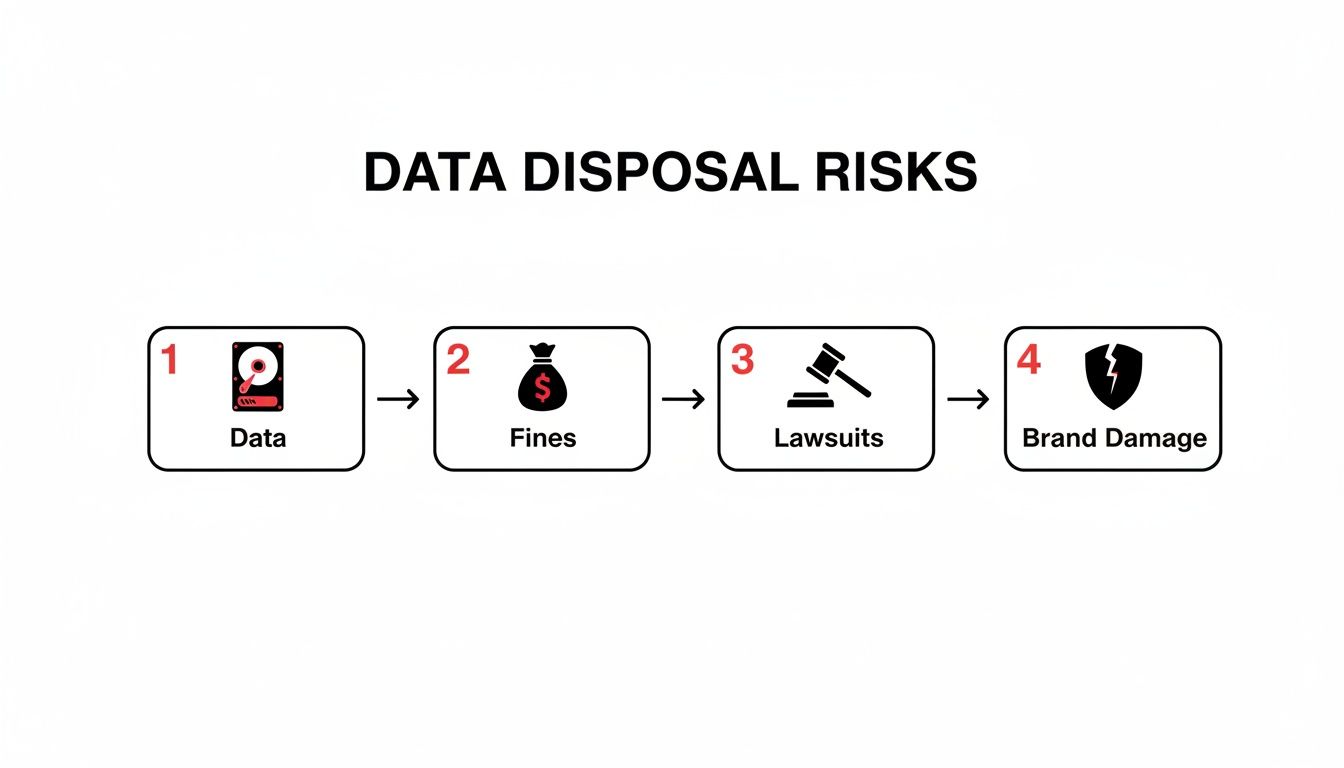
Each stage in this visual is a potential weak link that a documented, certified destruction process is designed to eliminate.
Step 4: Certificate Issuance and Verification
Once the drives have been shredded, the final and most crucial step is receiving your official HDD destruction certificate. This document is your concrete proof of compliance.
But your job isn't quite finished when it arrives. The last act of due diligence is to meticulously cross-reference the serial numbers on the certificate against your original inventory list. This is how you confirm that every single asset you sent out was actually destroyed.
If you spot any discrepancies, bring them up with your vendor immediately. A professional partner like Reworx Recycling makes this a smooth process by providing clear, accurate documentation from the start. To get a feel for how we handle things, check out our guide on the secure destruction of hard drives.
Once you've verified everything, file that certificate somewhere safe. You'll want it handy for your next audit.
How to Choose the Right Data Destruction Partner
Picking the right IT Asset Disposition (ITAD) vendor is easily one of the most important decisions an IT or sustainability manager will make. This isn't just about getting a good price—it's about who you trust with your company's data security, legal compliance, and corporate social responsibility goals. When every old hard drive is a potential liability, the partner you choose determines whether you’re minimizing that risk or multiplying it.
A great partner doesn't just smash hard drives. They deliver a secure, transparent, and fully auditable service that shields your organization from risk. As a social enterprise, Reworx Recycling takes this a step further, turning your disposal needs into a community benefit.
Verifying Certifications and Standards
The first step in vetting any potential partner is checking their certifications. These aren't just fancy logos for their website; they are hard-earned proof that a third-party auditor has meticulously inspected everything from their facility's security to their employee background checks.
Here are the non-negotiables:
- NAID AAA Certification: Think of this as the gold standard for secure data destruction. It confirms a vendor follows the absolute strictest industry protocols for every step of the information destruction process.
- R2v3 (Responsible Recycling): This one is all about environmental and social responsibility. An R2v3 certified partner like Reworx Recycling guarantees your e-waste is managed in a way that protects both the environment and worker safety, ensuring hazardous materials never end up in a landfill, in line with sustainable recycling practices.
Your first question should always be for proof of current certifications. If a vendor can't produce them immediately, it's a major red flag.
Scrutinizing the Chain of Custody
A secure chain of custody is the unbroken, documented trail your hardware follows from the second it leaves your building to the moment it's destroyed. This is where security breaches often happen. A single weak link in this chain can expose your data while it's in transit.
When you're evaluating a vendor, get specific with your questions:
- How exactly are the assets transported? You want to hear about locked, GPS-tracked vehicles.
- Are they secured in sealed, tamper-evident containers?
- Who has access to our assets during transit and at your facility?
- How is the entire journey documented, from pickup to the final shred?
A trustworthy partner will have clear, confident answers and provide detailed documentation for every stage, which all culminates in that final HDD destruction certificate.
On-Site vs. Off-Site Destruction
You’ll generally have two choices for how the actual destruction happens, and the best one for you comes down to your company's security policies and risk tolerance.
- On-Site Destruction: A mobile shredding truck comes right to your location, allowing you to physically watch your hard drives get destroyed. This offers the ultimate peace of mind and is often the required choice for organizations in highly regulated fields like healthcare and finance.
- Off-Site Destruction: Your assets are securely transported to the vendor’s facility for destruction. While this can be a more budget-friendly option, it requires absolute trust in the vendor’s chain-of-custody process. If you go this route, their NAID AAA certification is essential.
Reworx Recycling offers both on-site and off-site secure destruction, giving you the flexibility to meet your specific security needs. For a deeper dive into making this choice, our guide on selecting a reliable e-waste recycling partner is a great resource.
Beyond Security: Aligning with Social and Environmental Goals
A truly strategic partnership moves beyond simple compliance. Choosing a social enterprise like Reworx Recycling can transform a routine operational expense into a powerful force for good in your community and for the planet. While a standard recycler's goal ends with recovering commodity value, a social enterprise channels its success back into its mission.
Partnering with a social enterprise for ITAD isn’t just a transaction. It's an extension of your company’s corporate social responsibility program, turning retired assets into opportunities for digital inclusion, workforce development, and a healthier planet.
This approach gives your business a tangible "social return on investment." Your old IT equipment helps bridge the digital divide by getting technology into the hands of those who need it, all while you get the same top-tier, certified data destruction services you require. It's a powerful way to show that your company's values are woven into every part of your supply chain.
We understand that weighing these factors can be complex. To make it easier, here’s a straightforward comparison of what it looks like to partner with a mission-driven social enterprise versus a traditional recycler.
Choosing Your Partner: Reworx vs. a Standard Recycler
| Feature | Reworx Recycling (Social Enterprise) | Standard For-Profit Recycler |
|---|---|---|
| Primary Goal | Maximize social and environmental impact alongside secure recycling. | Maximize profit from commodity recovery. |
| Certifications | NAID AAA and R2v3 certified for security and responsibility. | Varies; may have one or none. Verification is critical. |
| Community Impact | Reinvests profits into programs for digital inclusion and workforce training. | Profits are distributed to shareholders. |
| Data Security | On-site and off-site certified data destruction. | Services vary; may not offer on-site or NAID certified options. |
| CSR Value | Directly contributes to your company's sustainability and social goals. | Primarily a transactional service with no added social value. |
| Transparency | Provides impact reporting on social and environmental outcomes. | Provides standard service reports (weight, items processed). |
Ultimately, the choice comes down to what you value most. If your goal is to find a partner that not only protects your data with the highest security standards but also helps you make a measurable, positive impact, then a social enterprise is the clear winner.
Got Questions About Your HDD Destruction Certificate? We've Got Answers.
Even with a solid plan, the details around an HDD destruction certificate can get tricky. IT managers, compliance officers, and business owners all know that the small print matters. Let's tackle some of the most common questions head-on with practical, straightforward answers to help you master the fine points of data disposal and documentation.
The idea here is to clear up any confusion and show why leaning on a certified, professional social enterprise like Reworx Recycling for this is so critical.
How Long Should We Keep Our Destruction Certificates?
That's a fantastic and vital question. The honest answer is: it depends on your industry's specific rules. For most businesses, holding onto these records for three to seven years is a solid rule of thumb. But for anyone in a tightly regulated field, that timeline can stretch out quite a bit.
- HIPAA: If you're in healthcare, you might need to keep records for at least six years.
- SOX (Sarbanes-Oxley): For publicly traded companies, record retention can easily go seven years or longer.
Your safest bet is to chat with your legal or compliance team to lock down a formal data destruction policy. But if you want a simple guideline? It's smart to keep these certificates indefinitely as a permanent part of your IT asset management history.
Is a Degaussing Certificate Just as Good as a Shredding Certificate?
Yes, it is—as long as it comes from a certified vendor and documents the entire process correctly. Both physical shredding and degaussing are recognized by the National Institute of Standards and Technology (NIST) as legitimate ways to make data completely unrecoverable.
The real key is what the certificate says. A degaussing certificate should confirm that the magnetic force used was strong enough to permanently wipe the data from that specific type of drive. A shredding certificate, on the other hand, should specify the tiny particle size the drives were ground down to.
Key Takeaway: The legitimacy of an HDD destruction certificate isn't about the method used. It's about the quality of the paperwork and the credibility of the vendor who did the work. When done right and certified, both shredding and degaussing are equally valid for compliance.
What's the Difference Between a Certificate of Destruction and a Certificate of Recycling?
This is a really common mix-up, but the difference is huge. These two documents do completely different jobs and you can't substitute one for the other.
| Certificate Type | Purpose | Key Information Included |
|---|---|---|
| Certificate of Destruction | To give you legal proof that specific hard drives were physically destroyed, making the data impossible to recover. | Serial numbers of each drive, the date and method of destruction, chain of custody details, and authorized signatures. |
| Certificate of Recycling | To show that your e-waste was handled in an eco-friendly way, following standards like R2 or e-Stewards. | The total weight of recycled material, types of materials processed, and confirmation it didn't go to a landfill. |
A top-notch IT asset disposition (ITAD) program will give you both. You need the Certificate of Destruction for data security and to keep auditors happy, and you need the Certificate of Recycling for your corporate social responsibility and environmental reports.
Can We Just Make Our Own Certificate Internally?
You technically could, but it's a really bad idea and comes with a ton of risk. An internal certificate is missing the one thing an auditor wants to see most: third-party validation.
A certificate from an independent, certified vendor like Reworx Recycling acts as unbiased proof that the job was done right and to industry standards. It effectively transfers the liability from your company to the vendor. An internal document gives you zero protection and would likely get tossed out during an audit, leaving you completely exposed if a data breach ever gets traced back to you. Professional, certified documentation is your only real shield.
At Reworx Recycling, we provide NAID AAA certified data destruction services that come with the audit-proof documentation your business needs to stay compliant and secure. When you partner with us through our corporate donation programs, you’re not just protecting your sensitive data—you're also supporting a mission of digital inclusion and environmental responsibility. Schedule a pickup or donate your old equipment today to partner with a social enterprise that puts security and community first. Check out our recycling blog to learn more about responsible IT asset disposition.