An Atlanta IT manager usually sees the problem before anyone else does. The new laptops have arrived, the migration is underway, and somewhere in a back room there’s a pile of retired desktops, dock stations, monitors, phones, access points, and a few mystery boxes from the last office move that nobody wants to claim.
That pile looks harmless until you start asking practical questions. Which devices still hold data? Which assets belong on an inventory? What has to be wiped, shredded, redeployed, donated, or recycled? Who signs off on chain of custody? Who schedules the pickup without disrupting operations? And if your company reports on sustainability, how do you show that the equipment was handled responsibly instead of disappearing into a vague disposal line item?
In atlanta, this isn’t just a housekeeping issue. It sits at the intersection of security, compliance, facilities planning, and corporate responsibility. The companies that handle it well build a repeatable IT asset disposition process. The ones that don’t usually end up with crowded storage rooms, unclear ownership, delayed office projects, and unnecessary risk.
The Hidden Challenge in Every Atlanta Office Upgrade
A technology refresh rarely fails because of the new hardware. It gets messy at the end, when the old equipment has to leave the building.
One of the most common breakdowns is simple. The IT team finishes deployment, but nobody owns retirement. Facilities assumes IT will deal with it. IT assumes finance already wrote the equipment off. Department heads keep asking to hold a few laptops “just in case.” A week later, the server closet has become overflow storage.
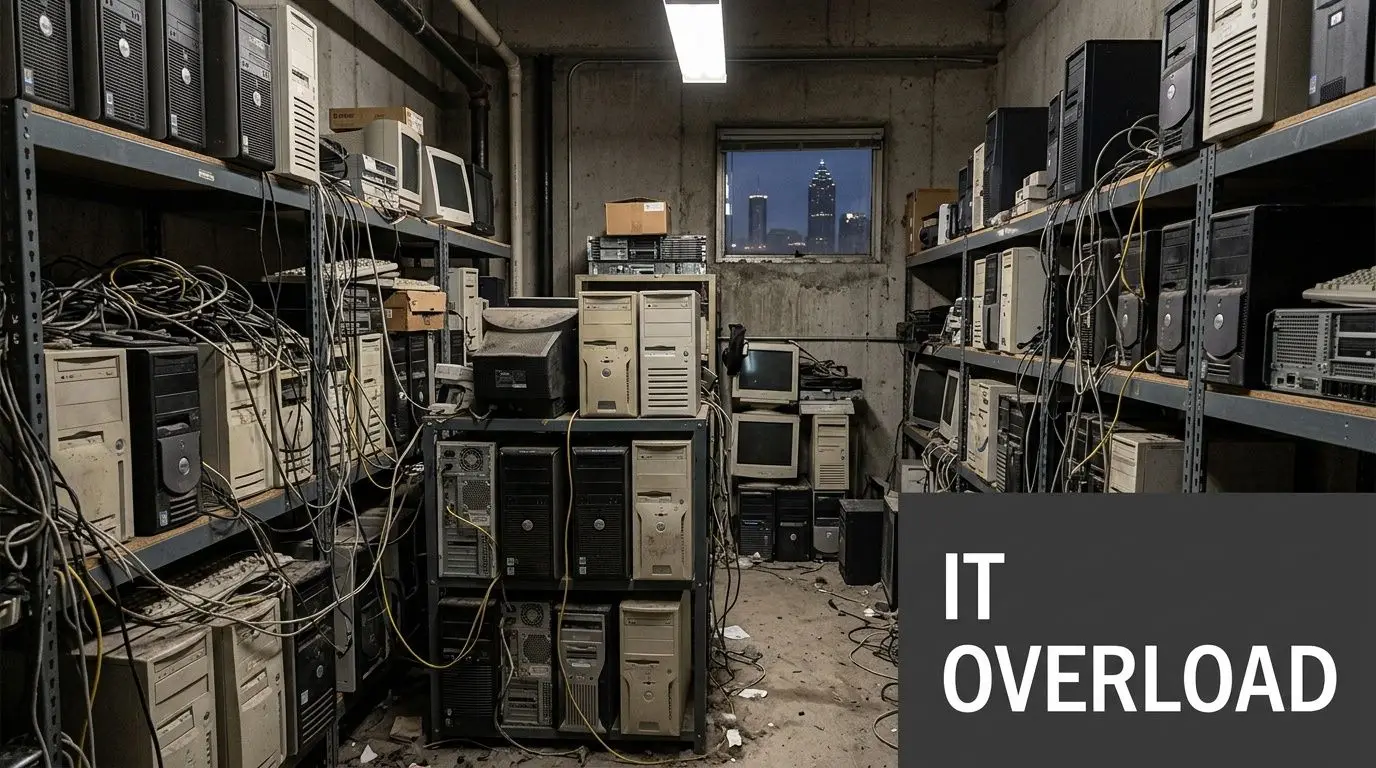
Why retired devices become a business problem
Old electronics create three immediate issues.
- Data exposure: A retired laptop isn’t safe because it’s powered off. If it contains local files, cached credentials, browser data, customer records, or old email archives, it still needs controlled handling.
- Space pressure: Office cleanouts stall when obsolete equipment starts filling conference rooms, receiving areas, or IT cages.
- Decision fatigue: Teams lose time arguing over whether equipment should be reused, sold, donated, dismantled, or recycled.
In atlanta, those decisions often hit during bigger transitions. A company opens a second office, consolidates floors, upgrades endpoint fleets, closes a warehouse office, or decommissions aging lab or clinical equipment. The disposal issue shows up at the end of every one of those projects.
What works and what usually fails
The businesses that stay in control use a simple rule. No device leaves a user, desk, closet, rack, or branch location without entering a documented retirement flow.
That sounds obvious, but many organizations still rely on informal methods that don’t hold up.
What doesn’t work:
- Ad hoc collection days: People drop off anything with a cord, with no labeling or ownership record.
- One-size-fits-all disposal: Treating a monitor, a firewall appliance, and an encrypted laptop as if they carry the same risk.
- Storage as a strategy: Holding assets for months because no one wants to decide.
Practical rule: If your equipment has been sitting unprocessed long enough that no one is sure what’s in the pile, your risk is already higher than it should be.
What works is narrower and more disciplined. Separate reusable devices from true scrap. Keep serial-level records where possible. Identify anything with data-bearing media before pickup. Make one owner accountable for final disposition, even if several departments are involved.
That’s the shift many atlanta organizations need to make. Electronics recycling isn’t just about getting things out of the building. It’s about closing the loop correctly.
Atlanta's E-Waste Landscape and Local Regulations
Atlanta has always been a logistics city. It was founded in 1837 as “Terminus,” the southern endpoint of the Western & Atlantic Railroad, then renamed Atlanta in 1847, and grew into a transportation and commercial hub that shaped the region’s economy (history of Atlanta). That legacy still matters. A city built around movement of goods, people, and infrastructure also generates a steady stream of end-of-life technology.
For businesses, that means e-waste isn’t an edge case. It’s part of normal operations.
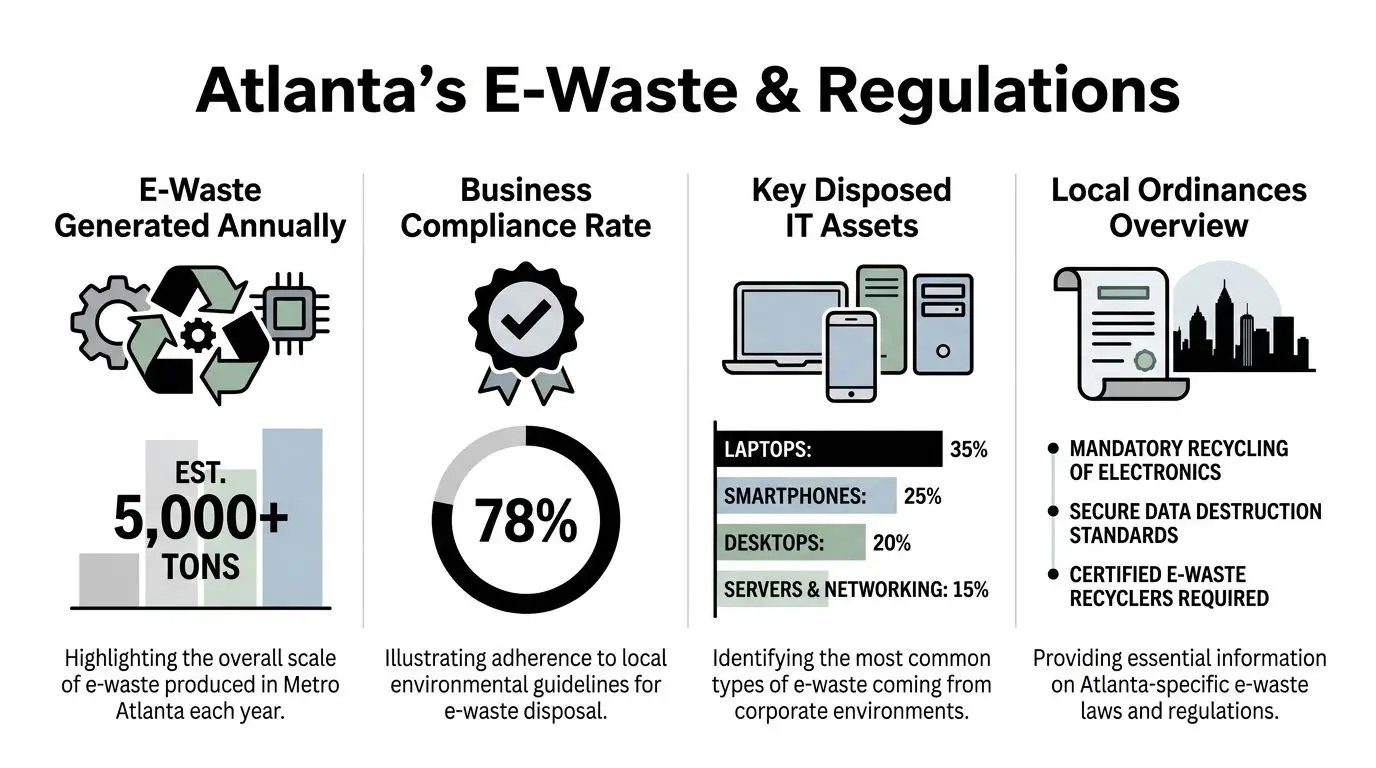
The scale is large enough to require process
The EPA reported that over 63 million computers were being discarded annually in the U.S. by 2007, which remains a useful baseline for understanding the scale of electronic waste nationally. In Atlanta, certified recyclers divert hundreds of millions of pounds of e-waste from landfills annually, and when a mid-sized business diverts 50 tons of IT equipment, it prevents toxic materials such as lead and mercury from entering groundwater while recovering valuable materials for reuse (Atlanta computer recycling details).
Those facts matter because they change the conversation. A room full of retired laptops isn’t just clutter. It’s part of a much larger waste stream that needs controlled handling.
What atlanta businesses have to navigate
Regulation in this space isn’t one rule. It’s a stack of requirements.
A business in atlanta may need to account for:
- Environmental obligations: Georgia’s Solid Waste Management Act and federal EPA guidance shape how electronic waste should be handled.
- Industry-specific rules: Healthcare, finance, and public sector organizations often carry stricter obligations tied to the information on devices.
- Internal audit expectations: Even where a specific recycling mandate isn’t spelled out, auditors still expect clear custody, documentation, and defensible disposal decisions.
For a practical local overview, this guide on e-waste laws in Fulton County and what your business needs to know is a useful starting point.
Responsible disposal in atlanta is less about finding someone who will “take the stuff” and more about proving what happened to each asset class after it left your control.
The real trade-off
Some organizations still choose convenience over structure. They call a junk hauler, move everything in one load, and count the room as cleared. That solves the space issue, but it doesn’t solve traceability, downstream handling, or data-bearing device control.
A stronger approach ties together three goals at once:
| Need | Weak approach | Strong approach |
|---|---|---|
| Space recovery | Clear the room fast | Clear the room with inventory and custody records |
| Compliance | Assume vendor handles it | Verify environmental and data handling practices |
| Sustainability | Treat as disposal | Treat as material recovery and landfill diversion |
That’s the practical atlanta standard now. If your business upgrades technology regularly, you need an ITAD process that stands up to legal review, security review, and sustainability reporting.
Securely Preparing Your IT Assets for Disposition
The safest pickup is the one you prepared for before the truck arrives.
Most mistakes happen upstream. A company schedules electronics recycling, then realizes half the assets were never tagged, several machines still belong to terminated employees, and nobody confirmed whether the storage arrays were wiped or merely unplugged. That’s how avoidable risk gets introduced.
Atlanta businesses must work within a compliance environment that includes HIPAA, SOX, and NIST 800-88 data sanitization standards, and certified ITAD providers are expected to ensure 100% eradication of sensitive data with an auditable chain of custody for sectors where liability is high (Atlanta electronics recycling compliance overview).
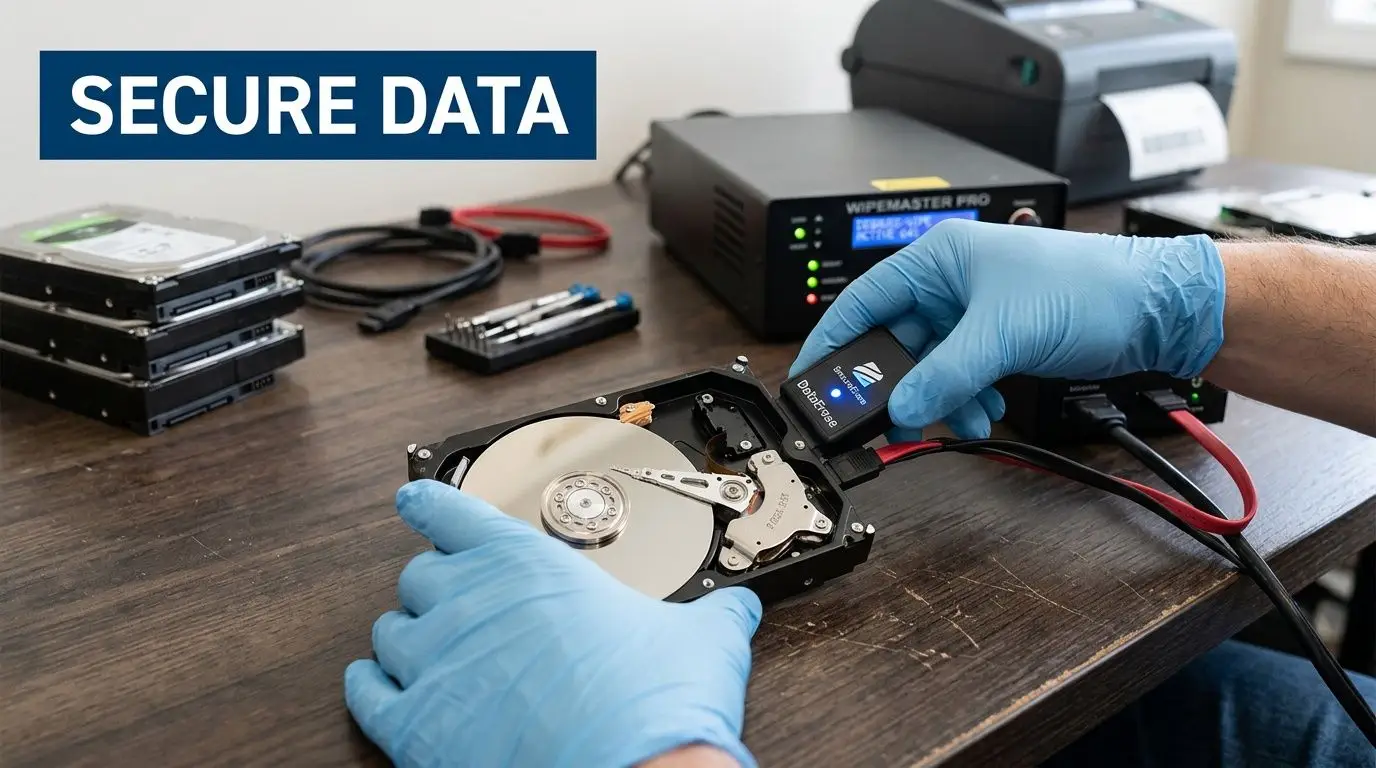
Start with an internal disposition list
Before anything moves, build a working asset list. It doesn’t have to be perfect, but it needs to be usable.
Include:
Asset type and location
Separate office endpoints, network gear, server equipment, phones, peripherals, printers, and specialty equipment. A branch office closet should not be mixed into the same removal plan as a data room rack.Identifier fields
Record serial number, asset tag, hostname, user assignment, or whatever your organization reliably tracks. If all you have is model and location, document that rather than guessing.Disposition intent
Mark whether the item is for redeployment, resale, donation, recycling, or physical destruction. This prevents good equipment from being scrapped and prevents high-risk devices from being lumped into a basic recycling stream.
Treat data-bearing assets differently
Not all electronics carry the same exposure.
A keyboard and a monitor are handling questions. A laptop, desktop, server, copier hard drive, SAN drive, backup device, and some networking equipment are data security questions. If your team doesn’t distinguish between those categories, your process is too loose.
Use a separate hold area for data-bearing assets if possible. Limit who can access it. Keep intake and outbound counts aligned.
If you can’t answer who had possession of a retired drive from the moment it left service to the moment it was destroyed or sanitized, you don’t have chain of custody.
Match the sanitization method to the asset
NIST 800-88 matters because it gives organizations a recognized framework for deciding how media should be sanitized. In practice, that usually means one of three paths: wiping, degaussing, or physical destruction, depending on the media type, reuse potential, and risk tolerance.
A practical checklist looks like this:
- Use wiping when reuse is possible: Suitable for devices intended for remarketing or donation, provided the media and method support verified erasure.
- Use degaussing for specific media types: Appropriate where magnetic media and internal policy allow it.
- Use physical destruction when risk is high: Best for failed drives, damaged media, or assets that shouldn’t re-enter service.
For organizations that need outside support on this step, secure disposal of IT equipment in Atlanta with data security in mind outlines what to look for in a documented process.
Don’t release equipment without paperwork
The handoff is not complete when equipment leaves the dock. It’s complete when your records are closed.
Keep these documents tied to every project:
- Pickup manifest or load list
- Chain-of-custody documentation
- Certificates of destruction where required
- Final reporting by asset category
One provider option in metro Atlanta is Reworx Recycling, which offers electronics recycling, pickup coordination, and secure hard drive shredding as part of broader IT asset disposition support. Whether you use that service or another qualified provider, the standard should be the same. No undocumented pickups, no vague promises, and no data-bearing device leaving your premises without a defined destruction or sanitization path.
Choosing Your Atlanta ITAD and Recycling Partner
Once your internal prep is solid, vendor selection becomes easier. The wrong partner creates blind spots. The right one removes them.
A lot of atlanta businesses still compare providers on pickup speed alone. That’s understandable during an office cleanout, but it’s the wrong primary filter. Fast removal doesn’t help if reporting is weak, downstream handling is unclear, or nobody can explain how data destruction is documented.
What to evaluate before you sign anything
Start with proof, not marketing language.
Look for:
- Relevant certifications: If a provider claims disciplined handling, ask which certifications support that claim and how those standards affect day-to-day operations.
- Chain of custody: You want to know how assets are logged, secured, transported, processed, and reported.
- Data destruction options: The provider should explain when they wipe, when they shred, and how they document each result.
- Material handling transparency: Zero-landfill claims, downstream vendor practices, and commodity recovery processes shouldn’t be vague.
- Project fit: A firm that can handle desktop recycling may still struggle with data center decommissioning, multi-site pickups, or medical equipment disposal.
A useful vendor screen is this guide on selecting a reliable e-waste recycling partner.
Comparing Atlanta ITAD Approaches
| Feature | DIY / General Waste | Basic E-Recycler | Certified ITAD Partner (like Reworx) |
|---|---|---|---|
| Asset tracking | Minimal or inconsistent | Limited | Structured and documented |
| Data-bearing device handling | Often unclear | May be available, may be inconsistent | Defined sanitization and destruction workflows |
| Chain of custody | Weak | Partial | Auditable |
| Reporting | Usually none | Basic weight or receipt | Asset-level and project-level reporting |
| Sustainability outcomes | Unclear | Better than trash disposal | Built around responsible recovery and diversion |
| Support for office cleanouts | Manual | Sometimes available | Typically coordinated as a service |
| Suitability for regulated sectors | Poor | Mixed | Better fit for healthcare, finance, and government needs |
The real difference in practice
Basic recyclers can be fine for low-risk commodity loads. The problem is that many corporate loads are not low-risk. They mix reusable hardware, scrap equipment, and devices with sensitive data.
That mix changes the standard.
A strong ITAD partner helps you answer questions a general recycler may not cover well:
- Which devices can be remarketed instead of destroyed?
- Which assets require serial-level tracking?
- How is destruction verified?
- What happens to equipment after intake?
- Can the provider handle staggered pickups from multiple locations?
Choose the partner that can survive your compliance review, not just your facilities deadline.
That’s usually the better long-term decision for atlanta businesses managing recurring refresh cycles.
Logistics Solved Corporate IT Pickups and Cleanouts
Even a good ITAD policy can fail on logistics. Many projects frequently slow down as a result.
The issue usually isn’t willingness. It’s coordination. Offices are still operating, employees need access to loading areas, building management has rules about freight elevators, and IT teams don’t want retired equipment mixed with active devices during a move. If you’re handling a facility cleanout or data center decommissioning, the margin for confusion gets even smaller.
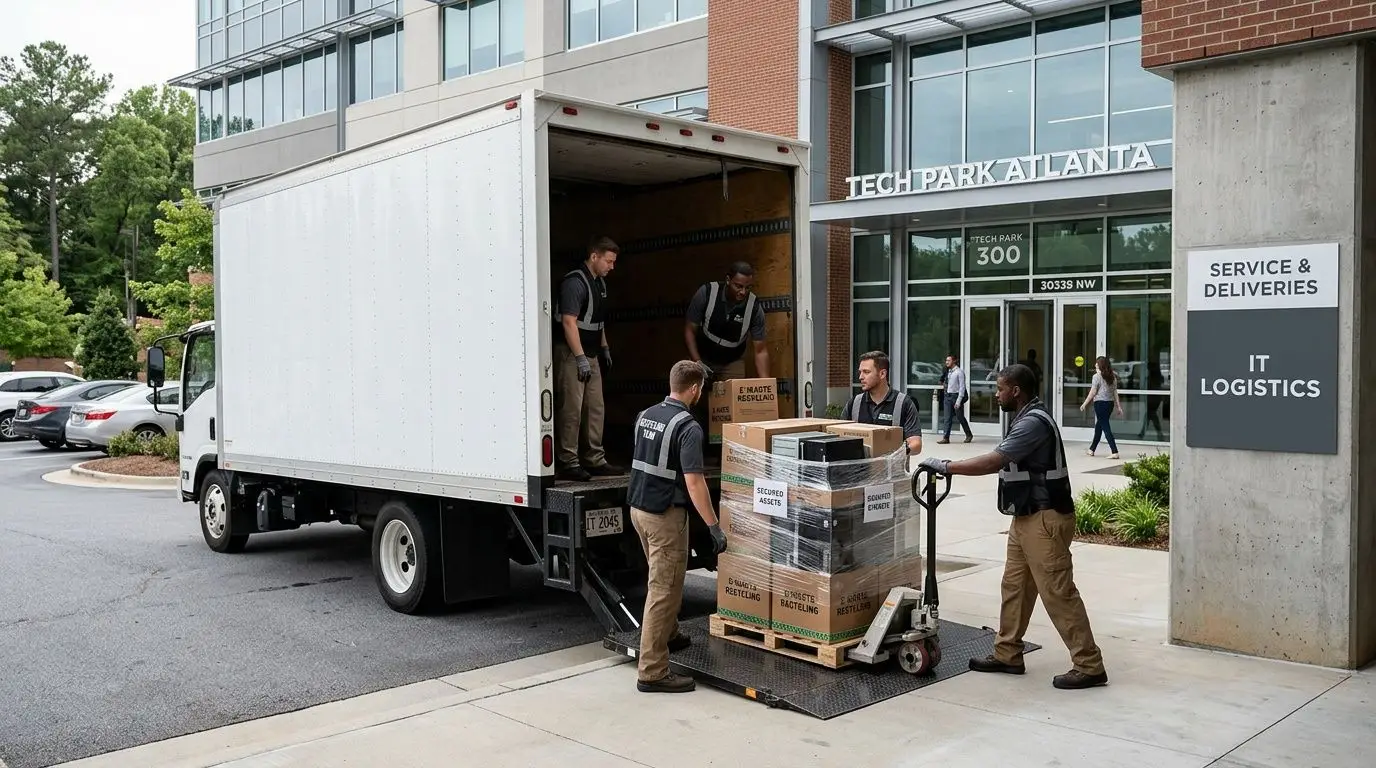
Pickup, drop-off, or full cleanout
Different loads need different logistics models.
Drop-off can work for small quantities, especially when a business has a limited number of laptops, monitors, or peripherals and a staff member can transport them securely.
Scheduled pickup fits better when you have palletized equipment, multiple departments contributing assets, or a timing window tied to an office refresh.
Full cleanout support is usually the right answer for larger jobs such as:
- Office relocations: Old cubicle endpoints, shared printers, conference room systems, and telecom gear all leave at once.
- Facility closures: Equipment is spread across rooms, closets, workstations, and storage areas.
- Data center decommissioning: Racks, UPS units, servers, networking hardware, and storage media need staged removal.
What smooth projects have in common
The best logistics plans are boring. That’s a compliment.
They usually include:
- A clear staging plan: Teams know where retired equipment goes before pickup day.
- Separation of active and retired gear: Nothing is left to visual guesswork.
- Loading coordination: Building access, dock hours, and elevator reservations are handled early.
- Named contacts: One person from facilities and one from IT can approve changes on the spot.
For companies managing larger or recurring removals, reverse logistics solutions built around efficiency and sustainability give a good picture of what a structured process should look like.
Value recovery matters too
Not every retired asset is scrap. Some laptops, desktops, phones, and enterprise hardware still have reuse or buyback value if they’re recent enough, functional, and cosmetically acceptable.
This is one of the biggest differences between a disposal mindset and an ITAD mindset.
A disposal mindset asks, “How do we get rid of this?”
An ITAD mindset asks, “What should be destroyed, what should be recycled, and what still has recoverable value?”
That distinction matters for budget owners. It also matters for sustainability teams. Reuse and remarketing can extend the life of equipment that doesn’t belong in a shred stream.
The practical lesson for atlanta organizations is simple. Plan the logistics with the same care you use for deployment. Pickup windows, packaging, chain of custody, and value recovery all affect the final outcome.
The Reworx Difference Donation-Based Social Enterprise
Most businesses think about end-of-life electronics in operational terms. Remove them, document them, close the ticket, move on.
That’s necessary, but it’s incomplete. End-of-life technology also creates a chance to direct usable equipment toward community benefit instead of treating every retired asset as waste.
Why the social enterprise model matters in atlanta
Atlanta has 79 high-need neighborhoods, with 77,000 children facing inequitable barriers, yet the documented conversation around those communities focuses heavily on health and food access rather than technology access or responsible e-waste pathways. That gap creates room for social enterprises to support digital inclusion and safer electronics handling in underserved areas (Atlanta urban heat island and community equity context).
That matters for companies deciding what to do with working or repairable devices.
A conventional recycler may process everything that arrives. A donation-based recycling model can create another track. Devices that are suitable for reuse may be refurbished and redirected in ways that support nonprofits, schools, or families that need access to technology.
What this changes for corporate responsibility
For sustainability directors and CSR leaders, the benefit isn’t just that equipment stays out of landfill channels. It’s that a routine ITAD project can support broader goals:
- Digital inclusion: Usable laptops and desktops can matter far more in a community setting than as residual warehouse stock.
- More credible donation programs: Donation only works when data security, testing, and equipment suitability are handled professionally.
- Better alignment between IT and CSR: Technology retirement becomes part of the company’s community impact story, not just an operations task.
That’s where a donation pathway can make sense. Businesses with refresh cycles often have a subset of equipment that’s too old for internal use but still viable for responsible refurbishment.
If that’s part of your company’s goals, a computer donation program for retired equipment is worth evaluating before you default everything into a shred or scrap stream.
A good atlanta ITAD program doesn’t force every asset into the same outcome. It sorts equipment by risk, reuse potential, and community value.
What doesn’t work
Unstructured donation is risky.
Don’t hand devices to staff, local groups, or informal collectors without verified data destruction, intake controls, and documented transfer. That’s not a community program. That’s unmanaged asset release.
The better model combines social impact with the same controls you’d expect from any serious ITAD process. Data gets handled correctly. Equipment is assessed. Non-usable material is recycled responsibly. Viable devices get another life where they can do real good.
How Atlanta Organizations Win with Responsible ITAD
The benefits of a strong ITAD process become obvious when you look at real operating scenarios. Not perfect case studies with glossy metrics. Just common atlanta situations handled the right way.
A Midtown tech company with constant laptop churn
A growing software firm in Midtown refreshes user devices often because employee turnover, role changes, and performance requirements move quickly. Their old process was messy. Team leads held extra laptops in drawers, IT kept retired units in a locked room, and nobody could tell finance which machines were ready for write-off.
They fixed it by creating a monthly retirement cycle.
IT now collects devices into a designated staging area, validates serials against internal records, separates reusable units from failed ones, and schedules pickup in batches rather than one-off removals. Facilities likes it because storage stays clear. Finance likes it because records close faster. Security likes it because old endpoints don’t drift around the office for months.
The biggest win wasn’t dramatic. It was consistency.
A healthcare operation that can’t afford loose handling
A healthcare group in the Atlanta market had a more serious concern. Their equipment included workstations, laptops, and specialty devices tied to regulated information. Their risk wasn’t landfill exposure first. It was data exposure.
They changed the process by narrowing who could touch retired assets and by treating all data-bearing devices as controlled material from the moment they came out of service. Clinical departments no longer parked old devices in shared closets. IT maintained a documented intake list, and destruction certificates became part of project closeout.
That’s the kind of discipline regulated organizations need. In those environments, the wrong disposal shortcut can create consequences far larger than the cost of proper handling.
A school district in a growth corridor dealing with refresh at scale
The Atlanta Regional Commission is overseeing 17 community transformation projects in growth corridors such as Cherokee County and Buford, and that kind of regional development tends to coincide with technology upgrades across schools, municipalities, and public facilities (Atlanta Regional Commission project overview).
That dynamic shows up in school systems. A suburban district replacing student and staff devices doesn’t just need recycling. It needs staging, pickup timing, inventory discipline, and clear rules for what can be donated, reused, or destroyed.
In practice, the successful districts don’t wait until summer turnover to decide. They plan retirement alongside procurement. That reduces chaos when old carts, laptops, chargers, and classroom technology begin coming back in volume.
The common pattern
These organizations are different, but their winning approach is similar:
| Organization type | Main risk | What improved outcome |
|---|---|---|
| Tech company | Asset sprawl and weak tracking | Scheduled retirement cycles and clear ownership |
| Healthcare group | Data exposure and audit failure | Controlled intake and documented destruction |
| School district | Volume and logistics complexity | Early planning and structured pickup coordination |
The takeaway is straightforward. Responsible ITAD works best when it’s operationalized, not improvised. Atlanta organizations don’t need a heroic cleanup every year. They need a repeatable system that handles laptop disposal, office cleanouts, secure data destruction, and electronics recycling as part of normal business operations.
Partner with Reworx for Your Atlanta E-Waste Strategy
If your atlanta business is sitting on retired equipment right now, the next step isn’t complicated. Get the assets identified, separate the data-bearing devices, and move the project into a documented disposition process.
The important part is choosing a method encompassing the entire task. Not just removal. You need security controls, environmental responsibility, reporting, and workable logistics. If your organization also cares about community impact, donation-based recycling adds another layer of value that basic disposal doesn’t provide.
A solid strategy usually comes down to a few practical decisions:
What to prioritize first
- If security risk is highest: Start with data-bearing devices and destruction controls.
- If space is the immediate problem: Build a staging and pickup plan that doesn’t sacrifice documentation.
- If sustainability reporting matters: Make sure your provider can show how equipment was processed and where reuse fits.
- If you have working surplus equipment: Evaluate donation, buyback, and reuse before defaulting to scrap.
What good looks like
Good atlanta ITAD programs are organized, documented, and realistic.
They don’t assume every asset deserves the same outcome. They don’t leave old laptops in closets waiting for the next office move. They don’t send mixed loads out the door with no manifest and hope the recycler handles it properly.
They create a chain from retirement decision to final disposition.
That’s the standard worth aiming for whether you’re planning computer recycling, secure data destruction, office cleanouts, medical equipment disposal, product destruction, or a larger data center decommissioning project.
If you want a partner that can support electronics recycling while also aligning with donation-based recycling and community benefit, Reworx fits that conversation. The company works with organizations retiring outdated equipment and offers support around pickups, secure hard drive shredding, and responsible end-of-life handling.
The right time to build your process is before the next refresh, move, or decommissioning project lands on your team. Once the pile has already taken over the storage room, you’re solving under pressure.
If your business needs a practical next step, visit Reworx Recycling to explore electronics recycling, schedule a pickup, or build a donation-based ITAD program that protects data, supports sustainability, and puts retired equipment to better use.