You're staring at a cabinet full of old client files, a box of dead laptops, and a branded uniform order that no one wants to throw in the general skip. That mix is exactly where confidential waste disposal gets messy, because the problem isn't just paper. It's asset disposition, and if you handle it like a shredding job only, you'll miss the control points.
The safe move is to treat every sensitive item as something that needs a defined end-of-life route, whether that item is a file, a hard drive, a USB stick, or branded stock that could be misused. That framing changes everything, from how you write vendor clauses to how you prove compliance to an auditor. It also makes the program easier to run, because you stop guessing and start assigning each material to the right destruction path.
If you're building or fixing a program now, use this playbook to answer four questions clearly. What counts as confidential, what the law expects, how the workflow should run, and how to judge vendors without getting distracted by sales talk. The rest of the process gets much simpler once those answers are fixed.
What Confidential Waste Disposal Really Means in 2026
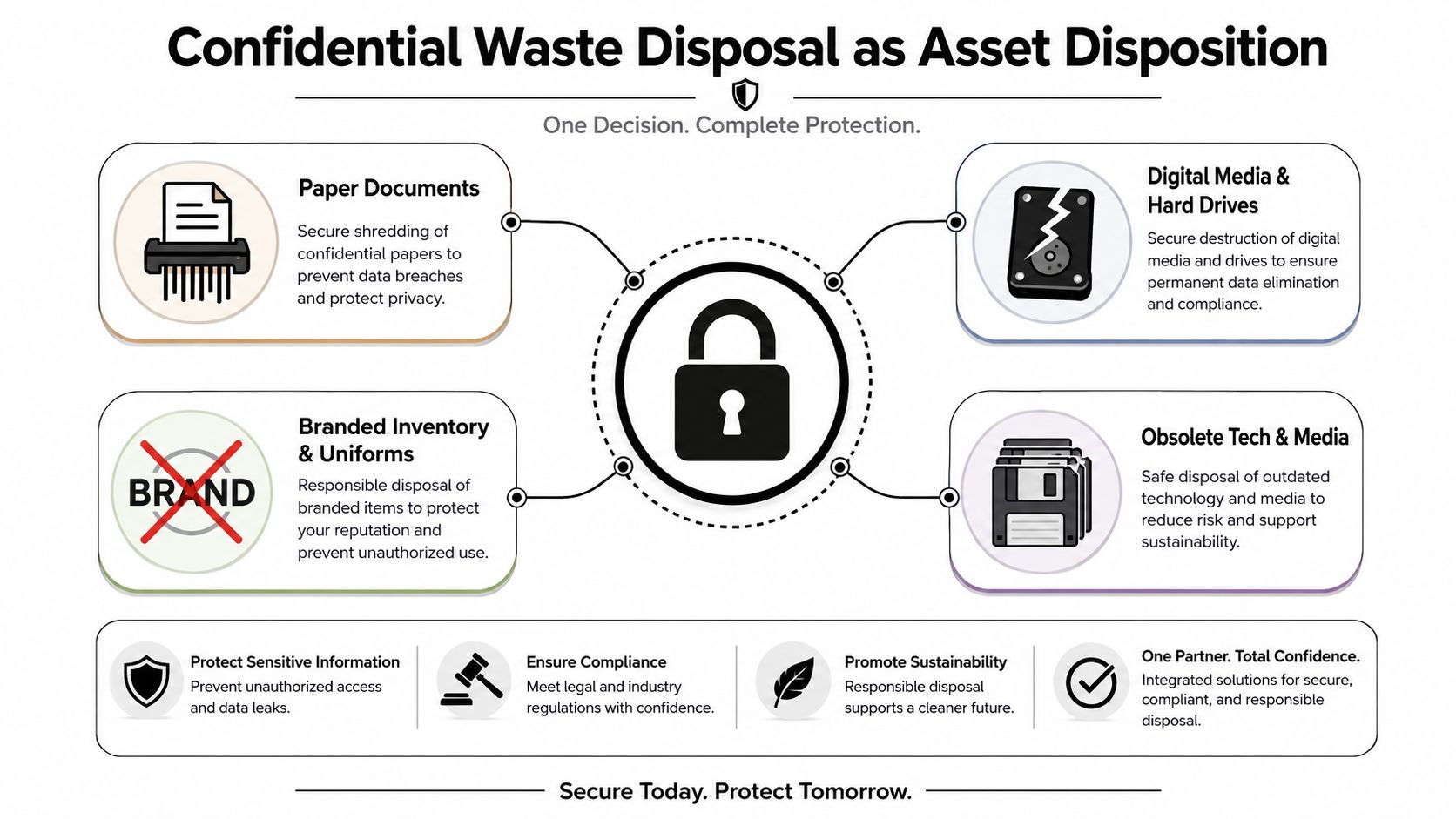
Most businesses still talk about confidential waste as if it were only a shredding problem. That's too narrow. In practice, you're managing an asset-disposition decision that covers paper, storage media, branded goods, uniforms, and other items that can still expose information or be reused in the wrong hands.
Why that framing matters
A shredder alone doesn't solve a mixed-material site. Paper records need secure destruction, but hard drives need media destruction, and branded inventory may need product destruction or controlled removal from circulation. If you buy one service for everything, you'll either overpay or leave a gap in your controls.
The right model is to map each asset to a disposal route before it leaves your hands. That changes the contract language you need, the audit trail you ask for, and the questions you ask at collection. It also makes vendor selection much sharper, because a supplier that handles paper well may not be suited to secure media destruction or branded stock disposal.
Practical rule: if an item can identify a person, expose a business process, or be reused as a branded asset, it belongs in your confidential disposal policy.
For a useful way to classify those routes, see Reworx Recycling's overview of IT asset disposition. That lens is the right starting point for mixed environments, especially when facilities teams, IT, and compliance all touch the same waste stream.
The point isn't to make confidential waste more complicated. It's to make it more complete. Once you treat disposal as a chain of custody problem across multiple asset types, the rest of the program becomes easier to standardize and defend.
What Counts as Confidential Waste and What the Law Says
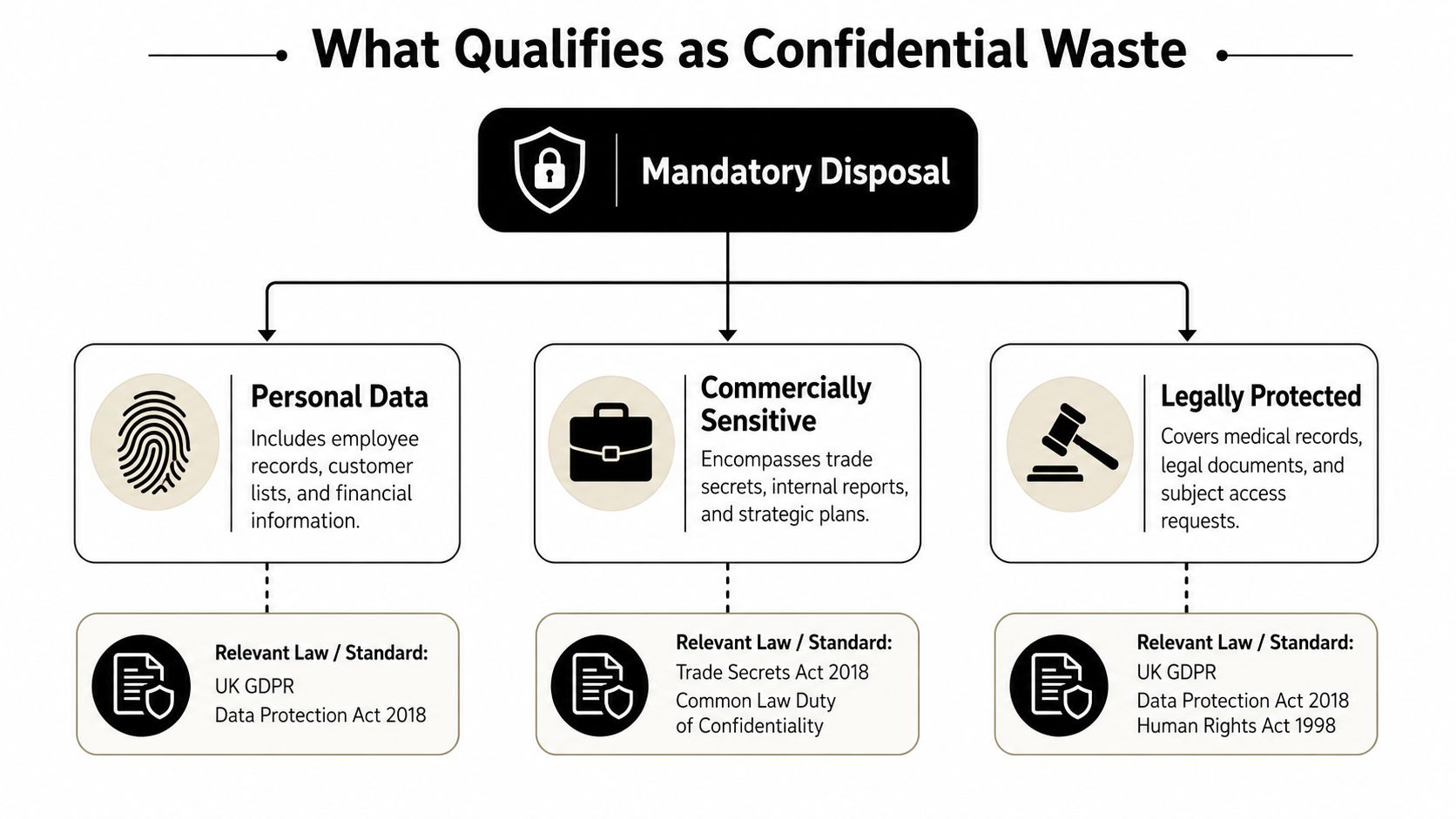
Confidential waste isn't limited to obvious personal files. It includes personal data, commercially sensitive records, financial documents, HR files, legal material, and anything else that could create a privacy, contractual, or reputational problem if it escaped your control. At a mixed site, that usually means you've got paper, media, and branded items sitting in the same building, even if they shouldn't travel together.
The legal pressure is real
UK-facing businesses need to think in terms of UK GDPR, the Data Protection Act 2018, the Freedom of Information Act 2000, the Environmental Protection Act 1990, and BS EN 15713:2023 for secure document destruction, as listed in business guidance from DCW (UK GDPR and secure destruction guidance). That matters because the legal burden isn't just “dispose of it somehow.” It's “dispose of it securely, prove it, and keep the process defensible.”
The stakes are not abstract. In the UK, breaching GDPR can trigger fines of up to 4% of annual turnover or €20 million, whichever is higher, and the average data breach cost is about £4 million (BusinessWaste confidential waste facts). Those figures should shape your program design, not just your legal review. Paper remains part of the risk picture too, since BusinessWaste notes that 40% of data-security incidents involve paper documents in the same source.
A practical policy also needs to separate paper from media and other sensitive items. Use one rule for records, another for hard drives and USBs, and a separate route for inventory or uniforms that carry company identifiers. If you don't do that, your policy will look neat on paper and fail at the bin.
If you want a legal cross-check for your own policies, a specialist such as Florida data privacy lawyer can help interpret how privacy obligations interact with operational disposal controls. For UK programs, the same principle applies, legal review should follow the actual disposal workflow, not sit apart from it.
On-Site vs Off-Site Destruction and When Each One Pays Off
On-site destruction feels safer because people can watch it happen. That's fine when you need witness destruction for especially sensitive batches, but it's overkill for a lot of routine office work. If your team is retiring a few boxes a week, secure collection and later destruction are usually enough, as long as custody is controlled from end to end.
What you're actually buying
On-site destruction gives you immediate reassurance, direct visibility, and less transit exposure. It also costs more in scheduling effort and usually carries tighter throughput limits. Off-site destruction is better for routine programs, because it scales cleanly, fits scheduled collections, and keeps your internal team from wasting time around a mobile truck.
That's why the decision should be based on risk and volume, not comfort alone. A small office with predictable monthly volume usually doesn't need witness shredding. A healthcare setting, archive purge, or large records clear-out may justify it, because the volume and sensitivity are different.
Secure collection, locked storage, and a documented handoff usually matter more than where the shredder sits.
A municipal collection model in Red Wing notes that confidential materials are commonly collected and shredded later, usually within 1–2 workdays, while same-day witness shredding is only needed if the customer requests it (Red Wing confidential waste guidance). That's a useful sanity check. In other words, the default control point is usually collection and transfer, not the shredding location itself.
For businesses weighing secure media handling, Reworx Recycling's on-site hard drive destruction is one route, but it shouldn't be the default assumption for every load. Use on-site service when the visibility and timing are worth the extra coordination. Use off-site service when routine control and documented custody already solve the risk.
Building the Chain of Custody From Bin to Certificate
Secure disposal fails most often in the boring middle. Someone leaves a box in a corridor. Someone throws a drive into a paper-only stream. Someone uses a domestic sack because it was close at hand. The fix is a tight workflow that leaves almost no room for improvisation.
The controls that actually work
Start at the source. Sensitive material should go straight into a locked or access-controlled container, not onto desks, into open bins, or into random storage. Procedures used in public-sector and university settings consistently rely on segregation at source, scheduled collection, and secure contractor handling before destruction. Derbyshire's guidance is blunt on the failure points, confidential waste must not be left unattended in corridors, reception areas, or vehicles, and containers need emptying at regular intervals rather than being allowed to build up (Derbyshire confidential waste procedures).
The material also needs the right destruction route. One local-government procedure uses a DIN P-4 minimum shredder standard, while institutional policies may require cross-cut shredders and only allow shredded material into ordinary waste or recycling streams (Nottinghamshire confidential waste procedure). For optical and magnetic media, the process is separate. CDs, tapes, disks, and USB sticks should not be treated like paper.
What the auditor wants
The end product is the Certificate of Destruction. That certificate should show what was destroyed, when it was destroyed, and by whom it was handled. If it doesn't clearly tie the load to your collection record, it's weak evidence. If your supplier can't produce it quickly, they're not giving you a defensible audit trail.
A clear internal process helps too. Reworx Recycling's chain-of-custody documentation fits the same principle, document the movement, control the handoff, and preserve the proof. That's the backbone of a compliant confidential-waste program, not the shredder itself.
Choosing a Certified Vendor You Can Trust
A polished sales deck can make any vendor sound careful. Ignore the deck. Ask for the evidence. For confidential waste, the contract has to read like an asset-disposition program, with documented chain of custody, the right destruction route for each material type, and a real Certificate of Destruction for each job or batch.
What to require
Paper needs one route, drives and storage media need another, and branded inventory can raise a separate disposal issue. Ask how the vendor handles BS EN 15713:2023 for paper destruction, how they manage secure destruction or sanitization for media and drives, and how they keep mixed batches from being lumped into a generic process. If they cannot explain paper, hard drives, and non-paper items separately, they do not have a confidential waste program. They have a bin service with a security label.
Insurance and screening matter too. You want employee vetting, controlled access to vehicles, and liability coverage that makes the contract worth anything. You also need to know whether destruction is subcontracted. If it is, get the chain of accountability in writing. Then compare vendors using vendor selection criteria as a practical screening tool for procurement.
If a vendor will not show you the audit trail, they are asking you to trust a process you cannot inspect.
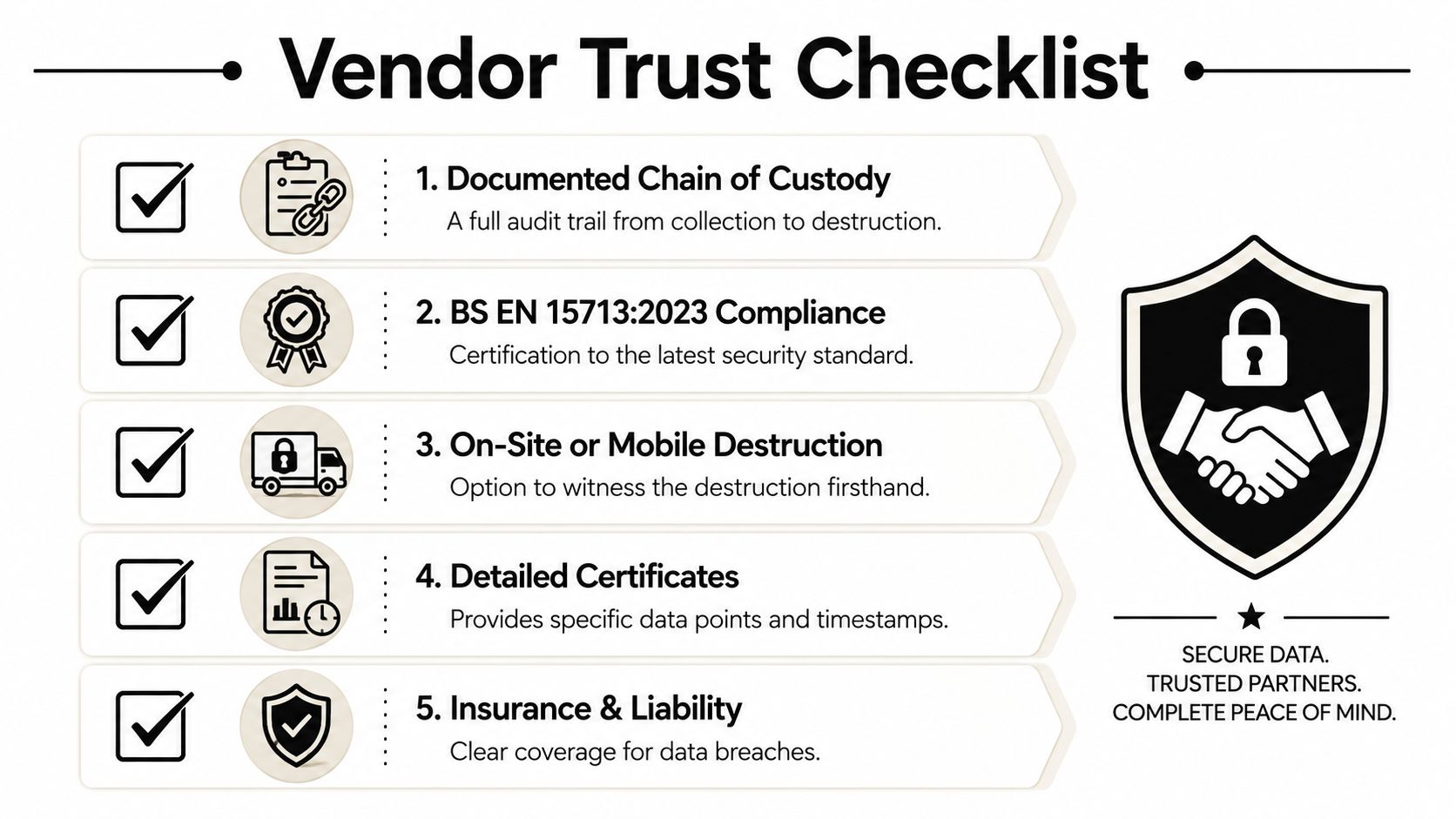
A useful shortlist should include these checks:
- Documented Chain of Custody: Every handoff should be traceable from collection to destruction.
- BS EN 15713:2023 Alignment: Paper destruction should meet the current security standard.
- Clear Media Handling: Drives, USBs, and other storage devices need a separate secure route.
- Detailed Certificates: The certificate should identify the job and confirm destruction.
- Insurance and Screening: The vendor should be able to describe both without hesitation.
Cost Benchmarks, Pricing Models, and Budgeting Your Program
Confidential waste pricing gets messy fast because vendors bundle different things together. Some charge per bin or console. Some charge by weight. Some use flat-fee scheduled service. The quote only means something if you know what handling, collection frequency, and media processing are included.
Use the benchmark, then test the quote
A large healthcare organization in England reported spending £63,003.66 on confidential waste disposal in 2024–2025, with 399.292 tonnes of confidential waste recorded in its waste-volume data, which works out to roughly £158 per tonne before other handling or security costs (UHBW response PDF). That's not a universal market rate, but it's a useful sanity check for institutional scale. If a quote is wildly outside your own volume pattern, ask why.
| Pricing model | Best suited for | Key risk to manage |
|---|---|---|
| Per-bin or per-console | Small, steady office volumes | Hidden fees for excess collections |
| Per-kilogram or per-tonne | Variable or bulk clear-outs | Mixed-material loads that aren't quoted clearly |
| Flat-fee scheduled service | Predictable recurring disposal | Contract minimums that exceed actual usage |
Collection frequency is one of the biggest cost drivers. So is on-site destruction, because it adds labor and logistics. Mixed-media handling costs more too, because paper, media, and branded items don't follow the same process.
If you're already budgeting industrial work, the discipline is the same as you'd apply when you manage industrial project costs. Build in the handling assumptions, not just the headline disposal fee. Otherwise, the vendor quote will look cheap until the first billing cycle exposes the load profile.
The right budget is the one your facilities lead, IT manager, and compliance lead can all explain the same way. If they can't, the pricing model is probably wrong.
30-Day Rollout Checklist and Common Questions
A workable program doesn't need a long launch. It needs a clean rollout. Start with policy scope in week one, container placement and access control in week two, vendor selection and contract signature in week three, then staff communication and the first collection cycle in week four.
A simple rollout sequence
- Define scope. List the asset types you will treat as confidential, including paper, media, and branded inventory.
- Place the containers. Put locked or access-controlled bins where the sensitive material is generated.
- Set the route. Decide which items are paper-only, which need media destruction, and which need separate handling.
- Choose the vendor. Sign only after you've checked custody, certification, insurance, and certificate quality.
- Train staff. Show people where to put items and what must never go into ordinary waste.
The most common question is how often bins should be emptied. The answer is regular enough that nothing accumulates in hallways, receptions, vehicles, or open work areas. Another frequent question is whether optical media follow the same rules as paper. They don't. CDs, tapes, disks, and USBs need their own secure destruction route.
If a Certificate of Destruction is delayed, treat that as a control failure, not an admin annoyance. The certificate is your proof that the load was handled correctly. Remote workers need a separate rule too. If staff are home-based, the program has to cover return logistics, approved drop points, or a secure pickup route, because confidential material doesn't stop being confidential just because someone's desk moved.
That's the core lesson here. Confidential waste disposal is not a bin issue. It's an asset-disposition system with legal, operational, and evidentiary parts, and the business that gets those parts aligned reduces risk without making the process harder than it needs to be.
Reworx Recycling handles secure hard drive shredding, IT asset disposition, and confidential disposal workflows for organizations that need a documented end-of-life path for sensitive equipment. If you're tightening your own program, visit Reworx Recycling to review practical recycling guidance, then schedule a pickup or talk through a disposal plan that fits your materials and compliance needs.