In 2022, the world generated a record 62 billion kilograms of discarded electrical and electronic equipment, yet only 22.3% was documented as formally collected and recycled in an environmentally sound way, according to the 2024 Global E-waste Monitor. For a business retiring laptops, servers, mobile devices, networking equipment, or storage media, that gap represents more than an environmental problem. It can mean lost asset value, exposed data, incomplete sustainability records, and uncertain downstream handling.
IT asset disposition services turn retirement into a controlled lifecycle. The right program helps your team answer four practical questions: what equipment is leaving, how will its data be made inaccessible, which assets should be reused or destroyed, and where will every item go afterward?
Why IT Asset Disposition Services Matter Now
E-waste contained an estimated $91 billion in metals in 2022.
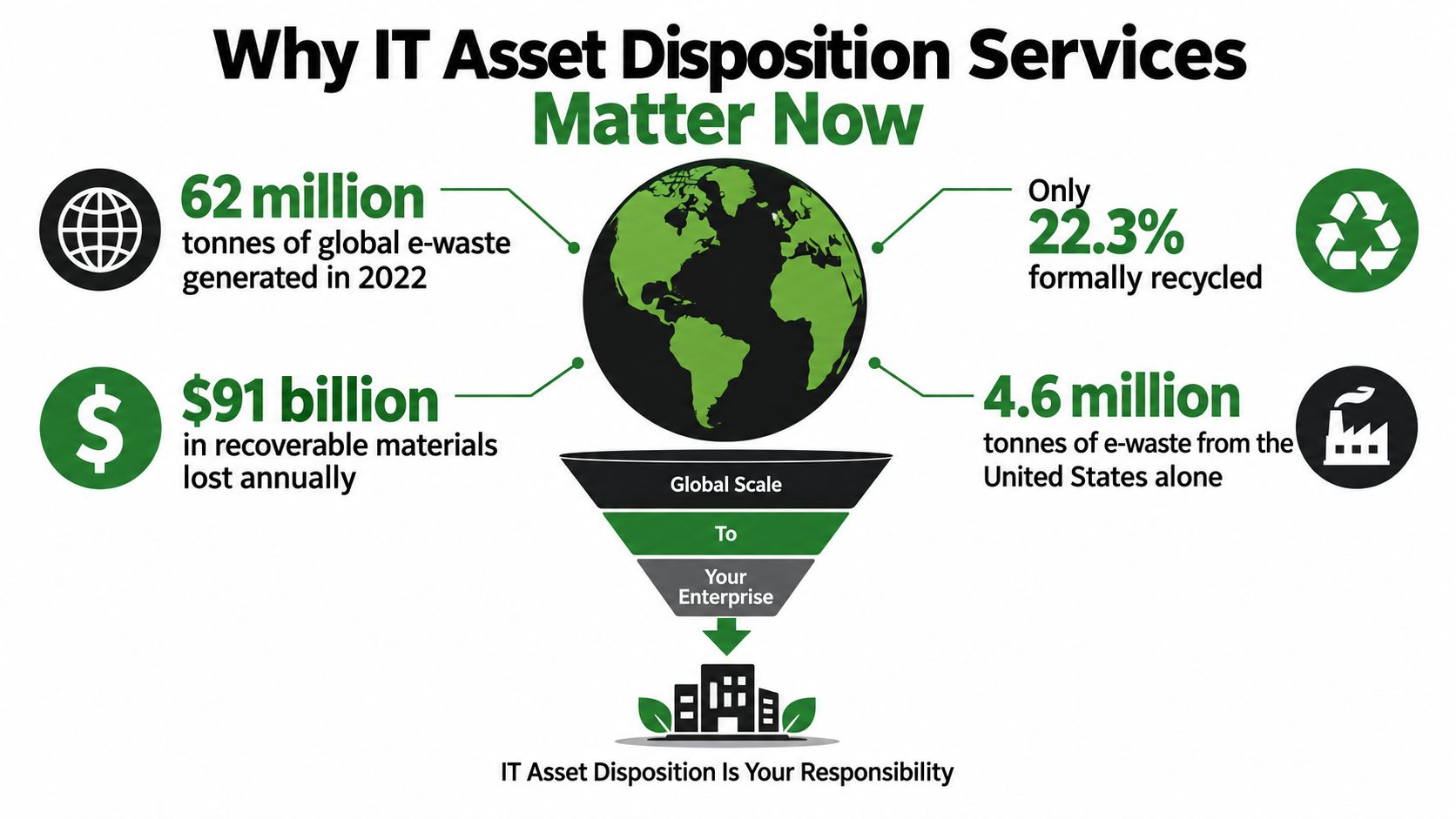
Global e-waste increased from 34 billion kilograms in 2010 to 62 billion kilograms in 2022. Documented formal collection and recycling rose from 8 billion to 13.8 billion kilograms during the same period, according to the Global E-waste Monitor. Those figures describe a growing operational problem for organizations: retired technology contains both sensitive information and materials with recoverable value.
A laptop in a storeroom still has an owner, serial number, data risk profile, and possible recovery route. The same applies to a decommissioned rack server, an employee's returned smartphone, or a monitor left after an office closure. Once these items are treated as anonymous waste, the organization can lose visibility before they reach a qualified processor.
The pressure is expected to increase. The 2024 Global E-waste Monitor projects annual generation of 82 billion kilograms by 2030, a 33% increase over 2022, while the documented recycling rate could fall to approximately 20% if collection capacity does not keep pace. The same report estimates that 2022 e-waste contained 31 billion kilograms of metals, valued at approximately $91 billion, including copper, gold, and iron.
ITAD is a program, not a haul-away
A managed IT asset disposition services program connects five controls:
- Inventory control: Record the asset tag, serial number, location, owner, and storage media.
- Data security: Choose clear, purge, or destroy according to the device and data sensitivity.
- Reverse logistics: Protect equipment as it moves from an office, clinic, school, or data center to processing.
- Value recovery: Separate reusable equipment from material destined for recycling.
- Downstream accountability: Document the final processor and disposition outcome.
The clear, purge, destroy structure helps resolve the central trade-off between sustainability and security. Clear may suit lower-risk reuse when data can be removed through approved logical methods. Purge uses stronger techniques when reuse remains possible but the data risk is higher. Destroy applies when the media cannot be reliably sanitized, the information is exceptionally sensitive, or reuse would create unacceptable exposure. Reworx applies these tiers by matching the disposition route to the device, its storage media, and the organization's risk requirements, rather than sending every asset straight to shredding.
This approach supports computer recycling, laptop disposal, and secure data destruction while giving sustainability leaders evidence for reporting and IT managers a defensible audit trail.
The Basel Convention overview describes the international framework for transboundary movements of hazardous waste and its disposal. Covered electronic waste crossing borders may require notification, written consent, compliant packaging, labeling, and transport. A provider that cannot explain its downstream route leaves the organization carrying that uncertainty.
The ITAD Workflow From Pickup to Final Disposition
A reliable disposition process follows the asset in sequence. It doesn't begin when a truck arrives. It begins when your team decides that a device is leaving service.
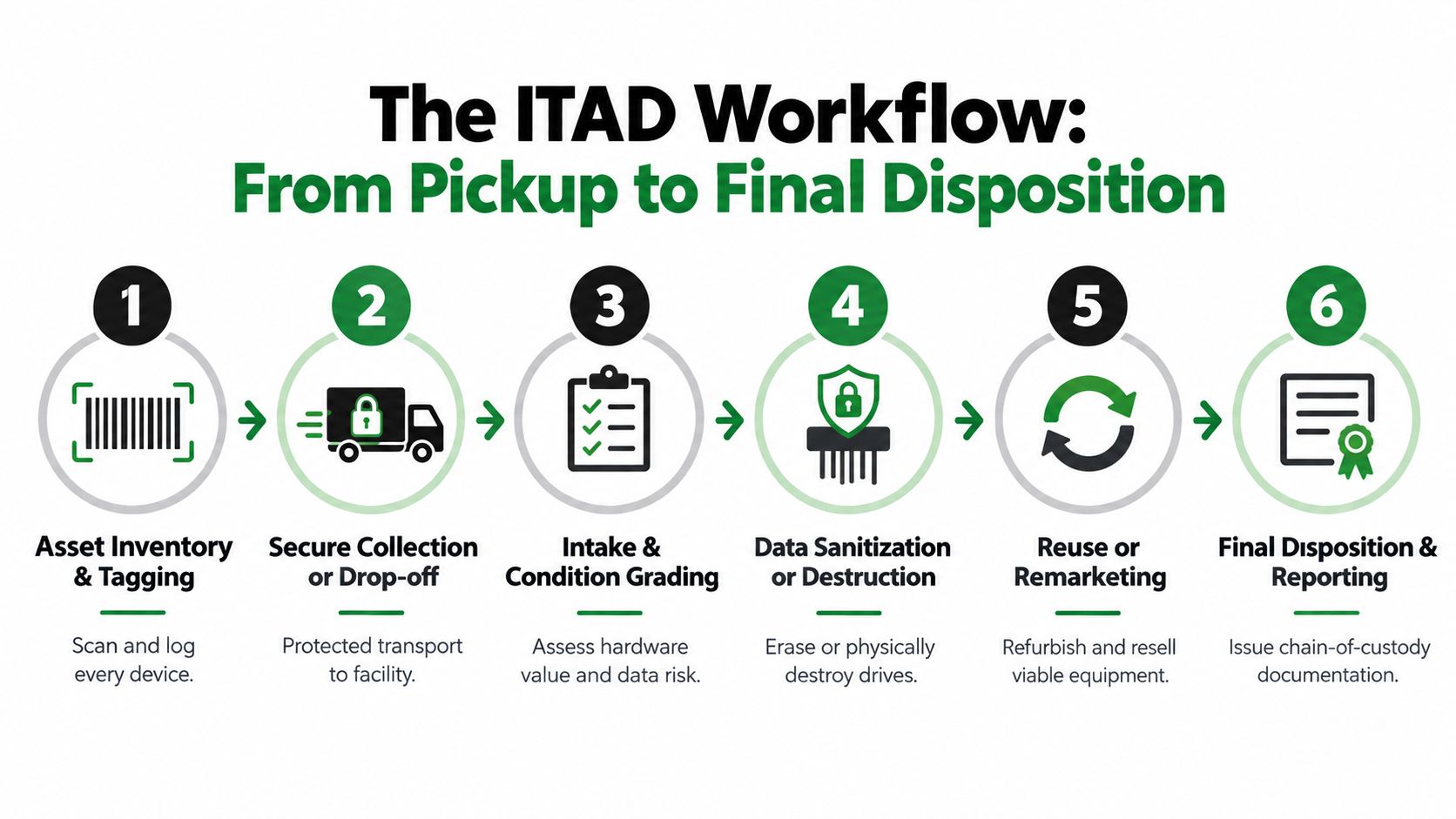
Six controlled handoffs
Asset inventory and tagging. Scan each laptop, server, tablet, monitor, and networking device. A corporate laptop record might include its serial number, asset tag, assigned user, location, operating condition, and storage media identifier.
Secure collection or drop-off. Package equipment so it remains identifiable and protected during transport. A server removed from a rack should be associated with its inventory record before it leaves the data center. Reworx outlines the logistics side of this process through its reverse logistics services.
Intake and condition grading. The processor confirms what arrived, reconciles discrepancies, and grades each item. A working tablet may be suitable for donation or resale. A cracked laptop with a failed SSD may require a different data and recovery path.
Data sanitization or destruction. The disposition plan determines whether the storage media will be cleared, purged, or destroyed. The operator records the method, tool or equipment used, version where applicable, timestamp, and verification result.
Reuse or remarketing. Functional equipment can be refurbished, redeployed, sold, or donated. A mobile device with no recoverable data and a healthy battery may retain useful life, while obsolete or damaged equipment may move directly to material recovery.
Final disposition and reporting. The organization receives documentation connecting the original asset to its final outcome. Reports should identify the serial number, disposition category, sanitization result, downstream route, and relevant certificates.
What chain of custody should prove
Chain-of-custody records should make handoffs visible. At minimum, connect the asset identifier with the media identifier, collection date, transporter or receiving operator, sanitization method, verification status, and final disposition.
A mature process resembles a controlled assembly line. The equipment changes hands, but its identity and risk status don't disappear between pickup, intake, processing, resale, donation, or recycling.
Data Sanitization Methods That Protect Every Device
Deleting files isn't the same as sanitizing media. NIST defines media sanitization as rendering access to target data infeasible for a specified level of effort, with the method selected according to media type and information sensitivity.
NIST SP 800-88 identifies three categories:
- Clear: Logical techniques remove data while preserving normal device reuse.
- Purge: Physical or logical techniques make recovery infeasible using state-of-the-art laboratory methods.
- Destroy: The media becomes unusable and data recovery becomes infeasible.
The choice should follow a decision tree. First, identify what data the device held. Next, identify the storage technology and whether the asset will be reused. Finally, select a method that can be verified and documented. NIST's September 2025 revision places greater emphasis on governance, validation, and alignment with IEEE 2883 and ISO/IEC 27040, including modern logical and virtual storage environments.
| Asset Class | Recommended Method | Verification | Resale Value Retained |
|---|---|---|---|
| Reassigned laptop with standard business data | Clear or purge, based on sensitivity and media type | Tool result plus representative verification where practical | Often retained |
| SSD using supported cryptographic erase | Purge through an appropriate cryptographic process | Confirm the erase result and inspect the process record | Often retained |
| HDD leaving the organization for reuse | Clear or purge according to risk | Verify the operation and retain asset-level evidence | Often retained |
| Failed drive or inaccessible storage | Destroy when sanitization can't be validated | Physical destruction record and serialized certificate | Not retained for that media |
| Server with mixed or highly sensitive storage | Purge or destroy, determined by classification and equipment condition | Record each media identifier and verification outcome | Depends on the server and components |
| Smartphone prepared for donation | Clear or purge, with account removal and reset controls | Confirm sanitization and device release status | Often retained |
NIST recommends checking sanitization whenever practical. When item-by-item checking isn't practical, representative samples should use pseudorandom locations distributed across addressable space, including user-addressable and reserved areas. Across subsections, the procedure should cover at least 10% through non-overlapping samples, and NIST recommends secondary full verification on at least 20% of sanitized media using a different verification tool from a separate developer. See the NIST media sanitization guidance for the control details.
A certificate is evidence of a process. It isn't automatically proof that every device was independently validated.
Physical destruction is justified when the media has failed, the data sensitivity demands it, or the organization can't validate a logical method. But destroying every functional SSD or laptop can create unnecessary e-waste and eliminate recoverable value. A documented, validated purge can protect information while keeping usable equipment in circulation. Reworx describes its data sanitization methods as part of the broader disposition decision rather than a one-size-fits-all rule.
Compliance Standards and Regulatory Requirements
Compliance determines where equipment may travel, how it must be processed, and which records your organization should retain. The useful test is whether a provider can show a lawful, traceable route from collection through final disposition, not merely say that equipment was recycled.
International movement controls
The Basel Convention was adopted on March 22, 1989, entered into force on May 5, 1992, and created an international framework for controlling transboundary movements of hazardous waste and its disposal. Parties adopted the Basel Ban Amendment in 1995. In 2022, they adopted further amendments covering electronic and electrical waste, which became effective on January 1, 2025.
Those e-waste amendments place covered movements under the prior informed consent procedure. Before a shipment crosses borders, the exporting state must notify the importing state and transit states. The importing state and applicable transit states must provide written consent before shipment begins. Provider records should therefore identify the destination, material classification, downstream processor, and required approvals.
U.S. state requirements
The EPA figures provide historical context rather than a current national snapshot. Its overview reported that end-of-life electronics increased 122% from 1999 to 2009. In 2009, approximately 2.37 million short tons were ready for end-of-life management, and only 25% went for recycling. The same overview described a patchwork of 25 state e-waste laws, including 15 states with landfill disposal bans, in the EPA electronics management overview.
State obligations can still affect routing today. A company operating across state lines should maintain an inventory showing where equipment was collected and match its disposition plan to each applicable jurisdiction. Ask how the provider controls downstream handling for batteries, hazardous components, reuse, and certified recycling.
Cybersecurity disclosure exposure
For domestic public companies, the SEC requires a material cybersecurity incident to be disclosed on Form 8-K within four business days after the registrant determines that the incident is material. The period begins with that materiality determination, not automatically when the incident occurs or is discovered, as explained in the SEC cybersecurity disclosure guidance.
Retired computers, servers, and storage devices can contain information relevant to an incident. Asset records, sanitization evidence, and chain-of-custody documentation can support incident response and governance. Teams building a wider compliance program can align asset-level controls with information security standards such as ISO/IEC 27040. The My Safety Manager's compliance guide can help connect operational controls with organizational oversight.
Value Recovery Models and Pricing Structures
ITAD pricing depends on condition, data risk, logistics, processing requirements, and the agreement between the organization and provider. One shipment can contain assets that qualify for buyback alongside equipment that requires a service fee.
Four routes for retired equipment
Buyback suits current-generation laptops, workstations, networking equipment, and servers with demand in the secondary market. The provider evaluates condition, configuration, age, and completeness, then applies an agreed valuation process.
Refurbishment and remarketing works when equipment needs testing, cleaning, repair, component replacement, or secure preparation before resale. This route can preserve more value than immediate recycling, but the provider should document what happened to the asset and its data.
Donation through a social enterprise fits functional equipment that can support schools, nonprofit programs, or community access initiatives. Donation-based recycling can extend useful life while connecting corporate surplus to digital inclusion and workforce development.
Certified material recovery is the right route for damaged, obsolete, incomplete, or non-repairable equipment. The processor separates recoverable materials and controls components that require special handling.
| Asset Condition | Best Path | Typical Recovery | Reworx Approach |
|---|---|---|---|
| Current-generation laptop in working condition | Buyback or refurbishment | Revenue or reuse value may be available | Evaluate for buyback, reuse, or donation |
| Older desktop with usable components | Refurbishment or donation | Continued service life may remain | Grade before choosing reuse or recycling |
| Server with marketable parts | Remarketing or component recovery | Value depends on configuration and condition | Separate reusable hardware from restricted media |
| Damaged equipment or failed storage | Material recovery and destruction | Material value may remain, but resale value is limited | Secure data treatment first, then responsible recycling |
The trade-off is straightforward. Destruction provides a final physical barrier, but it removes the possibility of reuse for that media. A validated purge can preserve resale or donation value when the data sensitivity, media type, and verification process support it.
Reading an ITAD quote
Look beyond the headline price. Confirm whether the quote includes packing, pickup, labor, testing, storage, data sanitization, hard drive shredding, product destruction, batteries, certificates, downstream processing, and report preparation. Ask how negative-value equipment is handled and whether revenue sharing is calculated before or after processing fees.
A clear proposal separates service charges from recovery credits. It also states what happens when serial numbers don't reconcile, a device fails verification, or an asset arrives in a condition different from the inventory.
Vetting Providers and Recognizing Red Flags
Certifications can help you compare providers, but a logo isn't a substitute for operational answers. Ask the vendor to explain how its certifications, internal controls, and subcontractor oversight apply to your specific equipment and locations.
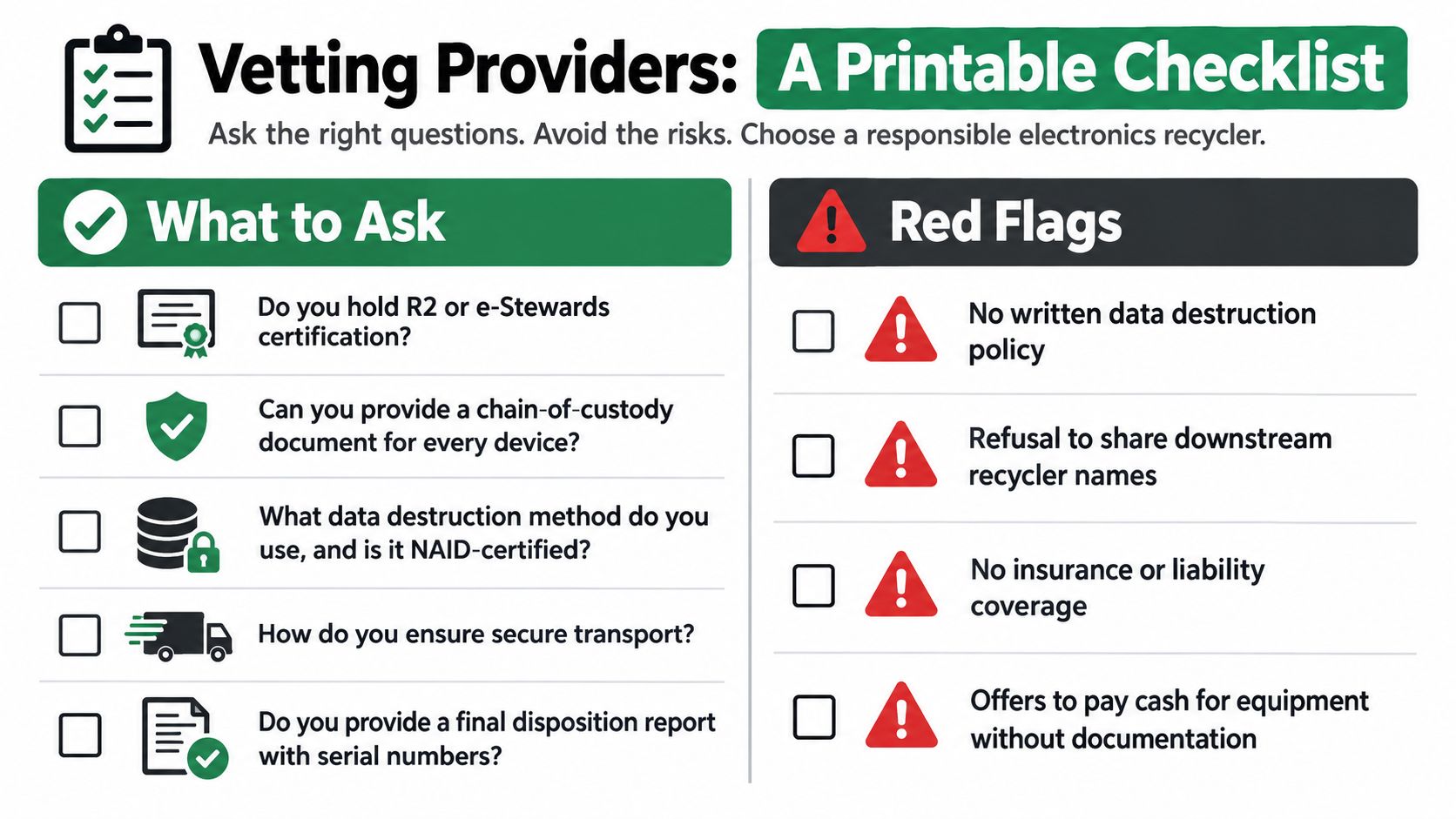
Questions for a defensible proposal
- Certification scope: Does the provider hold relevant R2, e-Stewards, ISO 14001, or NAID certifications, and do they cover the services you need?
- Asset-level reporting: Will you receive serialized records for every laptop, drive, server, and mobile device?
- Verification controls: How does the provider sample or independently verify sanitization, and what happens after a failed result?
- Downstream accountability: Can the provider identify downstream processors and explain how exported e-waste is controlled?
- Transport security: Who collects the equipment, how are loads sealed or tracked, and where is custody transferred?
- Insurance and liability: Does the proposal state coverage for loss, damage, data exposure, and transportation?
- Final reporting: Will the final report connect each asset to its sanitization result and disposition route?
Red flags that deserve a pause
- Blanket destruction: The provider recommends shredding everything without reviewing data sensitivity, media type, condition, or reuse potential.
- Missing serial records: The vendor offers only a weight ticket or general recycling receipt.
- Vague downstream names: The proposal says “approved partners” without identifying the processing chain or control method.
- Unclear failure handling: The vendor can't explain what happens when a wipe fails or an asset arrives without a readable identifier.
- Cash without documentation: The buyer offers immediate payment but won't provide an asset-level report or disposition evidence.
The strongest comparison is between proposals built on the same inventory, the same security requirements, and the same reporting standard.
A provider's social mission can also have practical importance. A donation-based model may create a defined route for functional devices that would otherwise be destroyed, while workforce development and community programs can give the reuse decision a measurable human purpose. Reworx Recycling combines electronics recycling, business pickups, secure hard drive shredding, equipment buyback, and donation-oriented reuse within its service model.
How Reworx Recycling Delivers These Services in Practice
Consider a school district retiring a Chromebook fleet. The district can inventory each device, separate working units from damaged ones, remove accounts, apply an appropriate sanitization method, and route functional equipment toward donation or reuse. Devices with failed storage or severe damage can receive secure data destruction before material recovery. The district's final report should connect each serial number to its treatment and destination.
A regional medical practice follows a stricter risk path for workstations and servers. Devices may contain patient information, so the practice should classify the media, document custody from the clinic to the processor, and quarantine any failed verification. Functional hardware can still be evaluated for buyback or refurbishment after validated sanitization, while failed or high-sensitivity media may require physical destruction.
Reworx Recycling provides IT asset disposition services that include equipment decommissioning, secure data destruction, hardware recycling, and disposal planning. Its operating model includes free customer drop-off at the Smyrna facility, scheduled business pickups, secure hard drive shredding with serialized certificates, buyback options for functional equipment, and e-waste drive planning for schools and offices.
The social-enterprise model adds a reuse pathway for suitable devices. Functional equipment can support technology donations, digital inclusion, and workforce development rather than moving directly to destruction. That approach doesn't remove the need for security controls. It makes validated sanitization, accurate inventory, and documented handoffs more important.
Reworx Recycling helps businesses plan secure data destruction, equipment pickups, electronics recycling, buyback, donation-based recycling, and responsible IT equipment disposal. Visit Reworx Recycling to plan your next office cleanout, school e-waste drive, facility cleanout, or IT asset disposition project.