A laptop refresh rarely ends when the replacement devices arrive. A finance firm may have employees waiting for new computers, storage rooms filling with returned equipment, and an IT director asking whether each device should be wiped, destroyed, resold, donated, or recycled. That uncertainty is the central IT asset disposition problem. The organization isn't removing hardware. It's making a series of security, compliance, environmental, and financial decisions that need to be recorded and defended.
For a small business, school, data center, or public agency, the right ITAD process connects asset inventory to data classification, sanitization, reuse, recycling, and final reporting. The result should be more than an empty storeroom. It should be a documented chain of custody, a defensible data-destruction decision, and a clear account of what happened to every asset.
Why Responsible IT Asset Disposition Matters Now
A mid-sized finance company is retiring laptops after a technology refresh. Some devices are still fast enough for redeployment. Others contain damaged storage, encrypted drives, or hardware that no longer supports the company's security baseline. A few laptops belong to employees who handled financial records, while others were used for routine administrative work.
The IT director has four options for each device, but none should be chosen by habit. A logical wipe may be suitable for one laptop, while another requires purge or physical destruction. A reusable computer could retain business value through resale or donation, whereas a failed drive may have no responsible endpoint other than destruction and material recovery.
That is why ITAD is a governance process, not a disposal ticket. Security teams care about data exposure. Compliance officers need evidence that regulated information was handled correctly. Sustainability leaders want to reduce uncontrolled e-waste. Finance teams want to recover value where practical.
The environmental case
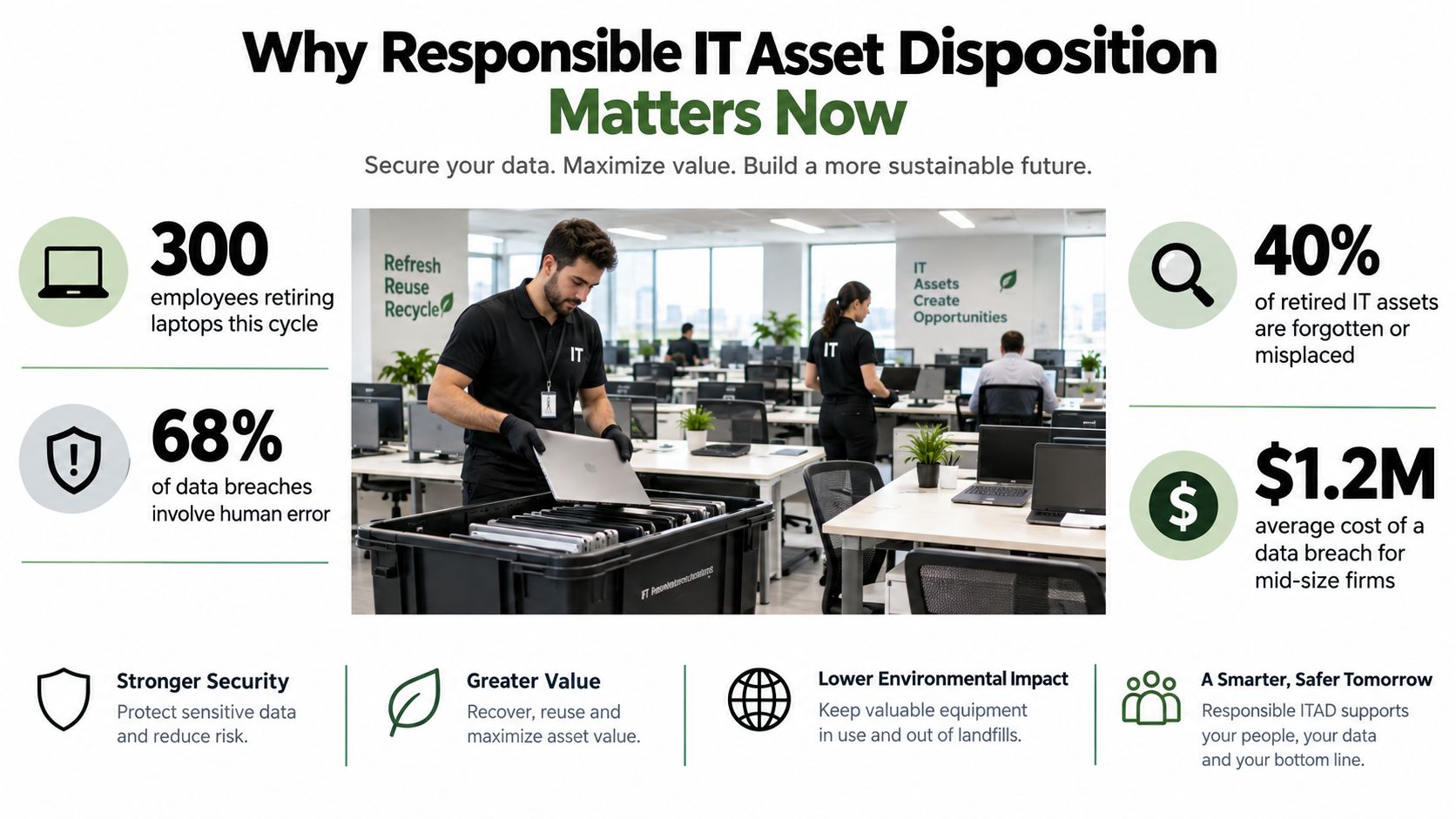
Global e-waste reached a record 62 million tonnes in 2022, or approximately 7.8 kilograms per person, according to the Global E-waste Monitor 2024. From 2010 to 2022, annual generation rose from 34 billion kilograms to 62 billion kilograms, while documented formal collection and environmentally sound recycling increased from 8 billion kilograms to 13.8 billion kilograms.
Only 22.3% of global e-waste was documented as properly collected and recycled in 2022. That leaves roughly 48.2 million tonnes outside documented formal recycling systems and approximately US$62 billion in recoverable natural resources, according to the same source. For organizations, responsible ITAD helps keep usable equipment in service and routes non-reusable material through accountable channels.
The environmental impact of electronic waste also affects how leaders evaluate their refresh programs. A complete record can show which assets were reused, which were refurbished, which were recycled, and which required destruction. Without that record, a company can't reliably demonstrate either secure handling or meaningful sustainability performance.
What IT Asset Disposition Really Means
Think of ITAD as the closing process for a property lease. When a company leaves an office, it doesn't abandon desks and keys. It confirms what was returned, documents the condition, resolves outstanding obligations, and determines whether anything can be recovered or reused.
Technology requires the same discipline, with an additional concern: data can remain on equipment after the user stops using it. IT asset disposition identifies the asset, approves its retirement, removes or destroys data according to risk, chooses the most appropriate endpoint, and preserves evidence of each decision.
Four outcomes from one program
Security means making information inaccessible through a method appropriate to the media and the data. NIST Special Publication 800-88 Revision 1, published on December 17, 2014, defined media sanitization as a process that makes access to data infeasible for a defined level of effort. The guidance was later superseded by Revision 2 in September 2025, but Revision 1 remains a foundational benchmark for documented, auditable sanitization. See the NIST SP 800-88 Revision 1 publication.
Compliance means producing evidence, not merely claiming that a device was handled correctly. That evidence may include an asset identifier, intake record, sanitization result, destruction certificate, and final disposition.
Sustainability means considering reuse before recycling when the equipment remains functional. The EPA's electronics donation and recycling guidance reports that recycling one million laptops saves energy equivalent to the annual electricity use of more than 3,500 U.S. homes. It also reports that recycling one million mobile phones can recover approximately 35,000 pounds of copper, 772 pounds of silver, 75 pounds of gold, and 33 pounds of palladium.
Financial recovery comes from redeployment, repair, resale, buyback, or component recovery. An old laptop isn't automatically worthless, and a recycling rate alone doesn't show whether the organization preserved or destroyed residual value.
Shared ownership matters
ITAD belongs across departments. IT operations identifies equipment and confirms dependencies. Security classifies data risk. Compliance defines evidence requirements. Facilities coordinates movement and storage. Sustainability teams track reuse and recycling outcomes. A downstream processor handles refurbishment or recycling under agreed controls.
Practical rule: If nobody owns the final record, nobody owns the disposition outcome.

The Five-Phase ITAD Lifecycle
A reliable ITAD program moves assets through connected phases. Each phase creates evidence that the next team can use. If a handoff is informal, the chain of custody becomes difficult to prove even when the final recycling vendor is reputable.
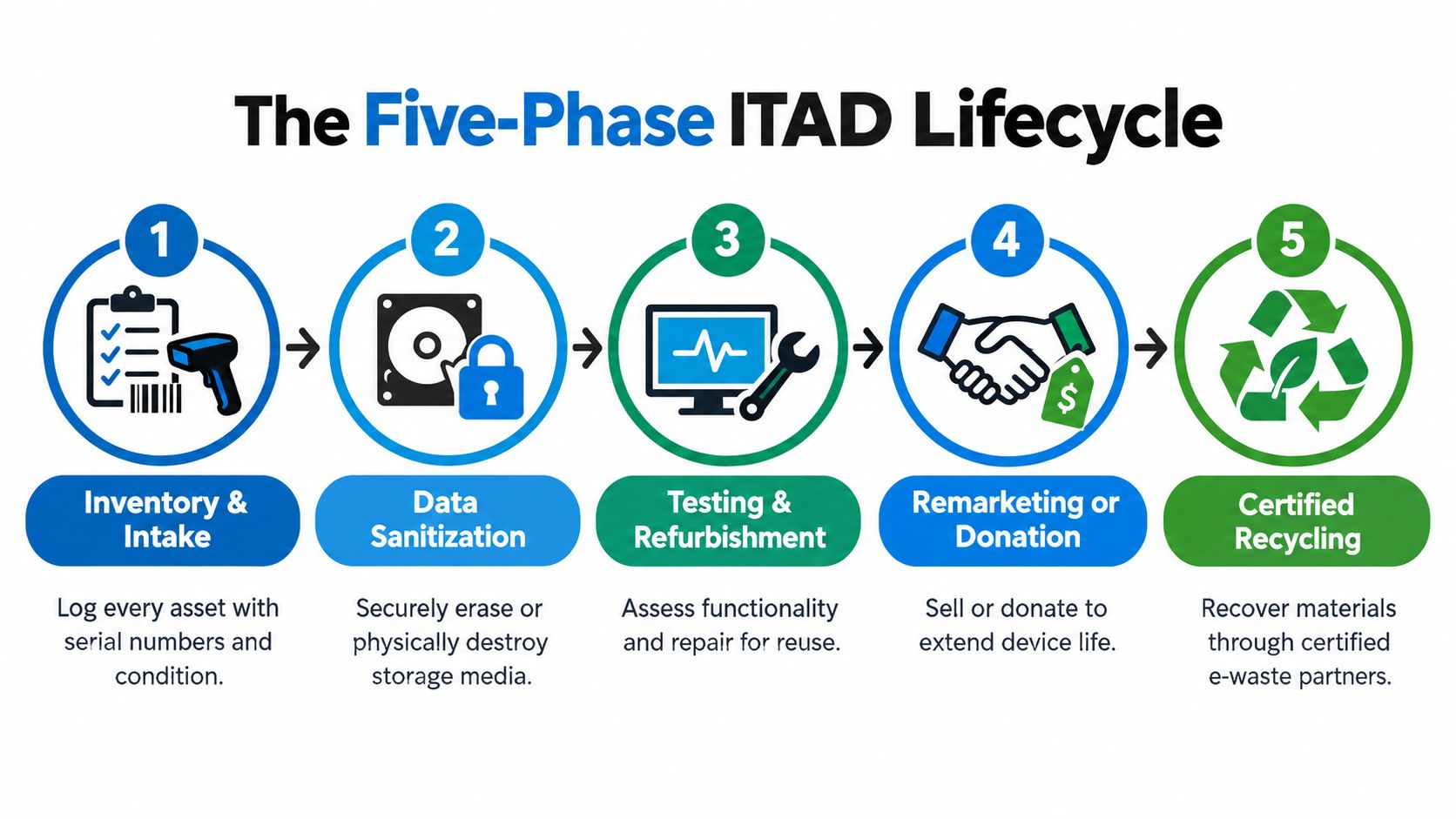
Phase one, inventory and intake
Start with a serialized inventory. Record the manufacturer, model, asset tag, serial number, media type, condition, location, owner, and data classification where available. A school may process student laptops in batches, while a data center needs to distinguish servers, storage arrays, network gear, and removable media.
The intake record should also note accessories, batteries, cables, and visible damage. This prevents a working laptop from being treated like a failed drive and gives finance a basis for evaluating residual value.
Phase two, sanitization or destruction
The approved method depends on the data risk and intended endpoint. Capture the method, operator, date, verification result, and device identifier. If a device can't be sanitized reliably, quarantine it until physical destruction is completed.
Phase three, testing and refurbishment
Technicians test functionality, inspect components, remove organization-specific labels, and grade the equipment. A grading report separates equipment suitable for redeployment or resale from equipment that should move to material recycling.
Phase four, remarketing or donation
A working asset may be resold, redeployed, donated, or refurbished. The choice should reflect data assurance, business value, supportability, and the receiving party's needs. For a server move or facility transition, teams can also plan your server relocation alongside decommissioning so transport, dependencies, and final disposition don't become separate undocumented workflows.
Phase five, certified recycling and closeout
Non-reusable equipment should go to documented recycling channels. Keep weight tickets, downstream processor details, recycling certificates, and the final asset list. Reworx provides a useful overview of the lifecycle of IT equipment from acquisition to recycling, including the decisions that determine whether equipment is reused or recycled.
The evidence varies by asset class. Laptop projects need serial-level records and sanitization results. Data center decommissioning needs equipment counts, storage-media controls, and transport records. Medical equipment disposal and laboratory equipment disposal may require additional attention to embedded storage, configuration data, batteries, and regulated components.
Choosing the Right Sanitization Level for Each Device
A laptop headed back to the same controlled environment does not face the same risk as a failed drive leaving the organization. Choose sanitization by weighing data confidentiality, media technology, verification confidence, and intended disposition.
Clear uses logical techniques, such as standard read and write commands, to remove data from user-addressable locations. It protects against basic, non-invasive recovery. A lower-risk business laptop approved for redeployment may suit this level when the organization retains control and the process is verified.
Purge uses physical or logical techniques intended to make recovery infeasible, even with state-of-the-art laboratory methods. It fits equipment leaving the organization, devices containing sensitive information, and media where ordinary clearing cannot provide enough assurance. NIST identifies techniques such as firmware-based secure erase for applicable ATA drives. Our guide to data sanitization methods compares how these approaches work in practice.
Destroy makes recovery infeasible and prevents the media from being reused for storage. Physical shredding or pulverization may be necessary for a failed drive, an untrusted device, or media whose sanitization cannot be verified.
| Asset type | Typical data sensitivity | Recommended method | Evidence to retain |
|---|---|---|---|
| Business laptop approved for redeployment | Internal business information | Verified Clear or an approved logical sanitization process | Asset identifier, method, operator, date, verification result |
| SSD leaving organizational control | Confidential or regulated information | Purge, including an applicable secure-erase or cryptographic approach | Media type, method, tool or process record, verification |
| Encrypted enterprise endpoint | Sensitive information protected by encryption | Validated cryptographic erase when key-management conditions support it, or Purge or Destroy when they do not | Encryption status, key-sanitization result, verifier, final disposition |
| Failed hard drive or removable media | Data cannot be reliably accessed or sanitized | Destroy | Destruction certificate, device identifier, date, downstream record |
| Smartphone prepared for donation | Personal, corporate, or mobile application data | Verified logical sanitization or an appropriate manufacturer reset process, with risk review | Device identifier, sanitization result, reviewer, recipient or disposition |
Media technology changes the decision. A process designed for magnetic disks cannot automatically be assumed effective for SSDs or removable flash media. Check the drive type, applicable firmware commands, encryption state, and whether the result can be validated before selecting Clear, Purge, or Destroy.
Cloud-connected equipment adds another responsibility. Logical deletion, factory reset, or key removal may address the endpoint, while synchronized services, managed storage, and externally controlled encryption keys retain separate risks. NIST's SP 800-88 Revision 2 initial public draft expands discussion of enterprise-wide sanitization, logical sanitization, cloud environments, and cryptographic erase.
For organizations handling Federal Tax Information, the IRS media-sanitization guidelines state that ordinary disposal is not acceptable. Clearing, purging, or destroying are the appropriate outcomes. Match the method to whether the media remains in use, changes purpose, leaves organizational control, or will not be reused.
Certifications and Regulatory Anchors That Shape an ITAD Program
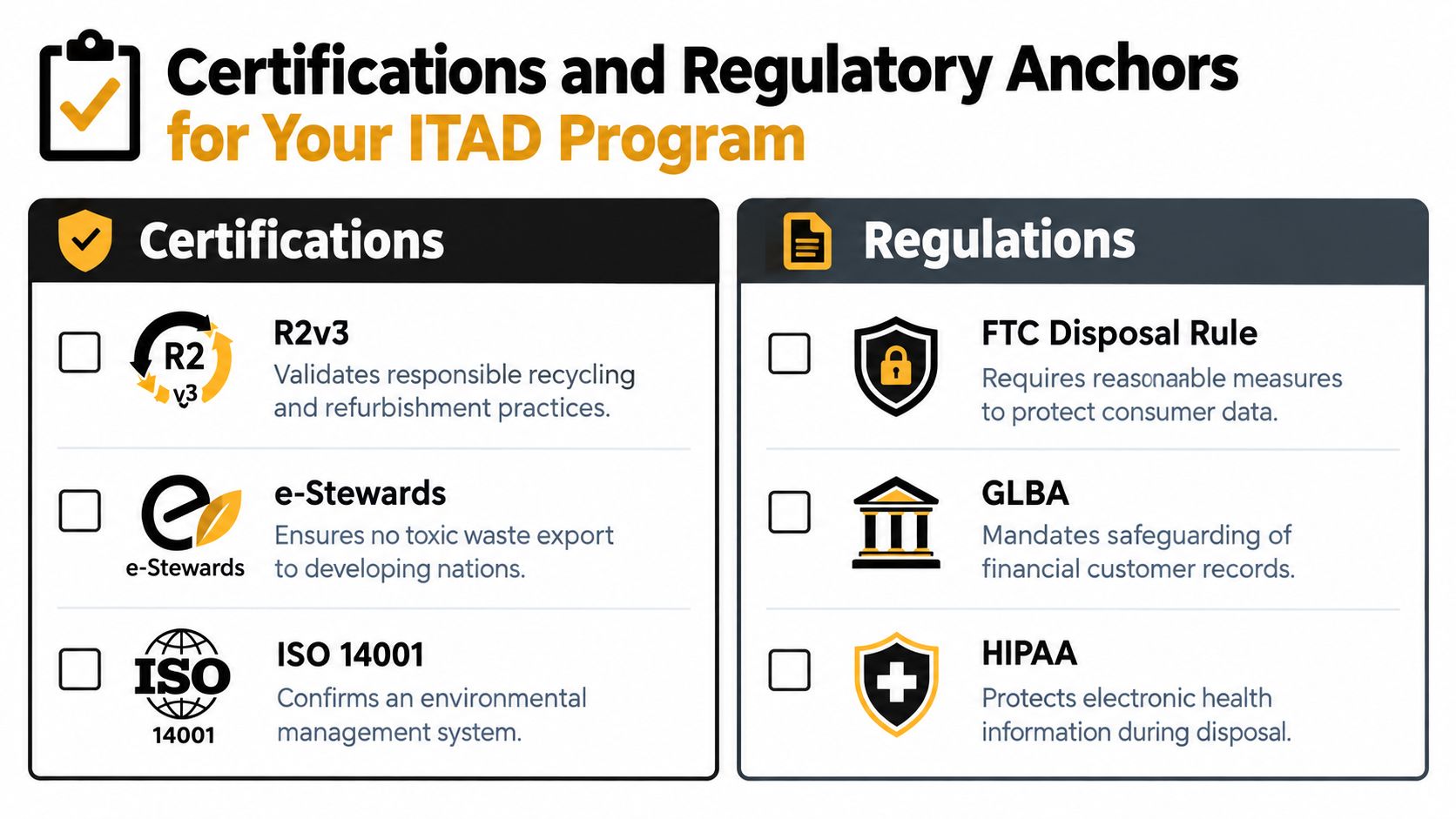
Certifications and regulations answer different questions. A stewardship certification can indicate how a provider manages facilities, downstream processors, health and safety, and environmental controls. A data-protection rule can require reasonable safeguards for a particular type of information. Neither should be treated as a substitute for asset-level evidence.
R2v3 and e-Stewards are commonly evaluated by organizations seeking accountable electronics processing. Buyers should ask what the provider's certification covers, whether downstream vendors are included, and how exceptions are handled. ISO 14001 addresses an environmental management system, which is relevant to sustainability governance but doesn't by itself prove that a specific laptop was sanitized.
NIST SP 800-88 provides the technical vocabulary for media sanitization. Revision 2 places greater emphasis on an enterprise-wide program, validation, logical sanitization, and cryptographic erase. That makes it especially relevant to organizations managing encrypted endpoints, cloud-connected systems, and mixed storage technologies.
Match the anchor to the information
HIPAA matters when electronic protected health information is involved. The FTC Disposal Rule applies to businesses and individuals that use consumer reports for a business purpose, including employers, insurers, landlords, government agencies, lenders, and service providers. It requires reasonable measures to prevent unauthorized access to or use of consumer-report information during disposal. The FTC's Disposal Rule guidance gives electronic examples such as erasing or destroying files and media so they can't be read or reconstructed.
GLBA may shape financial-data controls, while contractual requirements can add obligations beyond general law. An office cleanout involving employee-screening records, credit information, health information, or tax records should therefore use a documented process rather than ordinary recycling.
A provider should return a closeout package that includes:
- Intake evidence: Serialized asset list, condition, location, and custody transfer.
- Sanitization evidence: Method, operator, date, verification result, and media details.
- Destruction evidence: Certificate of destruction for media that couldn't be sanitized or reused.
- Disposition evidence: Reuse, resale, donation, refurbishment, or recycling outcome.
- Downstream evidence: Processor identity and relevant recycling or material records.
Organizations comparing environmental certifications and recycling controls should ask how those credentials connect to their actual assets, data categories, and reporting obligations.
How to Choose an ITAD Provider With Confidence
Price per pallet is a weak way to evaluate ITAD. A thorough purchase includes custody, data assurance, environmental controls, reporting, and the provider's willingness to accept responsibility when an asset doesn't follow the expected path.
Start by asking how the provider operates. Does it process equipment in its own facility? Does it use documented downstream partners? Does it broker material without giving the customer visibility into the chain? A national provider may suit a distributed enterprise, while a regional specialist may offer closer operational coordination. A donation-based partner may be a strong fit when community impact and technology access are part of the organization's sustainability goals.
Questions for the RFP
A competent request for proposal should require direct answers to these questions:
- Asset visibility: Will every device receive a serialized record from pickup through final disposition?
- Data controls: Which methods support Clear, Purge, Destroy, and validated cryptographic erase?
- Verification: Who verifies sanitization, and what happens when a device fails?
- Custody: How are collection, transport, storage, and downstream transfers documented?
- Liability: Which party accepts responsibility for a breach, lost asset, or undocumented handoff?
- Insurance: What coverage applies to data incidents, transportation, property, and environmental liability?
- Environmental controls: Which permits, certifications, and downstream records support responsible recycling?
- Value recovery: How are resale, buyback, refurbishment, and donation decisions made?
- Exit terms: Can the organization retrieve records and assets if the relationship ends?
A vendor should explain how it handles laptops, servers, networking equipment, displays, batteries, medical equipment, laboratory equipment, and removable media. It should also distinguish secure data destruction from product destruction. The first protects information. The second may be required for a product, prototype, defective unit, or branded item that must not re-enter the market.
Use a scorecard that weights security controls, evidence quality, sustainability credentials, cost transparency, logistics, and community impact. Reworx Recycling is one option for organizations evaluating a donation-oriented partner, with services that include business pickups, equipment decommissioning, IT asset management, hardware recycling, secure hard drive shredding, data destruction, and equipment buyback. Review ITAD vendor selection criteria before comparing proposals.
Measuring ITAD Outcomes That Matter
A report showing recycled pounds is useful, but it doesn't answer the most important management questions. Did the organization document every asset? Did it preserve usable life? Did it recover value? Did the final destination match the approved decision?
Start with measures that a small business can maintain without building a separate analytics program:
- Record completeness: Percentage of assets with serial numbers, custody records, and final disposition.
- Sanitization coverage: Percentage of storage-bearing devices with a verified sanitization or destruction result.
- Disposition mix: Count assets reused, redeployed, donated, resold, refurbished, or recycled.
- Exception volume: Assets placed on hold because of missing identifiers, failed sanitization, or uncertain ownership.
- Processing time: Time from pickup or intake to documented final disposition.
Enterprise teams can add recovered value per asset, average months of usable life extended, certified downstream routing, and the share of assets with complete chain-of-custody records. They can also connect disposition data to procurement, sustainability reporting, finance, and security governance.
Build a scorecard around decisions
A high recycling rate isn't automatically a sign of a strong program. If repairable laptops go directly to material processing, the organization may have simplified logistics while sacrificing useful life, resale value, and embedded manufacturing value. Reuse generally preserves more of that value than immediate material recovery.
Track outcomes by asset class. A data center may measure server redeployment, storage-media destruction, and component recovery separately. A school may focus on working devices donated to students, verified resets, and battery segregation. A medical organization may need distinct records for devices containing patient information and equipment requiring specialized handling.
The useful question isn't only “How much did we recycle?” It's “Why did each asset reach this endpoint, and can we prove that the decision was appropriate?”
For sustainability reporting, preserve the underlying asset records rather than relying on a single annual total. For audit preparation, make sure a reviewer can move from the original inventory to the sanitization evidence and then to the final disposition without reconstructing the story from emails and spreadsheets.
Putting the ITAD Playbook Into Action
A dependable ITAD decision chain is straightforward: identify every asset, classify the data risk, select Clear, Purge, or Destroy as appropriate, test for reuse, document each handoff, and report the final outcome. The same logic applies to a laptop disposal project, an office cleanout, a facility cleanout, a data center decommissioning program, or a corporate donation program. The difference is volume, equipment type, and risk, not the need for control.
Treat ITAD as a recurring lifecycle program rather than an occasional cleanup. Before the next refresh, create the inventory fields, approval path, sanitization rules, provider requirements, and reporting template. Then decide whether your organization should redeploy equipment internally, resell it, donate it through a social enterprise recycling model, or route it to certified electronics recycling.
Reworx Recycling supports businesses, schools, government agencies, and other organizations with donation-based recycling, computer recycling, laptop disposal, secure data destruction, equipment pickups, and responsible end-of-life processing. Its mission connects environmental responsibility with technology donations, digital inclusion, and workforce development.
Reworx Recycling can help you plan a documented ITAD project, arrange a business pickup, securely destroy data, recover value from reusable equipment, and route remaining electronics through responsible recycling. Visit Reworx Recycling to donate old equipment, schedule service, or discuss a recurring partnership for your next technology refresh.