
You've registered an LLC, found a promising office, and started comparing payroll software. Then the lease agent asks whether the space is approved for your intended use, the city requests zoning documents, and your IT lead points out that the old laptops contain customer data. Starting a business in Atlanta involves more than filing an entity with Georgia. You also need to align the location, local licensing, tax registration, cash flow, hiring, and technology lifecycle before opening the doors.
This guide explains how to start a business in Atlanta with a practical focus on the friction founders often discover too late. It covers the state formation sequence, Atlanta's occupational tax certificate and zoning review, municipal costs, financial controls, and sustainable IT operations for a new office.
Understanding the Atlanta Business Landscape
A proposed Atlanta address can create problems before the business earns its first sale. A founder may choose an entity, sign a lease, and still discover that the site does not support the intended activity or falls outside the City of Atlanta's jurisdiction. Confirm the address, permitted use, customer access, storage needs, and on-site equipment before treating a property as launch-ready. This applies to offices, storefronts, home-based service companies, warehouses, and businesses handling customer or company equipment.
Atlanta offers a large customer and supplier base, but competition is intense. Georgia has about 1.4 million small businesses, representing 99.7% of all businesses in the state, and those firms employ roughly 1.8 million people, or 42.5% of Georgia's workforce, according to the Georgia Small Business Profile. Between March 2023 and March 2024, the state added 41,761 business establishments and closed 37,392, for a net gain of 4,369 establishments.
Atlanta's metro performance has also been strong. The Fiserv Small Business Index reported 3.5% growth in Atlanta, compared with 1.6% across Georgia and 0.7% nationally in 2026. That growth does not remove the practical constraints facing a new operator. Established companies compete for talent, attention, suitable premises, and capital, so a viable plan must connect local demand with disciplined spending.
Opportunity comes with capital discipline
Atlanta is a significant Southern startup hub, although venture funding is not unlimited. A Boston Consulting Group analysis of Atlanta entrepreneurship identified 7 current-status unicorns in Atlanta, compared with 18 in Chicago and 11 in Austin. The analysis also recorded 158 Atlanta startup launches in 2022, down from 183 in 2021 and below the 2017 peak of 444.
Those figures show how formation activity can shift with funding conditions. Build around paying customers, manageable overhead, and a cash plan that does not depend on the next funding round arriving on schedule. Local support exists, yet founders may face a thin middle between seed capital and later-stage financing, a concern discussed in the Atlanta tech ecosystem report.
Practical rule: Validate the customer, the premises, and the cash runway before committing to a lease or a large technology purchase.
The UGA SBDC reports that entrepreneurs it assisted over the past five years launched more than 2,100 new businesses, created over 15,000 jobs, secured $1.25 billion in loan and equity financing, and generated more than $9.5 billion in sales, according to the BCG analysis linked above. That support can help with planning and financing, but founders still need operating controls, realistic occupancy assumptions, and a clear plan for permits and technology.
A founder assessing a franchise, service company, technology firm, or professional practice can consult this 2026 franchise startup guide from The Owner's Shortlist to compare operating models. Localize that decision around Atlanta zoning, occupancy, labor, and equipment requirements. Infrastructure, operating costs, and sustainable disposal of retired technology also belong in the launch budget. Businesses considering the region can review why businesses are relocating to Metro Atlanta, including its discussion of infrastructure and business operations. Secure IT asset disposition and documented e-waste handling protect data and keep old equipment out of general waste streams.
Forming Your Legal Entity and State Registration
The state-level formation process should create a clean foundation for local licensing, banking, payroll, and tax administration. It doesn't replace Atlanta approval, but it gives the city and other agencies a recognizable legal business to review.
Choose the structure around the business
A sole proprietorship is simple to start, but it doesn't create a separate legal entity from its owner. That can make it unsuitable for activities involving employees, contracts, customer property, regulated services, or meaningful operational risk.
An LLC generally provides a flexible structure and separates the business from its owners under applicable law. It's often a practical starting point for a small Atlanta service company, consultancy, agency, or operating business. A corporation may fit a company seeking outside investment or a more formal ownership structure. An S corporation is a tax election rather than a standalone state entity type, so the legal and tax decisions should be evaluated separately with a Georgia CPA or attorney.
For a useful comparison of ownership structures, review this advice from EndureGo Tax on business structures. The principles are broadly useful, but a Georgia professional should confirm the legal and tax treatment of your specific company.
Complete the state sequence
Use this order to reduce rework:
Define the activity and ownership. Write down what the company will sell, where employees will work, whether customers will visit, and whether equipment or inventory will be stored on site. These details will affect insurance, zoning, tax registrations, and lease decisions.
Register the entity with Georgia when appropriate. File through the Georgia Secretary of State's business registration process and retain the formation documents, registered agent information, and governing agreement.
Obtain an EIN from the IRS. Banks, payroll providers, and many business counterparties use the EIN to identify the company. Keep the IRS confirmation with the formation records.
Review Georgia tax registrations. Georgia says businesses must register through the Georgia Tax Center when applicable tax-registration requirements apply. The state also notes that an entity conducting business in Georgia may need one or more tax-specific identification numbers, permits, or licenses depending on its activities. Sales and use tax registration doesn't expire while the business exists without a change in ownership or structure.
Create a compliance file. Store formation documents, tax registrations, insurance certificates, leases, permits, affidavits, and renewal dates in a shared but access-controlled location. A business compliance checklist template can help organize the file without relying on memory.
The most common state-level mistake is assuming entity formation covers every tax and operating obligation. It doesn't. Treat the Secretary of State filing, IRS identification, Georgia Tax Center registration, and Atlanta licensing as separate workstreams with separate owners and completion dates.
Securing Atlanta City Permits and Zoning Approvals
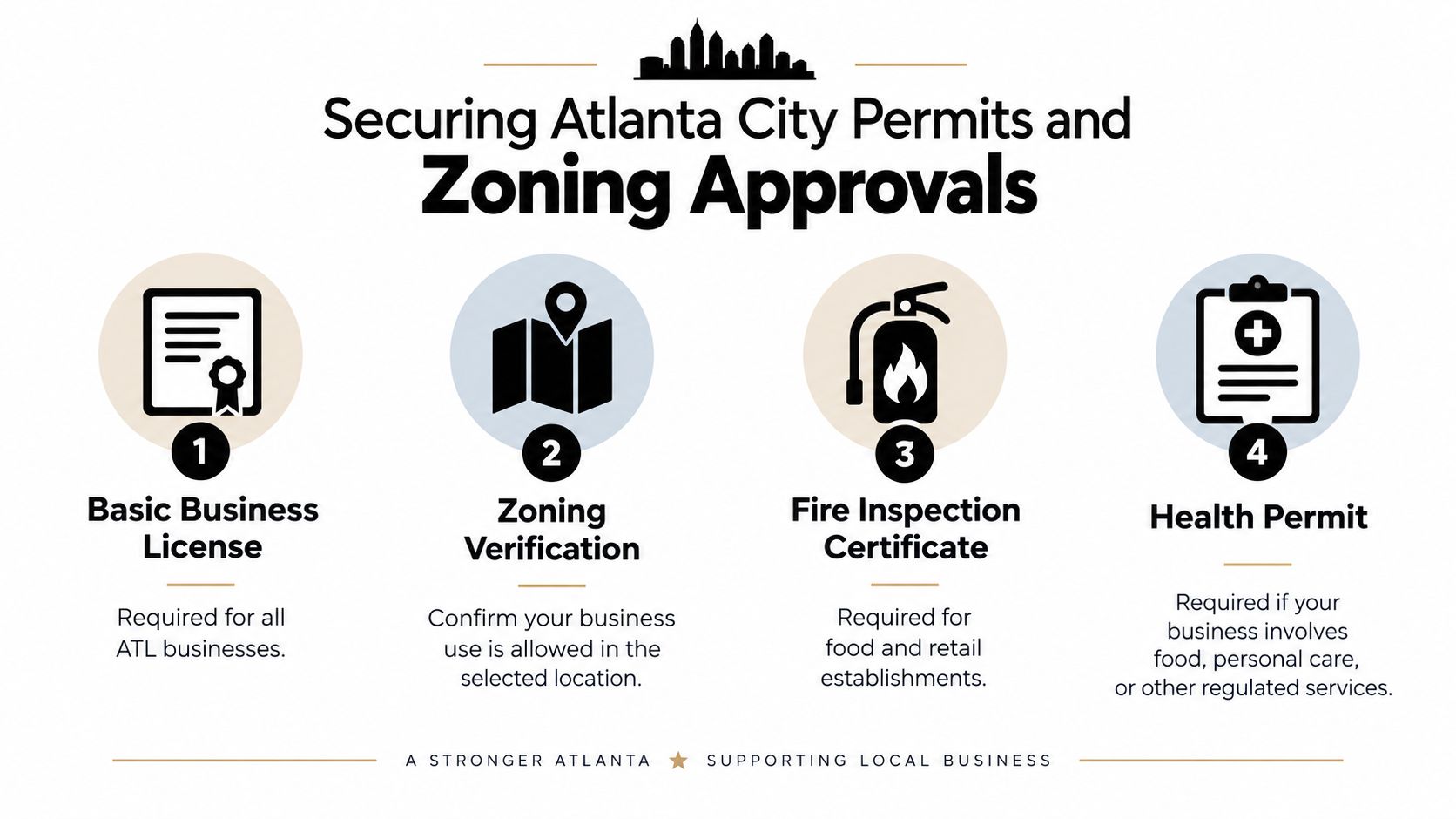
A lease can look affordable until the city determines that your planned operation does not fit the property. Before committing to an Atlanta address, confirm that the site is inside city limits, the proposed use matches its zoning, and any additional approvals are available.
Start with the address, not the application
Request the exact property address, suite details, existing certificates, and available zoning information from the landlord. Then describe the business activity precisely. “Office” may not cover customer visits, equipment storage, repair work, light assembly, medical services, retail sales, or regular loading.
The same review applies to a home-based business. Remote laptop work may create few site concerns, while receiving shipments, storing electronics, hiring staff, or inviting customers can change the approval requirements. If the proposed activity does not match the site's permissions, the city may delay or deny approval.
Apply through ATLBIZ
Atlanta submits its occupational tax certificate applications through ATLBIZ, together with required affidavits and supporting records. The city's licenses and permits guidance states that zoning review is mandatory. The application lists a $50 zoning review fee, a $191 application fee, and an additional $25 per employee fee for the business license process. Review the city's business-tax guidance separately so renewal and tax obligations do not get lost after approval.
Build the application package before opening the submission:
- Entity records: Use the same legal name, formation details, EIN, ownership information, and business contact details throughout the application.
- Premises details: Provide the street address, suite, lease or occupancy information, and a specific description of the proposed use.
- Affidavits: Complete the city's required affidavits. Informal explanations do not replace them.
- Supporting approvals: Collect documents tied to fire, health, construction, professional licensing, or other permits that apply to the operation.
- Employee information: Maintain the employee count used for the licensing calculation and update it when the business changes.

Treat zoning as a commercial decision
The least expensive time to find a zoning problem is before signing the lease. Ask the city or a qualified local professional to confirm the intended use. Where possible, make the lease contingent on receiving the approvals your operation requires. A low-rent property that cannot legally support your activity can cost more after legal review, redesign, delays, and lost opening time.
Neighborhood selection also affects commuting, customer access, deliveries, and hiring. A comparison of Buckhead versus Midtown for Atlanta businesses can help assess those trade-offs, but the final zoning decision belongs to the specific property.
Before you submit: Check that the legal name, address, business activity, employee count, and supporting documents describe the same operation. Conflicting information creates avoidable review delays.
The occupational tax certificate and zoning review answer different questions. The certificate addresses the business's municipal operating requirements, while zoning review determines whether the physical activity is allowed at the proposed site. Resolve both before build-out, hiring, or equipment delivery so the opening schedule rests on approvals rather than assumptions.
Financial Setup, Taxes, and Hiring
A launch budget can look healthy until rent, payroll, insurance, software, customer acquisition, deposits, equipment, municipal fees, and taxes begin drawing cash before revenue settles. Build the financial plan around that timing rather than around the filing cost alone.
Separate one-time setup costs from recurring fixed expenses, variable delivery costs, payroll, taxes, and replacement reserves. Include a scenario in which sales arrive later than expected. Stripe's overview of startup statistics reports that more than 20% of small businesses fail in the first year, nearly 50% by the fifth year, and more than 65% by the tenth year. The same source attributes 42% of failures to no market need and 29% to running out of cash.
Use those figures as prompts for two practical checks. Speak with prospective buyers before committing to a large office or major equipment purchase. Then calculate the cash needed to reach break-even, including permits, rent, payroll, marketing, technology purchases, and secure technology disposal.
Build a municipal deadline calendar
Atlanta's business tax schedule includes the following fees, rates, and deadlines. The current amounts and triggers are listed in the City of Atlanta business tax guidance.
| Fee or penalty type | Cost or rate | Trigger or deadline |
|---|---|---|
| Annual business registration fee | $191, beginning with the 2026 tax year | Annual registration |
| Per-employee fee | $25 per employee | Applies under the city's business licensing and tax schedule |
| Late renewal penalty | $500 | Renewal not completed by February 15 |
| Unpaid principal interest | 1.5% per month | Unpaid principal after the April 1 payment deadline |
| Additional late penalty | 10% of unpaid principal | Unpaid principal after June 30 |
Keep municipal deadlines in the same calendar or workflow as payroll filings, insurance renewals, and vendor payments. Assign one person to review city notices and confirm submissions. Founders often lose track of administrative dates while concentrating on sales, operations, or hiring.
Set up the financial operating system
Open a dedicated business bank account and keep owner spending separate from company expenses. Choose accounting software with receipt capture, approval workflows, payroll integration, and monthly-close support. Review cash on hand, outstanding invoices, upcoming payroll, tax obligations, and vendor commitments on a fixed schedule.
Hiring adds operational and security responsibilities. Before the first employee starts, document the employment arrangement, payroll process, workers' compensation requirements, benefits decisions, access permissions, and offboarding procedure. Limit access to customer, financial, and administrative systems according to each role. A small company still needs those boundaries.
Atlanta can support hiring, but planned headcount must match available funding. Local ecosystem reporting describes strong hiring intent among surveyed founders alongside a funding gap between seed and later-stage capital, according to the Atlanta Tech Hub ecosystem report. Tie each proposed role to a measurable operating need, expected contribution, and cash-flow scenario before adding it to payroll.
Equipping Your Office and Managing IT Assets Sustainably
A new office often accumulates technology faster than it accumulates procedures. Laptops arrive for new hires, monitors move between desks, networking gear gets replaced, and retired devices end up in a closet because nobody owns the final disposition decision. That pattern creates security, compliance, storage, and environmental problems from the first day of operation.
IT asset disposition, or ITAD, should be part of the office setup plan rather than a cleanup project at the end of a lease. Create an asset register that records the device type, serial number, assigned user, purchase source, condition, location, and disposition status. Include laptops, desktops, servers, storage devices, printers, networking equipment, phones, and specialized equipment.
Connect security to the equipment lifecycle
Secure data destruction begins before a device leaves company control. Your procedure should define who can authorize retirement, how assets are transported, how chain of custody is recorded, how data-bearing components are sanitized or physically destroyed, and what documentation the business retains.
Different assets require different handling. A working laptop may be suitable for reuse or donation after verified data destruction. A damaged hard drive may require shredding. A server room may need a coordinated decommissioning plan covering racks, power, network equipment, storage media, and access controls.
For access-sensitive premises, founders should also consider commercial gate access control alongside office keys and badge permissions. Physical access records can support ITAD accountability when contractors, movers, or recycling partners enter a facility.
Design the disposition path before purchasing
Use a simple decision tree:
- Reuse internally: Reassign equipment that meets security, performance, and support requirements.
- Donate or redeploy: Route functional equipment through a documented donation program after data destruction and inspection.
- Recover value: Evaluate equipment buyback when surplus hardware still has a resale market.
- Recycle responsibly: Send obsolete or damaged electronics to an electronics recycling provider that can separate materials and document processing.
- Destroy sensitive components: Use secure data destruction for media that can't be reliably sanitized or reused.
This approach supports sustainable recycling without treating sustainability as a marketing slogan. It reduces closet inventory, clarifies ownership, improves audit readiness, and can recover value from equipment the company no longer needs.
A startup may eventually need broader services, including computer recycling, laptop disposal, office cleanout, facility cleanout, data center decommissioning, medical equipment disposal, laboratory equipment disposal, product destruction, or reverse logistics for multiple sites. The right provider depends on the equipment, data sensitivity, volume, transportation requirements, and documentation needed.
For general environmental guidance, review the EPA's electronics donation and recycling information. Businesses should also confirm any industry-specific obligations that apply to medical, laboratory, government, or regulated equipment.
Reworx Recycling, a Smyrna-based social enterprise, provides business pickups, equipment decommissioning, IT asset management, recycling consultations, secure hard drive shredding with data destruction, free customer drop-off, and equipment buyback options. Its donation-based recycling model connects responsible electronics handling with community technology donations, digital inclusion, and workforce development. For an Atlanta founder, that makes sustainable e-waste handling part of the operating model, not an afterthought after the first office move.
Make the process repeatable
Write the ITAD procedure before the first upgrade. At minimum, define:
- Asset intake: Record each device and its condition.
- Access removal: Disable accounts, revoke credentials, and remove device access from company systems.
- Data handling: Apply the approved sanitization or destruction method.
- Transport control: Use a documented handoff for every transfer.
- Disposition evidence: Retain certificates, inventory updates, resale records, donation records, or recycling documentation.
- Final review: Confirm that retired equipment no longer appears as active in endpoint management, inventory, or access systems.
That workflow works for a two-person office and scales more effectively than storing unknown devices until a crisis forces a rushed cleanout.
Local Resources and Next Steps for Launch
An Atlanta launch rarely depends on one adviser. A CPA can review tax registrations and cash planning. An attorney can handle entity documents, leases, contracts, and employment matters. A zoning professional or permitting specialist can assess site use, while a managed IT provider can secure systems and an ITAD partner can define equipment retirement.
Use the UGA SBDC at the stage where outside guidance has the greatest effect. Early founders can use its business-planning support to test assumptions and organize a launch plan. As financing becomes relevant, its financing support can help prepare the information lenders or investors will review. The Atlanta Chamber of Commerce can provide local connections, while city permitting resources help clarify regulatory requirements.
Use a launch sequence with owners
Assign every action to a person and a due date:
- Validate demand: Document target buyers, purchasing triggers, competitors, pricing assumptions, and the evidence supporting the first offer.
- Confirm the site: Verify city limits, zoning compatibility, lease conditions, occupancy requirements, and required inspections.
- Form the entity: Complete Georgia registration, obtain the EIN, establish ownership records, and sign governing documents.
- Register for taxes: Review Georgia Tax Center requirements and identify tax-specific permits or accounts tied to the business activity.
- Submit the city application: Prepare the ATLBIZ occupational tax certificate application, affidavits, supporting documents, and applicable fees.
- Build financial controls: Open banking, configure accounting, schedule tax reviews, document payroll, and model break-even.
- Secure the office: Set up identity access, endpoint management, backups, physical access, inventory controls, and an ITAD procedure.
- Plan equipment retirement: Decide how the business will handle electronics recycling, secure data destruction, donation-based recycling, and future office cleanouts.
- Run a pre-opening review: Confirm insurance, contracts, permits, vendor contacts, emergency procedures, and renewal dates.
Give one person authority to track dependencies. A lease may depend on zoning confirmation. The city application may require documents that depend on the entity filing. Office access, endpoint controls, and equipment records should be ready before staff begin using company systems.
Treat the launch as an operating handoff, not a single filing. Atlanta operations depend on the relationship between the address, business activity, cash plan, employees, and technology.
Founders building an operating model around Atlanta's growth and infrastructure can review IT strategy planning for Atlanta businesses in 2026 to connect office technology decisions with long-term operations, security, and sustainability.
Reworx Recycling helps Atlanta-area businesses arrange electronics recycling, secure data destruction, equipment decommissioning, business pickups, and responsible IT asset disposition. Eligible equipment may also have donation or buyback pathways. Visit Reworx Recycling to plan a pickup or discuss a secure technology transition for a new office.