Your Friday pickup is confirmed by email. Then the vendor goes quiet. The truck arrives, the staging area isn't ready, asset records are incomplete, and the certificate of destruction still hasn't appeared when your security team asks for proof. The first reply was fast, but the support experience failed where the operational risk actually lived.
For IT managers, facilities teams, sustainability leaders, schools, and public-sector agencies, responsive customer support means more than acknowledging a request. It means owning the workflow through pickup scheduling, transport, data sanitization, processing, reporting, and final documentation. That standard matters across electronics recycling, IT equipment disposal, secure data destruction, and complex IT asset disposition (ITAD) projects.
A widely cited benchmark of 1,000 companies found that 62% didn't respond to customer service emails at all, while companies that did respond took an average of 12 hours and 10 minutes. The same benchmark reports that 89% of customers expect a reply within one hour, and nearly half expect a response within four hours (customer service response benchmarks). Those figures describe a broad support gap. ITAD adds more failure points after the initial acknowledgment.
Why Most ITAD Support Fails After the First Reply
The first reply is easy. A coordinator can send, “We received your request,” without confirming the driver, asset scope, staging requirements, data destruction method, or certificate timeline. In an ITAD workflow, that message creates confidence without necessarily creating readiness.
The ticket must stay owned from the first intake through closure. That includes confirming the pickup window, documenting asset weights and categories, recording serial numbers, tracking transport paperwork, verifying sanitization or destruction, and delivering the final certificate package. A customer shouldn't have to reopen the conversation to find out who is responsible for the next step.
Working rule: A ticket isn't responsive until the customer can give the completed record to security, finance, facilities, or an auditor without chasing the vendor.
The failure points that matter
Most silent-ticket problems are operational, not conversational. The support agent may answer quickly, but another team hasn't completed the action behind the reply.
Watch for these breakdowns:
- Pickup ownership: No named logistics coordinator confirms the time window, loading instructions, access requirements, or carrier details.
- Asset intake: Weights, equipment classes, serial numbers, or expected quantities remain undocumented.
- Processing visibility: Serial-logger entries, data sanitization status, or destruction routing stays pending without an update.
- Evidence delivery: A signed bill of lading, sanitization report, or certificate of destruction isn't attached to the closed ticket.
- Exception handling: A missed pickup, damaged asset, count discrepancy, or downstream processing question has no escalation owner.
The customer-service gap is substantial beyond the first acknowledgment. Recent survey data reports that 58.3% of consumers never hear back after contacting customer service, while only 26.1% report receiving a resolution (customer service trends). For ITAD, that distinction is critical because a fast first reply can conceal an unresolved chain-of-custody issue.
For teams reviewing their service model, this explanation of first response time in support is useful for separating acknowledgment speed from actual resolution. ITAD teams should go further and document the complete handoff path in their communication protocols.
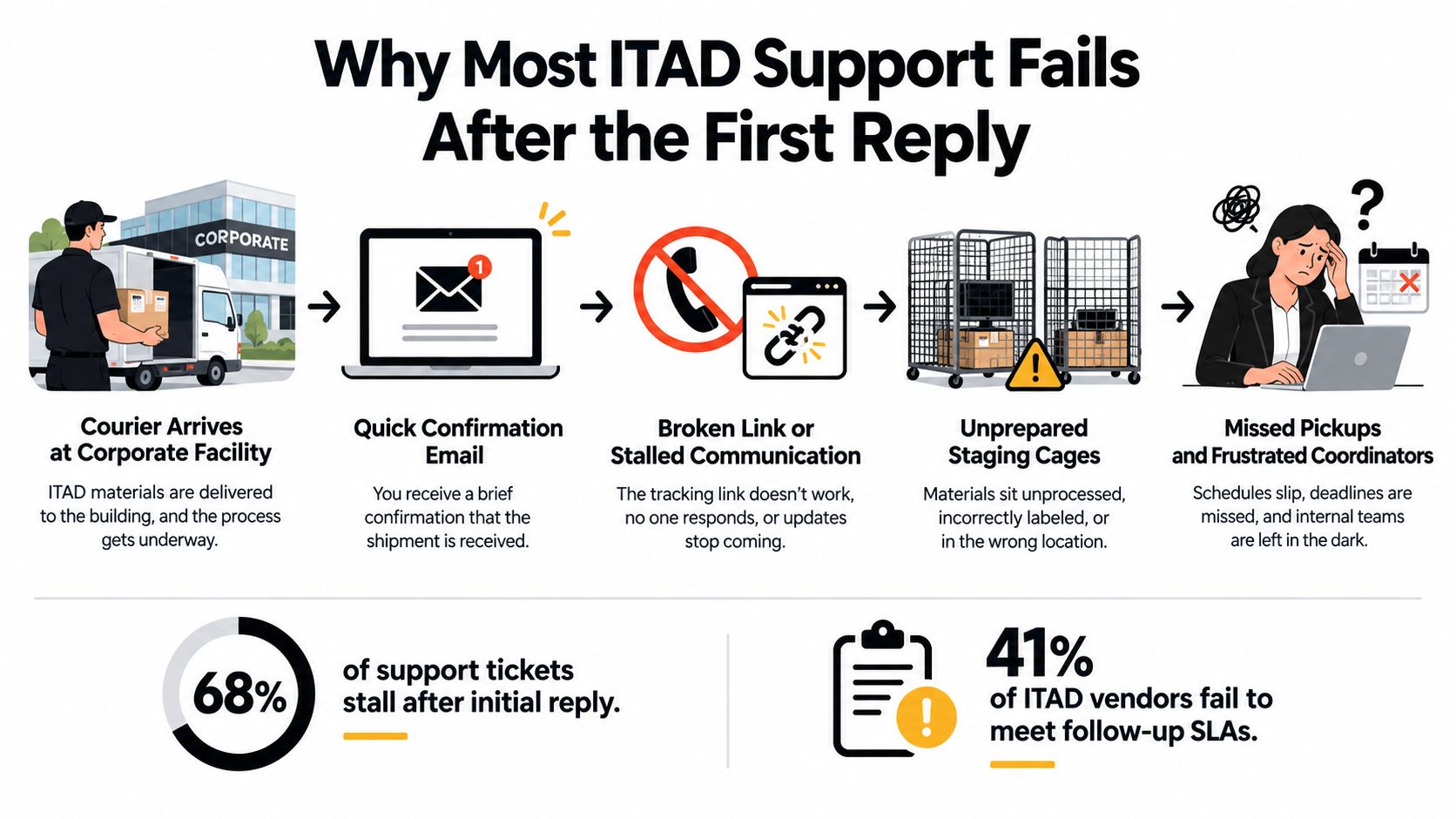
Responsive customer support in ITAD has a strict definition: accountability begins when the request arrives and ends only when the customer receives a complete, usable closure record. A confirmation email is one checkpoint, not the finish line.
The Real Cost of Slow Support in E-Waste Workflows
Slow support creates operational drag in ordinary service environments. In e-waste workflows, it can also expose data, delay decommissioning, and weaken the documentation needed to demonstrate responsible handling.
The compliance environment requires local attention. The United States has no single federal electronics-recycling law, and 25 states plus the District of Columbia have enacted their own e-waste legislation (state e-waste compliance requirements). A vendor that can't explain its collection, processing, and documentation responsibilities by location is creating uncertainty before equipment leaves the facility.
Data risk follows the physical asset. A laptop, server, hard drive, medical device, or laboratory instrument may contain sensitive information even when it appears obsolete. NIST Special Publication 800-88 defines three media-sanitization levels, Clear, Purge, and Destroy, which help organizations select an appropriate method based on the media and sensitivity (NIST-aligned sanitization guidance).
Three delay multipliers
A missed confirmation can block a loading dock or leave a decommissioning room occupied. A missing asset record can force an IT team to reconcile equipment manually. A late certificate can extend an audit request and prevent security staff from closing the related control.
| Delay Scenario | Operational Impact | Compliance / Data Risk | Typical Cost Range |
|---|---|---|---|
| Pickup window isn't confirmed | Staff, dock space, and staging labor remain committed | Assets may sit in an uncontrolled area | Not specified |
| Asset count or serial data is incomplete | Reconciliation and downstream processing slow down | Chain-of-custody evidence becomes harder to verify | Not specified |
| Destruction status isn't updated | Security and IT teams can't confirm disposition | Data-bearing devices may remain subject to unresolved risk | Not specified |
| Certificate delivery is delayed | Audit and asset-retirement records stay open | Proof of destruction isn't available when requested | Not specified |
| Carrier or subcontractor issue isn't escalated | Rescheduling affects facilities and project timelines | Handoffs may lack clear accountability | Not specified |
The table deliberately avoids invented dollar estimates. The available evidence establishes the response gap, not a universal cost range for late certificates or missed pickups. Your organization should calculate those costs from actual labor, room utilization, lease-return deadlines, audit effort, and incident exposure.
The EPA connects environmental and security duties in certified electronics recycling. Certified recyclers must maximize reuse and recycling, minimize human-health and environmental exposure, ensure safe downstream handling, and require destruction of data on used electronics (EPA requirements for certified electronics recyclers). A slow reply during a pickup or sanitization event is therefore more than poor etiquette. It can signal that the control itself isn't operating.
Designing Channel-Specific SLAs That Actually Work
A single response promise across every channel is lazy service design. A phone call during an active pickup incident doesn't carry the same urgency as an email asking for a future office cleanout estimate. Set the SLA around the operational event, then require enough information for the clock to mean something.
Use channel-specific targets that a vendor can measure:
| Channel | Use Case | First Response Target | Closure Target | Required Data Capture |
|---|---|---|---|---|
| Phone | Active pickup, security, or safety incident | 15 minutes | Same operating window or documented escalation | Ticket ID, site, pickup window, issue, caller |
| Standard request, asset list, compliance question | 1 hour | Defined by project phase | Ticket ID, asset class, location, requested service | |
| Chat or text | Quick triage and scheduling | 30 minutes | Routed to a tracked ticket | Contact, site, urgency, service type |
| Reschedule request | Carrier, access, or facility change | 2 hours | Confirmed appointment or named owner | Original window, new window, carrier, access notes |
These targets come from the operating framework, not from the benchmark study. They should be adjusted to your coverage model, but they must be written into the vendor agreement rather than implied in a sales conversation.
Make every first reply useful
A placeholder acknowledgment wastes the most important early exchange. Require the first substantive response to capture:
- Ticket ID and owner: The customer knows where to reference the issue and who carries it.
- Scheduled pickup window: The record shows the date, time range, site, and access conditions.
- Driver or carrier details: The logistics team can coordinate arrival and loading.
- Asset class and scope: The request identifies laptops, servers, networking equipment, medical equipment, laboratory equipment, or mixed electronics.
- Destruction method: The record states whether the project uses Clear, Purge, or Destroy, where applicable.
- Certificate expectation: The vendor states what evidence will be delivered and when.
Use templates for consistency, but don't let automation substitute for ownership. The AI-era support problem is especially clear in complex workflows. New 2026 CX data reports that half of surveyed customers identify lack of empathy as their biggest frustration, while only 23% of executives rank it as a priority. The same source reports that 95% of consumers want AI decisions explained, while only 37% of companies explain them (AI-era customer experience expectations). If an automated system routes a data destruction request, the customer still needs to understand the next step and escalation path.
Teams designing an omnichannel model can use the Formbricks omnichannel guide as a reference for coordinating conversations across channels. For an ITAD partner, the practical test is simple: every channel must feed one ticket, one owner, and one closure record. A written service-level agreement framework should define those requirements before the first pickup.
Every SLA needs three fields in the ticketing system: a recorded start time, a named owner, and a closure tied to a verified artifact. Without those fields, you're measuring activity rather than responsiveness.
Building an Escalation Path That Prevents Silent Tickets
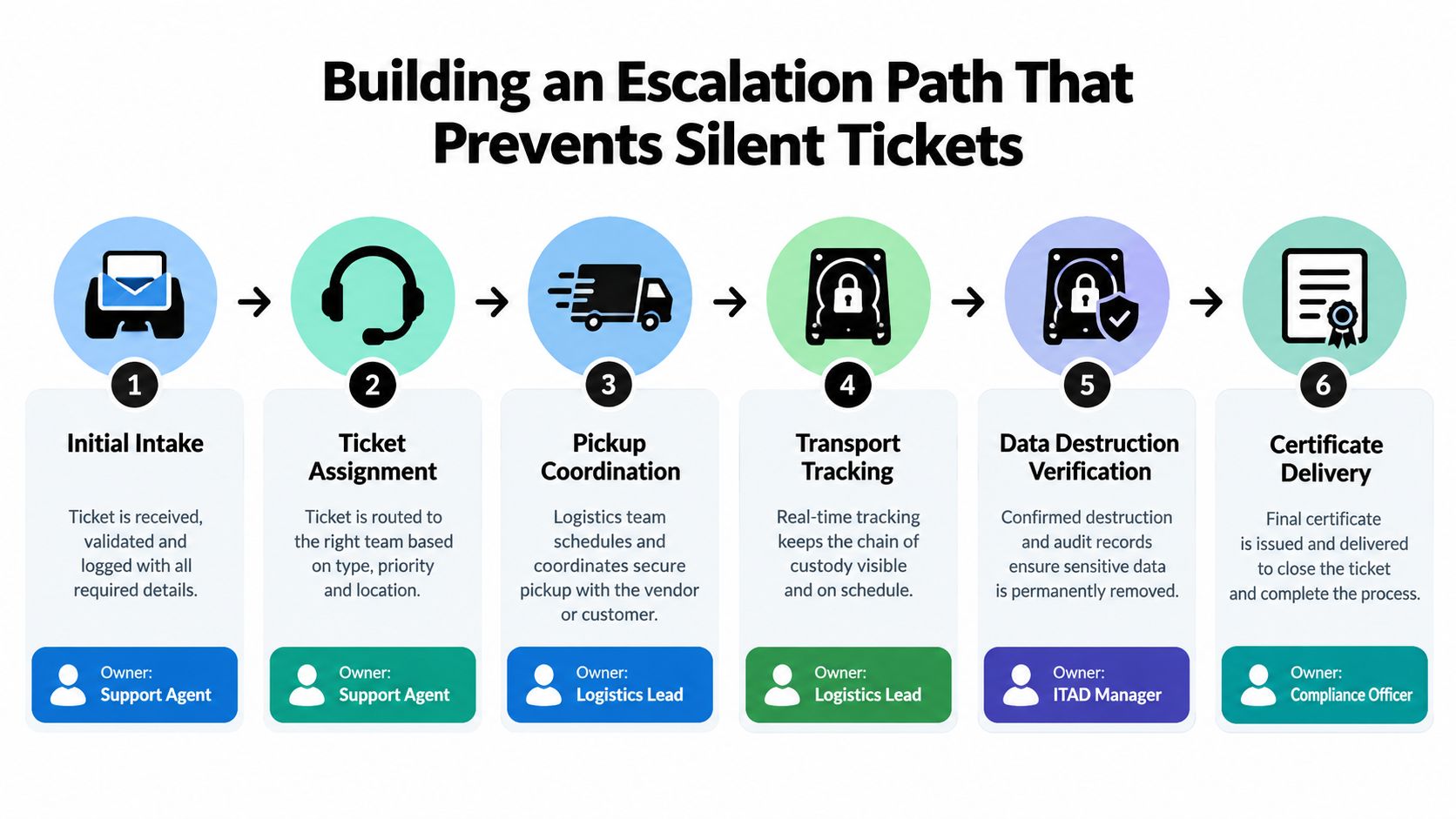
A ticket becomes dangerous when everyone assumes someone else owns the next action. Fix that with a tiered escalation path that follows the physical movement of the equipment.
The support agent owns intake and classification. The Logistics Coordinator owns pickup readiness and carrier communication. The ITAD Manager owns project execution across transport and processing. The Compliance Lead owns sanitization evidence, certificates, and audit questions. The Account Manager owns commercial exceptions and executive communication.
Use phase tags and timed handoffs
Tag every ticket by project phase, such as quote, pickup, processing, or reporting. Add issue tags for missed arrival, asset discrepancy, data destruction exception, certificate delay, and customer-requested change. Routing then sends the issue to the specialist who can act, instead of placing it in a general queue.
Use these checkpoints:
- At intake: The Support Agent confirms the request, creates the ticket, and records the required asset and site information.
- At four hours: If the assigned owner hasn't accepted the action, the Logistics Lead or ITAD Manager receives the escalation.
- At 24 hours: Any unresolved pickup, transport, or documentation issue moves to the ITAD Manager, with the Account Manager copied.
- At 72 hours: A stalled compliance or certificate issue goes to the Compliance Lead and Account Manager for a written recovery plan.
- At closure: The owner attaches the signed BOL, sanitization report, certificate PDF, or other agreed artifact before closing the ticket.
Sample escalation matrix
| Issue Type | Primary Owner | Escalation Trigger | Customer Update |
|---|---|---|---|
| Quote or service scope | Support Agent | Missing information at intake | Same business window |
| Pickup scheduling | Logistics Coordinator | No confirmed window or carrier | At each material change |
| Missed pickup | Logistics Lead | Driver absent or site inaccessible | Immediate incident update |
| Asset discrepancy | ITAD Manager | Count or serial mismatch | Recovery plan after review |
| Data destruction exception | Compliance Lead | Method or evidence question | Written explanation and next step |
| Certificate delay | Compliance Lead | Artifact not delivered as promised | Status update until delivery |
The no-silence rule matters most when there isn't new information. Send an update that states what has been checked, who owns the next action, and when the next update will arrive. Customers can tolerate a delay more easily than uncertainty, especially when a decommissioning schedule, secure data destruction requirement, or public-sector record is involved.
Metrics That Measure Real Responsiveness
First response time is useful, but it can become a vanity metric when the team closes tickets at acknowledgment. ITAD leaders need measurements that follow the work until the customer has evidence of completion.
Track four core indicators:
- First Response Time: The time from the customer's request to the first substantive response, separated by phone, email, chat, and scheduling.
- Full Resolution Time: The elapsed time from intake to a complete operational and documentation closure.
- Customer Satisfaction on Closed Tickets: A short survey after closure that asks whether the customer received clear communication, reliable ownership, and usable evidence.
- Chain-of-Custody Confirmation Rate: The share of completed projects with confirmed handoffs and required artifacts attached to the record.
The useful target isn't the average alone. Averages hide the one missed pickup that created a serious escalation. Review median performance, breached tickets, oldest open tickets, and the percentage of records missing a closure artifact.
| Metric | Target | Measurement Window | Workflow Stage |
|---|---|---|---|
| First Response Time | Under 2 business hours | Intake to substantive reply | Request intake |
| Full Resolution Time | Under 5 business days for standard pickups | Intake to complete closure | End to end |
| CSAT on closed tickets | Track every closed ticket | Immediately after closure | Customer experience |
| Chain-of-Custody Confirmation Rate | 100% confirmation within 24 hours of certificate generation | Certificate generation to customer confirmation | Reporting and audit |
The targets above are operating targets for a support program, not universal industry statistics. Put them in the dashboard with the channel, project type, location, asset class, and assigned owner. A standard laptop pickup shouldn't be judged against a data center decommissioning project with multiple sites and specialized equipment.
Build the review rhythm
Use a daily queue view for active pickups and incidents. Hold a weekly operations review for SLA breaches, repeated reschedules, missing serial records, certificate delays, and tickets that required customer follow-up. Review CSAT comments with logistics and compliance leads, not just the support manager.
Real-time visibility helps customers and internal teams see movement without sending duplicate messages. For example, Reworx Recycling's real-time tracking service can be evaluated as part of a broader support and reporting workflow. The tool matters less than the discipline behind it. A dashboard that doesn't trigger ownership is just a display.
Separate channel performance from end-to-end performance. A team can answer every email within target and still miss pickups or delay certificates. Your scorecard should show where the breakdown occurred, who owned it, and whether the customer received a complete recovery update.
Vendor Evaluation Checklist for Support-First ITAD Partners
Don't evaluate an ITAD vendor only through equipment pricing or recycling claims. Ask how the partner behaves when a carrier misses a window, a serial count doesn't reconcile, or a security team needs destruction evidence before the project can close.
Use a written questionnaire and request sample reports. Strong vendors answer with named roles, measurable commitments, and actual artifacts. Weak vendors rely on phrases such as “we'll take care of it” without defining who acts or when.
Responsiveness commitments
Ask:
- What are your response targets for phone, email, chat, and rescheduling?
- Do you provide after-hours coverage for active pickups and security incidents?
- How do you record the SLA start time?
- What happens when a target is missed?
A strong answer includes channel-specific commitments and an escalation timer. A weak answer promises a “dedicated team” without written terms.
Escalation infrastructure
Ask for:
- Named account, logistics, and compliance contacts.
- A sample ticket showing ownership and internal notes.
- Handoff rules from intake through certificate delivery.
- Customer visibility into open issues and status changes.
The partner should demonstrate one queue or connected system that preserves the full record. If each department keeps separate email threads, expect silent handoffs.
Compliance readiness
Check whether the vendor can provide:
- Applicable certification details, including R2v3 or e-Stewards where relevant.
- Chain-of-custody records and downstream processing information.
- Data destruction certificates and method documentation.
- Procedures for state-level requirements and regulated equipment.
A strong answer connects secure data destruction with environmental processing. The EPA states that certified electronics recyclers must support reuse and recycling, safe downstream handling, and data destruction, so these shouldn't be treated as unrelated services.
Operational reliability
Request evidence for:
- On-time pickup performance.
- Certificate turnaround process.
- Geographic coverage and subcontractor controls.
- Handling of office cleanout, facility cleanout, data center decommissioning, and specialized streams.
- Capabilities for laptop disposal, medical equipment disposal, laboratory equipment disposal, and product destruction.
Don't accept an operational claim without asking how it is measured and what happens when performance slips.
References and commercial transparency
Ask for verifiable references, retention context, relevant case studies, and permission to speak with a client about support quality. If you're comparing internal support with customer support outsourcing companies, compare ownership, escalation access, security controls, and documentation, not just labor coverage.
Weight the categories according to your risk. A school may prioritize secure data destruction and simple pickups. A healthcare organization may weight documentation and equipment handling more heavily. An enterprise data center may put logistics, geographic coverage, and certificate controls first.
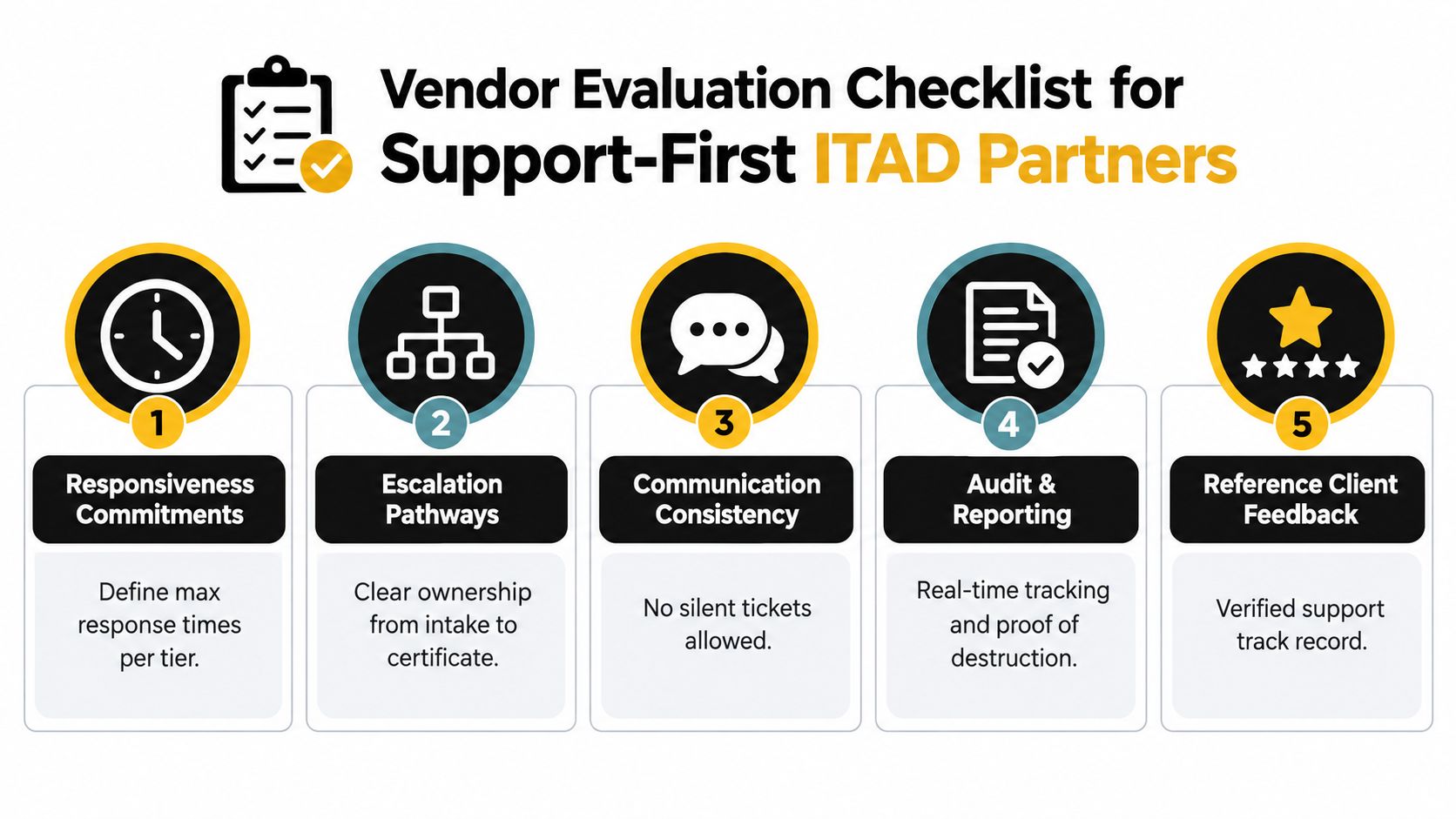
Red-flag any vendor that refuses to put SLA terms in writing, won't identify escalation owners, or can't show a complete example of closure evidence. Responsive customer support is part of the control environment, so evaluate it before signing, not after the first failed pickup.
For a structured comparison, use ITAD vendor selection criteria that covers service scope, documentation, data security, and operational fit.
Putting It All Together With Reworx Recycling
A support-first program can be rolled out in 30 days if the team stops treating it as a software project and starts treating it as an ownership project.
Week one: Baseline current response and closure times. Map every handoff from quote to pickup, processing, reporting, and certificate delivery. Identify tickets that required customer follow-up and assign the underlying failure to a process owner.
Week two: Publish channel-specific SLAs. Name the Support Agent, Logistics Coordinator, ITAD Manager, Compliance Lead, and Account Manager for each project type. Add the no-silence rule and escalation checkpoints to the operating procedure.
Week three: Wire the dashboard and CSAT request into the ticketing system. Require each record to capture the pickup window, asset list, destruction method, owner, and expected certificate timing.
Week four: Run a pilot pickup, then audit the chain-of-custody confirmation latency. Review whether each handoff produced a usable artifact and whether the customer received updates without asking.
Use this language for the initial customer email:
Pickup confirmation: Your pickup window is [date and time]. The approved asset list includes [asset classes and quantities]. The requested data destruction method is [method]. [Owner name] is responsible for coordination, and the certificate package will be delivered through [channel] after processing. We'll provide the next status update by [time].
After delivery, send a closeout message that asks for a CSAT rating, confirms the certificate was received, and references any agreed community impact reporting. That final exchange turns a completed transaction into an auditable service record.
Reworx Recycling can fit this model for organizations planning electronics recycling, donation-based recycling, business pickups, equipment decommissioning, secure hard drive shredding, and IT asset disposition services. Its donation-based social enterprise model connects responsible downstream processing with technology donations, digital inclusion, and workforce development, giving sustainability and community impact teams a concrete outcome to include in their reporting.
Reworx Recycling helps businesses coordinate responsible electronics recycling, IT equipment disposal, business pickups, equipment decommissioning, and secure data destruction with clear communication throughout the workflow. Visit Reworx Recycling to learn how to donate old equipment, schedule a pickup, or build a support-ready recycling program that protects data and supports communities.