Global return costs exceeded 1 trillion U.S. dollars, and North America alone accounted for 363 billion U.S. dollars in return delivery costs in 2019, according to Statista's reverse logistics data. That's the scale behind reverse logistics returns, not a small back-office chore, but a recurring supply chain flow that touches receiving docks, IT closets, warehouse space, and finance teams alike. For facilities managers, procurement leads, and IT asset owners, the key question isn't whether returns happen, it's whether the organization treats them as a managed recovery process or an expensive pileup.
What Reverse Logistics Returns Really Mean for Modern Businesses
Reverse logistics returns are the planned movement of goods backward through the supply chain, from the end user back to the seller, refurbisher, recycler, or donation partner. In practice, that can mean a retail return, a warranty swap, a lease-end device, a decommissioned server, or a pallet of office laptops headed for IT asset disposition. The point is simple, the item is no longer following the forward sales path, so the business needs a structured way to sort, inspect, document, and route it.
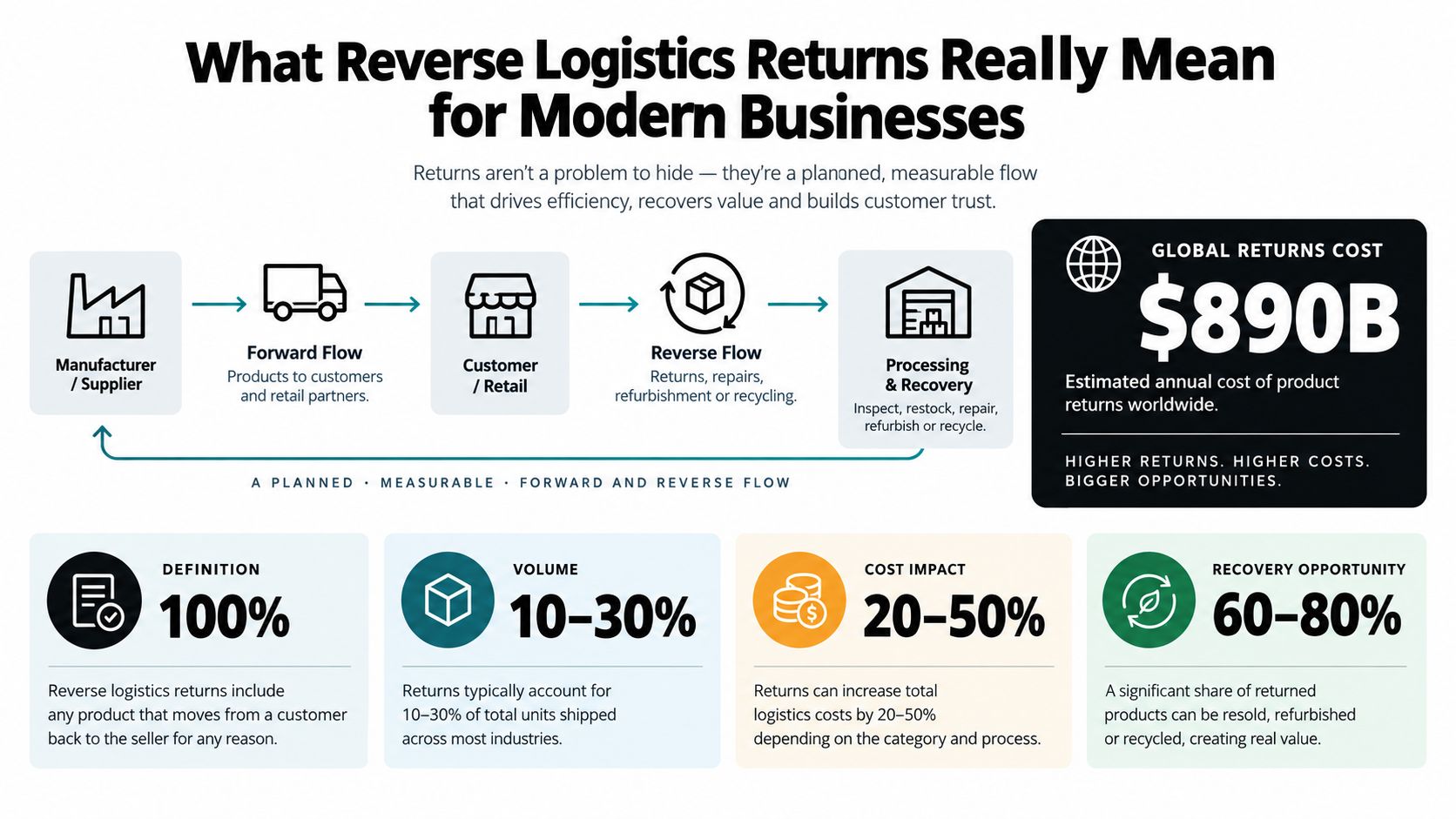
A useful way to think about this flow is as a second supply chain running in the opposite direction. The forward chain ships products out, while the reverse chain decides whether an item gets resold, refurbished, donated, recycled, or destroyed. That decision point matters because value is recovered or lost right there, not at the end of the process. For readers who want a broader operational lens, the reverse logistics companies guide is a practical way to compare service models and responsibilities across providers.
For IT and electronics, reverse logistics touches IT asset disposition (ITAD), electronics recycling, and secure data destruction in the same motion. A laptop can't be treated like a plain return if it still contains drive data, warranty records, or lease obligations. That's why chain-of-custody paperwork, grading, and sanitization need to be part of the return workflow, not an afterthought. The core idea is reflected in Reworx Recycling's reverse logistics benefits page, where returns are framed as a recovery process rather than a disposal problem.
Practical rule: if a returned asset can't be traced from pickup to final disposition, the organization doesn't really control the return.
That shift in mindset changes planning. A facilities manager who sees returns as a measurable stream will budget for receiving space, sorting labor, and partner handoffs the same way they budget for inbound freight. A team that still thinks of returns as exceptions usually ends up paying for them in overtime, clutter, and rushed decisions.
Why Returns Volumes Are Structurally Higher Than Your Forecast Shows
A consumer ordering apparel online knows the routine. Sizes do not fit, colors look different on screen, and the item gets boxed back up. Business buyers face a similar pattern, but with more moving parts, because remote purchasing, equipment refresh cycles, lease returns, warranty claims, and decommissioning programs all create a steady reverse flow that does not show up neatly on a normal purchase forecast.
The structural difference shows up in the numbers. A 2025 National Retail Federation and Happy Returns report said retailers expected 15.8% of annual sales to come back in 2025, totaling 849.9 billion dollars, and online sales were expected to have a 19.3% return rate. The same report found that 9% of all returns were fraudulent. That does not mean every business will mirror retail, but it does explain why reverse logistics has to be designed around recurring volume, not occasional surprises. For a useful market snapshot, see the NRF return benchmark coverage.
| Driver | Consumer Returns | B2B IT Returns |
|---|---|---|
| Purchase trigger | Fit, preference, damage | Refresh cycles, lease ends, warranty events |
| Return timing | Immediate after delivery | Staged, tied to project milestones |
| Volume pattern | Seasonal spikes | Project-based waves |
| Decision owner | Shopper or customer service | IT, procurement, facilities, compliance |
| Main concern | Refund or exchange | Reuse, data risk, recovery value |
The B2B pattern is less visible, but often more operationally complex
Consumer returns usually end when the refund posts. B2B IT returns often continue through decommissioning, asset tracking, inspection, and downstream routing. That can include a lease-end buyback, an office cleanout, or a data center decommissioning project with dozens or hundreds of devices moving at once.
Recent network-design research in electronics reverse logistics shows why that matters. A return-network model for the consumer electrical and electronics sector found 39.9% average cost savings when the return network was redesigned versus the current process. The lesson is not that every team will save the same amount, but that the structure of the return network, where items consolidate, how they move, and how quickly they are classified, drives the economics more than the return event itself.
Returns are a wave, not a one-off task. If dock space, inspection labor, and partner pickups are not sized for the wave, the backlog becomes the business problem.
A procurement lead may think in terms of vendors and price points, while facilities teams think in terms of pallets, cages, and truck routes. Reverse logistics asks both groups to look at the same flow and decide how much of it can be consolidated, inspected locally, or sent downstream quickly enough to preserve value.
The Core Return Flow From Authorization to Final Disposition
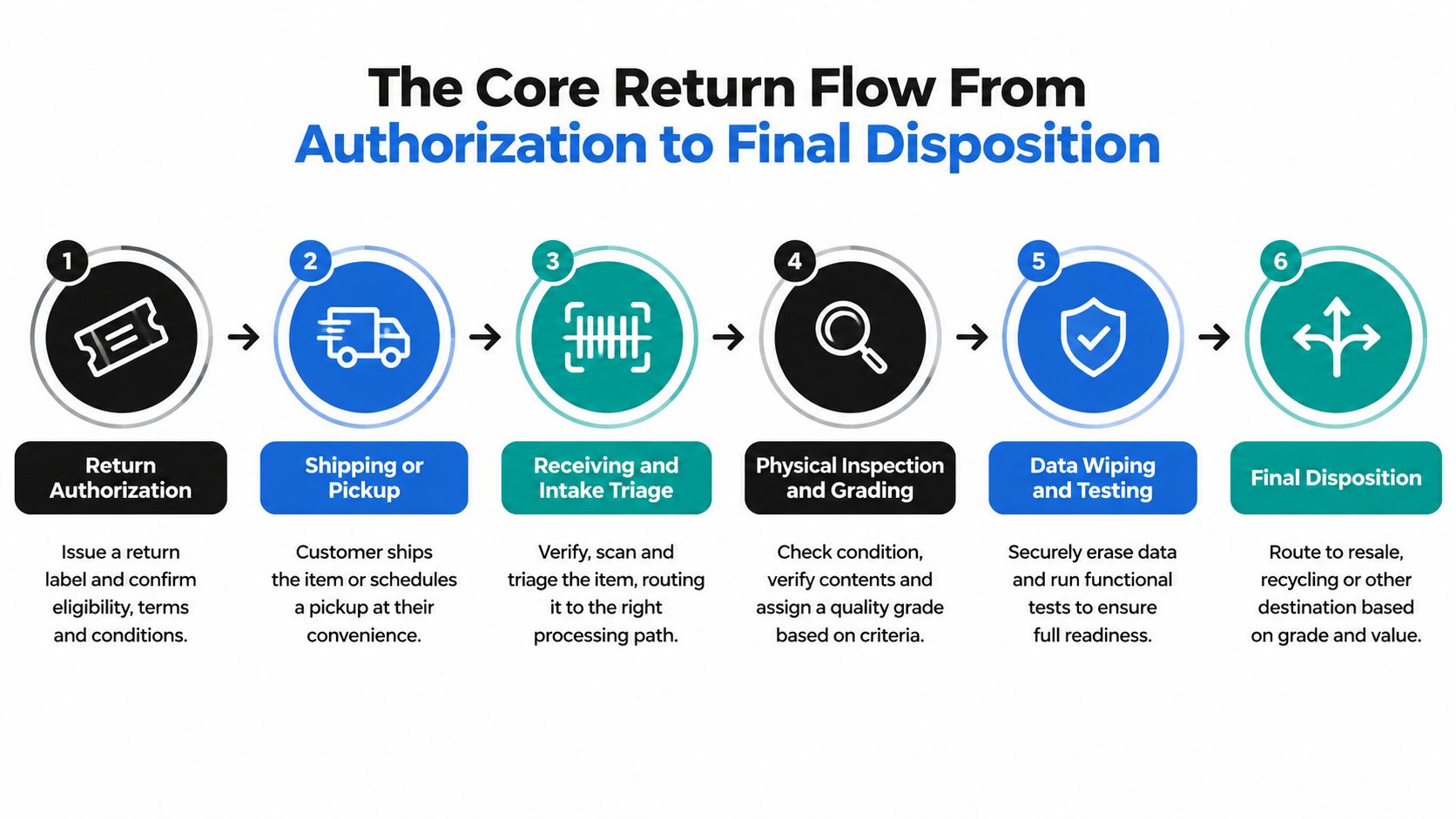
A well-run return process starts before anything physically moves. Return authorization sets the rules, confirms eligibility, and tells the receiving team what's coming. If that first step is sloppy, every later handoff becomes guesswork. For business equipment, the best authorizations include asset lists, serial numbers, pickup instructions, and the reason for the return, because those details shape how the item is handled at intake.
The handoffs are where control is won or lost
After authorization, the item is shipped or picked up, then logged at receiving. That receiving bench is where teams verify counts, capture serial numbers, and separate obvious exceptions from the normal flow. A good intake process turns a pile of mixed equipment into a tracked stream with clear labels, while a weak one creates confusion that lingers all the way to final disposition.
If you're reviewing a refund-style process for consumer goods, the check refund eligibility resource is a reminder that eligibility checks should happen early, before the business spends time moving and touching the wrong item. The same logic applies to IT returns. If the return wasn't approved, or the device isn't supposed to come back at all, the mistake should be found at the dock, not after testing begins.
The rest of the flow is mechanical once the handoffs are disciplined. Inspection and grading determine whether the item gets wiped, repaired, harvested for parts, resold, donated, or recycled. Each transfer should leave an audit trail. That means the team handling pickup, the team receiving the asset, and the team approving final disposition all need the same serial-level record.
Treat each step as a checkpoint, not a handoff of trust
A simple way to keep the process honest is to ask one question at each stage, “What proof do we have that the asset is exactly where we say it is?” If the answer is weak, the system isn't ready for scale. In reverse logistics, speed matters, but traceability matters more, because one missing record can break the value chain later.
Inspection, Grading, and Refurbishment Workflow Decisions
Once assets reach the bench, technicians need a rubric, not a debate. A solid grading system sorts items into functional, refurbishable, or end-of-life streams. Functional units can be redeployed or resold quickly, refurbishable units need parts, cleaning, firmware resets, or cosmetic work, and end-of-life units should move to responsible recycling without delay.
The fastest teams don't start with deep diagnostics. They start with visible condition, power-on status, screen integrity, battery condition, port damage, and missing parts. Those checks are enough to make a routing decision in many cases, which keeps high-value items from sitting around while a queue builds. A slower team often loses money not because the device is bad, but because the process waited too long to decide.
| Grade | Condition Criteria | Routing Decision | Typical Disposition |
|---|---|---|---|
| A | Fully functional, clean, no visible damage | Route to resale or redeployment | Secondary market or internal reuse |
| B | Functional with minor repair needs | Send to refurbishment | Repair, test, then resell or redeploy |
| C | Limited value, major defects, or missing parts | Send to recycling | Certified recycling or material recovery |
A benchmarked electronics reverse logistics program shows that moving items to disposition in under 15 days outperforms slower operations, while delays beyond 30 days are associated with below-average performance. Faster triage preserves resale and parts value because it reduces storage, testing, and obsolescence exposure. That matters most for equipment with short market lifecycles, where waiting too long means the secondary-market window closes before the asset ever gets listed.
The trade-off is straightforward. Every extra hour spent on an item that clearly belongs in the scrap stream is an hour not spent on a refurbishable laptop or a unit with intact parts value. Teams should build partner SLAs around pass or fail thresholds, not vague language like “best effort.” If the partner can't make a quick disposition call, the network starts leaking value.
Reworx Recycling's approach to buying a refurbished laptop fits into that kind of decision tree, where condition grading and downstream routing determine whether an asset still has a useful second life. The important point for buyers is not the label on the box, but whether the grading standard is clear enough to keep inventory moving.
Operational rule: the longer an item waits on the bench, the more it costs to decide what it's worth.
Data Sanitization and Chain of Custody as Built In Steps
A returned device can look ready for resale and still hold recoverable data. That is why sanitization belongs inside the inspection workflow, the same way a quality check belongs before a part leaves a shop floor. NIST SP 800-88 Rev. 2 gives the common reference point here, with Clear, Purge, and Destroy as the three disposal methods used to make storage media unrecoverable by known techniques. For a plain-language walkthrough of the methods, see Reworx Recycling's data sanitization guide.
Chain-of-custody records keep that process auditable. In practice, the file should show the serial number, intake timestamp, technician ID, sanitization method, and final disposition. For a facilities manager, that record is the paper trail that answers a simple question later, who had the asset, what was done to it, and when did that happen.
Compliance has to fit the workflow
Different media need different treatment. Logical wiping can fit some assets, while physical destruction fits others, and degaussing only works for certain media types and risk tolerances. The method should match the device class, the sensitivity of the data, and the organization's legal duties.
New Jersey's records-destruction rule shows how specific those duties can be. If a business or public entity no longer keeps customer records with personal information, it must destroy them or arrange destruction by shredding, erasing, or otherwise modifying the information so it is unreadable, undecipherable, or nonreconstructable through generally available means. Returned devices have to meet that standard before they can be treated as ordinary surplus.
That is why certificate-of-destruction records and verification sampling belong in the process, not in a separate cleanup step. If an auditor or buyer asks what happened to a specific asset, the answer should trace from pickup through the last verified action without gaps.
EU treatment of returned electronics makes the split between physical handling and information handling even clearer. Under the WEEE framework, non-restockable returned electronics must go to authorized treatment facilities instead of standard waste streams, and GDPR requires personal data to be securely erased before resale or further processing. A device can therefore need two routed paths at once, one for compliant material handling and one for data protection.
Cost Reduction Tactics Built Into the Return Network
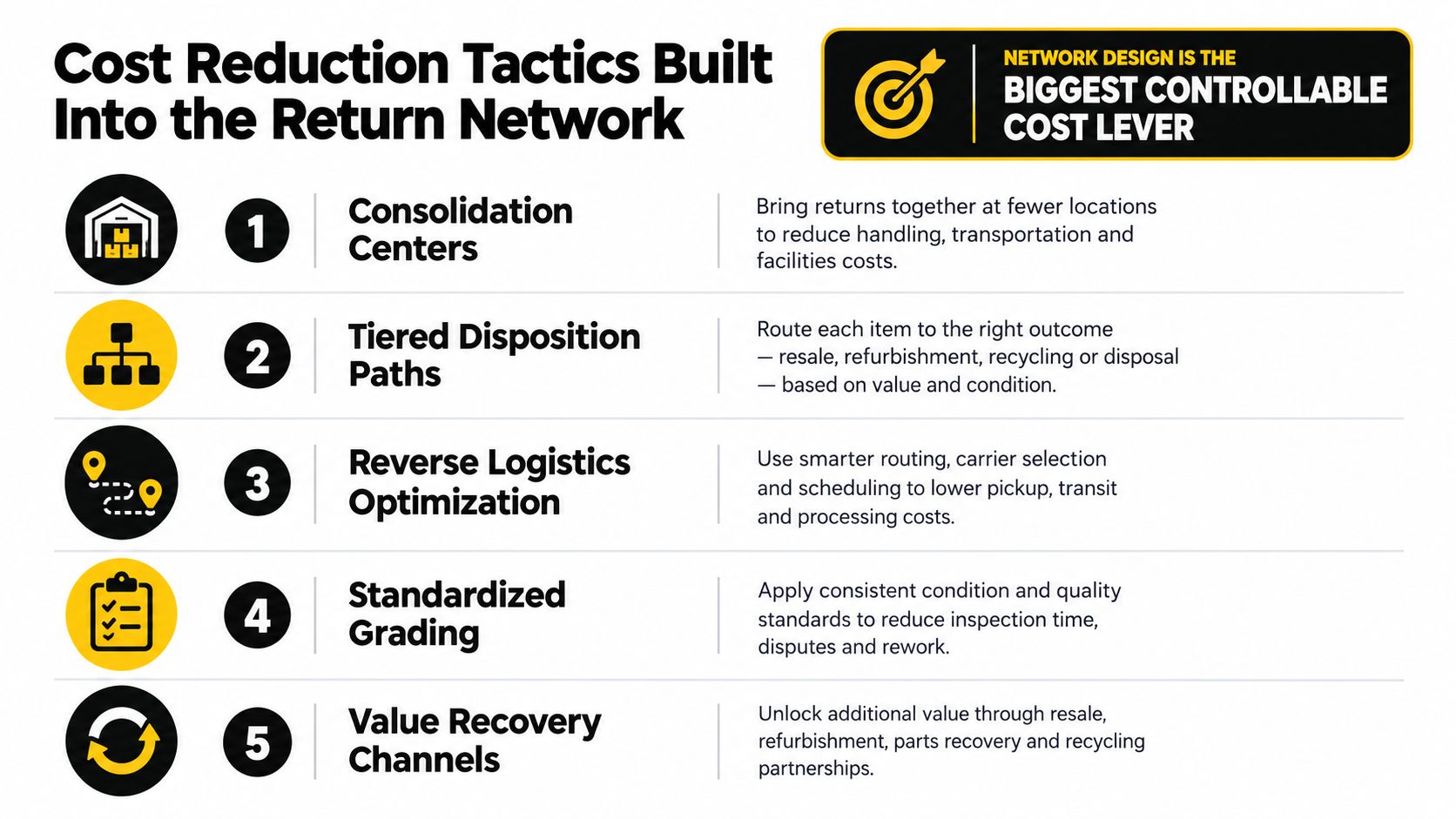
The biggest cost lever in reverse logistics is usually the network design itself. If returns bounce through too many handoffs, too many miles, or too many low-value touchpoints, the economics get worse before anyone notices. A well-structured network reduces unnecessary transport, shortens sorting time, and pushes each asset into the right downstream channel sooner.
Design choices beat ad hoc handling
Consolidation centers are useful when the alternative is a scatter of small return shipments that each carry their own freight and handling cost. Tiered disposition paths keep grade-A assets away from scrap channels, so the business can recover value instead of flattening everything into one disposal lane. Standardized grading also helps because the receiving team makes fewer subjective decisions, and that cuts rework.
The same network logic shows up in market behavior. Recent coverage noted that collection points were growing while home pickups declined in Europe, which suggests operators are already shifting toward more consolidated reverse flows. The practical takeaway is that last-mile convenience is not always the cheapest or cleanest option, especially when the return item has to be inspected, sanitized, and sorted before final disposition.
SKU-level routing rules and batch thresholds matter too. If one category of equipment always needs certification paperwork or special packaging, it should not be routed like common office supplies. A team can set a minimum batch size for pickups, group similar assets together, and negotiate with carriers around predictable lanes instead of one-off rush requests.
Know which levers you control
In-house teams usually control the policy side, the labels, the approval rules, and the timing of internal handoffs. Partners often control the deeper cost structure, including sorting capacity, refurbishment channels, and downstream resale access. That means the best savings plans are shared plans, with clear responsibilities on both sides.
If you want a practical starting point, Reworx Recycling's cost recovery strategies outline the kind of routing and value recovery choices that matter when a returned asset still has usable life. The important lesson is that the network should fit the product, not the other way around.
Useful test: if a return can be consolidated, graded, and routed in one pass, don't break it into three separate trips.
Putting It Together With a Practical Action Checklist
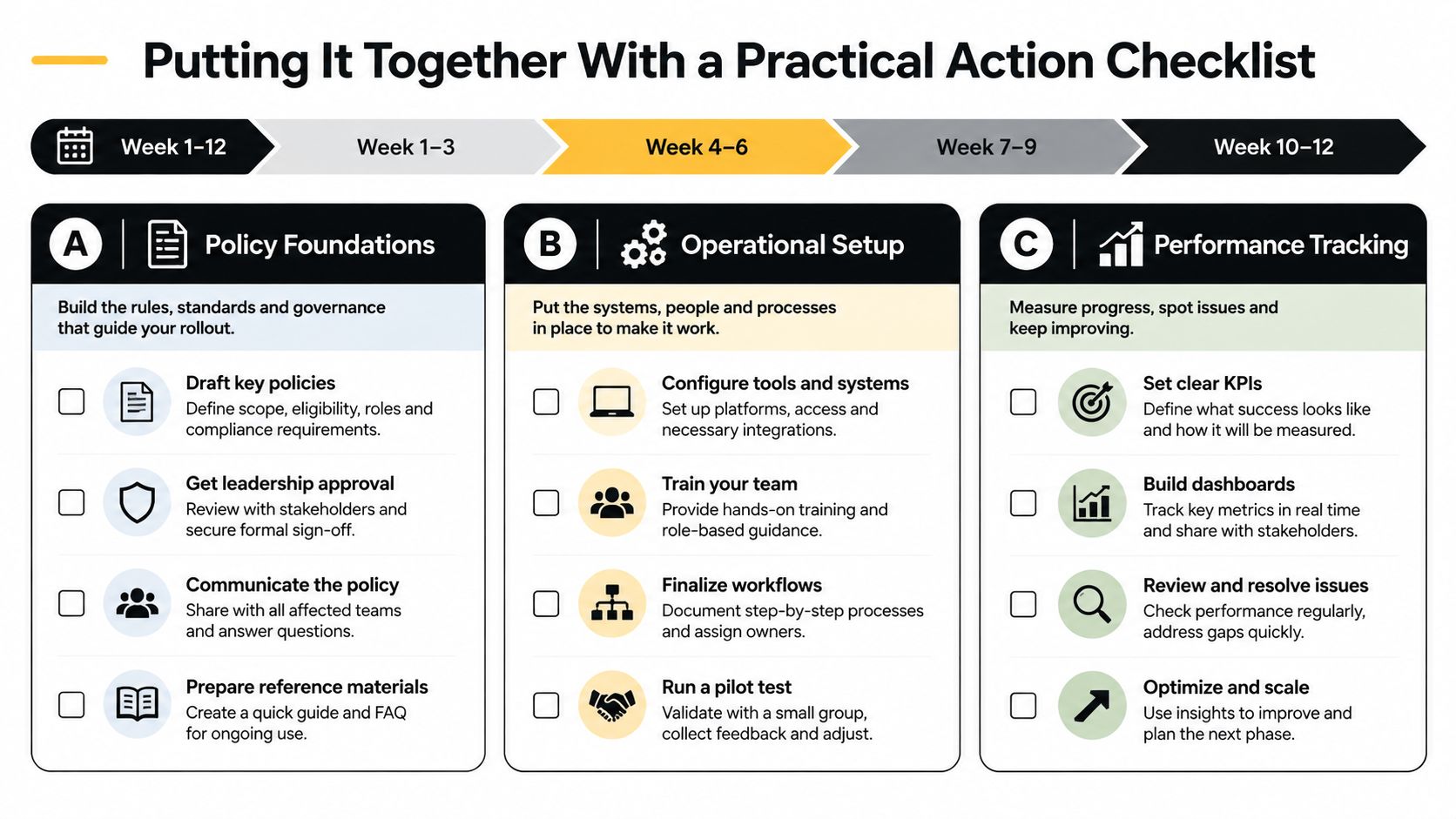
A return program is easier to run when the work is split into three stages, policy foundations, operational setup, and performance tracking. The sequence matters because reverse logistics returns are not just a shipping problem. They are closer to a triage desk, where each asset needs the right path before it can be reused, resold, recycled, or documented out of custody.
Policy foundations
- Set return authorization rules. Define who can approve a return, which asset types need pre-approval, and how long approvals stay valid.
- Standardize return reasons. Use a fixed list for defects, lease ends, refresh projects, warranty swaps, and end-of-life routing.
- Write grading criteria. Make pass or fail thresholds visible for screen condition, battery status, port damage, and missing components.
- Require serial-level intake. If the item cannot be matched to a record at the dock, it should not move into processing.
- Document chain-of-custody steps. Every handoff should show who had the asset, when it moved, and what happened next. A ready-made starting point is the compliance checklist template, which you can adapt to your own asset classes.
Operational setup
- Choose audited ITAD partners. Confirm they can handle collection, inspection, refurbishment, recycling, and downstream reporting.
- Build sanitization into intake. Decide which asset classes need Clear, Purge, or Destroy treatment before reuse or resale.
- Separate disposition lanes. Keep resale, donation, and recycling paths distinct so good assets are not downgraded by poor routing.
- Set inspection handoff rules. A device should move from intake to grading with the same paperwork trail, like a parcel moving through checkpoints instead of being dropped into a single bin.
Performance tracking
- Track cycle time. Measure how long an item sits before it is graded and routed.
- Watch recovery rate. Compare resale, refurbishment, donation, and recycling outcomes by asset type.
- Review cost per return. Include freight, labor, test time, storage, and downstream processing.
- Audit scrap ratio. If too many items fall into scrap, the grading or routing rules probably need work.
For organizations that want a downstream partner with a donation-based disposition model, Reworx Recycling is one option to evaluate alongside other ITAD and electronics recycling providers. The right partner should help you recover usable value, protect data, and keep equipment moving toward the right final path instead of sitting in storage.
If your team is sorting through office cleanout, laptop disposal, data center decommissioning, or secure data destruction, start with a documented return flow and a clear grading standard. Then visit Reworx Recycling to review practical guidance on electronics recycling, IT equipment disposal, and donation-based recycling that can help your organization plan the next pickup with less risk and more control.