Boston rewards travelers who plan by neighborhood rather than checklist. The city is compact enough for strategic walking routes, yet varied enough that crossing it repeatedly can waste valuable time. A well-planned day can connect historic landmarks, waterfront museums, cultural institutions, and local markets with fewer transfers and less backtracking.
This Massachusetts Boston travel guide organizes ten top attractions and hidden gems by location and trip purpose. You'll find routes for a half-day, a full day, and a longer visit, along with practical guidance on seasonal conditions, accessibility, dining, lodging, transit, admission planning, and corporate group travel. Boston is the capital and largest city of Massachusetts, sits on Massachusetts Bay, and covers 46 square miles, with more than one-fourth of the city's area made up of water, as Britannica's Boston overview explains.
The approach also works for business travelers. A corporate group might combine a Freedom Trail walk with downtown meetings, use the Fenway and Back Bay cultural district for client programming, or connect responsible travel planning with Reworx Recycling's mission when arranging an office cleanout, IT equipment disposal project, or broader sustainability initiative. If you're coordinating a renovation or addition before a business move, Aureli Construction's ADU planning resource offers a separate example of how careful space planning can support changing operational needs.
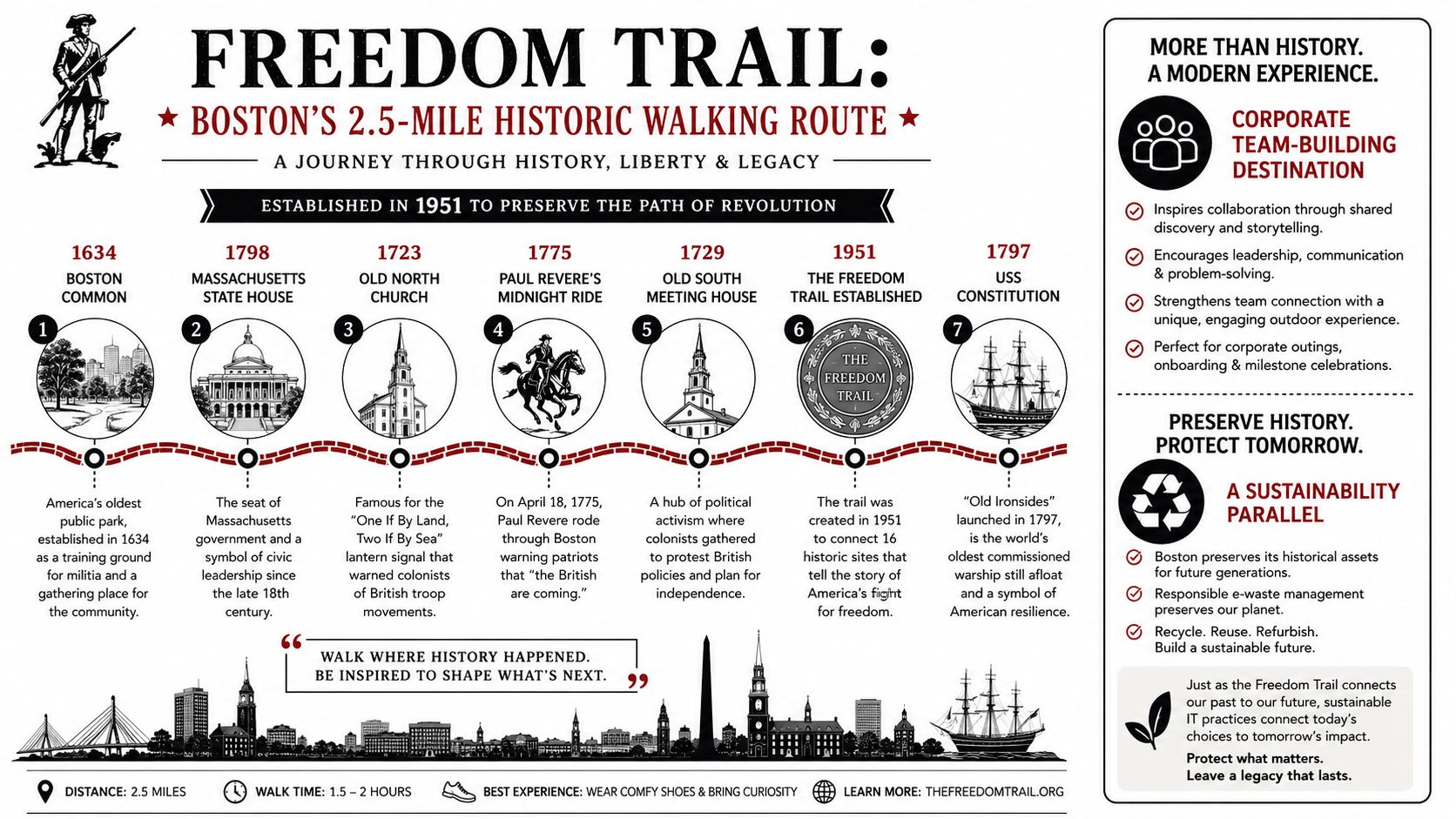
1. Freedom Trail Boston's 2.5-Mile Historic Walking Route and Corporate Sustainability Opportunity
The Freedom Trail is Boston's essential orientation route. Its red-brick line connects 16 historic sites across a 2.5-mile path, beginning at Boston Common and extending through downtown, the North End, and Charlestown to Bunker Hill Monument and the USS Constitution. The route's history is unusually long for a modern visitor attraction. It was officially dedicated in 1951, the red-brick line was added in 1958, and the route was extended in 1972, according to The Cultural Landscape Foundation's Freedom Trail history.
Start at Boston Common and follow the marked path toward the Massachusetts State House, historic burial grounds, Faneuil Hall, and the North End. The route is walkable, but it isn't uniformly flat or effortless. Cobblestones, crossings, stairs at some historic interiors, and busy sidewalks can affect visitors using mobility devices or traveling with young children, so check current site access before setting out.
Practical rule: Treat the trail as a connected route, not ten separate stops. Begin early, pause for lunch in the North End, and decide in advance whether Charlestown fits your energy and schedule.
For corporate groups, the trail offers a natural team-building setting without requiring a complicated venue program. A financial services team can use the downtown segment for an employee wellness walk, while a technology company might pair historic sites with a discussion about business change and responsible asset management. Boston businesses can also use the experience to introduce conversations about electronics recycling, sustainable recycling, and secure IT equipment disposal through Reworx Recycling's corporate sustainability and e-waste guidance.
Use the red line as a low-friction itinerary anchor, then connect nearby offices, restaurants, and meeting venues. For a shorter visit, walk from Boston Common to Faneuil Hall. For a fuller history-focused route, continue through the North End and reserve extra time for the Charlestown extension.
2. Museum of Fine Arts Boston Corporate Art Appreciation and Facility Decommissioning Insights
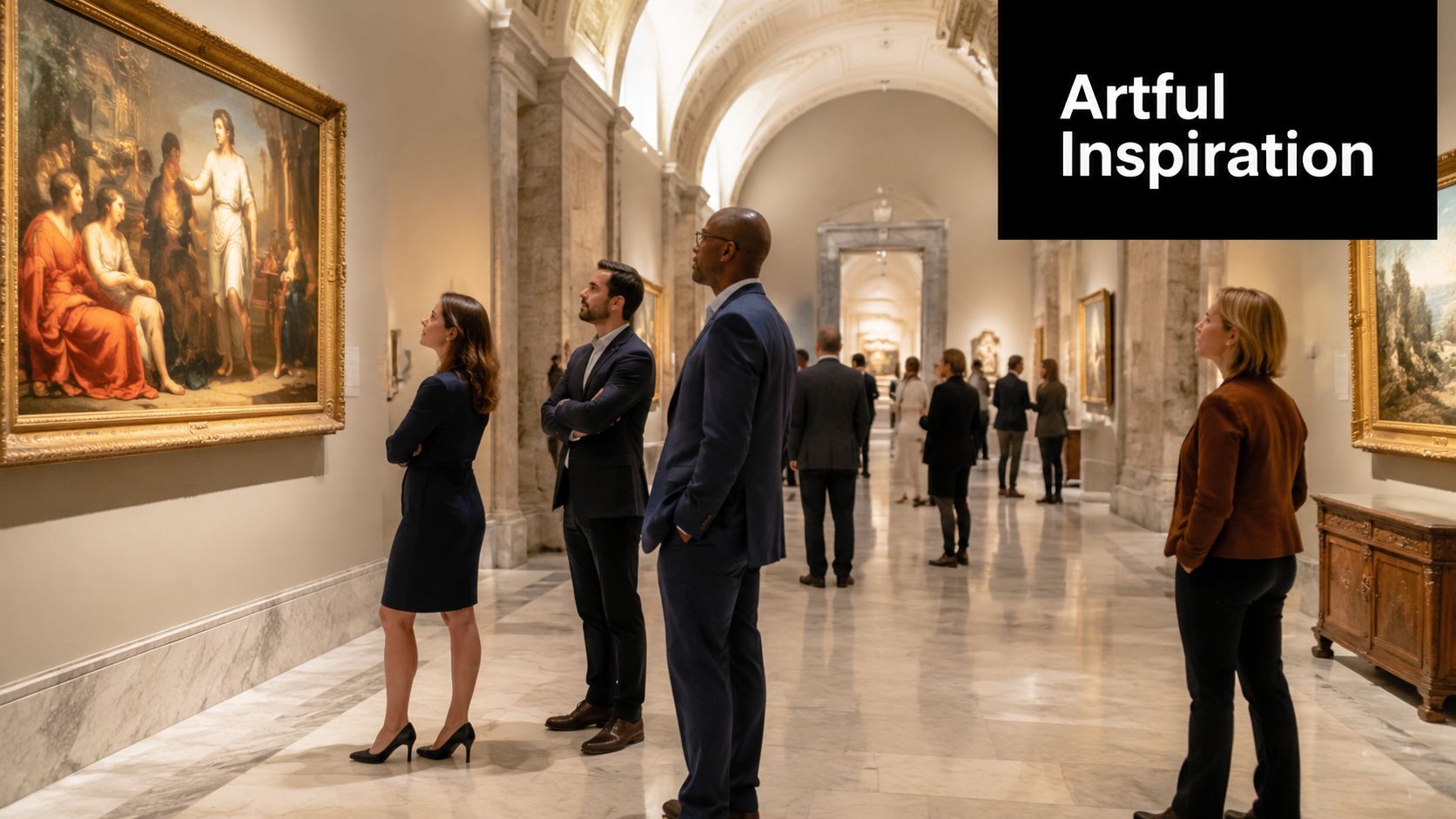
The Museum of Fine Arts, Boston gives visitors a different way to understand the city. Instead of moving through a linear historic corridor, you can spend a focused morning in the Fenway neighborhood, choosing galleries that match your interests and energy. The museum reported 849,041 visitors in FY2023 and 966,525 in FY2024, while FY2022 attendance was 632,000, according to the MFA's FY2024 annual report.
That attendance pattern helps explain why the museum belongs on both leisure and business itineraries. It has broad public appeal, but visitors still need to plan for large galleries, long indoor walks, seating availability, and the pace of group movement. Corporate organizers should review current hours, exhibition schedules, group policies, and accessibility information before confirming a program.
Use the museum as a conservation lesson
The MFA's collections span historic and contemporary work, creating useful discussion points for teams working in design, healthcare, technology, finance, and education. A healthcare leadership group might use a guided visit to encourage observation and creative problem-solving. A design team could connect conservation methods with the careful assessment required before a facility cleanout or technology refresh.
The parallel is practical. Businesses handling laptops, servers, monitors, laboratory equipment, or medical equipment need an orderly process that protects information, identifies reusable assets, and routes remaining materials responsibly. Reworx Recycling's office equipment decommissioning steps can support that planning conversation.
A museum visit works best for a corporate group when the organizer defines a theme before arrival. Conservation, design, innovation, and responsible stewardship each create a clearer shared experience than an unstructured walk through every gallery.
After the museum, stay in Fenway for dining or continue toward Back Bay by transit. Don't combine the MFA with the full Freedom Trail in a rushed day. The neighborhoods sit in different activity zones, and each attraction deserves enough time to feel intentional rather than squeezed between transfers.
3. Faneuil Hall and Quincy Market Historic Boston Business Hub and Corporate Meeting Destination
Faneuil Hall and Quincy Market combine historic interpretation, food, shopping, and constant pedestrian activity. Faneuil Hall has served as a civic gathering place since the colonial period, while the surrounding marketplace connects historic architecture with restaurants, vendors, and commercial activity. Its location makes it an easy addition to a downtown route, especially after the central portion of the Freedom Trail.
The best strategy is to treat the area as a flexible meeting zone rather than a guaranteed quiet workspace. Crowds, street performances, weather, and meal demand can change the atmosphere quickly. A professional group should confirm private-room availability, event policies, seating arrangements, and current vendor hours before relying on the marketplace for a formal gathering.
Match the venue to the meeting
Quincy Market works well for informal networking, client lunches, and mixed-preference groups because participants can choose different food options. A professional services firm might meet for a casual meal after a morning of downtown appointments. A technology company could use the historic setting for a product conversation, provided the organizer has arranged the right space and isn't expecting a standard conference-room environment.
The neighborhood also creates a useful business metaphor. Boston's marketplace has changed with the city, and companies must make similar decisions when replacing outdated infrastructure. A technology refresh may involve IT asset disposition, data center decommissioning, product destruction, laptop disposal, or secure data destruction, depending on the assets and risk profile.
For visitors, combine Faneuil Hall with attractions that sit within the same geographic pocket:
- Pair with the Freedom Trail: Walk from the central historic sites into the marketplace without adding a separate cross-city journey.
- Choose an off-peak meal: Earlier dining can make group coordination easier and reduce pressure on limited seating.
- Reserve formal spaces: A client presentation needs more planning than a casual vendor lunch.
- Continue toward the waterfront: The New England Aquarium and harbor attractions create a logical second stop.
The area is generally easy to reach by transit, but historic surfaces and heavy foot traffic can affect mobility. Check current accessibility details for individual buildings and venues, especially when organizing a corporate group with varied needs.
4. New England Aquarium Waterfront Destination and Corporate Sustainability Catalyst
The New England Aquarium anchors Boston's waterfront and gives travelers a strong environmental focus without leaving the city center. Its exhibits present marine life and ocean conservation in a setting that works for families, leisure travelers, school groups, and corporate programs. The aquarium's large-scale displays can also serve as a memorable setting for client appreciation or sustainability-focused discussion.
Plan the visit around energy and crowd tolerance. A weekday morning may offer a calmer experience than a busy afternoon, while an evening program can suit adult corporate groups. Before booking, confirm current exhibit schedules, admission requirements, group reservations, accessibility routes, and any restrictions on photography or event use.
Connect ocean stewardship to business operations
An aquarium visit becomes more valuable for a business group when the organizer links the setting to a specific operational question. An environmental consultancy might discuss marine protection with clients. A software company could use the visit to frame a conversation about resource efficiency. A financial services team might connect environmental risk with long-term business planning.
The connection to electronics recycling is direct but should remain practical. Poorly managed e-waste can create environmental risks, while structured recycling and reuse programs help organizations control what happens to outdated equipment. Reworx Recycling's overview of environmental stewardship in business provides a relevant starting point for teams building a responsible technology retirement policy.
Plan around the water, not just the building. The aquarium pairs naturally with a harbor walk, waterfront dining, or a second attraction nearby. That reduces unnecessary transit and gives a corporate program a stronger sense of place.
Visitors with limited time can use the aquarium as a focused waterfront stop after Faneuil Hall. Families may want more flexibility for exhibit pacing. Corporate organizers should leave transition time for registration, group movement, and accessibility needs rather than scheduling the next meeting immediately at closing.
5. Boston Public Library Knowledge Hub and Corporate Research Resource Hidden Gem
The Boston Public Library adds quiet architectural and intellectual depth to a Back Bay itinerary. Its Copley Square setting places it near Trinity Church, commercial offices, hotels, restaurants, and other cultural destinations. The library's public role also makes it an effective stop for travelers who want a slower experience after crowded streets and ticketed attractions.
Use the building respectfully. Reading rooms may serve active researchers, so visitors should check photography rules, public access areas, event policies, and current opening hours before arriving. Corporate groups should contact the library's events team rather than assuming that every impressive room is available for meetings or presentations.
Treat information as an asset
The library offers a useful comparison for organizations managing sensitive data. Its mission centers on preserving and providing access to information, while businesses must decide what to retain, what to archive, and what to destroy securely. That relationship makes the library a natural discussion point for secure data destruction, IT asset disposition, and responsible information governance.
A publishing company might organize an author event or client gathering nearby. A research firm could use the library's collections as a source of historical context. A professional association might build a knowledge-sharing program around the architecture and the institution's educational purpose.
Businesses that need local guidance on electronics recycling near Boston and Massachusetts can connect the visit with a broader office sustainability conversation. Old computers, displays, printers, networking hardware, and other devices shouldn't remain in storage indefinitely, especially when they contain business data or occupy space needed for new operations.
For leisure travelers, combine the library with Copley Square and the Back Bay commercial district. The route is compact and supports a mix of architecture, shopping, dining, and cultural stops. For corporate groups, the area works best when the library visit is a focused component of a larger program rather than an afterthought between unrelated meetings.
6. Institute of Contemporary Art Modern Design Inspiration for Corporate Technology Innovation
The Institute of Contemporary Art, commonly known as the ICA, brings contemporary art and modern architecture to the South Boston waterfront. Its glass and steel building creates a strong contrast with Boston's older neighborhoods, making it a useful choice for travelers who want to see the city's current creative identity rather than only its historic past.
The ICA suits visitors who enjoy installations, video, experimental work, and design-led spaces. It may not be the best choice for a traveler seeking a traditional collection or a quick landmark photo. Check current exhibitions, ticketing, late programming, photography policies, and accessibility information before planning a visit.
Build a design-focused half-day
A technology or design company can use the ICA as the central stop in a South Boston waterfront route. Start with the galleries, discuss a specific exhibition theme, then continue along the waterfront for an informal team conversation. A product team might use the building's architecture to explore user experience and spatial design. A sustainability group could discuss how materials, operations, and public access influence the environmental character of a modern institution.
The route also works for client entertainment. Media companies can use the waterfront setting for visual storytelling, while startups may prefer the ICA for a creative session that feels distinct from a conventional hotel meeting room. Keep the program flexible because the experience depends on the current exhibition mix and the group's interest level.
- For a short visit: Focus on one exhibition and the building's waterfront setting.
- For a team program: Add a facilitated discussion about innovation or responsible design.
- For an evening plan: Check late-night programming and coordinate dinner in South Boston.
- For accessibility planning: Review current gallery routes, seating, and service information in advance.
A business that is modernizing its technology can extend the conversation beyond design. Sustainable recycling, data center decommissioning, and IT equipment disposal are operational choices that shape how an organization expresses innovation in practice. The ICA makes that connection without turning a cultural outing into a sales presentation.
7. Boston Public Market Local Business Sustainability Showcase and Supply Chain Learning Opportunity
The Boston Public Market offers a practical look at local commerce, food systems, and community enterprise. Its indoor setting makes it useful in variable weather, and its vendors create a more grounded experience than a conventional restaurant or shopping district. Visit when you want to understand how Boston connects producers, sellers, residents, and visitors in one working marketplace.
This is an especially good stop for sustainability professionals and business travelers. The market encourages questions about sourcing, packaging, logistics, vendor relationships, and waste. Those questions also apply to corporate technology management. A company that buys, stores, transfers, and retires equipment needs visibility across its own reverse supply chain.
Turn a market visit into a business exercise
A sustainability officer might ask the team to observe how vendors explain origin, production, and product value. A food services company could explore local supplier relationships. A consulting group might use the market as an informal setting for a conversation about procurement and community economic development.
The same thinking applies to donation-based recycling. When businesses route usable equipment to a responsible partner, they can consider reuse, community benefit, material recovery, data security, and transportation together. Reworx Recycling's social enterprise model connects electronics recycling with community impact, technology donations, and workforce development, making it relevant to companies building corporate donation programs.
Arrive with a clear purpose:
- For visitors: Browse vendors, eat locally, and connect the market with nearby Haymarket and downtown attractions.
- For corporate groups: Reserve appropriate space and confirm catering or vendor arrangements early.
- For sustainability teams: Discuss traceability, waste reduction, and community value.
- For office managers: Use the visit to frame a later office cleanout or facility cleanout plan.
Pair the market with Faneuil Hall only if the group wants contrasting marketplace experiences. The historic district emphasizes heritage and tourism, while the public market offers a closer look at contemporary local supply relationships.
8. Copley Square Downtown Corporate District Heritage and Urban Sustainability Integration
Copley Square is one of Boston's most useful meeting points because it combines culture, business, architecture, transit access, and hospitality. Trinity Church and the Boston Public Library give the plaza a strong historic identity, while nearby commercial properties and hotels support modern corporate activity. Back Bay is also a practical base for visitors who want cultural attractions within walking distance of offices and dining.
Start with the square itself, then decide whether the group needs a cultural stop, a formal meeting, or a neighborhood walk. The area can support a client breakfast, a short architecture-focused outing, or a longer route through the library, surrounding streets, and nearby retail corridors. Because the district is dense, confirm construction conditions, pedestrian access, and event rules before bringing a large group outdoors.
Use the district for balanced programming
Copley Square works particularly well for a corporate itinerary that needs both professional and cultural components. A consulting team can schedule a meeting nearby, take a short group walk, and finish with lunch. A headquarters team can use the neighborhood's architecture and public spaces as part of a brand or recruitment program. A technology company can discuss how dense urban offices manage modernization while preserving a recognizable sense of place.
That balance also applies to facilities management. Office upgrades often involve removing furniture, networking equipment, printers, monitors, and computers while keeping daily operations running. A carefully sequenced office cleanout or facility cleanout can reduce disruption and support responsible IT asset disposition.
The district is best for travelers who value convenience over isolation. It offers a strong lodging base, but prices and availability vary by date, so compare hotels by location, cancellation terms, breakfast options, and proximity to planned meetings. For groups, ask venues about step-free access, restrooms, seating, and quiet areas before confirming.
Copley Square can anchor a Back Bay day with the library and the MFA, but don't assume the attractions are interchangeable. The library suits research, architecture, and quiet reflection. The MFA requires more time and attention. Build the route around the group's purpose.
9. Boston Tea Party Ships and Museum Historical Trade Impact and Modern Supply Chain Risk Management
The Boston Tea Party Ships and Museum turns a key historical event into an interactive waterfront experience. Replica ships, exhibits, and performance-based interpretation make the attraction accessible to visitors who prefer participation over passive viewing. It also fits naturally into a downtown and waterfront route with the Boston Harborwalk, the aquarium, and nearby dining.
Business groups can draw a useful lesson from the site without forcing a simplistic comparison. The historical story involves trade, commercial policy, conflict, and disruption. Modern organizations face different conditions, but they still need plans for supply interruptions, technology changes, vendor transitions, and asset retirement.
Apply the story to technology transitions
A supply chain management team might use the visit to start a discussion about dependency and contingency planning. An international business group could connect the attraction with Boston's commercial history. A leadership team managing a major infrastructure upgrade might discuss what happens when an organization changes systems faster than its processes can absorb.
Technology transitions require more than buying replacement equipment. They may involve data center decommissioning, product destruction, secure data destruction, laptop disposal, and equipment resale or donation. Each step should account for data, chain of custody, environmental requirements, and the needs of employees who rely on the systems being replaced.
Schedule the museum early if the group wants a calmer experience, then walk toward the harbor or continue to the aquarium. Confirm current performance times, admission arrangements, accessibility features, and photography rules before booking. The attraction is more effective when the group has time to discuss what it experienced afterward.
For leisure travelers, this stop works well in a history-heavy day that includes the Freedom Trail. For corporate groups, it can serve as a conversation starter before a strategy session, especially when the organization is planning a complex technology or facility change.
10. Hidden Gem Boston Harbor Islands National Recreation Area Corporate Retreat Destination and Environmental Stewardship Model
The Boston Harbor Islands National Recreation Area provides the strongest escape from the city's built environment. The islands and headlands offer walking, shoreline views, historic grounds, and environmental learning, with ferry access shaping the entire plan. Distinctive locations such as Georges Island, Spectacle Island, and Peddocks Island can give a corporate group a retreat atmosphere without requiring a long-distance trip.
Ferry-dependent planning demands flexibility. Weather, service schedules, seasonal operations, group size, and island facilities can affect the experience. Check current transportation information, reserve space where required, confirm accessibility conditions, and bring food, water, and other supplies when services on the chosen island are limited.
Make restoration part of the itinerary
The harbor islands are especially valuable for organizations that want an environmental theme with a visible local connection. A leadership team might use the setting for a strategy retreat focused on transformation. A nonprofit or school could explore environmental education and volunteer opportunities. An environmental consultancy might connect shoreline restoration with client discussions about resource recovery.
The broader lesson applies to electronics recycling and IT equipment disposal. Businesses can treat obsolete devices as materials and community resources, not as waste. Reworx Recycling's guidance on sustainable business practices can help organizations connect equipment retirement with environmental responsibility and community impact.
Ferry trips reward a flexible itinerary. Keep a land-based backup plan, avoid scheduling an immediately timed meeting after the return, and confirm the day's service status before leaving for the terminal.
The islands are best for a half-day or full-day retreat during favorable weather. They're less suitable for a tightly timed itinerary built around multiple indoor attractions. For corporate groups, communicate footwear, weather, mobility, food, and phone-service expectations in advance so everyone can participate comfortably.
Top 10 Boston Attractions: Visitor, Corporate & Sustainability Comparison
| Attraction | Implementation complexity 🔄 | Resource requirements ⚡ | Expected outcomes 📊 | Ideal use cases 💡 | Key advantages ⭐ |
|---|---|---|---|---|---|
| Freedom Trail: 2.5‑Mile Historic Route | 🔄 Medium, route coordination for groups | ⚡ Low, walking, minimal bookings | 📊 Team wellness + historical context; sustainability messaging (⭐⭐⭐) | 💡 Team-building walks; morning group reflection on preservation | ⭐ Free access; downtown proximity; flexible pacing |
| Museum of Fine Arts Boston | 🔄 Medium‑High, bookings, curated tours | ⚡ Medium‑High, admission, private spaces | 📊 Inspiration, conservation insight, CSR alignment (⭐⭐⭐⭐) | 💡 Corporate receptions; conservation-focused workshops | ⭐ World‑class collections; access to conservators |
| Faneuil Hall & Quincy Market | 🔄 Medium, event booking amidst public operations | ⚡ Medium, catering, venue fees | 📊 High‑visibility events; networking and client engagement (⭐⭐⭐) | 💡 Client appreciation events; large group lunches | ⭐ Iconic venue; diverse dining; high foot traffic |
| New England Aquarium | 🔄 Medium, logistics for groups and exhibits | ⚡ High, admission, limited private spaces | 📊 Strong environmental messaging & family events (⭐⭐⭐⭐) | 💡 CSR events; sponsorships; educational outings | ⭐ Powerful conservation mission; waterfront setting |
| Boston Public Library | 🔄 Medium, scheduling in historic spaces | ⚡ Low‑Medium, mostly free spaces, modest fees | 📊 Research support & knowledge‑sharing (⭐⭐⭐) | 💡 Seminars; research workshops; author events | ⭐ Extensive collections; inspiring architecture |
| Institute of Contemporary Art (ICA) | 🔄 Low‑Medium, smaller, flexible venue | ⚡ Low, free general admission; curated events cost | 📊 Design and innovation inspiration (⭐⭐⭐) | 💡 Product launches; creative brainstorming sessions | ⭐ Striking modern architecture; waterfront views |
| Boston Public Market | 🔄 Low, simple visits or vendor coordination | ⚡ Low‑Medium, vendor partnerships for catering | 📊 Supply‑chain transparency & sustainable sourcing (⭐⭐⭐) | 💡 Sustainability tours; local sourcing for corporate catering | ⭐ Local vendor network; minimal packaging focus |
| Copley Square | 🔄 Medium, coordinating venues across plaza | ⚡ High, premium real estate and services | 📊 Credibility, talent attraction, urban sustainability messaging (⭐⭐⭐) | 💡 Flagship meetings; prestigious client gatherings | ⭐ Prestigious address; transit access; cultural cluster |
| Boston Tea Party Ships & Museum | 🔄 Low, intimate venue with guided programs | ⚡ Low, moderate admission and staffing | 📊 Immersive lessons on disruption & risk (⭐⭐) | 💡 Small group workshops on supply‑chain risk | ⭐ Immersive historical storytelling; waterfront location |
| Boston Harbor Islands (Hidden Gem) | 🔄 High, ferry logistics and permissions | ⚡ Low‑Medium, planning, transport costs | 📊 Retreats, restoration inspiration, stewardship messaging (⭐⭐⭐) | 💡 Off‑site retreats; volunteer restoration events | ⭐ Unique natural setting; powerful restoration narrative |
Build a Smarter Boston Itinerary
A strong Boston itinerary follows geography first, then interest. The city's most famous attractions are close enough to combine, but forcing every headline stop into one day creates unnecessary walking, rushed meals, and missed reservations. Boston's visitor economy supports repeat travel and neighborhood-level discovery. Meet Boston reports 38.7 million domestic visitors, $14.08 billion in domestic visitor spending, a 3.2-day average stay, and 62% domestic repeat visitation for 2025. That makes efficient planning especially useful for returning visitors who have already seen the basic landmarks.
Half-day routes
For a historic half-day, begin at Boston Common and follow the Freedom Trail toward Faneuil Hall. Add Quincy Market for food, then continue toward the waterfront if time and energy allow. This route suits first-time visitors, visiting executives, and small corporate groups that need a memorable activity before or after meetings.
For a culture-focused half-day, choose Copley Square, the Boston Public Library, and the surrounding Back Bay streets. If the group has more time, continue toward the Museum of Fine Arts in Fenway, but check current hours and admission requirements before committing to both. The library and MFA offer different experiences, so select based on whether the group prefers architecture and research or collections and exhibitions.
Full-day routes
A downtown and waterfront day can combine the Freedom Trail, Faneuil Hall, the Boston Tea Party Ships and Museum, and the New England Aquarium. Start with the walking route while energy is high, schedule a meal before the waterfront attractions become crowded, and leave buffer time for group movement. Visitors with mobility limitations should review the walking surfaces and interior access for each site rather than assuming that a historic route provides uniform accessibility.
A Back Bay and Fenway day can pair Copley Square, the library, and the Museum of Fine Arts. Add a neighborhood meal or a quiet break between attractions. This route works well for corporate groups because it offers cultural programming near hotels, offices, restaurants, and meeting venues.
Multi-day planning
Visitors staying longer can separate the historic core from the cultural districts and reserve a weather-flexible day for the Boston Harbor Islands. Hidden gems such as the Arnold Arboretum, the Boston Athenaeum, Castle Island, and the harbor islands offer alternatives to the most heavily promoted central neighborhoods, as noted in this independent guide to distinctive Boston experiences.
Choose lodging based on the route you'll use. Back Bay supports access to Copley Square, the library, Fenway, and shopping. Downtown lodging can reduce transfers for historic and waterfront attractions. Other neighborhoods may better fit food, music, budget, or transit preferences. Boston has 23 neighborhoods, and organizing a visit by travel style can be more useful than choosing a hotel only by landmark proximity, a point also discussed in this Boston neighborhood guide.
Before finalizing plans, verify:
- Current hours and admission: Museums and historic sites can change schedules, ticket rules, and group policies.
- Transit conditions: Check subway, bus, commuter rail, ferry, construction, and service alerts on the day of travel.
- Dining reservations: Popular restaurants and group-friendly venues may require advance planning.
- Seasonal conditions: Weather changes walking comfort, ferry reliability, outdoor programming, and crowd patterns.
- Accessibility needs: Confirm step-free routes, elevators, seating, restrooms, accessible transportation, and surface conditions for each stop.
- Corporate logistics: Build time for registration, name lists, security procedures, meal coordination, and transitions between venues.
Boston also offers a useful model for responsible business travel. Cultural preservation, public access, local commerce, and environmental stewardship all depend on organizations making thoughtful operational choices. A company planning an office cleanout, facility cleanout, technology upgrade, or corporate sustainability program can extend that thinking to its own equipment. Reworx Recycling supports businesses with electronics recycling, IT equipment disposal, computer recycling, equipment decommissioning, secure hard drive shredding, data destruction, business pickups, and donation-oriented reuse programs. Organizations can also explore Boston premium cabin deals when travel planning includes senior leaders, clients, or distributed teams.
If your Boston organization is replacing laptops, clearing a workspace, decommissioning equipment, or preparing a larger ITAD project, decide what can be reused, what requires secure data destruction, and what should enter a responsible recycling stream. Then invite Reworx Recycling to help coordinate the next step through its recycling blog.
Reworx Recycling helps businesses manage electronics recycling, donation-based recycling, IT equipment disposal, computer recycling, secure data destruction, equipment decommissioning, and business pickups while supporting environmental responsibility and community impact. If your organization is planning an office cleanout, facility cleanout, technology upgrade, or corporate donation program, visit Reworx Recycling to learn how to donate old equipment, schedule a pickup, or discuss a responsible IT asset disposition plan.