Your team is refreshing laptops, pulling aging servers from a closet rack, or shutting down a small data room. The equipment has to leave the building, but the risk doesn't. Drives may still hold employee data, customer records, or regulated information. Sustainability teams need proof that material was handled responsibly. Procurement wants a vendor in place fast. Every recycler says the same thing: secure, compliant, sustainable.
That's where most problems start.
When the promises all sound polished, trust alone isn't enough. In electronics recycling and IT asset disposition, the gap between “we handle that” and “we can prove it” is the whole game. The right service level agreement turns a verbal assurance into a documented obligation. It defines what the provider must do, how fast they must do it, what records they must deliver, and what happens if they miss.
Choosing an ITAD Partner You Can Trust
A common situation looks simple on paper. An IT manager has a pallet of retired laptops, a stack of loose hard drives, and a few decommissioned network devices. Facilities wants the space back. Legal wants risk contained. Sustainability wants landfill avoidance. Finance wants no surprises in billing. The shortlist of vendors arrives, and every proposal uses the same words: secure pickup, certified recycling, full documentation.
That's not enough detail to protect a business.
The bigger context matters. In 2022, the world generated 62 million tonnes of e-waste, averaging 7.8 kg per person, representing an 82% surge from 34 million tonnes in 2010, with only 22.3% formally collected and recycled globally while 78% ended in landfills or illegal dumping sites according to global e-waste statistics. When a company disposes of electronics, it's participating in that system whether it means to or not.
Where trust breaks down
Most vendor evaluations start with certifications, insurance, and references. Those matter. But in practice, buyers usually get stuck on softer claims:
- Secure handling: Does that mean sealed transport, serialized logging, witness options, or just a locked truck?
- Data destruction: Is the vendor wiping drives, shredding them, or deciding case by case?
- Environmental compliance: Will you receive downstream reporting, or only a general certificate?
- Pickup timing: If equipment sits on-site for days after approval, who owns that risk?
A strong review process should push beyond marketing language. A useful place to start is a set of vendor selection criteria for ITAD partners that forces operational questions into the open before a contract is signed.
Practical rule: If a vendor can't explain how it measures its own performance, it can't give you a meaningful promise.
Service level agreements matter because they remove ambiguity from a high-risk handoff. They don't create trust by themselves, but they give trust a structure.
What Is a Service Level Agreement Anyway
A service level agreement is a contract that defines what service will be delivered, how performance will be measured, and what happens if the provider falls short. In plain language, it answers a simple question: what does good service look like?
A landscaping contract is a useful analogy. If you hire a crew for a corporate campus, you wouldn't accept “we'll keep it looking nice.” You'd want mowing frequency, scope of beds and trees, weed control expectations, response timing after storms, and who handles irrigation issues. Without that detail, every disagreement becomes subjective.
The same logic applies to technology services. A broader primer from RNC Group on Service Level Agreements is helpful because it frames the SLA as an accountability tool, not just legal paperwork.

What an SLA actually does
At a practical level, an SLA usually covers four things:
Service scope
It defines what's included and excluded. In ITAD, that could mean pickup, packing, deinstallation, data destruction, recycling, resale, reporting, and final certificates.Performance expectations
The document sets measurable targets. In traditional technology contracts, verified benchmarks often include uptime targets of 99.5% to 99.9% per month, response times within 1 hour, and resolution times for critical issues within 4 hours as described in service level agreement metrics benchmarking.Roles and responsibilities
It clarifies who labels assets, who approves destruction, who provides serial lists, and who signs off on exceptions.Remedies and escalation
If a provider misses a commitment, the contract should define service credits, corrective action, escalation contacts, or termination rights.
Why the definition matters in ITAD
Many buyers think an SLA belongs only in managed IT, cloud hosting, or help desk support. That's a mistake. In ITAD, the service isn't ongoing uptime. It's controlled disposition of assets that can expose data, create compliance trouble, and trigger environmental risk if mishandled.
Good service isn't what the vendor says it delivered. Good service is what the contract defines, the records confirm, and the customer can verify.
That's why the best service level agreements read less like boilerplate and more like an operating manual for a critical process.
Why SLAs Are Critical for ITAD and E-Waste
An office cleaning SLA deals with consistency. An ITAD SLA deals with exposure.
The difference matters because retired electronics don't become harmless once they're unplugged. Hard drives still contain data. Asset tags still link devices to business systems. Equipment can cross multiple hands before final destruction or recycling. If your contract only covers pickup windows and generic reporting, it leaves the highest-risk parts of the job vague.
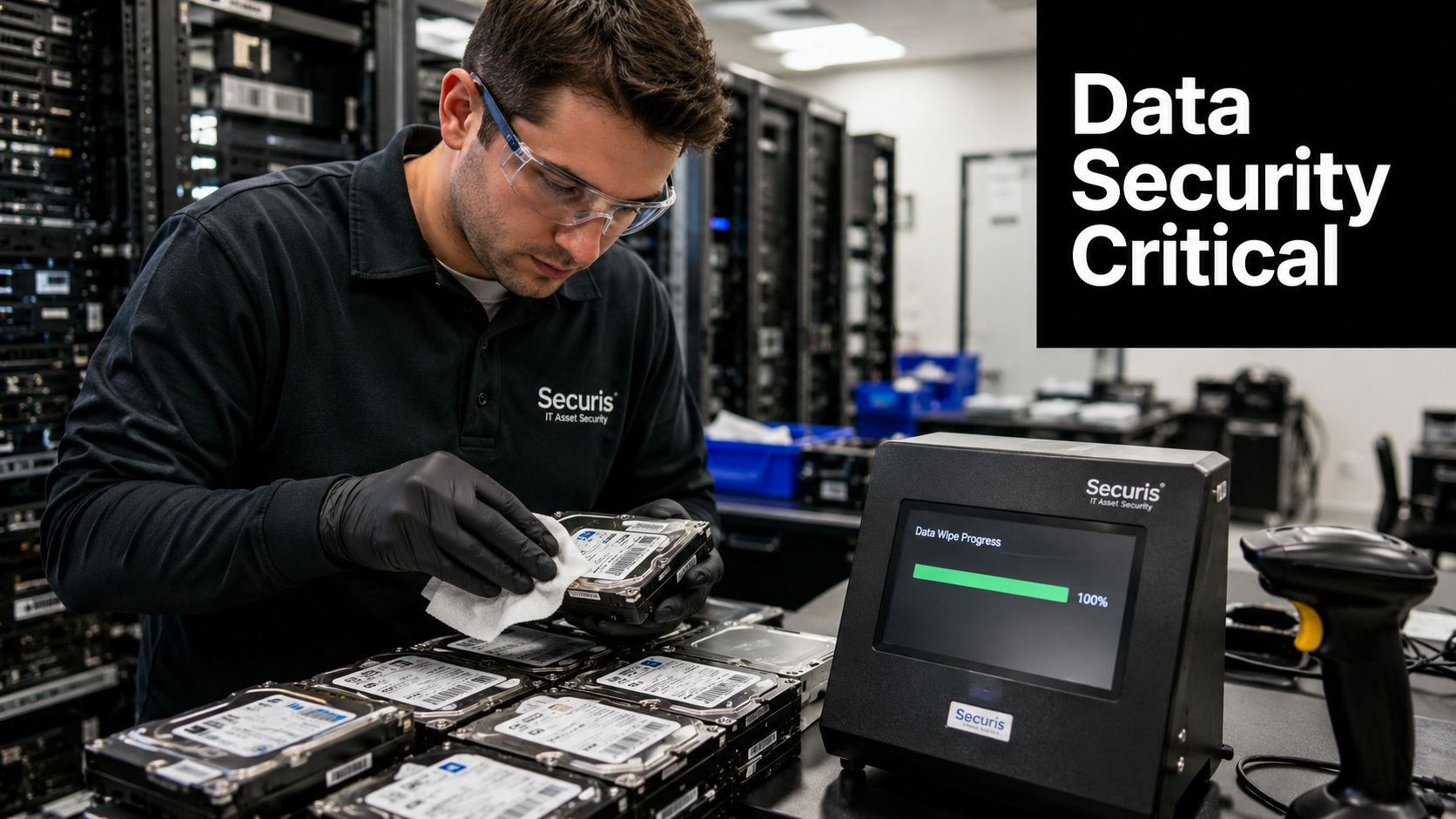
Data security is the first non-negotiable
Most companies focus on what happens before devices leave the building. Often, the failure point is the handoff. If assets aren't logged correctly, if containers aren't sealed, or if serial reconciliation happens late, you lose control of the chain of custody.
That's why a generic SLA doesn't work for ITAD. You need commitments around intake confirmation, serialized tracking, destruction approval workflow, and certificate delivery. Businesses that want a deeper operational view should also review data security in IT asset disposition best practices, because secure disposition starts before the truck arrives.
Environmental compliance is not just a recycling promise
Electronics contain materials that create real downstream risk. The World Health Organization notes that e-waste contains toxic materials such as lead, mercury, and dioxins that are classified as hazardous waste and can cause severe harm to human health). That's why responsible recycling requires more than a statement that material was “handled properly.”
For business buyers, this changes the SLA discussion. The agreement should require documented downstream handling, reporting that distinguishes reuse from recycling, and clear treatment of nonconforming or damaged assets. If a vendor exports risk into an opaque downstream chain, your organization may still own the reputational fallout.
Reputation risk sits behind both
Most public failures in disposal aren't caused by one dramatic event. They come from weak controls, poor documentation, and vague responsibility lines. A vendor misses a step. A report arrives incomplete. A destroyed asset appears on an exception list with no explanation. Suddenly, legal, procurement, and communications are all involved.
Public sector and highly regulated organizations tend to understand this earlier, which is why decommissioning frameworks in adjacent sectors can be useful. Bidwell's overview of UK decommissioning public sector is a good example of how structured decommissioning work relies on traceability and documented process, not vendor assurances alone.
A recycler's marketing promise may sound reassuring. An enforceable SLA is what keeps that promise from turning into a debate later.
For IT and sustainability managers, the point isn't to make the contract adversarial. It's to make risk visible before equipment moves.
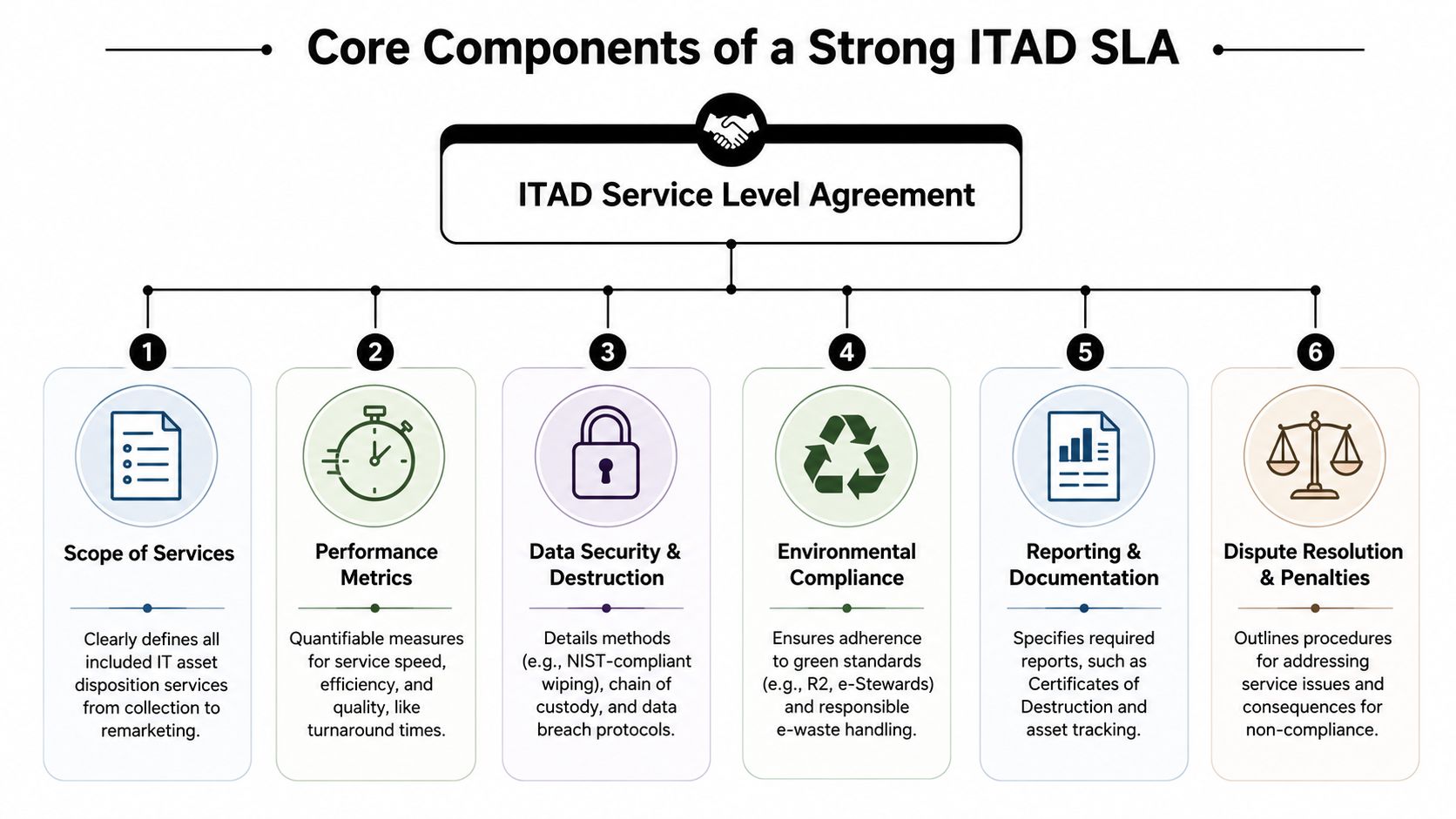
Core Components of a Strong ITAD SLA
The best ITAD service level agreements are specific enough to run the operation when something goes wrong. That means they don't stop at “secure disposal” or “responsible recycling.” They identify the service model, the controls, the evidence, and the consequences.
IBM's guidance notes that SLA structures often fall into Customer-Based, Service-Based, and Multilevel models, and that strong agreements should include data security, privacy, and regulatory compliance clauses with clear responsibilities to reduce legal risk, as outlined in IBM's explanation of service level agreements. For ITAD, multilevel structures often work best when a company needs one base agreement plus tighter terms for data center work, medical equipment disposal, or office cleanouts.
Scope and service boundaries
Start with scope. The SLA should say exactly what services are included.
That sounds obvious, but scope language is where weak agreements hide major gaps. For example, “data destruction” may cover drives removed by the client but not devices collected intact. “Pickup” may exclude de-racking, palletization, or after-hours loading. “Recycling” may not address peripherals, batteries, or lab devices.
A strong scope section should answer questions like these:
- Asset coverage: Which device categories are included, from laptops and servers to networking gear and accessories?
- On-site work: Will the provider disconnect, pack, label, and stage equipment?
- Disposition paths: Can assets be reused, remarketed, recycled, or physically destroyed, and who approves each route?
- Exception handling: What happens to damaged, unidentified, or nonstandard items?
Security controls and chain of custody
In ITAD, the security section should be detailed enough for both IT and audit teams to use. Vague language like “industry standard practices” doesn't help anyone.
The SLA should define intake controls, serialization requirements, transport conditions, custody transfer points, and destruction documentation. It should also connect those obligations to reporting. If your team has to reconcile a missing device six weeks later, chain-of-custody records will matter more than a certificate summary. A practical reference point is a documented chain of custody process for ITAD assets that shows how each handoff should be recorded.
Field note: If chain of custody lives only in the vendor's internal system and your team can't validate it, the control is weaker than it looks.
Smaller organizations sometimes underestimate this because their volume is lower. That's risky. Even a modest refresh can involve devices with payroll data, browser credentials, or cached cloud access. For teams building internal awareness, this article on cybersecurity for small businesses is a useful reminder that end-of-life hardware belongs inside the security program, not outside it.
Reporting, compliance, and remedies
A strong SLA should also define evidence. That includes asset inventories, certificates of destruction, exception reports, disposition summaries, and environmental documentation. The reporting cadence matters, but so does the format. If your sustainability team needs material diversion records and your IT team needs serial-level destruction proof, the SLA should require both.
The final piece is remedies. Many buyers skip it because they assume a good relationship makes penalties unnecessary. In practice, remedies force clarity. They establish what happens after a missed pickup, a late destruction certificate, or an unresolved exception. That can include service credits, mandatory corrective action, executive escalation, or the right to audit.
Without that section, the SLA is only a wish list.
Example Clauses and KPIs for Electronics Recycling
A standard SLA mindset breaks down fast in ITAD. An IT team can tolerate some variation in help desk response times. It cannot tolerate uncertainty about where retired laptops went, whether drives were destroyed as instructed, or whether downstream recycling records will stand up to a customer, regulator, or auditor review.
Many buyers are familiar with service level agreements built around uptime, response time, and ticket closure. Those measures still have a place in vendor management, but they do not control the main risks in electronics recycling. For ITAD, the useful metrics are the ones that prove custody, validate data destruction, and document final disposition in a form your security, compliance, and sustainability teams can use.
What useful ITAD KPIs look like
Good ITAD KPIs measure moments where a process can fail unnoticed.
That usually means pickup confirmation, intake accuracy, serialized reconciliation, destruction evidence, exception handling, and reporting quality. If a metric does not help your team investigate a missing asset, confirm a destroyed drive, or verify how material was handled downstream, it is probably too soft to belong in the SLA.
Here are examples of clause language that works in real contracts:
Chain of custody confirmation
Provider will confirm receipt of collected assets with a documented intake record that references the client shipment number, pickup identifier, or release document.Serialized reconciliation
Provider will provide an asset-level disposition report showing received, processed, resold, recycled, destroyed, and exception-status items against the client inventory, where an inventory was supplied.Data destruction evidence
Provider will issue a certificate of destruction for assets approved for destruction and retain supporting logs, serial records, and processing evidence for client or auditor review.Exception escalation
Provider will notify the client of damaged, unidentified, or out-of-scope assets within the agreed notification window and hold those assets pending written instruction.Environmental reporting
Provider will provide final disposition records by category, including reuse, recycling, and destruction, along with client-required compliance documentation. Teams that need a stronger reporting standard should define the exact output format in the SLA, especially for ITAD compliance and environmental reporting requirements.
Sample ITAD SLA Metrics and KPIs
| Metric Category | Example KPI | Why It Matters |
|---|---|---|
| Chain of custody | Custody confirmation issued with pickup or shipment reference | Shows the handoff was documented and can be traced |
| Asset reconciliation | Intake report matched against client manifest at serial level where available | Helps identify missing, substituted, or extra assets early |
| Data destruction | Destruction certificate and supporting records delivered within the agreed reporting window | Gives security, legal, and audit teams usable evidence |
| Exception handling | Exception assets flagged, segregated, and held until written approval | Prevents unauthorized processing of questionable equipment |
| Reporting quality | Disposition reports include asset status, processing method, and final outcome | Supports internal review and external audit requests |
| Environmental compliance | Final reports distinguish reuse, recycling, and destruction by disposition category | Reduces vague reporting and improves downstream accountability |
| Client communication | Named escalation contacts and response windows documented in the SLA | Shortens delays when issues affect legal, security, or compliance exposure |
How to avoid bad KPIs
Weak KPIs usually measure activity instead of control. “Pickup completed” is a common example. It records that a truck arrived. It does not confirm which assets were released, whether the count matched the manifest, or whether anything fell into an exception queue.
Use three tests when reviewing metrics:
Can your team verify the result?
If the provider is the only party that can interpret whether the target was met, the metric needs tightening.Does it map to a real risk?
Weight totals and summary recycling figures may help with program reporting, but they will not resolve a chain-of-custody or data destruction dispute.Does it trigger a defined response?
A useful KPI is tied to action, such as escalation, corrective action, reissuance of records, or audit access after a miss.
The best ITAD KPI is usually not the most complicated one. It is the one that lets your team answer a hard question with records, dates, serials, and disposition evidence.
Monitoring and Auditing Your ITAD Partner
An SLA only matters if someone checks whether the work matched the promise. That's where many organizations go light. They sign the agreement, receive a summary report, file a certificate, and assume the process is under control.
That approach misses the point of service level agreements.
A frequent gap in SLA practice is the failure to connect metrics to business need, rather than technical compliance alone. SysAid highlights that many agreements focus on measurable targets without clarifying assumptions or seasonal variance in this discussion of SLA business-need alignment. In ITAD, that means a vendor can meet a reporting target and still leave your security, legal, or sustainability teams short on the evidence they need.
What to review every cycle
Monitoring doesn't have to be burdensome, but it does need structure. The review process should focus on records that prove control, not just activity.
A practical oversight routine includes:
- Asset list cross-checks: Compare your release manifest to the vendor's intake and final disposition reports.
- Certificate review: Make sure destruction certificates align with the assets approved for destruction.
- Exception tracking: Look for unresolved serials, damaged units, or undocumented substitutions.
- Reporting fit: Confirm the report format works for audit, IT, procurement, and sustainability use cases.
- Compliance visibility: Use formal ITAD compliance reporting practices as a benchmark for what your vendor should be able to produce consistently.
Audits should test the process, not just the paperwork
Quarterly business reviews and dashboards are useful, but they don't replace process validation. If your organization has meaningful exposure, periodic audits are worth it. That may include a site visit, a witness review of destruction controls, or a walkthrough of how incoming assets are logged and exceptions are managed.
This isn't about trying to catch a vendor in failure. It's about confirming that the process still matches your risk profile. A vendor may be fully reliable for routine laptop disposal and still need tighter controls for medical equipment disposal, a facility cleanout, or a data center decommissioning event.
Ask one simple audit question: if an asset disappeared today, what records would both sides use to reconstruct the last confirmed handoff?
If that answer isn't immediate, the SLA may be written, but the control environment isn't mature enough yet.
A Simple ITAD SLA Checklist for Businesses
When teams evaluate an ITAD provider, it helps to reduce the contract review to plain yes-or-no questions. That keeps the discussion grounded and makes it easier for IT, legal, procurement, and sustainability stakeholders to align.
Use the checklist below whether you're reviewing a new agreement or renewing an existing one.
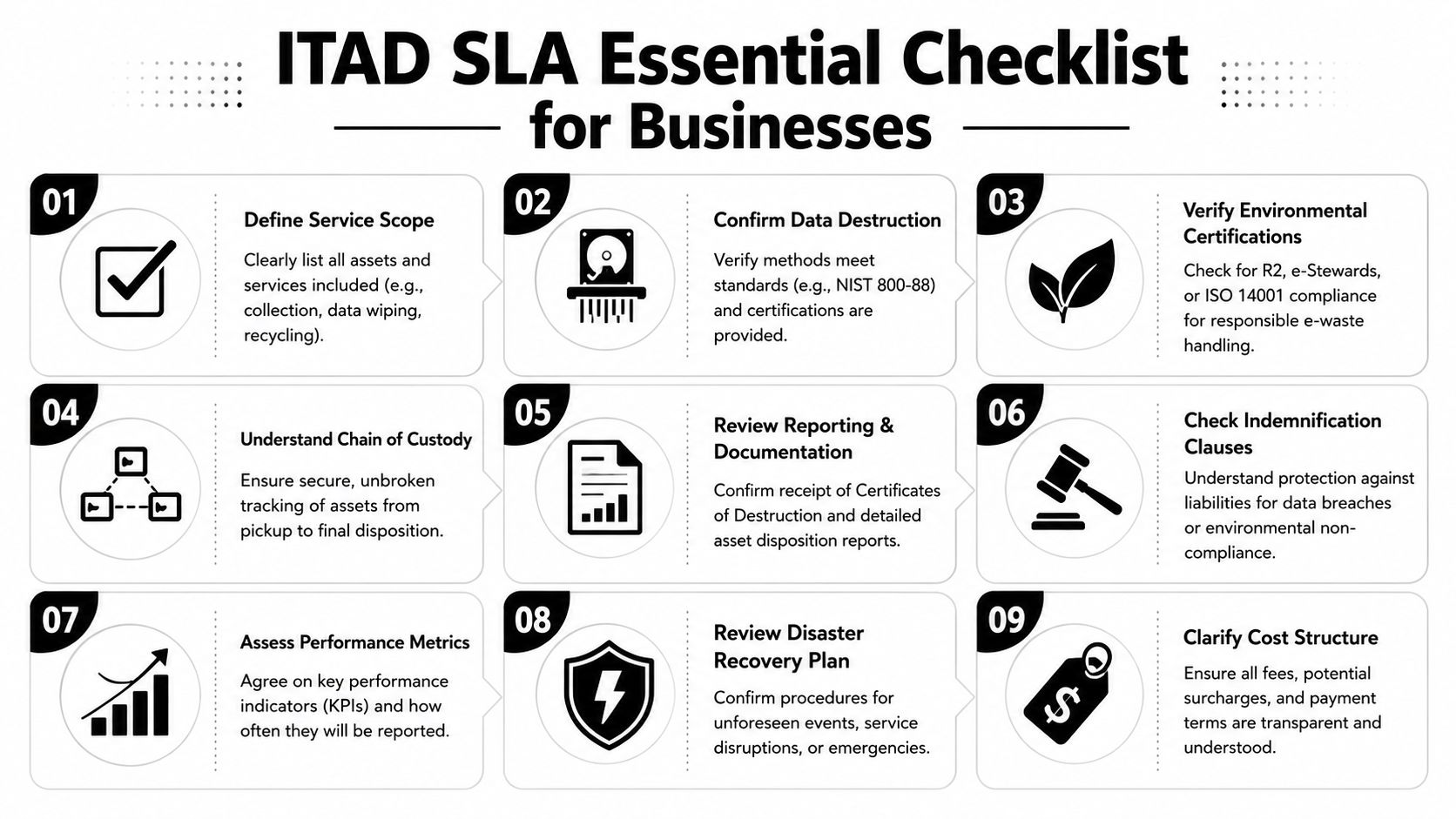
Security and custody checks
Does the SLA define chain of custody clearly?
You should be able to identify every custody transfer point from pickup through final disposition.Does it specify the data destruction method?
The agreement should state whether assets are wiped, shredded, or handled under another approved process.Does it require asset-level documentation where needed?
Bulk summaries are rarely enough for laptops, servers, and storage media.Does it explain exception handling?
Damaged, unidentified, or out-of-scope equipment shouldn't disappear into a generic process flow.
Compliance and reporting checks
Does the SLA require environmental documentation?
You want records that show what was reused, recycled, or destroyed.Does it assign responsibility for approvals?
Someone has to authorize remarketing, destruction, and nonstandard handling decisions.Does it include audit rights or review rights?
A mature provider should be comfortable with transparency.Does the reporting format support your internal stakeholders?
Sustainability may need different outputs than IT security or finance.
A practical supporting tool is an ITAD compliance checklist template that helps teams standardize what they ask every vendor to provide.
Commercial and governance checks
Before signing, ask a final set of questions:
Are remedies defined if commitments are missed?
If not, there's no clear path when performance slips.Are service boundaries explicit?
Make sure pickups, office cleanout work, product destruction, and special handling tasks are either included or excluded in writing.Is the agreement adaptable?
Your asset mix will change. A useful SLA can support laptop disposal one quarter and laboratory equipment disposal the next without creating confusion.
This checklist won't replace legal review, but it will make the legal review better. It gives the business side a sharper way to spot weak language before risk gets buried in boilerplate.
Building a Partnership on Accountability
A missed pickup or a late report is annoying. An unverified data destruction event or a gap in downstream recycling records is a board-level problem.
That is why the strongest ITAD relationships are governed like risk programs, not treated like one-off service orders. The SLA should do more than describe response times. It should define who signs off on destruction, how exceptions are handled, when incidents must be reported, and what proof your team receives without having to chase for it. That structure protects IT, procurement, legal, and sustainability at the same time.
Good vendors usually welcome that level of clarity because it removes ambiguity during high-pressure work such as office closures, refresh cycles, and data center exits. If a provider resists documented accountability, limited audit visibility, or clear environmental reporting, treat that as a warning sign, not a negotiation detail.
If your organization needs a partner for electronics recycling, donation-based recycling, secure data destruction, or broader IT equipment disposal, Reworx Recycling is worth a closer look. The team supports responsible IT asset disposition with a focus on environmental stewardship, community impact, and practical documentation businesses can use. Whether you are clearing out old laptops, managing medical equipment disposal, planning a pickup, or setting up a repeatable office recycling program, the core question is simple. Can the provider prove performance in writing, with records that stand up to internal review? Reworx Recycling is built to support that standard.