
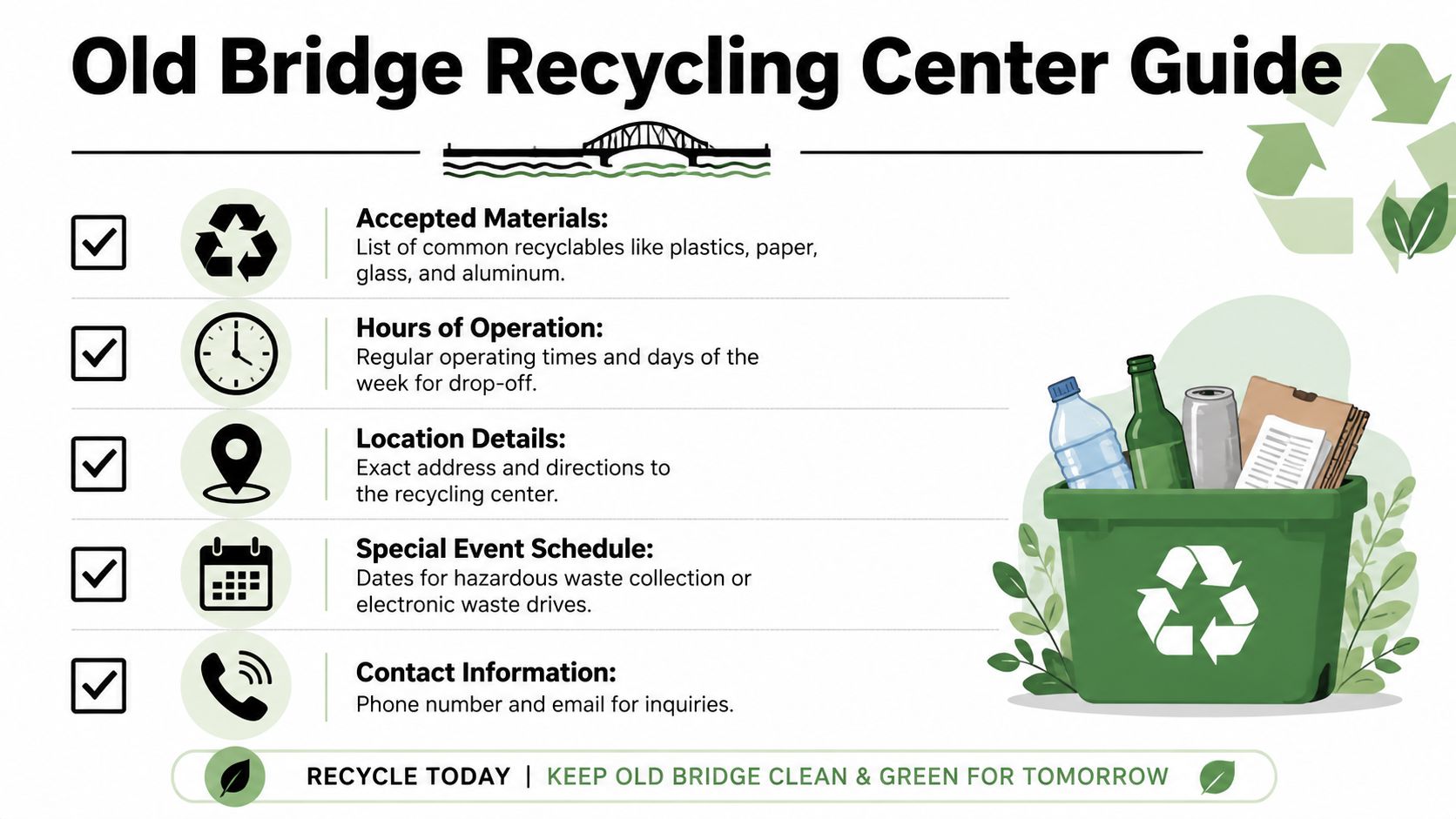
If you're trying to use the Old Bridge Recycling Center today, go to 1 Old Bridge Plaza, Old Bridge, NJ 08857. The current public drop-off hours are Tuesdays and Thursdays from 7:00 AM to 3:00 PM and Saturdays from 8:00 AM to 12:00 PM.
That's the practical answer often needed first. But if you manage an office, school, clinic, warehouse, or municipal department, that answer only gets you through the gate. It doesn't solve chain of custody, secure device handling, audit documentation, or the logistics headache of moving retired IT equipment without wasting staff time.
A lot of Old Bridge businesses are stuck between outdated assumptions and operational reality. They remember when local recycling options felt broader, then they load up staff vehicles with monitors, old laptops, office electronics, and mixed materials only to discover the rules are narrower than expected. That's avoidable if you separate public drop-off facts from business disposal strategy.
Your Guide to the Old Bridge Recycling Center
Your office manager loads a van with old monitors, a few dead PCs, carpet scraps from a small renovation, and a box of bulbs, then sends an employee across town. They get there and learn part of the load is accepted, part is only accepted on a specific Saturday, and none of that trip solved data security. That is the core issue with relying on a public recycling center for business cleanup.
The first fact to get straight is that Old Bridge has issued public clarification because residents and businesses still confuse curbside recycling with recycling-center drop-off. The township stated that “curbside recycling is no longer accepted at the center” in its Old Bridge public announcement on curbside recycling changes. That matters because outdated assumptions create wasted trips and mixed loads that do not match the site's rules.
What the center is for
The Old Bridge Recycling Center is a municipal drop-off site at 1 Old Bridge Plaza, behind the Animal Shelter at the township municipal complex. The township posts the current rules, accepted categories, and public schedule on the Old Bridge recycling center page. Use that page as the current authority before sending anyone there.
For a resident with a small, sorted load, the center can be useful. For a business manager handling an office cleanout, it is a narrow public service with limited hours and item controls.
What it accepts
The township lists several approved material categories, including:
- Metal and appliance items such as metal, iron, and appliances
- Electronics such as TVs, computers, and other electronics
- Bulky materials including mattresses, box springs, and carpeting
- Construction materials such as concrete, brick, pavers, cinder blocks, granite, and marble
- Oil-related items including motor oil and cooking oil
- Battery and reuse streams such as rechargeable batteries, used clothing and shoes, and reusable cloth bags
- Tanks including empty propane and helium tanks
That sounds broad until you apply it to a real business cleanout. Offices rarely generate a clean, single-material load. They generate mixed electronics, accessories, cables, storage media, furniture, fixtures, and records, all on a deadline.
What trips businesses up
Paint and fluorescent bulbs are accepted only on the second Saturday of each month. Miss that window and your staff either stores the material, makes another trip, or starts calling around at the last minute.
The township also sells a 32-gallon recycling bin for $20.00, with payment by exact change or checks only. That detail tells you exactly what this facility is built to do. It serves the public with fixed procedures, not businesses with chain-of-custody needs, serialized equipment tracking, or pickup logistics.
If you only need a personal drop-off option, a public electronics recycling drop-off center in New Jersey can make sense. If you are responsible for company devices, drives, or network gear, stop treating municipal drop-off as your disposal plan. A public center can accept approved material. It does not give your business data destruction, audit-ready documentation, or a managed pickup process.
Why Businesses Need More Than a Municipal Drop-Off
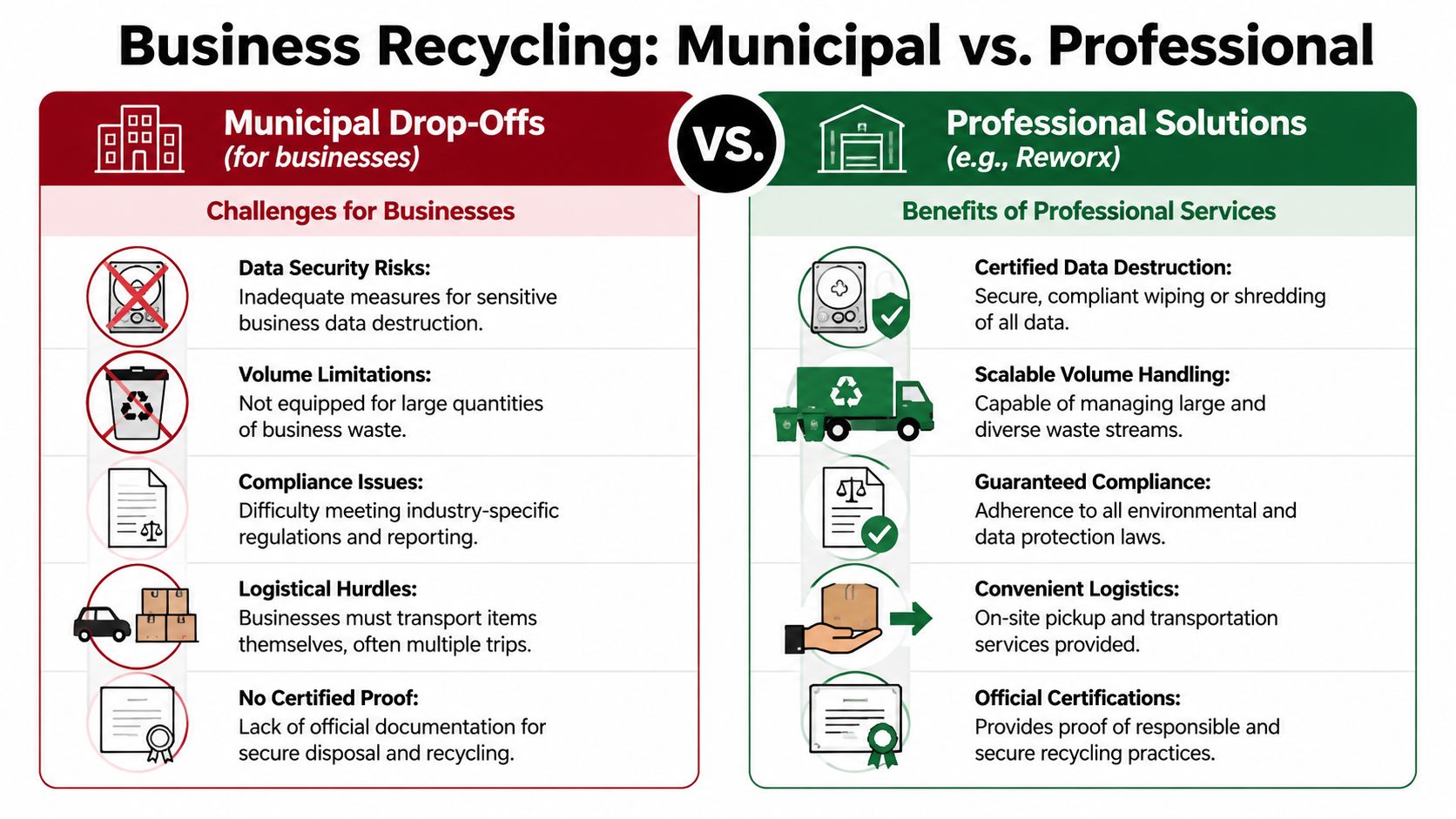
Business managers should stop treating a municipal center like a corporate asset disposition program. It isn't one.
Old Bridge's own ordinance makes that clear. For commercial, industrial, institutional, and government users, the township requires mandatory source-separated collection for electronics, fluorescent bulbs, rechargeable batteries, tires, white goods, and other designated streams. It also requires devices containing CFCs to be evaluated by licensed individuals, with recovered CFCs sent to an EPA-approved reclaimer, as laid out in the Old Bridge municipal code on source-separated recycling.
Where the risk starts
Once your company is disposing of laptops, desktops, servers, switches, phones, copiers, specialty electronics, or devices with storage media, the question changes. It's no longer “Can someone drop this off?” It becomes “Who handled it, how was it separated, where's the record, and who owns the risk if something goes wrong?”
A public center doesn't give you a business-grade workflow for those questions. It gives you a place to bring approved material during limited hours.
What municipal drop-off doesn't solve
| Business issue | Municipal drop-off reality |
|---|---|
| Data security | No business-facing process for secure data destruction or documented custody |
| Compliance | No audit packet for your internal controls or regulated disposal workflow |
| Scale | Limited public hours make large office cleanouts hard to schedule |
| Labor | Your staff still has to sort, load, drive, unload, and repeat |
| Proof | You may leave with less documentation than your legal, IT, or facilities team wants |
That's why business leaders should treat the municipal center as a resident-oriented convenience, not a disposal strategy for company-owned technology.
The better decision
If you're managing recurring electronics recycling or even a one-time cleanout, you need a partner built for organizational volume, process, and accountability. A public drop-off site can be useful for very specific approved items. It's not a substitute for a dedicated business recycling drop-off and service approach designed around real corporate workflows.
If your company has to explain its disposal process to leadership, auditors, or customers, “we drove it to the town center” is a weak answer.
Secure IT Asset Disposition The Reworx Solution
When companies retire devices, they usually focus on the visible hardware. The bigger issue is what remains inside those devices. Hard drives, SSDs, phones, and even peripheral systems can retain business data long after users think the machine is empty.
That's why IT asset disposition, or ITAD, needs a process, not a pile of equipment in a hallway waiting for someone to deal with it. If you need a solid primer before setting policy, review what IT asset disposition means in practice.
What good ITAD looks like
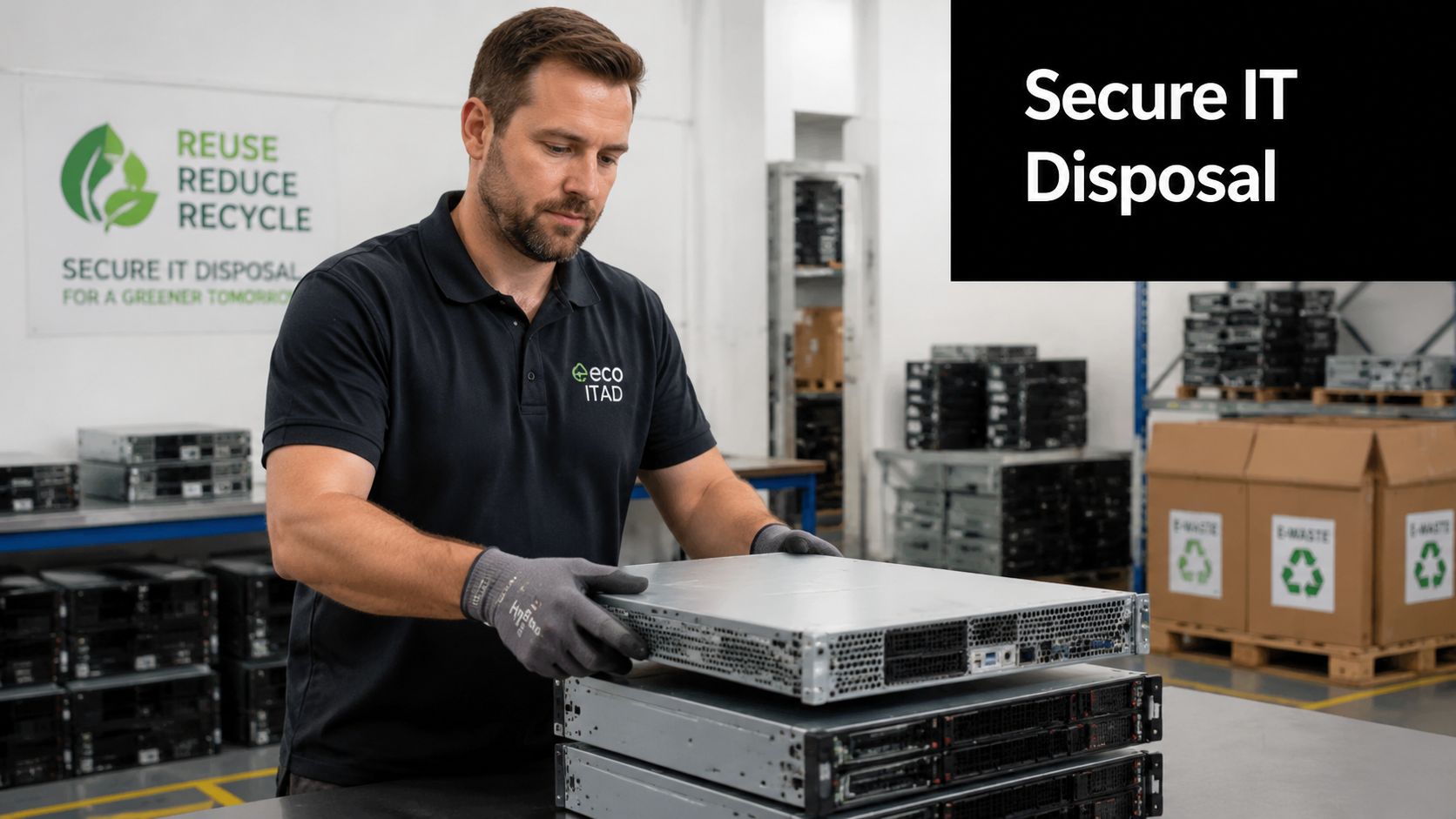
A professional ITAD workflow usually includes these control points:
- Asset identification so devices aren't mixed, lost, or casually reassigned
- Secure collection with controlled handling from pickup through processing
- Data destruction decisions based on device type, storage media, and policy
- Documentation that proves what was received and how it was handled
- Downstream disposition through reuse, refurbishment, resale, or recycling
That's what separates actual risk management from simple disposal.
Why this matters in the real world
A lot of businesses underestimate how much digital residue gets left behind. If your team wants a simple example of why device cleanup isn't just “delete the app and move on,” this explainer on how to understand Mac app leftovers is worth reading. It's consumer-friendly, but the lesson applies in enterprise environments too. Removal at the surface level often isn't complete.
The same principle applies to retired business hardware. You need a chain of custody and a documented destruction workflow that stands up after the fact, not just on the day of the cleanout.
Confusion at public drop-off sites is one problem. Unclear handling of retired business devices is a liability problem.
The operational takeaway
If public-facing recycling information is fragmented enough to create drop-off mistakes, your internal standard should be tighter, not looser. For business devices, the right move is straightforward: use a controlled ITAD process for anything that stores data, connects to your network, or came from a managed environment.
Streamlining Your Office Cleanout with Reworx
Most office cleanouts don't fail because the equipment is hard to identify. They fail because nobody owns the removal plan.
An Old Bridge office signs a new lease, the IT team refreshes laptops, facilities finds a closet full of old monitors, and suddenly the operations manager is asking staff to load personal vehicles and “make a few recycling runs.” That approach burns labor, creates confusion, and drags a one-day project into a week.

What a managed cleanout changes
A professional office cleanout service works better because it removes the hidden friction:
- No staff shuttle runs across town with mixed electronics and uncertain acceptance rules
- No hallway staging problem where old devices sit for days waiting for someone to move them
- No guesswork about how to separate laptops, phones, networking gear, printers, and accessories
- No last-minute scramble when a move deadline gets close
If you're planning a relocation, renovation, or hardware refresh, a guide to efficiently decommissioning office equipment is a useful place to start.
The scenarios where this matters most
Some cleanouts are bigger than standard office electronics. Medical practices may have specialized devices. Labs may have niche equipment. Warehouses may have handhelds, scanners, and old infrastructure hardware. Admin offices may have a simple laptop disposal problem on paper, but a complicated pickup problem in reality because the devices are spread across departments, storage rooms, and remote locations.
A managed pickup model fixes that by turning disposal into a scheduled project. Your team identifies what's leaving. The service provider handles removal, transport, and downstream processing. Your staff gets back to actual work.
The fastest office cleanout is the one your employees don't have to moonlight as movers to complete.
The Social Enterprise Difference Partnering for Impact
Most companies treat end-of-life electronics as a cost line. That's too narrow.
Handled correctly, retired technology can support environmental goals, community benefit, and internal sustainability reporting at the same time. That's the strongest argument for working with a social enterprise instead of a basic haul-away vendor. The transaction doesn't stop at “equipment gone.” It connects disposal decisions to a larger outcome.
Why the model matters
A social enterprise recycling model changes the logic of the decision:
- Environmental value comes from responsible electronics recycling and reuse, not dumping mixed loads into the easiest outlet.
- Community value comes from donation-based recycling programs that can put usable technology back into circulation.
- Operational value comes from having a clearer, more intentional process around corporate surplus equipment.
For sustainability leaders, that's useful because it aligns IT equipment disposal with broader ESG and community engagement goals without forcing the business to invent a new program from scratch.
The broader cleanout mindset
This is also where facilities and operations teams can think beyond electronics. When a company closes, relocates, or downsizes, furniture, fixtures, and reusable office contents often need the same thoughtful handling as tech assets. If your team is looking at the non-IT side of a move, this practical resource on how to Donate furniture to charity is a good reminder that disposal planning should include reuse pathways, not just dumpsters and junk removal.
The best cleanout plans separate what must be destroyed, what should be recycled, and what can still help someone else.
What businesses gain
That approach gives companies a better story to tell internally and externally. Your IT team gets a structured disposition path. Your sustainability team gets a community-impact angle. Your leadership team gets a decision that looks responsible instead of merely convenient.
For organizations that want that kind of alignment, a social enterprise partnership is worth exploring through Reworx's impact-focused partnership model.
Schedule Your Business E-Waste Pickup in Old Bridge
If you're a resident dropping off approved material, the Old Bridge Recycling Center has a clear municipal role. If you run a business, that's not enough.
You need a process that fits business reality: office cleanouts, laptop disposal, secure data destruction, IT asset disposition, and scheduled pickup that doesn't hijack your staff for a day. The smart move is to stop forcing corporate disposal needs into a public self-service system.
What to do next
Use this simple decision filter:
- Single approved household-style drop-off. The municipal center may work if the material fits the posted rules and timing.
- Business electronics with storage media. Use a professional ITAD workflow.
- Office move or facility cleanout. Schedule pickup instead of assigning employees to run disposal errands.
- Ongoing technology refreshes. Put a repeatable recycling and disposition process in place now, before the next pile builds up.
Keep it simple
A pickup-based model is usually the cleanest option for Old Bridge businesses because it removes the weakest part of the process: ad hoc internal handling. If you're ready to move from improvising to planning, start by requesting a business electronics pickup schedule.
That's the upgrade most organizations need. Less confusion. Better control. Far less operational drag.
If your business is ready to retire old laptops, servers, office electronics, or mixed IT equipment responsibly, talk to Reworx Recycling. You can donate old equipment, schedule a pickup, and build a cleaner ITAD process that supports secure handling, sustainable recycling, and community impact.