Your team is probably replacing laptops, refreshing server racks, retiring storage arrays, or planning a data center decommissioning project right now. Most companies treat that moment as a disposal problem. In reality, it's also a supply chain decision.
Inside the devices leaving your facilities are materials that modern industry depends on, including rare earth elements. Those materials help power hard drives, cooling systems, motors, medical devices, and other equipment that keeps operations moving. When businesses understand rare earth extraction, electronics recycling stops looking like housekeeping and starts looking like strategy.
That shift matters for IT leaders, sustainability managers, facilities teams, and executives alike. The global rare earth market is shaped by difficult chemistry, concentrated processing capacity, and long development timelines. Your end-of-life hardware sits at the opposite end of that chain, where practical recovery decisions can support resource security, reduce waste, and strengthen circular economy outcomes.
What Are Rare Earths and Why Do They Matter for Business
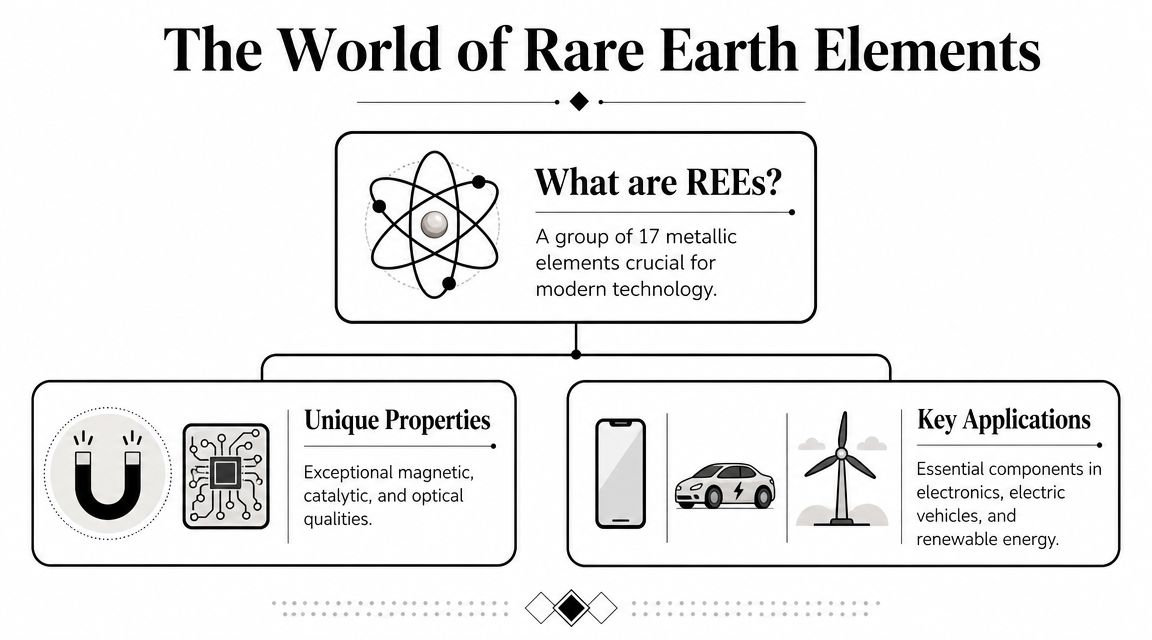
Rare earth elements are a group of 17 metallic elements used in a wide range of modern technologies. The name confuses people. They aren't necessarily rare in the sense of being absent from the earth's crust. The hard part is turning them into usable materials at commercial scale.
A simple way to think about it is this: imagine trying to separate a bowl of nearly identical gray beads that are mixed with sand. That's closer to the challenge than most business summaries suggest. Rare earth extraction is difficult because these elements often occur together in mixed mineral assemblages and have very similar chemistry, so producers usually need multi-stage solvent extraction or ion-exchange systems rather than a simple one-step process. Researchers also note that roasting, solvent extraction, precipitation, and calcination drive major energy use and acidification impacts in the lifecycle of rare earth production, as described in this review of rare earth processing impacts.
Why executives should care
Rare earths matter because they enable performance. Their magnetic, optical, and catalytic properties make them valuable in the components businesses rely on every day. If you run a hospital, a logistics company, a professional services firm, a university, or a manufacturer, rare earths are already part of your operating environment.
They show up in products such as:
- Servers and storage equipment that support digital operations
- Laptops and desktops used across office environments
- Medical equipment that depends on precision electronics and motors
- Industrial systems with magnets, sensors, and control components
- Data center infrastructure tied to broader electronics supply chains
Why the term “extraction” matters
Many people hear “rare earth extraction” and think only of mining. That's incomplete. Extraction also includes the separation and recovery steps needed to isolate useful materials from ore, industrial waste, or discarded equipment. That distinction matters because a sustainability discussion isn't just about where materials come from. It's also about how efficiently organizations can recover them after use.
Practical rule: If your company buys electronics at scale, your company is part of the rare earth value chain whether you've planned for it or not.
For business leaders, the takeaway is straightforward. End-of-life electronics aren't just old assets. They're part of a resource stream that deserves tighter control. Teams that want a clearer baseline on discarded devices can start with this overview of electronic waste recycling.
The True Cost of Conventional Mining
The usual rare earth story focuses on demand. The harder question is supply. Conventional mining can produce the materials industry needs, but it comes with environmental burdens and concentrated geopolitical risk.
Environmental strain is built into the process
Rare earth extraction from mined ore is chemistry-heavy and process-intensive. It typically involves multiple steps, substantial reagent use, and large industrial flows of material that have to be managed safely. That raises difficult questions around waste handling, emissions, water impacts, and long-term site stewardship.
For executives, the point isn't to master extractive metallurgy. It's to recognize that the environmental profile of a “clean” technology product can include a very resource-intensive upstream story. A server or imaging device may look compact in the purchasing catalog, but its material footprint starts far from the loading dock.
A useful companion topic is the broader environmental impact of electronic waste, especially when organizations want to compare upstream extraction with downstream disposal choices.
Supply concentration creates business exposure
The second issue is concentration. Rare earth supply hasn't always been organized the way it is now. Earlier production came from placer deposits in India and Brazil, then from South Africa in the 1950s, and later from the Mountain Pass mine in California, which led U.S. output from the 1960s through the 1980s. By the early 1990s, China had become the leading producer. By 2010, China was controlling about 95% of global rare earth production, after increasing its share from 21% in 1985 to 60% in 1995, according to this historical summary of rare earth production.
That level of concentration matters because it changes pricing power, trade dynamics, and resilience.
What that means inside your company
When supply is concentrated upstream, downstream buyers feel it indirectly:
| Business function | Risk if supply tightens |
|---|---|
| IT procurement | Longer replacement cycles and less flexibility |
| Facilities planning | Delays in equipment upgrades or retrofits |
| Healthcare operations | Pressure on availability of specialized devices |
| Sustainability reporting | Harder questions about material sourcing and circularity |
A resilient technology strategy doesn't start at procurement. It starts by deciding what happens to equipment at end of life.
That's why rare earth extraction isn't just a mining topic. It's a board-level supply chain topic with implications for capital planning, procurement timing, and asset recovery programs.
Urban Mining Recovering Value from E-Waste
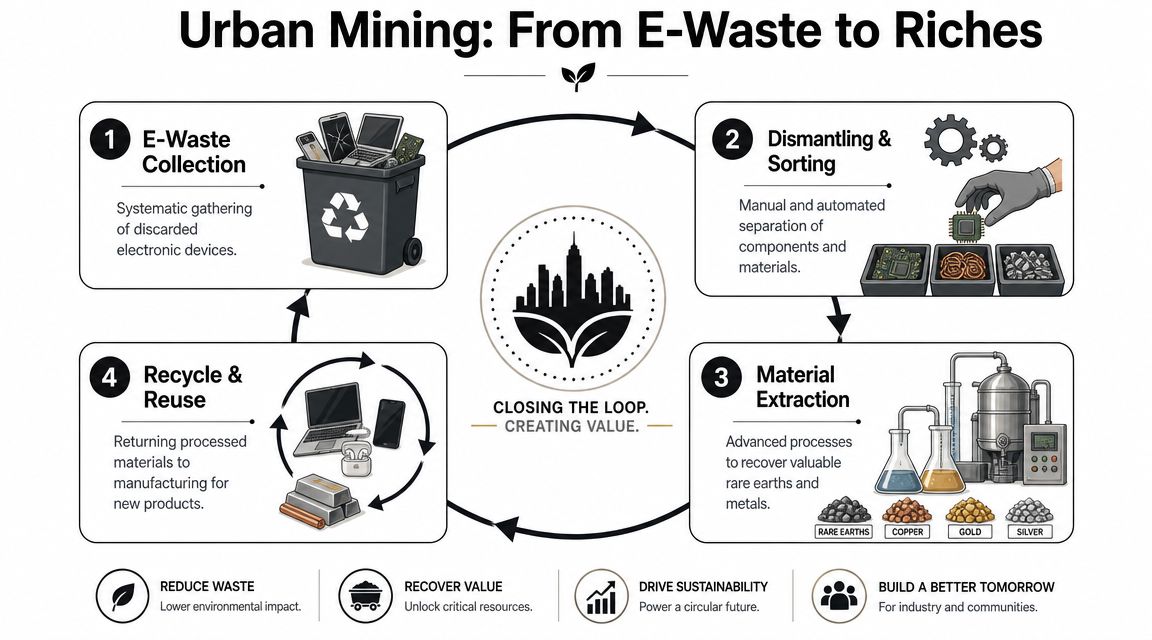
If conventional mining is one side of the rare earth equation, urban mining is the other. The term refers to recovering valuable materials from products that have already been manufactured and used. For most businesses, that means retired electronics.
Urban mining matters because it moves the conversation from “Where can we dig next?” to “What value are we already discarding?” Old laptops, networking gear, storage devices, hard drives, monitors, and specialized equipment often contain metals and components worth recovering. The recovery path isn't simple, but it's real.
How recovery works in plain language
Three terms come up often in discussions of rare earth extraction from waste streams.
- Hydrometallurgy uses liquids to dissolve and separate target materials. Think of it as a chemical sorting bath that pulls certain ingredients out of a mixed soup.
- Pyrometallurgy uses heat to transform or concentrate materials. It's closer to controlled industrial cooking than to household recycling.
- Bioleaching uses biological processes to help mobilize metals. It's promising because it suggests lower-impact routes in some cases, though deployment questions still matter.
Each method has tradeoffs around throughput, purity, waste handling, and economics. That's why business leaders shouldn't ask only whether a process works in principle. They should ask whether it fits commercial volumes, compliance needs, and reverse logistics realities.
Why waste streams are getting more attention
Research has expanded the conversation beyond mined ore. Several unconventional feedstocks can work, including coal fly ash, bauxite residue, industrial tailings, and e-waste. One flash Joule heating method reported rare earth recovery-yield increases of about 206% for class F fly ash and 187% for class C fly ash versus direct leaching, while other lab work showed protein-based separation could isolate rare earths from industrial waste more selectively, according to this Science Advances research on waste-based recovery.
That doesn't mean discarded electronics will replace mining. It means waste-based recovery is becoming more technically credible as a complementary source.
Urban mining works best when companies treat retired equipment as feedstock, not trash.
The operational side executives often miss
Recovery systems depend on collection, handling, dismantling, and material movement. Those steps sound mundane, but they shape whether a recycling program scales. In industrial settings, the same logic applies across sectors. Companies that want a window into heavy-duty movement systems can look at examples of gas industry material handling equipment to understand how specialized infrastructure supports complex material flows.
For IT and sustainability teams, the lesson is simpler. If assets disappear into mixed disposal channels, recovery options shrink fast. If they're tracked, segregated, and routed correctly, organizations preserve more value. That's why many companies are rethinking what happens after electronics recycling and how recovery connects to procurement strategy.
The Business Case for Sustainable IT Asset Disposition
Most companies already have an IT asset disposition process of some kind. The problem is that many programs were built to clear space, wipe data, and move on. That's no longer enough.
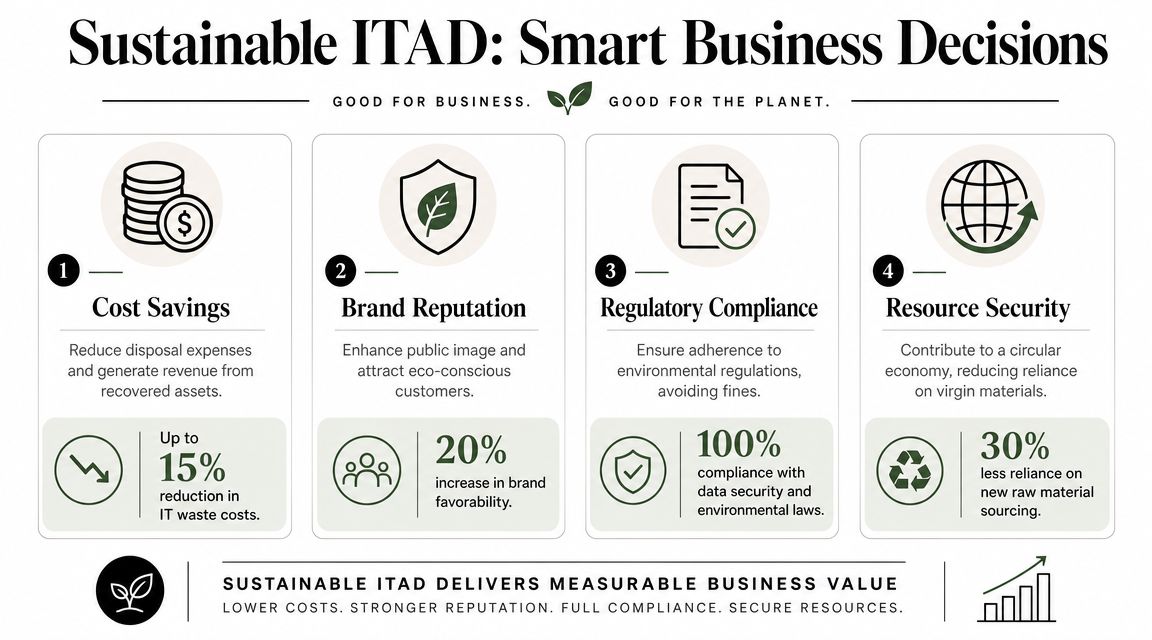
A sustainable ITAD approach addresses three executive priorities at once: resource risk, financial discipline, and credibility with customers, employees, and regulators.
The scale of the missed opportunity
The world generated 62 million tonnes of e-waste in 2022, and that total is projected to rise to 82 million tonnes by 2030. Only 22.3% was documented as collected and recycled, and the unrecovered material represents $91 billion annually in lost value, according to the UN's Global E-waste Monitor coverage.
That figure should reframe the conversation inside the C-suite. E-waste isn't a niche waste stream. It's a large, under-managed material reservoir.
Why sustainable ITAD belongs in strategic planning
A conventional disposal mindset asks, “How do we get rid of obsolete devices safely?” A strategic ITAD mindset asks better questions:
What supply chain value are we losing?
Retired equipment contains recoverable materials and reusable components. Even when direct rare earth recovery happens later in the chain, your program determines whether those assets stay recoverable.Where are we exposed?
Companies that rely on constant hardware refreshes are more exposed to upstream material volatility than they think. Better recovery programs don't eliminate that risk, but they support more resilient circular flows.What does this say about our standards?
Investors, customers, and employees increasingly look at whether companies align environmental claims with operational practice. End-of-life electronics are one of the easiest places to test whether that alignment is real.
What a strong business case sounds like internally
Different leaders need different framing.
- For CFOs: A better ITAD program can help preserve residual asset value, reduce unmanaged disposal costs, and improve decision quality around refresh cycles.
- For CIOs and IT directors: Secure disposition reduces data exposure while creating a cleaner chain of custody for decommissioned hardware.
- For sustainability leaders: Electronics recovery supports circularity goals in a concrete, auditable way.
- For operations teams: Standardized retirement workflows reduce clutter, confusion, and storage burdens.
Boardroom test: If your company tracks the purchase of high-value IT assets carefully but can't explain their final destination, the process is incomplete.
Organizations looking to formalize that case often start with the broader benefits of IT asset disposition for a sustainable future. The central shift is cultural. ITAD isn't a cleanup function. It's part of resource management.
Implementing a Responsible Recovery Program
Good intentions won't recover much material. Process does. Companies that want a more responsible electronics recovery program need a repeatable operating model that works for office cleanouts, laptop disposal, secure data destruction, medical equipment disposal, and full-scale data center decommissioning.
Start with asset visibility
The first step is an accurate inventory. Many organizations know what they bought but not what they're holding, where it sits, or whether it still has reuse potential. That weakens every downstream decision.
A strong inventory should identify device type, location, user or department, storage media status, and retirement path. That includes servers, networking gear, desktops, laptops, monitors, peripherals, and specialized assets such as laboratory systems or medical equipment.
Build a retirement policy people can follow
Policies fail when they're too abstract. Teams need plain-language rules for what happens when equipment is obsolete, broken, surplus, or replaced.
Use a checklist like this:
- Define ownership clearly so IT, facilities, compliance, and procurement know who approves retirement decisions.
- Separate reuse from recycling because some devices are suitable for refurbishment, while others should move straight to material recovery.
- Require secure data destruction before anything leaves controlled custody.
- Create collection points for offices, storage rooms, and remote sites so assets don't disappear into ad hoc disposal channels.
- Document chain of custody for pickups, transfers, and final processing.
Vet partners carefully
A recycler or ITAD provider isn't just hauling equipment. That partner is handling data-bearing devices, regulated waste streams, and assets with residual value.
Ask practical questions:
| Evaluation area | What to verify |
|---|---|
| Data security | How drives are sanitized or shredded |
| Downstream handling | Whether materials are tracked through final processing |
| Operational fit | Pickup logistics, reporting, and project management |
| Special asset capability | Experience with servers, medical devices, lab gear, or facility cleanouts |
Don't stop at marketing language. Ask how the provider handles exceptions, mixed loads, and incomplete inventories. Those are the moments when weak processes show up.
The best recovery program is the one employees can actually follow during a real office move, not the one that looks perfect in a policy binder.
Match the process to the project
A quarterly laptop refresh needs one workflow. A site closure needs another. A data center shutdown requires tighter sequencing around racks, storage media, access controls, and transport. The more specific your internal playbooks are, the less value leaks out through confusion.
Partnering with a Social Enterprise for Maximum Impact
Not all recycling partnerships create the same outcome. Two vendors may both collect equipment, but the broader effect of that work can be very different.
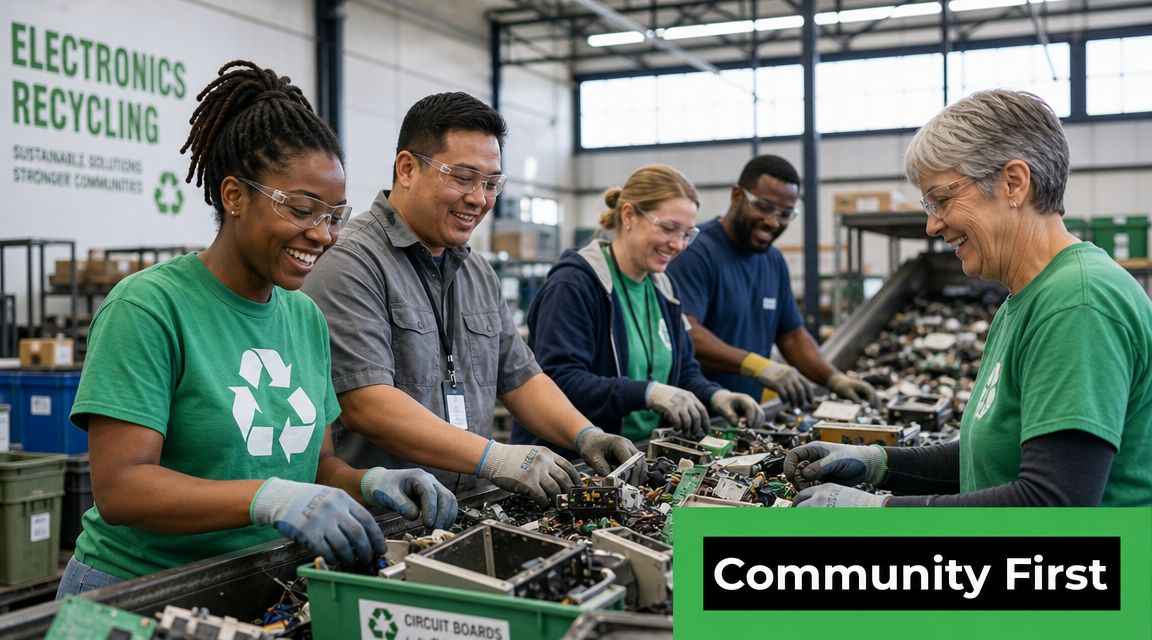
That distinction matters because end-of-life technology decisions don't just affect waste volumes. They also influence reuse opportunities, digital access, local jobs, and how much social value your company creates from assets it no longer needs.
Why partner choice changes the outcome
Natural Resources Canada reports that permanent magnets represented 48% of total rare earth demand in 2024, and those magnets are critical in electric motors used in hard drives, servers, and medical equipment, as outlined in its rare earth elements facts page. That means the hardware leaving your business often sits close to one of the biggest end-use categories in the rare earth economy.
A social enterprise model adds another layer. Instead of treating every retired asset as a disposal burden, it asks whether equipment can support community outcomes before final recycling. Donation-based recycling programs can extend the life of suitable devices, support digital inclusion, and create a more visible connection between sustainability policy and social impact.
What executives should look for
A strong partner should combine environmental discipline with operational rigor. That includes secure data destruction, reliable pickup coordination, transparent handling, and clear pathways for reuse, refurbishment, and recycling.
It should also align with your company's values. If your organization talks about community investment, workforce development, or circular economy leadership, your ITAD partner is one place those values become tangible.
Some businesses want a processor. Others want a partner with a broader mission. For organizations in the second group, it helps to understand the case for partnering for impact with Reworx.
When an asset leaves your building, it still carries your company's standards with it.
The practical implication is simple. Vendor selection in electronics recycling isn't only about price and convenience. It's also about what kind of environmental and community outcome your organization wants to fund through its normal operations.
Conclusion Your Role in the Circular Economy
Rare earth extraction can seem remote from day-to-day business decisions. It isn't. The same global system that supplies advanced materials to manufacturers also depends on what happens after companies retire the devices already in service.
That's the strategic bridge. A laptop refresh, office cleanout, secure shredding project, or data center decommissioning effort isn't just an end-of-life event. It's a chance to reduce waste, preserve recoverable value, support more resilient material flows, and tighten your company's environmental practice.
The companies that lead here don't wait for perfect policy or ideal market conditions. They build disciplined internal processes, choose partners carefully, and treat discarded electronics as part of resource strategy. That approach fits naturally with broader conversations around sustainability in facility management, where operations teams are being asked to connect waste, procurement, compliance, and ESG performance more directly.
Your servers, drives, laptops, and specialized equipment are part of a bigger system than most disposal plans acknowledge. If you manage them well at end of life, you do more than clear space. You contribute to a circular economy that values recovery, security, and accountability.
If your organization is ready to turn old equipment into measurable environmental and community impact, partner with Reworx Recycling. Reworx Recycling helps businesses handle electronics recycling, donation-based recycling, IT equipment disposal, secure data destruction, office cleanouts, and data center decommissioning with a social enterprise model that supports responsible reuse and recovery. Whether you need to donate old equipment, schedule a pickup, or build a stronger ITAD program, Reworx can help you move retired technology out of storage and back into the circular economy.