
A lot of New York financial firms are in the same position right now. A device refresh is underway, old laptops are stacked in a locked room, a few servers are waiting for decommissioning, and someone from compliance has asked a hard question: can you prove every retired asset was handled in a way that would stand up to a NYDFS review?
That question is where generic ITAD advice stops being useful. Most disposal guidance talks about wiping drives, scheduling pickups, and getting a certificate. It rarely addresses the issue New York firms must address, which is how to connect disposal activity to NYDFS 23 NYCRR 500, board reporting, and annual compliance sign-off. That gap matters because industry commentary on New York computer recycling and compliance notes that existing content often misses New York-specific financial requirements, and it also states that NYDFS fines reached $1.5 million in 2025 for data handling lapses.
In practice, secure computer disposal for financial firms in New York isn't a back-office cleanup task. It's a governance exercise involving cybersecurity, records management, legal review, vendor oversight, and environmental compliance. If your process can't show who approved disposition, who handled transport, what method was used, and how each asset was closed out in your records, you don't have a defensible process. You have a hope-based one.
That’s why firms are looking for more than a recycler. They need a program that maps operational steps to regulator expectations and produces evidence on demand. For organizations operating in Manhattan, Brooklyn, Queens, or anywhere in the metro area, local execution matters too. A provider familiar with business electronics recycling in New York City can support the logistics side, but the ultimate standard is whether the disposal program protects the firm in an audit, an incident review, or a board meeting.
Introduction Navigating the High-Stakes World of IT Asset Disposal in NYC
The risk starts before a single device leaves your floor. A retired workstation may still hold cached credentials, archived statements, internal reports, or customer data. A copier hard drive may contain scanned forms. A decommissioned server may carry years of operational history. Financial firms know this in theory, but many still treat disposition as a facilities task with a security add-on.
That approach breaks down in New York because regulators don't separate these issues the way internal teams often do. Cybersecurity leaders focus on nonpublic information. Facilities teams focus on removal. Sustainability teams focus on recycling. Legal wants records. Senior management wants assurance. A proper disposal program has to satisfy all of them at once.
Why generic destruction advice fails in New York
The common advice is simple: find a certified vendor, wipe or shred drives, and collect paperwork. That’s not enough for broker-dealers, registered advisers, lenders, insurers, and other regulated firms operating under New York's cybersecurity rules. The harder question is whether your disposal controls are tied to documented policies, risk assessment, oversight, and evidence retention in a way that fits Part 500 expectations.
A strong program answers questions like these:
- Policy alignment: Does your written cybersecurity or asset lifecycle policy define disposition requirements for data-bearing equipment?
- Approval control: Can you show who authorized retirement and under what classification?
- Vendor governance: Can you demonstrate why the vendor was selected and how their controls were reviewed?
- Record closure: Does your asset inventory reflect final disposition, not just pickup?
Secure disposal isn't judged only by what happened to the device. It's judged by what your firm can prove happened.
The compliance burden can become a governance advantage
The firms that handle this well don't just reduce risk. They create a clean, repeatable control that looks strong during internal audit, external review, and regulator inquiry. That matters because disposal is one of those processes that reveals whether a firm's broader control environment is disciplined or fragmented.
When leadership sees a disposal program that ties together inventory control, documented sanitization, chain of custody, environmental handling, and final reporting, the conversation changes. It stops being about old hardware and starts being about operational maturity.
Decoding the Regulatory Minefield for NY Financial Firms
A Manhattan broker-dealer clears out a storage room before an office move. The devices look harmless. A few retired laptops, a failed firewall, several traders' monitors, and backup drives from a decommissioned server. In a New York financial firm, that pile can trigger cybersecurity obligations, records handling questions, vendor oversight requirements, and state e-waste exposure at the same time.
The environmental side is straightforward. New York treats many discarded electronics as regulated e-waste, and improper disposal can lead to enforcement risk, as noted in New York e-waste regulation guidance. For a financial institution, sending data-bearing equipment into the wrong waste stream is not a facilities mistake. It is a control failure with legal and reputational consequences.
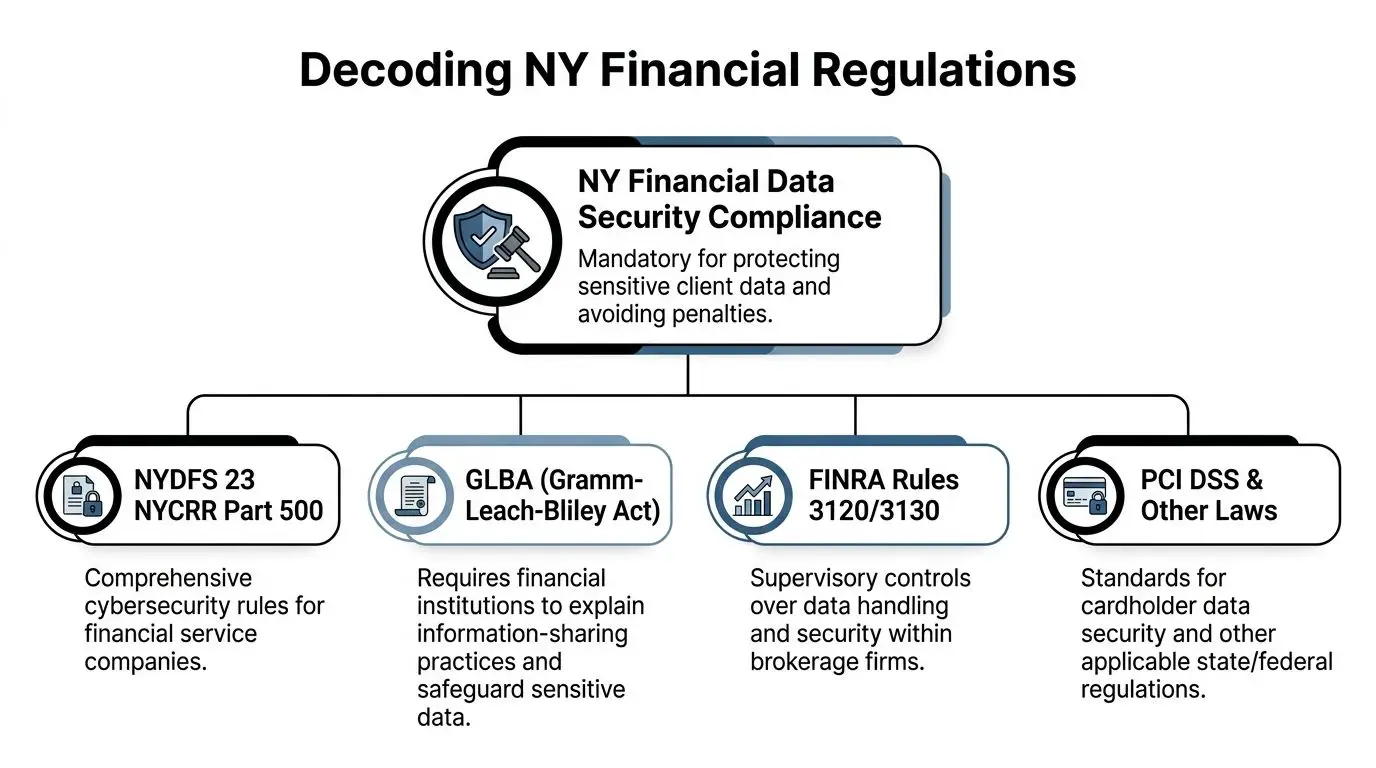
The harder issue is how disposal maps to NYDFS 23 NYCRR 500. Part 500 is not an ITAD statute, but it does require covered entities to maintain a cybersecurity program, written policies, risk-based controls, and governance that can withstand scrutiny. Once a retired device may contain nonpublic information, disposal falls inside that control environment. The 2023 amendments raised expectations around senior governance and accountability, which means end-of-life handling is no longer an informal back-office process.
Internal audits often reveal that firms underestimate this point. The gap usually is not whether someone intends to destroy data. The gap is whether the firm can show a repeatable process, documented approvals, custody control, and evidence that aligns with Part 500.
Where the rules intersect
Retired equipment sits at the intersection of several rule sets. NYDFS focuses on governance, risk assessment, access to nonpublic information, and the firm's ability to prove control. GLBA extends the duty to safeguard customer information through disposal. FINRA exam staff will care whether supervisory procedures, record handling, and vendor oversight match what the firm says it does. New York's e-waste rules add a separate obligation to send covered electronics through proper downstream channels.
That combination is what makes disposal a board-level governance issue rather than a recycling task.
| Regulation or framework | What it means for retired devices |
|---|---|
| NYDFS 23 NYCRR 500 | Requires written controls around data security, disposal, oversight, and records that support examination and audit |
| GLBA | Extends safeguards obligations to customer information through retention and disposal |
| FINRA supervisory expectations | Favors documented procedures, accountable ownership, and evidence that sensitive assets were handled under supervision |
| State e-waste rules | Restrict improper disposal and require electronics to be handled through approved recycling or reuse channels |
In practice, firms do not get to treat these as separate workstreams. A device leaves service once. The handoff, sanitization decision, transport method, downstream processing, and final records all need to hold up together.
Why disposal now reaches senior management
Regulators and internal audit teams often read end-of-life handling as a proxy for the wider control environment. If a firm cannot account for retired assets, it raises obvious follow-up questions. What else is missing from inventory? Where else are approvals weak? Which vendors are handling sensitive material without full review?
That is why disposal belongs in conversations with the CISO, compliance, legal, procurement, and the executives responsible for Part 500 certification. It also intersects with understanding cyber insurance protection, because insurers and counsel will ask how the firm prevented a preventable loss once equipment left active use.
Practical rule: If a device stored, processed, or transmitted nonpublic information, retire it through a controlled workflow with documented custody and a defined destruction or reuse decision.
What firms should do immediately
Start by reviewing whether your written policies connect disposal to NYDFS obligations. Many do not. They mention recycling in facilities language or reference destruction in an infosec standard, but they fail to assign approvals, escalation triggers, or record retention requirements.
Then tighten execution:
- Map Part 500 controls to disposal steps: Tie retirement, sanitization, transport, vendor review, exception handling, and evidence retention to named control owners.
- Assign one accountable process owner: IT, security, compliance, and facilities all have roles, but one function should own the procedure and the exceptions log.
- Screen vendors against financial-sector requirements: Use providers that can support chain of custody, documented sanitization, downstream transparency, and audit requests.
- Separate reuse from destruction by data risk: High-sensitivity assets may justify physical destruction. Lower-risk assets may be candidates for reuse, but only after validated sanitization and documented release.
- Require closure evidence: Pickup receipts are not enough. The file should support internal audit, examiner review, and management reporting.
For firms that need an operational partner on the environmental side, business electronics recycling support in New York can support lawful handling and reuse pathways. The stronger strategic move is to treat IT asset disposition as a governance control. Done correctly, it reduces regulatory exposure, gives leadership cleaner evidence under Part 500, and creates a credible community impact story when suitable equipment is refurbished and put back to use instead of discarded.
Building a Defensible IT Asset Disposition Framework
Most disposal failures don't start at destruction. They start much earlier, when the firm can't say with confidence what equipment it owns, where it is, what data it held, or whether resale is even appropriate.
A defensible framework starts with inventory discipline. If your CMDB, endpoint platform, or fixed asset records don't align, your disposal program will inherit those problems. Teams end up retiring devices in batches with partial serial lists, unclear owners, and no reliable data classification. That creates friction with compliance and invites mistakes at handoff.

Start with inventory and classification
Before retirement begins, each asset should be tied to a record that identifies the device, confirms status, and notes data sensitivity. In a financial environment, classification isn't optional. It determines whether reuse is viable, whether off-site transport is acceptable, and whether physical destruction is the right endpoint.
The strongest internal frameworks usually include:
- A retirement trigger tied to refresh cycle, failure, lease expiration, or decommissioning event.
- A verification step to confirm the asset matches internal records.
- A sensitivity classification based on the type of information the system stored or processed.
- An approved disposition path such as resale, redeployment, donation after sanitization, or destruction.
Many firms often discover their policy is too vague. For example, “Dispose securely” doesn't instruct teams on handling SSDs from trading desks, retired branch laptops, decommissioned backup appliances, or peripherals with embedded storage.
The resale versus shred decision is no longer straightforward
For years, many firms assumed value recovery was the default smart choice. Sometimes it still is. But the economics and the risk profile have changed.
According to NYC ITAD market commentary, used enterprise hardware prices dropped 28% in Q4 2025, 15% of 2025 data leaks traced back to incompletely wiped, remarketed drives, and NYC's 2026 e-waste pickup fees rose 20%. For risk-averse financial firms, those conditions can tilt the analysis toward shred-only policies for some categories of assets.
That doesn’t mean every device should be destroyed. It means the decision should be deliberate and documented.
| Asset category | Lower-risk path | Higher-security path |
|---|---|---|
| Standard office endpoints | Verified sanitization and controlled remarketing | Drive removal or full physical destruction |
| High-sensitivity devices | Limited reuse after strict review | Physical destruction as default |
| Failed storage media | Usually poor candidate for resale | Shredding or other irreversible destruction |
If the expected resale value is modest and the device held sensitive data, many compliance teams decide the safest answer is also the simplest one.
Write policy like an auditor will read it
A workable ITAD policy should specify who can authorize retirement, how data-bearing assets are classified, which sanitization methods are approved, when physical destruction is mandatory, and how evidence is retained. It should also address hidden storage in devices that non-technical teams often miss.
This is also the point where cyber insurance enters the discussion. Firms reviewing disposition controls often compare policy language, vendor requirements, and incident scenarios while understanding cyber insurance protection in the context of preventable data exposure. Insurance isn't a substitute for controls, but it does sharpen the question of what your firm can prove after an event.
For organizations building or revising policy, a structured IT asset disposition strategy framework helps turn one-off disposal projects into a repeatable operating model. That's what examiners and internal auditors want to see: not isolated cleanup efforts, but a controlled system.
Mastering Data Destruction Methods for Financial Compliance
At 6:30 p.m. on a quarter-end Friday, a retired trading-floor laptop is sitting in a Midtown office waiting for pickup. The device looks ordinary. Under NYDFS 23 NYCRR 500, it is a regulated risk event until your firm can prove the data is unreadable, the method matched the media, and the evidence will hold up in an exam or internal review.
That is the definitive standard for destruction in financial services. Firms do not just need data removed. They need a disposal method that fits the storage type, preserves defensible records, and supports the governance story management may need to tell later.
The NIST-based workflow that works
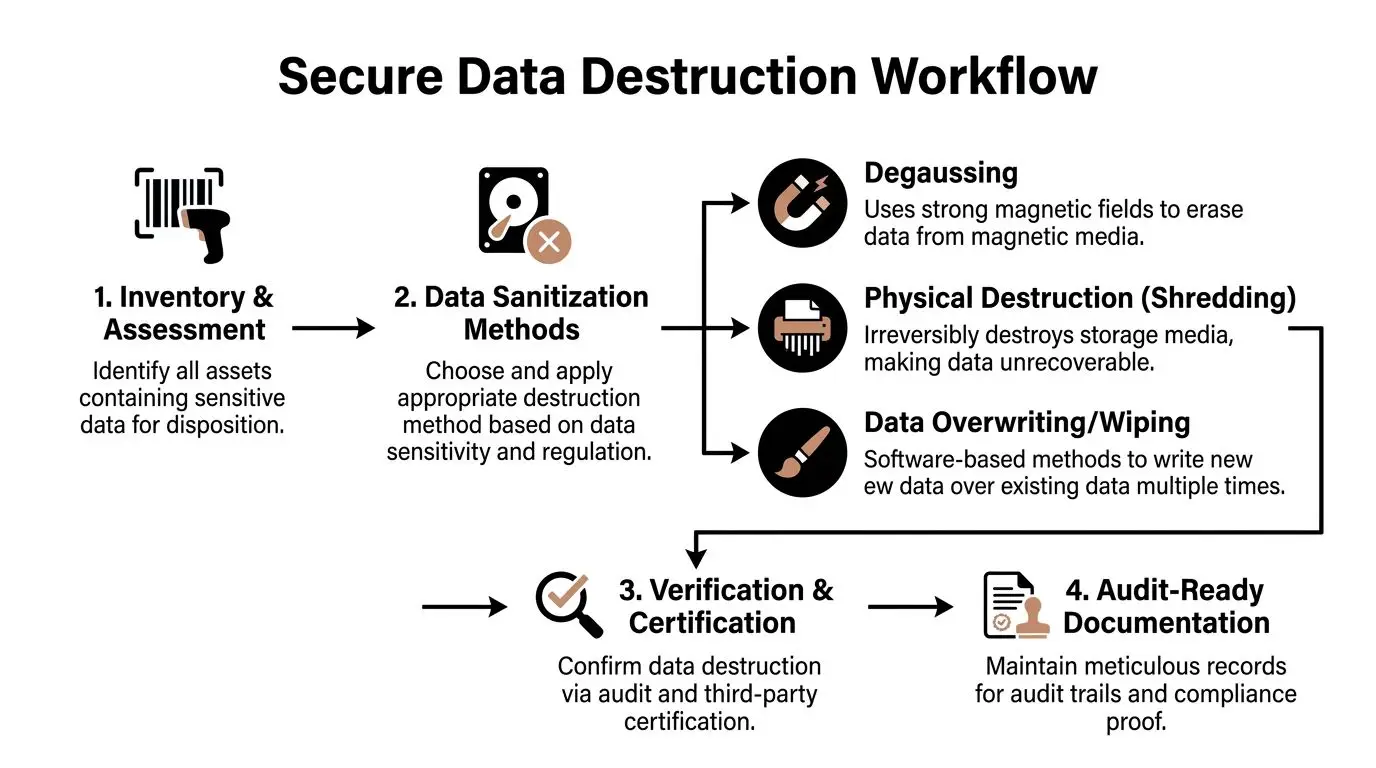
A sound workflow, consistent with New York data destruction and e-waste compliance guidance, starts with asset inventory and data classification, then moves to verified sanitization through wiping, degaussing, or physical destruction where appropriate. The core lesson is simple. Method selection matters, but verification determines whether the control is credible.
That distinction has direct relevance under NYDFS 500. A firm should be able to show that disposal controls are risk-based, consistently applied, and subject to oversight. If a regulator, auditor, or board committee asks why one class of assets was wiped and another was shredded, the answer should trace back to policy, data sensitivity, device condition, and the possibility of downstream reuse.
Choosing between wiping, degaussing, and shredding
Each method has a place. The mistake is treating them as interchangeable.
Wiping
Software overwriting is usually the right choice when drives are functional, the organization wants to preserve reuse or resale value, and the tool produces asset-level logs. This can be a strong option for standard employee endpoints leaving service in a controlled refresh cycle.
It is less forgiving than many teams expect. If the drive has bad sectors, the overwrite fails, or the verification record is incomplete, the firm may end up with a device that cannot be sold and still cannot be defended as sanitized.
Wiping is strongest when:
- The drive is operational
- The asset has legitimate reuse or resale value
- The sanitization tool creates clear verification records
- The firm can review exceptions and failed wipes promptly
Degaussing
Degaussing can work for magnetic media, including some legacy hard drives and tape environments that still appear in financial institutions. It destroys magnetic fields effectively, but it does not solve every storage problem. It is not suitable across all modern media types, and it still requires disciplined asset tracking before and after treatment.
For firms with older backup infrastructures, degaussing can be efficient. For mixed fleets with SSDs, embedded flash, and hybrid devices, it is often only a partial answer.
Physical destruction
Physical destruction is often the cleanest option when certainty matters more than residual value. Failed drives, executive devices, high-risk business unit assets, and storage with unclear history usually belong in this category.
That is why many firms default to destruction for SSDs and other media that are harder to sanitize with confidence. If your disposal policy prioritizes irreversible processing, a documented hard drive shredding process is often easier to defend than a patchwork of software-only methods applied inconsistently across device types.
Match the method to the risk and the recordkeeping burden
In practice, the right choice depends on two questions. Can the data be removed in a technically appropriate way, and can your firm prove that it happened for that specific asset?
| Situation | Preferred method |
|---|---|
| Working endpoint with a controlled reuse plan | Verified wiping |
| Magnetic media in a secure processing stream | Degaussing where appropriate |
| Failed drives, highly sensitive assets, or unclear media history | Physical destruction |
| Executive, trading, or regulated data environments with little tolerance for residual risk | Physical destruction as the default |
Verification is the required control.
Financial firms often focus on the destruction event itself. Auditors focus on whether the result was validated, tied to the correct serial number, reviewed for exceptions, and retained in a form the firm can produce later. Under NYDFS 500, that difference matters because disposal is not a housekeeping task. It is part of the firm's larger cybersecurity governance system.
The strongest programs treat destruction decisions as both a compliance control and a governance opportunity. They reduce breach exposure, protect client trust, and create a clear path for responsible reuse or recycling when policy allows it. Done well, IT asset disposition supports security and community impact at the same time.
Executing Flawless Vendor Due Diligence and Chain of Custody
Even strong internal controls can fail if the external partner is weak. That’s the uncomfortable lesson from New York's own public-sector experience.
A February 2025 audit cited by the New York State Comptroller’s office found that the state's Office of Information Technology Services had 17,887 IT items listed as absent, with 82% lacking known location information. Auditors also found 924 lightly used or new in-box desktop and laptop computers valued at over $500,000 marked for destruction rather than donation or resale. For financial firms, that case is a warning. If a large public entity can lose custody and make poor disposition decisions at that scale, private firms can't assume their process is sound just because it seems routine.

Certifications are not window dressing
Two certifications matter immediately in this context: NAID AAA for secure data destruction and R2v3 for responsible electronics recycling and downstream control. These certifications don't eliminate risk by themselves, but they give firms a better basis for due diligence than vendor promises or marketing language.
When reviewing vendors, ask for more than a logo sheet. Ask how the certified process works in practice:
- Asset identification: How are serial numbers captured and reconciled?
- Container control: Are assets sealed in locked bins, carts, or totes before transport?
- Transport security: How are vehicles controlled, monitored, and documented?
- Processing access: Who can enter the destruction area and how is access restricted?
- Exception handling: What happens if a serial number doesn’t match or a device arrives damaged?
A vendor that can't answer these questions in plain language is not ready for a regulated financial client.
Chain of custody should be visible at every handoff
The strongest chain of custody programs make custody transfer easy to follow. From the moment a device is pulled from service, there should be no ambiguity about who possessed it, where it was stored, when it moved, and how the final action was completed.
A practical custody model usually includes:
- Serialized pickup manifest
- Locked and controlled staging
- Documented handoff to transport personnel
- Secure arrival logging at the processing facility
- Recorded destruction or sanitization outcome
- Final reconciliation against the original manifest
If a firm can't reconstruct custody from retirement request to final certificate, it doesn't have a full chain of custody.
Donation and reuse require discipline too
Secure disposal doesn't always mean everything must be shredded. Some equipment can and should be reused or donated after proper sanitization. But the New York audit shows what happens when asset governance is weak. Useful devices can be wasted, and poorly documented decisions can create both compliance and ESG problems.
That’s why firms should evaluate not only whether a vendor destroys securely, but whether they can route eligible assets through responsible downstream channels without losing traceability. The social value of reuse is real, but only when it sits inside a disciplined control framework.
When evaluating secure destruction standards, it helps to understand what NAID AAA certification requires and how those controls support defensible documentation. In New York finance, vendor selection should be treated with the same seriousness as selecting any other material control partner.
Finalizing Compliance with Audit-Ready Documentation
A disposal event isn't finished when the truck leaves or the drives are shredded. It’s finished when your records show the asset lifecycle is closed in a way that internal audit, regulators, and senior management can follow without guesswork.
Many programs weaken because teams complete the operational work, then file a generic invoice, a batch receipt, or a broad certificate that says equipment was processed. That may satisfy basic procurement administration. It won't satisfy a serious compliance review.
What a usable Certificate of Destruction should contain
For financial firms, the Certificate of Destruction has to function as evidence, not just confirmation. It should connect the physical destruction or sanitization event back to the firm's own inventory records and policy framework.
A strong record package usually includes:
- Asset identifiers: Serial numbers or equivalent unique identifiers for each device or media item
- Service details: Date, time, location, and method of destruction or sanitization
- Vendor information: The legal entity that performed the work and the relevant certified service context
- Reconciliation data: Proof that the processed assets match the pickup manifest or approved retirement list
- Authorization trail: Internal approvals or references to the disposition request that triggered the work
The point is simple. An auditor should be able to start with one retired laptop in your CMDB and follow the record all the way to final disposition without hitting a gap.
Close the loop inside your own systems
External documentation matters, but internal closure matters just as much. Every completed disposition should update the firm's asset inventory and, where applicable, supporting systems used by IT, compliance, procurement, finance, or records management.
That internal closeout should answer four questions:
| Question | Record outcome |
|---|---|
| Was the asset retired through an approved process? | Linked approval or ticket |
| What happened to the data-bearing media? | Documented sanitization or destruction method |
| Who handled the final disposition? | Named vendor and service record |
| Is the asset still shown as active anywhere? | No, all systems updated and reconciled |
Good documentation should allow someone outside the project team to understand exactly what happened without asking for oral explanations.
Reporting for management and exam readiness
For senior management, the most useful final report is concise and control-focused. It should summarize the scope of the retirement event, identify any exceptions, confirm that approved methods were used, and note that supporting evidence is retained. It should also flag any lessons that require policy or workflow updates.
For exam readiness, consistency matters more than flourish. Regulators and auditors usually want the same things: a repeatable process, complete records, and evidence that management oversight is real rather than assumed.
In practice, the best programs build a standard documentation packet for every disposal cycle. That packet can be reused for branch closures, office cleanouts, data center decommissioning, laptop refreshes, and storage media destruction. Once the format is stable, compliance becomes easier because teams aren't rebuilding the evidence trail every time.
Conclusion A Strategic Partner for Compliance and Community
Secure computer disposal for financial firms in New York is a control function with legal, cybersecurity, operational, and environmental consequences. Firms that handle it well don't rely on generic recycling advice. They build a process that maps asset inventory, data destruction, vendor oversight, chain of custody, and final documentation to the standards regulators expect.
That approach reduces audit friction and lowers exposure, but it can also support broader corporate goals. When eligible equipment is processed responsibly, organizations can combine strong security with environmental stewardship and community benefit through technology reuse and donation programs. That’s the model more firms are moving toward: strict where data risk demands it, thoughtful where social impact is possible.
If your organization needs a more defensible approach to electronics recycling, IT equipment disposal, secure data destruction, office cleanout support, or donation-based recycling, Reworx Recycling can help you plan the process with compliance, sustainability, and community impact in mind. Whether you're retiring a handful of laptops, managing a larger IT asset disposition project, or looking for a social enterprise recycling partner that supports technology donations and digital inclusion, now is the time to schedule a pickup, start a consultation, or build a long-term recycling program.