The stack in the corner is familiar: a server room refresh, a datacenter decommission, or an office cleanout has left you with a row of UPS units and a simple problem nobody wants to own. Some still power on. Some are dead. A few are swollen or leaking. A common oversight is jumping straight to pickup scheduling before deciding whether they're retiring the battery cartridge or the entire UPS.
That choice drives everything that follows, from packaging and paperwork to who can legally touch the load. UPS battery recycling is not one process. It's two very different routes, and the right one depends on whether the equipment still has reusable electronics or is just scrap with a battery attached. If you get that wrong, you create avoidable handling risk, unnecessary cost, and a messy chain of custody.
Two Routes for Retiring UPS Batteries
The first question isn't who will recycle it. The first question is whether you're dealing with a battery-only replacement or full UPS retirement. In a lot of facilities, that answer gets buried under urgency, but it's the decision that determines whether the load should move as a regulated battery shipment or as a broader IT asset disposition event.
A hot-swappable sealed lead-acid cartridge in a rack UPS is a different animal from a tower UPS that's at end of life. The cartridge usually leaves the building as a battery unit, while the tower can still contain reusable electronics, casing, and power management components that deserve a different downstream path. A good reference point for operators who work around backup power systems is the tag for UPS systems, because it helps frame the equipment as a system, not just a box with a battery inside.
Battery cartridge replacement
If the UPS body stays in service and only the cartridge is being swapped, treat the move as a narrow battery retirement. The unit should be identified by chemistry, isolated, and staged for a recycler that accepts that chemistry. This is the fast lane, but it's still regulated work. Battery-only handling is where sloppy staging causes the most avoidable rejects.
Full unit retirement
If the whole UPS is coming out, stop thinking like a battery handler and start thinking like an ITAD manager. The UPS may include reusable electronics, power management hardware, or parts that can be processed through a broader take-back flow. Eaton separates battery recycling from broader product take-back, and that separation matters because the paperwork and downstream chain of custody change with the route Eaton battery recycle guidance.
Practical rule: If the rack stays, you're probably retiring the battery cartridge. If the rack unit comes out, you're probably retiring the whole UPS.
The easiest way to avoid confusion is to tag each unit before anyone rolls a cart into the room. One label for battery swap, one label for full retirement. That simple habit saves time, prevents mixed pallets, and keeps you from paying battery-hauler rates for equipment that should've gone through a fuller reuse or disposition stream.
Identifying Battery Chemistry and Condition
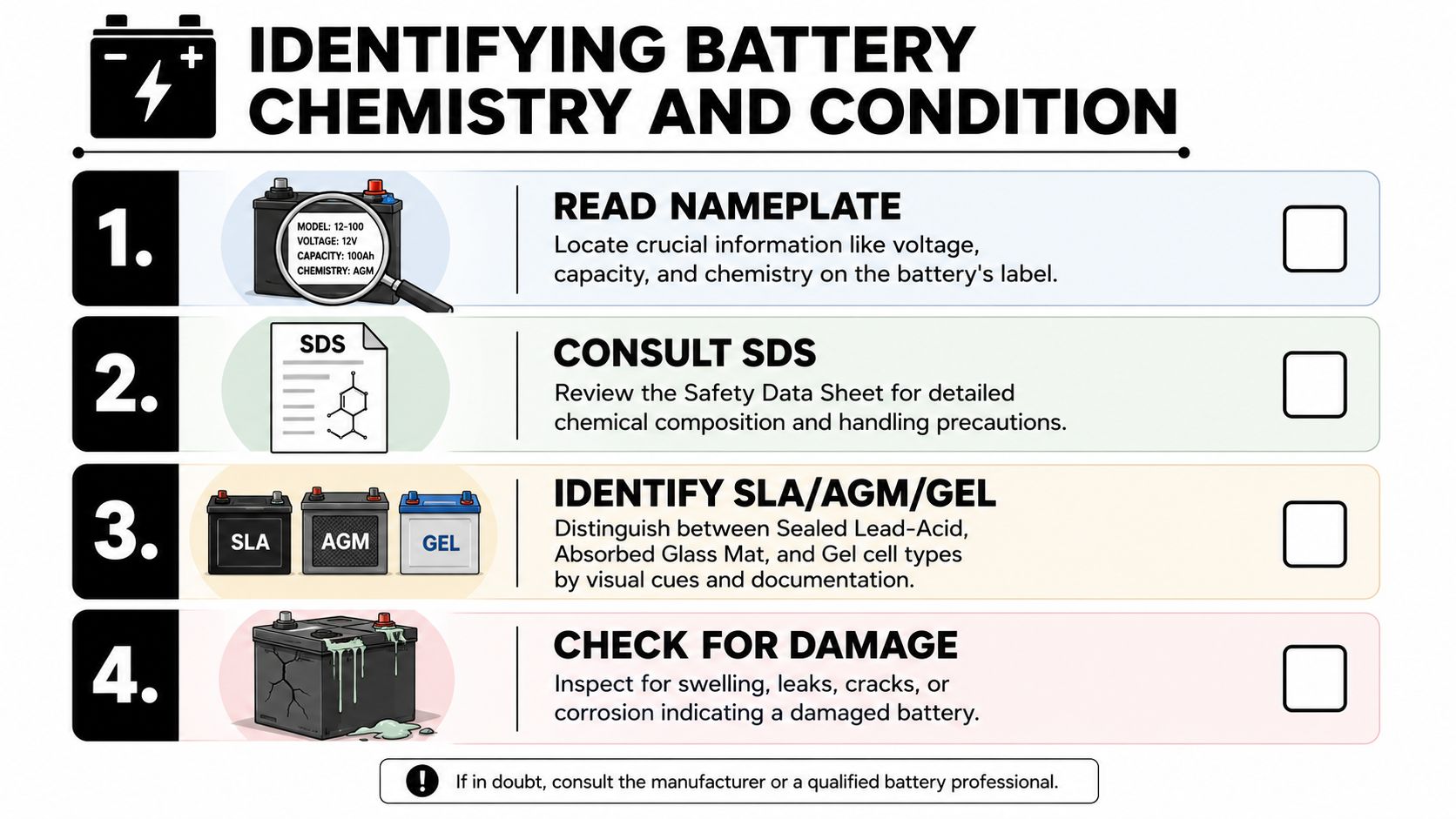
Start with the label, not the UPS display. The nameplate and the safety data sheet tell you what you are handling, and that is the line between a routine lead-acid pull and a lithium shipment that needs tighter controls. If the label is missing, unreadable, or inconsistent with the model, stop and verify it before the battery gets staged.
UPS rooms usually contain sealed lead-acid batteries, including AGM and gel, or lithium-ion and LiFePO4 packs. Those chemistries do not travel the same way, and they do not fail the same way either. A swollen lithium pack is a quarantine issue, not a “probably fine” unit. A lead-acid pack with sulfation or corrosion is still a problem that needs proper handling.
The voltage check matters because the UPS faceplate can hide what is happening at the terminals. Use a calibrated multimeter and read the open-circuit voltage directly. The guidance in the brief recommends reducing typical SLA batteries to 10.5 V and lithium packs to 3.0 V per cell before transport-ready staging, because that lowers short-circuit and fire risk during handling battery handling guidance. For lithium units that are headed out under stricter controls, follow lithium battery disposal guidance and keep the chemistry-specific rules in front of the crew. I would treat that voltage target as a technician's checkpoint, not casual advice.
Don't trust a green LED. Trust the terminals, the label, and the meter.
A junior technician can work from a one-page checklist without improvising:
- Read the nameplate: capture voltage, capacity, and chemistry from the label.
- Check the SDS: confirm handling notes and any chemistry-specific warnings.
- Measure the terminals: verify open-circuit voltage with a calibrated multimeter.
- Inspect the case: look for swelling, cracks, leaks, corrosion, or heat damage.
- Segregate by chemistry: keep lead-acid apart from lithium every time.
- Mark the outliers: anything damaged goes into a quarantine area immediately.
The best habit is the boring one. One battery type per tote, one condition category per pallet, and no mixing unknown units with known-good ones. That discipline keeps the recycler from rejecting the load and keeps your staff from making a handling decision that should have been obvious at the dock.
Safe Removal, Isolation, and Damaged-Battery Handling
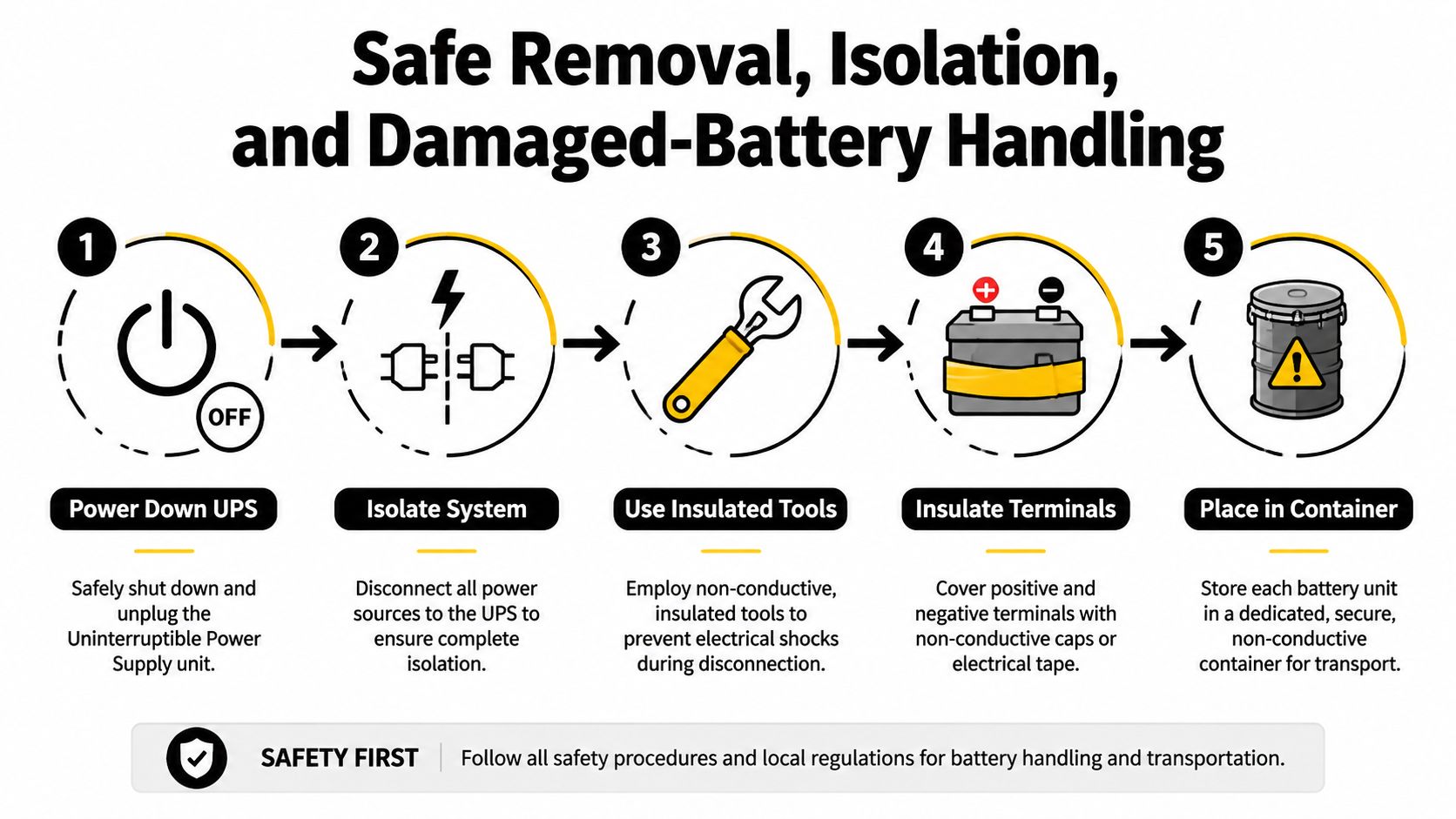
The safest battery move is the one that starts with a shut down, not a tug on the connector. Power down the UPS, isolate the system, and disconnect with insulated tools. After that, cap or tape the terminals and set each unit in a non-conductive container so one loose terminal doesn't become a short.
That sequence sounds basic because it is basic. It also gets skipped all the time when a facility team is trying to clear a room before the weekend. The shortcut is always the same, and it always creates the same risk, a battery with exposed terminals rolling against a metal cart or another battery in transit.
For staged loads that aren't damaged, the job is simple. For a damaged battery, the job changes immediately. Swollen, leaking, hot, or physically deformed batteries do not belong on the same pallet as routine inventory. They go into segregated quarantine with clear hazard labeling and a call to the recycler before pickup day. The common failure here is not the chemistry, it's treating a visibly compromised unit like a normal one.
Use the internal workflow that your team can repeat under pressure, and keep it short enough that nobody forgets it. Reworx Recycling's universal waste guidance fits that kind of operational discipline, because it keeps the focus on segregation, containment, and downstream control rather than wishful thinking about “just getting it out.”
For lead-acid spills, absorb and neutralize. For lithium thermal damage, isolate and stop the handoff until the recycler confirms the load path. If the battery looks fine, it can follow the routine route. If it looks puffy, wet, hot, cracked, or misshapen, it needs quarantine first.
A sound pickup prep room should have three bins, not one. Routine lead-acid, routine lithium, and damaged or suspect units. That simple split lowers the chance of a mixing error, and mixing is what turns an ordinary pickup into an incident report.
Choosing a Certified UPS Battery Recycler
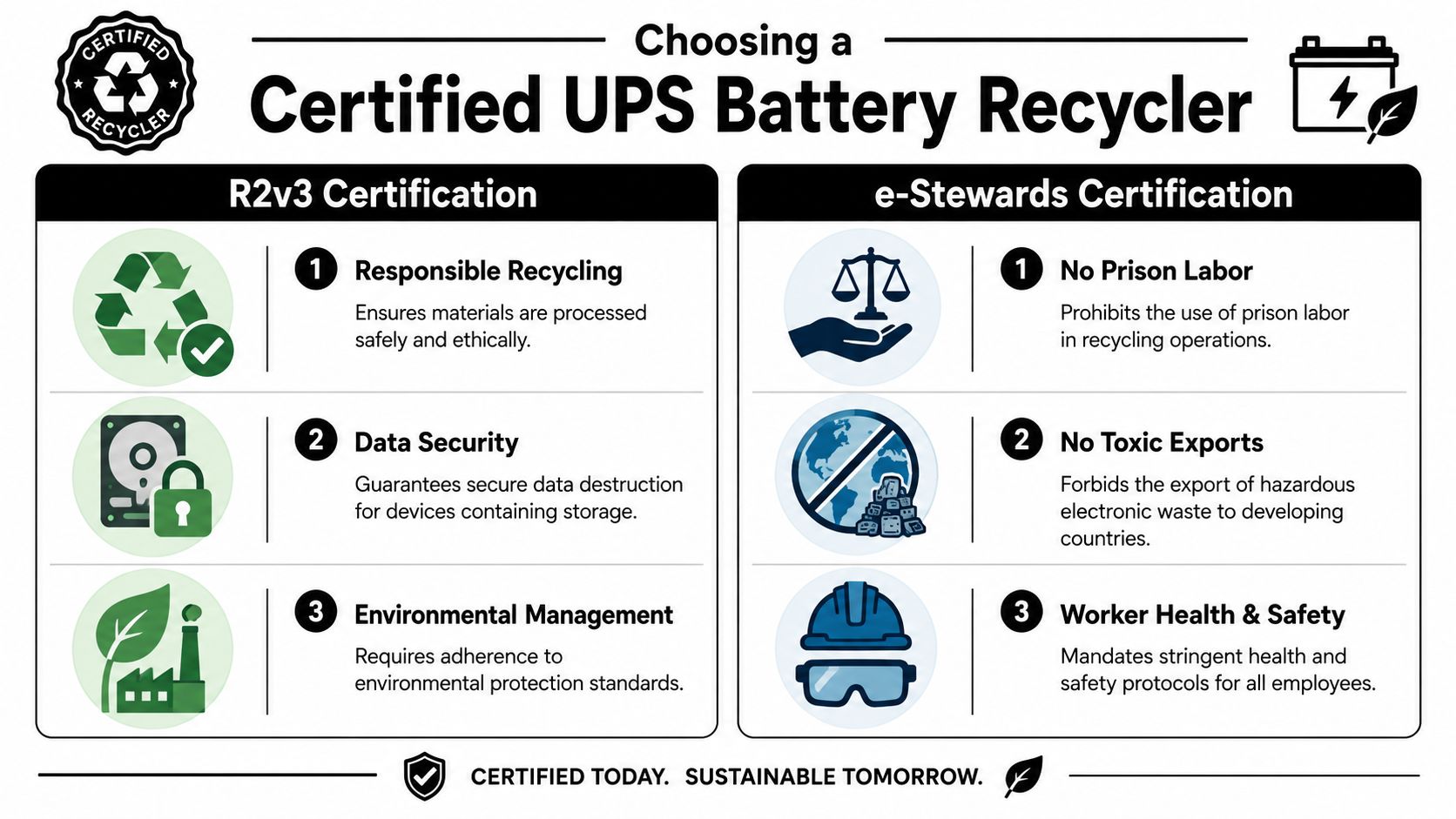
A recycler's homepage badge means very little. You need a facility that can prove control over chain of custody, downstream processing, and documentation. That is why certifications like R2v3 and e-Stewards matter. They are process controls, not marketing decoration, and they help separate real operators from anyone running a website template and a cargo van.
R2v3 should lead you to questions about responsible recycling practices, environmental management, and how reusable electronics are handled before shredding or destruction. e-Stewards should lead you to questions about downstream export risk, worker safety, and prohibited handling practices. The point is straightforward, certification does not prove a recycler is the right fit for every load, but it does show the kind of downstream discipline they are supposed to maintain certification comparison guidance.
If the shipment includes lead-acid units, the recycler needs to work cleanly within hazardous-waste and transport rules. If it includes lithium, the recycler needs the authority and packaging discipline to move regulated batteries legally under hazmat requirements. That is the difference between a load that can be audited and a load that turns into a liability after it leaves your dock.
Ask those questions on the first call, and ask them bluntly. If the answer is vague, keep calling.
- Do you accept lithium UPS packs?
- Do you provide a certificate of recycling per battery lot?
- What is your downstream vendor policy?
- Who signs the pickup paperwork?
- What happens to damaged units?
A good business load recycler should also make their service path easy to verify. Reworx Recycling's battery recycling service is the kind of place to check for clear chemistry acceptance, pickup documentation, and downstream transparency before you commit a pallet.
A vendor scorecard should be blunt. Clear chemistry acceptance. Written pickup documentation. Downstream transparency. No hesitation about damaged inventory. If a recycler cannot answer those five points without hand-waving, they are not ready for a business load.
Packaging, Labeling, and Transport Options
A shipment starts telling its story before anyone opens the box. For lithium or other high-energy batteries, use UN-certified packaging, add inner non-conductive liners, protect the terminals, and mark the chemistry clearly. If you are sending lithium packs, the container and label work together, and the shipping setup should match that requirement, including the right UN 3481 label guidance. A packaging partner such as UK flexible packaging solutions shows the point plainly, containment comes first, and the carton is not decoration.
Lead-acid batteries need the same discipline, just in a different form. Terminals still need protection, containers still need to be non-conductive, and the load still needs to be stabilized so batteries do not move against each other in transit. A recycler can manage the material at the back end. A sloppy shipment creates the hazard before it arrives.
B2B operators usually have three practical transport routes.
| Option | Best fit | Chemistry restrictions | Documentation |
|---|---|---|---|
| Drop-off | Small office batches | Routine batteries only, pre-cleared by the receiving site | Basic intake record, lot ID |
| Scheduled business pickup | Refresh cycles, closet cleanouts, multi-site work | Lead-acid or lithium, depending on recycler acceptance | Manifest, bill of lading, pickup signoff |
| Freight or specialty hazmat carrier | Palletized lithium loads or large battery inventories | Packaging and carrier rules must match chemistry | Full chain-of-custody packet, lot tracking, final disposition record |
That split is the one that matters. Small quantity, take it in person. Routine refresh, schedule pickup. High-energy or palletized loads, use a freight carrier or a hazmat-aware carrier that can handle the chemistry without improvising. Forcing every load into the same lane is how companies create avoidable risk.
Audit trails live or die on pickup paperwork. The carrier should leave with a signed manifest, the bill of lading, and a unique lot ID that lets the recycler trace the load later. For lead-acid shipments, uniform hazardous-waste manifests are the right anchor. For cross-border loads, keep the equivalent transfer document the same way. Do not bury the proof in email. Put it in the vendor file where you will find it later.
The failure points are predictable because they show up everywhere. Manifests get filed and never reconciled. Certificates sit in someone's inbox. A recycler sends material to a downstream smelter and nobody updates the final disposition record. Those are control failures, plain and simple, not administrative quirks.
Use a clean intake rule and stick to it. Small office batches can go to a certified site. Multi-site refreshes should be picked up on a scheduled route. Anything lithium-heavy deserves packaging and transport built for the chemistry, not just whatever is easiest for the loading dock.
Cost, Buyback, and the Real Economics of UPS Battery Recycling
The lowest quote is usually the worst deal. A cheap per-pound rate doesn't mean much if the vendor can't document where the batteries went or can't safely handle the chemistry you're sending. The true cost is the combination of recycling fee, freight, hazmat handling, and the time you spend fixing a bad handoff.
CoastTec's published program is a useful sanity check because it shows how the market prices the work. It pays $0.15 per pound for UPS units when they arrive sorted as UPS units with batteries, reduces that by $0.03 per pound when units are missing batteries, and pays $0.22 per pound for sealed lead-acid batteries by themselves. The same program does not accept lithium batteries under that battery offering CoastTec program sheet.
That doesn't mean every recycler should match those numbers. It does mean you should stop comparing quotes as if price were the only variable. A slightly higher fee with a clean certificate of recycling is usually the lower-risk choice because it closes the loop for audit and ESG review.
Cheap intake without proof is expensive later.
Lead-acid is where buyback or residual value tends to be most workable in the market. That lines up with the broader recycling economics that make sealed lead-acid easier to route than newer chemistries. If you want a simple reference point for a lead-acid route, Reworx Recycling's lead-acid battery recycling page fits the kind of intake you'd expect for routine business loads.
The cleanest financial play is often to split the stream. Route still-usable UPS hardware through donation or remarketing, and send spent batteries to the proper recycler. That's where a donation-based model can soften the total cost of an office refresh without pretending that broken batteries have reuse value.
FAQs and Your Next Step with Reworx
Lithium UPS batteries are not standard parcel freight. They need the right packaging, a carrier that will accept the chemistry, and an intake process built for hazardous materials. If a vendor tells you to box them like printer cartridges, walk away.
If the battery is still inside a working UPS that's being donated, do not pull it just because the battery is old. Send the intact unit through a refurbisher or donation channel that can handle the full device, then separate the battery only if the receiving process requires it. That keeps reusable electronics in circulation and avoids creating waste you never needed in the first place.
A healthy UPS battery should be replaced before it fails in the rack. I would rather see a planned swap than an emergency outage, because in-rack battery failure usually costs more than the battery itself. The replacement plan should follow your maintenance cycle, not a last-minute scramble when the alarm starts chirping.
For businesses that want one accountable path for both equipment and batteries, Reworx Recycling can handle donation-based electronics recycling, IT equipment disposal, secure data destruction, and pickup coordination for business loads in Smyrna and beyond. If you need a clean way to move a single pallet or clear an entire closet, start with Reworx Recycling and make the first call count.
If you are planning a UPS refresh, do not let the batteries sit in a corner until someone figures it out. Reworx Recycling can help you separate reusable equipment from spent batteries, set up a pickup that matches the chemistry, and keep the paperwork tight enough for audit review. Visit Reworx Recycling to schedule a pickup, ask about donation routing, or start with the one pallet your team wants off the floor this week.