
When an office finishes a hardware refresh, the cleanup problem rarely looks dramatic at first. It’s a locked storage room, a few rolling carts, old laptops stacked beside monitors, and a handful of retired servers nobody wants to touch until quarter-end. Then legal asks about data retention. Facilities wants the room back. Sustainability wants landfill diversion. Procurement asks whether any of the gear still has value.
That’s when the search often starts for universal waste systems inc and similar providers. On paper, this looks like a waste removal question. In practice, it’s a risk-management decision.
Most IT and facilities managers are not choosing between two identical vendors. They’re choosing between two different operating models. One model is built for hauling high volumes of general waste and recyclables. The other is built for chain of custody, electronics recycling, secure data destruction, and documented IT asset disposition. If you treat those as interchangeable, you increase the chance of compliance gaps, weak audit documentation, and unnecessary disposal costs.
This comparison matters most when your outgoing equipment includes business data, regulated information, reusable assets, or equipment your company may want to donate responsibly. That’s a different job from emptying a dumpster after a renovation.
Choosing Your E-Waste Partner An Introduction
A common scenario goes like this. The infrastructure team finishes a laptop deployment. The office also closes a floor, consolidates printers, and retires older networking equipment. Suddenly, there’s a mixed pile of devices with different owners, different data risk levels, and no clean disposition plan.
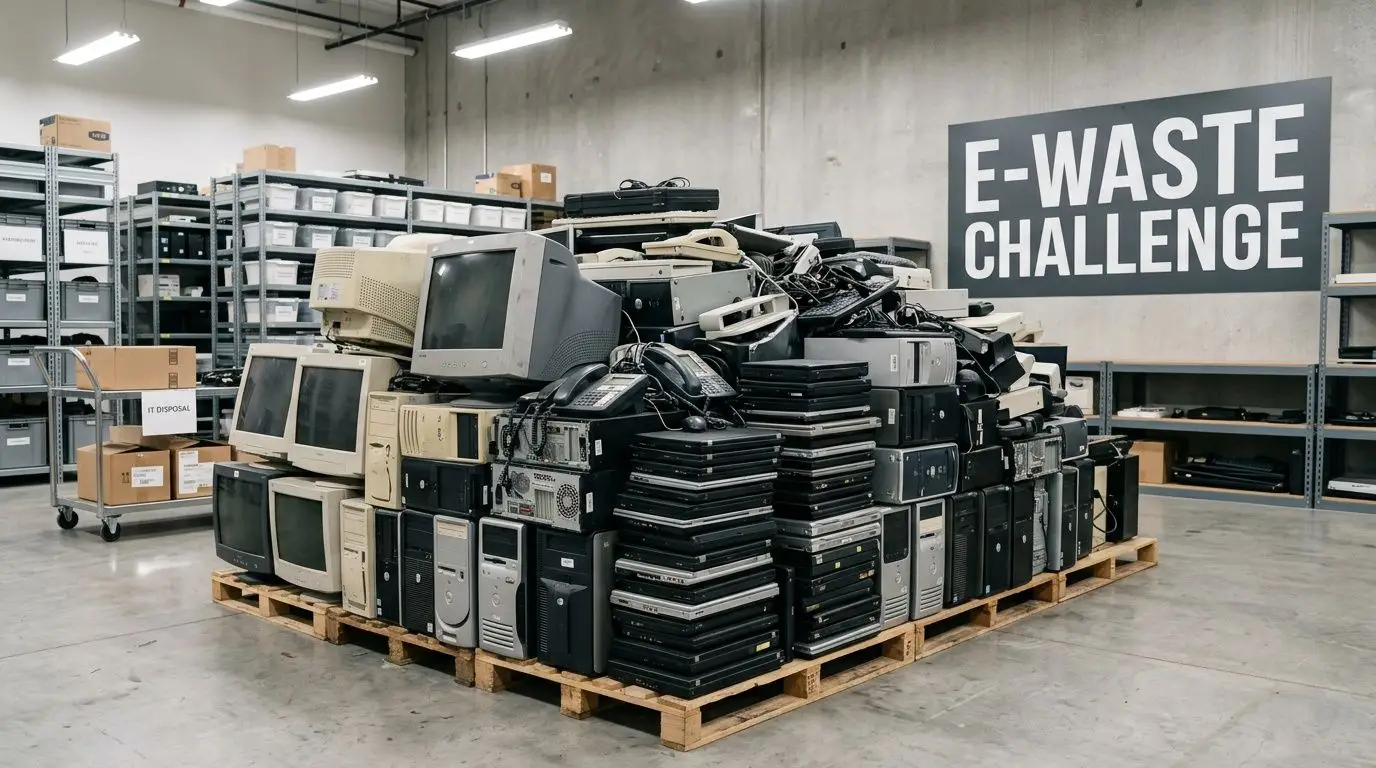
At that point, many teams make the same initial mistake. They search for any company that can “take electronics away.” That search turns up broad waste companies, junk removal firms, and specialist ITAD providers side by side. The listings look similar until you ask harder questions.
What the decision looks like
The first path is a traditional waste operator such as Universal Waste Systems Inc. The second path is a specialist focused on electronics recycling and end-of-life IT workflows. The difference shows up in the details that matter to a business:
- Data handling: Was every device inventoried, wiped, shredded, or documented?
- Compliance: Can the vendor handle universal waste items properly and explain the process?
- Reuse potential: Is working equipment being evaluated for refurbishment or donation?
- Reporting: Will your team receive records that satisfy internal audit, legal, or sustainability reporting?
A facilities-led disposal project often starts with speed. An IT-led disposition project usually starts with risk. Good vendor selection handles both.
For teams building a stronger evaluation process, this guide on selecting a reliable e-waste recycling partner is a useful companion because it focuses on the questions many buyers forget to ask until after pickup day.
Early comparison
| Evaluation area | Universal Waste Systems Inc. | Specialist ITAD social enterprise |
|---|---|---|
| Primary operating focus | General waste, recycling, green waste, hauling | Electronics recycling, data-bearing asset disposition |
| Best fit | Ongoing waste service, bulk material movement, general commercial waste | Laptops, drives, servers, office electronics, secure chain of custody |
| Data destruction visibility | Public information is limited | Typically central to service model |
| Reuse and donation pathway | Not clearly documented in public materials | Usually part of program design |
| Sustainability story | Waste and recycling infrastructure | Electronics lifecycle plus community impact |
If the project includes even one category of sensitive device, treat it as an IT disposition project first and a removal project second.
Understanding the Contenders An Overview
Universal Waste Systems Inc. is a large regional operator with a clear footprint in traditional waste management. Founded in 1986, Universal Waste Systems, Inc. has grown into one of Los Angeles County's largest family-owned waste management companies, servicing over 20,000 single-family homes and holding an exclusive contract for over 150,000 multifamily units in the San Fernando Valley, with a reported annual revenue of $42.3 million in 2025, according to RocketReach’s company profile.
That profile tells you a lot about where UWS is strong. It’s built for route density, hauling, municipal relationships, and large-scale material handling. Those are legitimate strengths. If you need recurring waste service or broad commercial waste support in its market, scale matters.
The issue is fit. Scale in waste management doesn’t automatically translate into expertise in IT asset disposition, secure media handling, or electronics reuse planning.
Universal Waste Systems Inc in practical terms
For a facilities manager, universal waste systems inc likely looks dependable because it has the traits buyers often associate with operational maturity:
- Regional infrastructure: Multiple facilities and an established operating base
- Municipal experience: The ability to perform under public service contracts
- Commodity volume handling: Strong capability for solid waste and recycling logistics
Those strengths are real. They just solve a different category of problem than secure technology retirement.
Why specialist focus changes the outcome
A specialist electronics partner starts from a narrower brief. The work begins with asset type, data risk, regulatory handling, and downstream disposition. That usually creates a different workflow:
- Assets are identified by category.
- Data-bearing devices are separated from non-data equipment.
- Pickup, packing, and chain of custody are planned around security.
- Reuse, resale, donation, and recycling paths are assigned intentionally.
That operating model is much closer to what IT managers need after a refresh, relocation, merger, or office cleanout.
A more focused look at this contrast appears on the Reworx page about Universal Waste Systems, which frames the gap between traditional waste services and electronics-specific disposition.
A waste hauler removes material. An ITAD partner manages risk embedded in that material.
The key business distinction
The most important distinction isn’t company size. It’s service design.
A general waste company is optimized to move material efficiently. A specialist electronics recycler is optimized to decide what the material is, what risk it carries, what can be reused, and what documentation the client will need later. For IT teams, those are not minor differences. They shape legal exposure, sustainability reporting quality, and whether the project creates value or removes clutter.
Core Services A Side-by-Side Analysis
The best way to compare these providers is to stop thinking in vendor categories and start thinking in task categories. What exactly do you need done with the equipment?
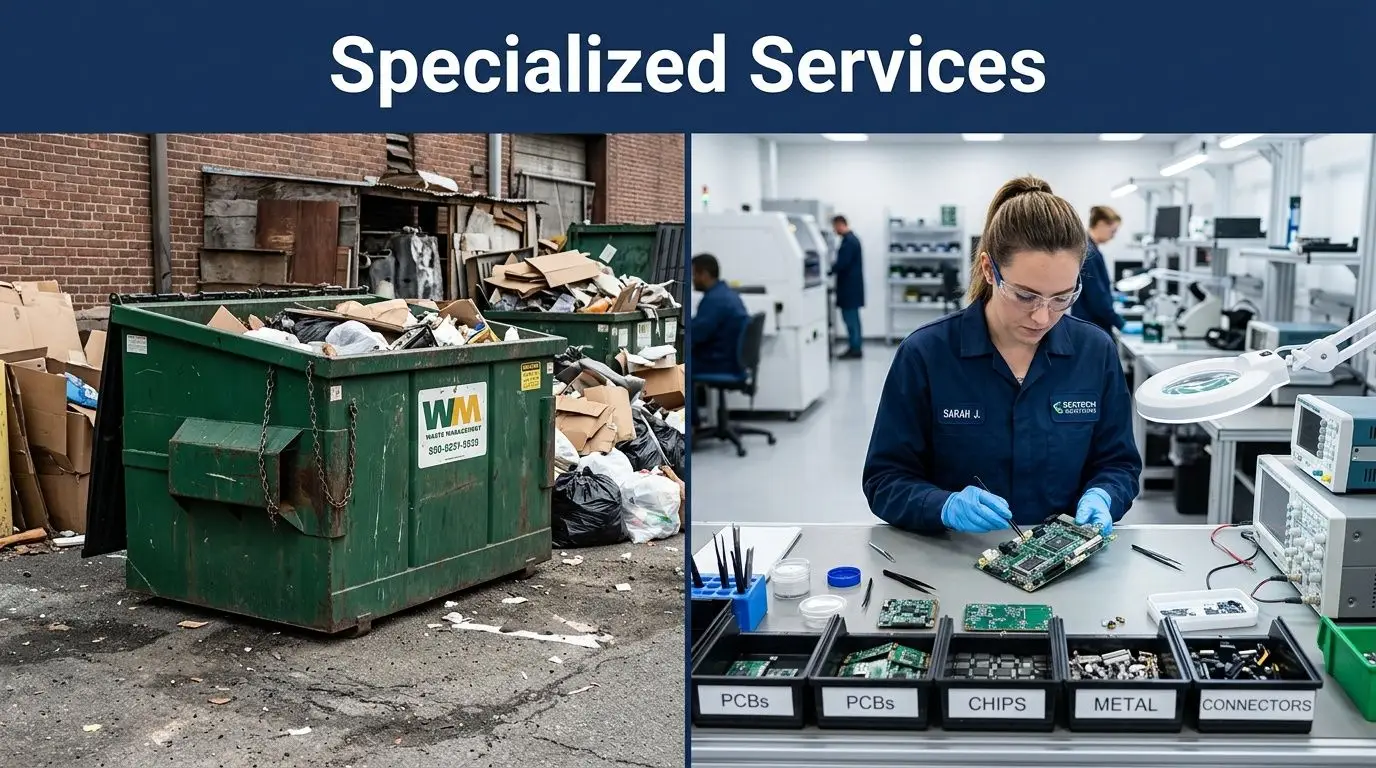
Where UWS appears strongest
Universal Waste Systems Inc. clearly presents itself around general waste services, recycling, hauling, and site support. That’s consistent with a company built around traditional waste streams.
For projects like these, that model can work well:
- Office renovation debris
- General commercial waste collection
- Bulk cleanouts with mixed non-sensitive material
- Container-based disposal needs
If the outgoing material is furniture, packaging, fixtures, or renovation waste, a traditional hauler can be the right operational choice.
Where the service gap starts
The gap appears when the project shifts from “waste” to “assets.” Public-facing materials leave important questions unanswered. A significant information gap exists regarding Universal Waste Systems Inc.'s capabilities in e-waste and ITAD. Their public-facing materials focus on general waste services, leaving unanswered critical business questions about secure data destruction, certified electronics recycling, or NAID AAA media sanitization, which are core offerings for a specialist like Reworx, as noted on uwscustomer.com.
That absence matters. For a business, undocumented capability is usually operationally similar to unavailable capability until proven otherwise.
Side-by-side service lens
| Service need | General waste hauler approach | Specialist ITAD approach |
|---|---|---|
| Old laptops and desktops | Pickup may be possible, but process detail may be limited | Asset-based intake and electronics-specific handling |
| Hard drives and SSDs | Public documentation may not address media destruction | Secure data destruction as a defined service |
| Data center decommissioning | Not typically core positioning | Structured project workflow |
| Office cleanout with mixed electronics | Good at removal logistics | Better at separating reuse, destruction, and recycling streams |
| Equipment value recovery | Often not central | Usually evaluated as part of disposition |
| Donation pathway | May be unclear | Often aligned to social impact or reuse programs |
What works and what doesn’t
For IT and facilities managers, I’d separate services into two buckets.
Works well with a traditional hauler
- Non-sensitive overflow: Broken furniture, packaging, fixtures, and ordinary site debris
- Containerized waste: Jobs where the main need is hauling volume, not asset tracking
- Property reset work: Clearing space after construction or tenant turnover
Usually needs a specialist
- Data-bearing devices: Laptops, desktops, phones, servers, storage arrays
- Chain-of-custody requirements: Equipment tied to audits, internal controls, or legal review
- Refurbishment decisions: Assets that may still support resale, redeployment, or donation
- Complex cleanouts: Projects where electronics are mixed with general office surplus
A specialist partner’s value is that the workflow starts before the truck arrives. Asset categories, pickup controls, destruction requirements, and reporting expectations are defined in advance. That’s the logic behind a dedicated IT asset disposition service.
The easiest way to overspend on e-waste is to treat every retired device like trash. The easiest way to create risk is to treat every retired device like harmless recycling.
The hidden cost of vague scope
The most expensive projects are often the ones with fuzzy scopes. If a vendor can remove electronics but can’t clearly explain how data destruction, sorting, downstream recycling, and documentation work, your internal team ends up doing the hard part anyway.
That usually means:
- extra staff time,
- rushed internal signoffs,
- inconsistent device tracking,
- and disposal decisions made too late.
A good ITAD process reduces that friction by making asset retirement a controlled workflow instead of a cleanup event.
Compliance Security and Environmental Impact
For electronics, compliance is not just about whether a vendor can pick material up legally. It’s about whether the handling method matches the waste stream and the risk profile of the devices.

Universal waste rules are useful, but they are not the whole answer
Some business buyers assume “universal waste” means the compliance issue is simple. It isn’t. The rules help handle certain items more efficiently, especially batteries and lamps, but they don’t eliminate the need for a vendor that understands evolving transportation and safety requirements.
The EPA's Universal Waste rules (RCRA Part 273) provide an efficient compliance path for items like batteries and lamps, but recent 2025 shifts, such as major carriers halting parcel shipments due to fire risks, highlight the need for certified bulk carriers and specialists who stay current with evolving regulations, according to this summary on beyondsurplus.com.
That’s the practical takeaway for IT teams disposing of mixed electronics. A compliant program has to account for more than collection. It has to address packaging, segregation, transportation method, and downstream processing.
Security controls are either designed in or added awkwardly later
General waste workflows are usually optimized for efficiency at scale. Specialist ITAD workflows are built around control points.
That difference shows up in several places:
- Pickup protocol: Who signs for assets, how containers are sealed, and whether item classes are separated on site
- Media handling: Whether drives are inventoried, destroyed, or wiped under documented procedures
- Audit evidence: Whether your company receives records that satisfy internal risk owners
- Exception management: How damaged devices, swollen batteries, or mixed loads are handled
If your company operates in healthcare, finance, education, legal services, or government, these details aren’t nice extras. They’re part of the decision.
Environmental impact is not the same as removal
Many vendors can say they recycle. Fewer can explain the order of operations. For electronics, the preferred path is usually to preserve reuse potential first, then process non-reusable material responsibly.
A specialist electronics partner generally performs better when your sustainability team needs answers such as:
- Which assets were reused, donated, or refurbished?
- Which materials entered electronics recycling channels?
- Which items required destruction because of data risk or physical condition?
- What records can be retained for ESG or internal environmental reporting?
That’s why certification standards matter. They don’t just signal environmental intent. They force process discipline around downstream handling, worker safety, and documentation. For buyers evaluating those issues, this overview of e-waste certification standards is worth reviewing.
Compliance without documentation won’t help much during an audit. Sustainability without traceability won’t satisfy a serious reporting team.
A practical rule for mixed loads
If a pickup includes any combination of laptops, phones, batteries, monitors, printers, networking gear, or storage devices, don’t run it through a generic cleanout process unless the vendor can clearly explain the compliance workflow. Mixed electronics loads create small failure points that become big management problems later.
The strongest programs keep security, environmental handling, and documentation tied together from the start.
Geographic Coverage and Business Model Comparison
Operational footprint matters more than many buyers expect. A vendor can be excellent in one metro area and still be the wrong fit for a company with satellite offices, branch locations, or a rolling refresh schedule across multiple states.

Regional strength versus multi-site flexibility
Universal Waste Systems Inc. appears strongest as a regional operator. That can be a real advantage if your business has a concentrated footprint inside its active service markets and your needs align with its core service model.
But B2B electronics disposition often doesn’t stay neatly regional. A company may have:
- a headquarters relocation,
- branch closures,
- remote employee equipment returns,
- a warehouse of legacy devices in one state,
- and a data closet cleanup in another.
That requires coordination, standardized processes, and quoting that works across locations.
Public information leaves buyers with some uncertainty here. Information on Universal Waste Systems Inc.'s B2B service model lacks clarity on pricing, multi-site scalability, and ZIP-specific availability, leaving enterprises and SMBs without tools for quotes or planning. This contrasts with ITAD specialists who offer transparent quotes and nationwide logistics for office cleanouts and reverse logistics, based on uwscompany.com/facilities.
Why the business model changes planning
Traditional waste contracts usually make sense for recurring service. They may be less intuitive for project-based electronics work, where scope changes quickly and each pickup can involve a different mix of equipment classes.
A specialist electronics partner usually fits better when you need:
- project scoping,
- itemized discussion of what’s being removed,
- pickup scheduling around business operations,
- and a process that can scale from one site to many.
What buyers should compare before signing
| Buying question | Traditional regional waste model | Specialist electronics model |
|---|---|---|
| Can they support one-off office cleanouts? | Sometimes, but process may center on hauling | Usually designed for it |
| Can they support multiple locations consistently? | Depends on footprint and network | Often core to service delivery |
| Is quote structure easy for IT and facilities to plan around? | Not always clear from public materials | Typically more project-oriented |
| Is support specific to electronics workflow? | May be generalist | Usually yes |
| Does the model support donation and value recovery? | Often secondary | Commonly integrated |
What works in the field
For a single local site with mostly non-sensitive material, a regional waste company can be perfectly efficient. There’s no reason to overcomplicate a straightforward hauling job.
For electronics-heavy projects, hidden friction usually comes from coordination failures:
- pickup windows that don’t align with IT staffing,
- unclear acceptance criteria for device types,
- uncertainty about batteries and damaged hardware,
- and no clean path for return logistics from multiple offices.
That’s where a more purpose-built operating model tends to outperform.
Buyers usually think first about truck coverage. They should think first about process coverage.
The strongest electronics disposition partners make logistics feel simpler because they’ve already accounted for the hard parts: mixed asset categories, security handling, chain of custody, and documentation after the load leaves your dock.
Making the Right Choice for Your Business
Universal Waste Systems Inc. is not the wrong answer to every disposal question. It’s the wrong answer to the wrong type of disposal question.
If your company needs support for general commercial waste, renovation debris, or broad hauling capacity in its market, a large waste operator can be the practical choice. UWS’s scale is clear. Universal Waste Systems Inc. demonstrates massive scale by transferring over 45,000 tons of solid waste annually from a single Los Angeles station. This high-volume, commodity-focused operation contrasts sharply with the high-touch, security-focused process required for specialized IT asset disposition, according to ZoomInfo’s company profile.
That sentence captures the decision well. The issue is not quality. It is specialization.
Choose based on asset risk, not vendor familiarity
A lot of teams default to the vendor category they already know. Facilities knows waste vendors. IT knows infrastructure vendors. Procurement wants consolidation. That’s understandable, but electronics disposition should be assigned according to risk profile.
Use a general waste hauler when the outgoing material is mostly:
- furniture,
- fixtures,
- packaging,
- non-sensitive scrap,
- or construction debris.
Use a specialist ITAD and electronics recycling partner when the load includes:
- laptops,
- desktops,
- phones,
- storage media,
- networking hardware,
- or regulated equipment.
A simple decision checklist
Ask these before approving pickup:
Does any device contain business, employee, student, patient, or customer data?
If yes, this is a secure disposition project.Do you need records for audit, legal, internal controls, or sustainability reporting?
If yes, documentation should be part of the vendor scope.Could any assets be reused, redeployed, donated, or refurbished?
If yes, avoid a disposal-first workflow.Will the project include batteries, damaged electronics, or mixed loads from several departments?
If yes, vendor process discipline matters more than hauling speed.Is this likely to repeat next quarter or at another site?
If yes, choose a partner whose workflow can be standardized.
The practical recommendation
For ordinary waste, choose the company optimized for ordinary waste. For retired technology, choose the company optimized for technology.
That sounds obvious, but many costly mistakes come from ignoring it. A secure laptop disposition project is not a dumpster problem. A decommissioned server rack is not bulk trash. An office cleanout with drives, monitors, batteries, and dock stations is not just a pickup request.
When buyers frame the problem correctly, the right vendor usually becomes obvious.
Your Path to Responsible IT Asset Disposition
A durable IT disposition program starts before equipment reaches end of life. The best teams don’t wait for a storage room to overflow. They build a repeatable process that connects procurement, IT, facilities, security, and sustainability.
Build the workflow before the next refresh
A practical internal playbook should cover:
- Asset identification: Define which device classes require tracked disposition
- Ownership: Assign signoff roles for IT, security, and facilities
- Segregation: Separate reusable assets, data-bearing devices, and damaged equipment
- Disposition route: Decide when to redeploy, donate, destroy, or recycle
- Documentation: Keep certificates, shipping records, and disposition reports in one place
If you’re tightening your internal process, Constructive IT’s guide to 10 IT Asset Management Best Practices is a useful planning resource because it connects day-to-day asset control with end-of-life decisions that often get overlooked.
What a mature program looks like
Mature programs don’t just “get rid of old equipment.” They reduce avoidable risk and preserve value where possible.
That usually means:
- security reviews happen before pickup,
- data-bearing devices aren’t mixed casually with low-risk scrap,
- business units know where equipment should go,
- and the organization can explain its process if asked by auditors, leadership, or sustainability stakeholders.
One of the most useful internal steps is to formalize the handoff from active asset management to end-of-life handling. This practical guide on how to implement an IT asset disposition strategy is a solid starting point for companies that want that handoff documented rather than improvised.
Good ITAD programs remove clutter. Great ones remove uncertainty.
What to do next
If your team is evaluating universal waste systems inc or any comparable vendor, don’t stop at pickup availability. Ask for process detail. Ask how data-bearing assets are handled. Ask what documentation you’ll receive. Ask whether working equipment is evaluated for reuse or donation before destruction or recycling.
Those questions will tell you very quickly whether you’re buying removal or buying risk reduction.
The right partner should help your company do three things well: protect information, handle electronics responsibly, and support a clear sustainability story. If a vendor can’t support all three, keep looking.
If your business is planning an office cleanout, laptop disposal project, data center decommissioning, or broader electronics recycling program, Reworx Recycling can help you handle retired equipment responsibly through donation-based recycling, secure data destruction, and practical ITAD support. Whether you need to donate old equipment, schedule a pickup, or build a repeatable disposition process, Reworx Recycling offers a community-focused path that supports environmental goals, digital inclusion, and responsible technology lifecycle management.