An IT manager in Midtown finishes an annual technology refresh and discovers a storage room filled with laptops, monitors, printers, network hardware, and loose drives. The equipment still has value, but it also contains business data and may include components that shouldn't enter ordinary trash. Sending the load to a convenient Atlanta drop-off point can create a documentation gap that only becomes visible when someone asks which devices were transferred, how the data was destroyed, and where the material ultimately went.
Atlanta e-waste recycling laws and best practices require more than finding a place that accepts electronics. Businesses need a defensible IT asset disposition process, source separation, secure data destruction, and records that connect each asset to its final destination. Reworx Recycling, a donation-based electronics recycling and IT equipment disposal social enterprise, offers one possible partner model for organizations that want environmental responsibility connected to community impact.
Understanding Atlanta E-Waste and Why Business Disposal Is Different
The Midtown office scenario is common. A company replaces a laptop fleet, consolidates a server room, or closes a satellite office. Facilities staff move the obsolete equipment to a loading dock, and someone suggests taking it to a consumer recycling event. That solution may handle the physical handoff, but it doesn't automatically address ownership records, data-bearing devices, resale value, or downstream accountability.
Residential recycling programs are designed around convenient public access and defined acceptance lists. A business ITAD workflow has a different purpose. It must show what entered the process, who handled it, which devices were suitable for reuse, which media required destruction, and what happened after collection. The distinction matters during an office cleanout, a facility cleanout, or a large data center decommissioning project, where equipment arrives in mixed condition and the volume makes memory unreliable.
The business risk behind an ordinary disposal route
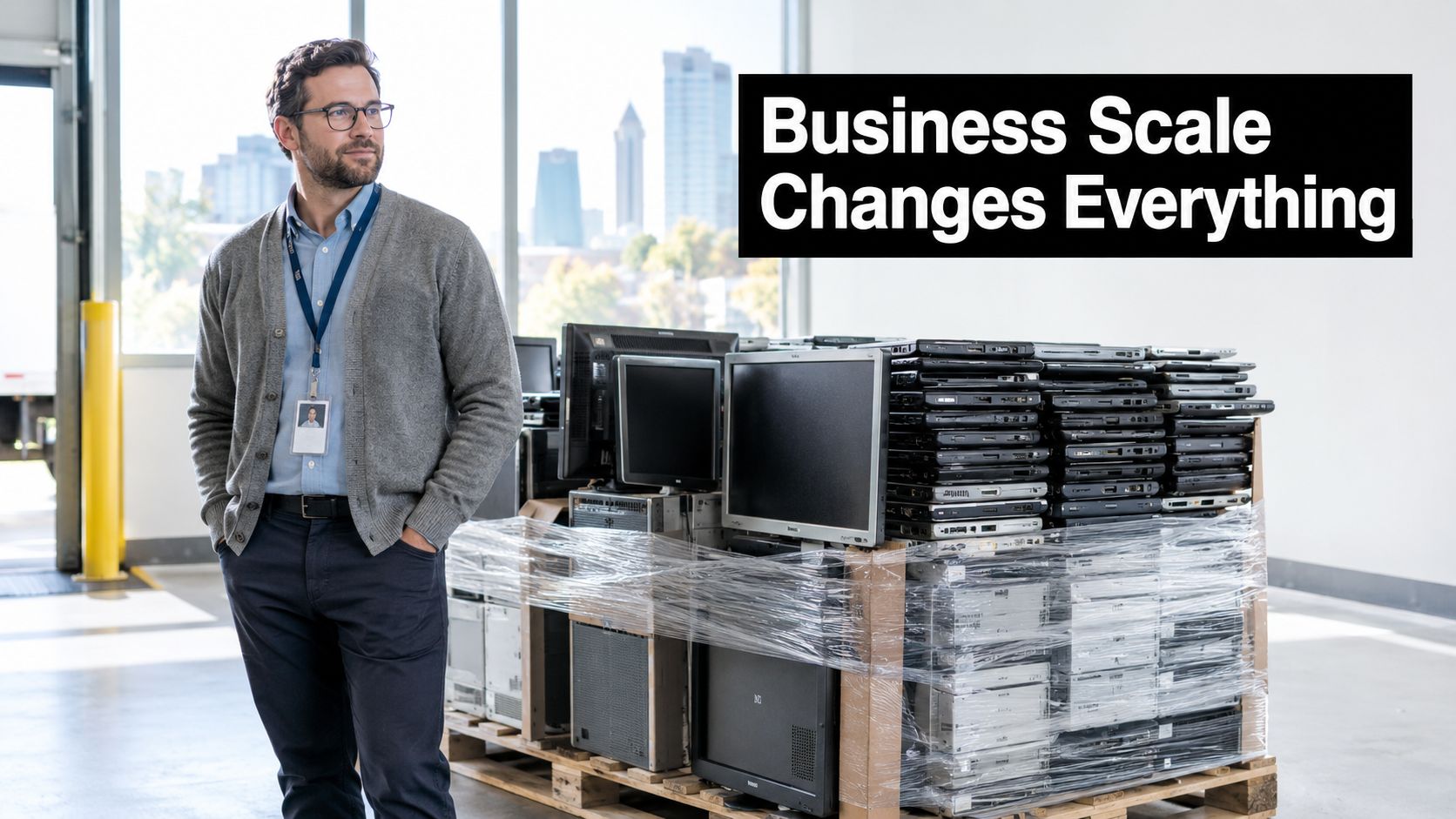
A laptop placed in a mixed load isn't just another piece of scrap. Its storage media may contain employee records, customer information, credentials, engineering files, or cached cloud sessions. A monitor may be harmless from a data perspective, while a server, smartphone, printer, or loose solid-state drive demands a very different handling decision.
The financial risk is just as practical. Equipment that could be redeployed, donated, remarketed, or harvested for parts loses value when workers mix it with broken peripherals and damaged material. Recycling remains necessary for equipment that can't be reused, but immediate shredding or bulk processing shouldn't be the default before anyone evaluates condition, support status, repairability, or resale potential.
Practical rule: Treat every business electronics load as an asset-control project first and a recycling project second.
A workable program begins with an asset inventory, a secure staging area, and a documented chain of custody. That approach supports the principles described in why responsible electronics recycling matters, while giving IT, facilities, finance, and sustainability teams a shared record.
What a defensible intake record contains
At minimum, record the device type, serial number, assigned owner or department, storage-media status, physical condition, intended disposition, receiving organization, and transfer events. For a large load, photograph pallets or containers before pickup and retain signed transfer records. Those simple controls make it easier to reconcile inventory and investigate discrepancies.
The practical baseline is straightforward:
- Separate data-bearing assets: Keep laptops, desktops, servers, phones, tablets, printers with storage, and loose drives apart from monitors, cables, keyboards, and other low-risk peripherals.
- Protect fragile components: Prevent breakage, especially for displays, batteries, and equipment that could release hazardous materials when damaged.
- Preserve asset value: Identify functional equipment before sending it to material recycling.
- Document the handoff: Capture dates, quantities, identifiers, receiving personnel, destination, and required certificates.
Consumer drop-off remains useful for suitable small loads and individual items. It isn't a substitute for business-grade IT asset disposition when the organization needs serialized records, auditable data destruction, product destruction documentation, or verified downstream processing.
Navigating Georgia and Atlanta E-Waste Regulatory Requirements
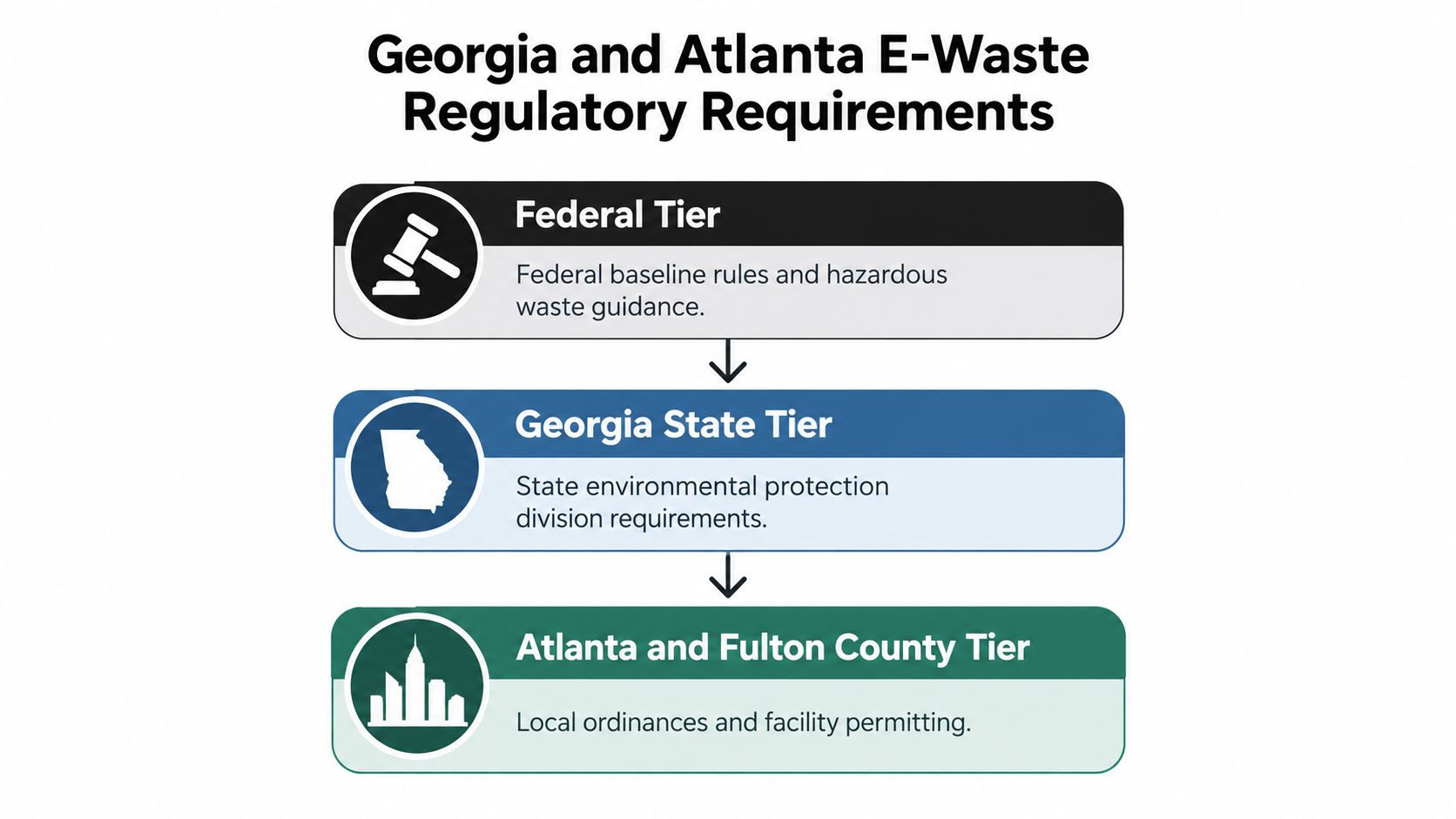
Georgia's electronics sector has a regulatory gap that can confuse business owners. The state doesn't operate a statewide manufacturer take-back, extended-producer-responsibility, or mandatory electronics-recycling program. Businesses generally arrange computer recycling and broader electronics recycling through private recyclers, nonprofit collection programs, retailers, or authorized waste facilities, but the absence of a dedicated state e-waste mandate doesn't make ordinary landfill disposal a safe default.
Atlanta adds a local layer. Atlanta Ordinance 07-O-1335 requires owners of multifamily properties with six or more living units, along with qualifying condominium or townhouse associations, to provide commercial recycling containers. The ordinance isn't limited to electronics, but it establishes a local expectation for source separation in larger residential settings. Atlanta Recycles Day also operates on the third Saturday of each month from February through December at Greenbriar Mall, according to the City of Atlanta recycling program. Organizations should confirm current eligibility and accepted materials before relying on a public event.
The federal baseline still matters
EPA guidance says federal, state, and local requirements can affect electronics while an organization controls the equipment and after a recycler receives it. The agency recommends documenting the equipment being recycled and evaluating data-security controls before transfer. That expectation applies even when a business isn't operating under a state-specific electronics take-back rule.
Georgia technical guidance also makes monthly hazardous-waste generation relevant. A business generating less than 100 kilograms, approximately 220 pounds, of hazardous waste per month may qualify for the federal RCRA small-quantity-generator exemption described in Georgia's electronic waste technical guidance. The exemption doesn't authorize careless disposal. Qualifying businesses still need to manage electronic waste through reuse, donation, or a facility authorized to receive solid waste.
Organizations generating more than 100 kilograms of hazardous waste per month must include hazardous e-waste in generator-status calculations. That makes weight tracking important during data-center decommissioning, office cleanouts, and facility closures. Lead-bearing CRT glass, mercury-containing equipment, and certain batteries deserve particular attention.
The compliance posture I recommend is conservative:
- Maintain an asset-level inventory.
- Confirm the processor's acceptance criteria and permits.
- Track weight and material categories where relevant.
- Keep transfer documents and downstream confirmations.
- Check current Georgia environmental requirements before a large collection.
Georgia electronics recycling guidance for businesses can help organizations identify a practical route, but each company remains responsible for confirming the rules that apply to its equipment, location, and waste profile.
Preparing Technology Assets for Responsible Collection and Disposal
A clean collection starts before the truck arrives. The most reliable Atlanta programs use a controlled staging area, an asset list, and a written decision for every storage medium. Workers shouldn't have to decide at the loading dock whether a failed drive gets wiped, purged, or physically destroyed.
Build the inventory before moving equipment
Start with device type, manufacturer, model, serial number, assigned owner, storage-media presence, condition, and proposed destination. Add a field for encryption status and another for the selected data-destruction method. For servers and network equipment, record rack position or business function when that information supports later reconciliation.
The inventory doesn't need to be elaborate software. A controlled spreadsheet can work for a small office, provided access is limited and changes are traceable. Larger programs may connect the inventory to an ITAM or ITAD platform. The important point is that the record follows the asset through intake, processing, and final disposition.
Separate equipment by risk and likely outcome
Create distinct staging zones for laptops and desktops, servers and networking hardware, monitors, printers, batteries, loose drives, and reusable peripherals. Keep batteries protected from impact and isolate damaged units so staff don't create a handling hazard by stacking or crushing them.
This separation supports several outcomes at once:
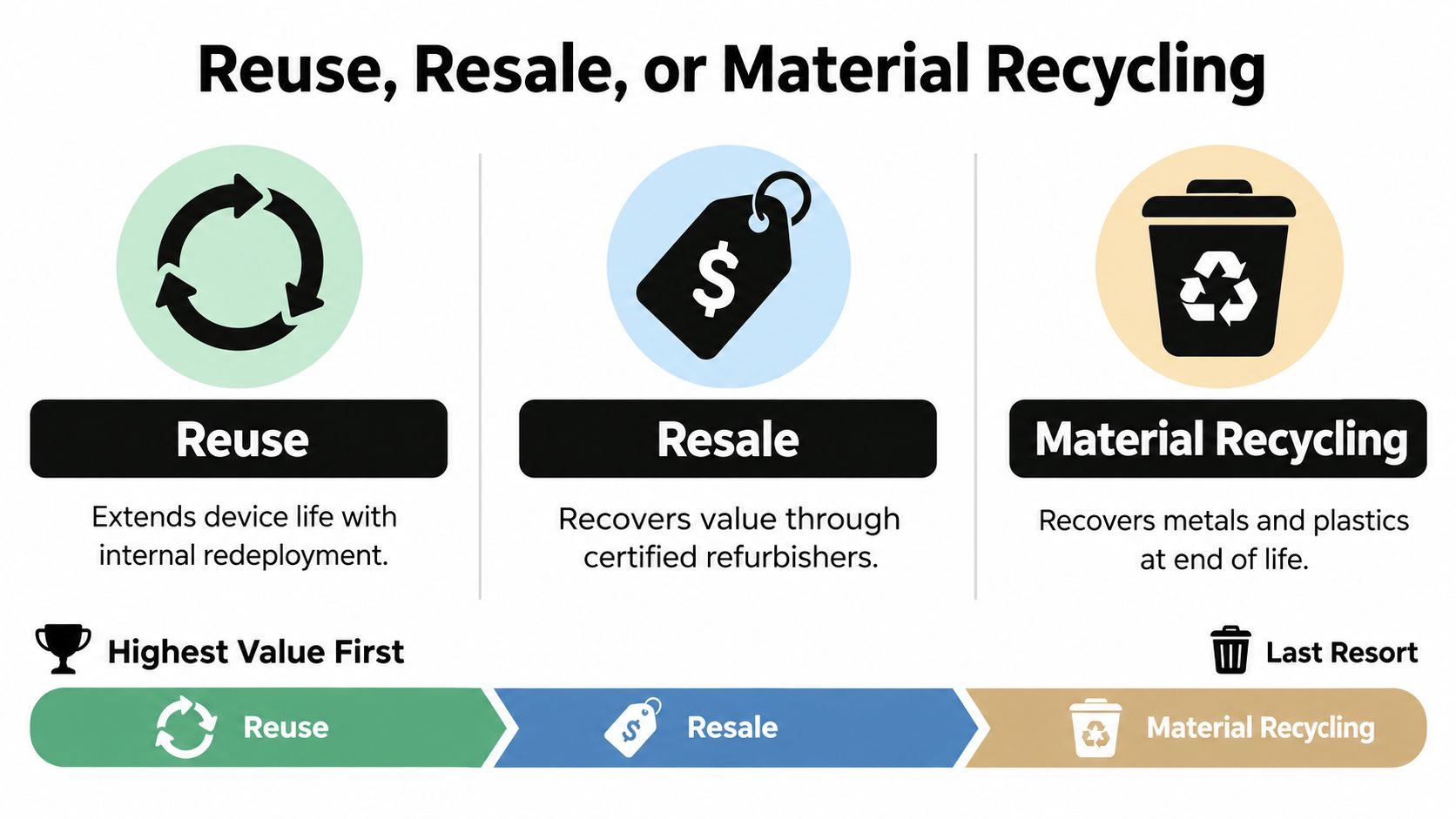
- Reuse and donation: Functional equipment with adequate support life can move to internal redeployment or a community program.
- Resale: Marketable systems can go to a qualified refurbisher after verified sanitization.
- Parts recovery: Incomplete equipment may provide usable components.
- Material recycling: Broken, obsolete, or uneconomical units can enter an appropriate recycling stream.
- Product destruction: Sensitive or contract-controlled equipment may require documented physical destruction.
A written decision matrix should connect device condition, encryption, confidentiality, reuse intent, and processing method. EPA guidance distinguishes clearing, purging, and destruction, and NIST media sanitization guidance frames sanitization around making access to target data infeasible for the required level of effort. Simple file deletion isn't enough for clearing.
For suitable encrypted drives intended for reuse, verified software sanitization or cryptographic erase may be appropriate. Failed, unencrypted, highly sensitive, or unmanageable media may require physical destruction. Record the method, operator, date, device identifier, and verification result.
Before transport, seal and label containers, reconcile the inventory against the pickup manifest, and identify the receiving contact. During a data-center decommissioning, retain rack diagrams, removal logs, drive counts, and transfer records. Preparing company electronics for recycling is operationally useful because it treats preparation as part of disposition control, not as an afterthought.
Comparing Business E-Waste Collection Options in Atlanta
Atlanta businesses have several collection routes, but they don't provide the same service level. A public event may be convenient for residents, while a private ITAD provider may be necessary for serialized assets and confidential media. The right choice depends on volume, risk, equipment condition, and the records your organization needs afterward.
| Collection route | Where it works | What it may not provide |
|---|---|---|
| Public city collection | Small, eligible loads and community participation | Enterprise inventory control, certificates, or commercial chain of custody |
| Appointment-based drop-off | Organizations able to transport separated equipment | Pickup logistics, asset-level reconciliation, or customized processing |
| Private recycler | Scheduled business pickups, mixed equipment, and material recovery | Reuse or community programs may vary by provider |
| Donation-based partner | Functional equipment with community or social-impact goals | Not every device is suitable for donation, and data controls still apply |
| Authorized waste facility | Material requiring regulated or specialized handling | May not offer resale assessment or ITAD reporting |
The City of Atlanta's recurring recycling infrastructure creates useful access points, but public access shouldn't be confused with a corporate disposition program. Available Atlanta-area guidance identifies appointment-based CHaRM drop-off as one route and lists a $25 charge per television or monitor plus $0.55 per pound for additional business electronics. Those figures and acceptance rules can change, so businesses should verify them before transport through current Atlanta e-waste disposal guidance.
The more important distinction is what happens after the handoff. A consumer-oriented route may accept a laptop but not provide a serialized certificate of destruction, a complete chain-of-custody record, a buyback assessment, or confirmation of downstream material routing. Those omissions matter for corporate donation programs, regulated environments, and any company that must answer an audit question months later.
A donation-based recycling partner can be a strong fit for working equipment, especially when a business values digital inclusion and workforce development. A material-recycling processor may be the better choice for failed, obsolete, contaminated, or uneconomical equipment. Reworx Recycling is one Atlanta-area option described through its electronics recycling services, including business-oriented handling. Regardless of provider, confirm commercial acceptance, pickup scope, data services, and documentation before scheduling a load.
Deciding Between Reuse, Resale, and Material Recycling
Recycling is not automatically the highest-value environmental decision. A functional device that can be securely redeployed or responsibly donated may preserve more embedded manufacturing value than immediate material recovery. That advantage disappears if the equipment no longer receives security updates, can't support the organization's work, or contains data that hasn't been verifiably sanitized.
The decision should combine operational and environmental factors:
- Device condition: Does it boot, hold a charge, and operate reliably?
- Software support: Can it run a supported operating system and required security controls?
- Repairability: Is repair practical, or would it consume more resources than the device justifies?
- Data sensitivity: Can the storage media be sanitized with a method that meets the required assurance?
- Resale potential: Is there a legitimate market for the model and configuration?
- Downstream control: Can the partner document refurbishing, parts recovery, or material processing?
A laptop with current software support, a functioning battery, and a verifiable sanitization path may suit internal redeployment or donation. A failed server drive containing sensitive information may require destruction even if the chassis has resale value. Indefinite reuse of obsolete or insecure devices can create cyber and operational risk, while sending every working device directly to a shredder wastes recoverable value.
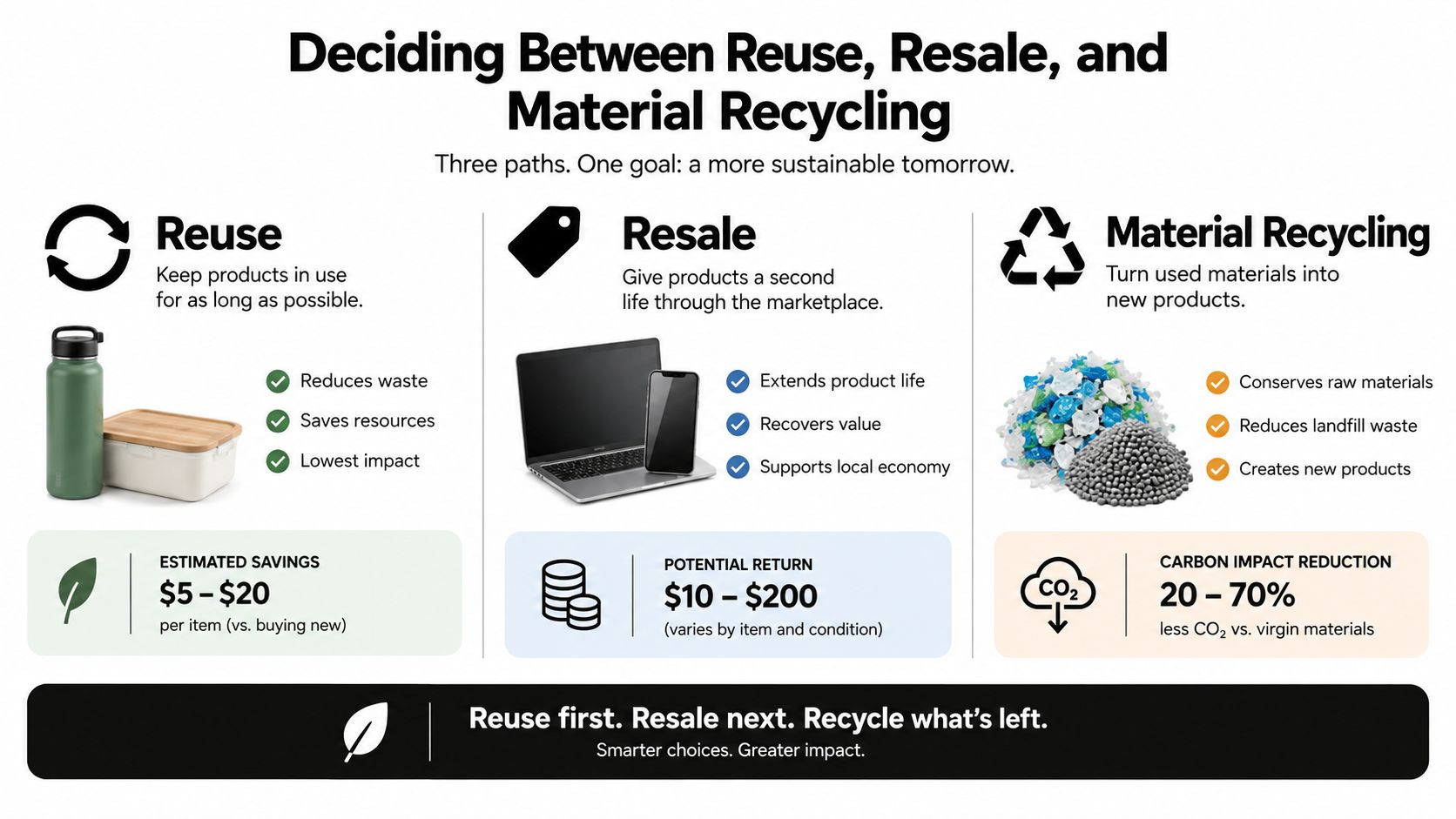
The global resource case reinforces the need for this hierarchy. The world generated 62 billion kilograms of e-waste in 2022, while only 22.3% was documented as formally collected and recycled in an environmentally sound manner, according to the Global E-waste Monitor 2024. The same assessment projects 82 billion kilograms by 2030, and reports that approximately 1% of rare-earth-element demand is currently met through e-waste recycling, as summarized by the European Commission's e-waste materials research.
Those figures don't mean every organization should chase recycling weight. They support a more useful scorecard:
| Outcome | What to record |
|---|---|
| Units reused | Devices redeployed, donated, or refurbished |
| Materials recycled | Weight and material categories processed |
| Hazardous components managed | Batteries, CRT glass, mercury-containing parts, and similar items |
| Verified data destruction | Devices and media with completed, documented sanitization |
Track these outcomes separately. A heavy load of low-value peripherals may increase pounds diverted without demonstrating meaningful asset recovery or security control. A smaller laptop donation program may produce stronger community value, provided sanitization, eligibility, and downstream accountability are documented.
Evaluating Electronics Recycling Vendors and Partnerships
Vendor selection should start with evidence, not a sustainability slogan. Ask how the provider receives assets, records serial numbers, protects data-bearing equipment, evaluates resale value, and controls downstream processors. A responsible partner should answer directly and provide sample documentation before pickup.
Questions worth asking before signing
- What happens at intake? Request a sample manifest showing device identifiers, quantities, condition, and receiving signatures.
- How is data destroyed? Ask which methods apply to encrypted, failed, removable, and physically damaged media.
- What proves completion? Confirm whether certificates identify devices, destruction methods, dates, operators, and verification results.
- Where does material go? Ask for acceptance criteria and an explanation of downstream routing for electronics, batteries, displays, and components.
- How is value recovered? Clarify whether the provider separates reuse, resale, parts recovery, and commodity recycling.
- What community outcomes are measured? For a social enterprise, request reporting on technology donations, digital inclusion, or workforce development where applicable.
The distinction between a generic scrap handler and a social enterprise recycling partner is visible in the operating model. A donation-based organization may evaluate equipment for community reuse before material processing, but it still needs disciplined data controls and transparent routing. Community impact doesn't replace chain of custody.
Red flags include vague claims that everything is “recycled,” refusal to identify downstream controls, missing pickup records, certificates that list only total weight, and reluctance to explain what happens to failed drives. A low price can also hide the absence of inventory reconciliation, secure media handling, or asset-value recovery.
Use vendor selection criteria for electronics recycling as a starting point, then adapt the questions to your industry, contracts, and information-security policy. Reworx Recycling can be considered alongside other providers when an Atlanta organization needs donation-based recycling, secure data destruction, pickup coordination, or IT equipment disposal connected to community programs.
Taking Action on E-Waste Compliance and Responsible Disposal
Start by auditing the equipment already sitting in storage, then establish one internal policy for segregation, sanitization, reuse screening, and transfer records. Finally, select a documented partner that can show how it handles data-bearing assets, hazardous components, value recovery, and downstream processing. That sequence works better than waiting for the next office move or year-end upgrade.
Atlanta businesses need collection access, but access alone isn't compliance. A repeatable ITAD process turns e-waste from an improvised cleanup task into a measurable environmental, security, and community program.
Reworx Recycling helps businesses coordinate electronics recycling, IT equipment disposal, business pickups, secure data destruction, equipment decommissioning, and donation-based reuse. Visit Reworx Recycling to explore responsible options for an Atlanta office cleanout, data-center project, or corporate donation program, and start planning your next equipment retirement cycle.