Atlanta's tourism engine handled 108.1 million airport passengers in 2024, the second-highest annual total in Hartsfield-Jackson Atlanta International Airport's history and the world's busiest airport total for the year, according to reported 2024 airport traffic. That figure reframes the question behind why Atlanta is one of America's fastest-growing tourist destinations. The city isn't growing because of one attraction or one tournament. It's converting enormous transportation access into hotel nights, convention attendance, restaurant demand, entertainment spending, and repeat business activity.
The important distinction is between scale and durability. Atlanta has durable foundations, including air connectivity, convention infrastructure, hotels, sports, entertainment, and corporate demand. It also experiences sharp event-driven surges, particularly around major championships and the projected 2026 FIFA World Cup activity. For local businesses, that difference determines whether demand supports a year-round operating model or only a short peak window.
The Scale Behind Atlanta's Tourism Boom
Georgia recorded 174.2 million domestic and international visitors in 2024, generating $45.2 billion in visitor spending, according to the Georgia tourism record announcement. Visitation was nearly 4% above the previous record set in 2023, while tourism produced $5.1 billion in state and local tax revenue. Atlanta is the main urban gateway within that statewide system, concentrating airport arrivals, conventions, major events, and leisure itineraries.
The statewide figures establish the market's scale, but they do not measure Atlanta's performance alone. Atlanta's visitor economy had already reached substantial size before the latest state record. The city announced 40.4 million visitors in 2012, a 28% increase over the prior decade, along with more than $5 billion in new attractions, restaurants, and hotels, as reported by the Atlanta Journal-Constitution. By 2017, Atlanta recorded 53 million visitors and $15 billion in visitor spending. Hospitality supported more than 223,000 jobs and over $12 billion in direct annual economic impact.
Atlanta Tourism at a Glance 2024
The supplied evidence does not provide a complete 2023 city-level visitor series. The table therefore separates verified figures from unavailable comparisons.
| Metric | 2023 | 2024 | YoY Change |
|---|---|---|---|
| Georgia visitors | Previous state record | 174.2 million | Nearly 4% above the previous record |
| Georgia visitor spending | Not provided | $45.2 billion | Not provided |
| Georgia tourism tax revenue | Not provided | $5.1 billion | Not provided |
| Atlanta visitor spending baseline | Not provided | Historical baseline of $15 billion in 2017 | Not provided |
| Atlanta airport passengers | Not provided | 108.1 million | 3.3% increase |
Raw visitor totals still require careful interpretation. They can include overnight leisure travelers, same-day visitors, business travelers, convention delegates, sports fans, and people using Atlanta as a gateway to other parts of the Southeast. These groups create different revenue patterns. An overnight convention delegate affects room occupancy, food service, local transport, and venue revenue more broadly than a same-day attraction visitor.
Atlanta therefore operates as a scale-and-conversion system. Air access supplies potential demand. Conventions, sports, entertainment, and corporate travel give people reasons to stay. Hotels, restaurants, attractions, and venues convert those movements into local revenue.
That distinction also separates durable demand from event-driven spikes. Airport access, convention capacity, and a large hospitality base can support recurring activity. A mega-event such as FIFA 2026 can create an unusually sharp peak, but it does not by itself prove year-round growth. Peak periods can also increase material use and discarded electronics, making Atlanta real estate market trends relevant to businesses assessing hospitality, commercial activity, and ITAD pressure.
How Airports and Infrastructure Move Visitors Into the City
Hartsfield-Jackson is the load-bearing layer of Atlanta's tourism model. The airport handled 108.1 million passengers in 2024, and airport officials and reporting cited a forecast that Atlanta could reach 125 million annual passengers within the next five years, indicating projected continued expansion rather than a one-season spike, as reported by the Atlanta Journal-Constitution.
The conversion from passenger volume to tourism revenue happens through a sequence of operational handoffs. A traveler must move from the aircraft to baggage claim, then to ground transport or rail, then to a hotel, and finally to a convention center, stadium, theater, restaurant, or attraction. Each handoff creates a possible point of friction, so reliable infrastructure affects more than convenience. It influences whether meeting planners can confidently recommend the city, whether visitors extend their stays, and whether hotels can sell rooms across multiple districts.
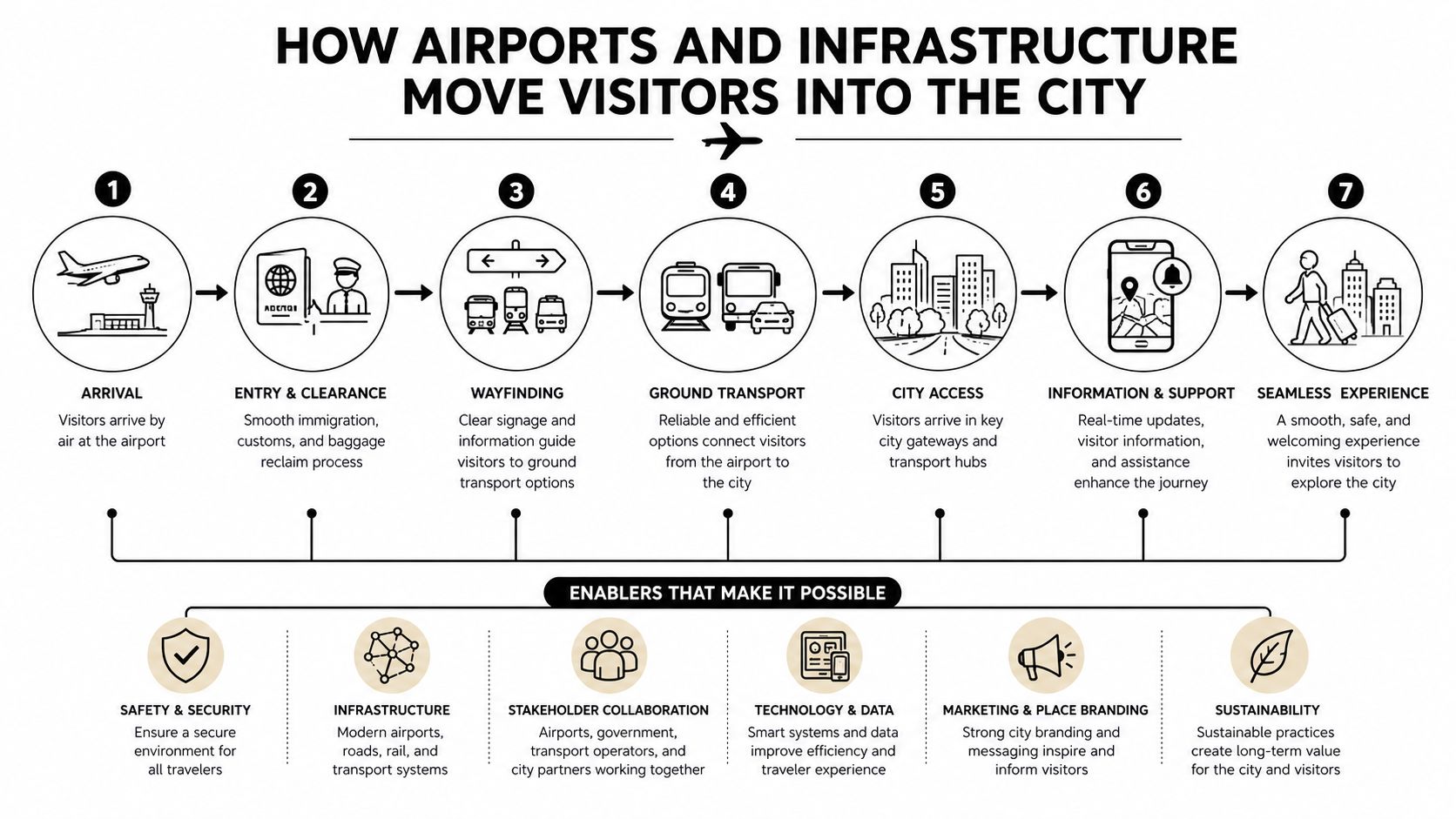
The airport-to-venue conversion chain
Arrival: Hartsfield-Jackson supplies a deep flow of domestic and international passengers. International traffic is particularly relevant because Atlanta's 2024 international passenger volume rose 14% to 14.6 million, while total airport traffic increased 3.3% year over year.
Distribution: Travelers choose MARTA, taxis, rideshare services, rental cars, shuttles, or other ground transportation. Rail access can make downtown and nearby business districts more predictable for visitors attending scheduled events.
Accommodation: Hotels in downtown, Midtown, Buckhead, and the airport district compete to capture different trip purposes. Convention travelers value proximity to meeting facilities, while leisure visitors may prioritize restaurants, cultural venues, or neighborhood access.
Attendance: A visitor who reaches a stadium, convention center, or attraction becomes an economic participant rather than a passenger statistic. The city earns more when arrivals convert into overnight stays and multiple local transactions.
The airport's scale also changes hotel planning. A larger accessible market supports more specialized lodging, meeting space, transportation services, and event logistics. Operators can model peak windows around flights and venue schedules, while visitors can compare neighborhoods based on the complete journey instead of choosing a hotel from room price alone.
For a practical look at arrival logistics, transportation options, and airport-area planning, travelers can use this Atlanta Hartsfield-Jackson guide. The underlying lesson is simple: Atlanta's tourism growth depends on how efficiently the city moves people after they land.
Conventions, Sports, and the Creative Industries Stack
Atlanta's tourism engine converts several kinds of demand into one operating system. The $15 billion visitor-spending baseline reached in 2017, reported by the Atlanta Journal-Constitution, indicates a market supported by more than leisure sightseeing. Conventions, professional sports, film and music production, and cultural institutions attract different audiences, schedules, and spending patterns.
The Georgia World Congress Center anchors business travel. Delegates arrive with fixed agendas, supporting midweek hotel demand and spending on meeting services, restaurants, local transportation, and event suppliers. Sports create a separate conversion pattern. Atlanta Braves and Atlanta Falcons schedules can concentrate visitors around weekends, while playoff and championship events increase short-term pressure on rooms, venues, and hospitality staff.
The creative industries extend that network beyond conventional tourism. Atlanta's “Hollywood of the South” identity connects production activity with hotels, catering, transportation, equipment services, and hospitality labor. Film projects do not behave like ordinary vacation demand, yet they keep related businesses active and can support suppliers that also serve visitors. Music, festivals, the High Museum of Art, and the National Center for Civil and Human Rights give travelers reasons to add cultural stops and lengthen their itineraries.
Atlanta Tourism Demand Verticals Compared
The available evidence does not establish comparable visitor volumes, per-visitor spending, or peak-season figures for each category. The useful comparison is behavioral: how each vertical enters the calendar and what businesses it supports.
| Vertical | Typical Volume | Avg Spend per Visitor | Peak Season |
|---|---|---|---|
| Conventions | Structured group demand | Not provided | Calendar-dependent |
| Professional sports | Event-based attendance | Not provided | League and postseason calendars |
| Film and music production | Production and audience-related demand | Not provided | Project and event-dependent |
| Cultural attractions | Individual and group visitation | Not provided | Calendar and programming-dependent |
The advantage is stacking. Conventions can support weekdays, sports can strengthen weekends, production can sustain supplier activity, and cultural venues can add stops to a trip. This mix gives hotels and local businesses more opportunities to replace weaker demand in one category, although each vertical still depends on its own calendar.
For baseball travelers, check Fubo News for live MLB coverage before building an Atlanta itinerary. Game timing affects arrival dates, overnight stays, restaurant demand, and the periods when nearby businesses need extra capacity. Atlanta's durable base comes from converting these separate audiences into repeat local transactions, while major events create sharper, less predictable peaks.
The 2026 FIFA World Cup and Other Mega-Events
The projected 2026 FIFA World Cup activity will test Atlanta's ability to convert concentrated international attention into local spending. A major tournament can fill hotels, restaurants, transit systems, retail corridors, and public spaces within narrow windows. Those surges can inflate short-term performance, so businesses should not treat match periods as a normal weekly baseline.
The market forecast supplied for Atlanta projects about 62.2% occupancy in 2026 and an ADR of roughly $127.87, with stronger pricing offsetting softer room-night volume, according to the 2026 Atlanta hospitality investment forecast. The combination points to a market where rate management matters as much as room volume. Higher rates can protect revenue when occupancy weakens, but they do not show that demand is equally strong across every date, district, or customer segment.
Atlanta Mega-Event Demand Profile 2025–2027
Available evidence does not provide measured occupancy lifts or event-specific ADR changes. The table therefore classifies each demand pattern without presenting unsupported performance estimates.
| Event | Demand Window | Demand Shape | Pricing Pattern | Notes |
|---|---|---|---|---|
| 2025 College Football Playoff activity | Concentrated event periods | Sharp event-period spike | Peak-date pressure likely | Strong sports-driven demand |
| 2026 FIFA World Cup activity | Match and surrounding travel windows | Repeated sharp spikes across scheduled matches | Peak dates with shoulder-night variation | International and domestic visitor pressure |
| SEC Championship | Event calendar window | Sharp short-duration spike | Peak-date pressure | Recurring college sports demand |
| Convention calendar | Distributed across the year | Distributed multi-night demand | More sustained, calendar-dependent pricing | More evenly scheduled business demand |
A convention can distribute demand across several nights and different weeks. Match-related travel behaves differently. Saturday inventory may tighten first, while shoulder nights depend on fan itineraries, flight schedules, and event sequencing. Restaurants and transportation providers face the same operating problem: they need capacity for concentrated peaks without carrying peak staffing and equipment levels through quieter periods.
The conversion question extends beyond hotel rooms. Visitors who arrive for a match may add restaurants, attractions, retail stops, and local transportation to their spending, while convention travelers can create steadier weekday transactions. Businesses connected to sporting travel can use the Vanta Sports guide to sporting events to assess how competition schedules shape audience behavior.
Atlanta's opportunity is substantial, but the useful question is precise: which dates will convert, which visitors will stay overnight, and which infrastructure will remain valuable after the event ends?
Local itineraries can be organized around the wider calendar through Atlanta events taking place this month. That broader view separates durable event programming from the temporary intensity of a global tournament and helps operators plan for demand peaks without mistaking them for permanent growth.
What Rapid Tourism Means for Local Businesses and Sustainability
Visitor growth creates an operating burden that doesn't always appear in headline tourism totals. Hotels cycle through front-desk terminals, payment devices, networking equipment, televisions, laptops, and office hardware. Convention venues refresh audiovisual systems, point-of-sale terminals, signage equipment, and back-office technology after large programs. Event campuses also generate packaging, temporary fixtures, food-service waste, and equipment that may have no clear owner after breakdown.
The e-waste problem is especially concentrated during loadout and refresh cycles. A venue may have functioning equipment that no longer fits a technical specification, while a hotel may retire devices in batches during a property upgrade. Without documented IT asset disposition, those assets can move into informal channels, lose residual value, or create data-security exposure if storage media isn't handled correctly.
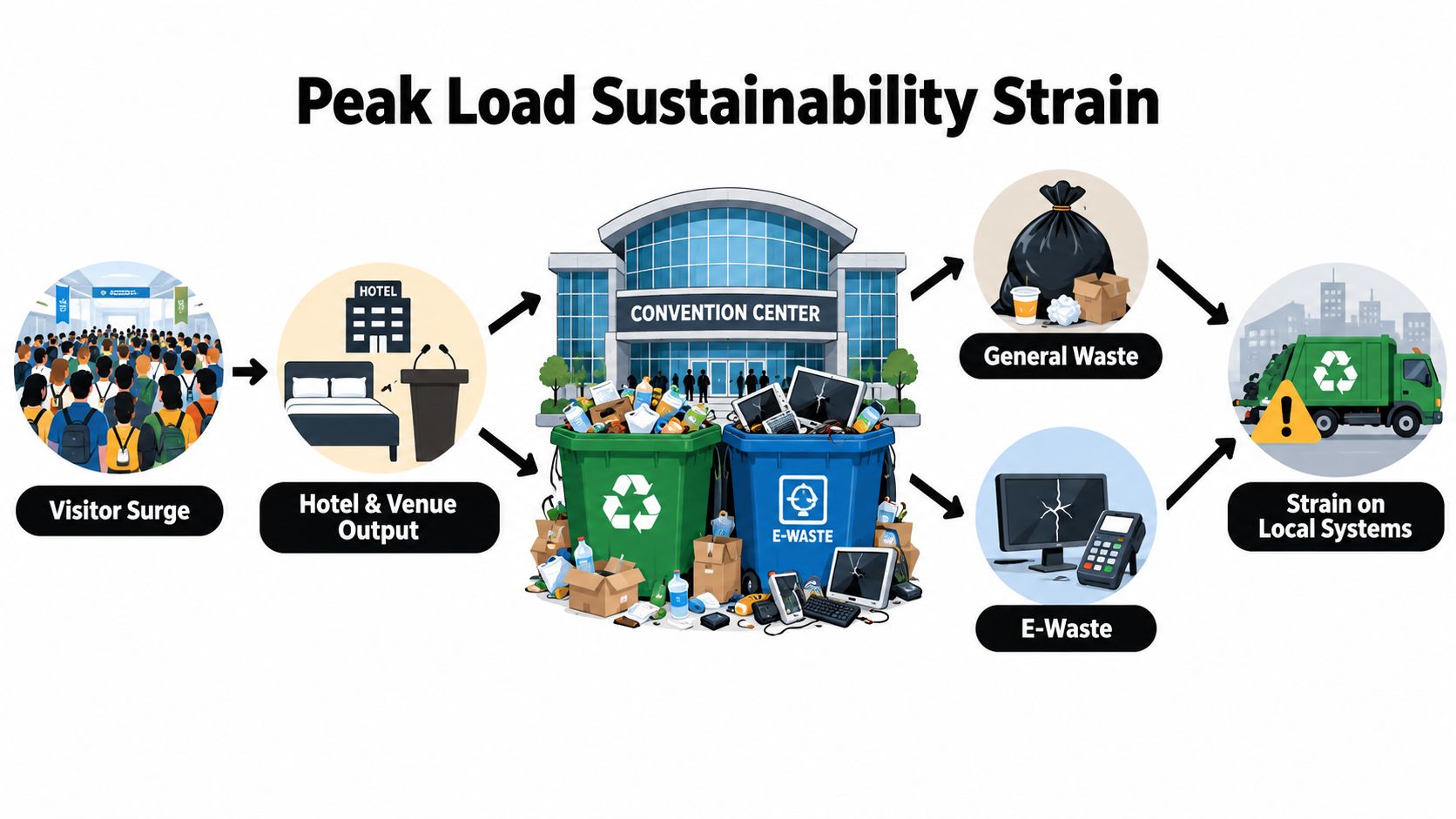
The sustainability pressure points
Hotels, venues, and corporate offices can reduce avoidable strain by connecting procurement, facilities, IT, and sustainability teams before the event cycle begins.
- Asset refresh planning: Identify laptops, monitors, servers, payment terminals, and networking devices scheduled for replacement before peak operations begin.
- Secure disposition: Use documented secure data destruction for storage media and maintain chain-of-custody records where organizational policy requires them.
- Material recovery: Separate reusable equipment, repairable devices, recyclable electronics, and product destruction requirements instead of treating every item as general waste.
- Reverse logistics: Schedule pickups around office cleanout, facility cleanout, hotel renovations, and convention loadouts so assets don't accumulate in temporary storage.
- Workforce enablement: Match retired but usable computers with donation-based recycling and corporate donation programs that can support digital inclusion.
This approach treats sustainability as an operating system rather than a post-event cleanup task. Reusable infrastructure can reduce recurring purchasing pressure, while documented recycling streams help businesses understand what happened to retired equipment. The EPA's electronics donation and recycling guidance provides a credible foundation for evaluating responsible electronics recycling practices.
The workforce effect matters too. Major events increase the need for temporary and permanent frontline staff, which creates onboarding demand for laptops, monitors, phones, and other devices. A business that plans its asset lifecycle early can redirect usable equipment, arrange computer recycling for obsolete units, and avoid a rushed disposal decision after the event.
Organizations developing a broader sustainability framework can also review sustainable practices for Atlanta businesses. The practical connection is clear: tourism growth increases both commercial activity and the volume of technology moving through local operations.
Is Atlanta's Growth Durable or Just Event-Driven
Atlanta's growth is real, but it isn't evenly distributed across the calendar. The durable foundation includes Hartsfield-Jackson access, convention demand, hotels, sports, creative production, cultural attractions, and corporate travel. Event spikes, including projected 2026 FIFA World Cup activity and 2025 College Football Playoff activity, add intensity without replacing those underlying demand channels.
The statewide numbers support the view that Atlanta sits inside a durable visitor system. Georgia's 174.2 million visitors and $45.2 billion in spending in 2024 extended a multiyear record streak, while the state tourism data also showed that international visitation can fluctuate even while the broader market remains strong. Atlanta's role as an air and convention gateway gives it multiple ways to monetize travel, rather than relying on one attraction.
Durable foundations versus temporary spikes
The strongest analytical conclusion is that Atlanta has a patterned growth curve. Demand can be durable at the annual level while remaining uneven by neighborhood, weekday, room type, and event date. A hotel near a convention district may benefit from business travel, while another property depends more heavily on weekend leisure or stadium schedules.
Risks remain. Hotel supply can outpace normalized demand, convention travel can weaken during a recession, and room performance can compress after a major event cycle. The projected 62.2% occupancy and roughly $127.87 ADR for 2026 show why operators should avoid using pricing strength as a substitute for room-night growth. Strong ADR may protect revenue while underlying volume softens.
Planning rule: Treat mega-events as accelerators, not as proof that every future week will perform like a tournament week.
That distinction changes investment and operating decisions. A venue should ask whether post-event infrastructure can serve conventions, concerts, sports, or community programming. A hotel should model shoulder nights and non-event demand. A corporate office should anticipate technology refreshes as part of normal growth, not only as a response to a global event.
Atlanta is therefore neither a temporary phenomenon nor a uniformly accelerating market. Its transportation and visitor infrastructure support real long-term expansion, while mega-events create sharp peaks that can distort short-term expectations.
Practical Takeaways for Visitors and Local Stakeholders
Visitors planning Atlanta trips around projected 2026–2028 demand should separate ordinary travel from FIFA-related dates. The supplied planning guidance recommends booking 9 to 12 months ahead for FIFA dates, while local stakeholders should prepare capacity upgrades 6 to 18 months before peak windows. Those time horizons reflect different risks. Travelers risk losing preferred rooms and routes, while businesses risk facing labor, inventory, and equipment constraints after demand has already arrived.
The projected 62.2% occupancy and roughly $127.87 ADR for 2026 suggest that pricing and availability can tighten around important periods, even if the annual market includes softer dates. Visitors should therefore build a complete trip plan rather than booking airfare alone.
A practical travel timeline
- Start with dates: Confirm match, convention, sports, and cultural schedules before choosing a hotel district.
- Reserve the largest constraint: Book airfare and lodging early for projected FIFA windows, then select transit and attraction reservations.
- Compare the full journey: Evaluate airport access, MARTA connections, venue distance, neighborhood restaurants, and return-trip timing.
- Protect flexibility: Keep cancellation and change terms visible because event calendars and travel conditions can shift.
- Choose responsible operators: Look for hotels and venues that explain their waste, energy, and recycling practices.
Local stakeholders need a parallel readiness plan. Hotels should align staffing, room inventory, and technology refreshes with projected demand windows. Convention venues should review audiovisual systems, payment terminals, networking hardware, and temporary equipment before load-in, then schedule ITAD work before post-event storage becomes a problem.
A business readiness checklist
- Audit assets: Map laptops, desktops, servers, monitors, medical equipment, laboratory equipment, and networking devices nearing end of life.
- Schedule disposition: Coordinate computer recycling, laptop disposal, data center decommissioning, and secure data destruction before peak operations.
- Protect usable value: Route repairable equipment toward reuse or donation-based recycling, and document product destruction where required.
- Plan the aftermath: Match post-event asset removal with office cleanout, facility cleanout, or renovation schedules.
- Use the annual calendar: Build sustainable recycling into recurring convention and hospitality operations instead of treating it as a one-time project.
Visitors exploring neighborhoods and trail connections can use the Atlanta BeltLine guide for visitors and locals to add flexible cultural and recreational stops outside major event venues. For local organizations, the three most useful partnership-ready actions are to align ITAD pickups with FIFA preparation windows, audit asset lifecycles against projected 2027 demand, and brief procurement teams on certified downstream processing.
Reworx Recycling helps Atlanta-area businesses manage electronics recycling, IT equipment disposal, secure data destruction, equipment decommissioning, and donation-based recycling while supporting digital inclusion and workforce development. Visit Reworx Recycling to learn how to donate old equipment, schedule a business pickup, or build a responsible technology retirement plan around Atlanta's next tourism cycle.