The facilities team has a deadline, the office is full of retired laptops, monitors, printers, and networking equipment, and nobody wants to become responsible for a storage room of obsolete technology. A search for “electronics recycling near me” looks simple, but the nearest map result may accept only household quantities, lack secure data destruction, or provide little evidence about what happens after collection.
For a business, school, or public agency, the right choice depends on more than distance. You need a workflow that matches the load, protects sensitive information, documents custody, handles batteries and specialized equipment appropriately, and supports your sustainability objectives. Drop-off convenience is useful for small batches. A scheduled pickup or IT asset disposition, ITAD, process is usually more practical for mixed business inventory.
Finding Electronics Recycling Near Me Without the Guesswork
An office cleanout often starts with a familiar scene. A company replaces a group of employee laptops, the old desktops move into a conference room, and a facilities manager searches for a nearby recycling location between other urgent tasks. The first result appears close enough, but a quick call reveals that the location accepts residential drop-offs only, limits quantities, or doesn't handle servers, batteries, or hard drives.
That distinction matters because commercial electronics recycling is a logistics and risk decision. A small retailer drop-off may work for a few keyboards or phones. It may not work for a mixed load containing laptops, monitors, printers, networking gear, storage media, and laboratory equipment. A business also needs to know whether the provider can issue inventory records, arrange transportation, perform secure data destruction, and explain downstream processing.

The scale of the global problem makes that diligence worthwhile. In 2022, the world generated a record 62 billion kilograms of e-waste, equal to 7.8 kilograms per person, but only 22.3% was formally collected and recycled in an environmentally sound way. The Global E-waste Monitor 2024 assessment explains why that gap matters for businesses, schools, and public agencies searching for electronics recycling near them. Usable material can remain in storage, enter informal channels, or reach landfills instead of moving through a documented recovery program.
Start with the load, not the map
Before calling a recycler, separate the inventory into practical groups:
- Standard office technology: Laptops, desktops, monitors, printers, keyboards, mice, and docking stations.
- Data-bearing equipment: Hard drives, solid-state drives, servers, phones, tablets, and network storage.
- Specialized assets: Medical equipment, laboratory equipment, telecom hardware, and devices containing unusual components.
- Facility materials: Racks, cabling, power equipment, batteries, and items requiring product destruction or decommissioning.
Reworx Recycling, based in Smyrna, Georgia, is one example of a donation-based social enterprise that provides electronics recycling, business pickups, equipment decommissioning, recycling consultations, and secure hard drive shredding with data destruction. Its model also connects retired equipment with community impact through technology donations, digital inclusion, and workforce development.
Choose drop-off, pickup, or both
A hybrid workflow often works well. Employees can bring a small number of approved devices to a customer drop-off, while facilities teams schedule a pickup for pallets or sensitive equipment. The important step is confirming acceptance rules before transport. Ask about commercial quantities, loading requirements, batteries, televisions, medical equipment, and documentation.
Practical rule: The closest recycler isn't automatically the closest complete solution. Compare the total effort, including sorting, transportation, data handling, loading, records, and downstream accountability.
For a business beginning its search, electronics recycling options for local business loads can help frame the decision around service fit rather than simple mileage.
How to Evaluate Nearby Recyclers for Business Needs
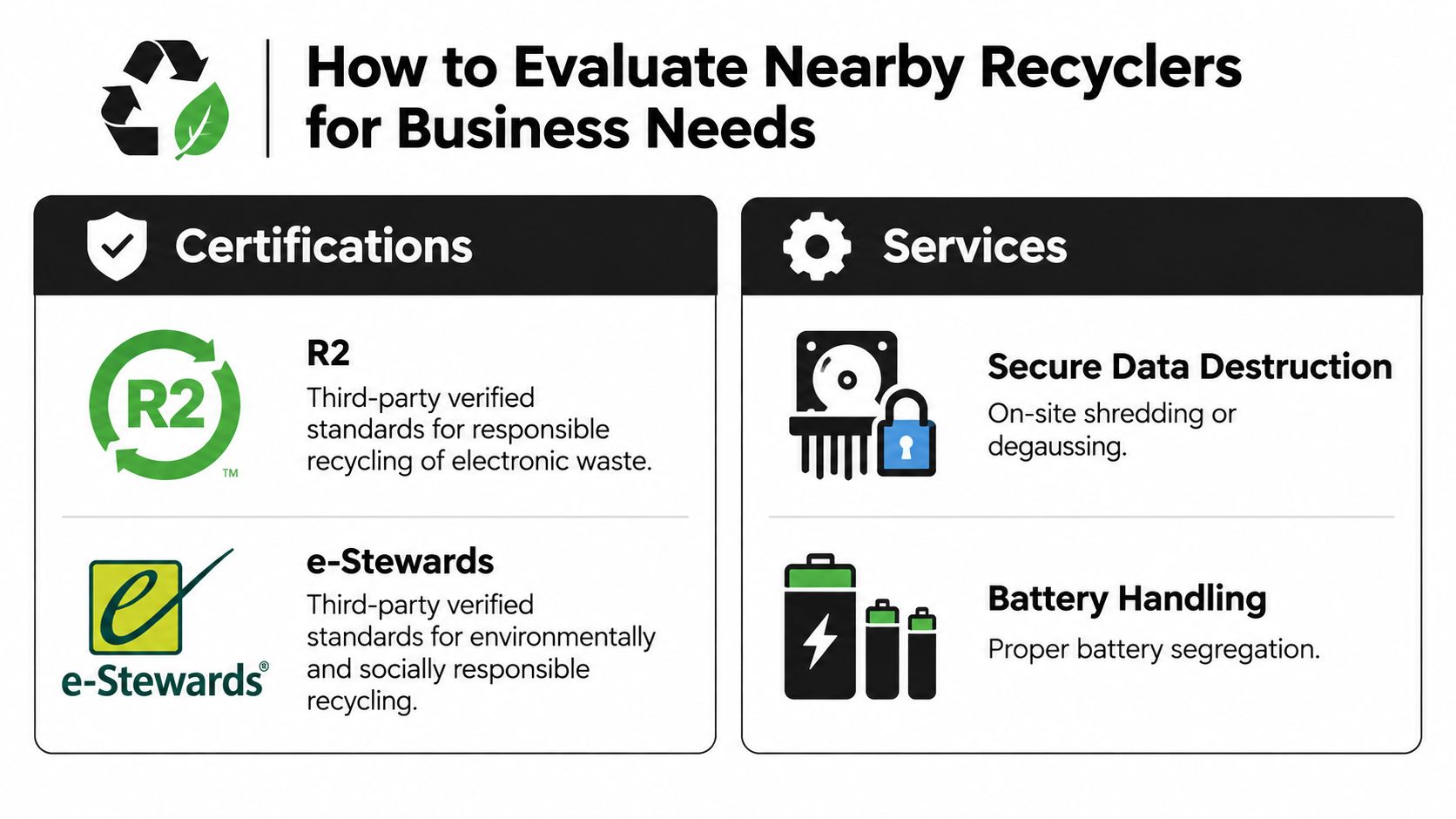
Distance and online reviews provide a starting point, not a qualification process. Two providers may appear equally convenient while offering very different controls for data-bearing devices, batteries, mixed loads, and downstream processing. A commercial recycler should be able to describe its operating process in plain language and provide records that match your internal requirements.
The EPA's electronics stewardship regulations state that 25 U.S. states plus the District of Columbia currently have electronics recycling laws. Because requirements vary by location, a national policy may not answer every state or organizational question. Your recycler should help identify the applicable expectations rather than treating every load as interchangeable.
Compare the evidence
Look for certification by an accredited independent third-party auditor, clear data destruction procedures, documented chain of custody, and an explanation of downstream partners. The provider should distinguish between reuse, refurbishment, resale, material recovery, and destruction. It should also explain how it handles batteries, damaged devices, and equipment that can't be economically refurbished.
| Evaluation Criteria | What Good Looks Like | Questions to Ask |
|---|---|---|
| Certification | Current certification from an accredited independent third-party auditor | Which certification applies to this facility and service? |
| Data security | A defined process for wiping, degaussing, or physical destruction | How are hard drives, SSDs, phones, and servers handled? |
| Chain of custody | Transfer records from collection through processing | What records will we receive, and when? |
| Downstream processing | Clear explanation of where materials go after intake | Do you use downstream processors, and how are they vetted? |
| Load flexibility | Ability to manage computers, networking equipment, batteries, and specialized assets | Can you accept our mixed inventory in one project? |
| Reporting | Asset lists, destruction documentation, and recycling or disposition summaries | Can the report match our serial numbers and internal ticketing? |
Identify red flags early
A recycler that promises to accept everything without inspecting the load may be underestimating the handling requirements. Vague answers about data destruction, no written acceptance list, missing custody records, and reluctance to identify downstream processors deserve attention. A low or zero price isn't proof of poor service, but free processing should still come with clear terms and documentation.
A useful consultation includes your approximate device categories, whether equipment contains sensitive data, the condition of the assets, site access details, and your required completion date. Reworx Recycling's partner-selection guidance provides another way to organize those questions before comparing local providers.
Preparing Devices for Secure and Sustainable Handoff
The recycler can't correct every problem created before collection. A clean handoff begins with an internal process that identifies assets, isolates hazards, and assigns the right disposition path for each device. This prevents a common delay, where equipment sits in a locked room because nobody knows whether it contains data or whether a battery is safe to transport.
Data concerns are a major reason people hold onto old devices. Recent literature notes that storage and delayed disposal can be driven by fear about information exposure and the belief that equipment may still be useful, while recycling behavior also depends on awareness, infrastructure, and incentives. The recent discussion of device disposition and recycling behavior supports treating data security as part of the workflow, not as an afterthought.
Build an inventory before moving anything
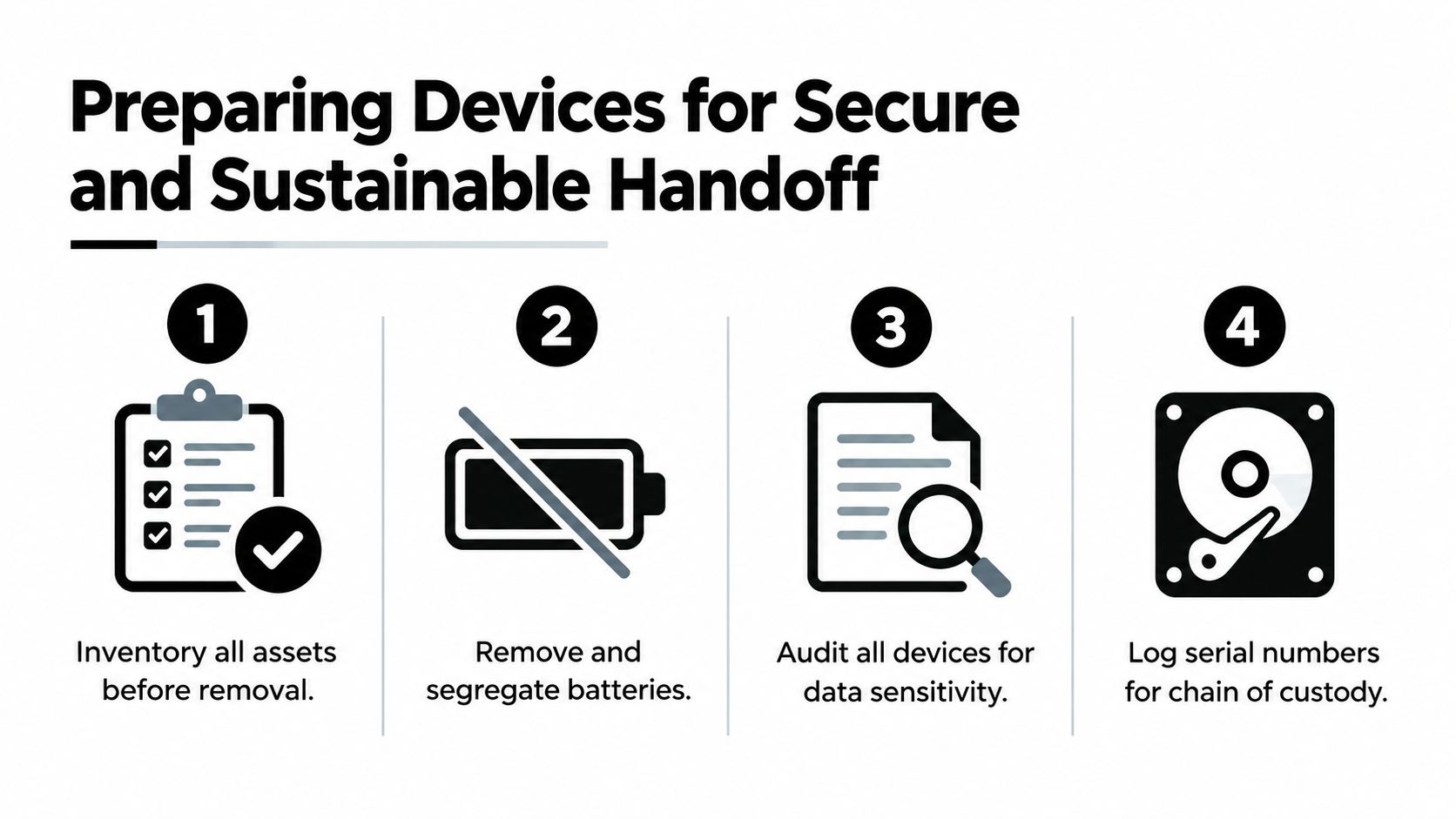
Use a spreadsheet, asset-management export, or barcode list to record manufacturer, model, serial number, department, condition, and disposition status. Mark laptops, desktops, phones, servers, and removable media separately. If a school has a laptop cart or a business has a mixed refresh, assign an owner to reconcile the physical count against the system record.
Remove personal labels and accessories only when your policy permits it, but keep chargers and matched components with their devices when they improve reuse potential. Photographing pallet groups can also help facilities teams document the condition at handoff without creating an unnecessary record of sensitive screens or files.
Assign the data path
A device may be suitable for logical wiping, degaussing, or physical destruction depending on its media type, condition, and sensitivity. Don't assume a factory reset removes every organizational record, and don't treat a damaged drive as harmless. Ask the recycler whether it can provide a method-specific certificate or destruction record tied to serial numbers.
Battery handling needs its own lane. Set aside loose, swollen, damaged, or removable batteries and ask for packaging guidance before loading them. Never place unknown battery packs loose in a box with metal equipment.
Security decision: Choose the disposition method from your data policy and media type, not from the device's resale value alone.
Finally, label each container by department or project, seal it appropriately, and maintain a handoff log. Reworx Recycling's preparation guidance can help teams organize equipment before a pickup or drop-off.
Scheduling Drop Off or Business Pickup That Fits Your Timeline
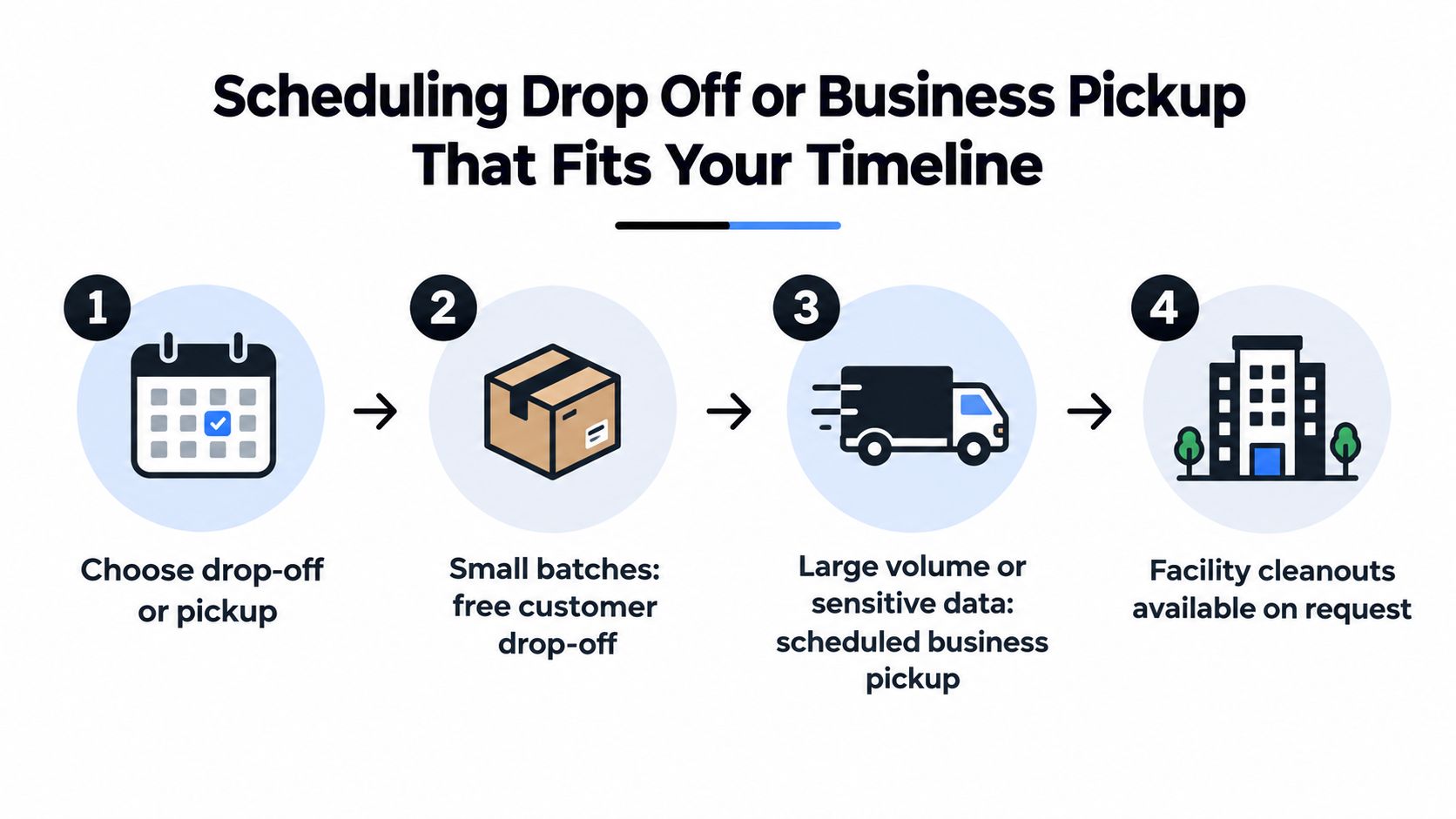
The practical choice usually comes down to volume, sensitivity, and site conditions. A few devices that have already been cleared for release can move through a customer drop-off. A full office cleanout, school rollout, medical equipment disposal project, or data center decommissioning needs a planned collection with people, vehicles, loading space, and records aligned.
Access isn't consistent across communities. Connecticut reports over 165 approved collection locations statewide, while Wisconsin's 2025 report relied on 55 free one-day events across 36 counties and permanent free sites in 11 counties. Those figures, documented in the Connecticut electronics recycling report, show why “near me” can mean very different things depending on location. A nearby free option may still be restrictive for a commercial load.
Use drop-off for controlled, small batches
Drop-off works when the inventory is compact, sorted, accepted by the location, and already cleared for transport. A small business replacing a group of laptops might use this route if the devices are boxed, documented, and free of unresolved data obligations. Call first, confirm business intake, and ask whether monitors, batteries, printers, or mixed equipment are accepted together.
This option saves scheduling effort, but the business assumes more responsibility for loading, transport, arrival timing, and proof of handoff. It also may require separate trips if the location excludes certain categories.
Plan pickups around the building
A pickup is more effective for an office cleanout, facility cleanout, or school fleet retirement. Provide the recycler with:
- Asset categories: Include laptops, desktops, servers, monitors, phones, networking gear, batteries, and specialized equipment.
- Approximate load condition: Explain whether items are boxed, palletized, loose, stacked, or located on multiple floors.
- Site constraints: Share dock access, stairs, elevators, security desks, parking limits, and loading windows.
- Data requirements: Identify media requiring wiping, destruction, or a documented custody process.
- Project timing: State the preferred pickup window and any building or audit deadline.
For a district-wide technology rollout, schedule collection by building or deployment phase rather than leaving all retired devices in one unsecured room. For a facility decommissioning, coordinate equipment removal with power-down, access control, and records retention.
Logistics insight: The smoothest pickup is designed around the building's constraints before the truck arrives.
Reworx Recycling offers business pickup coordination, equipment decommissioning, IT asset management, and secure hard drive shredding. Whether you need laptop disposal, computer recycling, or a larger mixed-load project, confirm the scope and documentation before the appointment.
Understanding Costs Certifications and Compliance Expectations
Business recycling costs depend on the equipment mix, labor, transportation, data services, handling requirements, and potential recovery value. A small, sorted load may qualify for donation-based recycling or a low-cost intake arrangement. A project involving heavy monitors, loose batteries, medical equipment, laboratory equipment, product destruction, or difficult access can require additional planning and labor.
Don't evaluate a quote on the pickup line alone. Ask what the price includes, whether loading is included, whether data destruction is separate, and what happens to equipment with resale or refurbishment potential. Some assets may have recoverable value through buyback or remarketing, while others require processing because they are damaged, obsolete, or costly to handle.
Pay for proof, not just removal
A credible business disposition file may include an asset inventory, transfer records, data destruction documentation, material summaries, and final disposition reporting. The exact package should match your internal policy, customer commitments, insurance requirements, and applicable regulations. “Free” should never mean undocumented.
The EPA's basic electronics management information encourages electronics recyclers to be certified by an accredited independent third-party auditor. That certification is a concrete quality signal, though buyers should still verify the scope, current status, facility coverage, and services included in the proposal.
Balance three approval questions
Finance leaders usually ask whether the project is affordable. IT managers ask whether the data is protected. Sustainability leaders ask whether the downstream outcome supports responsible recovery. A strong proposal answers all three without hiding exclusions in general language.
Use a written comparison that separates:
- Collection: Transportation, labor, access, palletizing, and loading.
- Disposition: Reuse, donation, refurbishment, resale, recycling, or destruction.
- Security: Wiping, degaussing, shredding, certificates, and custody records.
- Compliance: State-specific obligations, accepted materials, and downstream controls.
- Impact: Community donations, digital inclusion, workforce development, and environmental reporting.
Reworx Recycling's certificate requirements can help organizations identify the documentation they should request before approving a project.
Tailored Guidance for SMBs Schools and Government Teams
The right local workflow changes with the organization. A small business may need a repeatable process for quarterly equipment retirement. A school may have large groups of similar laptops mixed with chargers and carts. A government agency may require strict custody records and product destruction for assets that cannot be reused.
The common mistake is treating all retired technology as one material category. A electronics-recycling methodology triangulates three data streams: generation estimates, end-of-life surveys from residential and commercial users, and recycler or program throughput reports. The EPA methodology review notes that no single source captures every material flow, and multiple streams help reduce undercounting from stockpiling or informal diversion.
SMB playbook
Assign one person to approve releases, export asset records, and collect certificates. Group equipment by data sensitivity and condition before requesting a quote. For an office cleanout, ask whether the provider can handle computer recycling, laptop disposal, monitors, phones, networking equipment, and product destruction in one coordinated visit.
A donation-based route can also support corporate donation programs when devices remain suitable for reuse. Before promising donations internally, confirm that the recipient or program can accept the equipment, protect personal information, and provide the records your organization needs.
School and university playbook
Schools should separate student devices, staff equipment, servers, lab assets, and damaged batteries. Create a building-by-building inventory and coordinate collection with summer moves, technology deployments, or storage-room access. Donation-based recycling can extend the community value of usable technology through digital inclusion, while sustainable recycling provides a responsible path for equipment that can't be redeployed.
This guidance for small businesses and sustainable e-waste management also applies to schools that need a manageable process without building an internal ITAD operation.
Government playbook
Public agencies should define custody requirements before equipment leaves the site. Keep serial-number records, separate assets requiring secure data destruction, and specify whether unusable equipment needs physical product destruction. Include downstream documentation in the procurement scope rather than asking for it after collection.
Reworx Recycling's social enterprise model connects responsible electronics recycling with community support, including technology donations, digital inclusion, and workforce development. That gives organizations a way to align IT equipment disposal with environmental responsibility while maintaining a practical disposition process.
Reworx Recycling helps businesses, schools, and public agencies manage donation-based electronics recycling, secure data destruction, equipment pickups, decommissioning, and responsible IT asset disposition. If obsolete devices are taking up space or delaying an office, facility, or technology refresh, visit Reworx Recycling to learn how to donate equipment, schedule a pickup, or discuss an ongoing corporate recycling partnership.