

Arkansas looks inexpensive from 30,000 feet, but the state stops being simple the moment you compare cities. RentCafe places Arkansas 4% below the national average in 2026, yet the city spread runs from Hot Springs 5% above the national average to Jonesboro 17% below, with Conway and Pine Bluff sitting much lower on the scale. For site-selection teams, that means the key question isn't whether Arkansas is cheap, it's which Arkansas city gives you the lowest total monthly burden after housing, transport, and bills are all counted.
| City | Median Home Value | Median Rent | Local Cost Index | Avg Monthly Bills |
|---|---|---|---|---|
| Bentonville | $482,175 | $1,566 | 118 | $2,329 |
| Rogers | $379,318 | $1,182 | 102 | n/a |
| Fayetteville | n/a | n/a | n/a | $1,977 |
| Little Rock | n/a | n/a | n/a | $2,048 |
| Conway | n/a | n/a | n/a | n/a |
| Jonesboro | n/a | n/a | n/a | n/a |
| Fort Smith | $168,100 | $852 | 74 | n/a |
| Pine Bluff | $71,856 | $831 | 65 | n/a |
| Hot Springs | n/a | n/a | n/a | n/a |
Why Arkansas Costs Less on Paper but Varies Wildly by City
The statewide number is real, but it's also blunt. Arkansas sits below the national average overall, yet that single figure hides the city-level spread that matters to employers, relocators, and procurement teams. Salary.com shows Arkansas cities ranging from 5.3% below the national average in Little Rock to 15.2% below in Pine Bluff, with Bentonville at 8.7% below. RentCafe's city comparison adds an important wrinkle, because Hot Springs comes in 5% above the national average while Conway is 16% below and Jonesboro is 17% below. See Reworx Recycling's statewide service coverage.
That spread changes how a business should read Arkansas. A single “Arkansas cost of living” number is too coarse for payroll planning, office budgeting, or relocation packages. A company hiring in Northwest Arkansas is not dealing with the same affordability environment as one hiring in Pine Bluff or Jonesboro, even though both are in the same state.
What the headline number misses
A statewide average tells you almost nothing about local labor pressure, commute patterns, or household bill strain. It also ignores the fact that some cities are cheaper in housing but less forgiving in transportation or recurring household costs. That's why a city-specific lens is more useful than a state-level slogan.
Practical rule: if a number doesn't separate housing, transportation, and bills, it's a planning shortcut, not a budget model.
For businesses, that distinction matters because location choice can change office occupancy cost, employee affordability, and the wage level you need to stay competitive. For households, it changes whether a “cheaper” city leaves more money at the end of the month. Arkansas is affordable in many places, but it's not uniformly affordable.
How Cost of Living Indices Actually Work in Arkansas
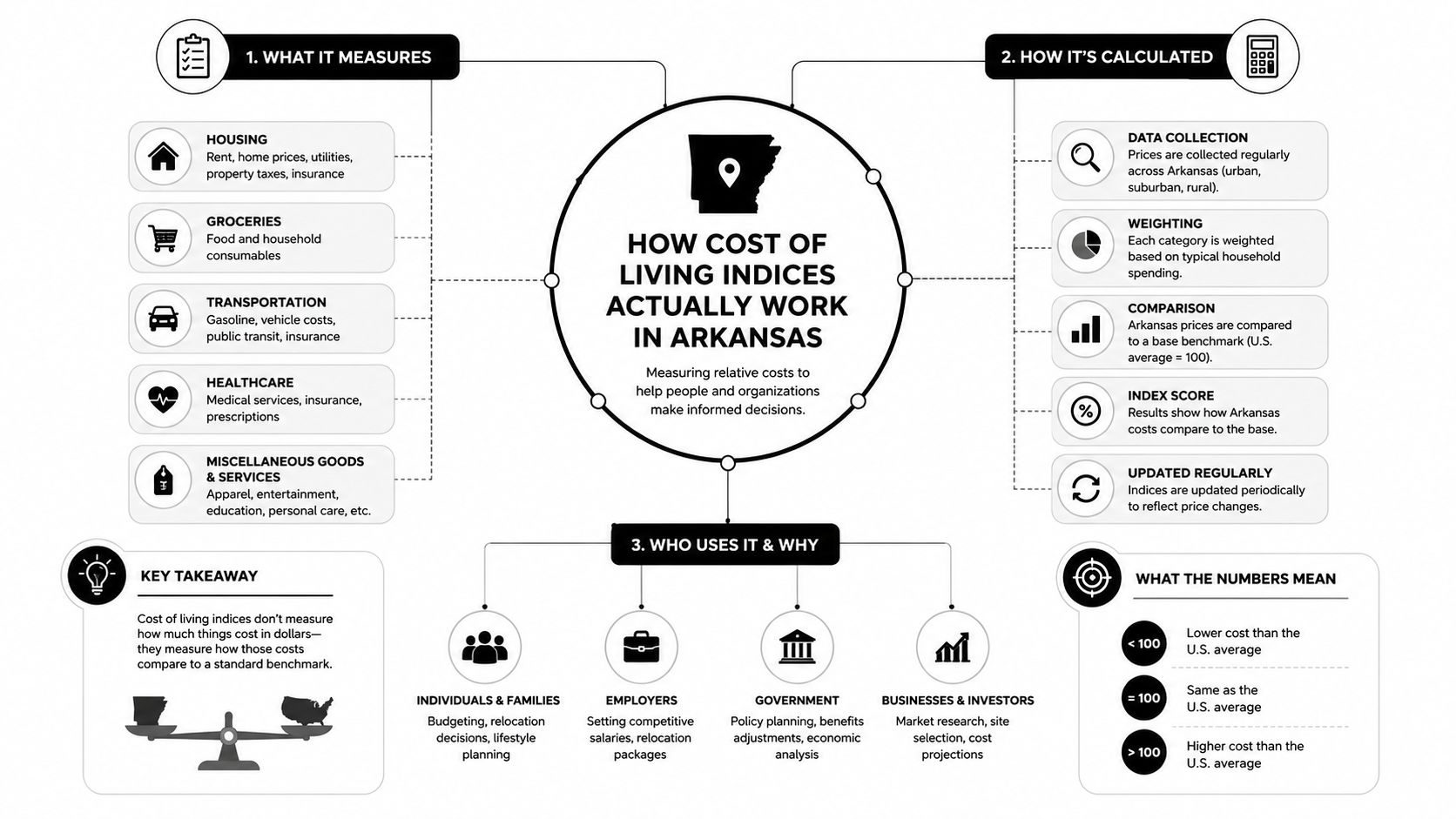
A cost-of-living index only helps if you know what it measures. In Arkansas, the numbers are useful precisely because they answer different questions. Salary.com gives a broad city-based cost comparison against a national baseline. LivabilityCalc adds a local cost-of-living index that helps compare one city against another inside the state. doxoINSIGHTS focuses on recurring household bills, which is closer to monthly cash pressure than headline housing alone.
Matching the index to the decision
The Arkansas Economic Development Commission's metro comparison shows Little Rock-North Little Rock at 94.5 on the composite index, Conway at 81.6, and Jonesboro at 84.3. It also splits the picture into separate components, with housing at 68.1 in Conway versus 80.8 in Little Rock, and transportation at 90.8 in Conway versus 95.6 in Little Rock. That matters because a lower housing score doesn't automatically produce a lower monthly budget if commuting is more expensive or more dependent on private vehicles. Arkansas Economic Development Commission metro comparison
LivabilityCalc's 2026 city table gives another layer of context. Bentonville posts a local cost-of-living index of 118, while Fort Smith is 74 and Pine Bluff is 65. Those figures help businesses compare markets, but they still don't tell the full story on recurring bills or commute burden.
doxoINSIGHTS adds that missing piece. In its Arkansas ranking, Bentonville shows $2,329 in average monthly bills with a COBI of 110, while Little Rock shows $2,048 with COBI 96. That bill pressure is a practical proxy for consumer room to spend and the pace at which households replace devices, furniture, and other discretionary purchases.
A city with cheaper housing can still feel expensive if transportation and bills absorb the difference.
The right takeaway is simple. Use Salary.com when you want broad wage comparability, LivabilityCalc when you want city ranking context, and doxoINSIGHTS when you want monthly household pressure. Mixing those frameworks without naming them is how people misread Arkansas.
The Seven Major Arkansas Cities Ranked Side by Side
The city split becomes easier to see when the numbers sit next to one another. Northwest Arkansas clearly carries the state's premium, while the south and west lean much more affordable. That's not a theory, it's visible in home values, rent, local indices, and monthly bills.
Arkansas Major Cities Cost Snapshot
| City | Median Home Value | Median Rent | Local Cost Index | Avg Monthly Bills |
|---|---|---|---|---|
| Bentonville | $482,175 | $1,566 | 118 | $2,329 |
| Rogers | $379,318 | $1,182 | 102 | n/a |
| Fayetteville | n/a | n/a | n/a | $1,977 |
| Little Rock | n/a | n/a | n/a | $2,048 |
| Conway | n/a | n/a | n/a | n/a |
| Jonesboro | n/a | n/a | n/a | n/a |
| Fort Smith | $168,100 | $852 | 74 | n/a |
| Pine Bluff | $71,856 | $831 | 65 | n/a |
| Hot Springs | n/a | n/a | n/a | n/a |
Bentonville sits at the top of the Arkansas cost stack with a $482,175 median home value, $1,566 median rent, and 118 local cost index. Rogers is still higher relative to the lower-cost markets, but it's clearly below Bentonville on housing pressure. Fort Smith and Pine Bluff are on the opposite end, with much lower home values and rent. Compare nonprofit tools with Alignmint if you want to see how a clean side-by-side comparison can clarify a complex decision.
What the spread means in practice
The deeper point is not that one city is “good” and another is “bad.” It's that each one answers a different business problem. Bentonville can justify a higher cost structure if a company needs talent density and consumer spending power. Fort Smith and Pine Bluff make more sense when a firm is optimizing for lower occupancy cost and simpler budget control.
doxoINSIGHTS shows the same regional pressure in bills. Bentonville averages $2,329 in monthly household bills, while Little Rock averages $2,048 and Fayetteville $1,977. Those figures matter because recurring bills shape how much local demand is left for IT upgrades, electronics purchases, and service subscriptions. Little Rock free computer and laptop recycling.
The city ranking also explains why Northwest Arkansas feels more expensive even when statewide averages look moderate. It's not just rent. It's the combination of housing value, monthly bills, and a market where households can absorb a higher baseline.
Where the Real Monthly Budget Diverges Once You Add Commute
Rent-only comparisons miss the part that hits budgets. A city can look cheaper on housing and still cost more once you account for how people move around the metro every day. Arkansas's own metro data shows the point clearly, because Conway's housing score is 68.1, but its transportation score is 90.8, while Little Rock's housing score is 80.8 and its transportation score is 95.6. Lower housing doesn't automatically erase commute pressure.
Why transportation changes the answer
That tradeoff matters most for households that live in one metro and work in another, or for businesses whose staff drive across a wider service area. Conway can look favorable on housing, but the transportation component pulls back some of that advantage. Little Rock is less affordable on housing, but the overall metro structure is more balanced.
The same logic applies to the state's extremes. Recent city-level dashboards show Helena-West Helena with a median home value around $72,300, while Cave Springs is around $562,095, a rough 7x gap that statewide averages can't hide. That kind of spread affects where a company can afford warehouse space, where a relocating family can buy into a neighborhood, and how much capital gets tied up in real estate instead of operations.
Budget insight: cheap housing only matters if it doesn't get eaten by commute cost, vehicle dependence, or longer service routes.
For operations teams, the spreadsheet gets more honest here. A lower-cost city may reduce lease pressure, but it can increase mileage, route time, or driver expense. A more expensive central metro can sometimes be cheaper on the full monthly ledger because staff and suppliers spend less time on the road. The most useful number is not rent alone, it's the combined monthly burden.
For a site-selection committee, that means the question shifts from “Where is rent cheapest?” to “Where does the total monthly cost stay lowest after the working life of the city is included?” That's the question that predicts budget stability.
Two Sample Budgets That Make the Numbers Real
A household budget and a small-office budget don't behave the same way, but they both reveal the same basic truth. Northwest Arkansas demands more cash at the top end, while lower-cost cities can reduce pressure without always producing the same level of operational flexibility. Bentonville's $2,329 average monthly bills and COBI of 110 show a market with heavier recurring expense, while Little Rock's $2,048 and COBI 96 reflect a softer bill load. Forrest City households using 60% of household income for bills is a reminder that affordability also depends on income absorption, not just absolute prices.
Household budgeting logic
For a four-person household, the main question is whether a lower rent city leaves more room after transportation and recurring bills. Little Rock often lands as the balance point because it avoids the extreme housing premium of Bentonville without dropping into a market where infrastructure or employment options become too thin for some families. Pine Bluff can be cheaper on housing, but lower rent doesn't automatically create a comfortable discretionary cushion if wages are weaker or household bills take up a larger share of income.
Fayetteville and Bentonville sit in a different category. They can work for households that want proximity to higher-income employers, broader amenities, or a stronger labor market, but the monthly baseline is higher. A relocating family should not compare them on rent alone.
Small-office budgeting logic
For a five-person office, the same issue becomes payroll pressure. Bentonville's higher cost structure can be justified if the business is chasing customer access, supplier density, or a specific labor pool. Little Rock is more balanced for a professional-services office that wants a central footprint without a premium market. Pine Bluff is better when occupancy cost matters more than prestige or proximity.
A useful way to think about it is this:
- Bentonville: higher recurring expense, stronger market density.
- Little Rock: middle-ground cost, practical for balanced operations.
- Pine Bluff: lower baseline cost, better for lean structures.
- Fort Smith: lower rent profile, useful for cost control.
If you're comparing financing terms for an office purchase or buildout, the financing piece matters as much as the zip code. A practical guide on SBA commercial real estate loans from GoSBA Loans can help frame that capital decision without assuming every market needs the same structure. Arkansas ITAD services for business locations.
The bottom line is straightforward. Bentonville buys proximity and purchasing power, Little Rock buys balance, and Pine Bluff buys lower overhead. Which one wins depends on what the business is trying to minimize.
Choosing Between Arkansas Cities for a Business Site
The right Arkansas city depends on the cost lever you care about most. A professional-services office is not solving the same problem as a fulfillment operation, and a tech startup doesn't shop the same way a back-office team does. Bentonville's 118 cost index signals a premium market, while Fort Smith's 74 and Pine Bluff's 65 are clearly lower-cost environments.
A decision matrix by business model
A logistics-light firm usually fits Little Rock because the metro gives you a more balanced cost profile and a central position for statewide work. A consumer brand that needs a strong labor pipeline can still choose Bentonville, even with the higher cost, because the market supports a different kind of growth strategy. Back-office, IT staging, and support operations often fit Fort Smith or Jonesboro, where the cost structure is more forgiving.
For companies that want to turn location into community impact, Pine Bluff is a stronger fit than many people assume. Lower baseline cost can make donation-based service models easier to sustain, especially when equipment is being collected, sorted, and routed back into reuse. That matters for corporate donation programs, especially when the goal is to reduce waste and keep retired equipment in circulation longer.
A site choice should follow the operating goal:
- Payroll pressure: choose the city that keeps wage expectations manageable.
- Occupancy cost: choose the market with the cleanest lease math.
- Workforce availability: choose the market where you can hire.
If you're evaluating property acquisition, the structure matters as much as the city name. A commercial lending reference such as GoSBA Loans on SBA CRE loans can help teams think through ownership versus leasing before they commit. Arkansas electronics recycling services.
The business takeaway is not subtle. Little Rock is the compromise market, Bentonville is the premium-growth market, and Fort Smith or Jonesboro are the cost-control markets. Pine Bluff belongs in the conversation when social mission and lean overhead are both priorities.
What Cost of Living Means for ITAD and Electronics Recycling Operations
Cost of living isn't just a household issue. It shapes whether an electronics recycler can open a staging site, how far a pickup truck has to drive, and how much overhead sits inside an ITAD contract. Arkansas's lower-cost markets, especially Pine Bluff and Jonesboro, make it easier to run collection, sorting, and refurbishment operations without loading the budget with premium real estate or wage pressure. The tradeoff is that lower-cost sites can also mean longer reverse-logistics routes for statewide pickups.
Why this matters for ITAD planning
That route distance is not a small detail. A business doing office cleanout, facility cleanout, or scheduled pickups across Arkansas has to account for mileage, routing time, and chain-of-custody handling. In higher-cost Northwest Arkansas, the local market can support stronger wages and denser commercial activity, but it also pushes facility and bill costs higher. In lower-cost markets, the operating base is lighter, which can help a donation-based recycling model stretch further while still serving higher-cost clients.
Salary.com's city numbers show why the geography matters operationally. Little Rock is 5.3% below the national average, Fayetteville 8.0% below, Bentonville 8.7% below, and Pine Bluff 15.2% below. That spread affects staffing, client pricing, and where a recycler can position its service routes without overbuilding overhead. Circular economy business models guide from DPP Grid is a useful companion for teams trying to connect reuse, recovery, and longer hardware lifecycles into one operating model.
Reworx Recycling fits into that structure as a practical disposal partner for businesses that need electronics recycling, IT equipment disposal, computer recycling, secure data destruction, IT asset disposition, and corporate donation programs. In a state with meaningful city-level cost variation, the most efficient recycler is often the one that can combine logistics, compliant handling, and reuse pathways without treating every pickup like a one-off event.
The broader point is simple. A lower-cost Arkansas market can improve the economics of donation-based recycling, but value comes from matching facility location, pickup coverage, and data security to the city map. That is what turns cost-of-living analysis into an operations decision instead of a household statistic.
Practical Recommendations and a Direct Next Step
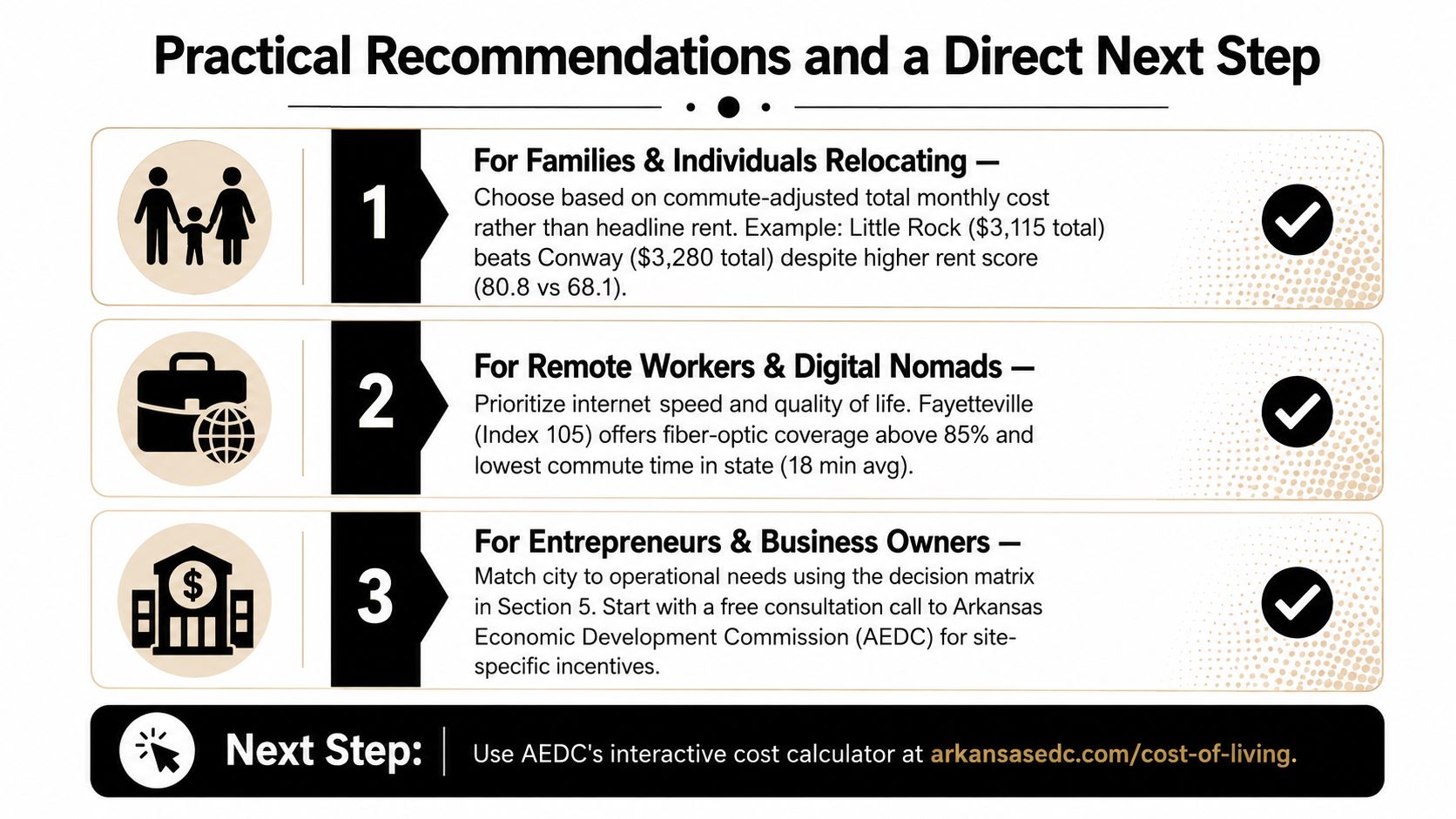
The right choice depends on what you're optimizing. For households, the cleanest answer is to choose on commute-adjusted total monthly cost, not on headline rent. For businesses, the right answer is to treat city cost as a lever inside payroll, occupancy, and route planning, not as a generic affordability label. Vendor selection criteria for Arkansas businesses can help teams formalize that choice before they sign anything.
Three direct recommendations
- For families and individuals relocating, use total monthly cost as the filter. Conway and Jonesboro can make sense when housing dominates the budget, while Little Rock or Rogers can be better when you want a more balanced tradeoff between housing and access.
- For SMB owners, treat the city map as a payroll decision. Pine Bluff and Fort Smith support leaner wage structures, while Northwest Arkansas can justify higher compensation if the business needs the market depth.
- For IT and facilities managers, read the map as a reverse-logistics plan. The farther your equipment travels, the more important pickup coordination, staging efficiency, and secure handling become.
For organizations retiring laptops, servers, peripherals, and office equipment, Reworx Recycling offers donation-based electronics recycling, IT equipment disposal, and secure data destruction options that fit this cost-sensitive environment. It's a practical choice when you need to clear a site, protect data, and keep usable hardware out of the landfill.
If your team is comparing Arkansas cities for an office move, equipment refresh, or facility cleanout, contact Reworx Recycling to plan a pickup, discuss a corporate donation program, or map out ITAD for retired devices. Their service model fits the same budget logic covered here, lower waste, tighter logistics, and a cleaner path for equipment your business no longer needs.