Your team is replacing laptops, clearing a server room, or shutting down a department storage area full of aging devices. The hardware looks harmless. The risk doesn't. A retired desktop can still hold customer files, employee records, design documents, credentials, and years of operational history.
That's why IT asset disposition in Rockford, Illinois deserves executive attention. In a market with manufacturing, healthcare, education, and professional services all handling sensitive data, the end of an asset's life is still part of the asset's lifecycle. If you treat retirement as a trash-hauling problem, you invite compliance trouble, weak documentation, and lost recovery value. If you treat it as a managed business process, you reduce exposure and make better use of equipment that still has life left in it.
What IT Asset Disposition Means for Rockford Businesses
IT asset disposition, or ITAD, is the controlled retirement of technology equipment. That includes laptops, desktops, servers, networking gear, drives, monitors, and related peripherals. In practice, it covers inventory, data destruction, logistics, remarketing, recycling, and reporting.
For Rockford businesses, that matters because many local organizations operate in sectors where old devices can still hold high-value information. A machine on a factory floor may contain process data or proprietary configurations. A clinic workstation may contain protected records. A finance office laptop may hold tax documents, account files, or archived email. The equipment is retired. The liability often isn't.
The industry itself shows why businesses no longer treat this as an afterthought. The global ITAD market was estimated at USD 25.31 billion in 2024 and is projected to reach USD 54.54 billion by 2030, reflecting sustained expansion, with a projected 8.9% CAGR over that period, according to Grand View Research's IT asset disposition market analysis. That same research notes the U.S. market was valued at USD 5.3 billion in 2025 and projected to grow at 11.4% CAGR from 2025 to 2030, which signals how seriously organizations now treat secure retirement, reuse, and compliance.
Why ITAD is more than disposal
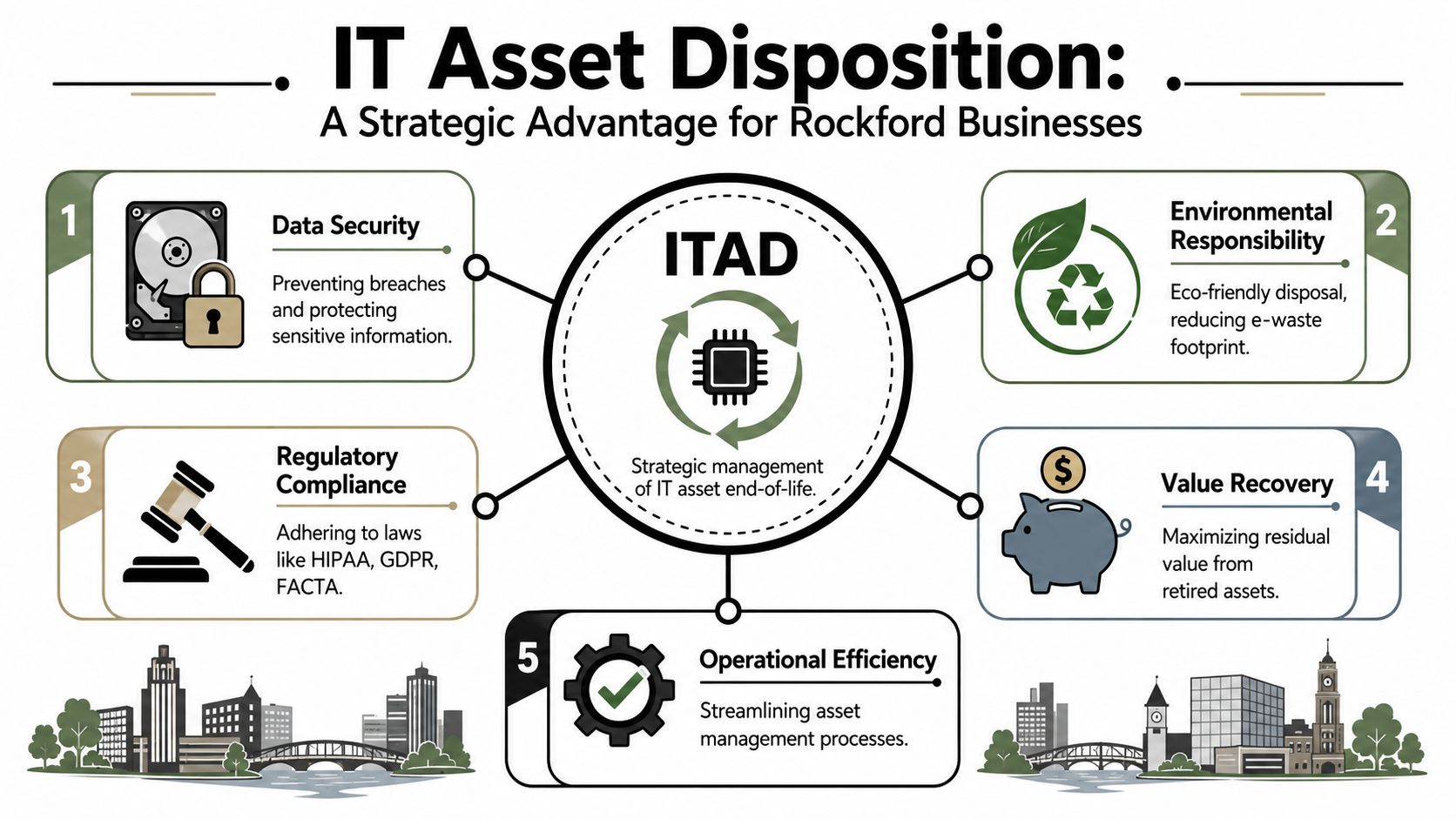
A good ITAD program supports five business outcomes:
- Risk control by making sure data is wiped or destroyed before equipment leaves your chain of custody
- Compliance support through documentation, certificates, and auditable handling
- Value recovery when usable devices can be remarketed or directed to reuse
- Environmental responsibility through proper electronics recycling instead of informal disposal
- Operational discipline by tying refresh cycles to documented retirement procedures
That mix is what separates ITAD from junk removal. A general hauler can remove equipment from a loading dock. An ITAD process documents what was removed, what happened to the data, where the assets went, and which items still had residual value.
Practical rule: If your provider can't tell you what happened to a specific serial-numbered device after pickup, you're not buying ITAD. You're buying uncertainty.
Where Rockford organizations usually get this wrong
The most common failure isn't malicious behavior. It's informal handling. Devices pile up in closets. A facility team schedules a cleanout without involving IT. Staff assume a factory reset is enough. Someone donates old computers without documenting the drives. Months later, no one can prove what happened.
That approach breaks down when auditors, clients, insurers, or internal leadership ask for records.
A stronger approach starts with policy. Decide which assets qualify for reuse, which require sanitization, and which must be destroyed. Assign ownership between IT, compliance, facilities, and finance. Then use a documented process every time equipment leaves service.
For a broader primer on the discipline itself, this overview of what IT asset disposition involves is a useful starting point.
The High Stakes of ITAD Compliance and Data Security
Every organization says data security matters. ITAD is where that claim gets tested.
When companies in Rockford retire equipment, the key question isn't whether a device still powers on. It's whether the storage media inside it still contains regulated, confidential, or commercially sensitive information. In healthcare, legal services, finance, manufacturing, and public administration, that answer is often yes.

Liability doesn't end at the loading dock
A retired device can create risk in several ways:
- Residual data on drives that were never properly wiped or destroyed
- Broken chain of custody when equipment changes hands without logs or signed transfer records
- Unverified downstream handling when a vendor removes devices but can't document final disposition
- Inconsistent internal procedures when one department follows policy and another improvises
This is especially important for organizations that manage protected health information, employee records, financial data, or customer account information. Compliance frameworks may differ by sector, but the operational lesson is the same. If you can't prove secure retirement, you're exposed.
Certifications and timing matter
Professional ITAD programs rely on repeatable controls, not verbal assurances. Industry guidance identifies NAID AAA, R2, and e-Stewards as common credibility markers for providers, and it notes that batches of 10 to 50 devices typically take 5 to 10 business days from pickup to certificate-of-destruction delivery, while 500+ device projects or data-center decommissioning work can take 3 to 6 weeks because of logistics and documentation requirements, as outlined in this guidance on how professional ITAD programs operate.
That timeline matters because secure retirement is rarely instantaneous. If a vendor promises vague “same-day disposal” for a complex project without discussing serial tracking, transport controls, and reporting, that should raise questions.
Security isn't just wiping a drive. It's proving who handled the asset, when they handled it, what method they used, and what happened next.
What weak vendors tend to miss
A weak provider usually focuses on removal. A strong provider focuses on evidence.
Look for these controls when evaluating a process:
| Area | Weak approach | Strong approach |
|---|---|---|
| Data handling | General claims about wiping | Defined sanitization or destruction methods with documentation |
| Pickup | Basic collection | Logged chain of custody from pickup through processing |
| Reporting | Batch summary only | Asset-level reporting where appropriate |
| Security | “Trusted staff” language | Controlled facility procedures and documented workflow |
| Final records | Informal email confirmation | Formal certificate package and disposition records |
If your internal stakeholders need a practical reference, this article on the growing importance of data security in IT asset disposition gives a business-focused explanation of why disposal practices now sit inside the broader security program.
A Step-by-Step Guide to Retiring Your IT Assets
Most ITAD problems start before pickup. They start with poor planning, incomplete inventories, and unclear decisions about reuse versus destruction. A controlled process fixes that.
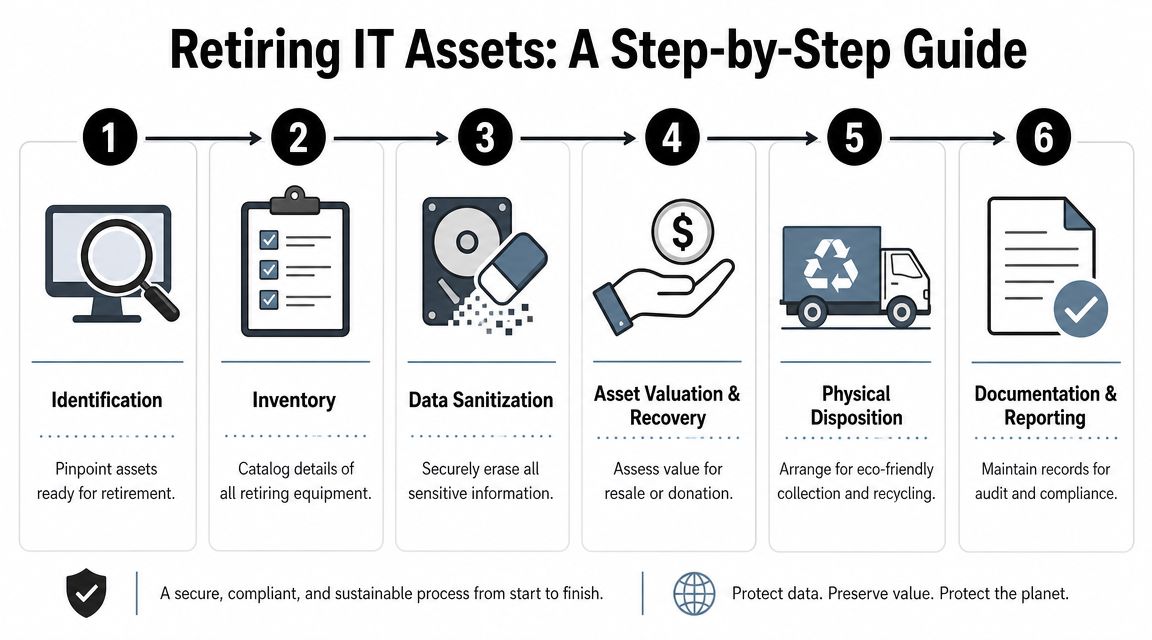
Industry guidance says a compliant ITAD process begins by inventorying assets by make, model, and serial number, then assessing condition to route each device into one of three streams: resale, secure sanitization for reuse, or physical destruction for recycling. That structure improves financial return while reducing exposure to data breach risk, as explained in this guide to the core ITAD process.
Start with identification and inventory
Before anyone packs a box, identify what is being retired. That sounds obvious, but many office cleanouts fail here. Teams know they're replacing “old laptops” or “a rack of servers,” but they haven't built an asset list.
At minimum, your inventory should capture:
- Asset identity such as make, model, serial number, and internal tag
- Location including office, plant, clinic, or storage room
- Condition so you can distinguish reusable hardware from scrap
- Data risk based on whether the device stored sensitive information
- Ownership status if leased, company-owned, or assigned to a specific department
This stage affects every downstream decision. If you skip it, you can't validate pickup, reconcile missing items, or compare the vendor's final report against what left your site.
Decide how data will be handled
Not every device should follow the same path. Some organizations want onsite drive shredding for the most sensitive media. Others are comfortable with controlled offsite processing if the chain of custody is strong and documentation is complete.
A useful decision filter looks like this:
High sensitivity assets
Devices from healthcare, finance, executive teams, R&D, and regulated environments often justify stricter handling and sometimes physical destruction.Reusable business hardware
Newer laptops, desktops, and some network gear may be better candidates for sanitization and remarketing or redeployment.End-of-life or damaged equipment
Hardware with little residual value usually belongs in physical recycling after data-bearing components are destroyed or sanitized.
Field note: A factory reset is an operational reset, not a retirement strategy. It doesn't replace documented sanitization or destruction.
Control the handoff
The day equipment leaves your building is where informal processes fail fast. Pallets get mixed. Loose drives travel separately. Someone signs a generic pickup slip that doesn't match the actual asset count.
Use a chain-of-custody process that includes:
- Prepared staging in a restricted area before pickup
- Matched documentation between internal inventory and shipping records
- Named custody transfers so you know who released and received the equipment
- Exception handling for missing tags, damaged devices, or unlisted items
This is also the point where many business leaders realize how different ITAD is from general junk hauling. If you've ever looked at resources on understanding homeowner junk removal in Ontario, the contrast is useful. Household removal is built around convenience and volume. ITAD is built around data risk, documentation, and final disposition.
Route equipment to the right outcome
Once assets are processed, each device should move into the right stream. That may include reuse, refurbishment, resale, parts harvesting, or materials recycling. The best outcome depends on the age, condition, and security profile of the device.
Not every organization needs to build this from scratch. A practical reference for planning policy, logistics, and reporting is this guide to implementing an IT asset disposition strategy.
Close the loop with reporting
The last step is where many buyers settle for too little.
You should expect final documentation that confirms what was received, how data-bearing assets were handled, and how materials were dispositioned. If the project involved value recovery, reporting should also make it clear which assets qualified and which did not.
A good closeout package makes future refreshes easier. It also helps finance, compliance, sustainability, and IT speak from the same record instead of maintaining separate spreadsheets and assumptions.
Tailoring ITAD Services to Your Organization's Needs
The right ITAD setup for a ten-person office isn't the right setup for a hospital department, a school district, or a plant clearing out industrial workstations. The process stays disciplined, but the service mix should change based on security needs, asset volume, and how much labor your team can absorb.
Small office versus large-scale retirement
A small business in Rockford might only need periodic pickup for laptops, monitors, docking stations, and a few network devices. In that case, convenience and documentation usually matter more than a complex decommissioning plan. The key questions are simple. Will the provider track what leaves the site? Will they document data destruction? Will they separate reusable equipment from scrap?
A larger organization often needs something more structured. A facility cleanout, office consolidation, or data center decommissioning project usually involves staged pickups, packed pallets, serial reconciliation, and coordination between IT, facilities, compliance, and finance. That's not a one-truck errand. It's a project.
How to match service options to the job
Here's a practical way to think about common service combinations:
- Scheduled business pickup works well when your team has already consolidated equipment and needs secure collection with documentation.
- Onsite hard drive shredding makes sense when internal policy or client obligations require destruction before any media leaves the property.
- Equipment buyback or value recovery fits newer laptops, servers, and networking gear that still have market value.
- Office cleanout support helps when IT equipment is mixed with furniture moves, lease-end deadlines, or departmental closures.
- Full decommissioning support is the better fit for server rooms, lab spaces, and multi-phase retirements.
What works and what usually doesn't
What works is choosing a service level that reflects your actual risk. If your team handles regulated data, cheap pickup with minimal records is usually a false economy. If you're clearing a small batch of low-risk peripherals, a heavy process may be unnecessary.
What usually doesn't work is mixing incompatible goals. Companies say they want maximum recovery, immediate removal, zero internal effort, and no documentation burden. In reality, there are trade-offs. Higher recovery often requires better sorting. Faster projects can reduce time for reconciliation. Stricter security can narrow reuse options.
Some organizations also want a donation-based recycling path for eligible equipment, especially when devices still have useful life and the business wants community benefit alongside responsible electronics recycling. That can be a smart fit when the provider can still meet data destruction and reporting requirements.
Choosing a Reputable ITAD Partner in Northern Illinois
Vendor selection is where strategy becomes reality. A surprising number of companies still choose an ITAD provider the way they choose a scrap hauler. They compare pickup speed, basic price, and whether someone answers the phone. That's not enough.
A real ITAD partner should help you verify what happens after pickup. Industry guidance highlights this as an often-missed issue: organizations should demand proof of downstream handling, chain of custody, and reuse versus destruction outcomes, especially if they want an audit trail tied to circular-economy or reporting goals, as explained in this discussion of why downstream verification matters in ITAD.
Questions that separate professionals from opportunists
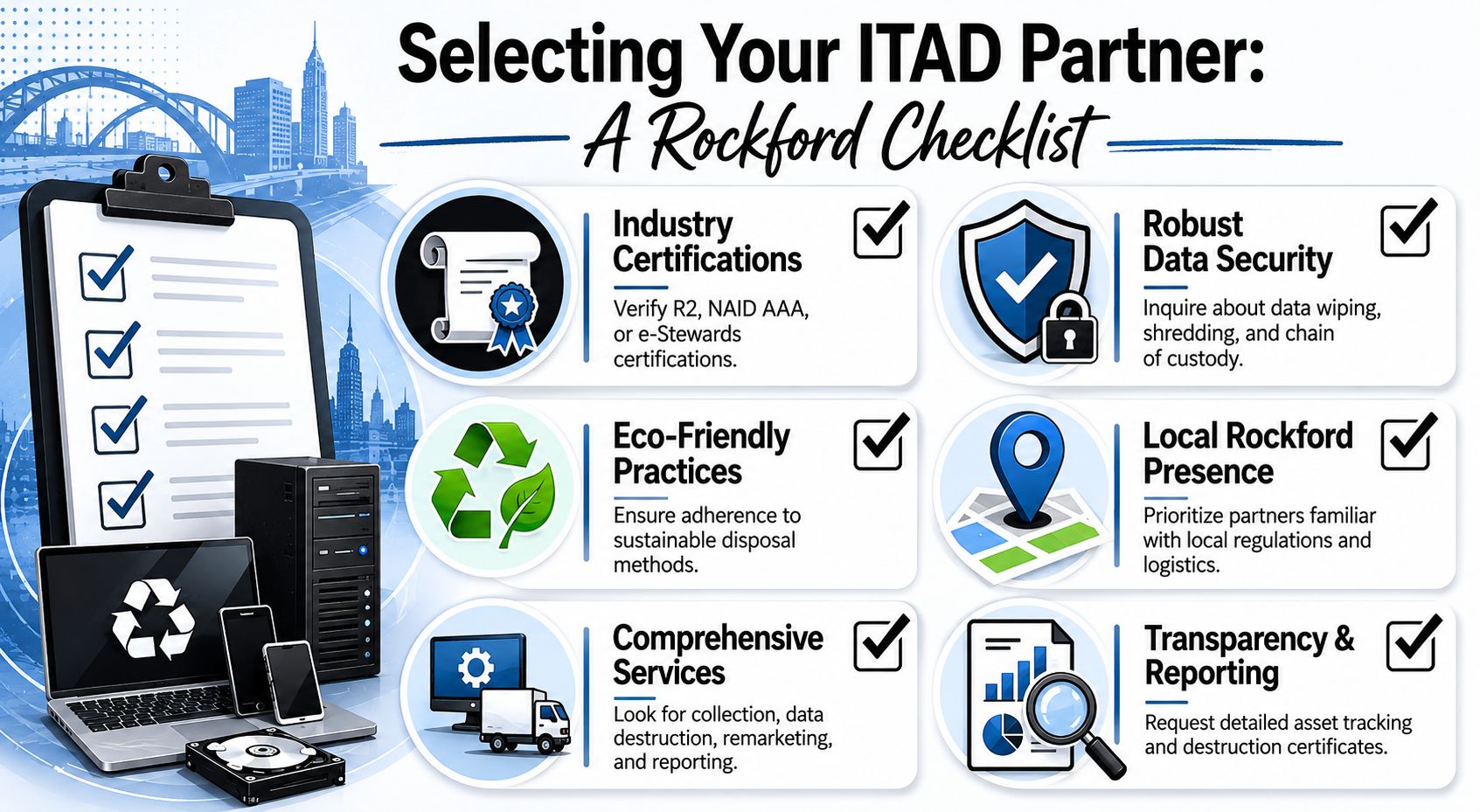
Ask direct questions. Good vendors won't be bothered by them.
How do you track assets after pickup
You want more than a truck receipt. Ask how they maintain serial-level or batch-level accountability, depending on the project.What proof do you provide for data destruction
A certificate matters, but so does the process behind it.Which assets are reused, and which are destroyed
The answer should explain decision criteria, not just broad promises.How do you manage downstream vendors
If a partner outsources portions of the work, they should still be able to explain controls.What certifications support your process
Certifications aren't everything, but they are meaningful screening tools.
Decision standard: Don't just ask, “Can you recycle this?” Ask, “Can you prove what happened to it?”
A practical vendor checklist
Use this checklist during procurement or renewal:
| Checkpoint | What to look for |
|---|---|
| Security controls | Clear handling procedures for data-bearing assets |
| Documentation | Pickup records, destruction records, and disposition reporting |
| Transparency | Willingness to explain downstream process, not just front-end collection |
| Service fit | Ability to support office cleanouts, laptop disposal, product destruction, or decommissioning as needed |
| Environmental handling | Responsible electronics recycling, not vague disposal language |
| Communication | Fast answers from people who understand compliance and operations |
One provider businesses may evaluate for Illinois projects is Reworx Recycling's Illinois ITAD services, which include IT asset disposition, secure data destruction, reverse logistics, and business pickup support.
Why local context still matters
Northern Illinois organizations often have a mix of older industrial sites, medical offices, distributed branches, and growing hybrid work inventories. That creates logistics issues that aren't obvious in national sales pitches. You may need a partner who can handle a downtown office pickup, a warehouse cleanout, and a clinic equipment retirement under one reporting structure.
That's why familiarity with local business conditions matters almost as much as technical process. A vendor should understand that a Rockford manufacturer retiring engineering workstations has different concerns from a school replacing classroom laptops or a healthcare group clearing exam-room PCs.
Local Rockford and Illinois E-Waste Resources
Rockford businesses don't need to rely only on vendor claims. Illinois has public resources that help organizations understand the broader e-waste environment and responsible handling expectations.
Useful public resources for Illinois organizations
Start with the EPA's page on electronics donation and recycling. It's a practical reference for understanding why electronics recycling requires more care than ordinary waste handling and why reuse should be considered where appropriate.
For state-level direction, review the Illinois EPA information on electronic waste. That's a good place to understand the state framework around electronic products recycling and what kinds of materials require special attention.
If your project involves a facility move, office cleanout, or public-facing disposal event, it also helps to check local government pages for current disposal instructions and collection policies in Winnebago County and the City of Rockford before scheduling removal.
How to use those resources in practice
Use public guidance to support three internal decisions:
- Policy alignment by making sure your internal disposal rules match current Illinois expectations
- Vendor review by comparing a provider's claims against public environmental guidance
- Employee instructions so staff know that old computers, drives, and peripherals shouldn't be tossed into ordinary waste streams
If your team needs a starting point for local service availability, this page on electronics recycling options in Illinois can help frame what to ask when comparing pickup, processing, and documentation options.
The Reworx Recycling Difference and Community Impact
Most ITAD vendors focus on compliance, logistics, and recycling outcomes. Those matter. For many organizations, though, there's also a broader question. Can retired equipment support community value when devices are still suitable for reuse?
That's where a donation-based recycling model stands apart from a purely transactional scrap process. When equipment is appropriate for reuse, a social enterprise approach can align responsible IT equipment disposal with digital inclusion and community support goals. Instead of viewing every retired asset as waste, the organization can treat some of that equipment as a resource that may still help people, schools, or workforce-focused programs after proper processing.
Why that matters to business leaders
For a Rockford-area company, this can strengthen more than recycling performance.
- CSR alignment because equipment retirement supports visible community benefit
- Sustainability reporting support when reuse is part of the final outcome
- Employee goodwill because staff often respond positively when retired technology is handled responsibly
- Operational consistency because donation doesn't replace secure data destruction. It depends on it
That combination is attractive to companies trying to connect ITAD with environmental goals, community values, and practical governance. It turns a back-office disposal event into a more intentional business decision.
A social enterprise model also creates a healthier internal conversation. Instead of arguing only about storage costs or recycling pickups, leadership can ask better questions. Which assets still have useful life? Which should be sanitized and reused? Which should be physically destroyed? And how can the organization document those outcomes in a way that satisfies both compliance teams and community stakeholders?
If your organization is planning IT asset disposition in Rockford, Illinois, retiring laptops, handling an office cleanout, or preparing for data center decommissioning, consider reviewing the resources available from Reworx Recycling. You can use them to evaluate donation-based recycling options, secure data destruction needs, pickup planning, and responsible electronics recycling workflows before your next refresh cycle.