Proper electronics recycling in Florida is a critical operational function for any business committed to protecting sensitive data and upholding modern environmental standards. As the state's economy thrives, companies are continuously upgrading technology, leaving a trail of outdated IT assets—from servers to laptops—that present a significant disposal challenge. For IT managers and corporate sustainability leaders, a strategic approach to IT equipment disposal is not just about logistics; it's about mitigating risk and enhancing corporate reputation.
Why Florida Businesses Need a Proactive E-Waste Strategy
Florida's dynamic business environment accelerates technology turnover, causing old electronics to accumulate rapidly. Without a formal IT Asset Disposition (ITAD) plan, companies expose themselves to severe risks beyond a cluttered storage room, including massive data breaches from improperly wiped hard drives and significant fines for non-compliance with federal disposal regulations. In an era where customers value corporate responsibility, how a business manages its electronic waste speaks volumes about its commitment to ethical operations.
The Regulatory Landscape and Its Implications
Florida's legislative environment adds a layer of complexity. The state currently lacks a mandatory, statewide e-waste recycling law specifically for businesses. This regulatory gap can lead to complacency, but it does not absolve companies of their responsibilities. Federal regulations, particularly the Resource Conservation and Recovery Act (RCRA), still apply and govern the disposal of devices containing hazardous materials like lead and mercury.
Nationally, the volume of e-waste is staggering, yet only a fraction is properly recycled. This trend has tangible consequences for Florida's industries, from healthcare to technology. The absence of a state mandate makes it even more crucial for businesses to adopt a proactive stance on sustainable recycling.
A proactive IT Asset Disposition (ITAD) strategy is not just about compliance. It’s about transforming a potential liability into a genuine asset by safeguarding data, recovering value from retired hardware, and demonstrating a strong commitment to environmental stewardship.
Turning Risk into Opportunity with Social Enterprise Recycling
This is where partnering with a social enterprise like Reworx Recycling fundamentally changes the approach to IT equipment disposal. Instead of viewing it as a cost center, businesses can frame it as an opportunity for profound community impact. Our donation-based recycling model ensures your old equipment is managed with the highest standards for both data security and environmental care.
By choosing this path, your company can:
- Ensure Secure Data Destruction: Gain peace of mind knowing all sensitive corporate and customer information is certifiably destroyed.
- Promote Digital Inclusion: Support local communities by donating refurbished equipment to schools and non-profits, helping to bridge the digital divide.
- Strengthen Corporate Social Responsibility (CSR): Build a powerful narrative of positive impact that resonates with customers, employees, and stakeholders.
Ultimately, the benefits of e-waste recycling extend far beyond clearing out old hardware; they are integral to running a modern, responsible enterprise.
Preparing Your IT Assets for Secure Recycling
Before any equipment leaves your Florida facility, a clear, structured plan is essential. This preparatory work forms the bedrock of secure and efficient IT disposal, ensuring your company's data remains protected and the entire process is seamless. A successful office cleanout or data center decommissioning project begins with a detailed inventory. This means documenting every asset—from servers and networking switches to specialized medical or laboratory equipment—cataloging its type, serial number, and condition.
This inventory allows you to sort assets based on their disposition path. Newer devices may be suitable for refurbishment and donation, while older or non-functional hardware is designated for material recovery. Proper initial sorting is key to maximizing the value of your retired IT portfolio.
The Critical Importance of Data Destruction
The single most critical step in this process is ensuring all sensitive data is permanently and verifiably destroyed. Simply deleting files is insufficient, as residual data can often be recovered, posing a massive security risk. You must choose a data sanitization method that aligns with your security policies and industry regulations.
There are three primary methods for secure data destruction:
- Data Wiping: A software-based method that overwrites drive data with random characters multiple times, rendering the original information unrecoverable. It is ideal for newer devices slated for refurbishment.
- Degaussing: An powerful magnetic field scrambles the magnetic platters on hard drives and tapes, instantly rendering data unreadable.
- Physical Shredding: This method physically annihilates the hard drive, grinding it into small, unsalvageable fragments. It provides the ultimate guarantee that data can never be compromised.
Choosing the right method is paramount. Most organizations find that a hybrid approach—combining wiping for reusable assets and shredding for obsolete or highly sensitive drives—offers the optimal balance of security and sustainability.
This visual breaks down the journey of electronic devices, from production all the way to e-waste and the risks involved.
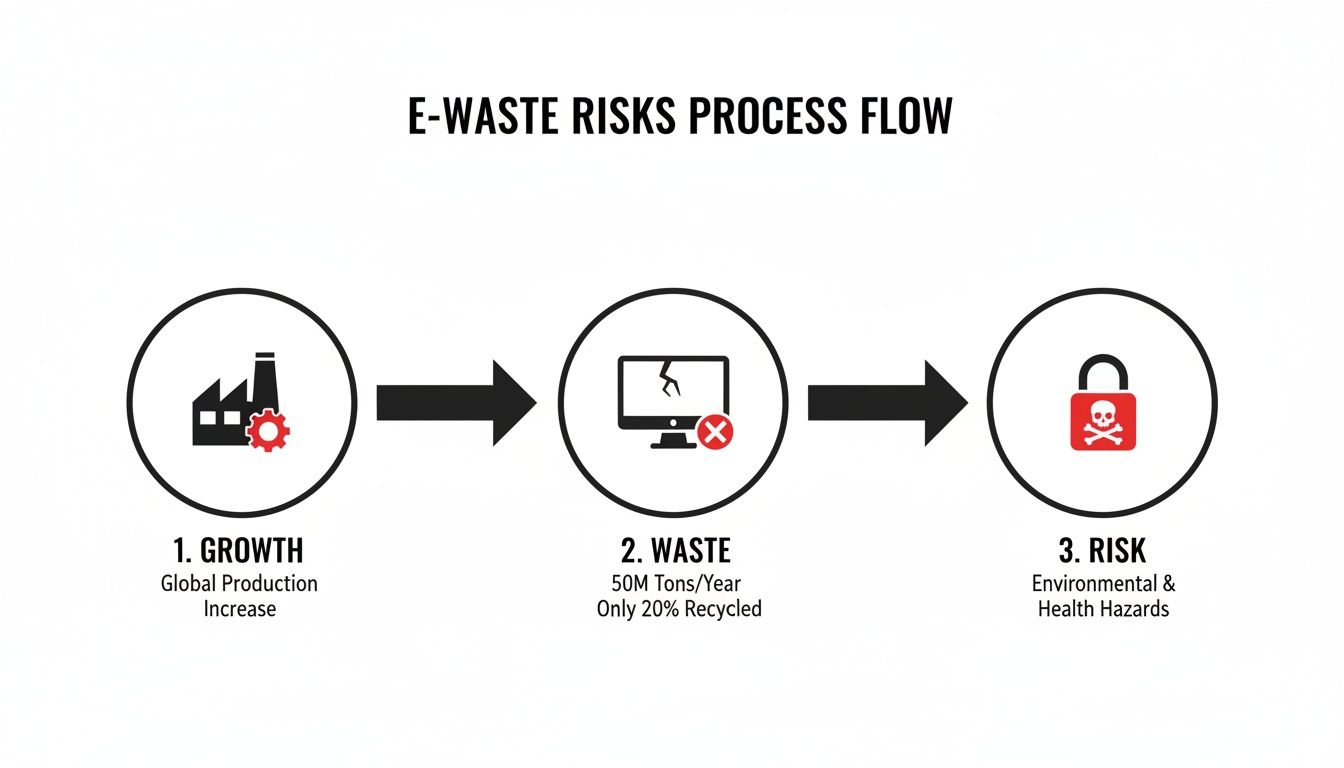
It highlights how unchecked electronics manufacturing leads directly to waste streams that can become serious security and environmental hazards if not managed responsibly.
A Smooth and Secure Handover
With your inventory complete and a data destruction plan in place, the final step is ensuring a smooth physical transition. This involves securely packaging assets, especially loose hard drives, to prevent damage during transport. A clear chain of custody must begin the moment equipment is collected from your location.
For a deeper dive, review our comprehensive guide on how to prepare your company's electronics for recycling. It provides actionable steps for Florida IT managers to streamline their entire process. Partnering with Reworx Recycling simplifies this journey, as we offer certified data destruction and provide the documented proof of compliance needed to turn a complex task into a secure and manageable operation.
Choosing The Right E-Waste Recycling Partner in Florida
Selecting an electronics recycling partner is one of the most important decisions in your IT asset disposition (ITAD) strategy. You are entrusting this vendor with your company's sensitive data, environmental compliance, and public reputation. The Florida market offers many options, but a generic scrap hauler often lacks the infrastructure for secure data destruction or responsible downstream processing, exposing your business to significant risks.
Look For Certifications That Matter
When vetting potential partners, certifications provide independent proof that a recycler adheres to the highest industry standards for security and environmental stewardship. For any business serious about Florida electronics recycling, the R2 (Responsible Recycling) certification is the non-negotiable baseline.
An R2-certified facility is regularly audited to ensure it follows strict protocols for:
- Data Security: Implementing and verifying secure processes to sanitize or physically destroy data on all devices.
- Environmental Protection: Properly managing hazardous materials and preventing their illegal export.
- Worker Health and Safety: Maintaining a safe environment for employees.
Choosing an R2-certified partner like Reworx Recycling provides assurance that your retired assets are handled responsibly from the moment they leave your facility.
Comparing E-Waste Vendor Certifications and Standards
| Certification/Standard | What It Guarantees | Why It Matters for Your Business |
|---|---|---|
| R2 (Responsible Recycling) | Adherence to best practices for data security, environmental protection, and worker safety. The leading global standard. | Protects your brand from data breaches and environmental liability. Ensures a transparent and accountable process. |
| e-Stewards® | A rigorous standard with a strong focus on preventing illegal export of hazardous e-waste and prison labor. | Offers the highest level of assurance against illegal dumping overseas, aligning with strong corporate social responsibility goals. |
| NAID AAA Certification | Verifies secure data destruction processes, including physical destruction and data erasure. Specific to data security. | Critical for industries with strict data privacy regulations (like healthcare or finance). It proves your data was irretrievably destroyed. |
| ISO 14001 | An international standard for an effective Environmental Management System (EMS). | Shows the vendor has a systematic approach to managing their environmental impact, which helps meet your own sustainability goals. |
| ISO 45001 | An international standard for Occupational Health and Safety (OH&S) management systems. | Demonstrates a commitment to worker safety, reducing the risk of accidents and associated liabilities within your supply chain. |
These certifications represent a vendor's investment in processes that protect your business.
The Social Enterprise Difference
Beyond technical certifications, consider a potential partner's business model. A social enterprise offers a unique value proposition. Unlike a purely commercial recycler, a social enterprise like Reworx Recycling integrates a community-focused mission into its core operations. After your data is securely wiped, viable equipment is expertly refurbished. Your company’s old laptops and desktops can then empower students, support local non-profits, or contribute to workforce development programs.
Partnering with a social enterprise transforms a standard operational cost into a powerful corporate social responsibility initiative. It's a tangible way to demonstrate your company's commitment to sustainability and community impact.
Questions To Ask Your Potential Partner
To make an informed decision, ask direct questions:
- Data Destruction: What specific methods do you use? Will we receive a formal Certificate of Data Destruction?
- Chain of Custody: How do you document and track our assets from pickup to final disposition?
- Downstream Auditing: How do you vet your downstream partners? Can you prove they are also certified?
- Reporting: What kind of reports can you provide for our asset management and ESG goals?
The responses will distinguish basic haulers from true ITAD partners who can protect your business. For more, our guide on selecting a reliable e-waste recycling partner offers a comprehensive checklist.
Streamlining Your Electronics Disposal Logistics
With your IT assets inventoried and a data destruction plan in place, the next step is logistics: getting the equipment from your facility to a certified recycler. The method should match the scale of your project. A small firm upgrading a few laptops might use a drop-off service, while a large enterprise decommissioning a data center will require a scheduled pickup with specialized handling.
Comparing Disposal Methods for Florida Businesses
Choosing the right transport option balances convenience, cost, and security. Most certified ITAD partners offer several core services:
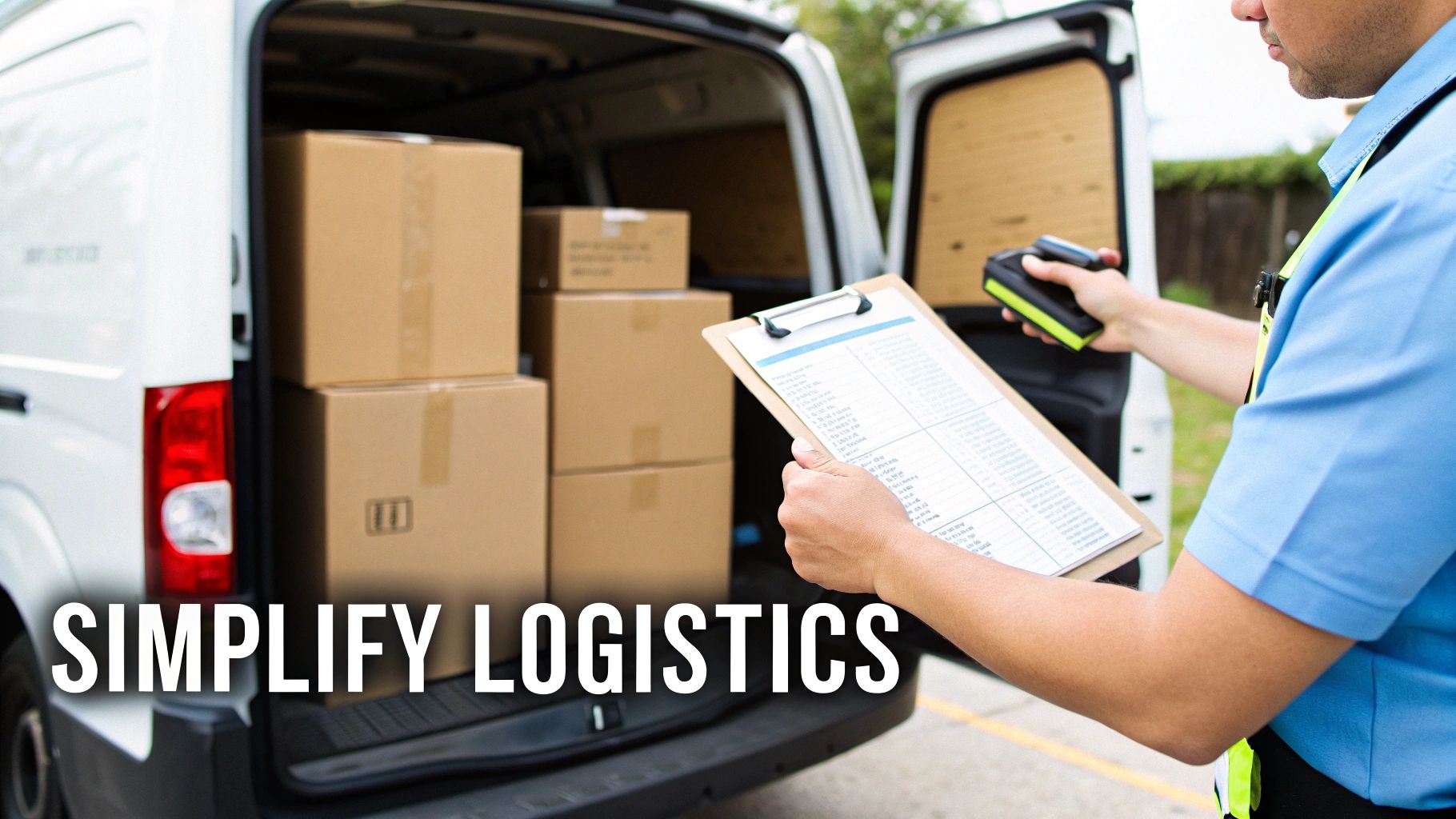
- Scheduled Pickups: Ideal for most corporate office cleanouts. A professional team arrives with the right equipment to securely pack and transport everything, ensuring a documented chain of custody from your door. This is essential for large volumes or heavy items.
- Facility Drop-Offs: Works well for smaller businesses or a steady trickle of e-waste. A dedicated corporate partner like Reworx provides a secure drop-off point designed for business assets.
- Mail-In Programs: A great solution for remote offices or recycling smaller, high-value items like corporate smartphones. Devices are sent in secure, pre-paid packaging, simplifying asset management across multiple locations.
The most critical moment in the logistics process is the handoff. A robust chain-of-custody process becomes your legal and security safeguard, providing documented proof of compliant disposal.
The Importance of Chain-of-Custody Documentation
Regardless of the method, chain-of-custody documentation is non-negotiable. This is the official paper trail tracking your assets from your property to their final destruction. It serves as your auditable proof of compliance for regulators, auditors, or internal stakeholders, demonstrating you took every necessary step to protect data and dispose of e-waste responsibly.
A reliable partner will provide detailed reports, including serialized asset lists and Certificates of Data Destruction, to complete your records. To learn more about how this works, read our guide on optimizing e-waste management with reverse logistics.
Navigating Florida’s Shifting E-Waste Regulations
Staying current with environmental regulations is a strategic business imperative. While Florida does not currently have a state-specific e-waste law for businesses, federal laws, particularly the Resource Conservation and Recovery Act (RCRA), remain in full effect. This legislation governs how hazardous materials found in most electronics must be handled.
This means your company is still liable for improperly disposing of items like old CRT monitors or certain batteries. The lack of a state mandate can create a false sense of security, but the legal and financial repercussions of violating federal rules are substantial. A proactive approach is essential to protect your business from liability.
What’s on the Horizon for Florida E-Waste Rules?
The regulatory landscape is shifting. Recent legislative efforts indicate a move toward stricter waste management rules. Businesses that anticipate these changes will be better positioned for future compliance. Florida's ambitious recycling goals signal that responsible IT equipment disposal is evolving from a best practice to a formal requirement. Establishing a documented, compliant process now will ensure a seamless transition as new regulations are implemented.
Being proactive isn’t just about avoiding future penalties. It’s about demonstrating corporate responsibility and building operational resilience. A forward-thinking e-waste strategy is a competitive advantage.
Partnering for Future-Proof Compliance
How can your business prepare for these evolving rules? Partner with an expert who understands both current federal requirements and the future direction of Florida's laws. A compliance-focused partner like Reworx helps you build a responsible and future-proof disposal program today.
This partnership involves more than just logistics. It means establishing a system that includes:
- Auditable Documentation: Receiving Certificates of Data Destruction and detailed asset reports to prove due diligence.
- Adherence to High Standards: Working with an R2 Certified partner guarantees your electronics are managed according to the highest industry benchmarks.
- Strategic Guidance: Gaining expert advice on structuring internal processes to meet both current and future regulations.
These steps protect your organization from fines and liability. You can get a clearer picture by exploring the environmental and legal impacts of improper e-waste disposal in our detailed guide. This approach turns a regulatory challenge into an opportunity to strengthen your company’s commitment to sustainable operations.
Common Questions About Business E-Waste Recycling
When finalizing an IT asset disposition (ITAD) strategy, most decisions come down to a few key questions. Florida businesses require clear, direct answers to feel confident in their choices. Here are some of the most common concerns from IT managers and sustainability leaders.
What Happens to My Company’s Sensitive Data?
This is the most critical question. A certified ITAD partner guarantees the complete and permanent destruction of all sensitive information. Upon arrival at a secure facility, devices are tracked under a strict chain of custody. Data is then wiped using methods meeting or exceeding NIST 800-88 standards. For assets designated for reuse, this means a multi-pass data wipe; for maximum security, it means physical shredding. You will always receive a Certificate of Data Destruction for each serialized asset, serving as your auditable proof of compliance.
Can We Recover Any Value From Our Old Equipment?
Yes, absolutely. Value recovery, or IT asset remarketing, is a key component of a modern ITAD strategy. If your retired devices retain market value, a good partner will assess them and help you recoup that value. Significant returns can often be realized from equipment like enterprise-grade servers, newer-model laptops, and specialized medical or laboratory equipment. This revenue can offset the costs of your recycling program and, in many cases, generate a positive return, transforming an operational expense into a financial gain.
The goal of a modern ITAD program isn't just disposal; it's about maximizing the lifecycle of every asset, whether through reuse, remarketing, or responsible recycling. This approach is both economically and environmentally intelligent.
What Are the Costs for Business Electronics Recycling?
Costs for Florida electronics recycling vary based on the volume of equipment, pickup logistics, and specific data destruction services required. However, it's crucial to view this as an investment in risk mitigation rather than a simple cost. The expense of professional, certified disposal is minimal compared to the potential financial and reputational damage from a data breach or an environmental compliance fine. Partners like Reworx Recycling often provide transparent, upfront pricing and may offer complimentary pickups for large quantities of valuable assets.
How Does Partnering with a Social Enterprise Benefit Us?
Choosing a social enterprise like Reworx Recycling adds a powerful layer of corporate social responsibility to your operations. It transforms recycling into a story of community impact. After secure data destruction, reusable devices are expertly refurbished and donated to non-profits, local schools, and workforce development programs, helping to bridge the digital divide in our community. This provides your company with a tangible way to demonstrate its commitment to social good, strengthening your brand and engaging employees, customers, and stakeholders.
Ready to transform your retired IT assets into an opportunity for your business and community? Reworx Recycling provides secure, certified, and socially responsible electronics recycling services for businesses across Florida. Schedule a pickup or request a consultation today to build a smarter, more sustainable ITAD strategy.