For companies in Bowie’s bustling tech and government contracting world, getting data center equipment disposal right isn't just a box to check—it's a critical part of doing business. A decommissioning project done correctly protects sensitive information, keeps you in line with Maryland's tough environmental rules, and safeguards your hard-earned reputation. Partnering with a donation-based social enterprise like Reworx Recycling ensures your old IT assets also create positive community impact.
Your Guide to Data Center Decommissioning in Bowie
Shutting down a data center in Bowie, Maryland, is much more than just unplugging servers and clearing out a room. It's a high-stakes project that requires careful planning, perfect execution, and a solid grasp of security. IT managers know the pressure is on. One small mistake during an office cleanout or facility cleanout could lead to a massive data breach, steep fines, and a loss of client trust that’s hard to win back.
The goal of this guide is to break down this complicated process into a clear, straightforward roadmap for businesses facing this exact challenge. We'll walk through the big hurdles, from making sure secure data destruction meets NIST standards to figuring out the logistics of securely moving assets during data center decommissioning.
This simple visual breaks down the process into its three main stages.
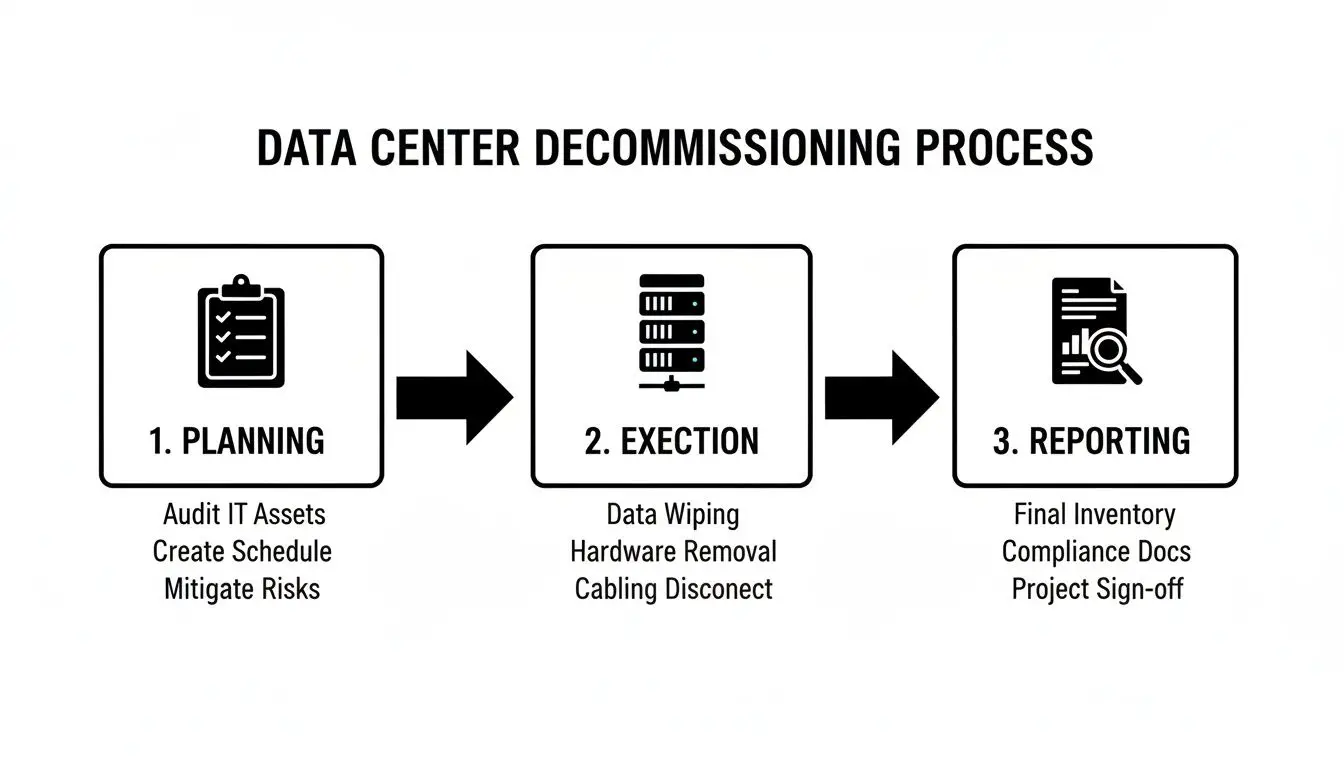
Think of it this way: a successful project moves from careful preparation to the physical work, and finally to creating a paper trail that proves you did everything right. Understanding these phases is the first step toward a seamless transition.
Setting the Stage for Success
Good planning is everything. It’s what separates a smooth, secure IT asset disposition (ITAD) project from a chaotic, risky one. This isn't just about scheduling a truck; it’s about creating a strategy that covers logistics, data security, and compliance from day one. As you map out your project, using a good data center migration checklist can give you some great ideas, even if you aren't moving to a new physical site.
To help you frame your own plan, this table breaks down the key stages of a decommissioning project.
Phases of a Bowie Data Center Decommissioning Project
| Phase | Key Activities | Primary Goal |
|---|---|---|
| Planning & Scoping | Asset inventory, data mapping, defining project goals, selecting an ITAD partner, and risk assessment. | To create a detailed, actionable plan that minimizes risk and sets clear objectives for the entire project. |
| Execution & Logistics | Secure packing and transport, on-site or off-site data destruction, physical de-installation of equipment. | To safely and securely remove all targeted assets from the facility while maintaining a strict chain of custody. |
| Reporting & Value Recovery | Asset grading, remarketing viable equipment, responsible recycling, and providing certificates of destruction and recycling. | To provide complete, auditable documentation, ensure environmental compliance, and maximize financial return on retired assets. |
Each phase builds on the last, ensuring that by the end, you have a fully compliant and documented process.
Why Partnering with a Local Specialist Matters
For businesses in Bowie, the stakes are even higher. With so many government contractors and federal agencies nearby, data security is non-negotiable. This is where bringing in a certified specialist like Reworx Recycling can turn a major headache into a streamlined, secure process. Our deep experience in data center equipment disposal in Bowie Maryland means we handle every step with the precision you need.
By partnering with a social enterprise like Reworx, your decommissioning project does more than just meet compliance standards—it actively contributes to community-building initiatives through corporate donation programs, adding a powerful layer to your corporate social responsibility efforts.
We provide a seamless experience, managing everything from secure logistics to certified data destruction. Our process is designed to make sure your company not only meets but exceeds its responsibilities. To see how we support businesses across the state, check out our guide to comprehensive Maryland ITAD services. By choosing a certified and mission-driven partner, you protect your business and turn retired hardware into a force for good.
First Things First: Building Your Asset Inventory
Every successful data center decommissioning project begins long before a single server is powered down. The very first move—and honestly, the most important one—is creating a precise, detailed asset inventory. This isn't just about counting boxes; it's about capturing the critical data that will guide every decision you make from here on out, forming the foundation of your project's chain of custody.
Taking this step ensures every piece of equipment, from your Bowie data center to its final destination, is tracked and handled correctly.
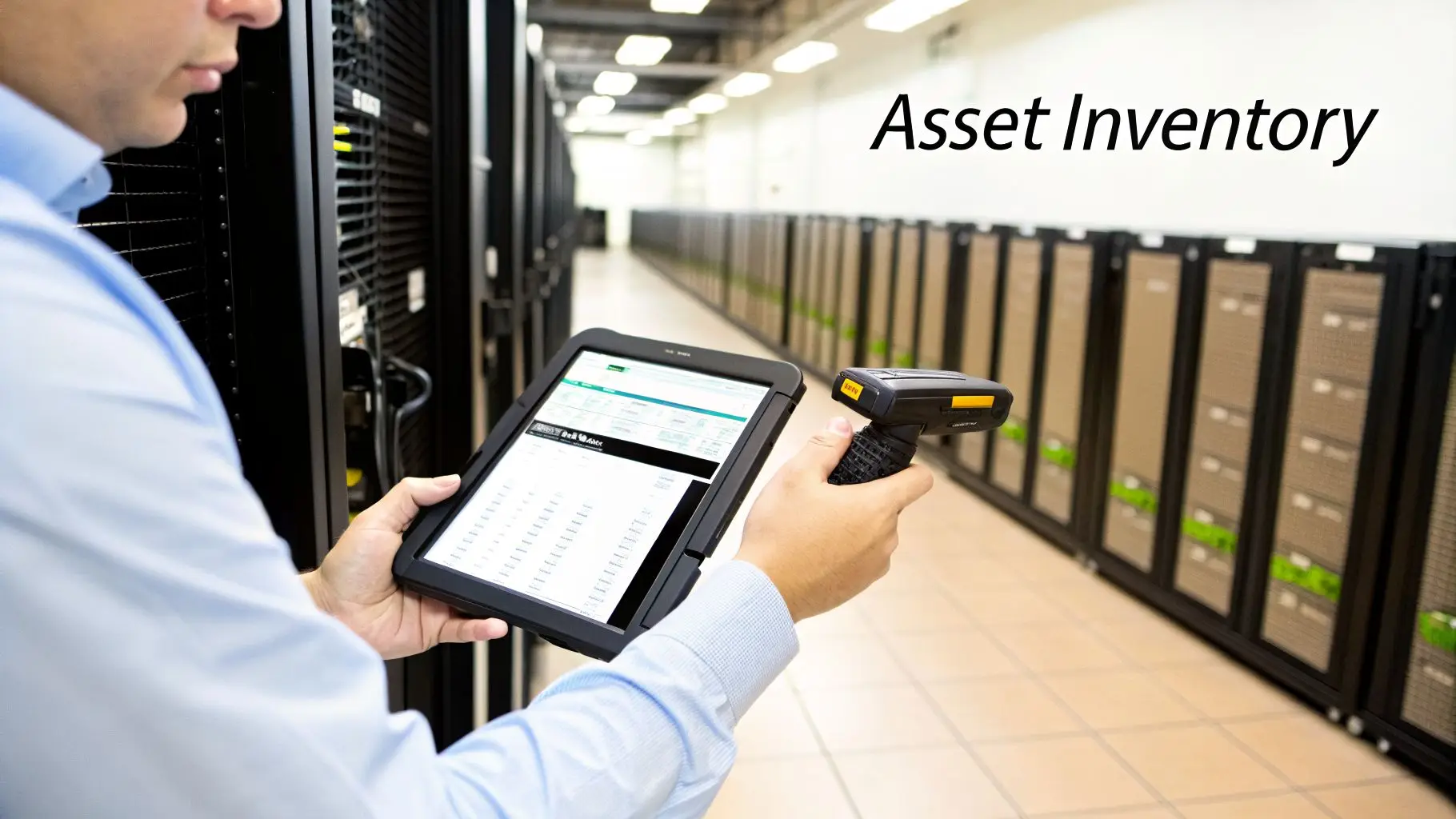
Without an accurate inventory, you're flying blind. You can't make smart calls about data destruction, value recovery, or logistics. It's the difference between a controlled, auditable process and a chaotic, high-risk mess. This applies to all assets, from servers and switches to laboratory equipment disposal for specialized facilities.
What to Capture on Your Master List
The aim here is to build a master list that serves every phase of the project. For each asset—from individual server blades to entire storage arrays—your inventory needs to document a few key details.
Here’s a quick rundown of what you need to record:
- Unique Identifiers: This means both the manufacturer's serial number and any internal asset tags your company uses. These are non-negotiable for proving a clear chain of custody.
- Equipment Specs: Note the make, model, and specific configurations (like RAM, CPU type, and drive capacity). This information is gold when it comes to assessing resale value.
- Physical Condition: Is the asset working, dead on arrival, or damaged? This helps you sort gear for potential remarketing versus heading straight to recycling.
- Location, Location, Location: Document the asset's exact spot in the data center—rack number, U-position, and row. This makes the physical de-installation process go so much faster.
A partner like Reworx Recycling uses integrated tracking systems that can import this data, creating a seamless, transparent record from start to finish. This detailed approach is a key part of how data center equipment disposal in Bowie Maryland can be handled without a single device getting lost. You can learn more by checking out our guide on why IT inventory audits matter before recycling.
Sorting Assets for Security and Value
Once you have your inventory, the next step is to sort the assets. This isn't just about getting organized; it's a strategic move that directly impacts your project's security and financial return.
The real goal of asset classification is to separate the high-value equipment that can be sold from the legacy hardware that needs secure data destruction and sustainable recycling. This simple act of sorting unlocks value and keeps you compliant.
This classification dictates what happens next for each item. Newer, high-value equipment might get flagged for on-site data wiping and refurbishment. Older, obsolete servers full of sensitive data will be tagged for immediate physical shredding.
Real-World Example: A Bowie Firm's Rack Cleanout
Think about a financial services firm in Bowie we worked with on a multi-rack cleanout. Their initial plan was to just log the racks themselves. They quickly realized they were missing crucial details, like the specific serial numbers for each hard drive inside the server chassis.
That oversight could have been a disaster. They would have had no way to prove that every single data-bearing device was properly sanitized. By bringing in an ITAD partner, they put a barcoding system in place right at the point of de-installation. Every server, hard drive, and switch was scanned and logged against their master inventory before it left the building. This gave them a perfect, auditable chain of custody that satisfied their tough compliance rules. Their initial mistake—underestimating the detail required—is a common one, but it got fixed before it became a costly headache.
Making Sure Your Data is Gone for Good: Secure Destruction
Of all the steps in decommissioning a data center, this is the one that keeps IT managers up at night. For businesses in Bowie, Maryland, especially those in the sensitive government contracting and tech sectors, this is where your risk is highest. Your data security duties don't just vanish when a server is powered down—they actually become more intense. A single slip-up here can snowball into a massive data breach, wiping out years of customer trust and bringing on serious regulatory fines.
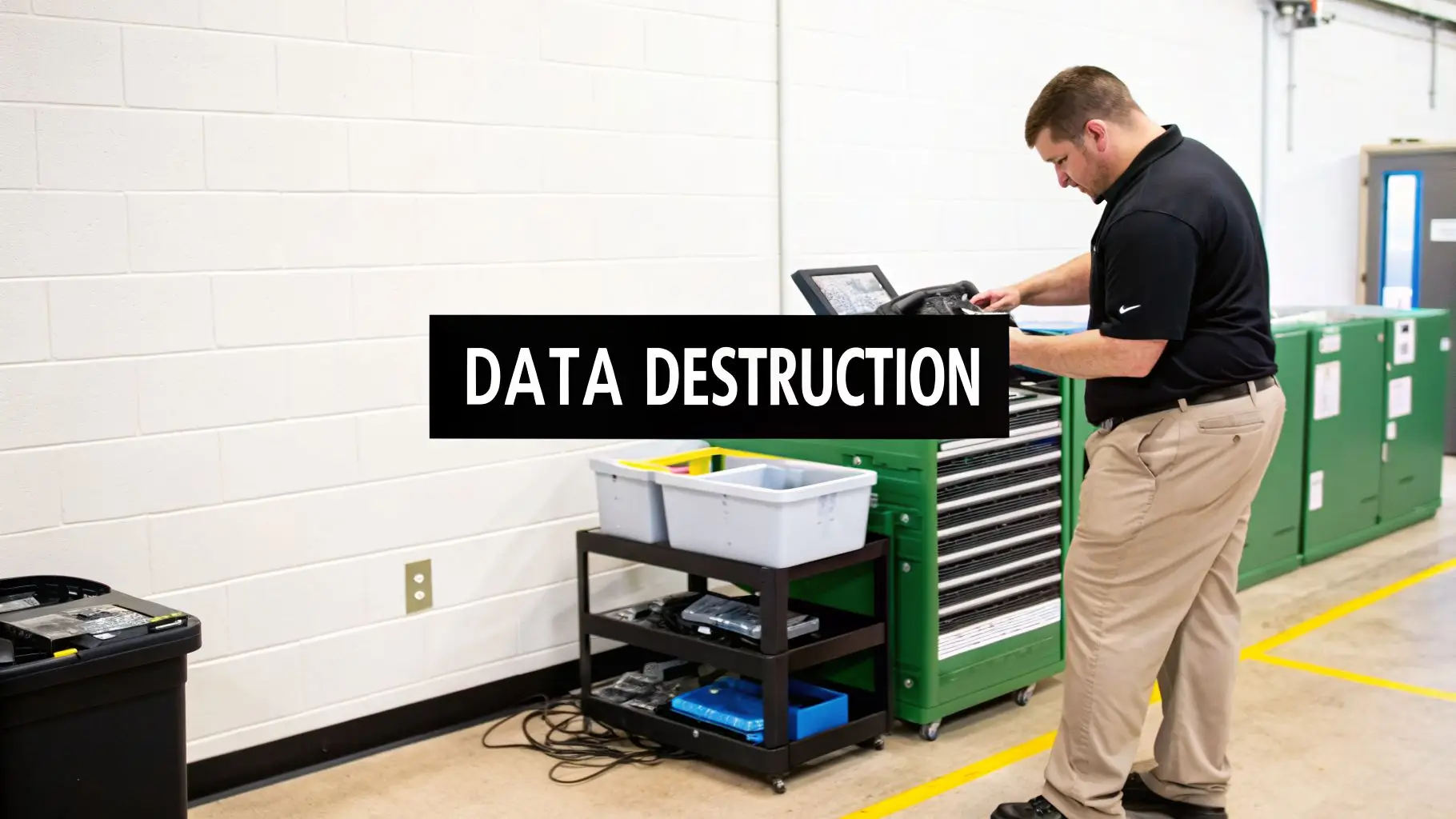
The name of the game is irreversible data destruction. We're not talking about just dragging files to the trash bin. The goal is to make absolutely certain that no scrap of information can ever be pulled from a retired hard drive or storage device. This is why picking the right method—and the right partner—is so critical for secure laptop disposal, computer recycling, and product destruction.
What Are My Data Destruction Options?
Not all destruction methods are the same, and what’s right for one company might not be right for another. Your choice will come down to your security policies, compliance needs, and whether the drives have any potential resale value. Let's break down the main options.
- Data Wiping (Sanitization): This is a software-based method where special programs overwrite every bit of data on a drive with random gibberish, often multiple times. When done to a standard like NIST 800-88, it makes the original data impossible to recover. This is the way to go for newer, working drives you hope to resell to get some value back.
- Degaussing: This technique zaps tapes and some older hard drives with a powerful magnetic field, scrambling the data into oblivion. It’s quick, but it also kills the drive, so this is only for assets you plan on destroying anyway.
- Physical Shredding: This is the most final solution. We feed the drives into an industrial shredder that chews them up into tiny metal fragments. There is zero chance of data recovery. This is the go-to for drives with highly sensitive information or for organizations whose policies demand complete physical destruction.
A certified ITAD partner like Reworx Recycling can walk you through these choices and help you figure out the best fit for each asset based on your risk and budget.
On-Site vs. Off-Site Destruction
Another big decision is where the destruction happens. Each has its own benefits, and the right call usually depends on your internal security rules and logistics.
On-site destruction means we bring a mobile shredding truck or degaussing unit right to your Bowie facility. This gives you the ultimate peace of mind because you can watch the entire process unfold with your own eyes. For many businesses in regulated fields, this is a must-have.
Off-site destruction, on the other hand, involves securely transporting your assets to a certified facility for processing. This is usually the more cost-effective and efficient route for large projects. The key here is a rock-solid chain of custody, complete with locked trucks, vetted drivers, and detailed tracking from your loading dock to our destruction line.
A crucial takeaway for any IT manager is that compliance with standards like HIPAA or SOX doesn't stop at your facility's door. You are responsible for the data until it's verifiably destroyed. That's why every step, including transport, must be rigorously secured.
This is where a partner's certifications really show their value. When you work with a certified company for data center equipment disposal in Bowie Maryland, you know that both their on-site and off-site processes are held to strict, regularly audited standards.
With the data center IT asset disposition market expected to hit USD 27.38 billion by 2033, and the average data breach costing $4.45 million, cutting corners on destruction just isn't an option. You can learn more about these market trends and what they mean for IT leaders.
Ultimately, a partner like Reworx Recycling provides a serialized Certificate of Data Destruction when the job is done. This document is your auditable proof that every single drive was properly destroyed, protecting your Bowie business and satisfying even the toughest compliance auditors. You can get more details on our process by reviewing our guide on secure data destruction services.
Handling Logistics and Maryland's E-Waste Rules
Getting heavy, sensitive IT equipment out of your Bowie facility is more than just booking a truck. This is a precision operation that demands a solid grasp of logistics and Maryland’s specific environmental laws. A single misstep could lead to damaged equipment, a data breach, or serious compliance fines. This part of the process is all about making sure your retired hardware has a secure and legally sound exit.
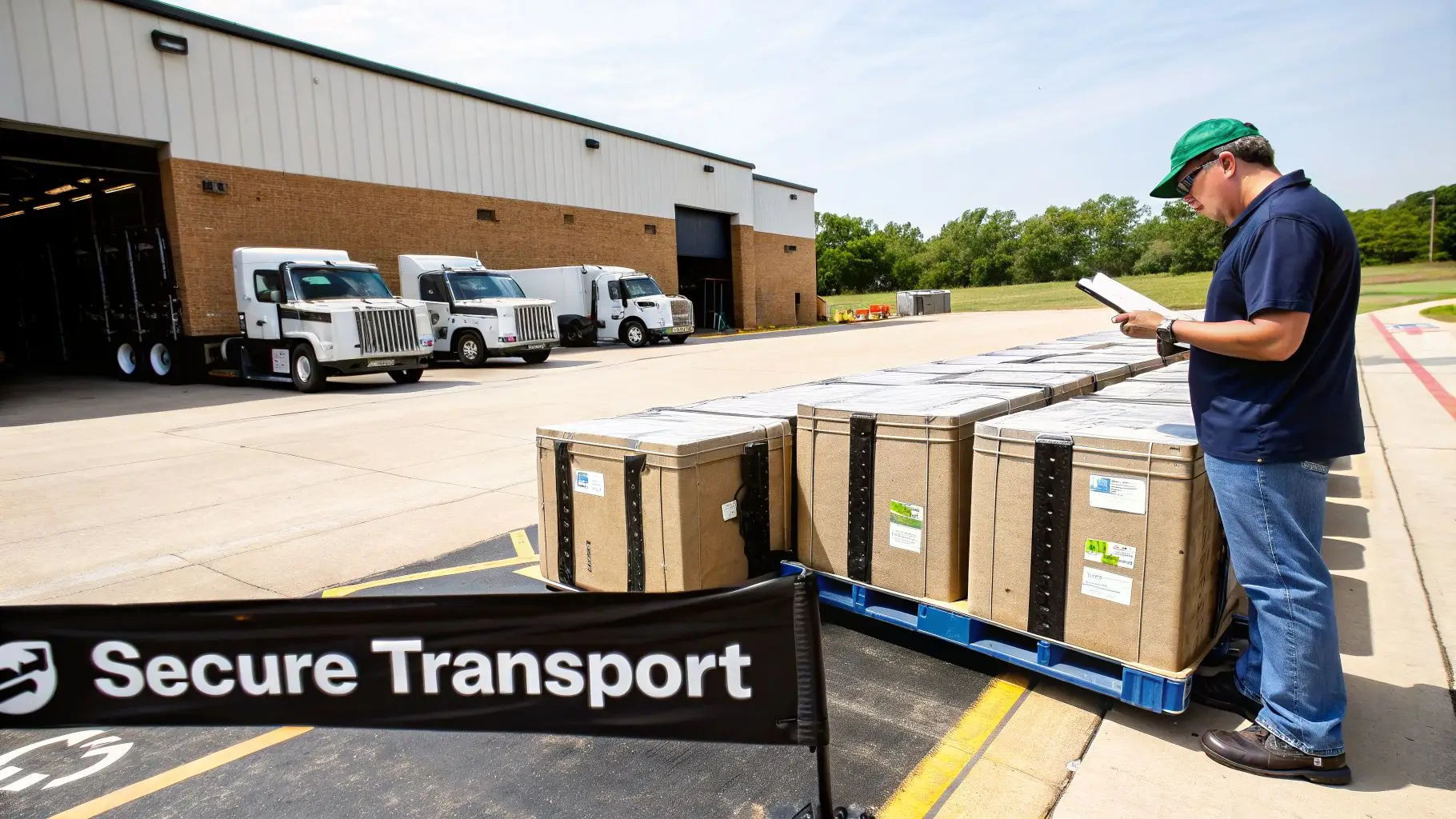
The trip from your data center to a processing facility is one of the riskiest moments in the entire disposal project. It’s when assets are most vulnerable to getting lost, damaged, or even stolen if you don't have professional oversight. A secure chain of custody isn't just a buzzword; it’s a documented, unbroken line of responsibility that has to be maintained from start to finish.
Forging an Unbreakable Chain of Custody
A rock-solid chain of custody starts with that detailed asset inventory you worked so hard on. This manifest is the master key for the whole logistical move. Every pallet, server, and storage device needs to be scanned and checked against this list before it even thinks about getting on a truck.
This is far more than a simple headcount. A professional ITAD partner like Reworx Recycling uses a multi-step verification to make sure nothing slips through the cracks.
- Secure Packing: Assets are carefully packed into locked, sealed containers. We often use specialized server carts for racks and secure, tamper-evident bins for loose hard drives.
- Vetted Transport: Every vehicle is tracked by GPS, and all drivers undergo extensive background checks. This gives you a real-time eye on your assets from your Bowie loading dock right to our secure facility.
- Sealed Shipments: Containers are secured with serialized tags. If a seal is broken before it reaches the destination, that’s an immediate red flag that a security protocol was breached.
Think of the chain of custody as the project's legal and security backbone. It's the auditable trail proving that every single asset you retired was handled responsibly, from the second it left your control until its final disposition. Without it, you have no way to defend yourself if questions about lost data or improper disposal come up.
Staying Compliant with Maryland and Federal E-Waste Laws
Compliance isn't a choice. Both Maryland and the federal government have strict e-waste rules. Specifically, Maryland's Environment Article §§9-1727 to 9-1730 puts the responsibility squarely on businesses to manage their old electronics correctly. These state laws work alongside federal guidelines from the Environmental Protection Agency (EPA), which classifies many electronic components as hazardous waste.
Getting this wrong can lead to huge fines and a major hit to your reputation. This is exactly why partnering with an R2v3 certified recycler is so crucial for any company handling data center equipment disposal in Bowie Maryland. The R2v3 certification is your guarantee that a partner meets the highest global standards for environmental safety, data security, and downstream vendor accountability. For a deeper look at statewide rules, you can learn more about Maryland electronics recycling and see how a certified partner keeps you compliant.
The global market for data center decommissioning services is expected to blow past $15 billion by 2033. When you consider that worldwide e-waste reached 62 million tonnes in 2022 with only 17.4% being properly recycled, it's clear why partnering with R2-certified providers like Reworx Recycling is a must. You can read more on these global market trends to grasp the growing scale of this challenge.
Reworx Recycling’s nationwide logistics network takes the complexity out of this entire process. We provide a seamless, legally sound solution that protects your business and honors your commitment to environmental stewardship.
A data center decommissioning doesn't just have to be another expense on your company’s balance sheet. When you approach IT Asset Disposition (ITAD) strategically, what looks like a logistical cost can actually generate a surprising financial return. The trick is to stop seeing old hardware as junk and start seeing it as a hidden asset.
There's a strong secondary market for used servers, networking gear, and storage hardware, and a good ITAD partner knows how to tap into it. They'll handle the testing, grading, and remarketing to get you the best possible return on your investment. But choosing the right partner is about more than just the money.
Turning Retired Hardware into Revenue
The basic idea behind value recovery is straightforward. Your retired equipment, especially enterprise-grade hardware that's only a few years old, still has significant value. Instead of paying someone to shred and recycle it, a certified partner can refurbish that gear and sell it through their network.
This is where a partner like Reworx Recycling makes a difference. Our entire process is built to pull the maximum value from every single asset that still has life in it. We take care of all the details:
- Testing and Grading: Every component is carefully tested to figure out its functional condition and cosmetic state.
- Market-Based Pricing: We use real-time market data to price your assets, making sure you get a fair and competitive return.
- Secure Refurbishment: All devices go through certified data wiping before they are ever prepped for resale.
The market for IT equipment disposal is projected to hit $1,257.6 million by 2025. With server lifespans getting shorter and nearly 90% of large companies now requiring certified disposal, a professional ITAD provider is the key to turning those old assets into new revenue. You could be looking at recovering hundreds of dollars per server. You can find more on these market shifts and how they're changing IT strategies.
Finding the Right ITAD Partner in the Bowie Area
Choosing the right team for data center equipment disposal in Bowie Maryland is a decision you need to get right. Your vetting process should be meticulous, covering everything from certifications and insurance to their reporting process. It's all about protecting your organization.
Here’s a quick checklist of things you should absolutely demand from any potential ITAD vendor:
- Key Certifications: Don't just take their word for it. Ask to see current R2v3 and NAID AAA certifications. R2v3 is the gold standard for responsible electronics recycling, while NAID AAA is the seal of approval for a vendor's data destruction process.
- Solid Insurance: Your partner has to carry liability insurance that specifically covers data breaches and environmental incidents. This is your shield against any downstream risk.
- Clear Reporting: A real pro will provide serialized reports for everything. That means a Certificate of Data Destruction and a Certificate of Recycling, giving you a perfect, auditable paper trail for every asset.
If a potential partner seems hesitant to hand over this documentation, walk away. These aren't nice-to-haves; they are the foundation of a secure, compliant, and trustworthy partnership.
The Social Enterprise Advantage
Working with a social enterprise like Reworx Recycling brings a completely different element to your corporate social responsibility (CSR) goals. While a standard ITAD vendor is focused purely on the financial return, our donation-based recycling mission goes much deeper—right into the community.
When you choose Reworx, your decommissioning project directly funds social good. The money from remarketing your assets, along with some of the refurbished equipment itself, goes into our programs that support workforce development and help bridge the digital divide for local families and students.
This approach turns a routine operational task into a powerful story about community impact. It shows a real commitment to sustainability and social equity—a story that connects with your employees, your customers, and your stakeholders. You're not just getting rid of old equipment responsibly; you're creating opportunities and making your own community stronger.
Common Questions About Data Center Disposal in Bowie
If you're an IT manager or business owner in Bowie, tackling a data center decommissioning project brings a lot of questions to the surface. You're trying to protect sensitive data, follow environmental laws, and make a smart financial decision all at once.
Getting straightforward answers is the first step to a successful project. Let's walk through some of the most common questions we hear from businesses right here in Maryland.
What Kind of Equipment Can Be Recycled?
Many people think "data center equipment" just means servers and hard drives. But a full-scale decommissioning project involves so much more, and your partner needs to be ready for all of it.
A truly comprehensive electronics recycling service covers the entire ecosystem of your data center. This includes:
- Core IT Hardware: This is the obvious stuff—servers of all kinds (rack-mounted, blade, tower), storage area networks (SANs), and network-attached storage (NAS) units. This also includes medical equipment disposal for healthcare facilities.
- Networking Gear: Switches, routers, firewalls, and load balancers that keep your data flowing.
- Infrastructure Components: Server racks, cabinets, uninterruptible power supplies (UPS), power distribution units (PDUs), and all the associated cabling.
- Peripherals and Media: Don't forget the keyboards, monitors, and stacks of backup tapes.
Basically, if it was part of your data center, a full-service ITAD provider should have a documented process for it. This is what a successful data center equipment disposal in Bowie Maryland really looks like.
How Do I Know My Data Is Truly Destroyed?
This is the big one. Your company’s reputation—and your legal compliance—hinges on this answer. Complete certainty doesn't come from a handshake; it comes from a certified process with an auditable paper trail.
There are two primary, industry-standard methods for secure data destruction:
- Software-Based Wiping: Using specialized software that follows NIST 800-88 standards, every single sector of a drive is overwritten with random data. This renders the original information permanently unrecoverable and is a great option for newer drives that can be refurbished and resold.
- Physical Shredding: This is the final answer for data destruction. Drives are fed into an industrial shredder that grinds them into tiny, unrecognizable fragments of metal. There is zero possibility of data recovery.
After either process, you should always receive a serialized Certificate of Data Destruction. This is your legal proof, an official record confirming that each asset was sanitized according to industry best practices. Without this document, you can't prove you met your compliance obligations.
The most important takeaway is that data security is a documented process, not a verbal promise. A professional partner provides a clear paper trail for every single data-bearing device, giving you the auditable proof needed to satisfy any compliance or legal inquiry.
What Does the Process Typically Cost?
The cost of data center disposal isn't one-size-fits-all. It can vary significantly based on the volume and type of equipment you have, its potential resale value, and the logistics of the project.
For example, if you're retiring relatively new equipment, the value recovered through remarketing can often offset—or even exceed—the cost of services. In those scenarios, your decommissioning project can actually generate revenue. On the other hand, a project with mostly older, obsolete hardware will be a service-based cost. For a deeper look at what to expect, you can check out our frequently asked questions page.
Why Should I Partner with a Social Enterprise?
Choosing a social enterprise like Reworx Recycling adds a powerful layer of social impact to what is normally just an operational task. While any certified recycler can handle the technical side, our model extends the value of your retired assets directly into the community.
When you work with us, the value recovered from your equipment helps fund our mission. We refurbish usable devices and get them into the hands of students, families, and nonprofits that need them, helping to bridge the digital divide. It transforms a standard business process into a meaningful act of corporate social responsibility that resonates with your employees, your customers, and your community.
Ready to turn your retired IT assets into an opportunity? Partner with Reworx Recycling for secure, compliant, and socially responsible equipment disposal. Contact us today to donate your old equipment, schedule a pickup, or learn how our corporate donation programs can benefit your business and the Bowie community.