As Fishers cements its place in Indiana's booming tech corridor, the lifecycle of IT equipment has become a critical, practical issue for local businesses. A proper data center decommissioning in Fishers, Indiana isn't just a spring cleaning; it's a careful process that involves managing risk, meeting regulations, and embracing corporate social responsibility.
Decommissioning Your Data Center in the Fishers Tech Corridor
With the explosive growth of tech in Fishers, from startups to enterprise-level operations, hardware is constantly being refreshed, replaced, and retired. Sooner or later, that old gear has to go somewhere, and that's where a data center decommissioning project begins. For any IT manager or business owner, it can feel like a massive undertaking.
You're right to be cautious. The process is full of potential tripwires, from data security breaches to fines for environmental non-compliance. But with a clear plan, you can navigate it smoothly and even recover value from your old assets.
This is about much more than just unplugging servers and calling a junk hauler. It's a detailed, step-by-step procedure designed to protect your most critical asset—your data—while ensuring every last component is handled responsibly. A successful project moves beyond simple disposal into a comprehensive IT Asset Disposition (ITAD) strategy.
Understanding the Modern Decommissioning Process
Today's decommissioning projects are all about precision and accountability. It's a world away from the old days of just unplugging machines. The focus now is on creating a documented, auditable trail that proves every asset was managed according to strict security and environmental rules. For any business in a tech-focused city like Fishers, showing this level of care is vital for protecting your brand and demonstrating your commitment to sustainable practices.
The entire process can be broken down into three main phases. This flowchart gives you a high-level look at the essential steps.
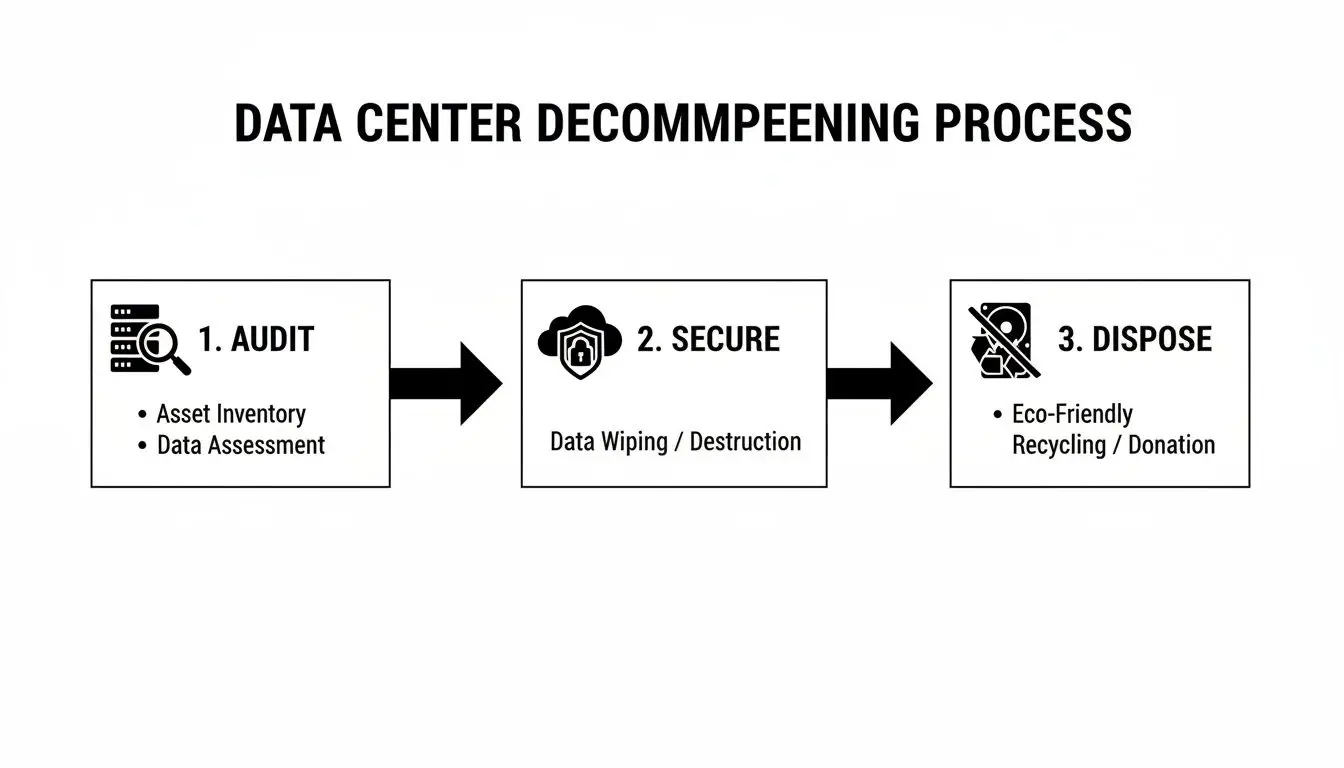
As you can see, a successful project is always built on a foundation of careful auditing, followed by strict security measures, and finished with responsible disposal or resale.
To give you a clearer picture, here’s how these phases typically break down in a real-world project.
Key Phases of a Fishers Data Center Decommissioning Project
| Phase | Primary Goal | Key Activities |
|---|---|---|
| 1. Planning & Audit | Create a complete project plan and inventory. | Project scoping, on-site inventory audit, asset tagging, defining security needs, and setting the timeline. |
| 2. Secure De-installation | Safely remove assets while protecting data. | Physical disconnection of hardware, secure data destruction (on-site or off-site), and packing for transport. |
| 3. Logistics & Disposition | Responsibly process all assets. | Secure transport to a certified facility, sorting for value recovery, sustainable recycling, or donation. |
Each phase requires a unique set of skills and a sharp eye for detail to ensure nothing slips through the cracks.
A Growing Market Reflects a Critical Need
The demand for professional decommissioning isn't just a local trend. The global market for these services is growing fast, jumping from USD 12.12 billion to USD 12.95 billion in 2025 alone. This shows just how seriously companies are taking end-of-life asset management.
For businesses in the Fishers area—where giants like Amazon and Google have announced huge data center investments—the message is clear. As these massive facilities age, the need for certified decommissioning partners is only going to grow.
For a Fishers-based company, partnering with a certified expert isn't just a best practice; it's a strategic necessity. A partner like Reworx Recycling ensures that every stage, from the initial audit to final reporting, is handled with the precision and social responsibility that stakeholders now expect. This transforms a complex task into a testament to your company's commitment to corporate citizenship.
Building Your Decommissioning Blueprint
Before you even think about unplugging a single server in your Fishers facility, the real work begins. A successful data center decommissioning is won or lost in the planning phase. This is where you draw up the project's blueprint, which will be the deciding factor between a smooth, predictable process and a chaotic, costly mess. Getting this part right prevents expensive surprises later on.
First things first, you need to get a handle on the project's scale. Is this a simple hardware refresh where you're just retiring a single server rack? Are you clearing out an entire server room after moving to the cloud? Or is this the big one—vacating a complete data center facility? Your answer here will shape every single decision that follows.
A smaller project might just be a task for your internal IT team, but a full-facility cleanout is an all-hands-on-deck effort that needs a dedicated project team.
Assembling Your Internal Stakeholders
A decommissioning project never happens in a vacuum. It’s a team sport that needs input and approval from several different departments. To get started on the right foot, your core team should have someone from:
- IT Department: As the asset owners, they know the hardware inside and out, from configurations and data sensitivity to all the technical dependencies.
- Facilities Management: This team is your go-to for the physical site. They understand the building's power, cooling, and structural limits when it comes time to move heavy equipment.
- Finance Department: They need a seat at the table for budgeting, tracking costs, and handling the financial reporting for any assets you end up reselling.
- Legal & Compliance: Your legal team provides the guardrails, offering guidance on data privacy laws, contractual obligations, and making sure the entire process is legally sound.
Getting these key people involved from day one ensures every angle is covered and helps you avoid hitting last-minute roadblocks. A collaborative start is a strong start.
Conducting a Preliminary Asset Audit
You can’t create a realistic budget or timeline until you know exactly what you’re working with. This is where a preliminary asset audit comes in. It gives you a high-level count of the equipment you plan to decommission. Don't worry about capturing every single serial number just yet; the goal here is a solid estimate of the volume and types of assets.
You'll want to get a rough count of the major categories, including:
- Servers (rack-mounted, blade, and standalone)
- Storage arrays (like SANs and NAS)
- Networking gear (switches, routers, firewalls)
- Rack infrastructure (PDUs, KVM switches)
- Cabling and any other miscellaneous peripherals
This initial count is absolutely fundamental for getting a ballpark idea of labor needs, logistics, and data destruction costs. For a more detailed guide on what to look for, you can use a professional server decommissioning checklist to make sure nothing gets missed.
Bringing in a partner like Reworx Recycling at this stage can provide immediate clarity. Our team can jump in and help with this preliminary audit, offering expert insight on how to categorize assets and what their potential disposition paths look like—which is crucial for an accurate budget.
Budgeting and Timeline Development
With a clear scope and a preliminary inventory in hand, you can start putting together a realistic budget. The obvious costs are labor for de-racking, secure transport logistics, and certified data destruction. But don’t forget to look at the other side of the equation: potential revenue. Newer or in-demand equipment can have significant resale value, which can offset a huge portion of your project costs.
At the same time, you need to map out a project timeline that lines up with your bigger business goals. If the decommission is tied to a cloud migration, your timeline has to sync up perfectly with the go-live date. If it’s because of a facility closure, everything needs to align with your lease termination.
By creating this detailed blueprint, your Fishers data center decommissioning goes from an intimidating challenge to a manageable, well-defined process. This level of planning not only guarantees a smoother execution but also sets your company up to maximize value recovery and meet its corporate responsibility goals right from the start.
Securing Your Data and Managing Assets
Once your plan is set, it's time to get your hands dirty. This is where the project really comes to life, moving from spreadsheets to the data center floor. The focus now shifts to two of the most critical parts of any data center decommissioning in Fishers, Indiana: locking down your assets and making sure your data is gone for good. Getting this right isn't just about ticking boxes; it's about protecting your business and having a transparent, auditable process from start to finish.
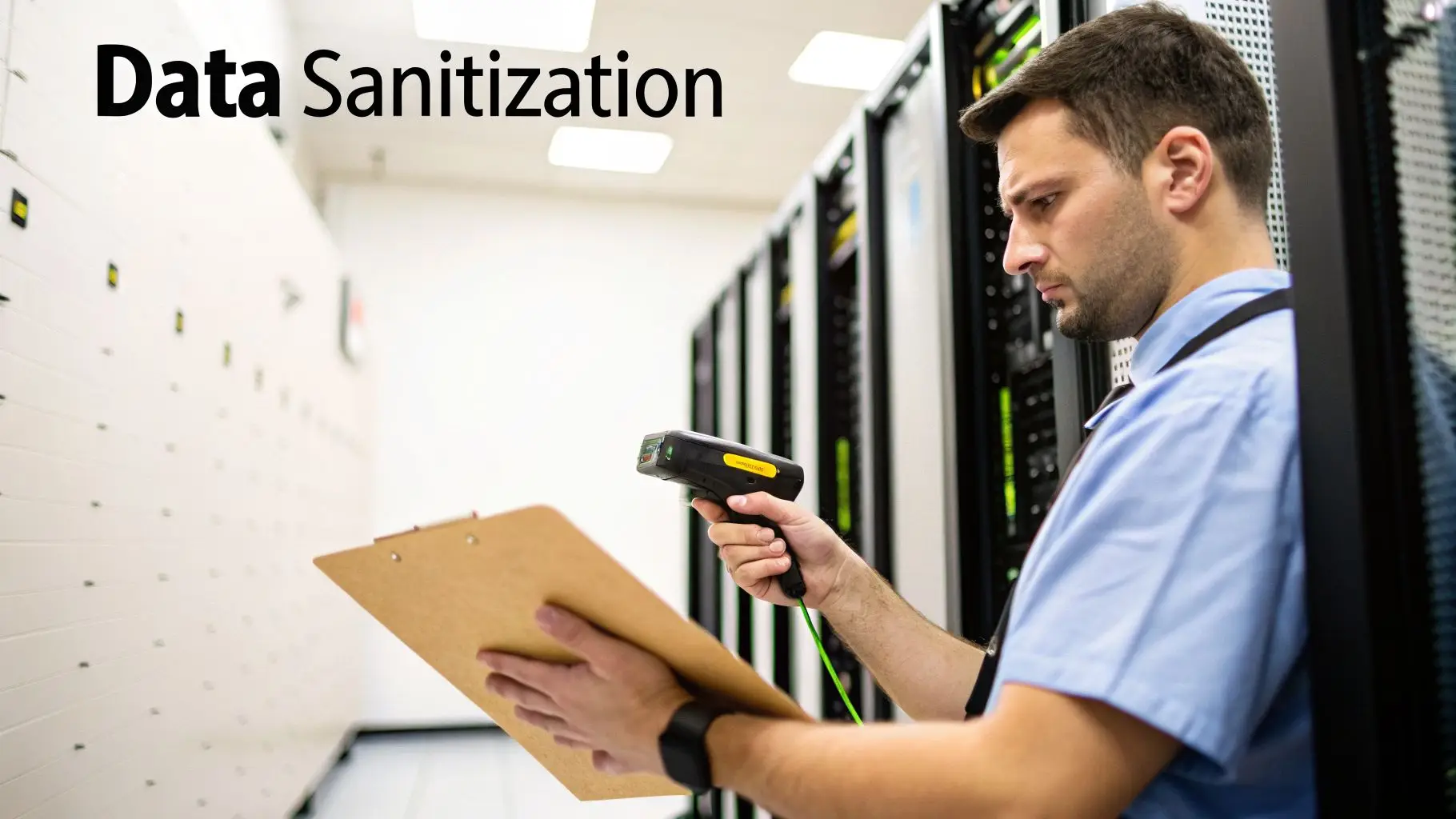
This is where your initial audit gets serious. We're talking about tagging and tracking every single piece of equipment—servers, storage arrays, switches, and even individual hard drives. Using barcode or RFID scanners to log serial numbers and your own asset tags is the best way to create that crucial digital paper trail.
This process establishes a solid chain of custody. Think of it as a logbook that follows each asset from the moment it leaves your racks until its final destination, whether it's being resold, donated, or recycled.
Choosing the Right Data Destruction Method
With every asset accounted for, the spotlight turns to data security. You can't just drag files to the trash or reformat a drive and call it a day. That data is still easily recoverable. Professional secure data destruction is a must, and it typically comes in three flavors. The right choice depends on your data's sensitivity, your industry's compliance rules, and whether the hardware has any resale value.
- Software-Based Wiping: This approach uses specialized software to overwrite every bit of data on a drive with random characters, usually in several passes. It's a great option for newer, working hard drives that you hope to resell or reuse.
- Degaussing: A degausser uses an incredibly powerful magnetic field to instantly scramble the data on magnetic media like traditional hard disk drives (HDDs) and backup tapes. The process renders the drive completely inoperable, so it’s perfect for older media that needs to be secured but has no aftermarket value.
- Physical Shredding: When you need the absolute highest level of security, nothing beats physical destruction. Commercial-grade shredders grind hard drives, solid-state drives (SSDs), and other media into tiny metal fragments, making data recovery physically impossible.
For Fishers-area businesses handling sensitive information, especially those governed by HIPAA or financial regulations, we often find a hybrid approach works best, matching the destruction method to the media type and data sensitivity.
Compliance and Proof of Destruction
Following recognized industry standards is how you prove you did everything by the book. The NIST 800-88 Guidelines for Media Sanitization is the framework most organizations, including ours, rely on. It gives clear instructions for clearing, purging, and destroying data based on how confidential it is. Sticking to these guidelines makes your process bulletproof in an audit.
When the job is done, your ITAD partner must issue a Certificate of Data Destruction. This is a legal document that serves as your official proof, listing every serialized drive that was sanitized, the method used, and the date it was completed.
For a company in Fishers, this certificate is more than just paperwork—it’s a shield. It protects your reputation, demonstrates your commitment to customer privacy, and provides an ironclad defense in the event of a regulatory inquiry. It’s an essential final step in the data security process.
Working with Reworx Recycling, our process is built around certified compliance and transparency, providing the peace of mind that comes from knowing every gigabyte of data is professionally handled.
This level of diligence is becoming more important every day. Just look at the recent news from Starke County, Indiana, where local resistance led to a one-year moratorium on new data center construction. Residents are becoming more aware of the long-term impact of these facilities, including how they are eventually decommissioned. This proves that having a certified, responsible end-of-life plan isn't just a good idea—it's a modern necessity.
Ultimately, secure data destruction comes down to trust. By working with a certified expert like Reworx Recycling, you ensure every last gigabyte of your sensitive data is handled with the highest security standards, giving you, your stakeholders, and your customers total confidence.
Executing the Physical Decommissioning and ITAD
Once your plan is solid and you know how you'll handle data security, it's time to get hands-on. This is where the physical work of decommissioning and IT Asset Disposition (ITAD) begins—the moment your careful planning turns into real action on the data center floor. For any business tackling a data center decommissioning in Fishers, Indiana, this phase is all about precision, safety, and getting the most out of every piece of hardware.
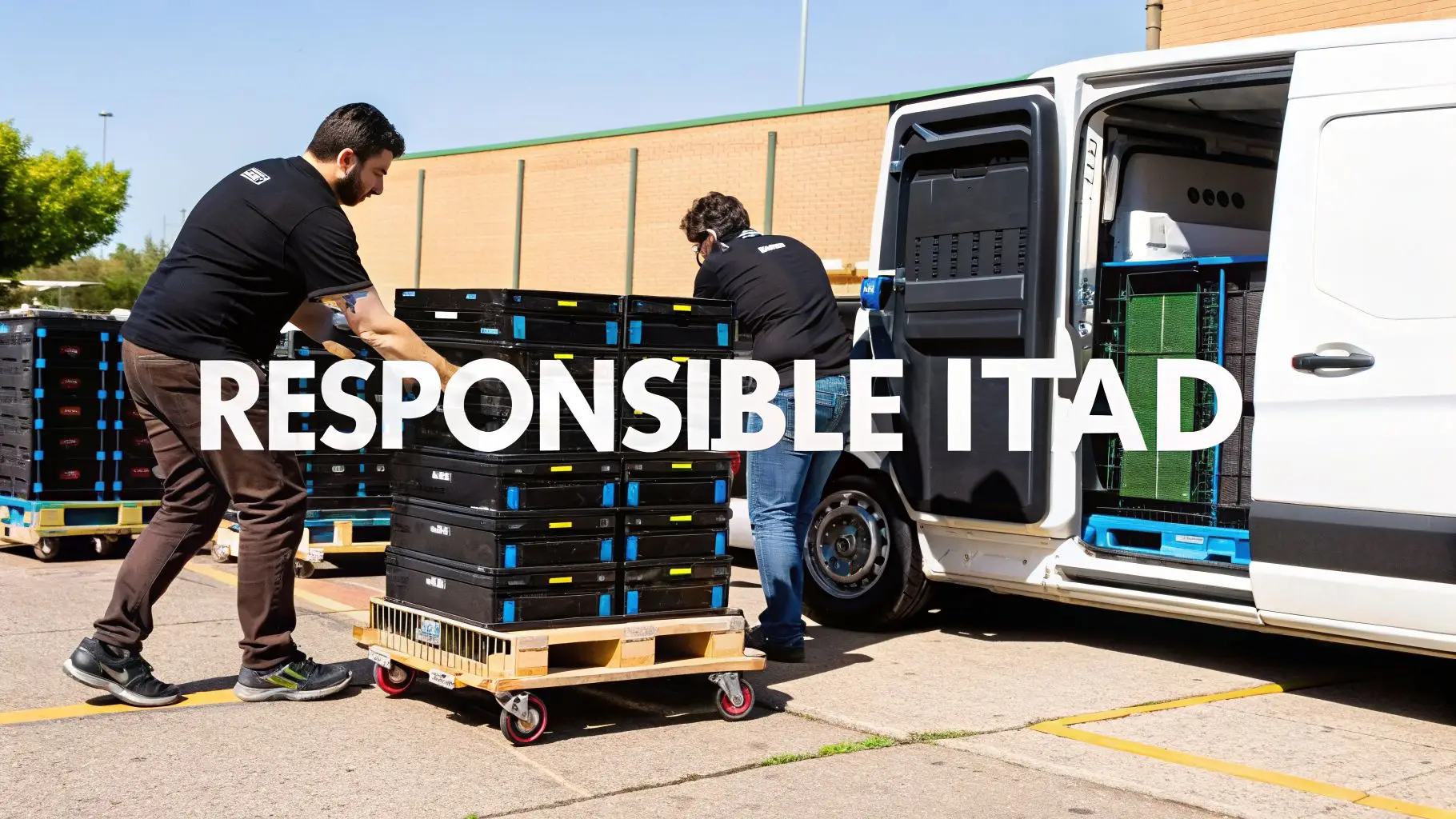
The process kicks off with the methodical de-racking of servers, network gear, and storage arrays. This isn't a chaotic free-for-all; it's a careful, systematic job. Your team will follow the inventory list you built, disconnecting, labeling, and staging each item. Honestly, managing the tangled mess of power and network cables is often the most tedious part, so patience and a good pair of cable snips are your best friends here.
Staging and Secure Transport Logistics
After the equipment is de-racked and every piece is accounted for, the next step is staging it for secure transport. This means palletizing the assets, shrink-wrapping them, and getting them ready for pickup. Make sure every pallet is clearly labeled and matches your chain-of-custody documentation so nothing gets misplaced along the way.
Picking the right logistics partner is absolutely crucial. You need a provider with proven experience in moving sensitive electronics. This should include:
- Using sealed, GPS-tracked trucks to watch the shipment from your door to its final destination.
- Employing background-checked drivers who understand secure handling protocols.
- Providing detailed shipping manifests that line up perfectly with your asset inventory.
This level of security isn't just a "nice-to-have"—it's a necessity. The second that hardware leaves your building, it's at its most vulnerable. Professional logistics help close that security gap.
Sorting Assets for Value Recovery and Recycling
Once the equipment reaches a certified facility, the real ITAD work starts. Every single item gets sorted and evaluated. This is the decision point where each asset is sent down one of three paths: remarketing, donation-based recycling, or product destruction.
Identifying Assets for Resale: Don't assume all your old equipment is just junk. Newer servers (less than three to five years old), enterprise-grade networking switches, and high-capacity storage arrays can still have significant market value. A good ITAD partner will test and grade these assets to figure out their condition and what they might sell for. The money you get back can make a real dent in the project's overall cost.
Sustainable Recycling: For hardware that's too old, broken, or obsolete for resale, responsible recycling is the only ethical choice. Electronics are full of hazardous materials like lead, mercury, and cadmium, which can do serious environmental harm if they wind up in a landfill. Certified e-waste recycling guarantees these materials are managed in full compliance with EPA and Indiana state regulations.
Choosing a partner for this final step defines your company's environmental legacy. A social enterprise like Reworx Recycling not only guarantees compliant, environmentally sound disposal but also redirects reusable technology back into the community. This approach turns your decommissioned assets into a powerful tool for social good, supporting digital inclusion and workforce development.
This isn't a small-scale problem. For example, think about the planned AI data center boom in Northern Indiana. These new facilities are projected to use more power by 2030 than all 6.8 million Hoosier homes combined. When those massive sites eventually reach their end-of-life, the sheer volume of equipment will be staggering, making scalable ITAD partnerships more critical than ever.
By focusing on a meticulous process and a clear ITAD strategy, your Fishers business can navigate the physical decommissioning with confidence. You’ll not only protect your data and the environment but also maximize your return and turn a necessary project into a positive force for the community.
Finalizing Compliance with Auditable Reporting
So, the last server has left your Fishers data center. You might think the project is over, but we're not quite at the finish line yet. The final, and arguably most important, step is gathering the paperwork that proves you handled every single asset correctly.
This is all about creating an airtight audit trail. It’s the documentation that confirms you’ve met all compliance standards and disposed of your IT assets responsibly. Think of it as your ultimate proof of corporate due diligence and your best defense in any potential audit.
At the heart of it all is your chain-of-custody documentation. This is the non-negotiable logbook that follows each piece of equipment—tracked by its unique serial number—from the moment it leaves your facility to its final destination, whether it's resale, donation, or recycling. There can be no gaps in this story.
The Essential Reports You Need
For any decommissioning project in Fishers, a reputable ITAD partner will deliver a full suite of reports. These aren't just nice-to-haves; they are essential for satisfying everyone from your IT manager to the CFO and your sustainability team. Your final reporting package should always include these key documents:
- Certificate of Data Destruction: This is your proof that every data-bearing device was sanitized according to NIST 800-88 standards. It will list every single hard drive and SSD by serial number, along with the date and method used for destruction.
- Certificate of Recycling: This document verifies that any non-reusable assets were processed in an environmentally sound way, following both EPA and Indiana state regulations. It’s your guarantee that hazardous e-waste stayed out of the landfill.
- Detailed Settlement Reports: If any of your equipment had resale value, this report gives you a transparent financial breakdown. It should clearly itemize each asset sold, its final sale price, and the net revenue coming back to your organization.
These documents work together to tell a powerful story of due diligence. They prove you protected sensitive data, followed environmental laws, and managed company assets with financial care. At Reworx Recycling, providing this level of transparent reporting is a standard part of every project we manage.
Why Transparent Reporting Matters in Fishers
The tech scene in Fishers and the surrounding areas is booming, which means local and state regulators are paying much closer attention to how companies manage their environmental responsibilities. We’re seeing a major industry shift right here in our backyard, like the partnership between Fishers-based ReElement Technologies and ERI to recover rare earth elements from electronics.
This intense focus on creating a circular economy makes responsible end-of-life management more visible than ever. Your documentation is what proves you’re not just compliant, but a forward-thinking participant in this movement. To give you a clearer picture of what this looks like, we offer resources like our destruction certificate template so you can see what thorough reporting entails.
Sometimes, a decommissioning project goes global when it comes to remarketing assets. In those cases, understanding the role of an Importer of Record becomes critical for staying compliant. This just highlights how complex the chain of custody can get and why you need a partner who gets the nuances of both domestic and international compliance.
When you work with Reworx Recycling for your data center decommissioning, you get a complete, auditable reporting package that leaves no room for doubt. Our social enterprise model adds another layer of value—your project doesn't just meet compliance standards, it also directly supports local community initiatives. For businesses in Fishers and the greater Indianapolis area, this turns a complex operational headache into a powerful story of good corporate citizenship.
Questions We Hear All the Time About Data Center Decommissioning
Even with the best-laid plans, a project as complex as a data center decommissioning is bound to bring up questions. For IT managers and business owners here in Fishers, getting straight answers is the key to moving forward with confidence. Let’s tackle some of the most common questions we hear, drawing from our experience in the field.
What Are the Biggest Risks We Should Be Worried About?
Without a doubt, the two things that should be at the top of your list are data breaches from improperly sanitized media and environmental non-compliance from mishandling e-waste. A single lost hard drive with sensitive company or customer data can trigger massive fines, legal headaches, and cause damage to your reputation that’s hard to come back from.
Likewise, discovering your retired assets were illegally dumped in a landfill can bring on serious regulatory penalties and a PR nightmare. The only real way to protect yourself is by working with a certified partner like Reworx Recycling who provides a fully auditable chain of custody. This means you get a Certificate of Data Destruction and a Certificate of Recycling—your official proof that you did everything by the book.
How Can We Get Some Money Back from Our Old IT Gear?
This is where value recovery, or asset remarketing, comes into play. It’s a core part of any smart ITAD strategy and involves finding and reselling the functional equipment that still has some life left in it. We're typically talking about newer-generation servers (usually less than five years old), enterprise-grade networking equipment, and high-capacity storage arrays.
An experienced ITAD partner already has the sales channels to market these assets where they’ll get the best price. They take care of the testing, grading, data wiping, and logistics, turning what was once just surplus hardware into a revenue stream. This can go a long way in offsetting the costs of the decommissioning project itself. At Reworx Recycling, we've gotten pretty good at spotting this hidden value and managing the whole resale process for our clients.
Why Should We Choose a Social Enterprise for Our ITAD Project?
Partnering with a social enterprise like Reworx Recycling for your data center decommissioning in Fishers, Indiana brings benefits that you just don't get from a standard recycler. A traditional for-profit company is focused on one thing: profit. A social enterprise has a dual mission: delivering exceptional ITAD services while also creating a real, positive impact in the community.
When you choose a partner with a social mission, your end-of-life assets are transformed from a simple cost center into a powerful statement about your company's values. It’s a direct way to bolster your ESG (Environmental, Social, and Governance) profile.
Here’s what that actually looks like when you work with us:
- Environmental Responsibility: We guarantee that 100% of your non-reusable assets are recycled right here in the U.S. in full compliance with EPA and Indiana state regulations. No exceptions.
- Community Support: Good, functional equipment that doesn't get sold is refurbished and then donated to local nonprofits and schools in our area, helping to bridge the digital divide.
- Workforce Development: Our operations create valuable training programs and steady jobs, contributing directly to the local economy.
This approach means your project doesn't just end when you get a compliance certificate. It creates a positive ripple effect, turning old technology into a resource that helps your own community. That’s a powerful story you can share with customers, employees, and stakeholders.
Is It Better to Destroy Data On-Site or Off-Site?
The honest answer is: it depends on your organization’s security policies and how much risk you're comfortable with.
- On-site destruction is exactly what it sounds like. We bring a mobile shredding truck directly to your facility. You can literally watch your hard drives, SSDs, and backup tapes get physically destroyed, which gives a lot of people ultimate peace of mind. This is often the go-to for organizations in healthcare, finance, or government.
- Off-site destruction involves securely packing and transporting your assets in GPS-tracked vehicles to a certified facility for destruction. As long as you’re working with a trusted partner who maintains a strict chain of custody from door to door, this is a highly secure and more cost-effective option.
Either way you go, a certified vendor like Reworx Recycling will provide a Certificate of Data Destruction that confirms every single serialized drive has been destroyed. We can walk you through the pros and cons to help you decide which option makes the most sense for your security needs and your budget.
Ready to turn your decommissioning project into a story of security, compliance, and community impact? Contact Reworx Recycling today to schedule a pickup or learn how our donation-based social enterprise model can benefit your Fishers business. Visit our blog for more insights: https://www.reworxrecycling.org/category/recycling-blog