Reverse logistics has already reached a scale that changes how IT leaders should think about retired equipment. One market assessment estimated the global reverse logistics market at USD 954.9 billion in 2026, with a projection of USD 3.19 trillion by 2033, according to Grand View Research's reverse logistics market analysis. For a sustainability director, that figure isn't just about online returns. It reflects the expanding movement of leased laptops, surplus servers, decommissioned data center hardware, medical devices, and other assets back into repair, resale, donation, or material recovery channels.
In 2026, reverse logistics is best understood as a controlled value-recovery system. The important question isn't only how quickly a truck collects equipment. It's whether every device reaches the safest, most valuable, and most responsible next destination.
What Reverse Logistics Really Means in 2026
Traditional returns handling usually begins when a customer sends a product back. Modern reverse logistics begins much earlier, often when an IT department plans an office refresh, a school retires student devices, or a data center removes servers from production. The flow includes collection, inspection, grading, sorting, processing, and recovery, with a documented decision at each stage.
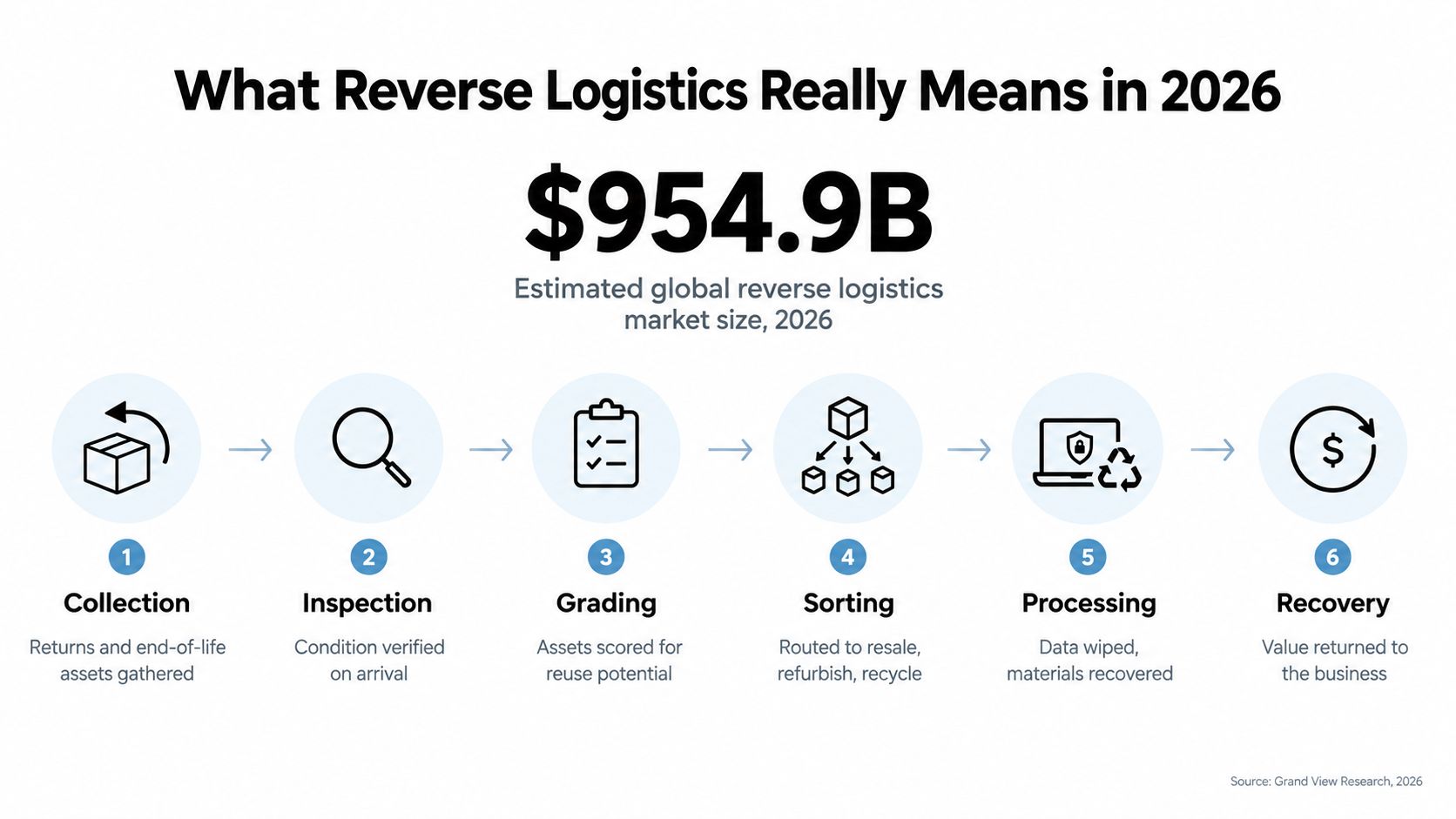
A retired laptop illustrates the difference. First, the organization identifies the asset, records its serial number, and removes it from service. A secure pickup team then transports it to a processing location. Receiving staff verify the condition, apply a grade, and determine whether the laptop qualifies for reuse, refurbishment, employee purchase, charitable donation, parts harvesting, or recycling.
The six control points
- Collection: Returns, lease assets, surplus equipment, and end-of-life devices enter the program.
- Inspection: Technicians verify the physical condition, model, accessories, and data-bearing components.
- Grading: The asset receives a condition and recovery assessment based on functionality, age, specifications, and market suitability.
- Sorting: Teams route it toward resale, refurbishment, donation, component recovery, or material recycling.
- Processing: Technicians perform secure data sanitization, repairs, testing, dismantling, or material preparation.
- Recovery: The organization receives recovered value, documented environmental outcomes, or both.
This staged model also applies to servers, network switches, storage arrays, monitors, and specialized equipment. A useful overview of the broader process is Peak Transport returns management, particularly for readers who need to connect transportation planning with inspection and disposition.
The distinction matters because IT asset disposition, or ITAD, includes data-bearing devices and enterprise equipment that never passed through a consumer return channel. A company retiring a server rack has different security, insurance, transportation, and reporting needs from a shopper returning a monitor.
Organizations that want a fuller introduction can review what reverse logistics means in the supply chain. The practical definition is simple: reverse logistics moves assets backward through a controlled chain so the business can preserve value, protect information, and reduce waste.
From Cost Center to Value Recovery Network
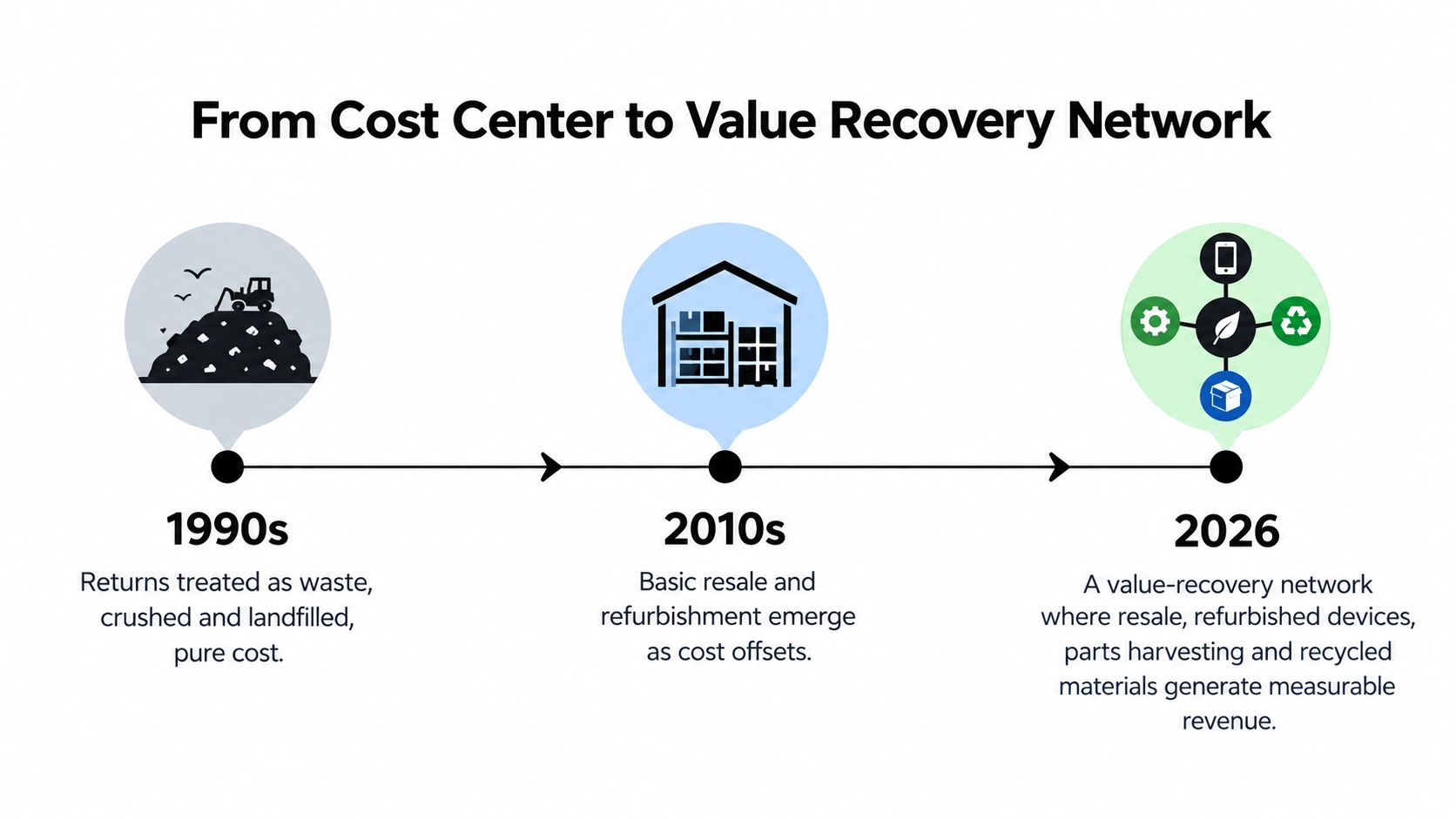
Reverse logistics used to be treated as an unavoidable expense. A returned or retired product was often moved out of the operating environment with little analysis of its remaining usefulness. In electronics programs, that approach could mean sending equipment directly to destruction or recycling before anyone assessed whether a working device could serve another user.
The modern model assigns different destinations to different asset conditions. A working laptop may enter a secondary market. A device with a damaged display may be refurbished. A server with obsolete firmware may contribute components to another repair. Equipment with no safe or practical reuse path can move to certified material recovery.
What changed for ITAD buyers
Several developments reshaped expectations for disposition partners:
- Certified processing: Buyers increasingly expect documented environmental controls, downstream accountability, and verifiable handling practices.
- Secondary markets: Resale and recommerce channels create destinations for equipment that no longer fits the original organization but still has practical use.
- Refurbishment hubs: Centralized technicians can test, repair, reimage, and prepare equipment for another deployment.
- Asset management platforms: Serialized inventories connect physical devices with financial, security, and sustainability records.
- ESG reporting: Sustainability teams need evidence of reuse, donation, recycling, and material recovery, not broad claims that equipment was “handled responsibly.”
The result is a network rather than a single disposal lane. Finance may want residual value. IT may prioritize secure data destruction. Facilities may need a fast pickup. Sustainability teams may require material and reuse reporting. A capable partner coordinates those priorities within one workflow.
Practical rule: Don't evaluate an ITAD provider only by its pickup capacity. Ask how it decides between reuse, refurbishment, resale, donation, parts harvesting, and recycling.
Regional execution also matters. Organizations planning complex removals can examine resources such as San Diego logistics support to understand how security, transportation, and site coordination can fit together.
For businesses planning a disposition program, asset recovery services from Reworx Recycling illustrate the broader direction of the market. The goal is no longer just to remove unwanted equipment. It's to document what happened, recover what remains useful, and send the rest through responsible processing.
Circular Economy Models Driving Electronics Flows
A circular economy keeps products, components, and materials in use for as long as practical. In an ITAD program, that principle produces four distinct recovery paths. They aren't interchangeable, and a strong program will usually use more than one.
Reuse keeps a complete, working device in service with another user. An end-user laptop may move to an employee buyback program, a school, a nonprofit, or a secondary market. Reuse usually preserves the most of the original product because the organization avoids dismantling it.
Refurbishment adds labor to restore usefulness. Technicians may replace a battery, keyboard, display, storage drive, or cosmetic component. They may also reimage the operating system and test the device before resale or donation.
Remanufacturing involves a deeper rebuild for a defined application. This path can suit specialized equipment used in sectors such as healthcare or education, where a controlled configuration and reliable support matter more than consumer resale appeal.
Material recovery dismantles equipment so processors can recover metals, plastics, glass, and other materials. This route is essential when a device is unsafe, uneconomical to repair, or unsuitable for another user.
Circular Economy Recovery Paths Compared
| Recovery Path | Typical IT Assets | Value Recovery | Carbon Impact |
|---|---|---|---|
| Reuse | Working laptops, desktops, monitors, and mobile devices | Preserves the value of the complete unit | Usually avoids the need for an immediate replacement product |
| Refurbishment | Devices needing parts, testing, reimaging, or cosmetic work | Recovers value after targeted labor and component replacement | Extends product life while limiting demand for new equipment |
| Remanufacturing | Specialized systems, configured equipment, and selected enterprise hardware | Creates a rebuilt asset for a defined use case | Retains more embedded materials than destructive processing |
| Material recovery | Broken devices, obsolete hardware, and components without viable reuse | Recovers metals, plastics, and other feedstock | Prevents inappropriate disposal and returns materials to industrial use |
Matching the path to the asset
A modern program shouldn't force every device into the same channel. Laptops and monitors often deserve functional testing before recycling. Data center switches may have resale or parts value even when they're no longer supported by the original manufacturer. Storage arrays require special attention to drives and data-bearing media. Laboratory and medical equipment may need documented decommissioning before any reuse decision.
The most important operational improvement is earlier sorting. When technicians identify reuse candidates before destructive processing, the organization preserves more product value. When they isolate damaged or contaminated equipment early, the recycling stream avoids unnecessary handling and risk.
Businesses evaluating this model can explore circular economy business models for electronics programs. The practical lesson is that sustainability and recovery economics work best when the program uses multiple paths deliberately.
Automation and AI in Modern Reverse Logistics
Automation is changing reverse logistics, but not every technology creates the same result. Some tools improve the decision itself. Others make an existing decision faster. IT leaders should separate those outcomes before approving a platform or equipment investment.
AI-driven disposition decisioning can compare device age, specifications, functional condition, security status, and likely market demand. It recommends whether an asset should move to resale, refurbishment, donation, parts recovery, or recycling. That recommendation sits near inspection and grading, where the organization still has time to change the asset's destination.
Automated grading uses computer vision, test fixtures, barcode scanners, and structured diagnostic routines. It can standardize cosmetic and functional assessments across a large batch. For B2B programs, consistency matters because hundreds or thousands of similar devices may arrive together.
Route optimization works earlier, during pickup planning. It consolidates locations, sequences stops, and selects practical transportation lanes. Digital tracking then follows serialized assets through collection, receiving, processing, and final disposition.
Technology Impact on B2B ITAD vs Consumer Returns
| Technology Layer | Function in Reverse Chain | B2B ITAD Impact | Consumer Returns Impact |
|---|---|---|---|
| AI disposition decisioning | Recommends the next destination after asset assessment | Helps separate high-value enterprise hardware from low-value material streams | Speeds decisions across varied individual returns |
| Automated grading | Scores condition and verifies functionality | Creates consistent grades across bulk office refreshes and data center removals | Supports faster processing of mixed consumer products |
| Route optimization | Plans pickups and consolidates transport | Reduces fragmented collection across offices and facilities | Improves delivery and return routing for distributed customers |
| Digital tracking | Records location, custody, and processing status | Strengthens auditability for serialized devices and sensitive assets | Improves customer visibility for individual returns |
Technology produces the most strategic value when it changes routing. A dashboard that shows an asset's location is useful, but a decision system that prevents a reusable laptop from entering a shred stream protects more value.
Organizations can also review real-time asset tracking for recycling programs when comparing visibility tools. The right question isn't whether a platform uses AI. It's whether the platform improves security, recovery, transportation efficiency, or reporting in a way the operating team can verify.
Compliance and Data Security as Routing Decisions
Data security used to appear at the end of the disposition checklist. In a mature ITAD program, it appears before transportation and determines which destinations remain available.
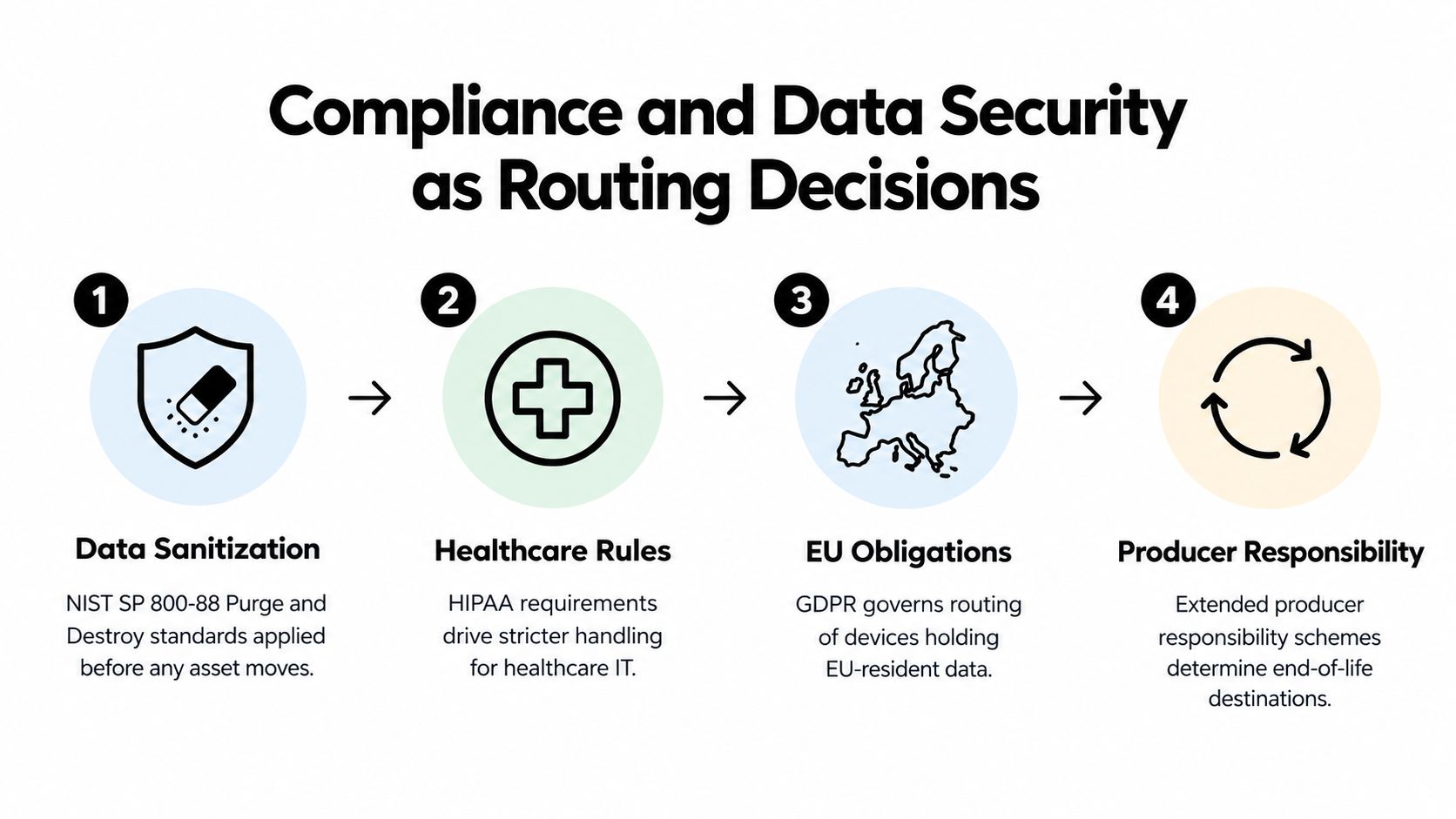
NIST SP 800-88 provides three sanitization levels, Clear, Purge, and Destroy, allowing organizations to match the treatment to the media type and the required protection against data recovery. A device that passes an approved sanitization process may qualify for resale or donation. A device that can't be reliably sanitized may need physical destruction, depending on the organization's policy and data classification.
Four variables that change the route
- Data sanitization: The team identifies storage media, applies the approved method, and preserves a certificate or other required record.
- Healthcare rules: Organizations handling healthcare information must account for HIPAA obligations and the sensitivity of medical and clinical systems.
- EU obligations: Devices containing data connected to EU residents may require routing decisions that account for GDPR responsibilities.
- Producer responsibility: Extended producer responsibility requirements can influence where products and materials go at end of life.
These rules affect more than legal review. They change packaging, custody controls, insurance, processing locations, downstream contracts, and reporting requirements. A sustainability team that counts recycled units without confirming data outcomes may produce an incomplete or unreliable report.
The growing importance of data security in ITAD reflects this operational reality. Secure data destruction isn't a separate service added after recycling. It's a routing decision that determines whether an asset can be reused, donated, resold internationally, or physically destroyed.
Security principle: Treat every data-bearing asset as restricted until the organization has verified its sanitization status and documented the next approved destination.
ITAD buyers should ask how a provider separates sanitized assets from pending assets, who can access the equipment, how exceptions are handled, and how the final outcome is reported. Compliance becomes manageable when those answers are built into the physical workflow.
How an IT Asset Refresh Moves Through Reverse Logistics
Consider a representative office refresh involving 500 laptops. The project starts before the first device leaves a desk. IT, facilities, finance, and the disposition partner agree on the inventory, asset identifiers, collection dates, lease deadlines, and data-handling requirements.
Before collection
The IT team exports device records and identifies models, serial numbers, locations, users, and storage configurations. Facilities groups equipment by floor or site. Finance flags leased equipment and assets with book-value or return obligations. The disposition vendor creates labels and a collection plan that reduces confusion during removal.
At pickup, technicians verify the asset tag, disconnect accessories, protect screens, and place equipment into labeled containers. A consolidated truckload is usually easier to control than scattered individual shipments, especially when the organization has several offices.
At receiving
The receiving team scans each laptop into the processing system and records condition exceptions. Devices then move through data sanitization, functional testing, cosmetic grading, and disposition review. A working model may qualify for resale or donation. Another may need a battery or display. A damaged unit may contribute parts or move directly to material recovery.
The project produces handoffs as well as physical movement:
- IT confirms inventory and data requirements.
- Facilities coordinates access, packing, and removal.
- Finance reviews lease and residual-value implications.
- The disposition partner records custody, processing, and final outcomes.
- Sustainability uses the resulting data for reuse, recycling, and impact reporting.
The exact outcome depends on warranty status, lease return dates, device condition, data policy, and the organization's social or environmental objectives. A well-run refresh makes those decisions before equipment accumulates in a storage room, where delay can reduce resale value and obscure accountability.
The Underserved Truth About Smarter Triage
More automation doesn't automatically mean more processing. In many 2026 programs, the better result comes from processing fewer unsuitable assets through expensive channels.
A low-value device may not justify a long-distance shipment to a centralized refurbishment facility. A unit that fails approved sanitization may not belong in a resale queue. A mixed pickup with scattered sites may create more handling than the recovered equipment can support. Smarter triage identifies those conditions before the asset consumes freight, labor, storage, and administrative capacity.
Triage begins before the truck arrives
Endpoint telemetry can provide useful clues about age, configuration, battery condition, and recent performance. Asset records can identify devices with missing components or unsupported operating environments. Regional aggregation can consolidate equipment before it moves to a specialized processor.
The decision framework should compare the expected recovery value with the cost and risk of the next step:
- Ship for reuse when the complete unit has a credible destination and manageable processing needs.
- Refurbish locally or regionally when a targeted repair can restore practical value.
- Harvest components when the complete device has limited market appeal but useful parts remain.
- Recycle through a certified channel when secure processing and material recovery are more responsible than resale.
- Destroy and document when data, safety, contamination, or contractual requirements rule out other routes.
This approach challenges the assumption that robotic sorting alone solves reverse logistics. A sorter can classify equipment efficiently, but it can't compensate for poor thresholds, missing asset data, or a market that won't support the next shipment.
The strongest triage program prevents wasteful movement before it begins. Speed matters, but the destination decision matters more.
That principle is particularly important for office cleanouts, school device retirements, and small facility cleanouts. A program designed only around units processed may reward unnecessary handling. A program designed around recovered value, secure outcomes, and avoided movement gives teams a clearer basis for action.
Building a Forward-Looking Reverse Logistics Program
A practical program starts with four phases. Each phase should have an owner, a record, and a decision rule.
Inventory and value forecasting
Create a reliable inventory before collection. Record serial numbers, device classes, storage media, age, location, lease status, and known condition. Use available endpoint information to estimate which assets may qualify for reuse, refurbishment, donation, or parts recovery.
Map data classifications at the same time. A laptop used for ordinary administrative work may follow a different sanitization route from a device that held regulated healthcare information. That distinction should appear in the work order, not remain in someone's memory.
Secure collection and logistics
Select a partner that can document pickup, custody, transportation, and receiving. Ask how the provider handles locked areas, multi-site collections, packing materials, loading exceptions, and assets that don't match the manifest.
Set consolidation thresholds that prevent low-value freight. A pickup plan should protect equipment without creating unnecessary movement. For data center decommissioning, confirm how racks, drives, switches, batteries, and accessories will be separated and recorded.
Grading and disposition routing
Require written criteria for reuse, refurbishment, resale, donation, parts harvesting, product destruction, and material recovery. Verify that the provider aligns data sanitization with the organization's approved policy and can produce records for completed work.
Request downstream transparency. You should know whether equipment was resold, donated, refurbished, dismantled, or sent to a recycling processor. Certifications and processor qualifications should be verifiable rather than presented as unexplained badges.
Reporting and improvement
Build an ESG-ready report that connects asset identifiers with final outcomes. Useful measures include recovered value, reuse and donation pathways, material recovery, secure data outcomes, avoided unnecessary transport, and unresolved exceptions. Units processed alone don't show whether the program protected value or merely moved equipment.
Reworx Recycling fits this operating model as a donation-based electronics recycling and IT asset disposition provider for business pickups, equipment decommissioning, secure hard drive shredding, equipment buyback, and responsible electronics recycling. Its social enterprise approach also connects technology donation with community access and workforce development, which can matter when sustainability leaders want their IT retirement program to support both environmental and social objectives.
Reworx Recycling can help your organization plan electronics recycling, secure data destruction, office cleanout, facility cleanout, and IT equipment disposal with documented handling and practical recovery pathways. Visit Reworx Recycling to explore its services and start planning a responsible pickup, equipment donation, or ITAD partnership.