
Texas keeps showing up on affordability lists, but the surprising part is how uneven the value proposition becomes once you compare job access against housing pressure. Statewide, a median-income Texas family had 1.19x the income needed to afford the median home in 2022, yet the metro ratio ranged from 0.96 in Austin-Round Rock to 1.26 in Houston and 1.21 in Fort Worth-Arlington, according to the Texas Comptroller's regional affordability data. That gap matters. A strong labor market doesn't automatically create an affordable relocation choice for employees, or an efficient expansion market for employers.
The better question is where jobs, housing, operating realities, and logistics line up well enough to support stable growth. For this ranking of the best cities in Texas for jobs and affordable living, the lens is practical: employment diversity and growth, supplied income and housing metrics, cost pressure, commute and corridor access, and what happens when offices, labs, schools, and industrial sites need to retire aging technology responsibly. That last point is no longer a side issue. It affects risk, compliance, facility planning, and ESG execution.
Reworx Recycling fits that intersection well. As a donation-based electronics recycling and IT asset disposition partner, Reworx Recycling supports secure data destruction, sustainable recycling, technology donations, digital inclusion, and workforce development. For companies opening, consolidating, refreshing, or relocating in Texas, that matters almost as much as rent. The ranking starts with major employment engines, then moves into specialized and lower-cost markets where employers can still build durable operations. Each city profile ends in a business-minded action path.
1. Austin Tech Hub Boom with Growing E-Waste Management Opportunities
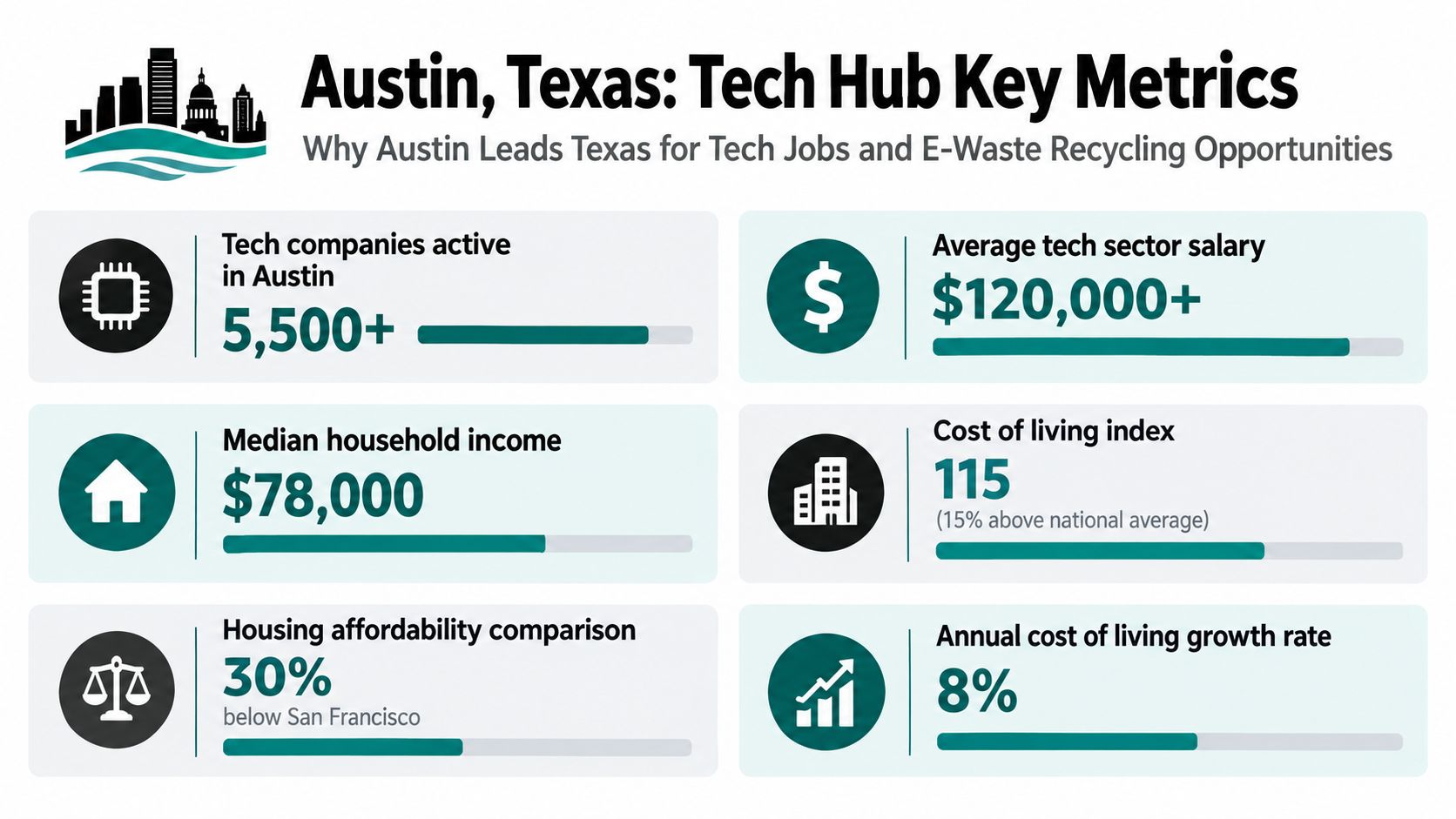
Austin ranks high because it offers one of Texas's strongest concentrations of technical talent, research activity, and high-growth employers. It ranks lower on pure affordability. For employers and relocating professionals, that mix creates value, but only if compensation, housing costs, and operating logistics are planned together.
As noted earlier, Austin pairs low unemployment with some of the state's heaviest housing pressure. That changes the relocation math. A firm can gain access to software, hardware, semiconductor, and university-linked talent, yet still face higher wage expectations, tougher retention pressure, and longer commutes from more affordable suburbs.
Why Austin still ranks high
Austin's employment base is broader than the startup stereotype suggests. The market supports enterprise IT teams, chip and hardware operations, cloud and software firms, public-sector technology functions, and university research labs. That diversity matters because it gives both employers and workers more exit options inside the same metro, which reduces career risk even when living costs rise.
The trade-off is operating intensity. Fast-growing offices and labs cycle through laptops, monitors, mobile devices, networking gear, and storage hardware at a steady pace. In Austin, IT asset disposition is usually an ongoing operating need, not a one-time cleanup project tied to a move.
That point is easy to miss.
A company hiring aggressively in Austin often needs more than recruiting reach. It also needs serialized asset tracking, secure data destruction, scheduled pickups, and a recycling partner that can handle refresh cycles without slowing down office expansions or relocations. For businesses managing those requirements, Austin corporate computer recycling services from Reworx Recycling fit the market well.
The affordability trade-off professionals should weigh
Austin works best for professionals whose income can absorb above-average housing costs in exchange for faster career mobility. That is especially true for engineers, IT managers, product staff, and technical operations roles linked to major employers and research institutions. For lower-margin employers or workers seeking the best housing value, Austin can look less efficient than other Texas markets in this ranking.
Commute patterns matter too. More affordable housing often sits farther from major job nodes, which can raise time costs even when headline pay is higher. For employers, that can show up in attendance friction, hybrid scheduling pressure, and more demand for distributed device deployment and retrieval.
Best fit
Austin is a strong choice for employers that need technical talent density and can budget for higher labor and housing costs. It is a weaker fit for businesses optimizing purely for low overhead.
For relocating professionals, the practical question is not whether Austin has jobs. It does. The better question is whether the city's salary upside offsets its housing burden, commute realities, and day-to-day cost structure. For firms with active hardware refresh cycles, Austin also offers a clear secondary advantage: a large enough technology base to make secure ITAD, electronics recycling, and donation-based reuse part of normal operating practice rather than an exception.
2. Dallas-Fort Worth Business District Expansion Driving Enterprise-Scale Recycling Demand
Dallas-Fort Worth ranks high on combined employer value because it offers scale without depending on a single industry. The region concentrates finance, telecom, healthcare, aviation, defense, logistics, and back-office operations across multiple business districts. For employers, that reduces concentration risk. For relocating professionals, it expands the number of viable job nodes, which matters in a metro where commute geography can change the cost of living as much as rent does.
Dallas and Fort Worth should not be treated as one uniform cost market. Dallas typically carries higher housing pressure near major office corridors, while Fort Worth often gives households more space and shorter access to industrial and logistics employers. That split creates a practical trade-off. Professionals chasing corporate, consulting, or headquarters roles may accept higher housing costs to stay closer to Dallas job centers. Operations, aviation, manufacturing, and distribution workers may find a stronger value equation on the Fort Worth side.

Why DFW works for employers building at scale
DFW's main advantage is network depth. A company can place sales and corporate functions in Dallas, support operations near airport and freight corridors, and maintain manufacturing or field-service capacity in Fort Worth, all within one metro. That structure supports regional headquarters, hospital systems, transportation firms, financial institutions, and acquisitive companies consolidating several offices after mergers.
The growth pattern also matters. Analysts at the Dallas Fed reported year-to-date annualized job growth of 2.0% in Dallas and 2.5% in Fort Worth in the June 2026 Texas Economic Indicators report. Fort Worth led the major Texas metros in that release, which suggests the west side of the region is not just a lower-cost alternative. It is gaining employment momentum in its own right.
What the metro's growth pattern means for ITAD and e-waste logistics
DFW generates enterprise-scale hardware turnover because its expansion is distributed across office towers, medical systems, airport-adjacent operations, call centers, warehouses, and secure government-linked environments. That creates a different disposition profile than a single-core tech city. The work is less about occasional startup cleanouts and more about repeatable pickup schedules, serialized asset tracking, chain-of-custody controls, and downstream recycling capacity that can handle volume.
Three use cases stand out:
- Corporate restacks and office moves: Headquarters growth, floor reconfigurations, and tenant turnover create recurring batches of laptops, monitors, networking gear, and peripherals.
- Regulated equipment retirement: Healthcare, finance, and defense-adjacent users often need documented data destruction and tighter audit trails.
- Multi-site route efficiency: Companies operating across Dallas, Irving, Arlington, Plano, Fort Worth, and surrounding suburbs benefit from scheduled collections instead of one-off haul-offs.
For businesses with assets spread across the region, secure IT asset disposition services for businesses in Dallas fit the metro's operating reality better than ad hoc recycling. That is the non-obvious DFW advantage. The same regional sprawl that can complicate commuting also makes professional ITAD logistics more valuable, because centralized planning lowers pickup friction, improves asset recovery, and reduces compliance risk across multiple sites.
3. Houston Energy Sector and Industrial Hub with Unique ITAD Partnership Potential
Houston earns a high ranking because it gives employers scale, industry depth, and a more workable cost structure than many major U.S. job markets. Recent metro data from the Council for Community and Economic Research cost-of-living index shows Houston below the national average, which helps explain why the region continues to attract large operational footprints as well as relocating professionals.
Its employment base is also unusually diversified for a city often reduced to energy. Greater Houston Partnership identifies energy, life sciences, advanced manufacturing, logistics, and corporate services among the region's major industry clusters in its Houston economic profile. That mix matters. A metro with refineries, hospitals, port activity, engineering offices, and headquarters functions generates a broader stream of retiring assets than a software-heavy market.
Why Houston works for employers
The business case starts with labor access and facility logic. Companies can recruit from a very large metro, place teams near the Port of Houston, the Texas Medical Center, or major office corridors, and still avoid some of the housing pressure seen in tighter high-growth markets. The trade-off is travel time. Houston's footprint is wide, so site selection has to account for commute patterns, truck routing, and the cost of moving people and equipment between dispersed locations.
That operating reality creates a different value equation for employers. In Houston, lower occupancy pressure can be offset by longer drive times and more complicated fleet scheduling. For energy operators, healthcare systems, and industrial distributors, the better decision is often the one that reduces friction across multiple sites, not the one with the lowest lease rate.
Why e-waste logistics look different here
Houston's ITAD demand is shaped by asset complexity and geography. A downtown office relocation may produce standard batches of laptops, monitors, and phones. A medical campus, field operations group, or industrial site can add storage media, networking hardware, badge-access devices, lab electronics, and ruggedized equipment that requires tighter chain-of-custody controls.
Collection planning matters as much as downstream processing. Plant access rules, loading constraints, safety requirements, and the distance between offices, clinics, warehouses, and operating sites all affect pickup efficiency and audit quality. That is why secure IT asset disposition services in Houston for businesses fit the region well. They align with Houston's actual operating pattern, which is distributed, compliance-sensitive, and heavy on recurring asset turnover rather than occasional one-site cleanouts.
4. San Antonio Government and Military Tech Expansion Creating Secure Disposal Demand
San Antonio may be the strongest Texas value play for organizations that need stable hiring, lower occupancy pressure, and stricter asset controls. Its edge is not headline growth. It is the mix of defense, federal activity, healthcare, and back-office operations that keeps equipment refresh, records retention, and secure disposal demand relatively consistent through different business cycles.
That matters for both employers and relocating professionals. A market built on military installations, hospital systems, public-sector work, and contractor support tends to produce steadier employment than cities tied more heavily to one fast-moving private industry. Housing costs also remain more manageable than in Austin, which changes the total cost equation for teams building long-term operations instead of short-term expansion.
Why San Antonio ranks well on jobs and affordability
San Antonio works best for employers that care about predictability. Joint Base San Antonio, cybersecurity activity, medical research, university health operations, and agency-facing service firms create a broader employment base than many people expect. That diversification supports hiring across IT support, compliance, logistics, healthcare administration, facilities, and secure technical operations.
The trade-off is wage acceleration. San Antonio usually offers less upside for workers chasing the highest tech salaries in Texas. For many households, though, lower housing pressure and shorter commutes offset part of that gap. For employers, the same pattern can improve retention because workers are less exposed to the cost strain that drives frequent job switching in more expensive metros.
Location also helps. San Antonio sits on the I-35 corridor with direct reach into Austin, South Texas, and border trade routes. For companies managing distributed offices, field teams, clinics, or contract sites, that logistics position supports recurring pickups and scheduled asset moves better than a single urban-core model.
Why secure disposal demand is higher here
San Antonio's e-waste profile is shaped by compliance. A standard office move may generate laptops, displays, phones, and docking stations. A defense contractor, hospital network, or public agency may add encrypted drives, network appliances, badge systems, printers with stored data, testing devices, and specialized electronics that require documented custody from pickup through destruction.
That raises the value of process, not just recycling capacity.
Public-sector and regulated buyers often need serialized tracking, certificates of destruction, data-bearing media handling, and clear downstream reporting. Companies comparing Texas markets should read San Antonio as a city where IT asset disposition supports risk control as much as sustainability. Local organizations that need that mix can use electronic recycling in San Antonio, Texas as part of a larger ITAD plan.
The city is also practical for firms pursuing agency-related growth. Contractors and service providers expanding near military and civilian demand centers often monitor procurement tools such as AI for Government Contracts while building local operating capacity. In San Antonio, that capacity often includes secure device retirement, documented chain of custody, and scheduled pickups across multiple facilities rather than one-time cleanout volume.
5. Austin Suburbs Round Rock and Cedar Park High-Growth Tech Corridor with Rapid Business Expansion
Round Rock and Cedar Park may offer better combined value than central Austin for employers that need tech access, lower occupancy pressure, and room to scale. For relocating professionals, the appeal is similar. You stay tied to the Austin labor market while avoiding part of the housing and traffic premium concentrated closer to the core.
That trade-off matters in a corridor where growth often spreads faster than infrastructure.
These suburbs work well for mid-market software firms, IT services companies, support operations, medical-adjacent tech, and distributed teams that need a credible Austin address without paying central-Austin rates for every seat. They also fit companies shifting from early-stage coworking setups into leased office, flex industrial, or mixed office-warehouse space.
The operating pattern is different from a single-campus tech market. A company may have a small headquarters in Round Rock, a support team in Cedar Park, remote employees across Williamson County, and surplus devices stored between refresh cycles. That creates steady, smaller-volume disposition needs rather than one large downtown cleanout.
For IT asset disposition and electronics recycling, that changes the service model. Pickup flexibility, chain-of-custody discipline, and accurate asset counts matter more than maximizing one-time truck volume. A vendor serving this corridor needs to handle recurring laptop turnover, monitors from hybrid office reconfigurations, networking gear from office moves, and occasional bulk decommissions after expansion or consolidation.
Quality of life is part of the business case, but it comes with a logistics cost. Employees may gain larger homes, newer schools, and more practical daily routines. Facilities and IT teams often inherit a wider service area, more site coordination, and more time spent planning collections around office parks, business campuses, and residential device returns.
That makes Round Rock and Cedar Park stronger fits for organizations that plan ahead. Firms that standardize refresh schedules, maintain serialized inventories, and set recurring pickup windows usually get better recovery value and fewer compliance gaps. In this part of the Austin corridor, affordability is relative, not absolute. The advantage comes from balancing access to Austin's talent base with more manageable space costs and a cleaner operating setup for growth-stage businesses.
6. San Marcos Higher Education Hub with Research Facility and Campus Equipment Disposal Needs
San Marcos offers one of the clearest value positions in Central Texas. Employers and relocating professionals get access to both Austin and San Antonio while avoiding much of the cost pressure and congestion that define those larger markets.
That trade-off matters in practice. A company can recruit from two metro labor pools, place support functions in a lower-cost city, and still maintain reasonable access to clients, campuses, and suppliers along the I-35 corridor. For professionals, the appeal is similar. Commutes and housing choices are usually more manageable than in Austin, while job access is broader than in many smaller Texas cities.
The employment base is also more stable than the city's size suggests. Texas State University anchors hiring, supports demand for housing and services, and creates recurring turnover in classroom devices, lab systems, AV hardware, and administrative IT equipment. Research spaces, student technology programs, and department-level refresh cycles produce a different disposal profile from a corporate office park. Volumes can be smaller by department, but they recur consistently across the academic calendar.
That makes San Marcos relevant for IT asset disposition planning, especially for institutions that need documented pickups, serialized tracking, and clear downstream handling for mixed equipment categories. Colleges, research units, and training centers often retire equipment in batches tied to funding cycles, renovations, and semester transitions rather than one-time office closures. For schools and universities building a repeatable process, e-waste management for educational institutions aligns well with campus refresh schedules and surplus planning.
San Marcos also works well for regional operators that do not need a flagship headquarters address. A back-office team, light administrative hub, or education-adjacent service business can often operate more efficiently here than in Austin, while keeping day-trip access to both major metros. That is a practical advantage for firms managing equipment across multiple sites in Central Texas.
Best use cases for this market
- Higher education and training institutions: Classroom computers, monitors, projectors, lab-adjacent equipment, and office systems age out in predictable cycles.
- Research and grant-funded programs: Equipment retirement often requires stronger inventory control, internal approvals, and documented disposition.
- Regional employers between Austin and San Antonio: San Marcos can support lower facility costs with easier access to both markets.
- Community donation programs: Education-centered markets often provide a better fit for reuse, refurbishment, and local technology access initiatives.
San Marcos ranks well for employers that want balanced operating economics rather than maximum scale. It is not the deepest job market in Texas, but it combines institutional stability, corridor access, and recurring equipment turnover in a way that creates practical value for both hiring and electronics disposition.
7. Corpus Christi Port and Energy Operations with Industrial Equipment Disposition Opportunities
Corpus Christi ranks well for employers that value freight access, industrial labor, and lower operating pressure more than a major-office address. Its advantage is functional: a port economy tied to energy, marine services, manufacturing support, and coastal logistics creates jobs that depend on equipment movement, site coordination, and physical infrastructure.
That changes the affordability discussion. Corpus Christi is not the broadest white-collar labor market in Texas, but it can offer better value for companies whose revenue depends on terminals, yards, vessels, field service, and refinery-adjacent operations. For relocating professionals, the trade-off is clear. Housing and daily costs are often easier to manage than in larger metros, while career paths are narrower and more concentrated in industrial sectors.
The employment base matters here. Port traffic, petrochemical activity, heavy maintenance, construction support, and transportation create demand for technicians, operations staff, compliance personnel, dispatch teams, and back-office support. That mix also produces a different asset-disposition profile than Austin or Dallas. Businesses in Corpus Christi are more likely to retire a blend of laptops, network hardware, radios, monitors, industrial electronics, and specialized communication equipment rather than standard office devices alone.
Why Corpus Christi can be the right value market
Corpus Christi sits in a useful middle position for employers comparing cost against infrastructure. It does not match the scale or labor depth of Houston. It can, however, reduce occupancy pressure, shorten certain freight routes along the Gulf Coast, and place teams closer to the assets they maintain. For companies handling marine operations, energy support, or industrial contracting, that proximity can matter more than a larger corporate ecosystem.
Commute patterns are also part of the calculation. A smaller metro can simplify daily travel between offices, port facilities, yards, and customer sites. That improves field productivity and makes pickup scheduling more practical for IT asset disposition and electronics recycling vendors serving multiple industrial locations in one run.
Why recycling strategy matters here
Corpus Christi is one of the clearer examples of why e-waste planning should follow the local industry mix. Port operators, contractors, and energy-linked businesses often cycle through equipment during facility upgrades, fleet changes, control-room updates, and site consolidations. Those projects usually require more than a standard office cleanout.
The practical need is segregation and chain of custody. Companies may need to separate reusable IT assets from damaged industrial hardware, document data destruction for storage devices, and route scrap materials through approved downstream processors. In an industrial market, logistics quality matters as much as environmental intent.
For Reworx Recycling, Corpus Christi is less about volume from dense corporate towers and more about recurring project work tied to infrastructure-heavy employers. That makes it a strong fit for firms that want affordable operations, direct Gulf Coast access, and a disposition partner that can handle mixed equipment streams without disrupting site operations.
7 Texas Cities: Jobs & Affordability
| Region | 🔄 Implementation Complexity | ⚡ Resource Requirements | 📊 Expected Outcomes | Ideal Use Cases | ⭐ Key Advantages |
|---|---|---|---|---|---|
| Austin: Tech Hub Boom | Medium–High, high client volume, rapid refresh cycles, traffic logistics | Moderate, secure shredding, dedicated pickup fleet, ESG reporting tools | High recurring ITAD demand; strong donation/ESG outcomes | Startup rollouts, data center refreshes, corporate donation programs | ⭐ Highest concentration of tech firms; strong sustainability culture |
| Dallas–Fort Worth: Business District Expansion | High, large enterprise coordination across a sprawling metro | High, enterprise-scale logistics, multi-site scheduling, regulatory compliance | Steady large-volume contracts and frequent facility cleanouts | Corporate relocations, data center modernization, finance/aerospace ITAD | ⭐ Many Fortune 500 HQs; affordable corporate operating costs |
| Houston: Energy & Industrial Hub | High, industrial sites, hazardous-material considerations, port access | High, specialized handling, industrial/logistics equipment, environmental compliance | Bulk disposition and long-term industrial partnerships driven by compliance | Energy/refinery decommissions, lab equipment disposition, port operations | ⭐ Major energy/port hub with bulk-disposition opportunities |
| San Antonio: Government & Military Tech | High, strict procurement and DOD-specific compliance cycles | Moderate–High, certifications (CMMC), security clearances, chain-of-custody systems | Stable, multi-year government contracts but longer sales cycles | Military bases, defense contractors, healthcare institutional ITAD | ⭐ DOD-compliant demand with predictable, high-value contracts |
| Austin Suburbs (Round Rock, Cedar Park) | Medium, fast growth but newer vendor relationships | Moderate, rapid-response teams, local partnerships, flexible scheduling | Consistent cleanouts for expanding offices; strong partner retention | New office buildouts, manufacturing/R&D facility openings | ⭐ High-income, fast-growing tech corridor near Austin |
| San Marcos: Higher Education Hub | Medium, academic procurement cycles and calendar constraints | Low–Moderate, lab-specialized handling, seasonal pickup planning | Recurring campus contracts, strong community-donation impact | Universities, research labs, K‑12 district technology refreshes | ⭐ Stable institutional demand aligned with donation programs |
| Corpus Christi: Port & Energy Operations | High, port security, coastal conditions, heavy-equipment logistics | High, bulk-capacity trucks, heavy-lift equipment, port-access coordination | High-volume industrial disposals and maritime/renewables partnerships | Port authority upgrades, refinery decommissions, maritime ITAD | ⭐ Largest Texas port by volume; industrial-scale disposition needs |
Choose the Texas Market That Fits Your Next Move
The best cities in Texas for jobs and affordable living don't point to one universal winner. They point to different operating models. Austin and its suburban corridor fit technology-led growth but demand more discipline around housing pressure, retention, and device lifecycle planning. Dallas-Fort Worth offers the broadest enterprise base and the deepest multi-industry flexibility. Houston and Corpus Christi work best for industrial, logistics, energy, and port-linked operations that care about facility practicality as much as labor access. San Antonio supports regulated government, defense, and healthcare workflows. San Marcos gives education-centered and regional organizations a lower-cost base between two larger labor markets.
For relocating professionals, the lesson is simple. Don't stop at home prices or job headlines. Compare whether the local labor market fits your field, whether the housing burden leaves room for savings, and whether the commute pattern supports the life you want to build. Texas has affordable pockets, but affordability changes sharply by corridor, suburb, and metro function.
For employers, the decision framework needs to go further. Start with workforce and industry fit. Then test housing metrics against compensation strategy, because affordability affects recruiting just as much as payroll does. Map commute patterns and pickup geography before signing a lease, especially if you expect multi-site IT equipment disposal, office cleanout work, or recurring reverse-logistics needs. Review facility requirements early. Labs, healthcare systems, school districts, defense contractors, and industrial operators retire equipment in very different ways.
Then get specific about end-of-life controls. Categorize assets before pickup. Separate laptops, servers, networking gear, drives, monitors, mobile devices, medical electronics, and lab equipment. Confirm secure data destruction standards and chain-of-custody expectations before decommissioning starts. If your organization has ESG or community goals, ask where donation-based recycling and technology reuse can support digital inclusion and workforce development instead of defaulting everything into a scrap stream. The strongest programs don't treat recycling as a one-time purge. They build it into relocation, refresh, and expansion planning.
That's where Reworx Recycling becomes relevant across this Texas map. Whether a company is opening a tech office in Austin, clearing a regional floor in Dallas, retiring industrial systems in Houston, supporting secure disposal in San Antonio, managing campus equipment in San Marcos, or coordinating coastal operations in Corpus Christi, the same priorities keep showing up: secure data destruction, reliable pickups, clear documentation, sustainable recycling, and donation pathways that create measurable community value.
Texas offers real choices. The smart move is picking the market that matches your operating model, then building your electronics recycling and ITAD process into the plan from day one.
If your business is upgrading systems, closing offices, refreshing campus devices, or retiring industrial technology, Reworx Recycling can help with donation-based electronics recycling, secure data destruction, pickup coordination, and practical IT asset disposition planning. Visit Reworx Recycling to donate old equipment, schedule a pickup, or build a recycling partnership that supports environmental responsibility, digital inclusion, and workforce development.