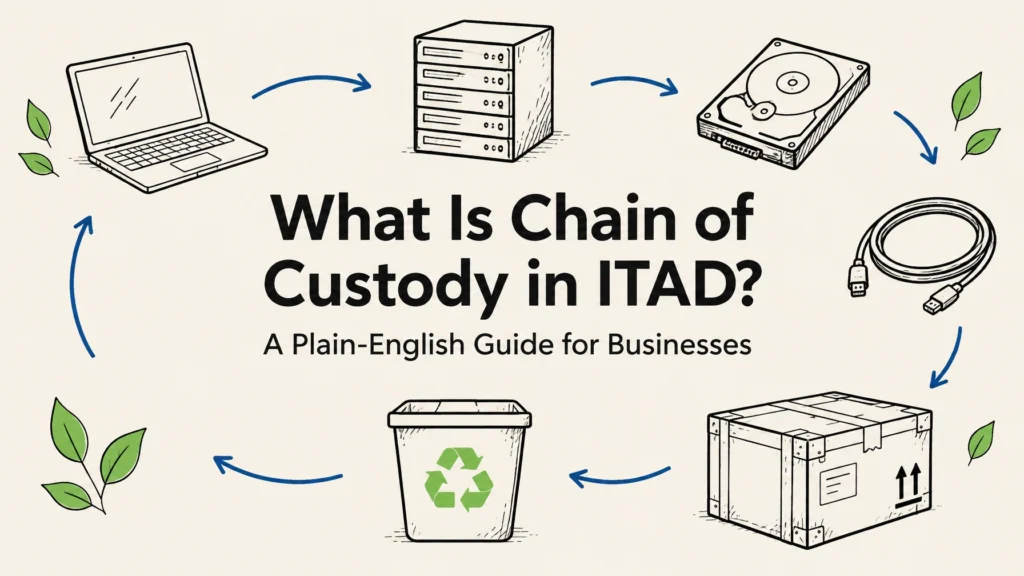
Chain of custody in ITAD is the process of tracking and controlling IT equipment from the moment it leaves your organization until it reaches its final destination. It helps show who handled each asset, where it went, and whether it was wiped, shredded, reused, or recycled as planned. In plain English, it’s how you make sure a device doesn’t become unaccounted for along the way.
That matters because retiring equipment is more than arranging a pickup. Laptops, servers, network devices, phones, and storage media can contain sensitive information, and several people or companies may handle them before the job is complete.
What chain of custody means in IT asset disposition
IT asset disposition, or ITAD, is the organized retirement of business technology. Equipment may be prepared for reuse, resold, donated, recycled, or physically destroyed. Chain of custody is the set of controls that keeps track of that equipment as it moves through those steps.
A useful way to think about it is a relay race. Each person who receives an asset accepts responsibility for it, then hands it to the next person in a traceable way. The goal is to account for the asset at each transfer, not just at the beginning and end.
Chain of custody is often supported by records, such as an inventory or transfer confirmation. But it is the handling process itself that matters: clear ownership, controlled access, secure transport, asset checks, and a plan for resolving anything that doesn’t match.

Why it matters to your business
A device can be physically small but still create a big concern if its location or handling is unclear. If a laptop disappears between pickup and processing, or a storage device reaches a recycling facility without being checked, your organization may not be able to confirm what happened to its data.
A strong process helps your team:
- Keep retired equipment accounted for during pickup, transport, and processing.
- Identify who is responsible at each handoff.
- Notice missing items or mismatched asset details before closing the project.
- Connect data wiping or hard drive shredding to the right device.
- Confirm whether equipment was reused, destroyed, or recycled as intended.
Chain of custody can support your internal controls and compliance work, including requirements related to HIPAA, PCI DSS, state data breach laws, or contractual standards. It does not, by itself, guarantee compliance. Your organization still needs to understand its obligations and choose suitable handling and data destruction methods.
What should be tracked during the process?
The level of detail depends on your project and internal requirements. As a practical starting point, you’ll want to know which equipment is leaving, who has it, and what happened to it.
| Part of the process | What it helps establish |
|---|---|
| Asset identification | Which device or storage media is involved |
| Handoff and transport | Who accepted custody, and when and where the transfer occurred |
| Processing | Whether the device was wiped, shredded, or routed for another outcome |
| Final disposition | Whether it was reused, recycled, or otherwise handled as agreed |
Records such as an inventory, transfer confirmation, or certificate of destruction can help you verify these details. But a certificate alone is not the whole chain of custody. It may show that a drive was destroyed, for example, without accounting for what happened to that drive before it reached the destruction process.
It’s also helpful to distinguish custody from ownership. A handoff may change who is physically responsible for an asset, but it does not automatically settle every legal responsibility or contractual obligation. Make sure your agreement explains responsibilities at each stage.
A practical chain-of-custody process
Your process doesn’t need to be complicated. It should be consistent enough that your team can follow an asset from release to its final outcome.
-
Decide what is leaving. Identify the equipment and storage media included in the project. Note any missing, unreadable, or unusual asset identifiers so they can be addressed before pickup.
-
Assign responsibility. Decide who at your organization can approve the release and who will coordinate the handoff. Confirm who will receive the equipment next.
-
Prepare for transfer. Group equipment according to the pickup plan, and make sure the receiving party can check what is being handed over. Avoid leaving devices in an unsecured area while you wait.
-
Record each handoff. Confirm that the equipment has been received by the next responsible party. For a larger project, reconcile the items received against the original inventory, rather than relying only on an overall box count.
-
Complete the agreed data handling. Choose an appropriate method for the storage media and intended outcome. A wipe in a NIST 800-88-style process may be suitable for some devices intended for reuse. Hard drive shredding may be more appropriate when a drive cannot be reliably wiped or when physical destruction is required.
-
Confirm the final route. Check whether equipment was reused, shredded, or sent for recycling. Resolve missing items or other discrepancies before treating the project as complete.
A missed scan, a broken seal, or an unexpected count does not automatically mean a breach has occurred. It does mean someone should pause, investigate, and record how the issue was resolved.

How chain of custody protects data
Chain of custody helps your organization connect the right device to the right data destruction outcome. A service provider might wipe a working laptop’s drive using a suitable method or shred a hard drive when physical destruction is the chosen route. In either case, you want to know that the device was accounted for and handled according to the agreed plan.
If a device is intended for reuse, ask how the wiping process is selected and checked. If a drive is to be destroyed, ask how the provider links the destruction result to the specific asset. A certificate of destruction gives you evidence of the destruction service, and it is most useful when your team can match it to the equipment involved.
Reworx Recycling provides free data destruction, with wiping or hard drive shredding and a certificate of destruction. You can learn more about our data destruction services. The right method depends on the device, storage media, data, and planned outcome, so tell your provider what you need before the equipment leaves your site.
What to ask an ITAD provider
Before you schedule a project, ask how the provider manages handoffs and discrepancies. A helpful conversation should cover both what happens to your equipment and how you’ll know the process went as planned.
Consider asking:
- How do you identify and reconcile equipment at pickup and receipt?
- How is equipment protected during transport and while it waits for processing?
- What happens if an item is missing, damaged, or doesn’t match the inventory?
- How do you link the data destruction result to the correct device?
- What is the final route for reusable equipment and recyclable materials?
Ask about environmental handling, too. Reworx provides eco-friendly certified recycling with R2-style responsible downstream processing. A responsible route considers reuse where appropriate and ensures remaining electronics are handled through an accountable recycling process. See our IT asset disposition services for more about how we handle retired equipment.
Making the process easier across locations
For a business with offices in several states, consistency matters. Use the same basic handoff and asset-check process at each location, and make sure local teams know who can approve equipment release. If equipment is collected at different times or by different teams, agree in advance on how they will report and resolve mismatches.
Reworx Recycling serves organizations across all 50 states, with headquarters in Smyrna, Georgia, in metro Atlanta. Free nationwide pickup can make collection easier to coordinate. Depending on your needs, we can also discuss flexible or after-hours scheduling and tamper-proof drop-off boxes. For a quick response, you can text us or call 678-449-0003.
After equipment is collected, it should still have a clear destination. Devices may be suitable for reuse, while others need data destruction and responsible recycling. Our electronics recycling service supports the environmentally responsible handling of retired business equipment.
Frequently asked questions
Is chain of custody the same as a certificate of destruction?
No. A certificate of destruction records a destruction outcome. Chain of custody is the broader process of tracking and controlling equipment through handoffs, transport, processing, and final disposition.
Does chain of custody apply to laptops and servers?
Yes. It can apply to any retired equipment your organization needs to track, including laptops, servers, network devices, phones, and storage media. How much detail you need depends on your inventory and internal requirements.
Who is responsible for equipment during pickup and transport?
Responsibility should be clear at each handoff. Confirm who is releasing the equipment, who is accepting it, and what happens if there is a mismatch or delay. Your contract should explain responsibilities and any related terms.
How can I get rid of old business IT equipment securely?
Start by identifying the equipment and deciding what data handling it needs. Then arrange a pickup or drop-off with a provider that explains how it tracks equipment, handles data destruction, and routes electronics for reuse or recycling.
Keep the handoff clear from start to finish
The simplest test is this: can your team explain where each device went, who handled it, and what happened to it? If the answer is unclear, strengthen your handoff process before the next equipment retirement.
Reworx makes free nationwide pickups available and offers flexible scheduling, tamper-proof drop-off boxes, free data destruction, and responsible recycling. As a social enterprise, we also help bridge the digital divide by giving refurbished technology to marginalized and vulnerable communities for education and career readiness. To plan a pickup or ask a question, text us or call 678-449-0003.