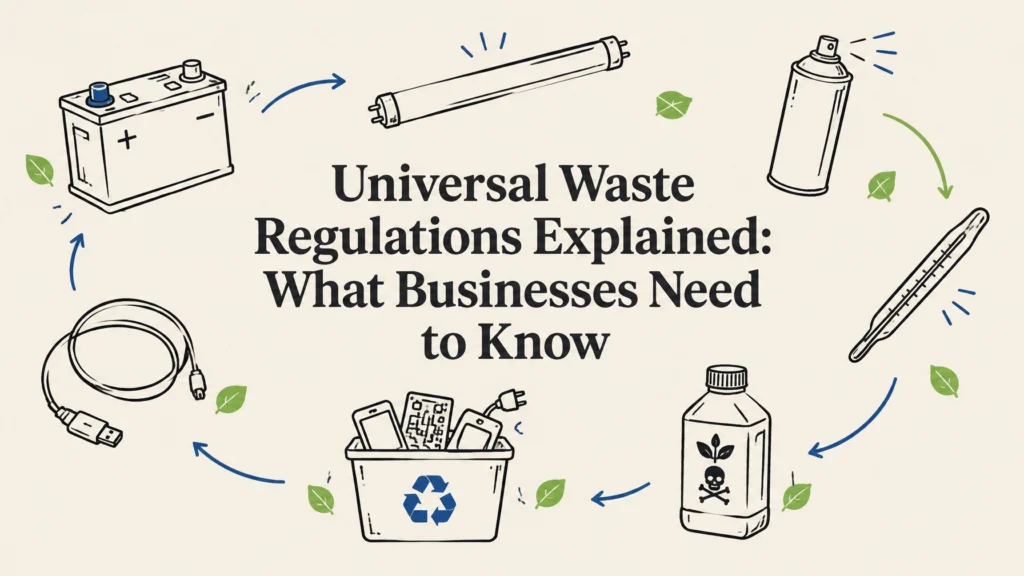
Universal waste regulations are federal and state rules for managing certain common hazardous wastes, such as batteries, lamps, and aerosol cans, under a simpler framework than the full hazardous-waste system. They set requirements for who handles these materials, how much can be accumulated, how they are stored and labeled, and where they can go.
For businesses, the key is to identify each waste stream correctly and check the rules for every state where you operate. The federal framework is a useful starting point, but state programs may add materials or set stricter requirements.
Why is there a universal waste category?
Some hazardous wastes are generated by many kinds of workplaces. Offices, schools, warehouses, and maintenance facilities may all have used batteries or lamps to manage. Applying a streamlined set of requirements to certain common waste streams can make proper collection and recycling more practical.
Universal waste is not a label for anything a business wants to recycle. It applies to materials recognized by the applicable federal or state program, and the waste still needs to be handled appropriately. For the federal framework, the main requirements are in 40 CFR Part 273.

What are the five federal universal waste categories?
The federal program covers five categories. A particular item belongs in the program only when it meets the applicable requirements; don’t assume that every item resembling one of these examples qualifies.
- Batteries: Certain discarded batteries from equipment, tools, and devices.
- Lamps: Qualifying lamps, including some fluorescent lamps.
- Mercury-containing equipment: Certain devices such as mercury switches and thermostats.
- Pesticides: Certain pesticides managed under the relevant requirements.
- Aerosol cans: Qualifying discarded aerosol cans.
These are the five federal categories, not a complete list for every state. States can add other waste streams, including some electronics, or set additional rules for materials already covered federally.
Are electronics universal waste?
Not always. Computers, monitors, servers, phones, and other electronics are not automatically universal waste under the federal program. Some states do include certain electronics in their universal waste rules, so the answer can depend on where your facility is located.
For businesses with multiple locations, a single national policy may need state-specific guidance. A device that fits one state’s program may be regulated differently in another. A facility’s compliance review should distinguish electronic equipment from the batteries, lamps, or other materials that may be stored alongside it.
Data security is a separate but connected concern. Retired laptops, servers, and storage devices can contain sensitive information even when the equipment is being recycled. Requirements tied to HIPAA, PCI DSS, state data breach laws, or internal policies may affect how a business handles those devices. Reworx provides free data destruction through wiping using NIST 800-88-style methods or hard drive shredding, with a certificate of destruction where relevant.
What does it mean to be a universal waste handler?
A handler is generally a business or facility that generates universal waste, or one that receives, accumulates, and sends it onward. The federal framework distinguishes handlers by the total quantity of universal waste accumulated at a site at one time. That amount is counted across the applicable universal waste streams, not just one category in isolation.
| Federal handler category | General quantity distinction | What it means |
|---|---|---|
| Small quantity handler | Below 5,000 kg accumulated at a site at one time | Follows the applicable handler standards |
| Large quantity handler | 5,000 kg or more accumulated at a site at one time | Has additional federal requirements, including notification and recordkeeping provisions |
The federal threshold is a useful planning point, but state rules may differ or impose additional obligations. If a large cleanout, lighting project, or equipment refresh could raise the amount stored at a site, check the applicable requirements before materials accumulate.

What responsibilities apply to handlers?
Requirements depend on the handler category, waste type, and state program. In general, businesses should be prepared to manage universal waste so it does not leak, break, or otherwise escape into the environment. Containers and storage areas should be appropriate for the materials, and waste should be identified clearly.
The federal framework commonly limits accumulation to one year. It also sets expectations around employee awareness, safe handling, and responding to releases. Larger handlers have additional federal notification and recordkeeping obligations. State rules may add requirements, so don’t treat a federal summary as a substitute for checking your state’s program.
It helps to assign clear ownership across departments. Facilities, maintenance, shipping, IT, and sustainability staff may all encounter different waste streams or move materials into storage. If one team tracks batteries and another holds lamps, someone should still be able to see the site’s broader accumulation picture.
What happens if you cross the 5,000 kg threshold?
Under the federal framework, reaching or exceeding 5,000 kg of universal waste at a site places the facility in the large quantity handler category. That category brings additional federal obligations. State rules may add to or differ from those requirements, so confirm the rules that apply at the facility before relying on a threshold-based decision.
It can be easy to overlook the combined total when several projects overlap. A technology refresh, maintenance cleanout, and lighting replacement may each create separate waste streams, but the site needs to consider the total universal waste accumulation together. Planning before a large project begins gives your team time to confirm roles, storage, and recordkeeping expectations.
How does this relate to electronics recycling?
Universal waste rules focus on specific waste categories. Electronics recycling is broader: it can include retired computers, phones, servers, network devices, and other equipment, whether or not a specific item is covered by a state universal waste program.
For electronics, ask the recycler how it manages data-bearing devices, tracks equipment through handoffs, and directs materials to responsible downstream processors. Reworx Recycling provides nationwide electronics recycling and IT asset disposition, with free nationwide pickups, flexible after-hours scheduling, and text-for-fast-service. Its certified eco-friendly recycling programs support responsible downstream processing, and eligible equipment may also be considered for equipment buyback.
When equipment can be refurbished, reuse can also benefit communities. Reworx’s mission includes helping bridge the digital divide by getting refurbished technology and support to marginalized and vulnerable communities for education and career readiness.
What should you ask about your program?
Before setting a policy or arranging a large project, make sure you can answer these questions:
- Which materials qualify under the federal and applicable state rules?
- How much universal waste is being accumulated at each site?
- Who is responsible for storage, training, and records?
- How will your organization track accumulation time?
- What happens to devices that contain sensitive data?
- Can a recycler explain its chain of custody and downstream handling?
If your organization is planning a larger equipment retirement, IT asset disposition services can help connect data security, equipment tracking, and responsible end-of-life handling. For electronics that need a recycling route, review nationwide electronics recycling. Reworx is headquartered in Smyrna, Georgia, and serves organizations nationwide across all 50 states.
Frequently asked questions
What are universal waste regulations?
They are federal and state requirements for managing certain common hazardous wastes under a streamlined framework. The details depend on the waste category, handler role, and state program.
What are the five types of universal waste?
The five federal categories are batteries, lamps, mercury-containing equipment, pesticides, and aerosol cans. States may add other materials or impose additional requirements.
How long can you store universal waste?
The federal framework generally limits accumulation to one year. Check your state’s rules and the requirements for your specific waste and handler category.
Is e-waste universal waste?
Not automatically under federal rules. Some states regulate certain electronics as universal waste, so check the requirements for the state where the equipment is located.
What happens if you cross the 5,000 kg threshold?
Under the federal framework, a site that accumulates 5,000 kg or more is considered a large quantity handler and must meet additional requirements. Verify your state’s rules before making a compliance decision.
If you’re reviewing your waste program or planning an electronics retirement, start by confirming what materials you have and which rules apply at each location. Then contact Reworx to discuss nationwide pickup, secure data destruction, and responsible recycling options.