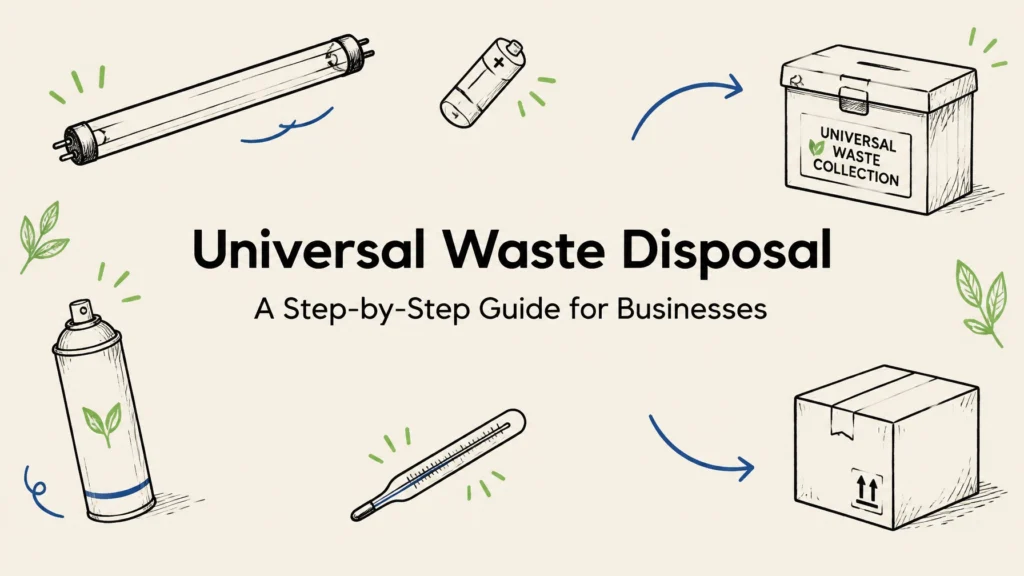
Businesses dispose of universal waste by identifying eligible waste, keeping different types separate, placing them in safe containers, labeling and dating them, then arranging shipment to an appropriate handler or destination facility. Check your state’s rules before starting, since states may add requirements or include additional waste types.
The work is easiest when it’s part of a routine: staff know what to set aside, a designated person checks the collection area, and someone keeps the shipment records. The guide below covers that practical process without replacing your state-specific requirements.
What may count as universal waste?
Federal and state programs commonly cover batteries, lamps, mercury-containing equipment, pesticides, and aerosol cans. Whether a particular item qualifies depends on its type and condition. For example, not every battery, lamp, can, or electronic device automatically counts as universal waste.
Some states include certain electronics in their universal waste programs; others may handle them differently. Check the environmental agency rules for each state where your business operates before collecting or shipping waste. If you’re unsure how to classify an item, ask your environmental contact or a qualified waste professional rather than guessing.
A quick department-by-department review can help you find likely collection points:
| Where it may come from | Items to check |
|---|---|
| Facilities and maintenance | Lamps, batteries, thermostats, and aerosol cans |
| Grounds or pest control | Pesticide products and containers |
| IT and office teams | Batteries, lamps, and electronics that may need a separate e-waste route |
| Labs or equipment rooms | Mercury-containing instruments and other specialty equipment |

A step-by-step universal waste disposal process
-
Identify what you’re discarding. Ask staff to flag items before they go into a general waste area. Record the item type and where it came from. Don’t assume all electronics, lamps, batteries, pesticides, or aerosol cans follow the same disposal route.
-
Separate waste by type and condition. Keep batteries, lamps, mercury-containing equipment, pesticides, and aerosol cans in their own clearly identified groups. Set aside leaking, broken, or damaged items for appropriate handling. Don’t mix universal waste with ordinary trash or recycling.
-
Choose a safe collection area and suitable containers. Use containers that are sturdy and compatible with what they hold. Keep them closed except when adding or removing waste, and protect lamps and mercury-containing equipment from breakage. Keep aerosol cans away from heat. If a battery is leaking or damaged, don’t handle it like an intact battery; follow your site’s response procedure and confirm the right containment.
-
Label each item or container. Use a clear label that identifies the waste type, such as “Universal Waste, Batteries” or “Universal Waste, Lamps.” The label should be easy to read and stay with the material while it’s stored and shipped. State rules may specify details, so confirm the wording and any other marking requirements locally.
-
Track when accumulation begins. Date the container or use an inventory system that lets you show when the waste was first added. Federal rules generally set a one-year accumulation limit, but your state may have additional requirements. Don’t rely on memory or an undated collection area to establish how long material has been stored.
-
Arrange shipment with the right recipient. Confirm that the receiving handler or destination facility accepts the specific waste type and condition you have. Before pickup, agree on packaging, quantities, scheduling, and who is responsible for transportation. If transportation rules apply to your shipment, make sure the packaging and shipping paperwork are handled accordingly.
-
Close out the shipment and review your records. Keep the pickup or shipping documentation, the quantities sent, the receiving party’s details, and proof of final disposition. Reconcile what left your site against your inventory, and note any exceptions or rejected items. Schedule regular checks so containers remain in good condition and stored waste doesn’t sit past the applicable time limit.

Set up storage that’s easy to manage
A good collection area is orderly, clearly marked, and easy to inspect. Assign someone to check it on a schedule that suits your waste volume. During each check, confirm that containers are closed, labels are legible, dates are recorded, and there are no leaks, breakage, or signs of damage.
Train the employees who handle the waste or manage the area. They should know which items go in each container, what to do if something breaks or leaks, and whom to contact when an item doesn’t fit the normal process. Keep the relevant instructions close to the collection point.
Federal rules distinguish between small- and large-quantity handlers. The federal threshold is 5,000 kg of universal waste accumulated at a site at any one time; reaching that amount can bring additional steps. If you’re approaching the threshold, confirm your status and any notification or recordkeeping requirements with your state environmental agency. State programs may differ from the federal baseline.
Keep electronics and data-bearing equipment on a clear path
Electronics aren’t automatically universal waste. Check your state program to see whether it includes particular electronic items. If it doesn’t, those devices may need a separate electronics recycling route.
For computers, servers, phones, and storage media, include data protection in the disposal plan. Back up information you need, sign out of accounts, and remove SIM or memory cards when appropriate. Deleting files alone may not be enough to protect sensitive data. A qualified provider can discuss a NIST 800-88-style wipe for suitable devices or hard drive shredding when physical destruction is the right choice.
Reworx provides free data destruction and can arrange free nationwide pickups for eligible business electronics. Ask how the devices will be tracked, what happens to them after collection, and what documentation you’ll receive. For data-bearing media, request a certificate of destruction when destruction is performed. Learn more about IT asset disposition for businesses or hard drive shredding.

Choose a recycling and pickup partner carefully
Ask a prospective provider practical questions before scheduling a shipment:
- Do you accept the exact waste types and conditions we have?
- What packaging, labels, and inventory details do you need from us?
- Who handles transportation, and what shipment records will we receive?
- How will you document final recycling, treatment, or disposal?
- How will data-bearing electronics be wiped or destroyed, and what documentation is available?
For electronics, use a provider that can explain its downstream handling and responsible recycling process. Reworx offers certified eco-friendly recycling with responsible downstream processing, free nationwide pickups across all 50 states, and flexible or after-hours scheduling. Tamper-proof drop-off boxes may suit eligible small electronics, but they aren’t a substitute for confirming the correct route for lamps, loose batteries, chemicals, or other universal waste. Text us for a fast response about service options.
Reworx is headquartered in Smyrna, Georgia, and supports businesses nationwide. Through its mission, the company also helps bridge the digital divide by getting refurbished technology and support to marginalized and vulnerable communities for education and career readiness.
If electronics are part of your project, review our electronics recycling services to plan a separate route alongside your universal waste process.
Frequently asked questions
How do you dispose of universal waste?
Identify the waste type, check your state’s rules, separate it from other materials, place it in a suitable container, label and date it, then arrange shipment to an appropriate recipient. Keep records of the shipment and final disposition.
Can you throw aerosol cans in the trash?
Don’t assume an aerosol can belongs in ordinary trash. Its contents and condition matter, and state requirements can vary. Keep it in a safe, designated area while you confirm the correct disposal route.
How long can universal waste be stored?
Federal rules generally allow accumulation for up to one year. The business should be able to show when accumulation began. Check state rules too, since they may add requirements.
Is e-waste universal waste?
Not always. Some states include certain electronics in their universal waste programs, while others handle them separately. Check the rules for your state and arrange secure data handling for devices that store information.
What records should we keep for universal waste disposal?
Keep your waste inventory, labels or dates, pickup or shipping records, recipient details, quantities, and proof of final disposition. For data-bearing electronics that are destroyed, keep the applicable data destruction documentation as well.
Start by assigning one person to review your waste collection area and check your state’s requirements for each waste type. If electronics are part of the cleanout, contact Reworx to discuss a pickup, responsible recycling, and secure data destruction.