When your business finally retires an old server, laptop, or hard drive, the single most important document you'll receive is the Certificate of Destruction (CoD). Think of it as the formal, auditable proof that your sensitive data has been completely and permanently destroyed. It's also your confirmation that the physical hardware was disposed of correctly, following all environmental regulations.
This document is your legal shield. It’s what stands between your company and a potential data breach or a hefty regulatory fine, especially when managing an office cleanout or large-scale facility cleanout.
The Critical Role of a Destruction Certificate
For IT managers and business owners, a stack of old equipment is more than just another task on a long to-do list. That hardware—from computers and laptops to data center servers—is a repository of sensitive information, including customer records, financial data, and proprietary intelligence. Simply wiping a drive or hitting "delete" is no longer a sufficient safeguard. That's why a Certificate of Destruction is an absolute must-have in any modern IT Asset Disposition (ITAD) strategy.
More Than Just a Receipt
A CoD is far more than a simple receipt for services rendered. It’s a legal document that officially transfers liability from your company to your ITAD partner, like the social enterprise Reworx Recycling. It creates an undeniable, auditable paper trail proving your data was securely sanitized and the hardware was responsibly handled through sustainable recycling practices.
This documentation is essential for complying with a host of data privacy regulations, including:
- HIPAA (Health Insurance Portability and Accountability Act): For protecting sensitive patient health information during medical equipment disposal.
- GDPR (General Data Protection Regulation): For safeguarding the personal data of EU citizens.
- FACTA (Fair and Accurate Credit Transactions Act): For properly disposing of consumer credit information.
Being caught without proof of destruction during an audit can result in crippling financial penalties and cause serious damage to your corporate reputation.
The Growing Need for Verifiable Destruction
As the electronics recycling market continues to expand, the demand for secure data destruction is skyrocketing. This market, valued at USD 43.2 billion in 2025, is projected to hit an incredible USD 147.9 billion by 2035.
A major driver of this growth is the constant turnover of PCs and laptops, which make up a massive 45% of the market share and are always packed with sensitive data. As businesses upgrade their technology, the need for secure destruction methods like hard drive shredding—backed by a detailed CoD—becomes non-negotiable for every organization, from small businesses to large enterprises undergoing data center decommissioning.
"A Certificate of Destruction isn’t just about proving you got rid of old equipment. It’s about proving you protected the data on it. It’s the final, crucial step that closes the loop on data security and corporate responsibility."
Understanding how to make a certificate people value is key to seeing why a CoD from a trusted partner carries so much weight. It signals a deep commitment to security and diligence that your stakeholders, customers, and regulators all expect to see.
When you partner with a social enterprise like Reworx Recycling, you get more than just a certificate. You get peace of mind knowing your entire ITAD process, from computer recycling to product destruction, is handled with the highest standards for both data security and environmental stewardship. Our processes are designed to provide the comprehensive documentation you need to prove due diligence. Take a look at our commitment to secure and compliant data destruction to see how we protect your business.
Ultimately, this document isn't just a best practice; it's a core component of modern risk management that protects your reputation, secures your data, and proves your commitment to sustainability.
What Makes a Certificate of Destruction Truly Compliant?
Not all destruction certificates are created equal. A generic, one-line statement saying "items destroyed" offers almost no real protection if an auditor comes knocking. To truly shield your organization, you need a detailed, verifiable document that stands up to scrutiny.
Think of a compliant Certificate of Destruction (CoD) as the official record of your asset's end-of-life journey. For IT managers, corporate sustainability leaders, and compliance officers, knowing what to look for is non-negotiable. A weak certificate is just as risky as having no certificate at all. Let's break down the anatomy of a CoD that will actually protect you.
Identifying the What: The Asset Details
The foundation of any credible CoD is a precise list of the assets destroyed. Vague descriptions like "10 hard drives" or "one pallet of computers" are major red flags. A compliant certificate must list each item with its unique identifiers, creating an unbreakable link between your inventory records and the final destruction event.
Here's the level of detail you should expect:
- Serial Number: This is the critical unique identifier assigned by the manufacturer. It's the best proof you have that a specific device was destroyed.
- Asset Tag Number: Your company's internal tracking number is just as important. It’s how you’ll reconcile the destruction with your own IT asset management system.
- Manufacturer and Model: Listing the make (like Dell or HP) and model (like Latitude 7420 or ProLiant DL380) adds another critical layer of verification.
- Device Type: The certificate should clearly state whether the item is a laptop, server, hard drive, or another type of media, such as laboratory equipment.
Without this level of granularity, you can't definitively prove to an auditor that the specific device holding sensitive data was the one that was actually destroyed. It leaves a gap in your chain of custody that’s easy to question.
To help you ensure every critical piece of information is included, here's a breakdown of the essential fields that make a Certificate of Destruction audit-proof.
| Field Name | Description | Why It's Critical |
|---|---|---|
| Unique Certificate ID | A serialized number assigned by the vendor. | Allows for easy tracking, filing, and retrieval during an audit. |
| Client Information | Your company's full legal name and address. | Formally identifies you as the legal owner of the assets being destroyed. |
| Vendor Information | The ITAD partner's full name, address, and contact info. | Clearly establishes which certified party performed the destruction service. |
| Asset Details | A granular list including Serial Number, Asset Tag, and Type. | Creates an irrefutable link between your records and the destroyed items. |
| Method of Destruction | A clear statement on the process used (e.g., Shredding, Degaussing). | Proves compliance with data security standards like NIST 800-88. |
| Transfer of Custody Date | The date the assets were picked up or received by the vendor. | Marks the official handoff of responsibility for the equipment. |
| Date of Destruction | The exact date the destruction process was completed. | Provides a definitive timeline for the asset's end-of-life. |
| Location of Destruction | The physical address of the secure facility where it happened. | Confirms the process took place in a controlled, secure environment. |
| Authorized Signatures | Signatures from both the vendor and, if required, your representative. | Serves as a legal attestation that the information on the CoD is accurate. |
This table covers the non-negotiables. A CoD with all these fields is more than just a receipt; it's a powerful legal document that confirms your due diligence.
Documenting the How: The Destruction Method
Next, the certificate must explicitly state how the data was destroyed. Different methods offer different levels of security, and your CoD needs to reflect the specific process used. This detail is absolutely vital for meeting regulations like NIST 800-88, which sets the gold standard for media sanitization.
Your certificate should clearly specify one of these common methods:
- Shredding: The physical destruction of media into tiny particles. A good certificate will even note the final shred size (e.g., 2mm), as this is a key indicator of the security level.
- Degaussing: Using a powerful magnet to completely erase the magnetic field on a hard drive, which renders the data permanently unrecoverable.
- Crushing/Pulverizing: Physically deforming or smashing the device to make it impossible to operate and access the data platters.
For business owners who need absolute certainty that their data is gone for good, learning more about the secure hard drive shredding services offered by a certified partner like Reworx Recycling can provide that peace of mind. The method used directly impacts your compliance claim, so make sure this field is accurate and unambiguous.
Verifying the Who, When, and Where
Finally, a compliant CoD has to establish a clear, unbroken chain of custody. This part of the certificate confirms the timeline and transfer of responsibility, closing any potential security loopholes along the way.
A strong chain of custody is your proof that the assets were secure from the moment they left your facility to the moment they were destroyed. Any ambiguity here undermines the entire document.
Look for these critical elements to lock down your chain of custody:
- Your Company's Name and Address: Identifies you as the owner of the assets.
- The ITAD Vendor's Name and Address: Clearly states who was responsible (e.g., Reworx Recycling).
- Date of Custody Transfer: The date your equipment was picked up or dropped off.
- Date of Destruction: The exact date the destruction took place.
- Location of Destruction: The physical address where the process happened.
- Authorized Signatures: Signatures from your representative (if needed) and the destruction vendor, legally attesting to the facts.
- Unique Certificate Number: A serialized number for easy tracking and reference.
When all these pieces are in place, your certificate of destruction transforms from a simple piece of paper into a powerful legal and compliance tool. It gives you a complete, auditable record that proves your commitment to data security and responsible IT disposal.
Managing Your Certificates for Audit-Proof Records
Receiving a Certificate of Destruction is a significant milestone, but it is not the end of the process. True, lasting compliance stems from how you manage, store, and organize these critical documents over time. A robust internal workflow for handling your CoDs is what transforms a simple document into an ironclad, audit-proof shield for your organization.
This process should begin long before you even receive the certificate. It starts with a clean inventory of the devices slated for retirement and thorough vetting of your ITAD partner. When you work with a trusted social enterprise like Reworx Recycling, you’re not just hiring a vendor; you’re gaining a partner equally invested in your compliance and data security.
Building Your Internal CoD Workflow
A disorganized approach to managing your certificates can be as detrimental as not having one at all. If an auditor requests a specific CoD and you cannot produce it, it is effectively non-existent. A structured workflow is your best defense, ensuring every certificate is properly reviewed, filed, and readily accessible when needed.
Your internal process should include several key checkpoints:
- Initial Review: The moment a CoD arrives, cross-reference it with your internal asset list. Do the serial numbers and asset tags on the certificate match exactly what you sent out for destruction?
- Completeness Check: Scan the document for all essential fields. Is the destruction method listed? Is there a date, location, and an authorized signature? If anything appears generic or is missing, address it with your vendor immediately.
- Digital Archiving: Scan the physical copy and save it to a secure, centralized digital repository. Use a consistent naming convention—such as
CoD_VendorName_Date_CertID.pdf—to facilitate easy searching. - Access Control: Secure the digital repository. Access should be limited to authorized personnel, such as your IT manager, compliance officer, or legal team.
This simple breakdown shows the core anatomy of a certificate and highlights the key areas you need to verify.
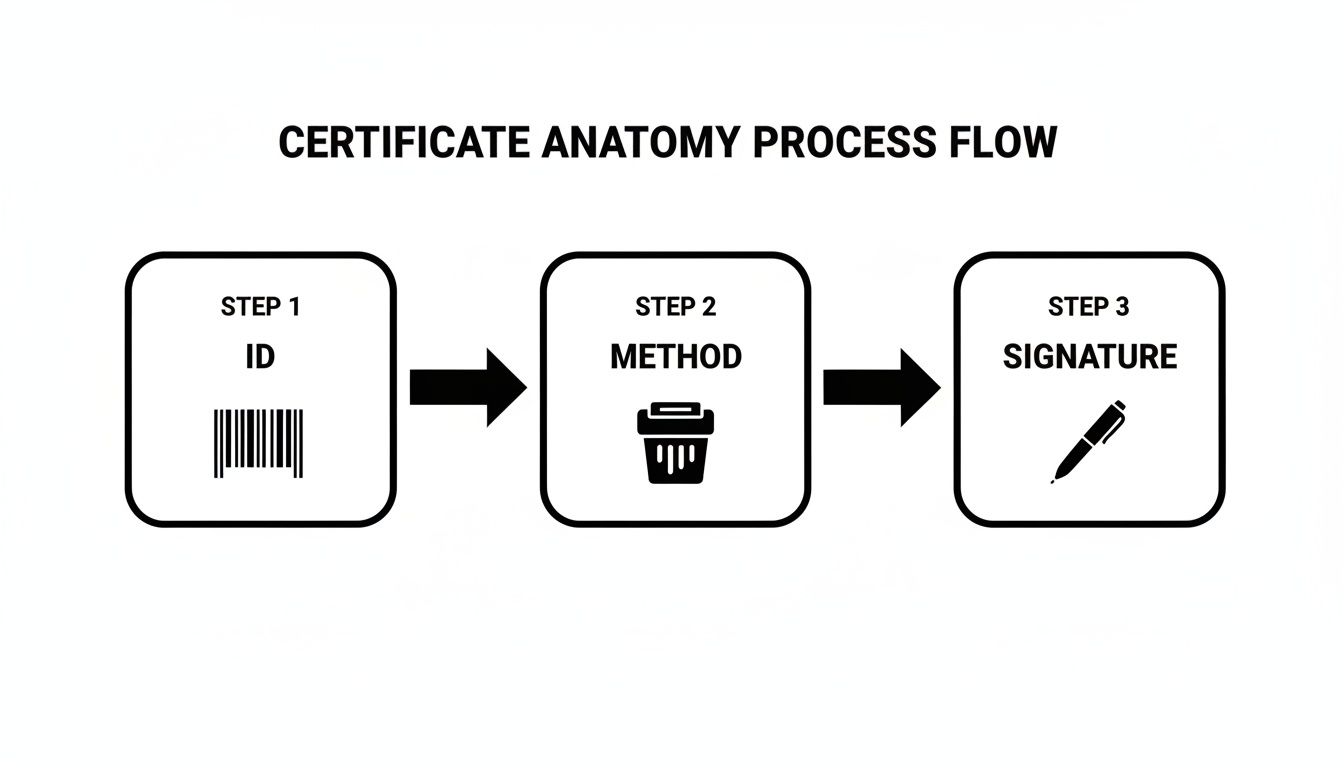
This flow—from unique identification to method verification and final sign-off—creates a complete, defensible record of that asset's final journey.
Retention Policies and Audit Preparedness
So, how long must you retain these records? The duration depends on your industry and the specific regulations you are subject to. While there is no single standard, a general rule of thumb is to keep CoDs for at least three to five years. However, some regulations mandate much longer periods.
For instance, healthcare organizations under HIPAA may be required to retain destruction records for six years from the date of their creation. It is always advisable to consult with your legal or compliance team to establish a retention policy that meets your specific needs.
Maintaining organized digital files is the key to a smooth audit. Create a logical folder structure, perhaps by year and then by vendor or disposal batch. This enables you to retrieve specific documents in minutes, demonstrating to auditors your diligence and control over your processes. You can see how this fits into a bigger picture by reading about comprehensive IT Asset Disposition (ITAD) services.
Spotting Red Flags in a Certificate
Not all ITAD vendors operate under the same standards. A weak or even fraudulent CoD can leave your company exposed to significant risk. It is crucial to know how to identify red flags that suggest a document is not what it purports to be.
Be wary of certificates that:
- Lack Specificity: They use vague language like "various electronics" or "a box of hard drives" instead of itemizing every single serial number.
- Have Missing Information: Key details such as the destruction method, date, or physical location are absent.
- Look Unprofessional: The document contains typographical errors, inconsistent formatting, or lacks a professional letterhead and contact information.
- Are Not Serialized: There is no unique certificate number, which makes tracking and verification impossible.
If you receive a document with any of these issues, do not simply file it away. Contact the vendor immediately and request a corrected, detailed certificate that meets compliance standards. A reputable partner like Reworx Recycling will always provide a comprehensive, audit-ready document without hesitation. Your diligence here is the final, crucial layer in your data security strategy.
Staying Compliant in a World of Data Privacy Laws
In today's business environment, organizations navigate a complex web of regulations—HIPAA, GDPR, CCPA—each with significant implications for the disposal of old hard drives and servers. These are not mere suggestions; they are strict rules with severe consequences. A single misstep in your IT disposal process can lead to crippling fines, legal battles, and damage to a hard-won reputation.
This is precisely why a detailed Certificate of Destruction is not just a piece of paper but your most critical compliance tool. It serves as your official, verifiable proof that you have taken all necessary steps to protect sensitive information. Without it, you are effectively hoping for no scrutiny—a risky gamble for any organization.
Navigating the Regulatory Minefield
Different laws apply to different types of data, making it essential to understand your specific obligations. Each regulation has its own stringent rules for data sanitization and disposal.
Let’s break down a few of the big ones:
- HIPAA (Health Insurance Portability and Accountability Act): If you handle any protected health information (PHI), HIPAA requires that data be rendered completely unreadable, indecipherable, and impossible to reconstruct. A CoD is your proof that you used a compliant method, like physical shredding, to achieve this.
- GLBA (Gramm-Leach-Bliley Act): This applies to financial institutions. The Safeguards Rule under GLBA mandates that companies have a written security plan that explicitly includes the secure disposal of customer information.
- GDPR (General Data Protection Regulation): This comprehensive EU law grants individuals the "right to be forgotten." Your Certificate of Destruction serves as definitive proof that you’ve honored a data erasure request and permanently wiped personal data from your retired assets.
A simple data wipe no longer suffices. You need proof of irreversible destruction, and your CoD is the only document that truly provides that assurance.
The Real-World Stakes of Non-Compliance
The sheer volume of e-waste underscores the significant risk for businesses. In 2022, the world generated an astonishing 62 million tonnes of e-waste, yet only 22.3% of it was properly documented and recycled. For partners like Reworx Recycling, this statistic highlights the urgent need for secure data destruction, where a sample certificate of destruction acts as ironclad proof that hard drives from retired PCs and laptops have been irreversibly shredded. You can dig deeper into these global trends in The Global E-waste Monitor 2024.
Consider a hospital retiring a server but failing to obtain a detailed CoD. If those hard drives are later found in a dumpster with patient data intact, the hospital could face millions in HIPAA fines and a complete loss of public trust. A CoD from a certified vendor would have transferred that liability, creating a clear paper trail of secure destruction.
A detailed Certificate of Destruction is your frontline defense during a regulatory audit. It's the document that proves you went beyond good intentions and implemented a verifiable, secure process for end-of-life data.
Beyond just proving destruction, a compliant Certificate of Destruction is a key piece of the puzzle for demonstrating adherence to broader regulatory frameworks, including international standards like the Australian data privacy laws.
Building a Fortress Around Your Data
Working with a certified ITAD vendor who is an expert in this complex legal landscape is non-negotiable. An expert partner does more than just destroy your hardware; they provide the meticulous documentation you need to prove it was done correctly. They deal with state and federal data security laws daily, ensuring the CoD you receive is airtight and ready for any audit.
This is about more than just checking a compliance box. It’s about building a robust risk management strategy that protects your company's most valuable asset: its data. By making a detailed Certificate of Destruction a mandatory part of your ITAD policy, you create a fortress around your information, protecting your business from the devastating financial and reputational fallout of a data breach.
How Reworx Recycling Guarantees Ironclad Destruction
Choosing an IT Asset Disposition (ITAD) partner is fundamentally an act of trust. You are entrusting devices containing sensitive data, relying on them to be handled securely and responsibly. At Reworx Recycling, we earn that trust through a transparent, rigorous process designed to provide complete peace of mind and ironclad, auditable proof.
We understand that a sample certificate of destruction is more than just a document. It’s the final, crucial link in your data security chain. Our entire operation is built to ensure that the certificate you receive from us is a true, accurate reflection of a secure, compliant, and socially responsible process from start to finish.
A Process Built on Transparency and Security
Our commitment begins the moment we take custody of your assets. We believe in total transparency, which means providing you with a clear view of your equipment's journey from your facility to its final disposition.
This is how we guarantee an unbroken chain of custody:
- Secure Logistics: Our vehicles are equipped with GPS tracking, ensuring every asset is monitored from the moment it leaves your door until it arrives at our secure facility.
- Controlled Access: Our facility is monitored 24/7 with strict access controls. Only authorized, trained personnel handle your sensitive equipment.
- Detailed Inventorying: Upon arrival, every asset is logged by serial number and asset tag. This creates a detailed inventory that is reconciled against your final Certificate of Destruction.
This meticulous approach ensures there are no gaps in the chain of custody. It is a core component of our process and what makes our documentation so reliable.
Advanced Technology for Complete Data Obliteration
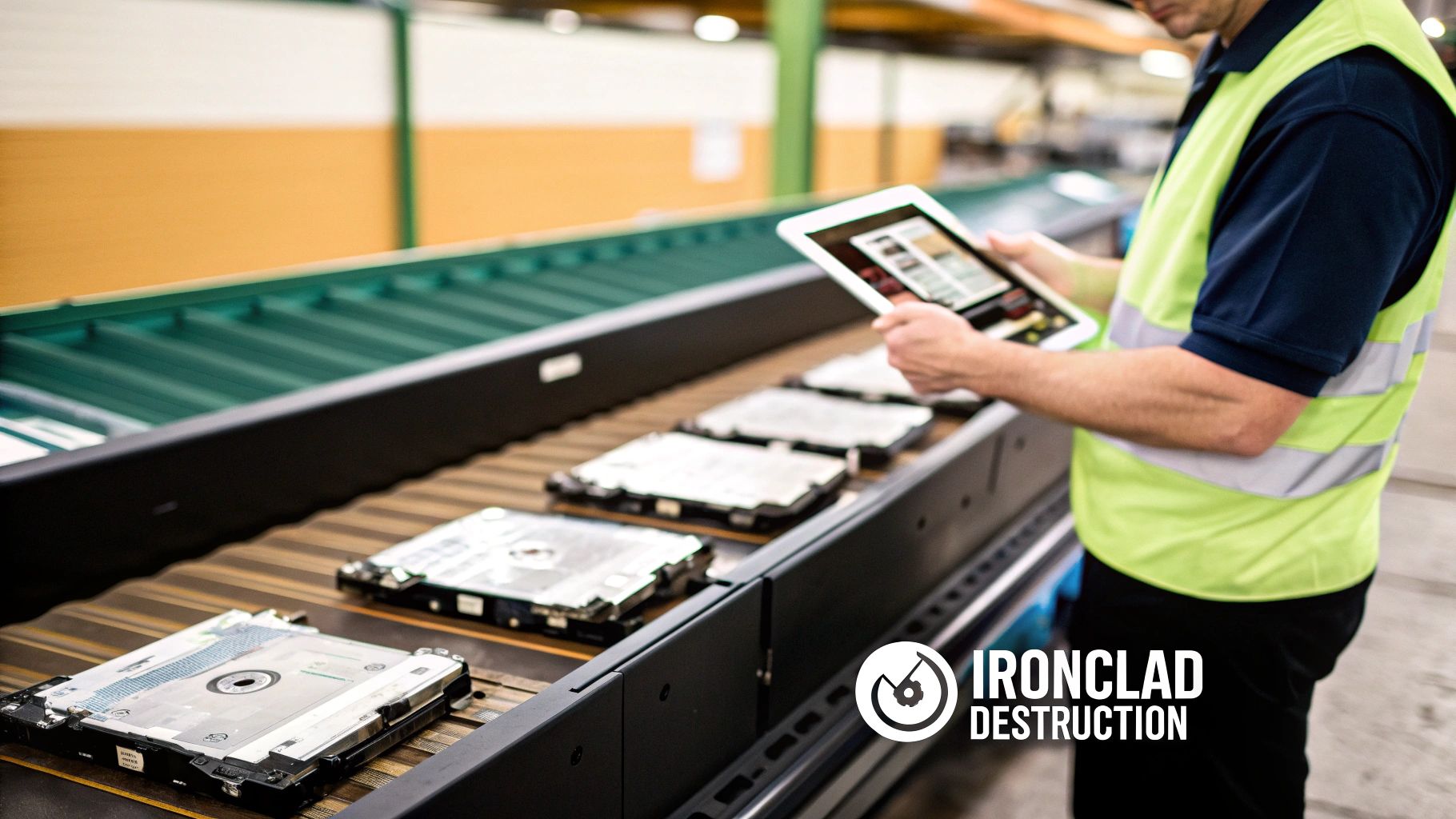
When it comes to the actual destruction, we utilize state-of-the-art shredding technology that far surpasses simple data wiping. Our industrial shredders physically pulverize hard drives, SSDs, and other media into tiny, confetti-like fragments, making data recovery absolutely impossible.
This physical destruction method is recognized by leading standards as the most secure way to permanently eliminate data. The Certificate of Destruction you receive will specify this shredding process, providing the solid proof required for any compliance audit.
By choosing Reworx, you are not just meeting a compliance requirement; you are selecting a partner dedicated to the highest standards of data security and environmental stewardship.
More Than Compliance—It's a Community Impact
Partnering with Reworx Recycling for your IT equipment disposal transforms a standard operational task into a powerful act of corporate social responsibility. As a donation-based social enterprise, your retired assets fuel our mission to support the community.
Here’s how it works:
- Secure Destruction: First, we guarantee the secure destruction of all data on every device.
- Responsible Recycling: We then responsibly recycle all shredded materials and non-reusable components, keeping hazardous e-waste out of landfills.
- Community Support: Finally, we refurbish non-sensitive, viable equipment and donate it to support digital inclusion programs, workforce development, and provide essential technology to those in need.
This model allows you to protect your data while making a tangible, positive impact on the environment and your community. While the global e-waste recycling rate hovers at a mere 22.3%, your partnership with us ensures your assets are handled responsibly. The US electronics recycling market, valued at $14.1 billion in 2024, is driven by the need for compliant practices, and our certificate proves you’ve met that standard. You can explore more about the global e-waste challenge and see how different regions compare by reading these insightful e-waste statistics.
Our detailed documentation, including a comprehensive Certificate of Destruction, not only satisfies your legal and compliance needs but also tells a story of positive social and environmental impact. For a deeper look at our secure processes, learn more about our professional equipment decommissioning services. We provide the security you demand and the purpose you value.
Common Questions We Hear About Data Destruction
Even with a strong IT asset disposition strategy in place, specific questions about the documentation are bound to arise. Let’s clarify a few common points about Certificates of Destruction so you can manage the final steps with complete confidence.
What's the Difference Between a CoD and Data Wiping?
This is a very common point of confusion, and it’s a critical one to understand. Data wiping, also known as erasure, is the action of using specialized software to completely overwrite data on a drive, making it unrecoverable.
A Certificate of Destruction (CoD) is the proof. It is the official, legally defensible document confirming that a secure process—whether data wiping or physical destruction like shredding—was completed correctly and verifiably. Think of wiping as the service and the CoD as your formal, auditable record. While some software tools generate reports, a formal CoD from a certified partner like Reworx guarantees an end-to-end secure chain of custody.
How Long Do I Need to Keep a Certificate of Destruction?
There is no single answer, as it depends on your industry’s compliance regulations. However, as a solid rule of thumb, you should plan on retaining all Certificates of Destruction for a minimum of three to five years.
For businesses in more heavily regulated sectors, that timeline extends:
- Healthcare (HIPAA): You will need to retain those records for at least six years.
- Finance (SOX/GLBA): Retention periods can extend to seven years or more.
It is always best to consult with your own legal or compliance team to establish a policy that covers all your specific requirements.
The simplest way to think about it is this: keep the certificate for as long as you could possibly be audited for the data that was on that device. It's your defensible proof if anyone ever comes asking.
Is a Digital CoD as Valid as a Paper One?
Absolutely. In fact, a securely delivered and digitally signed PDF is often preferable to a paper copy. Digital certificates are far easier to file, search for, and integrate into your existing record-keeping systems without requiring physical storage.
The most important factor is authenticity. A valid digital CoD must come from a trusted vendor and should include security features like a digital signature to prove it has not been altered. If you want to explore more topics like this, feel free to visit our Reworx Recycling FAQ section.
What if My Vendor Won’t Provide a Detailed Certificate?
That is a significant red flag. If a vendor provides a generic, vague certificate—or worse, refuses to provide one at all—they are not adhering to professional standards. This puts your organization at serious risk.
A proper, compliant certificate must include details such as the unique serial numbers of the destroyed assets, the specific destruction method used, the date of completion, and an authorized signature. If your current partner is hesitant to provide this, it's time to find a new one. A reputable ITAD provider like Reworx Recycling understands that a detailed Certificate of Destruction isn't optional; it's a fundamental part of the security and trust you are paying for.
At Reworx Recycling, our mission is to help businesses like yours manage IT equipment disposal securely and responsibly. We issue detailed, audit-proof Certificates of Destruction for every project, providing the peace of mind and documentation you need to stay compliant. By choosing our donation-based recycling services, you not only protect your data but also contribute to our social mission of supporting communities through technology, digital inclusion, and workforce development.
Ready to dispose of your old IT equipment with confidence? Contact Reworx Recycling today to schedule a pickup or learn more about our corporate donation programs. Partner with us to make a secure, sustainable, and impactful choice.