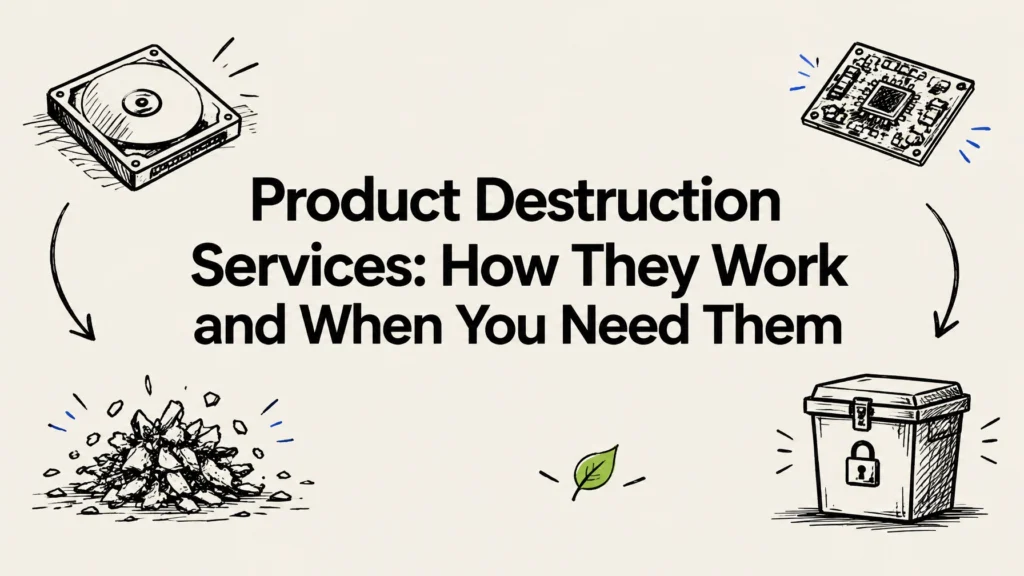
Product destruction services securely render products, equipment, or storage media unusable when they must not be reused, resold, or put back into circulation. A provider assesses what you have, selects a suitable method, manages the items through pickup and processing, and gives you proof of completion.
For businesses, the need may come up during a product recall, equipment refresh, office move, or end-of-life cleanup. The right approach depends on what needs to be destroyed, whether it stores data, and how much visibility you need during processing.
What can product destruction services handle?
The term covers more than one kind of item. A service may handle data-bearing electronics, such as hard drives, laptops, servers, and phones, or products that should no longer be used or sold, such as defective, recalled, branded, or obsolete inventory.
Not every provider processes every material. Electronics recyclers focus on IT equipment and e-waste, while products such as branded apparel or certain regulated materials may need a specialist. Before booking, give the provider an accurate inventory and ask which items it accepts, how it will process them, and what happens to the material afterward.
Data-bearing products need special attention. Destroying the device’s outer casing does not necessarily destroy the storage media inside. For a hard drive or SSD, the process should address the media itself or use an appropriate data-sanitization method before the equipment is reused or recycled.
Common product destruction methods
The method should fit the item and the outcome you need. Industrial shredding, crushing, and degaussing each work differently, and they are not interchangeable.

| Method | Best suited for | Security fit and typical use |
|---|---|---|
| Shredding | Hard drives, electronics, and other items a suitable shredder can process | Physically breaks items into fragments. Often chosen when the product or storage media must not be reused. |
| Crushing | Bulky equipment or products that are difficult to feed into a shredder | Deforms or flattens an item. Confirm that it destroys the important components, especially the storage media, rather than just damaging the outer case. |
| Degaussing | Suitable magnetic media, such as certain hard drives or tapes | Uses a strong magnetic field to disrupt stored data. It does not destroy the device and does not work on SSDs or flash storage. |
Shredding
Industrial shredding reduces a product or storage device to fragments. When the device contains data, the process needs to reach the storage components. Ask what kinds of items the equipment can handle and what happens if a device cannot be processed as planned.
Crushing
Crushing applies force to bend or flatten an item. It can be useful for bulky products, but a damaged casing is not the same as destroyed data. If a device contains a hard drive or SSD, ask whether the storage media will also be destroyed or handled separately.
Degaussing
Degaussing targets magnetic data on compatible media. It is not a physical-destruction method, and it is not suitable for SSDs, USB flash drives, or other non-magnetic storage. If you are unsure which media your equipment contains, ask the provider to identify it before selecting a method.
For data-bearing equipment that may still be usable, a secure wipe can be a better fit than physical destruction. Reworx can securely wipe data using NIST 800-88-style processes when appropriate, or arrange hard drive shredding when physical destruction is the better route. The method should match the storage type, condition, and requirements of your organization.
On-site or off-site destruction?
With on-site destruction, processing takes place at your location. This can let your staff observe the work and reduce the time items remain in transit before destruction. It may require more scheduling and coordination, and availability can depend on the equipment and items involved.
With off-site destruction, the provider picks up items and transports them to a processing facility. This can be practical for larger or mixed equipment batches. Ask how items are secured during pickup and transport, how the handoff is recorded, and how the provider confirms which items were processed.

Neither option is automatically right for every business. Think about the sensitivity of the products or data, the volume, your location, and whether witnessing the process matters to your team. Reworx is headquartered in Smyrna, Georgia, in metro Atlanta, and provides nationwide service across all 50 states.
What happens from pickup to proof?
The exact steps vary with the type and quantity of products, but a clear process helps you keep track of items from collection through final handling.
- Describe and inventory the items. Share product types, quantities, locations, and any data-bearing devices. Identify items that are recalled, defective, branded, or subject to internal handling requirements.
- Choose the destruction approach. Confirm which method is appropriate for each item. Separate magnetic media from SSDs and other flash storage, since they need different treatment.
- Arrange collection and handoff. Agree on pickup details and how items will be secured and accounted for while they are in transit. For off-site processing, ask how the provider records the transfer.
- Process the items. The provider performs the agreed work. For data-bearing equipment, that may mean an appropriate wipe or physical destruction such as hard drive shredding.
- Review the outcome. Confirm what was processed, whether any items could not be completed as planned, and what proof you will receive. A certificate of destruction is useful confirmation of the service.

A certificate of destruction can help document that products or media were processed. For this service overview, the main point is simple: ask what items and methods the certificate covers. Your organization can decide what additional records its policies or obligations require.
When might a business need product destruction services?
Professional destruction may be useful when products should not return to use or when devices leave your organization’s control. Common situations include:
- A recall or product defect: Keep affected products from being resold, reused, or accidentally returned to inventory.
- A technology refresh: Dispose of old laptops, servers, hard drives, and network equipment while protecting data.
- A facility move or cleanout: Process accumulated, obsolete equipment without leaving items in an unsecured storage area.
- Sensitive prototypes or branded goods: Prevent items from circulating when their design, branding, or condition could create a business risk.
- A policy or contractual requirement: Follow the handling process established by your organization, customer agreements, or applicable rules.
For recalled products, don’t send items straight to a general waste stream without checking your organization’s instructions. Quarantine them if needed, record what you have, and confirm the approved method of disposition with the responsible product or compliance team.
Businesses retiring devices can also combine destruction decisions with broader IT asset disposition services. That makes it easier to consider which items should be destroyed, which may be eligible for reuse, and which should go to responsible recycling.
How to choose a provider
Before scheduling, ask practical questions that clarify the service:
- Does the provider accept every item in your inventory?
- Which method will be used for each product and data-storage type?
- Can the work take place on-site, off-site, or either way?
- How will the provider secure and track items during pickup and transport?
- What proof of completion will you receive?
- How will reusable equipment and remaining materials be handled?
A good partner should be able to explain the process in plain language. If you need data destroyed, ask specifically whether the provider will wipe suitable devices or physically shred their drives. Reworx offers free nationwide pickups and free data destruction; ask us which option fits the equipment and how the pickup can be scheduled. Businesses with eligible working equipment can also ask about equipment buyback, which may be an alternative to destroying reusable assets.
For electronics that have reached end of life, responsible downstream handling matters too. Reworx supports electronics recycling through certified eco-friendly programs and R2-style responsible downstream processing. Refurbished technology may also support our mission of bridging the digital divide by helping marginalized and vulnerable communities access technology for education and career readiness.
Frequently asked questions
What is product destruction?
Product destruction is the controlled processing of items that should not be reused, resold, or put back into circulation. The method may involve physical destruction, such as shredding or crushing, or a separate data-sanitization step for reusable devices.
What can product destruction services destroy?
Depending on the provider, services may handle electronics, hard drives, servers, phones, recalled items, prototypes, or branded goods. Ask about accepted materials before arranging pickup, especially for batteries or products that may need specialized handling.
What’s the difference between on-site and off-site destruction?
On-site means processing happens at your location, where staff may be able to observe the work. Off-site means items are collected and processed elsewhere, so secure transport and recorded handoffs are important parts of the service.
How do I prove my products were destroyed?
Ask for a certificate of destruction that confirms the service and identifies the work it covers. You can also ask how the provider tracks items through pickup and processing, and keep the records with your organization’s project documentation.
Why can’t we just throw recalled products away?
A general waste bin may not prevent a recalled or defective item from being recovered or reused. Follow your organization’s recall instructions, keep affected items accounted for, and confirm an appropriate destruction or recycling route.
Plan your next pickup
Start with an inventory and flag data-bearing devices, recalled products, or items that should not be reused. Reworx provides nationwide pickups across all 50 states, free data destruction, hard drive shredding, flexible after-hours scheduling, and easy text-for-service. Explore electronics recycling or text Reworx to discuss a pickup and the right handling approach for your equipment.