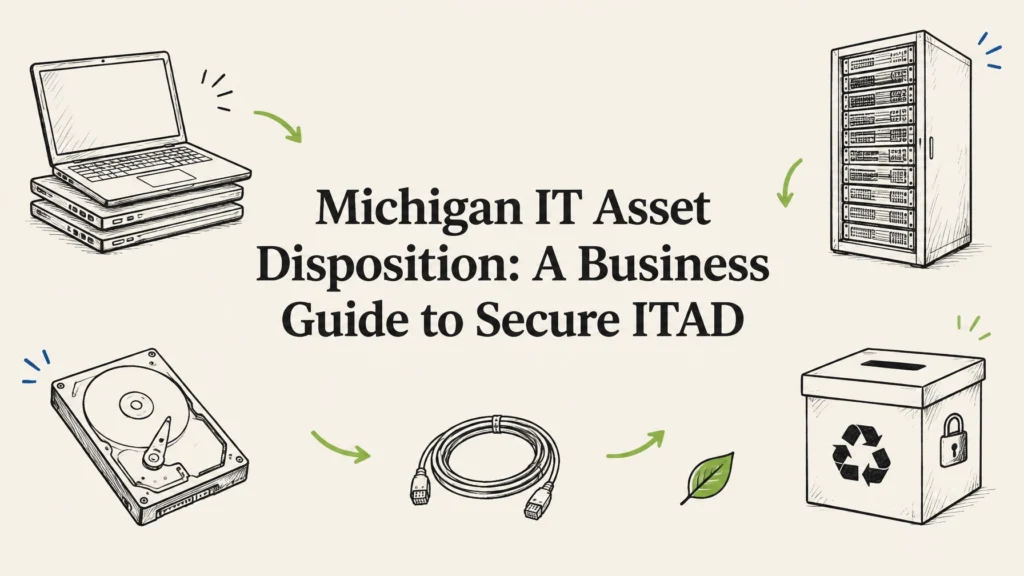
For Michigan organizations, IT asset disposition (ITAD) is the secure, documented process for retiring, collecting, sanitizing, reusing, reselling, or recycling business technology. A sound ITAD plan helps protect sensitive data, create a clear record of what happened to each asset, and recover value from equipment that still has a useful life.
If retired laptops, servers, or network equipment are gathering dust in a storage room, you can treat them as an asset-control project, not just a cleanup job. Here’s how to plan secure IT equipment disposal and choose an ITAD partner that fits your needs.

What IT asset disposition in Michigan should include
ITAD begins when equipment is taken out of service, not when it reaches a recycling facility. The process should account for the device, any data it holds, who has custody of it, and its final destination.
A business ITAD project may include:
- Laptops, desktops, phones, tablets, and monitors
- Servers, storage arrays, backup devices, and network equipment
- Printers, cables, docking stations, and related electronics
- Data sanitization or physical destruction for storage media
- Testing and sorting for redeployment, refurbishment, resale, donation, or recycling
- Inventory and disposition records your team can retrieve later
This is especially useful for organizations managing hardware refreshes, office moves, data center changes, or equipment from multiple sites. It also helps close the gap between an asset being removed from service and your records showing that it was securely and responsibly handled.
Secure IT equipment disposal: protect data and document the handoff
Deleting files or reinstalling an operating system does not, by itself, prove that data is unrecoverable. Choose a data-handling method based on the device, media condition, sensitivity of the information, and whether the equipment will be reused.
For reusable, functioning drives, a documented wipe following NIST 800-88-style practices may be appropriate. For failed drives or media that your policy requires to be destroyed, hard drive shredding is a physical option. Ask your provider to explain how it chooses between wiping and shredding, and what happens when a drive cannot be accessed or identified.
A strong process also follows the equipment through collection, transport, and final disposition. Request serialized tracking when available, clear custody records, and a certificate of destruction for data-bearing devices that are wiped or shredded. These records can help your team respond to internal reviews and support security obligations involving information covered by rules such as HIPAA or PCI DSS. They do not replace your organization’s own legal or compliance advice.
Michigan’s Identity Theft Protection Act addresses the destruction of personal information in certain circumstances. Businesses should understand how their policies apply, especially when equipment may hold personal information. You can review the Michigan statute and consult your legal or compliance team about your specific obligations.

How to plan ITAD services in Michigan
Use this checklist to get your organization ready before the equipment leaves your site:
- Build a working inventory. Gather records from IT, facilities, procurement, and individual departments. Include serial numbers where possible, asset tags, device types, quantities, and site locations.
- Confirm ownership and status. Identify leased equipment, devices scheduled for redeployment, and hardware that needs approval from a department or asset owner before release.
- Separate equipment by risk and destination. Flag devices that may hold sensitive information. Decide which assets may be wiped for reuse and which storage media should be shredded.
- Prepare the equipment. Back up any business information you need to retain. Sign out of accounts, remove SIM cards from phones, and gather loose accessories. Keep data-bearing devices secure until handoff.
- Agree on pickup and custody details. Confirm site access, collection responsibilities, inventory reconciliation, and any scheduling needs, including after-hours work.
- Review the final records. Request disposition reporting and certificates of destruction, then update your asset register and review exceptions such as missing tags or failed drives.
A little preparation makes it easier to spot discrepancies while your team still has the equipment on hand. For larger projects, ask the provider how it will handle multiple locations, changes to the inventory, and devices that arrive without labels.
Compare ITAD providers, general recycling, and junk removal
The right option depends on what you are disposing of. A routine cleanout of non-data-bearing materials is different from retiring servers or employee laptops.
| Option | Best suited for | Common limitation |
|---|---|---|
| General recycling | Electronics with low data risk and simple disposal needs | May not provide the asset tracking or data records your business needs |
| Junk removal | Moving unwanted items out of a space | Physical removal alone does not establish secure data handling or final disposition |
| ITAD provider | Business equipment requiring custody controls, data destruction, reporting, and value recovery | Requires planning and agreement on inventory, data methods, and outcomes |
For business ITAD, a provider should be ready to explain its end-to-end process, not just how quickly it can clear a room. Ask whether it offers free data destruction and free nationwide pickups, and whether it can coordinate secure, flexible collection options. Tamper-proof drop-off boxes or after-hours recycling scheduling may help when a site has access restrictions or cannot pause normal operations. Reworx also offers text-for-fast-response service for teams that want to get pickup questions answered quickly.
Questions to ask an ITAD provider
Before you sign off on a project, ask:
- How will you track equipment from collection through final disposition?
- What information appears on the certificate of destruction?
- Do you wipe drives, shred them, or offer both methods?
- How do you handle failed, missing, or unidentifiable storage media?
- Which downstream partners receive equipment or materials, and how do you document those transfers?
- Can you identify equipment that may qualify for reuse, donation, or equipment buyback?
- What scheduling options are available for sites across Michigan?
Ask for sample reporting and clear answers about exceptions. For example, if a listed device is missing at pickup, you should know how the difference will be recorded and who will follow up.
Recycling, reuse, and value recovery
Not every retired device needs the same outcome. Equipment that is still functional may be suitable for redeployment, refurbishment, resale, donation, or buyback, depending on its condition and market value. Older or damaged equipment may be better suited to responsible recycling.
A provider should explain how it makes those decisions and how it manages downstream processing. Reworx supports certified eco-friendly recycling programs and responsible downstream processing aligned with R2-style practices. When comparing providers, ask what certifications apply to the specific facilities and services involved, and how the provider can document downstream accountability.
Reuse can also make a retired asset useful to someone else. Reworx is a social enterprise that gives refurbished tech to marginalized and vulnerable communities for education and career readiness. Where equipment is suitable, that creates a community benefit alongside secure handling and responsible disposition.
For more information about Reworx IT asset disposition, its hard drive shredding service, or its electronics recycling program, review the service details and ask how they fit your project.
Nationwide ITAD support for Michigan businesses
Michigan organizations can use nationwide pickup logistics to coordinate equipment collection across offices, campuses, and other sites. Reworx is headquartered at 1835 S Cobb Industrial Blvd SE #103, Smyrna, GA 30082, in metro Atlanta, and serves Michigan remotely through its nationwide logistics.
For a single-site refresh, start with an inventory and data-destruction plan. For a multi-location project, identify a contact at each site and agree on how equipment will be packed, counted, and released. Reworx offers free nationwide pickups and free data destruction, with wipe or hard drive shredding options and certificates of destruction. Ask about tamper-proof drop-off box options and flexible, including after-hours, recycling scheduling when coordinating site access.
FAQs about ITAD services in Michigan
What does ITAD include?
ITAD includes the controlled retirement, collection, data handling, and final disposition of IT equipment. Depending on the asset, that may mean redeployment, refurbishment, resale, donation, or responsible recycling, with records to document the process.
How much do ITAD services cost?
Costs depend on the equipment, project scope, logistics, and requested services. Ask for a project-specific quote and confirm whether pickup, data destruction, reporting, and any equipment buyback value are included.
Is wiping a hard drive enough, or should it be shredded?
It depends on the media, its condition, your data-handling policy, and the equipment’s intended destination. A documented wipe may suit a working drive being prepared for reuse; shredding is an option when physical destruction is required or the drive cannot be reliably wiped.
What should a Michigan business ask an ITAD vendor?
Ask how the provider tracks assets, protects custody, selects data-destruction methods, documents downstream processing, and handles exceptions. Also ask which certifications apply to the services and facilities in your project.
Can an ITAD provider pick up equipment from multiple Michigan locations?
Nationwide providers can coordinate pickups across multiple sites. Share your locations, approximate inventory, access constraints, and preferred schedule so the provider can plan collection and reporting.
Ready to clear retired technology without losing track of security, value, or final disposition? Gather a basic equipment list, then contact Reworx to discuss a free nationwide pickup. You can also text Reworx for a fast response about your Michigan ITAD project.