For Maine businesses searching for "electronics recycling near me," the solution isn't as simple as a local drop-off. While the state offers an excellent program for residents, corporate needs for secure and compliant IT equipment disposal require a more robust strategy. What your organization needs isn't just recycling; it's a comprehensive process known as IT Asset Disposition (ITAD).
Reworx Recycling, a donation-based social enterprise, offers Maine businesses a path to not only meet environmental regulations but also enhance corporate social responsibility through secure ITAD services.
Why Standard E-Waste Programs Fall Short for Maine Businesses
Maine is a leader in environmental stewardship, with a manufacturer-funded e-waste program that has successfully diverted millions of pounds of electronics from landfills. This system is ideal for households and very small businesses disposing of items like TVs and computers. However, it was never intended to manage the complex requirements of a corporate technology refresh, office cleanout, or data center decommissioning.
For businesses, the risks associated with retiring IT assets extend far beyond simple disposal.
This is where the distinction between consumer recycling and professional ITAD is crucial. Your organization’s retired devices are not just "old computers"; they are assets containing sensitive data, from customer information to proprietary business intelligence. Disposing of this equipment involves navigating significant compliance, security, and logistical challenges that municipal programs are simply not equipped to handle.
The Limits of State-Run Programs for Corporate Needs
Maine’s product stewardship program is a model of success, having recycled nearly 103 million pounds of electronics between January 2006 and December 2021. The system effectively serves its target audience by covering common consumer electronics.
However, for a corporation, this model presents critical gaps:
- No Secure Data Destruction: State programs do not offer certified data destruction, leaving your business vulnerable to data breaches.
- DIY Logistics: Businesses are expected to transport their own equipment, an impractical solution for facility cleanouts involving hundreds of devices.
- Lack of Documentation: You will not receive an auditable chain of custody or a Certificate of Destruction, which are essential for proving compliance with regulations like HIPAA or GDPR.
- Limited Scope: Specialized assets such as data center hardware, medical equipment, or laboratory equipment disposal are typically not covered.
For IT managers and corporate sustainability leaders, the objective is not just equipment disposal. It’s about safeguarding the company, ensuring regulatory compliance, and maximizing the social and environmental value of retired assets.
Introducing IT Asset Disposition (ITAD)
ITAD is the strategic business process designed to manage the complete end-of-life cycle for IT equipment. It is far more sophisticated than basic recycling. A dedicated ITAD partner like Reworx Recycling manages every step, from secure on-site pickup to final, documented disposition.
The process includes secure logistics, meticulous inventory tracking, certified data destruction, and environmentally responsible recycling. Crucially, it also emphasizes refurbishment and donation, aligning with corporate social responsibility (CSR) objectives. Through ITAD, businesses can transform a disposal challenge into a community benefit.
Maine's State Program vs. Business ITAD Services
To clarify the differences, here is a comparison between Maine's residential program and the comprehensive ITAD services required by businesses.
| Feature | Maine State E-Waste Program | Reworx Recycling Business Services (ITAD) |
|---|---|---|
| Primary Audience | Residents, schools, small businesses (<100 employees) | Small, mid-size, and enterprise businesses |
| Data Security | No certified data destruction services offered | Certified data wiping and physical destruction |
| Logistics | Self-service drop-off at designated locations | Secure, GPS-tracked pickups from your facility |
| Documentation | Basic receipts at drop-off | Auditable chain of custody, Certificates of Destruction |
| Accepted Items | TVs, computers, printers, monitors | All IT assets, including servers, networking gear, medical devices |
| Value Recovery | None; focused on responsible disposal | Asset remarketing, refurbishment, and component harvesting |
| Compliance | Meets state environmental laws for consumers | Designed for HIPAA, GDPR, FACTA, and other data privacy laws |
As this table illustrates, while the state program is excellent for its intended purpose, corporate requirements operate on a different level of security and compliance.
To learn more about how these services are tailored for organizations, explore our in-depth guide to Maine ITAD services. This approach ensures your search for electronics recycling in Maine leads to a solution that is secure, compliant, and socially responsible.
Preparing Your IT Assets For Secure Disposal
Before any device leaves your facility, the most critical task is to secure the data it contains. For any Maine business, this process is far more complex than a simple factory reset. A basic reset often leaves sensitive corporate, employee, and customer data recoverable, creating a significant liability.
Protecting this information is a legal and ethical imperative. A single hard drive from a retired server or old laptop can contain thousands of files with proprietary information, financial records, and personal details. If compromised, the consequences can include costly data breaches, regulatory penalties, and damage to your brand's reputation.
This is why professional data sanitization is essential—it ensures all information is permanently and irretrievably destroyed before the asset is recycled, resold, or donated.
Beyond The Factory Reset
Factory resets are designed for consumer convenience, not corporate data security. They typically remove pointers to data without overwriting the files, making information surprisingly easy to recover with the right software. For businesses subject to compliance standards like HIPAA or FACTA, this method is inadequate.
Professional secure data destruction relies on verifiable methods to guarantee that information is permanently eliminated. Three primary standards are used to achieve this.
- Software-Based Wiping: Specialized software overwrites every bit of data with random characters, often in multiple passes. This is an ideal solution for devices destined for refurbishment and reuse, as the hard drive remains functional.
- Degaussing: A powerful magnetic field is used to scramble the data on magnetic media like traditional hard disk drives (HDDs) and backup tapes, rendering the drive inoperable.
- Physical Shredding: For the highest level of security, the hard drive or entire device is fed into an industrial shredder that reduces it to small, unrecognizable pieces. Data recovery is impossible.
A common scenario involves a medical practice upgrading its office computers. Simply dragging patient files to the trash is a clear violation of HIPAA. The practice must ensure every hard drive is sanitized using a certified method—and receive documentation to prove it—before those computers are disposed of.
This flowchart helps visualize the different paths for electronic waste in Maine, highlighting the divergence between residential needs and business requirements.
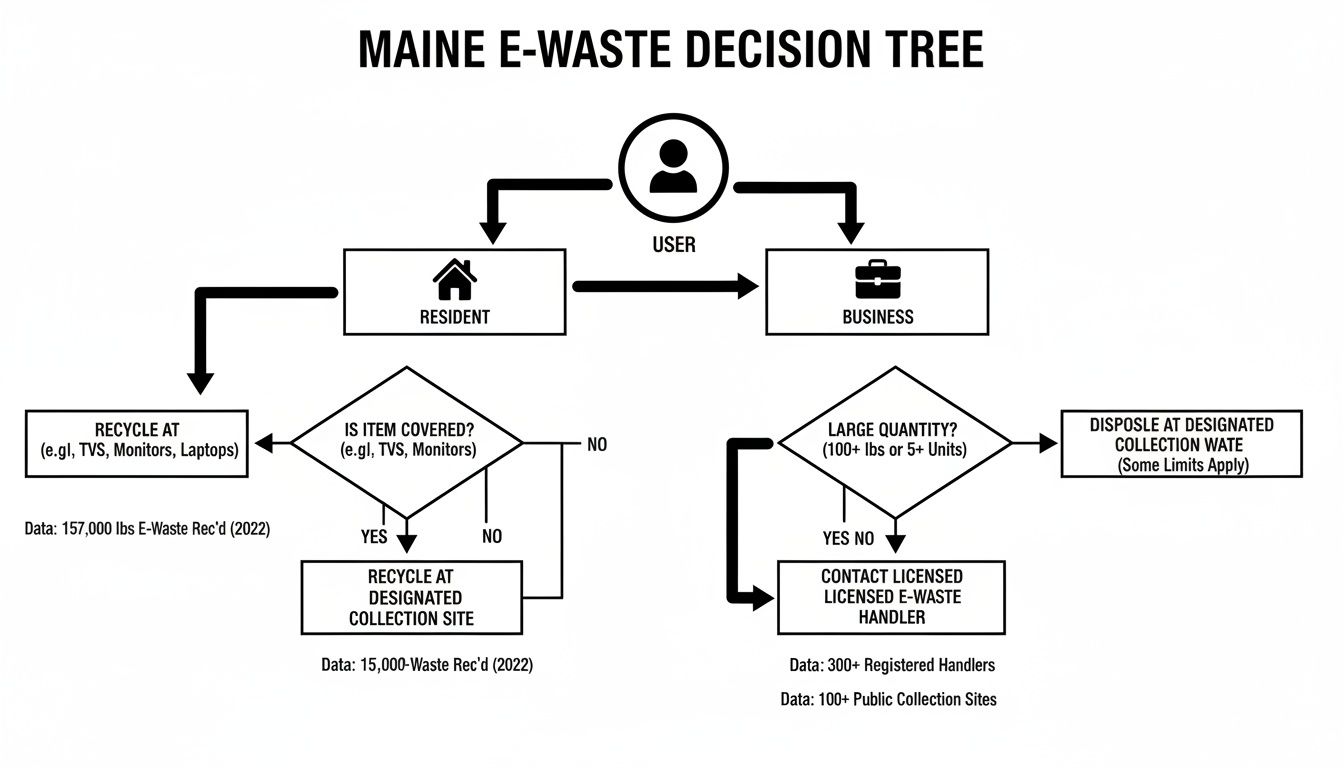
As shown, residents have a direct route to local drop-off sites. Businesses, however, must incorporate critical steps like data security and certified disposal, which are best managed by a professional ITAD partner.
The Importance Of Certified Destruction
How can you be certain your data has been properly destroyed? Partnering with a certified IT asset disposition provider like Reworx Recycling provides this assurance. We don't just promise security; we prove it.
Our data destruction processes adhere to rigorous standards, including those from the National Institute of Standards and Technology (NIST). Upon completion, we issue a Certificate of Destruction.
This legally binding document serves as your official record and details:
- The specific devices processed
- The unique serial numbers of the assets
- The date and method of destruction
- Confirmation that the process was completed according to industry regulations
This certificate is your proof of due diligence, demonstrating to auditors, stakeholders, and clients that you have taken all necessary measures to protect sensitive information. Partnering with a professional for projects like a data center decommissioning or an office cleanout eliminates guesswork, mitigates risk, and ensures your business remains secure and compliant.
Understanding Maine E-Waste Laws And Business Compliance
Navigating Maine's e-waste regulations is the first step for any business committed to responsible disposal. While the state's manufacturer-funded program is beneficial for residents, schools, and very small businesses, larger organizations must understand its limitations.
Maine’s law is specific about what it defines as "covered electronic devices," focusing primarily on electronics found in a typical home or small office.
What Maine's State Program Covers
The primary items accepted at municipal drop-off points under the state’s program typically include:
- Televisions and Computer Monitors: This includes older CRT monitors, flat-panel screens, and plasma TVs.
- Computers (CPUs): Both desktop towers and laptops are covered.
- Printers and Scanners: Most desktop printers, scanners, and all-in-one machines with screens larger than four inches are included.
- Game Consoles and Digital Picture Frames: These devices are also part of the state program.
While this program has been highly effective, it is not immune to market fluctuations. After peaking at 8.5 million pounds collected annually, collections fell to approximately 3 million pounds in 2023 due to various industry challenges. This highlights why businesses cannot solely rely on public programs for consistent compliance.
Beyond The Basics: Business Compliance Responsibilities
For most businesses in Maine, compliance extends far beyond the state's list of covered devices. The heavy-duty equipment that powers your operations—and stores your most sensitive data—almost always falls outside the scope of municipal recycling programs. This equipment requires a specialist for both environmental safety and data security.
This is where a dedicated ITAD partner becomes essential.
Consider these common business scenarios and the types of equipment involved:
- Data Center Decommissioning: This includes servers, storage area networks (SANs), switches, routers, and uninterruptible power supplies (UPS). None of these are covered by the state program, and all contain vast amounts of sensitive data.
- Medical Equipment Disposal: Hospitals and clinics retire everything from diagnostic imaging machines and patient monitors to lab analyzers. This equipment must be handled in compliance with HIPAA to protect patient privacy.
- Laboratory Equipment Disposal: Scientific labs use specialized instruments like spectrometers, chromatographs, and electronic testing equipment. Proper disposal requires ensuring sensitive research data is destroyed and any hazardous materials are managed correctly.
A common misconception is that if a device plugs into the wall, it can go to the local e-waste drop-off. For a business, the critical question isn't "Is it electronic?" but "What are my legal and security obligations for this asset?"
Navigating The Complexities With A Certified Partner
A certified ITAD provider like Reworx Recycling is designed to fill this gap. We specialize in managing assets that standard programs cannot handle. Our processes are engineered to manage the logistics, security, and environmental challenges of corporate electronics disposal.
We ensure that every piece of equipment, from a full server rack to a specialized medical device, is processed according to the highest industry standards.
When you work with a certified expert, you gain peace of mind knowing your company is compliant with all relevant regulations, not just basic state laws. This transforms a major compliance burden into a streamlined, secure, and fully documented process.
Finding Local Recycling and Commercial Pickup Services
For a Maine resident with an old TV or laptop, a search for "electronics recycling near me Maine" will quickly lead to a local drop-off location through the state's robust program.
However, for a business, the logistics are entirely different.
An IT manager in Portland facing an office cleanout or a facility manager in Bangor overseeing a tech refresh cannot simply load hundreds of computers, servers, and monitors into a truck. This approach is not only a logistical nightmare and a drain on employee time but also a significant security risk.
This is where the distinction between a consumer drop-off and professional commercial services becomes crucial.
Why Self-Service Doesn't Work for Businesses
Attempting to use public e-waste programs for corporate disposal creates major problems that can be costly in the long run.
- Wasted Resources: Your team's time is valuable. Diverting them from their primary responsibilities to handle equipment disposal is a significant loss of productivity.
- Major Security Gaps: Public drop-off sites are not secure environments. Leaving pallets of company computers unattended is an open invitation for theft and a potential data breach.
- No Documentation: You will not receive the critical paperwork needed for compliance, such as a chain of custody or a Certificate of Destruction, which is problematic during an audit.
These challenges demonstrate why a structured, professional approach is essential for any company that values its data and assets.
The Professional ITAD Pickup Process
A dedicated IT Asset Disposition (ITAD) partner like Reworx Recycling fundamentally changes the disposal process. Instead of you struggling to transport assets to a recycler, we bring the entire secure recycling service to your facility. Our commercial pickup services are designed to eliminate logistical hassles and provide a seamless, secure handoff.
The process is straightforward and tailored to your specific needs. It begins with a consultation to understand the scope of your project, whether it's disposing of a few dozen laptops or a full data center decommissioning. From there, our team manages every detail.
For a business, professional pickup is about more than convenience. It’s the first step in establishing a secure, documented chain of custody that protects the organization from the moment an asset leaves the building to its final disposition.
We handle the entire logistical process, freeing your internal team to focus on their core responsibilities.
This includes:
- On-Site Coordination: Our logistics team works with your facility managers to schedule a pickup that minimizes disruption to your operations.
- Secure Packing and Palletizing: We provide all necessary materials and labor to safely pack and prepare your assets for transport.
- Professional Transport: Your equipment is loaded onto secure, GPS-tracked vehicles, ensuring it is safe and accounted for from your loading dock to our processing facility.
A professional approach transforms a chaotic, high-risk task into a managed, secure, and efficient process. With a partner handling the details, you can be confident that every asset is managed responsibly.
How To Choose A Secure And Socially Responsible Partner
Selecting an electronics recycling partner is a decision that extends beyond logistics. It reflects your brand's commitment to security, compliance, and social responsibility. Not all ITAD providers are the same, and careful evaluation is necessary to protect your organization from potential data breaches or environmental liabilities.
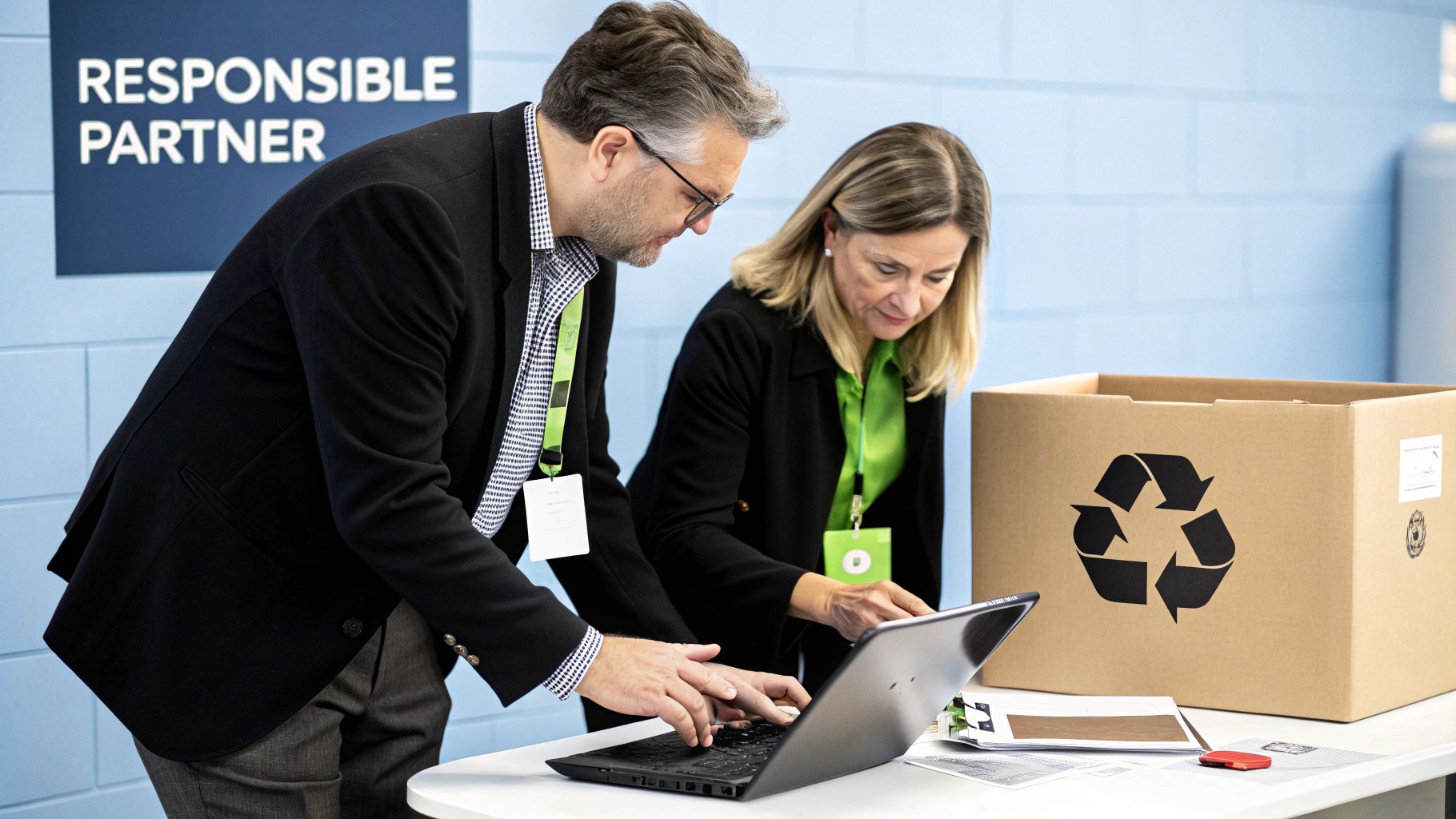
The first step in evaluating a potential partner is to verify their industry certifications. These credentials are proof that a recycler adheres to the highest standards for both environmental stewardship and data security.
Look For R2 And e-Stewards Certifications
In electronics recycling, two certifications are paramount: R2 (Responsible Recycling) and e-Stewards. A provider holding one or both has passed rigorous third-party audits of their entire operation.
- R2 Certification: This standard follows a "reuse, recover, dispose" hierarchy, ensuring functional equipment is refurbished before being recycled for materials. R2 also enforces strict requirements for data sanitization and worker safety.
- e-Stewards Standard: Known for its strict prohibition against exporting hazardous e-waste to developing countries, this certification offers the highest level of assurance for environmental protection and social accountability.
A certified partner provides a documented, auditable trail for every asset, which is essential for compliance and risk management.
Scrutinize Data Destruction Protocols
While certifications are a good start, it's crucial to examine a partner’s specific data security procedures. A vague promise to "wipe drives" is insufficient. Ask direct questions about their methods and the documentation they provide.
A secure partner should readily provide a detailed breakdown of their data sanitization process, confirm compliance with standards like NIST 800-88, and offer a sample Certificate of Destruction. Transparency in this area is non-negotiable.
Demand clarity on the entire chain of custody. Are the transport vehicles locked and GPS-tracked? Is their facility secure, with controlled access and video surveillance? These details are what protect your sensitive corporate data from a potential breach.
The Social Enterprise Advantage
While security and compliance are essential, a partnership can offer more than just disposal services. Choosing a social enterprise recycling organization like Reworx Recycling creates unique value. Unlike traditional recyclers focused solely on commodity recovery, our mission is built on community impact.
Maine has a strong history of recycling initiatives. Between 2008 and 2012, the state collected 45 million pounds of e-waste and made significant progress in recycling other materials. This spirit of responsibility aligns perfectly with the social enterprise model.
When you partner with an organization like Reworx, you transform a routine operational task into a meaningful component of your Corporate Social Responsibility (CSR) program. We prioritize refurbishment and corporate donation programs, giving your retired but functional IT equipment a second life. Instead of being destroyed, your old laptops and computers are securely data-wiped, repaired, and placed in the hands of schools, nonprofits, and community centers.
This approach achieves several objectives simultaneously:
- It promotes digital inclusion by providing technology to those who need it most.
- It extends the life of electronic devices, which is the most sustainable form of recycling.
- It generates a positive, tangible story your company can share with customers and employees.
Choosing the right ITAD partner is a strategic decision. It ensures you find a provider that not only protects your data but also enhances your brand's commitment to social and environmental good.
Common Questions About Maine Electronics Recycling
When disposing of old technology, many questions arise. For businesses in Maine, understanding the difference between a municipal drop-off and professional ITAD services is key to maintaining compliance and security.
Here are answers to some of the most common questions we receive.
Is It Free To Recycle Electronics In Maine For Businesses?
The answer depends on the context. For residents or a home office disposing of a single covered device, dropping it off at a municipal site is often free, thanks to Maine's manufacturer-funded program.
However, for most businesses, the answer is no—and for good reason.
A simple drop-off does not provide the security, liability protection, or detailed documentation that businesses require. Comprehensive IT Asset Disposition (ITAD) services are a necessary operational expense because they include secure logistics, certified data destruction, and auditable reporting. At Reworx Recycling, we provide clear, transparent quotes for services ranging from office cleanouts to data center decommissioning, tailored to your project's specific needs.
How Can I Guarantee My Company's Data Is Destroyed?
This is one of the most critical questions a business can ask. Simply deleting files or performing a factory reset is a significant security risk, as these methods do not permanently erase data.
True data security is achieved through a professional, certified process that adheres to strict industry standards like NIST 800-88.
To provide complete peace of mind, we offer several methods to ensure your data is permanently destroyed:
- Certified Data Wiping: We use specialized software to overwrite every sector of a drive.
- Degaussing: A powerful magnetic field scrambles the data, rendering the drive unusable and the information irretrievable.
- Physical Shredding: For the highest level of security, we physically shred the drives into small metal fragments.
Upon completion, we issue a formal Certificate of Destruction. This legal document serves as your auditable proof that you have met compliance obligations and protected your company's information.
What If My Business Isn't Located In Maine?
While this guide focuses on Maine, Reworx Recycling provides nationwide ITAD and electronics recycling services. We manage secure logistics for businesses across the United States.
Whether you have a single office in Augusta or multiple locations coast to coast, our process is designed to manage the entire chain of custody—from pickup to final disposition. You receive the same secure, responsible, and socially impactful service, managed through a single point of contact to simplify the process for your team.
What Is The Difference Between Recycling And A Donation Program?
This is an important distinction that highlights the value of a socially responsible partnership.
Traditional recycling focuses on de-manufacturing electronics to recover raw materials like plastic, metal, and glass. While vital for the circular economy, it is the end of life for the device.
A corporate donation program, the core of our mission at Reworx Recycling, prioritizes reuse.
The most sustainable form of recycling is extending the life of an asset. Our social enterprise model is built on this principle, transforming what would be waste into a valuable community resource.
We begin by assessing your retired IT assets for refurbishment potential. Equipment that is still functional is professionally data-wiped, repaired, and provided to schools, nonprofits, and community organizations in need of affordable technology. This social enterprise approach not only prevents waste but also extends the value of your assets and creates a tangible, positive impact.
Ready to manage your company's IT asset disposal responsibly? The Reworx Recycling team is here to help you develop a strategy that protects your data, ensures compliance, and supports communities. Partner with us to schedule a pickup or establish a corporate donation program. Visit our blog to learn more about creating a sustainable electronics recycling program. https://www.reworxrecycling.org/category/recycling-blog