When a business is done with its old tech, what happens next? For most Colorado companies, it's not as simple as just tossing it out. That's where IT Asset Disposition (ITAD) comes in. Think of it less like disposal and more like a strategic reverse supply chain for all your retired electronics, including everything from servers and laptops to specialized medical or laboratory equipment.
A solid ITAD plan is about wringing every last drop of value from old hardware, making absolutely sure sensitive data is gone for good, and staying on the right side of Colorado's environmental laws. With a donation-based partner like Reworx Recycling, it’s also an opportunity to support digital inclusion and workforce development in our communities.
What Are Colorado ITAD Services Really About?
For the IT managers and sustainability leaders on the front lines, a smart ITAD program transforms a pile of potential liabilities into a genuine asset. It’s a complete lifecycle management plan for your outdated tech, covering everything from the moment a device is taken offline to its final recycling, donation, or resale.
This is a world away from a simple junk pickup. We're talking about a structured process that shields your company from the triple threat of data breaches, steep environmental fines, and a damaged reputation. Every old server, company laptop, or office printer is a container for both sensitive data and potentially hazardous materials, both of which are heavily regulated here in Colorado.
Beyond the Landfill: A Strategic Approach
The old way of doing things—shoving old gear into a storage closet or, even worse, sending it to the dump—just doesn't cut it anymore. It's risky, wasteful, and illegal.
A well-executed ITAD program is not an operational expense; it is a risk management essential. It protects your data, ensures compliance, and can even recover value from retired assets, directly contributing to your bottom line.
Working with a partner that specializes in Colorado ITAD services means they handle every last detail. This includes everything from secure logistics and facility cleanouts to certified data destruction and the reams of paperwork needed to prove you’ve done everything by the book. For a closer look at the basics, you can learn more about what IT asset disposition entails and why it's so critical today.
The Core Pillars of Effective ITAD
A proper ITAD process is built to tackle three core business needs: getting money back for old gear, wiping out data security risks, and meeting your environmental obligations. This flow shows how it all works together.
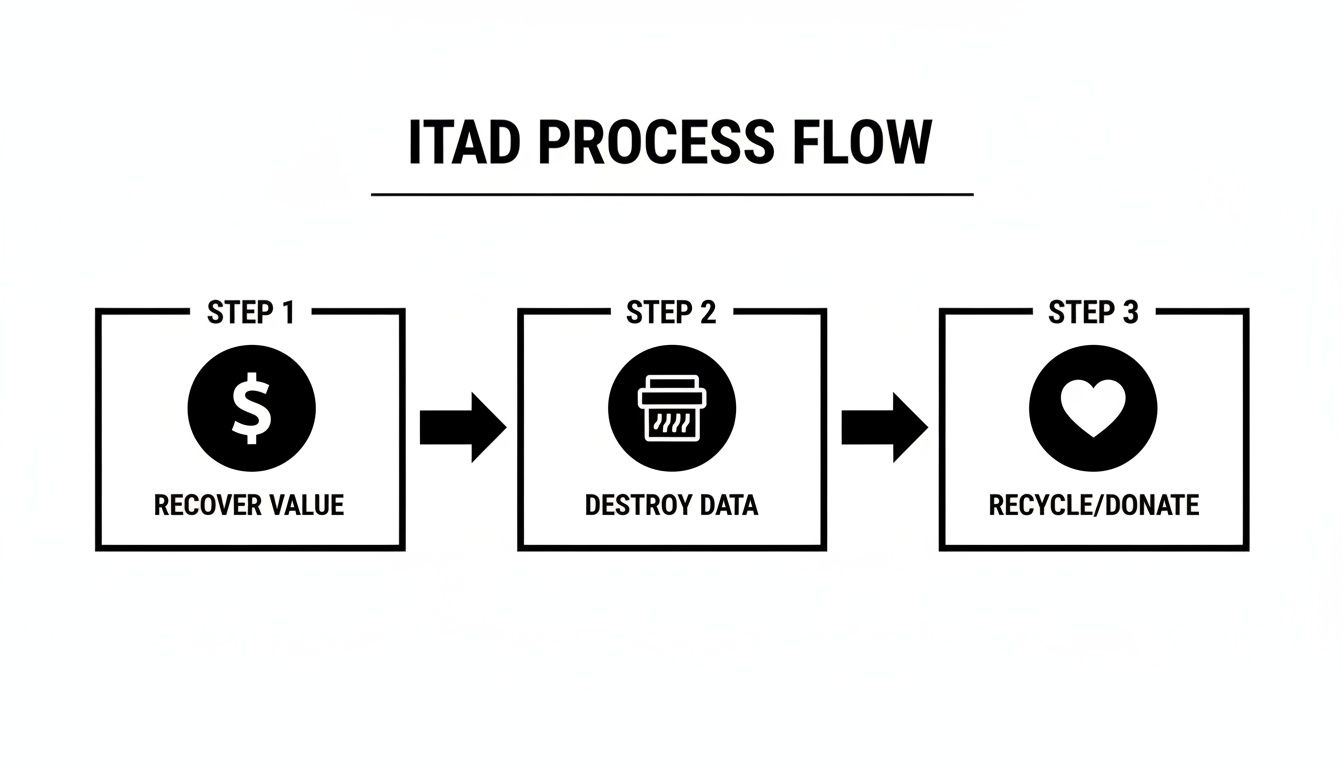
As you can see, it's not a straight line to the landfill. The journey for retired equipment is a circular one, moving from value recovery and data destruction to responsible recycling or donation. It’s about creating value, not waste.
A successful ITAD strategy covers several critical stages, each with its own set of actions and goals. Below is a table that breaks down the essential steps for any Colorado business.
Key Stages of a Comprehensive Colorado ITAD Program
| ITAD Stage | Key Action for Colorado Businesses | Primary Goal |
|---|---|---|
| Asset Discovery & Inventory | Create a detailed list of all equipment slated for retirement, including make, model, and serial number. | Establish a clear chain of custody and accountability from the start. |
| Secure Logistics | Arrange for insured, secure transportation from your facility to the ITAD vendor's processing center. | Prevent theft or loss of assets (and the data on them) during transit. |
| Data Destruction | Use certified methods like data wiping, degaussing, or physical shredding to destroy all data. | Ensure 100% data sanitization to prevent breaches and meet compliance standards like HIPAA or PCI. |
| Value Recovery | Test, grade, and refurbish functional equipment for resale on the secondary market. | Maximize the financial return on your initial technology investment. |
| Responsible Recycling | Dismantle non-working equipment and ethically recycle raw materials (metals, plastics, glass). | Comply with Colorado's e-waste laws and prevent hazardous materials from entering landfills. |
| Reporting & Certification | Receive detailed reports, Certificates of Data Destruction, and Certificates of Recycling. | Provide auditable proof of compliance, data security, and environmental responsibility. |
Following these stages ensures your program is not only compliant but also secure and financially sound, protecting your business on all fronts.
Partners like Reworx Recycling even add a social impact layer to this process. By focusing on refurbishment and donation, your company's retired technology finds a second life supporting local schools and nonprofits. This approach turns a routine task into a powerful act of corporate social responsibility, allowing your business to hit its security and environmental targets while directly boosting digital inclusion right here in Colorado.
Staying on the Right Side of Colorado's E-Waste and Data Security Laws
For any business in Colorado, getting a handle on the state's legal landscape isn’t just a good idea—it’s a core part of managing risk. One misstep with compliance can spiral into hefty fines, unwanted attention from regulators, and a serious blow to your brand’s reputation. Let's break down what you absolutely need to know.
The single most important rule to understand is Colorado's strict landfill ban on electronics for businesses. Simply put, it is illegal for your company to just toss old computers, monitors, servers, or other IT gear into the dumpster. This is a critical factor for any business planning an office cleanout or data center decommissioning.
So, why the tough stance? These devices are packed with hazardous materials like lead, cadmium, and mercury. When they end up in a landfill, these toxins can seep into the soil and groundwater, threatening Colorado's beautiful environment and public health. This law makes professional Colorado ITAD services an absolute necessity for doing business here.
Understanding Colorado's E-Waste Landfill Ban
Colorado is serious about managing its electronic waste. In 2023, the state kept nearly 12,000 tons of electronics out of landfills, which shows a real commitment to responsible disposal. Still, that number is down from a peak of around 17,000 tons in 2018, underscoring the ever-growing challenge of dealing with mountains of retired tech. This is exactly why the state's rules are so critical—they require organizations to work with certified ITAD partners for safe, sustainable recycling.
This ban isn’t just for big tech companies. It applies to a huge range of devices you’d find in any office, whether you're a Denver startup decommissioning servers or a Boulder school district retiring hundreds of student laptops.
Common Devices Covered by the Ban:
- Computers and Laptops: Desktops, towers, and portable computers.
- Monitors: Including CRT, LCD, and plasma displays.
- Printers and Scanners: All-in-one devices, copiers, and fax machines.
- Servers and Networking Gear: Racks, switches, routers, and data storage arrays.
- Mobile Devices: Company cell phones and tablets.
Trying to ignore these regulations can lead to some steep penalties, and the responsibility for proper disposal falls directly on the business that owned the equipment.
The Critical Link to Data Security Laws
Beyond the environmental rules, your ITAD plan is also your primary defense against a data breach. Every single retired asset—from one old hard drive to an entire data center's worth of equipment—is a potential goldmine of sensitive information that must be permanently destroyed.
Colorado businesses have to comply with both state and federal data privacy laws. These regulations demand that companies protect consumer data and ensure it's securely destroyed when it's no longer needed. A failure here can trigger massive fines and cause immense damage to your reputation.
A Certificate of Data Destruction is more than a piece of paper; it is your legal proof of compliance. It demonstrates that you took every necessary step to protect sensitive information, shielding your organization from liability in the event of an audit or investigation.
This is where a professional ITAD provider becomes your most valuable partner. Certified vendors offer proven methods for secure data destruction that meet or exceed strict government standards.
Accepted Data Destruction Methods:
- Data Wiping: Using specialized software to overwrite data repeatedly, making it impossible to recover.
- Degaussing: Using powerful magnets to scramble the magnetic field on hard drives and tapes, completely erasing all data.
- Physical Shredding: Grinding hard drives, solid-state drives, and other media into tiny, shredded fragments.
Working with a social enterprise like Reworx Recycling ensures your organization covers both bases. We provide certified data destruction to lock down your sensitive information and responsible electronics recycling to keep you compliant with Colorado's tough environmental laws. By managing these complexities for you, we help you reduce risk while supporting our community-focused mission.
How New Recycling Laws Will Impact Your ITAD Strategy
The way Colorado handles electronics recycling is about to change in a big way, and smart businesses are already getting ready. New laws are coming that will reshape the responsibilities around IT asset disposition, making a solid plan more important than ever. If you're an IT manager or sustainability leader, getting a handle on these changes now will put you way ahead of the game.
The big story here is Colorado's new Extended Producer Responsibility (EPR) laws. The easiest way to think about EPR is as a complete rewiring of who's accountable for e-waste. Instead of leaving the entire burden of recycling on consumers and businesses like yours, EPR shifts a huge chunk of that financial and logistical weight back onto the electronics manufacturers themselves.
This isn't just about shuffling costs around. The goal is to create a more sustainable, circular economy by giving producers a real incentive to design products that are easier to fix, reuse, and eventually, recycle.
Aligning ITAD with Colorado’s Environmental Goals
These new laws aren't coming out of nowhere; they're a direct answer to a real statewide problem. Colorado's waste diversion rate was recently sitting at just 15.7%, a number that hasn't budged much for years. To tackle this, the state is rolling out EPR laws set to launch in 2026, which will be a major catalyst for ITAD services and electronics recycling across the board.
This legislative push—which also includes new rules for battery stewardship and the right to repair—specifically goes after the growing issue of electronics with built-in batteries. It’s designed to fix a major flaw in the current system where the state's landfill ban on electronics has no dedicated funding, forcing local governments to foot the bill for collection events. For enterprise IT managers, this is a clear signal to double down on compliant Colorado ITAD services.
This upcoming EPR framework is more than just another regulation—it’s a fundamental shift in strategy. Businesses that adapt their ITAD programs early won't just stay compliant; they'll establish themselves as leaders in corporate sustainability and responsible governance.
Preparing Your Business for the Change
So, what does all this mean for your company's ITAD strategy? Simply put, your choice of an ITAD partner just became more critical than ever. You need a provider who not only gets the current rules but is also plugged into the future of e-waste management in Colorado.
- Proactive Compliance: A partner who’s ahead of the curve can help you tweak your internal processes long before the 2026 deadline hits, so you can avoid any last-minute chaos or compliance headaches.
- Strategic Alignment: Weaving your ITAD plan into the state's environmental goals is a powerful way to show corporate responsibility. A good ITAD strategy often connects with a company's commitment to broader sustainability initiatives.
- Value-Driven Partnerships: Look for partners who see the bigger picture beyond simple disposal. A social enterprise like Reworx Recycling, for example, is a natural fit for these goals because we prioritize refurbishment and donation, giving your assets a second life and helping the community.
By teaming up with a knowledgeable and mission-driven ITAD provider like Reworx Recycling, you can ensure your business stays both compliant and environmentally responsible. Our team is deeply familiar with the upcoming changes and can help you build a strategy that meets regulatory demands and your own corporate social responsibility goals. To see how these laws work in practice, you can explore our guide on EPR and e-waste management. This forward-thinking approach turns a regulatory hurdle into a chance to strengthen your company’s commitment to a sustainable future for Colorado.
Choosing the Right Colorado ITAD Partner
Picking the right provider for your Colorado ITAD services is one of the most critical decisions your company can make. This isn't just about hauling away old equipment; it's about entrusting a partner with your most sensitive data, your legal compliance, and even your public reputation.
A great ITAD partner is your shield. They protect you from the nightmare of a data breach, keep you on the right side of Colorado's tough e-waste laws, and give you a transparent, auditable trail from start to finish. The wrong one? They can expose you to some serious liabilities.
Certifications and Security Protocols
The first thing to look for when vetting a potential partner is their certifications. These aren't just fancy badges for their website—they're proof that a third-party auditor has meticulously verified their processes for data security, environmental safety, and employee health.
- R2v3 (Responsible Recycling): This is the gold standard for the electronics recycling industry. It means the vendor is committed to best practices for data sanitization, environmental protection, and tracking every last scrap of material.
- e-Stewards: Another highly respected certification, e-Stewards puts a heavy emphasis on preventing hazardous e-waste from being shipped to developing nations and holds vendors to the highest security standards.
When you're talking to a potential vendor, don't just ask if they're certified. Ask to see the certificate. Then, dig a little deeper. How do they guarantee a secure chain of custody from the moment your assets leave your building? What specific data destruction methods do they use, and do they meet tough standards like NIST 800-88?
A vendor’s commitment to top-tier certifications is a direct reflection of their commitment to protecting your business. A lack of R2 or e-Stewards certification should be an immediate red flag for any Colorado company.
To help you stay organized, here's a practical checklist you can use when comparing potential ITAD partners in Colorado. It covers the essentials—from certifications to reporting—to ensure you're making a choice that protects your organization from every angle.
ITAD Vendor Vetting Checklist for Colorado Businesses
| Evaluation Criterion | What to Look For | Why It Matters for Compliance & Security |
|---|---|---|
| Industry Certifications | R2v3 or e-Stewards certification. Ask for a copy of their current certificate. | These are non-negotiable. They prove a third-party auditor has verified their data security and environmental processes, which is essential for Colorado compliance. |
| Data Destruction Methods | Adherence to NIST 800-88 standards for data sanitization. Options for on-site and off-site hard drive shredding. | Guarantees your sensitive data is irreversibly destroyed, protecting you from breaches and meeting legal requirements under laws like HIPAA and FACTA. |
| Chain of Custody | Detailed, documented process from pickup to final disposition. Secure, GPS-tracked vehicles and locked containers. | A secure chain of custody is your proof that assets were never lost, stolen, or accessed improperly, minimizing risk at every step. |
| Insurance Coverage | Ask for a Certificate of Insurance (COI) covering data breach liability, pollution, and general liability. | Protects your business financially if something goes wrong during transport or processing. Standard insurance often won't cover data breaches. |
| Reporting and Documentation | Provides Certificates of Data Destruction and detailed asset reports (make, model, serial number). | This documentation is your official record for audits and compliance checks. It proves you acted responsibly and followed all required procedures. |
| Downstream Vendor Audit | A transparent process for vetting their own recycling and commodity partners. | Ensures your e-waste doesn't end up in an overseas landfill, which would violate both R2/e-Stewards standards and your corporate responsibility goals. |
| Local Colorado Logistics | Ability to service your specific locations, from the Front Range to the Western Slope. Experience with projects of your scale. | A provider with a strong local presence understands Colorado's geography and regulations, ensuring timely and efficient service no matter where you are. |
Using a checklist like this turns a complex decision into a manageable one. It helps you cut through the sales pitches and focus on what truly matters: finding a partner who can genuinely protect your business.
Logistics and Statewide Capabilities
Your needs can change fast. One day it's a simple office cleanout in Denver, the next it's decommissioning an entire data center in Fort Collins. A capable partner needs the logistical muscle to handle any project, regardless of its size or location in Colorado.
Ask them about their capacity for complex jobs. Do they offer on-site services like hard drive shredding? Can they provide secure, locked transport for high-value or data-heavy assets? A vendor with a proven track record of managing large-scale facility cleanouts has already demonstrated they have the resources and expertise to get the job done right.
Beyond a Transaction: A Social Enterprise Partner
Finally, think about the values of the ITAD provider you choose. Is the relationship purely transactional, or can it be something more? This is where a social enterprise like Reworx Recycling really stands apart from the crowd.
While a standard recycler is focused on one thing—processing materials—a donation-based social enterprise adds a powerful layer of community impact to your ITAD program.
Key Differences to Consider:
- Transactional Vendor: Their job is to process your e-waste for a fee or commodity value. The story pretty much ends there.
- Social Enterprise (Reworx Recycling): Our mission is to give your retired but still-useful equipment a second life. We refurbish devices and donate them to schools, nonprofits, and community programs across Colorado, helping to bridge the digital divide.
When you partner with Reworx Recycling, your routine asset retirement becomes a genuine contribution to your corporate social responsibility goals. You get the same certified data destruction and compliant recycling you absolutely need, but you also create real opportunities for people in your own community.
For a deeper dive into what to look for, you might be interested in our guide on selecting a reliable e-waste recycling partner. Choosing a partner whose mission aligns with your company’s values transforms ITAD from a chore into a strategic decision that benefits everyone.
Turning Retired IT Assets into Value and Impact
It's time for Colorado businesses to stop thinking of IT Asset Disposition as just another line item on the expense report. Instead, see it for what it really is: a chance to recover value, burnish your brand, and make a real difference in the community. The secret is finding the right strategy that balances smart financial recovery with genuine social responsibility.

The most straightforward way to get value back is through remarketing and refurbishment. Just because a piece of tech is retired doesn't mean it's useless. Far from it. Many devices—especially recent-model laptops, servers, and networking gear—still have plenty of life left and hold significant value on the secondary market.
From Cost Center to Value Generator
A sharp ITAD partner knows how to spot these valuable assets. They’ll perform certified data destruction and then refurbish the equipment to get it ready for resale. This simple process flips a potential disposal fee into a revenue stream, helping to offset the costs of your ITAD program and even contributing back to your bottom line.
This smart approach is only becoming more important as Colorado tightens its environmental regulations. Take the state’s upcoming Extended Producer Responsibility (EPR) rollout for packaging. By July 2025, companies will be held more accountable for their waste. The goal? To skyrocket Colorado’s recycling rate from a dismal 16% to as high as 60% by 2035. While it’s focused on packaging for now, it signals a major shift that will inevitably increase demands on Colorado ITAD services by putting a bigger spotlight on e-waste. You can read more about Colorado’s EPR development to get a sense of where things are headed.
Focusing on value recovery also lines up perfectly with the principles of a circular economy. You're extending the life of electronics and cutting down on the need for new resources. For a deeper dive, check out our guide on maximizing value through IT asset disposition.
The Triple Bottom Line of Donation-Based ITAD
While getting cash back is great, the most meaningful value comes when you connect your ITAD program to a social mission. This is where donation-based partners like Reworx Recycling create a powerful triple bottom line, benefiting your finances, the planet, and the local community.
Instead of only thinking about resale, a social enterprise makes it a priority to get working technology into the hands of people who need it most. Your company's old laptops can become game-changing tools for kids in under-resourced Colorado schools or critical equipment for local nonprofits trying to make a difference on a tight budget.
Partnering with a donation-based social enterprise transforms your ITAD program from a simple operational task into a powerful story of corporate social responsibility. It demonstrates a genuine commitment to community enrichment that resonates with employees and customers alike.
This path delivers benefits that you’ll never see on a spreadsheet.
- Boosts Brand Reputation: When you publicly support local education and community groups, you build an image as a responsible corporate citizen people want to do business with.
- Improves Employee Morale: People love working for a company that invests in its own community. It fosters a real sense of pride.
- Achieves Sustainability Goals: Prioritizing reuse over recycling is the single most effective way to reduce your environmental footprint.
By choosing a partner like Reworx Recycling, you ensure your old assets do more than just stay out of the landfill. They create opportunities, help bridge the digital divide, and build a stronger, more connected Colorado.
Your Colorado ITAD Questions Answered
When you start digging into IT Asset Disposition, a lot of questions pop up. For any business in Colorado, getting clear, direct answers is the key to making smart moves that protect your company, keep you compliant, and even support your values. Let’s walk through some of the most common questions we hear every day.
What Is the True Cost of ITAD Services in Colorado?
It’s easy to think of ITAD as just another expense on the balance sheet. But the reality is a bit more complex—the final cost isn't a fixed fee. It’s a dynamic number that can be dramatically offset by the value still locked inside your old equipment.
Think of it less as a bill and more like a final accounting for your hardware’s entire lifecycle. Several moving parts determine your final Colorado ITAD services cost:
- Logistics and Transportation: The cost to securely pack and move equipment from your office in Colorado Springs or a data center in Denver is the starting point. The sheer volume of gear and your location naturally play a big role here.
- Data Destruction Method: How you want your data handled affects the price. Certified, software-based data wiping is usually the most budget-friendly option. On the other hand, on-site physical hard drive shredding provides the ultimate peace of mind, but at a higher price.
- Asset Type and Condition: Older, clunky gear like old CRT monitors or ancient printers actually has a net cost to recycle because of the hazardous materials inside. But newer, working equipment often has real residual value.
- Value Recovery and Remarketing: This is the game-changer that can slash or even wipe out your costs. A savvy ITAD partner will test, refurbish, and find new homes for valuable assets like recent-model laptops, servers, and networking gear. That revenue is then shared back with you, directly offsetting any recycling and service fees.
Any transparent ITAD provider should hand you a detailed quote breaking down all potential costs and credits. At Reworx Recycling, we’re obsessed with maximizing both resale and donation value, making sure you get the best possible financial and social return on your assets.
How Do I Manage a Large-Scale Office or Data Center Cleanout?
Tackling a major cleanout, whether you're moving offices or decommissioning an entire data center, can feel like a monster project. The good news? With a structured plan and the right partner, it’s a totally manageable—and secure—process. The secret is all in methodical project management.
A successful large-scale cleanout is 90% planning and 10% execution. Your project plan, built hand-in-hand with your ITAD partner, is the blueprint for a smooth, secure, and compliant process from day one.
Here’s what that process typically looks like, step-by-step:
- Initial Assessment and Scope: First, your ITAD provider will work with you to wrap their heads around the full scope. That means identifying the types and amounts of equipment, flagging any unique logistical hurdles (like servers on the 10th floor or in a secure room), and nailing down your data security needs.
- Project Plan Development: Next, a detailed plan comes together. It outlines timelines, roles, and who is responsible for what. This is where on-site technicians are scheduled, secure transport is arranged, and everything is coordinated with your facilities team to keep disruptions to a minimum.
- On-Site Asset Inventory and Removal: On go-day, a trained team arrives to safely de-install, inventory, and palletize everything. Every single asset gets tagged and recorded to create a rock-solid chain of custody before it even leaves your building.
- Secure Transportation: All assets are loaded into locked, secure vehicles and transported directly to the ITAD facility for processing.
- Auditing and Reporting: Once everything arrives, each item is audited against the initial inventory list. You get a final, detailed report confirming what was received, along with your official Certificates of Data Destruction and Recycling.
What Documentation Should I Expect from My ITAD Provider?
In the world of ITAD, if it isn't documented, it didn't happen. The paperwork you get isn't just a receipt—it's your official, auditable proof that you’ve met your legal and security obligations. This documentation is your first line of defense if an auditor ever comes knocking.
You should always expect two critical documents:
- Certificate of Data Destruction: This is a legal document confirming that every data-bearing device was sanitized or destroyed according to a specific standard, like NIST 800-88. It should list the serial numbers of the hard drives, the method used (shredding, wiping, etc.), and the date it was all done.
- Certificate of Recycling: This paper trail proves your non-functional electronics were recycled responsibly and in line with all local, state, and federal rules—including Colorado’s strict e-waste landfill ban. It’s tangible proof of your commitment to doing the right thing for the environment.
On top of those, you should get a detailed asset report. This report is a full inventory of every single item processed, including its make, model, serial number, and what ultimately happened to it (recycled, resold, or donated). This complete documentation trail provides total peace of mind.
Can My Old Equipment Actually Benefit the Community?
Absolutely. This is one of the most powerful and overlooked upsides of a well-run ITAD program. When you partner with a donation-based social enterprise like Reworx Recycling, you can turn your retired assets into tools that empower the community.
Here’s how it works: Instead of just defaulting to the recycling bin, we prioritize giving any functional equipment a second chance. Our team securely wipes every byte of data, then tests, cleans, and preps the devices for a new life. We then donate these refurbished computers, laptops, and tablets to schools, nonprofits, and digital inclusion programs right here in Colorado.
Your company’s old IT equipment can help students in an under-resourced school district get online, give a local nonprofit the tools to run more efficiently, or provide a family with their very first computer at home. It’s an approach that transforms a routine business task into a genuine act of corporate social responsibility, creating a positive ripple effect that goes far beyond your own four walls.
At Reworx Recycling, we provide certified, secure, and compliant ITAD services that Colorado businesses need, all while ensuring your retired assets create lasting value for our community. Whether you're planning an office cleanout or a full data center decommissioning, our donation-based model protects your data, meets your sustainability goals, and makes a tangible difference. Partner with us to turn your old equipment into opportunity. Ready to get started? Schedule a pickup or explore our corporate donation programs today.