For corporate sustainability leaders and IT managers in Alabama, managing outdated electronics is far more than an operational task—it’s a strategic decision impacting data security, environmental compliance, and corporate reputation. An intelligent approach to Alabama electronics recycling isn't merely about disposal; it's about transforming a potential liability into a tangible asset for your organization and the community.
This guide outlines a secure, sustainable framework for managing your company's end-of-life electronic assets, from initial IT asset disposition (ITAD) planning to realizing your corporate social responsibility goals.
Why Strategic Electronics Recycling Matters in Alabama
Managing retired IT assets is a critical responsibility for any Alabama business. Disposing of old computers, servers, or medical equipment in a dumpster is not a viable option. Such actions create severe environmental hazards and expose your company to significant data breach risks and steep regulatory fines. A well-structured IT Asset Disposition (ITAD) program is essential for navigating these challenges effectively.
This guide moves beyond basic disposal tactics to help you build a comprehensive system for managing your company's electronic assets. We will explore the inherent risks of improper disposal and provide a clear, actionable path forward for Alabama businesses.
Key Risks of Improper E-Waste Disposal
An unplanned approach to retiring old electronics can lead to severe consequences. For businesses, the primary concerns fall into several key areas:
- Data Breaches: Retired hard drives and devices are treasure troves of sensitive information, including corporate financials, customer data, or patient records. Without a certified, secure data destruction process, your business risks a costly breach and irreparable damage to its brand.
- Environmental Fines: Federal and state regulations are explicit about the handling of hazardous materials found in electronics. Improper disposal can lead to substantial fines and legal repercussions.
- Wasted Resources: Electronic components contain valuable, recoverable materials. Discarding them in landfills represents a significant missed opportunity for sustainable resource management and contributing to a circular economy.
A proactive ITAD strategy is not just a compliance checkbox; it is a fundamental component of modern corporate risk management and social responsibility. By planning ahead, you protect your business, secure your data, and preserve the local Alabama environment.
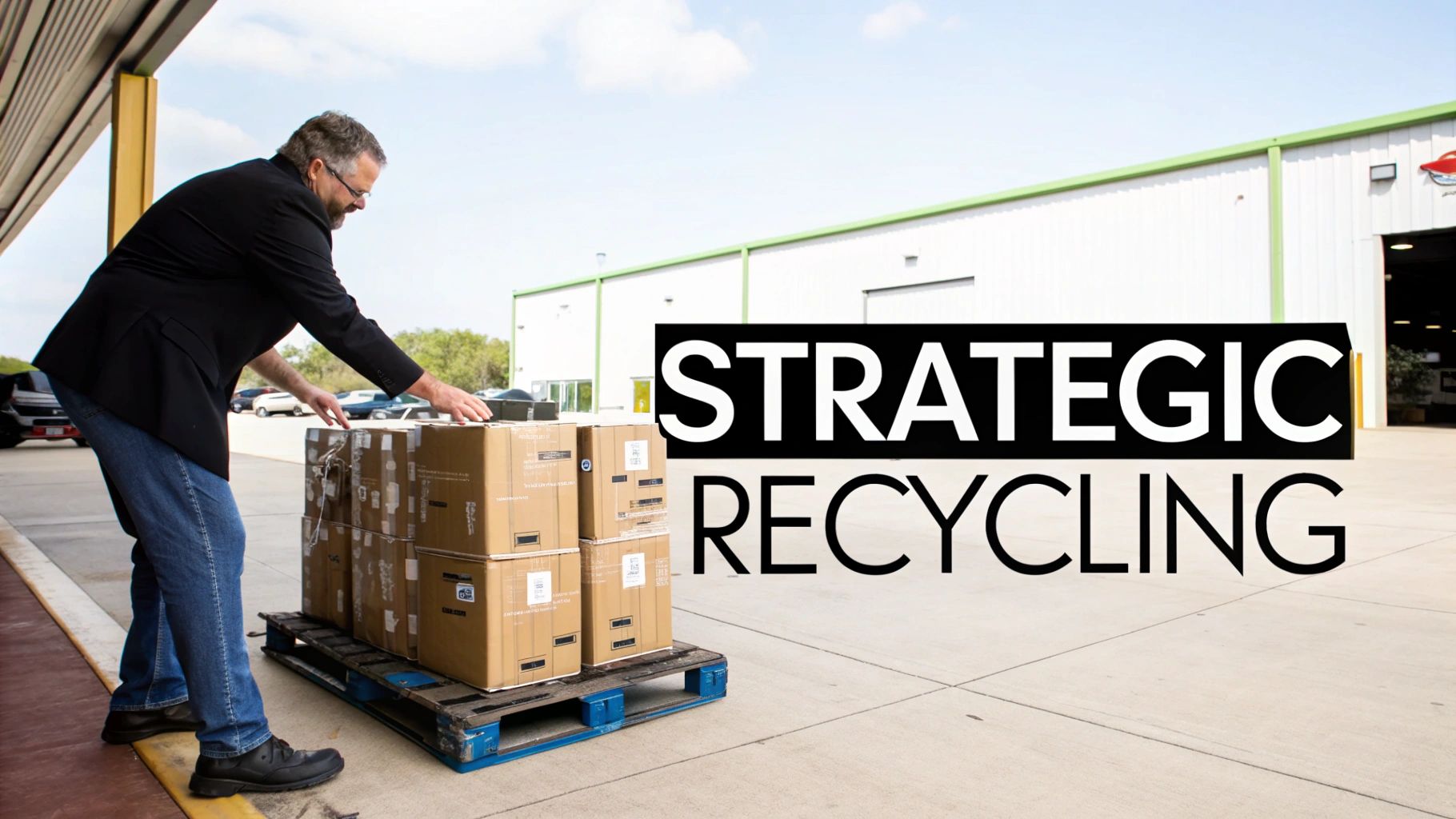
A strategic approach can make a significant difference. To assist you in developing a robust plan, we've outlined the most critical factors for any Alabama business to consider.
Key Considerations for Alabama Business E-Waste Programs
This table summarizes the primary factors Alabama businesses must address when creating an electronics recycling plan, from compliance and data security to community impact.
| Factor | Key Action for Alabama Businesses | Why It Matters |
|---|---|---|
| Data Security | Implement a certified data destruction process (e.g., shredding, wiping) for all devices containing sensitive corporate data. | Protects against data breaches, ensures compliance with privacy laws like HIPAA, and safeguards your corporate reputation. |
| Environmental Rules | Partner with a certified recycler who adheres to federal (RCRA) and state environmental regulations. | Avoids hefty fines for improper disposal of hazardous materials and demonstrates corporate environmental stewardship. |
| Logistics & Cost | Evaluate needs for on-site pickups, secure chain of custody, and transparent reporting to identify a cost-effective solution. | A streamlined process saves time and internal resources, while clear reporting provides verifiable proof of compliance. |
| Community Impact | Choose a recycling partner like Reworx Recycling, a social enterprise that reinvests value into the local community. | Enhances your brand's social responsibility profile and transforms retired assets into a positive force for Alabama. |
By addressing these key areas, your business can develop a comprehensive and responsible ITAD program that aligns with both regulatory requirements and corporate values. Partnering with a certified social enterprise like Reworx Recycling turns this operational necessity into a powerful opportunity. Exploring the benefits of ISO 14001 certification for businesses can further illuminate the broader impact of responsible environmental practices.
When you partner with us, you are not just ensuring compliance—you are converting retired assets into valuable resources for Alabama communities. Discover the full range of benefits of responsible e-waste recycling on our blog.
Navigating Alabama's Environmental Compliance Rules
For any business operating in Alabama, adherence to state and federal environmental regulations is non-negotiable. When it comes to Alabama electronics recycling, the rules converge on a single principle: technology must be disposed of responsibly. Discarding old equipment in a dumpster is a direct violation that can result in serious penalties.
The primary regulatory body is the Alabama Department of Environmental Management (ADEM). Although Alabama does not have a single, dedicated e-waste law like some states, all electronics fall under broader solid waste regulations. This places the responsibility squarely on businesses to ensure hazardous materials like lead, mercury, and cadmium do not contaminate local soil and water.
Understanding ADEM and SWRMMA
The state’s framework is guided by the Solid Wastes and Recyclable Materials Management Act (SWRMMA). This legislation establishes statewide goals for waste reduction and dictates the operational standards for recycling facilities.
Essentially, state-level policy governs how e-waste is managed. ADEM's program sets the standards for any facility processing recovered materials, impacting how recyclers must register, track material flow, and maintain environmental controls. These regulations define Alabama’s capacity for safe e-scrap handling. You can learn more about how ADEM's recycling program works directly from their official site. This regulatory landscape makes your choice of a recycling partner a critical business decision.
An expert partner doesn’t just remove old equipment; they provide a shield against compliance risks. They understand ADEM's requirements for handling, transporting, and processing e-waste, ensuring your business meets its obligations without needing to become an expert in environmental law.
Practical Steps for Business Compliance
For your IT or facilities manager, compliance translates into establishing a clear chain of custody and maintaining meticulous records. Here is what that looks like in practice:
- Asset Tracking: Maintain a detailed inventory of every electronic asset designated for disposal, including serial numbers and equipment type.
- Proof of Destruction: For any device that stored data, you must obtain a Certificate of Data Destruction. This document serves as official proof of secure handling and is invaluable during audits.
- Recycling Certificates: Your partner should provide a Certificate of Recycling, confirming that your assets were processed in an environmentally compliant manner.
Partnering with a certified electronics recycler like Reworx Recycling removes this entire burden from your team. We manage the process from secure pickup at your facility to delivering final documentation, ensuring every step aligns with Alabama's environmental standards. Our transparent reporting provides the assurance that your retired IT equipment was handled correctly.
Failure to meet these standards can have serious repercussions. It is vital to understand the environmental and legal impacts of improper e-waste disposal. Choosing the right partner is a strategic move to protect your company from fines, legal challenges, and reputational damage.
Implementing an Ironclad Data Destruction Process
For any business in Alabama, data security is a fundamental operational risk. Every retired server, laptop, and office computer contains a segment of your company's history—financial records, proprietary information, and sensitive customer data. Simply deleting files or reformatting a drive is insufficient, as that data is often easily recoverable, leaving your organization vulnerable to a breach long after the equipment has been discarded.
An ironclad data destruction process is non-negotiable. It requires adopting practices that guarantee sensitive information is rendered permanently irrecoverable. A verifiable chain of custody is especially critical for businesses needing to meet stringent compliance standards like HIPAA or PCI-DSS.
Beyond the Recycle Bin: Methods That Actually Work
True data security demands methods that make information completely and permanently unreadable. We rely on three industry-standard approaches, each suited for different security and asset requirements.
- Multi-Pass Data Overwriting: A software-based method that overwrites the entire hard drive with random characters, often in multiple passes. This process effectively sanitizes the original data, making it an excellent choice for drives intended for refurbishment and reuse.
- Degaussing: Utilizing a powerful magnet, degaussing destroys the magnetic field on a hard drive's platters where data is stored. This process instantly and permanently erases all information but also renders the drive inoperable. It is a highly effective method for loose hard drives.
- Physical Shredding: This is the ultimate form of data destruction. The hard drive is fed into an industrial shredder that reduces it to small, mangled metal fragments, making data recovery impossible. This is often the required standard for government, healthcare, and financial institutions.
This simple flow chart breaks down how to keep your electronics recycling process compliant from start to finish.
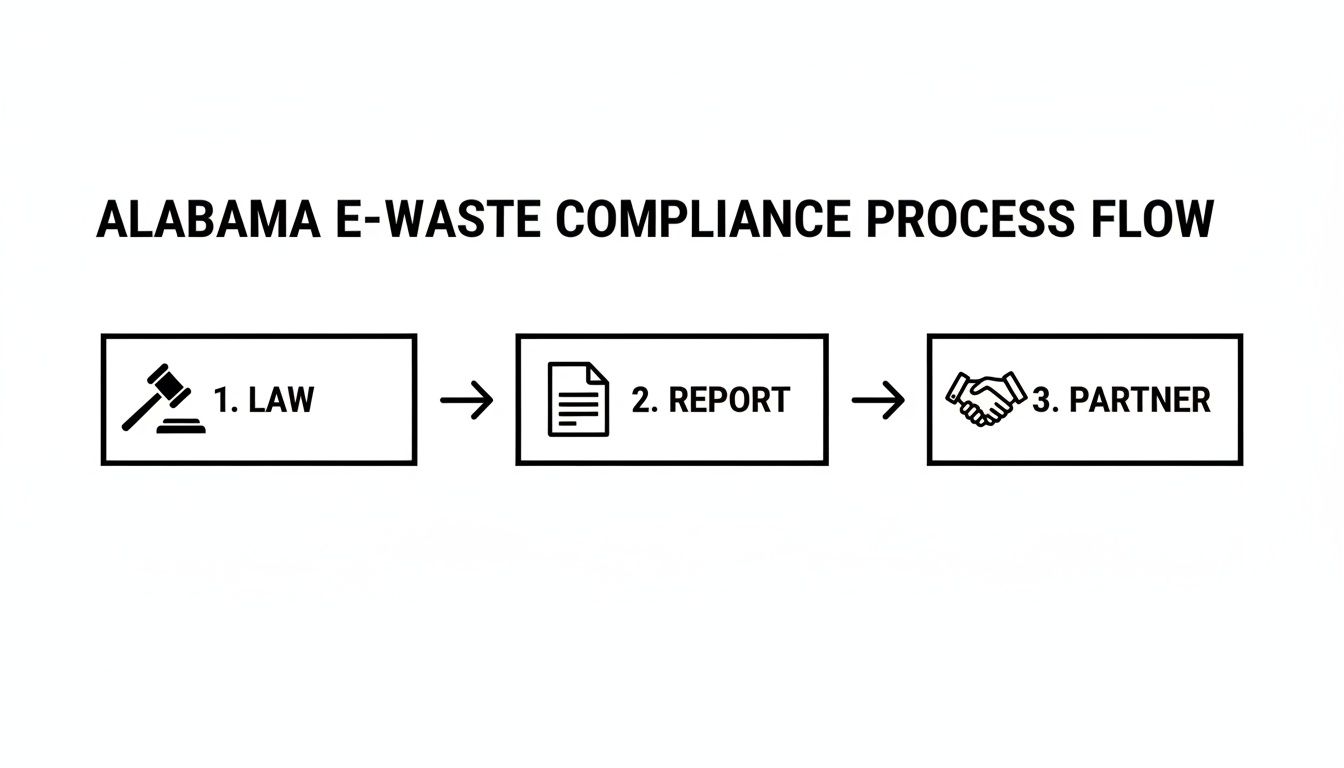
As illustrated, compliance is built on three pillars: understanding the law, documenting every step, and selecting a trustworthy partner.
Creating a Verifiable Audit Trail
Your internal data destruction policy must be built upon a foundation of comprehensive documentation. Every asset designated for retirement needs to be tracked from the moment it is taken offline. This inventory list, complete with serial numbers, should accompany the equipment throughout the entire destruction process.
The objective is to create a clean, unbroken audit trail. Upon completion, your recycling partner should provide a formal Certificate of Data Destruction. This document serves as your official proof of compliance and your defense in an audit.
Partnering with a certified electronics recycler like Reworx Recycling removes the guesswork and liability from this critical task. We offer both on-site and off-site secure data destruction services tailored to your company’s specific security needs, providing all necessary documentation to ensure your business is fully protected.
To delve deeper into creating a robust program, consult our comprehensive guide to secure data destruction. It will help ensure your Alabama electronics recycling initiative is secure from start to finish.
Managing Logistics for Large-Scale Office Cleanouts
Undertaking a large-scale facility cleanout, whether due to an office relocation, a technology refresh, or data center decommissioning, is a significant logistical challenge. The volume of IT equipment—from servers and laptops to specialized laboratory or medical devices—can be overwhelming. Without a strategic plan, these projects can disrupt business operations and create logistical chaos.
A successful cleanout hinges on a well-defined project management framework. The initial step is always a thorough asset inventory. This involves more than just counting devices; it requires documenting every electronic asset, including its type, brand, model, and serial number. Understanding the full lifecycle of your devices is a core component of effective IT asset management. This inventory serves as the roadmap for the entire project.
Building a Project Management Framework
With the inventory complete, you can develop a realistic timeline. A frequent mistake is underestimating the time required to properly disconnect, sort, and prepare equipment for transport. Assigning clear roles—who is responsible for disconnecting workstations, who will verify the asset list against the physical hardware—is crucial for maintaining order and efficiency.
A seamless office cleanout depends on tight coordination between your internal team and your recycling provider. A professional partner should collaborate with you to create a schedule that minimizes disruption, offering flexible pickup times, including after-hours or weekend services.
Streamlining Pickup and Transport
Once everything is inventoried and disconnected, the physical removal begins. This is where a professional service demonstrates its value. Instead of diverting your employees from their primary duties for heavy lifting, a dedicated logistics team can manage the entire process efficiently.
What this includes:
- Secure Palletizing: Trained technicians safely stack and wrap all equipment on pallets, ensuring it is secure for transport.
- Professional Loading: The crew manages the loading process, preventing damage to your equipment and facility.
- Documented Chain of Custody: From the moment the assets leave your premises, they are tracked, providing a secure and verifiable chain of custody for every item.
This turnkey approach transforms a major logistical burden into a managed, efficient process. For a closer look at how these complex operations are handled, review our guide on reverse logistics services for businesses.
Scheduling a professional pickup with Reworx Recycling eliminates the stress from your Alabama electronics recycling project. We handle the complex logistics, freeing your team to focus on core business activities while ensuring your retired assets are managed securely and responsibly.
Turning E-Waste Into a Corporate Social Responsibility Win
What if your company’s retired IT equipment could create new opportunities for communities across Alabama? While compliance and data security are critical drivers for electronics recycling, focusing solely on them overlooks a powerful opportunity to generate significant social value. This is the core principle behind donation-based electronics recycling.
This approach shifts the objective from simple disposal to purposeful reinvestment. By partnering with a social enterprise like Reworx Recycling, your retired assets are transformed from liabilities into tools that empower students, support non-profits, and help bridge the digital divide in Alabama communities.

From Retired Assets to Community Impact
The social enterprise model is the foundation of Reworx Recycling. It ensures that maximum value is recovered and redirected back into the community. Instead of being immediately shredded for raw materials, viable equipment like laptops, desktops, and tablets are professionally refurbished.
These devices are then provided at low or no cost to individuals and organizations that need them most. This delivers a measurable, tangible impact on digital equity and educational access throughout Alabama.
The results of such efforts are clear. A series of 2023 e-waste events coordinated by Alabama Extension and its partners saw 635 participants divert a massive 17,080 pounds of electronics from landfills. That single effort prevented an estimated 491 pounds of toxic metals from entering our environment and conserved over 5,700 pounds of total metals, demonstrating the power of coordinated community recycling.
Aligning ITAD with ESG Goals
This approach to Alabama electronics recycling aligns directly with your company’s Environmental, Social, and Governance (ESG) objectives. Partnering with a social enterprise recycler provides tangible data for sustainability reports and strengthens your corporate narrative.
- Environmental: Report the exact tonnage of e-waste diverted from landfills and the specific hazardous materials safely managed.
- Social: Contribute directly to digital inclusion initiatives, workforce development, and educational access in local communities.
- Governance: Demonstrate a clear commitment to ethical and responsible supply chain management through end-of-life.
Choosing a donation-based model proves that responsible ITAD is an investment in both community and corporate sustainability. It elevates your brand, engages employees proud to work for a socially conscious company, and builds goodwill with customers who increasingly favor businesses that make a positive impact.
By looking beyond basic disposal, your company can transform a routine operational task into a cornerstone of its corporate social responsibility strategy. Learn more about how to integrate electronics recycling into its corporate social responsibility program and start making a greater impact today.
Common Questions About Business Recycling in Alabama
Even with a clear strategy, IT managers and business leaders often have questions when establishing an Alabama electronics recycling program. Obtaining clear answers is essential for moving forward with confidence.
Here are some of the most common concerns we hear from businesses across the state.
How Can We Be Certain Our Data Is Securely Destroyed?
This is the most critical question we receive. Your company’s data is its most sensitive asset, and any potential for a breach is unacceptable. A reputable recycling partner must provide a Certificate of Data Destruction for every data-bearing device they process. This legal document creates an official audit trail.
A proper certificate will detail the serial numbers of the devices and specify the destruction method used—whether multi-pass wiping, degaussing, or physical shredding. The absence of this level of documentation is a major red flag.
What Types of Equipment Do You Accept?
A common misconception is that electronics recycling is limited to computers and laptops. A true ITAD partner is equipped to handle a much wider range of corporate assets.
At Reworx Recycling, our services cover nearly anything with a plug or a battery. We routinely process:
- Standard Office Equipment: Laptops, desktops, monitors, printers, keyboards, and servers.
- Data Center Hardware: Network switches, server racks, UPS battery backups, and storage arrays.
- Specialized and Industrial Gear: Medical equipment, laboratory instruments, and manufacturing electronics.
- Miscellaneous Electronics: Office phones, mobile devices, cables, and circuit boards.
- Full Facility Cleanouts: We can manage the disposal of all electronics during an office cleanout or data center decommissioning project.
If you have unique or highly specialized equipment, contact us. We can almost always find a responsible recycling solution.
Do We Have to Deliver Our Old Equipment to You?
For most businesses, self-transporting a large volume of assets during an office cleanout or tech upgrade is a logistical burden. That is why we offer professional, secure pickup services across Alabama. Our logistics team will coordinate with you to schedule a convenient time, ensuring minimal disruption to your operations.
We manage the entire process—from palletizing and shrink-wrapping to the heavy lifting and transport. Our goal is to make the experience completely seamless for your team while maintaining a secure chain of custody from your facility to ours.
Is There a Cost for Business Recycling Services?
The answer depends on the equipment. For many standard IT assets like newer laptops, servers, and networking gear, there is often no charge for the recycling service. The commodity value recovered from the materials and components is sufficient to cover processing costs.
However, certain items—such as old CRT monitors or specialized industrial equipment containing hazardous materials—may incur a fee to ensure they are handled and disposed of in an environmentally compliant manner. We are always transparent and provide a clear quote upfront, so there are never surprises.
Ready to implement a secure and responsible electronics recycling program for your Alabama business? As a donation-based social enterprise, Reworx Recycling provides certified secure data destruction, convenient pickup logistics, and a commitment to transforming your retired IT equipment into community benefits. Partner with us to handle your computer recycling, IT equipment disposal, or full office cleanout needs.
Schedule your pickup or request a consultation today. Find more insights on the Reworx Recycling Blog.