You're probably dealing with one of two situations right now. Either old laptops and monitors have been piling up for years, or a refresh project just landed and suddenly IT, facilities, and compliance all want answers on the same day.
The first question is almost always the same. How long is this going to take?
That question matters more in IT asset disposition than many teams expect. A rushed electronics recycling or IT equipment disposal project can create chain-of-custody gaps, slow an office cleanout, delay a facility cleanout, and leave secure data destruction decisions hanging until the last minute. A realistic plan gives you room to sort reusable devices, schedule pickups, coordinate laptop disposal, and handle product destruction without disrupting normal operations.
For teams planning their first major ITAD effort, implementation timelines aren't just a project-management detail. They shape risk, staffing, vendor coordination, and whether your corporate donation programs and sustainable recycling goals are achieved.
What to Expect from Your ITAD Project Timeline
A common starting point looks like this. An IT manager opens a locked storage room and finds retired Dell laptops, aging HP desktops, a few Apple MacBooks, network switches, loose hard drives, and maybe an old rack server from a prior migration. Finance wants the room cleared. Security wants documented data handling. Sustainability wants to keep equipment out of landfill streams.
That's when timeline mistakes usually begin.
Most organizations underestimate the work because the equipment is already “done” from an operational standpoint. But retired gear still has to move through inventory review, collection planning, secure handling, disposition decisions, and final documentation. If any one of those steps is vague, the project stretches.
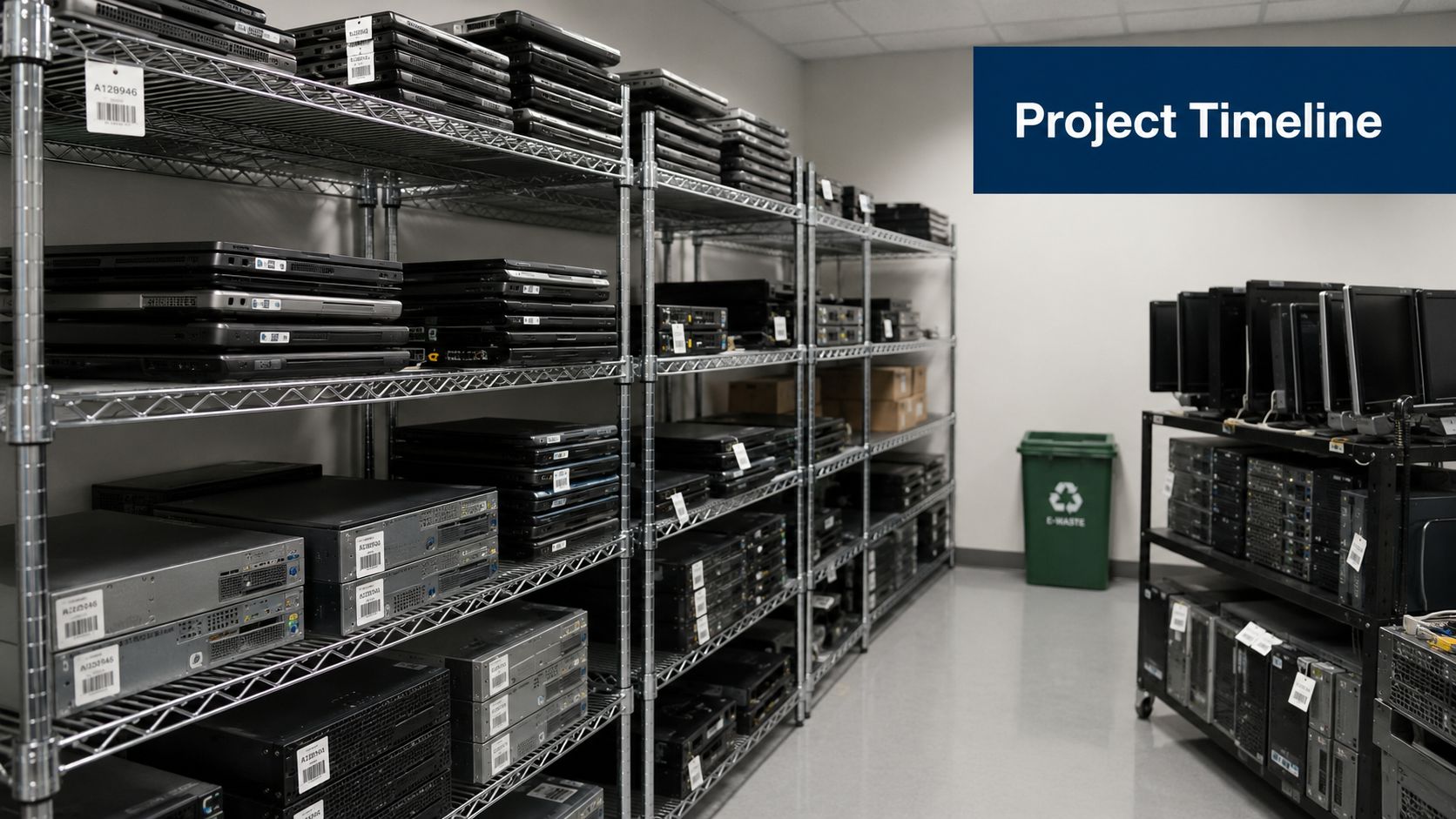
For first-time planners, it helps to frame the work as an operational rollout, not a junk-haul. That's especially true when the project includes computer recycling, medical equipment disposal, laboratory equipment disposal, or data center decommissioning. Those projects need decisions about asset tags, audit trails, pickup windows, and downstream reporting.
A useful starting point is understanding what IT asset disposition includes in practice. This overview of IT asset disposition basics is a good primer for teams that are still defining scope.
What clients usually misjudge
The biggest misses tend to be simple:
- Asset condition isn't documented. Some devices are ready for reuse, some need recycling, and some need product destruction.
- Ownership is unclear. Shared equipment often sits between IT, facilities, and department managers.
- Data requirements arrive late. Hard drive shredding, sanitization approvals, or server handling standards can change the schedule quickly.
- Pickup is treated as the whole project. In reality, pickup is only one visible step in a longer chain.
Field rule: If your team can't explain where every device category goes after pickup, the timeline isn't ready yet.
When implementation timelines are realistic, the project becomes manageable. Teams can stage pickups, prepare stakeholders, and fit electronics recycling into broader refresh cycles instead of forcing it into emergency mode.
The Core Phases of Any ITAD Implementation
Every solid ITAD project follows the same basic sequence, whether you're handling a few carts of laptop disposal or a multi-site IT asset disposition program.
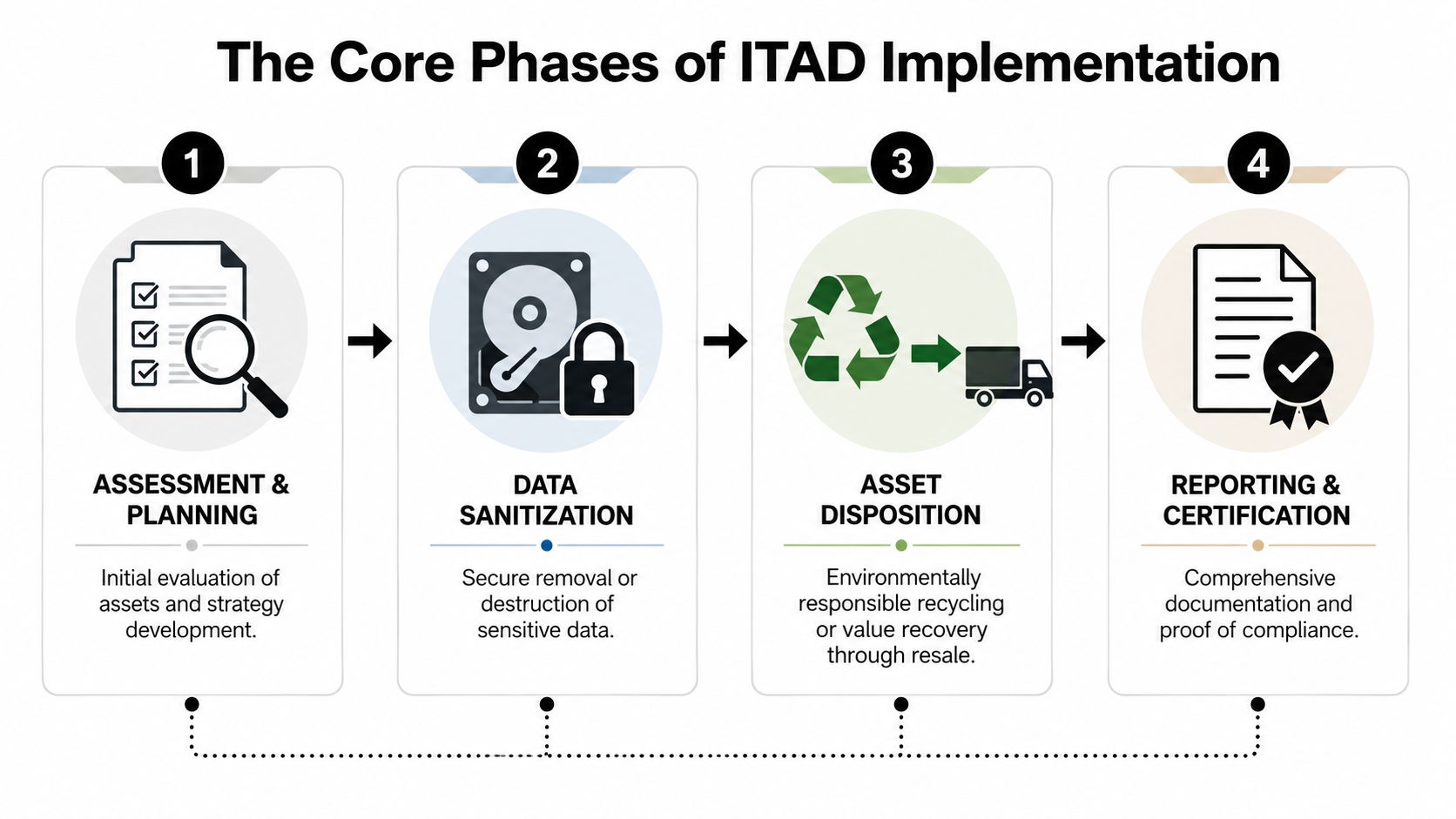
Assessment and planning
This phase decides whether the rest of the project moves cleanly or gets stuck in rework.
Teams need a working inventory, clear scope boundaries, and a list of decision-makers. That includes basic categories like laptops, desktops, monitors, servers, mobile devices, peripherals, and specialty equipment. It should also define whether the effort includes secure data destruction, social enterprise recycling goals, donation-based recycling, or value recovery.
This is also where timelines get protected. Expert benchmarking in enterprise information systems shows that dedicating 30 to 40% of total project duration to discovery, data preparation, and customized training yields the highest ROI, and more than 60% of projects that exceed planned timelines do so because of unclean data and poorly scoped change management according to this implementation timeline analysis.
If your internal team needs a straightforward planning model before kickoff, this guide for project implementation success is useful because it translates planning discipline into practical workstreams.
A formal ITAD strategy framework also helps when the project is bigger than a one-time cleanout.
Collection and logistics
Once the scope is stable, logistics become the pacing item.
This phase covers packaging, palletization when needed, on-site staging, loading, transportation windows, and any site access restrictions. For office environments, collection is often shaped by business-hours disruption. For hospitals, labs, or industrial sites, chain-of-custody and restricted-area access matter more.
A few questions make a major difference:
- Will pickup happen all at once or in waves
- Do devices need to remain powered down in place until collection day
- Are there loading dock limits, badge requirements, or freight elevator constraints
- Will remote offices join the same project or run separately
Processing and data sanitization
This is the phase most executives care about, even if they don't always say it directly.
Devices are received, sorted, audited, sanitized, dismantled, recycled, refurbished, or routed into donation-based recycling channels depending on policy and condition. For some organizations, this includes hard drive shredding. For others, the priority is logical sanitization with documented downstream records.
The fastest way to lose time is to make data decisions after the equipment is already moving.
That's why mature teams define media handling rules before trucks are scheduled.
Reporting and certification
The project isn't finished when the equipment leaves your building. It's finished when documentation closes the loop.
That usually means certificates tied to secure data destruction, itemized reporting where required, and summaries that support compliance, sustainability, or internal audit needs. This is also where corporate donation programs and sustainable recycling outcomes become visible to leadership.
A timeline that ignores this last phase isn't complete. It just stops at the loading dock.
Realistic Timelines for Small Mid-Size and Enterprise Projects
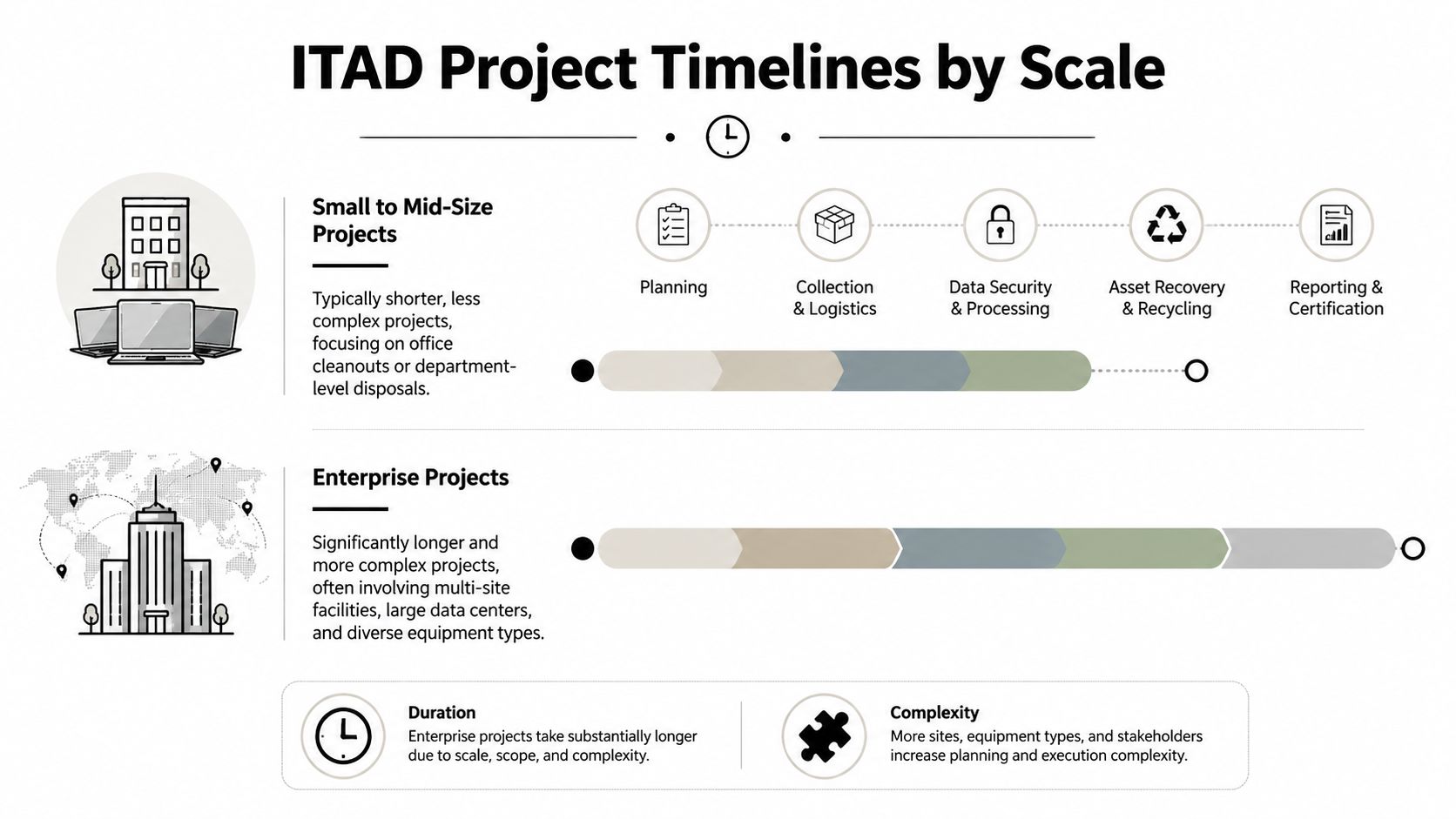
The right timeline depends less on your headcount and more on complexity. A small legal office with scattered devices and strict data controls can be harder than a larger company with a clean inventory. Still, scale gives you a practical starting point.
Small projects
Small projects usually involve a single office, one department, or a straightforward office cleanout. The work often centers on laptop disposal, monitor removal, printer retirement, and a limited amount of secure data destruction.
These timelines are usually short because the approval chain is short. One IT lead, one office manager, and one pickup schedule can move quickly when the inventory is visible and the destination for each device type is already understood.
Typical examples include:
- Small-office computer recycling
- A startup clearing storage before relocation
- A clinic retiring a modest batch of end-user devices
- A branch office handling a one-time facility cleanout
What slows these projects isn't enterprise bureaucracy. It's disorganization. Devices are often spread across desks, closets, and personal offices, and no one wants to own the final count.
Mid-size projects
Mid-size organizations usually run into a different issue. The equipment volume is still manageable, but coordination becomes harder.
A mid-size project often includes multiple business units, phased pickup windows, a tech refresh calendar, and some tension between speed and control. IT may want devices out immediately. Department heads may want more time to review what's being removed. Finance may ask whether some assets still have resale value. Sustainability may want donation-based recycling or social enterprise recycling outcomes documented.
Implementation timelines need structure instead of optimism.
A practical planning model for this tier is to break the work into separate tracks:
| Workstream | What drives timing |
|---|---|
| Inventory validation | Asset accuracy and department response time |
| Pickup planning | Site access, staging space, business-hour constraints |
| Data handling | Sanitization rules, media exceptions, signoff requirements |
| Final disposition | Reuse, recycling, donation, product destruction |
| Reporting closeout | Audit needs, sustainability reporting, internal review |
For broader IT scheduling discipline, these CloudOrbis IT planning insights are useful because they map planning habits to execution risk in a way most internal teams recognize.
Enterprise projects
Enterprise ITAD is different. It behaves more like a program than a project.
Once you're dealing with multi-site pickups, data center decommissioning, phased server retirement, warehouse inventory, or regional refresh cycles, simple scheduling logic breaks down. You're coordinating security, infrastructure, logistics, legal review, and often sustainability reporting at the same time.
The closest useful analogy comes from advanced manufacturing systems. Software implementation timelines in advanced manufacturing range from 3 to 6 months for mid-sized firms and 9 to 24 months for large enterprises, largely because of system integration and data migration. The same source notes that a full-scale ITAD system rollout for an enterprise, including asset tracking and chain-of-custody logging, should be estimated at 6 to 12 months in this manufacturing implementation timeline reference.
That range makes sense in practice. Enterprise ITAD timelines stretch because of:
- Multi-site coordination
- Legacy asset records
- Approvals across IT, finance, legal, and facilities
- Special handling for servers, network gear, and regulated equipment
- Integration with broader refresh or relocation programs
A server decommissioning checklist helps enterprise teams avoid one of the most common mistakes, which is treating server retirement like desktop disposal.
Decision test: If your project includes racks, backup media, multiple custodians, or staggered shutdown dates, plan it as an enterprise initiative even if the final equipment count looks moderate.
A practical way to set expectations
If you want a useful internal answer, don't ask, “How long does ITAD take?” Ask these instead:
- How many sites are involved
- How clean is the asset inventory
- What data-bearing devices need exceptions
- Will pickups happen in one event or several
- Who signs off on final disposition categories
Those five questions usually tell you more than a raw asset count.
Key Factors That Accelerate or Delay Your Timeline
Most timeline problems aren't random. They show up because teams miss dependencies, split ownership, or leave key decisions too late.
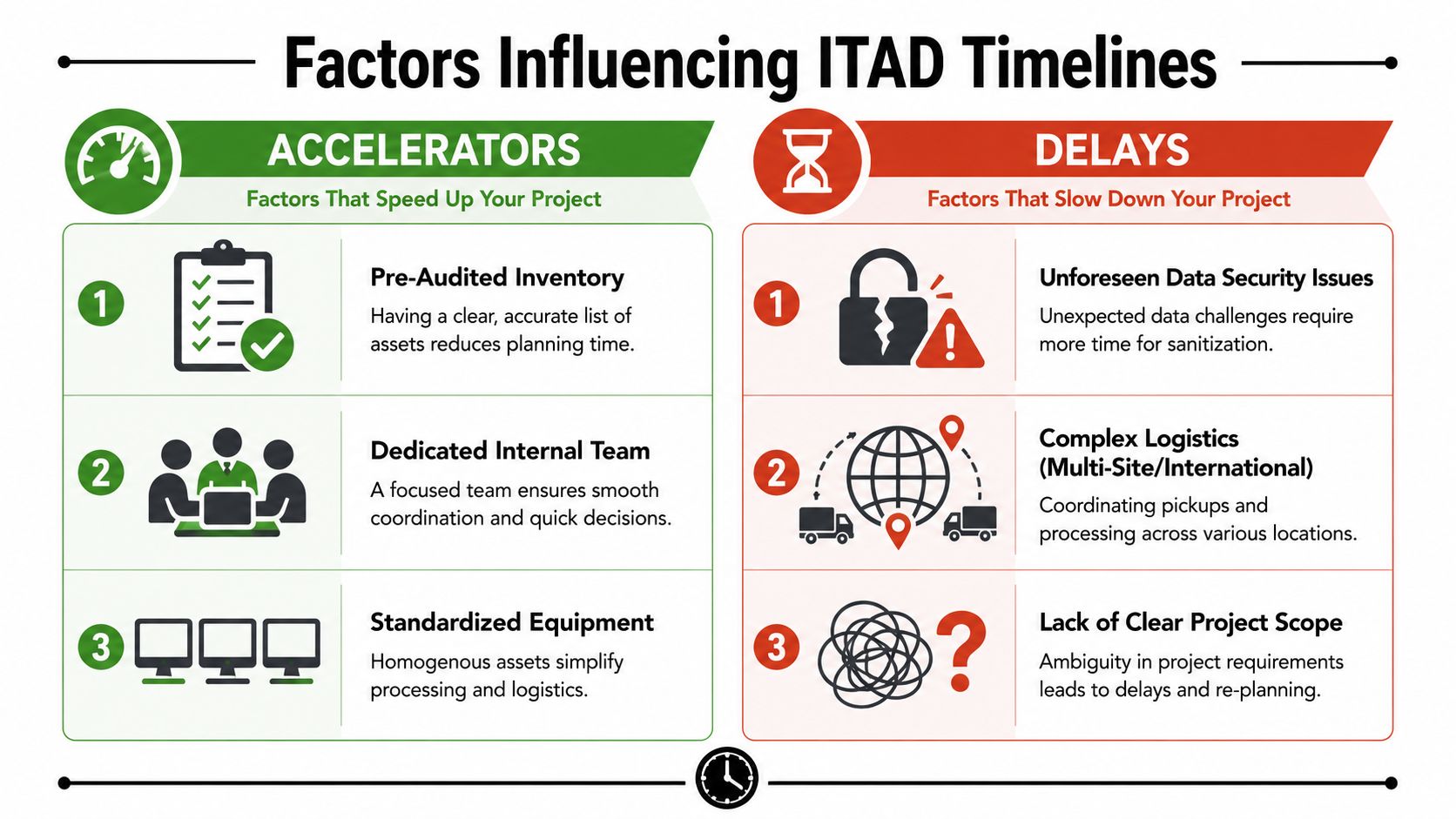
What moves an ITAD project faster
A few conditions consistently help.
- A pre-audited inventory makes scheduling easier because everyone is working from the same list.
- One internal project owner cuts approval lag. When IT owns technical decisions and one business lead owns coordination, projects stop drifting.
- Standardized equipment simplifies sorting, packing, and downstream handling.
- Early policy decisions on reuse, recycling, donation, and destruction prevent last-minute argument.
There's also a hidden accelerator. When teams define the project alongside other planned moves, such as an IT refresh, office relocation, or lease turnover, they can combine effort instead of creating a second disruption later.
What creates delays
The biggest delays are usually upstream.
Implementation-science frameworks show that fewer than 30% of projects systematically map upstream dependencies such as vendor onboarding or third-party audits, according to this staged implementation reference. That gap matters in ITAD because the project often depends on outside timing, internal access, and approval sequencing at the same time.
Here's how that shows up in the field:
- Facilities schedules loading access after IT expected pickup.
- Security adds handling conditions after boxing has started.
- A department head asks to review assets after they were already marked for removal.
- A sustainability team wants donation reporting after disposition paths were already finalized.
Upstream dependencies don't look serious on day one. They become serious when the truck is booked and approvals still aren't done.
An early IT inventory audit process can prevent a lot of this friction because it exposes missing tags, unknown owners, and equipment categories that need special treatment.
The hardest combination
The most fragile timeline is a parallel project environment. That happens when ITAD is running next to office moves, infrastructure upgrades, data center changes, sustainability certifications, or procurement transitions.
In those cases, delays don't come from electronics recycling itself. They come from teams competing for the same people, loading areas, approvals, and calendar space.
A project can survive imperfect inventory. It struggles much more with split attention.
Aligning Stakeholders for Smooth Project Execution
ITAD projects stall when leaders treat them as a back-office disposal task. They move when the right stakeholders see their own risk in the outcome.
IT owns data security, device records, and technical signoff. Facilities controls access, staging, and removal logistics. Finance often cares about asset retirement controls, residual value, and documentation. Sustainability or CSR teams care about landfill diversion, donation pathways, and the community value created by responsible end-of-life handling.
That mix is why stakeholder alignment matters early, not halfway through.
Why governance matters more than people think
Complex implementation timelines don't break because the work is impossible. They break because governance arrives late.
The UNECE guidelines on statistical system reform describe implementation as a multi-stage process spanning several years, with many member states needing 36 to 60 months from commitment to compliance in the UNECE implementation guidelines. ITAD isn't the same kind of institutional reform, but the lesson holds. Cross-functional work succeeds when stakeholders stay aligned over time instead of approving one kickoff meeting and disappearing.
What a kickoff meeting should settle
A kickoff that works doesn't try to answer everything. It settles ownership and decision rights.
Use a checklist like this:
- Scope owner. Who can confirm what's in and out.
- Data authority. Who decides sanitization versus destruction for each asset class.
- Logistics lead. Who controls access, staging, and pickup timing.
- Reporting needs. What IT, finance, compliance, and sustainability each need at closeout.
- Escalation path. Who breaks ties when timing and policy conflict.
A project with shared responsibility and no final decision-maker will usually miss its date, even when the physical work is simple.
What good alignment looks like
Good stakeholder alignment isn't constant meetings. It's fast decisions with clear boundaries.
IT shouldn't have to chase facilities for loading details the day before collection. Finance shouldn't discover after the fact that some devices were suitable for reuse. Sustainability shouldn't need to reconstruct donation outcomes from scattered records. Smooth execution comes from setting those expectations while the timeline is still flexible.
That's especially important in medical equipment disposal, laboratory equipment disposal, and data center decommissioning, where one late requirement can force the entire project to pause.
Streamline Your Next ITAD Project with Reworx
The best implementation timelines for ITAD are realistic, not aggressive. They account for inventory quality, business disruption, secure data destruction, stakeholder approvals, and the fact that electronics recycling is rarely a single event.
They also leave room for adjustment.
Large programs almost never hit every milestone exactly as first planned. That's normal. In one national multi-year statistical strategy, 25 out of 35 planned activities were completed in a single year, a 71% completion rate, according to the Montenegro implementation report. The lesson for corporate ITAD is straightforward. Even well-planned initiatives are iterative, and a flexible operating model is usually more valuable than a rigid calendar.
What strong execution actually requires
Reliable execution usually comes down to five things:
- A clear inventory
- Defined data handling rules
- One owner for day-to-day decisions
- A disposition path for each asset category
- Closeout documentation that satisfies all internal stakeholders
If one of those is missing, timelines get soft fast.
For organizations managing computer recycling, secure data destruction, office cleanout work, facility cleanout projects, and broader corporate donation programs, the most practical move is to treat ITAD as part of your operating calendar. Fold it into refreshes, relocations, and decommissions instead of waiting for surplus equipment to become a storage problem.
A structured IT asset disposition service approach is often the difference between a controlled project and a reactive cleanup.
Why a social enterprise partner changes the equation
A standard recycler can remove equipment. A strong social enterprise partner can help you align security, sustainability, and community impact in the same workflow.
That matters when leadership wants more than basic disposal. It matters when donation-based recycling and digital inclusion goals sit next to chain-of-custody requirements. And it matters when your business wants a practical path to sustainable recycling that also supports workforce development and community outcomes.
Implementation timelines work best when they reflect how organizations operate. Busy teams need a plan that's secure, documented, adaptable, and grounded in the practical pace of internal decision-making.
If your business is planning electronics recycling, IT equipment disposal, computer recycling, secure data destruction, product destruction, or a larger IT asset disposition initiative, Reworx Recycling can help you build a practical timeline and execute it responsibly. Whether you need help with laptop disposal, data center decommissioning, medical equipment disposal, a facility cleanout, or donation-based recycling tied to community impact, the next step is simple. Donate old equipment, schedule a pickup, or explore a partnership that supports both your operational goals and your social impact priorities.