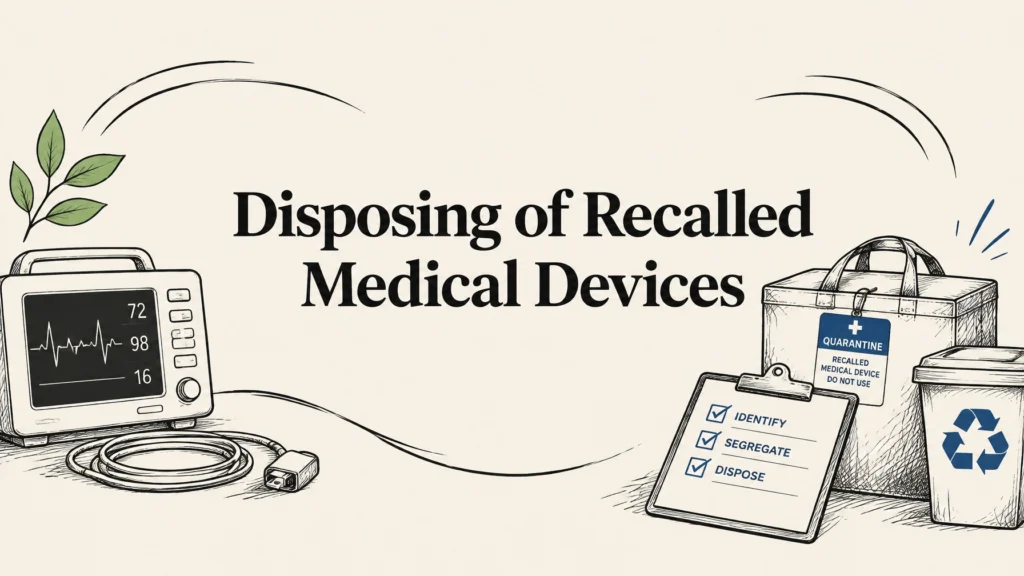
Disposing of a recalled medical device is a reconciliation and documentation task, not simply a matter of booking a pickup. The correct route for each unit depends on its contamination status, whether it stores data, and the remedy specified in the recall notice.
Start with the recall notice, not the disposal plan
A recall does not automatically mean every affected device must be destroyed. The manufacturer’s instructions may call for a return, repair, replacement, relabeling, or correction in place. Some notices require devices to be held while instructions are clarified. Follow the specific notice and contact the manufacturer if a unit’s status or required action is unclear.
The FDA’s overview of device recalls, corrections, and removals explains the general recall process. Keep in mind that recall termination is a separate regulatory process. Your organization should complete and document its own assigned actions, but should not treat its internal closure as a declaration that a recall has been terminated.
Before arranging any transport, identify who owns the recall response. This is often shared among biomedical engineering, facilities, infection prevention, supply chain, IT or information security, and the clinical team. One person should coordinate the inventory and keep the records together.
Common device categories and handling risks
These are general planning considerations, not permission to dispose of a device through any particular route. The recall instructions, contamination status, and applicable requirements determine what is authorized.
| Device category | Main handling risk | General route |
|---|---|---|
| Implanted or blood-contacting devices | Contamination or exposure risk | Follow the recall’s instructions and your organization’s applicable medical-waste procedures. |
| Battery-powered devices | Battery-related handling and transport risk | Confirm acceptance and handling requirements before moving the device; see battery-specific guidance. |
| Data-bearing monitors and workstations | Patient data may remain on internal or removable storage | Preserve any required records, then sanitize the data or destroy the storage media before disposal. |
| Accessories | An accessory may or may not be included in the recall | Match its identifiers and status to the notice; do not assume the entire system is affected. |
A monitor can be both a recalled device and a data-bearing asset. A device can also be contaminated, so its route may need to address more than one risk. Ask the relevant internal teams to assess the whole unit before it is packed or moved.

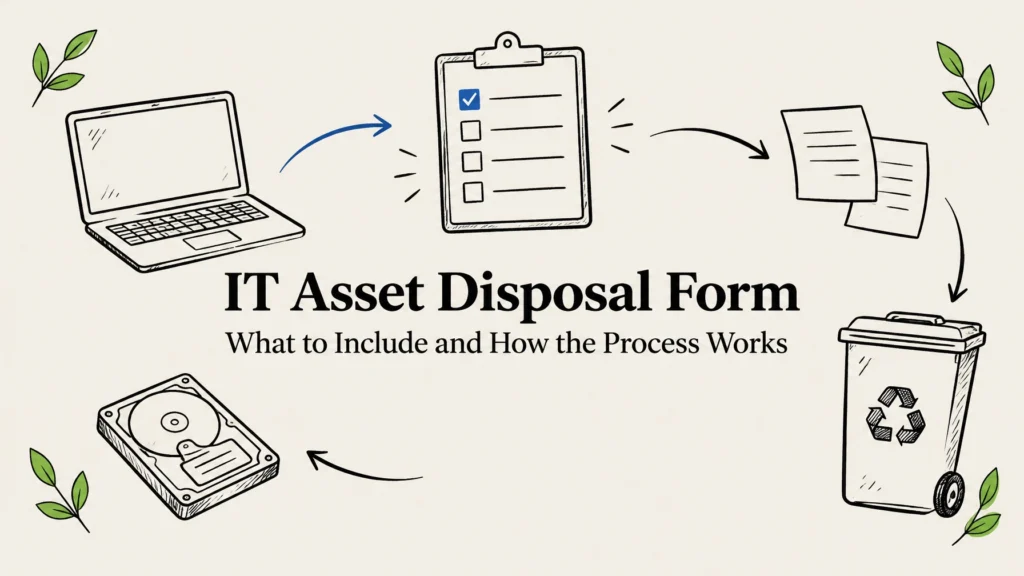
A practical disposal workflow
Use one controlled workflow from quarantine through final review. Keep a record for each unit, or for each lot and controlled quantity when individual serial numbers are not available.
-
Quarantine affected units. Follow the notice about stopping use, and move affected units to a clearly identified, access-controlled area when instructed. Keep them separate from usable inventory. If the notice is unclear, contact the manufacturer before making an irreversible change.
-
Reconcile the inventory against the notice. Check identifiers such as model, lot, serial number, and UDI when available. Search clinical areas, biomedical engineering storage, repair locations, supply rooms, and other sites your organization operates. Record where each unit was found and whether any are missing or already transferred.
-
Classify each device by its authorized outcome. Record whether the notice requires return, correction, repair, replacement, or destruction. Don’t substitute recycling, donation, resale, or disposal for the manufacturer’s remedy. If a unit’s route is not specified, ask for written clarification before releasing it.
-
Address contamination and data before transport. Have the appropriate clinical, infection-prevention, or waste-management staff determine handling requirements for potentially contaminated equipment. For devices that store patient data, preserve records your organization must retain, then sanitize the data or destroy the storage media before disposal under applicable healthcare privacy obligations.
-
Transfer devices with signed records. Prepare an inventory that connects the units leaving your site to the authorized outcome. Record the sender, recipient, date, and destination, and retain the signed handoff and any return or disposition confirmation. Do not send a device to a vendor until you have confirmed in writing that its device category and contamination status are within that vendor’s accepted scope.
-
Run an effectiveness check. Recheck the locations where affected units could be held, resolve inventory differences, and document the final status of each unit. Keep your internal records with the recall notice and manufacturer communications. This internal check supports your organization’s closeout; it does not replace the separate recall-termination process.
Protect patient data before a device leaves your control
Medical monitors, workstations, and other connected equipment may store patient information on internal drives or removable media. Before reuse, return, recycling, or destruction, make sure the data is sanitized or the storage media is destroyed, consistent with your organization’s policies and applicable healthcare privacy obligations.
The HHS guidance on reusing or disposing of electronic media discusses safeguarding information when devices and media are reused or disposed of. Coordinate with IT or information security to identify storage that may not be obvious, including removable media. Don’t assume that deleting files or restoring factory settings is sufficient.
For accepted data-bearing IT assets, Reworx offers free data destruction through wiping using NIST 800-88-style practices or hard drive shredding, with a certificate of destruction. The method depends on the media and the job’s agreed scope. Confirm in advance that the particular device, media, and contamination status can be accepted.

Choosing a vendor for the electronics portion
Reworx’s documented services center on electronics and IT assets. That does not mean every medical device, contaminated item, or regulated waste stream is automatically accepted. Before booking, describe the device category, condition, contamination status, storage media, and required recall remedy, and ask the vendor to confirm in writing that the items are within scope.
For accepted electronics, Reworx offers free nationwide pickup across all 50 states, free data destruction, and certified eco-friendly recycling with responsible downstream processing. Reworx is headquartered in Smyrna, Georgia, in metro Atlanta, and serves organizations nationwide.
You can ask about flexible or after-hours scheduling and text for a fast service response. If considering a tamper-proof drop-off box for appropriate electronics, confirm current availability and acceptance requirements first. Keep medical devices that need special handling out of any general electronics collection unless the vendor has explicitly approved them.
A useful vendor discussion covers:
- Which device categories and conditions are accepted?
- What must be done before pickup, including any required decontamination?
- Can the vendor handle the device’s data-bearing components?
- What signed transfer and final disposition records will be provided?
For more on the electronics and IT equipment side of a project, see Reworx’s IT asset disposition services and hard drive shredding. Reworx also supports a mission to bridge the digital divide by helping provide refurbished technology and support to marginalized and vulnerable communities for education and career readiness. That mission applies to eligible equipment, not to devices that remain subject to a recall or other restrictions.

Frequently asked questions
How do hospitals dispose of recalled medical devices?
Hospitals should first follow the specific recall notice, quarantine units when instructed, and reconcile their inventory against the affected identifiers. Each device’s authorized route depends on the notice, contamination status, and whether it stores patient data. Keep records of transfers and outcomes, then complete an effectiveness check.
Can recalled medical devices be donated?
Do not donate a recalled device unless the recall instructions and responsible authorities explicitly allow that outcome. A unit may need to be returned, corrected, or destroyed, and it should not be redeployed while its status is unresolved. Donation is not a substitute for the remedy in the recall notice.
Who is responsible for disposing of recalled medical devices?
Responsibility depends on the recall instructions and the organization’s role in handling the affected device. Inside a healthcare organization, biomedical engineering, facilities, supply chain, clinical leadership, infection prevention, and IT may all have part of the work. Assign one recall owner to coordinate the inventory, decisions, and records.
Should a recalled monitor be wiped before it is returned?
Check the manufacturer’s return instructions before wiping or altering a device, since the manufacturer may need the device or its data for evaluation. Coordinate with IT or information security to preserve information your organization must retain and to address patient data before the approved return or disposition.
Confirm the scope before scheduling
Gather the recall notice, affected-device inventory, and information about contamination and data storage. Then confirm the authorized outcome and ask any proposed vendor to verify in writing that it accepts your specific device category and condition. For accepted electronics, you can schedule a Reworx pickup or text for fast service.