For businesses in Charlotte, from the bustling financial district to the growing tech hubs, retiring old computers involves much more than just unplugging them. It's a critical sequence of backing up data, securely wiping all information, and then finding a certified, local recycler you can trust.
The best approach ensures your company's sensitive information is completely protected before the physical hardware is handled. Partnering with a certified social enterprise like Reworx Recycling turns a simple disposal task into a secure, compliant, and environmentally positive move for your Charlotte-based business, providing a clear chain of custody from start to finish.
Your Playbook for Responsible Computer Recycling in Charlotte
For IT managers and business leaders in Charlotte, recycling old business computers is no longer a simple environmental checkbox. It's a critical pillar of your data security strategy, corporate responsibility goals, and overall operational efficiency.
That single outdated PC or server sitting in a storage closet isn't just taking up space. It's a potential data breach waiting to happen, a compliance risk you can't afford, and a missed opportunity to support the Charlotte community.
Think of this guide as your direct, actionable playbook for handling your company's e-waste. It’s built for real-world scenarios, whether you're managing a small office cleanout or decommissioning an entire data center. We’re moving beyond generic advice to give you a clear path for implementing a secure, sustainable, and socially responsible IT Asset Disposition (ITAD) program right here in North Carolina.
Why a Proactive Approach Is Non-Negotiable
The need for a structured electronics recycling plan is more urgent than ever. The world generated a massive 62 million tonnes of e-waste in 2022—an 82% jump since 2010. This surge is fueled by rapid technological advances and shorter device lifecycles.
Worse yet, the documented global recycling rate was a mere 22.3%. That means tons of valuable materials are lost forever, while hazardous substances risk contaminating our environment.
A well-defined strategy gives your Charlotte organization a clear edge:
- Mitigates Data Breach Risks: Professional recyclers provide certified data destruction, completely eliminating the threat of sensitive corporate or customer data falling into the wrong hands.
- Ensures Regulatory Compliance: Adhering to federal and state laws, like the Resource Conservation and Recovery Act (RCRA), helps you sidestep massive financial penalties.
- Enhances Corporate Social Responsibility (CSR): Partnering with a certified, mission-driven recycler like Reworx Recycling shows a real commitment to environmental stewardship, strengthening your brand's reputation with customers, employees, and investors.
The core idea is to transform retired IT assets from a liability into a strategic advantage. Instead of seeing old computers as waste, see them as a resource. When handled correctly, that resource protects your business and supports the community. This shift in perspective is key to building a successful ITAD program.
You can learn more about the wide-ranging benefits of e-waste recycling in our detailed guide.
Ultimately, figuring out how to recycle old computers properly is about more than just disposal. It’s about choosing a partner that aligns with your company's values. By working with a social enterprise like Reworx Recycling, you not only ensure compliance but also convert retired IT assets into valuable tools for community development and digital inclusion across North Carolina.
Your Starting Point: An E-Waste Assessment
Before you can build a plan, you need to know what you have. A quick inventory helps you categorize your assets and identify immediate risks and opportunities. Use this checklist as a starting point to get organized for your facility cleanout.
Initial E-Waste Assessment Checklist
| Asset Category | Key Action | Primary Concern | Reworx Recycling Solution |
|---|---|---|---|
| Desktops & Laptops | Inventory by department, cataloging age and condition. | Data security and potential for reuse. | Secure data destruction (wiping/shredding) and refurbishment for our corporate donation programs. |
| Servers & Networking Gear | Document specifications (CPU, RAM, storage) and decommission from the network. | High-density data storage requiring certified destruction. | On-site or off-site hard drive shredding with a Certificate of Destruction. |
| Monitors & Peripherals | Separate CRT monitors from modern flat screens. | Hazardous materials in older CRT models (lead, mercury). | Responsible handling and recycling of all display types according to EPA guidelines. |
| Medical & Lab Equipment | Collect and centralize specialized devices from healthcare or research facilities. | Sensitive patient or research data; specialized disposal needs. | Complete data wiping compliant with HIPAA and other standards for all medical and laboratory equipment disposal. |
This initial assessment gives you a clear picture to work from, making it much easier to coordinate with your recycling partner and ensure every piece of equipment is handled correctly.
Preparing Your Computers For Secure Disposal
Before any computer, server, or laptop leaves your Charlotte office, the number one priority is protecting the sensitive information stored on it. Just dragging files to the trash or doing a quick format on a hard drive isn't going to cut it. This first stage of preparation is where your data security is either locked down tight or left wide open.
The process kicks off with a detailed inventory of every single IT asset you plan to dispose of. This isn’t just about getting a headcount of machines. It’s about creating a specific record for every device—desktops, laptops, servers, you name it. Each item needs to be logged with its serial number, model, and maybe even the last user or department it belonged to.
The Importance Of Asset Tagging and Chain Of Custody
Once you've got your inventory list, every device needs an asset tag. This is a non-negotiable step for any kind of compliance, as it creates a clear chain of custody. That simple tag connects the physical piece of hardware to its record in your system, letting you track it from the moment it leaves your desk to its final destination.
This kind of detailed tracking is absolutely essential for audit trails. It’s your proof that the company followed a secure, documented process and is the first line of defense against "disappearing" assets and the data breaches that can follow.
This flowchart breaks down that initial sorting process for retired equipment.
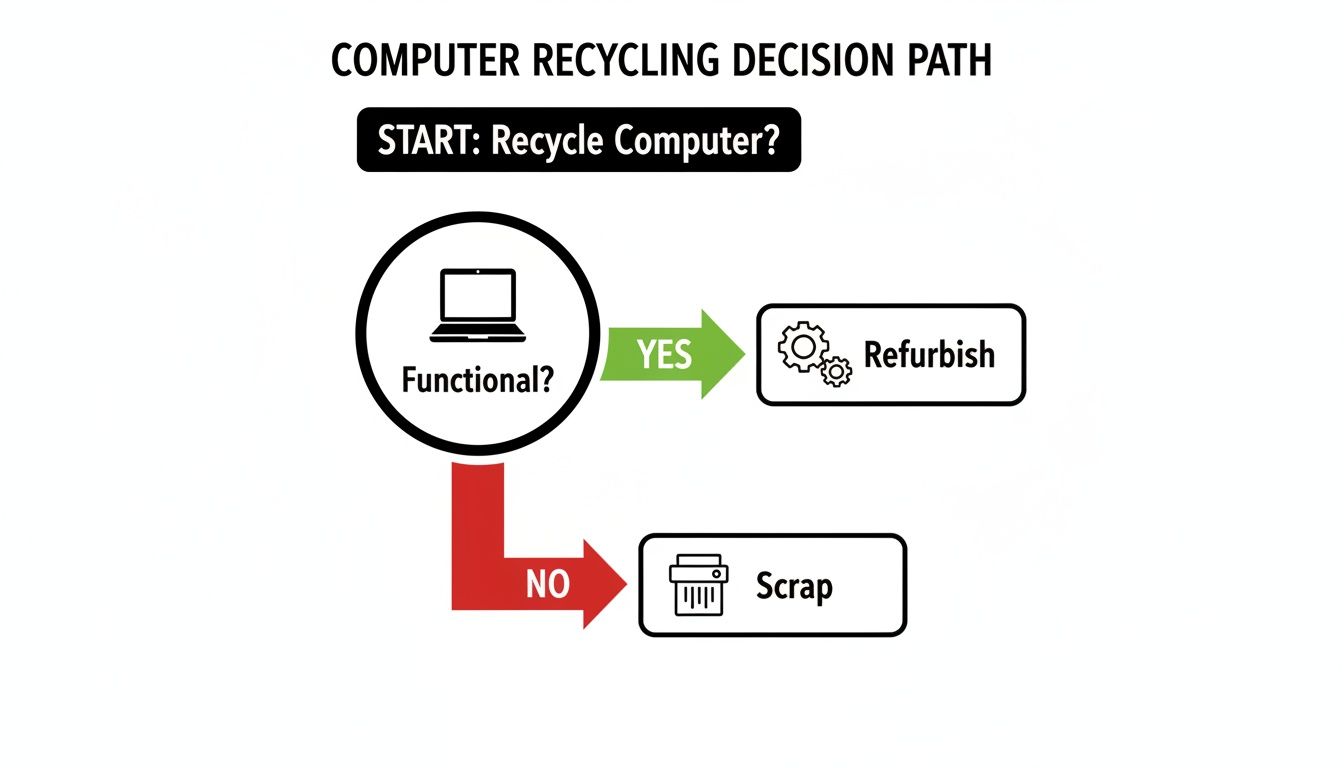
As you can see, the goal is always to prioritize reuse for gear that still works, while making sure non-functional devices are securely broken down for materials recovery.
Secure Data Destruction Methods
With a solid inventory in hand, the next mission-critical task is secure data destruction. This is so much more than hitting the 'delete' key. Real data destruction makes information totally and permanently unrecoverable, protecting your business, your clients, and your team. There are two main ways to get this done, and the right one depends on your specific situation.
1. Software-Based Data Wiping
This approach uses specialized software to overwrite a hard drive with random junk data, usually in several passes. The process follows strict standards like the Department of Defense 5220.22-M or NIST 800-88.
- Best For: Working hard drives in computers that could be refurbished, resold, or donated. Wiping keeps the hardware usable.
- Process: A certified tech runs the software, which meticulously overwrites every single sector of the drive.
- Outcome: The drive is physically fine but completely scrubbed clean of all prior data. It's ready for a fresh start.
2. Physical Hard Drive Destruction
When you need the absolute highest level of security, or when a drive is dead anyway, physical destruction is the undisputed champ. This means shredding, crushing, or degaussing the hard drive, which physically obliterates the platters where the data lives.
- Best For: Devices that held sensitive intellectual property, financial data, or personal health information (PHI) covered by HIPAA. It's also the go-to for failed or ancient drives.
- Process: The hard drive gets fed into an industrial shredder that turns it into a pile of unrecognizable metal fragments.
- Outcome: The drive is gone. Data recovery is physically impossible.
Choosing the right method comes down to balancing data sensitivity with your sustainability goals. For assets you hope to give a second life, professional data wiping is a fantastic, eco-friendly choice. But for maximum security on end-of-life hardware, nothing beats turning it into confetti.
A professional partner like Reworx Recycling can walk you through the right choice for each asset. You can check out our certified options for secure hard drive disposal to see how we keep your data locked down.
No matter which method you go with, your recycling partner absolutely must provide a Certificate of Data Destruction. This document is your legal proof that your data was wiped out securely and verifiably, protecting you from future liability and satisfying compliance rules for regulations like GDPR, HIPAA, and FACTA. Without that piece of paper, you have no official record of responsible disposal.
Navigating The Logistics Of IT Equipment Removal
Okay, so your computers are all accounted for, and the data is wiped clean. Now comes the physical challenge: how do you actually get all that gear off-site safely and efficiently? This is the point where a good plan saves you from major operational headaches, whether you're clearing out a small office or decommissioning an entire data center.
For a small business retiring just a handful of devices, asking an employee to drop them off at a certified facility might seem like a simple solution. But that approach falls apart quickly. As the volume grows, it becomes impractical and risky, leaving you with no clear chain of custody and putting an unnecessary burden on your team.
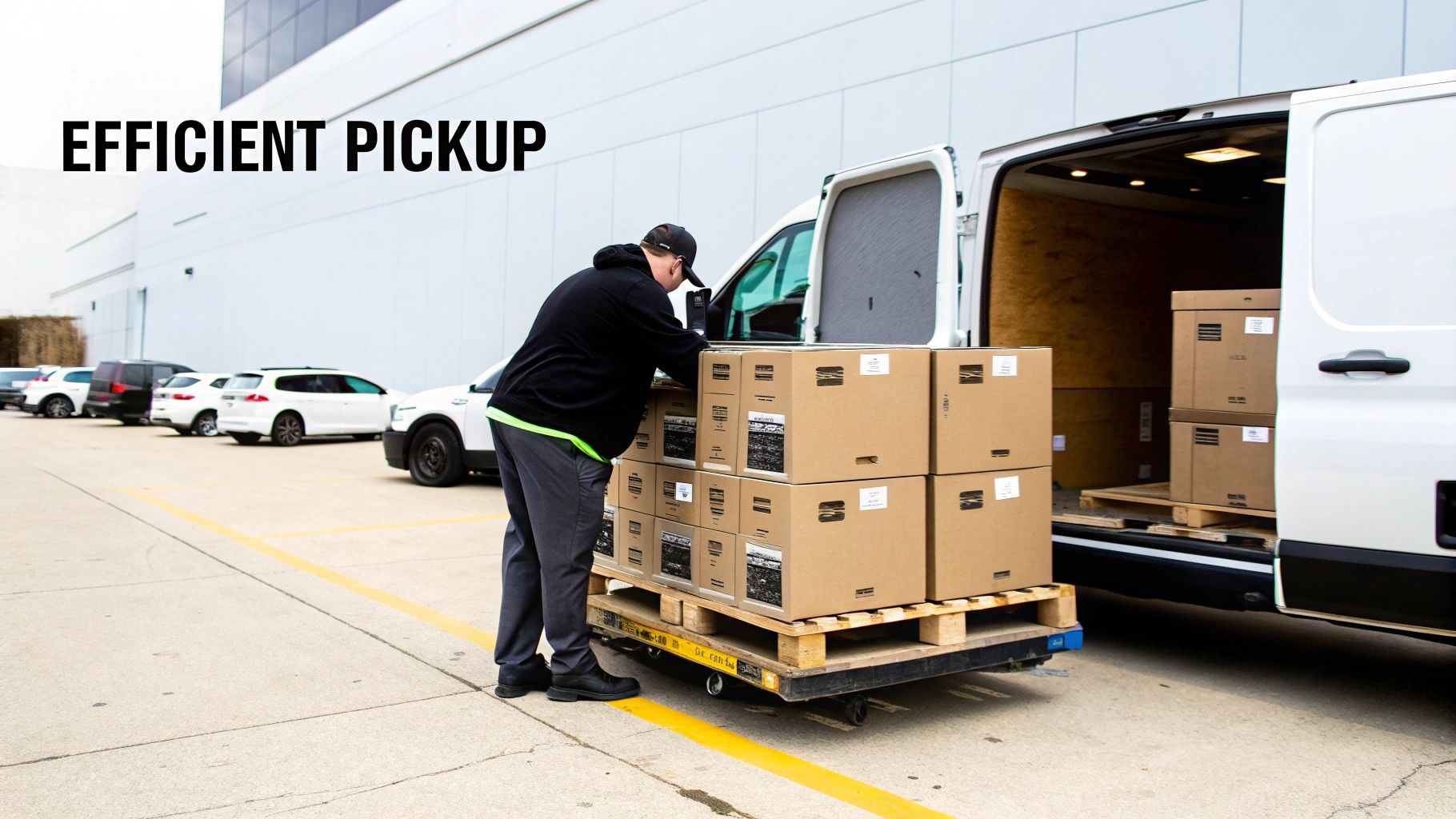
Once you're dealing with more than a few machines, a coordinated corporate pickup service isn't just a nice-to-have—it's essential. This is where you graduate from an impromptu cleanout to a professional IT Asset Disposition (ITAD) strategy.
Scheduled Pickups For Seamless Removal
A scheduled pickup service takes the entire logistical puzzle off your plate. A professional recycling partner, like Reworx Recycling, will work with your Charlotte team to find a time that won't disrupt your daily operations. This is a game-changer for larger projects like facility-wide hardware refreshes or laboratory equipment disposals. Choosing the right partner for this step is critical; you can get a better sense of what's involved by reading up on finding a reliable courier for business IT equipment removal.
A professional pickup service brings a lot to the table:
- Security and Accountability: Trained technicians handle your equipment, making sure it’s transported securely and maintaining that all-important chain of custody you started during inventory.
- Efficiency at Scale: A few dozen laptops or multiple pallets of servers? A dedicated service has the right vehicles and manpower to get the job done fast.
- Proper Handling: These crews know how to manage heavy, delicate electronics, which minimizes the risk of damage and keeps everything compliant with transportation regulations.
By scheduling a pickup, you’re essentially handing off the logistical responsibility to the experts. This frees up your IT and facilities staff to focus on their actual jobs, not on playing Tetris with old equipment in the back of a van.
This kind of organized approach is a fundamental part of effective reverse logistics. If you're curious, you can dive deeper into how reverse logistics services empower your business and make IT retirement a smooth process.
Preparing For A Large-Scale Collection
A little prep work on your end can make the pickup process incredibly smooth. Getting organized beforehand ensures the collection is quick, accurate, and fully documented.
Before the recycling team shows up, consolidate all the assets in one designated, secure spot. This could be a spare conference room, a corner of the warehouse, or an empty office—anywhere that's easy for the crew to access.
Next, make sure your items are neatly packaged or stacked. While partners like Reworx can often supply pallets or bins, having everything ready to go will speed things up tremendously. Finally, have your asset inventory list finalized and on hand. As the equipment is loaded, you can cross-reference the list, giving you a final check that every single device is accounted for. This simple preparation transforms a potentially chaotic day into a well-managed, auditable event.
Choosing The Right E-Waste Recycling Partner
Let's be blunt: not all electronics recyclers are created equal. Who you choose to handle your old IT equipment can be the difference between a seamless, secure process and a nightmare of data breaches, environmental fines, and brand damage. Your choice of partner directly reflects your company's commitment to responsibility.
This is where industry certifications become your most powerful vetting tool. They cut through the marketing noise and provide a clear, third-party-verified signal that a recycler operates at the highest level. Think of them as your guarantee that your old computers won’t end up illegally dumped in a landfill overseas.
Decoding Key Industry Certifications
When you're looking at potential partners, two certifications are the absolute gold standard in the IT asset disposition (ITAD) world. If a company holds these, it means they've passed rigorous, independent audits covering everything from data security to environmental safety.
-
R2 (Responsible Recycling): The R2 Standard is all about a holistic view of responsibility—protecting people, the planet, and your data. An R2-certified recycler has proven their environmental, health, and safety practices are top-notch. They've demonstrated that hazardous materials are managed correctly and that every data destruction process is secure and effective.
-
e-Stewards: This certification is known for being especially tough on environmental standards. An e-Stewards certified partner has made a binding commitment to never export hazardous e-waste to developing nations and to keep it out of landfills and incinerators. Period.
Partnering with a certified recycler is your first line of defense. It’s an independently verified promise that your old computers and the sensitive data they contain will be handled with the utmost care, from the moment they leave your facility to their final disposition.
Beyond these two heavyweights, look for partners who also hold ISO 14001 (Environmental Management) and ISO 45001 (Occupational Health and Safety) certifications. These show a deep-seated commitment to running a truly responsible operation. For a deeper dive, check out our guide on selecting a reliable e-waste recycling partner.
The Social Enterprise Advantage
While certifications guarantee compliance, working with a social enterprise recycler takes your program to another level. It transforms a simple operational task into a powerful story of corporate social responsibility (CSR).
A social enterprise like Reworx Recycling has a dual mission. We provide best-in-class, certified ITAD services, but we also exist to create a positive impact in the community.
Instead of just maximizing profit, this model reinvests. When your company retires functional equipment, we expertly refurbish it and get it into the hands of those who need it most. These devices support nonprofits, help bridge the digital divide for underserved families, and equip workforce development programs with the tools they need to train the next generation.
Suddenly, your IT asset disposition isn't just an expense line—it's a measurable boost to your company's ESG (Environmental, Social, and Governance) goals. It becomes a genuine story you can share with customers, employees, and investors, proving your commitment goes way beyond a press release.
Comparing E-Waste Partner Models
Choosing a partner is about more than just logistics; it’s about aligning with a philosophy. This table breaks down the core differences between a standard for-profit recycler and a mission-driven social enterprise.
| Feature | Standard Recycler | Social Enterprise (Reworx Recycling) |
|---|---|---|
| Primary Goal | Maximize profit from recovered materials and service fees. | Balance sustainable recycling with measurable community benefit. |
| Asset Focus | Primarily materials recovery (shredding and scrapping). | Prioritizes refurbishment and reuse to extend device lifecycles. |
| Social Impact | Limited to environmental compliance and jobs within the firm. | Directly supports digital equity, workforce training, and nonprofits. |
| CSR Value | Meets basic environmental compliance needs. | Creates a powerful, authentic story for sustainability reports and brand-building. |
Ultimately, by partnering with a social enterprise, you aren’t just closing the loop on your electronics' lifecycle. You’re opening doors of opportunity right here in your community.
Maximizing Value From Your Recycling Program
Thinking about recycling old computers as just another compliance checkbox or a line-item expense is a huge missed opportunity. When you manage your IT asset disposition (ITAD) program strategically, you can actually unlock some surprising financial returns and give your brand’s reputation a serious boost.
The trick is to shift your mindset from "getting rid of stuff" to actively recovering value. This isn't just about hauling away old equipment. It’s about finding the hidden potential left in those retired assets and turning what looks like a cost into a win for your bottom line and your company's story.
Unlocking Financial Returns Through IT Asset Buybacks
Let's be clear: not every old computer is headed straight for the shredder. A lot of equipment, especially devices that are only a few years old from a recent hardware refresh, still has plenty of life and market value left in it. This is where an IT asset buyback program can be a game-changer. It's a direct way to offset the cost of recycling the older, truly obsolete gear.
An experienced ITAD partner like Reworx Recycling can take a look at your inventory and pinpoint which devices are good candidates for refurbishment and resale. It’s a pretty straightforward process:
- Assessment: Your partner goes through your retired assets—laptops, servers, networking gear—and evaluates their age, condition, and specs.
- Valuation: They'll check the current secondary market and give you a fair market offer for the equipment that's still viable.
- Secure Processing: Before anything gets refurbished, every single device goes through certified data destruction. No security risks, period.
- Value Recovery: You get the value of that equipment back, either as a direct payment or as a credit you can apply to your recycling services.
Suddenly, a cost becomes a revenue stream. As you look at your options for old electronics, exploring resale can often get you the most bang for your buck, much like when you figure out how to maximize the value of your old electronics.
Amplifying Your Brand With Social Impact
While the financial side is great, the most powerful value often comes from the social impact your recycling program can create. This is where partnering with a social enterprise like Reworx Recycling becomes a huge strategic advantage. Your choice of how to handle old computers can become a central part of your company's sustainability narrative.
A social enterprise isn't just a vendor; they're a partner with a mission. The value they bring goes way beyond just recycling.
- Community Contribution: Functional equipment you donate gets professionally refurbished and placed in the hands of nonprofits, schools, and workforce development programs. Your old laptops become the tools that help people build new skills and bridge the digital divide.
- ESG Reporting: This partnership gives you real, tangible results to feature in your Environmental, Social, and Governance (ESG) reports. You can show a genuine commitment that goes beyond talk and truly enhances your brand.
- Employee Engagement: When you can share stories about how the company is supporting the local community, it does wonders for employee morale. It’s proof that your organization’s values are being put into action.
Think about it: when you partner with a social enterprise, your retired IT assets are transformed. An old office computer becomes a student's first gateway to coding. A decommissioned server helps a local nonprofit manage its operations more effectively. This narrative is authentic, powerful, and deeply resonant with today's conscious consumers and employees.
By taking this approach, your ITAD program becomes so much more. It’s no longer just about ticking compliance boxes; it’s about making a measurable difference. To dive deeper, check out our guide on maximizing value through strategic IT asset disposition. This strategy demonstrates a real commitment that pays dividends in brand loyalty and public perception.
Got Questions About Computer Recycling? We've Got Answers.
Even with the best playbook in hand, IT managers and business owners usually have a few lingering questions before they pull the trigger on a recycling project. That’s smart. Getting clear answers is the only way to make sure you’re protecting your company, staying compliant, and actually meeting your sustainability goals.
Let's tackle some of the most common questions we hear every day.
What’s the Real Difference Between Data Wiping and Hard Drive Destruction?
This is probably the most critical question in the entire process. The choice you make here directly impacts your data security and whether you can recover any value from your old gear.
-
Data Wiping (Erasure): Think of this as a software-based deep clean. We use specialized programs to overwrite every single sector of a hard drive with random data, making the original information completely unrecoverable. The big win here? The drive is left physically intact and perfectly usable. This is the go-to method for newer computers that you might want to refurbish for donation or sell back to a recycler.
-
Hard Drive Destruction: This is the physical, brute-force approach. The hard drive is literally fed into an industrial shredder and ground into tiny metal fragments. There's no coming back from that. It offers the absolute highest level of security because data recovery is physically impossible. This is non-negotiable for devices that held sensitive IP, classified info, or data covered by strict rules like HIPAA.
At Reworx Recycling, we do both, and we’ll help you figure out which assets need which treatment. Either way, you get a formal Certificate of Data Destruction for your records, proving your data was properly eliminated.
How Do We Know Our Old Computers Won’t Just Be Dumped Overseas?
This is a huge and completely valid concern. The last thing you want is for your company’s logo to be spotted on a piece of equipment sitting in an overseas landfill. That’s a compliance nightmare and a brand reputation disaster waiting to happen.
The single best way to prevent this is to work only with a recycler that holds internationally recognized certifications like R2 (Responsible Recycling) or e-Stewards. These aren't just fancy badges; they require intense, independent audits that scrutinize a recycler's entire process from top to bottom.
A core principle of both the R2 and e-Stewards standards is a strict ban on exporting hazardous e-waste to developing countries. Certified recyclers are required to keep a transparent, documented chain of custody for everything they touch.
We live by these standards at Reworx Recycling. You get transparent reports that track your equipment from the moment it leaves your building to its final, responsible end-of-life, giving you total peace of mind.
Our Company Has a Mix of New and Really Old Equipment. Can You Take It All?
Absolutely. In fact, that’s the most common scenario we see. It’s rare for a company to retire a perfectly uniform batch of computers. A flexible, full-service ITAD partner is built to handle exactly these kinds of mixed-age, mixed-condition inventories.
Here’s how we’d typically approach a project like that:
- Triage and Sort: First things first, we sort all the equipment by age, condition, and its potential for a second life.
- Find the Value: Newer, working devices—like laptops from a recent employee refresh—might be perfect for our refurbishment and donation programs or could qualify for an IT asset buyback offer, putting money back in your budget.
- Secure the Data: Any device destined for reuse gets a certified data wipe that meets NIST 800-88 standards.
- Recycle Responsibly: The older, non-functional gear is slated for secure hard drive shredding and responsible materials recycling.
This strategy ensures that every single item is handled in the most secure, eco-friendly, and financially smart way possible.
What Kind of Paperwork Should We Expect From Our Recycling Partner?
Documentation isn't just paperwork; it's your proof. Without a solid paper trail, you have no way to officially verify that you handled your assets—and the sensitive data on them—responsibly.
Your recycling partner should provide a complete documentation package. No excuses.
At a bare minimum, you should always walk away with:
- A Bill of Lading or Custody Transfer Form: This is your receipt from the moment of pickup, documenting that the assets have left your control and are now in the recycler's hands.
- A Detailed Asset Report: For anything with a serial number, this report should list each item individually and state its final outcome (e.g., refurbished, recycled, or destroyed).
- A Certificate of Data Destruction: This is the big one. It certifies that the data on your drives was destroyed according to industry standards, specifying the method used (wiping vs. shredding).
- A Certificate of Recycling: This final document confirms that the physical materials from your non-reusable assets were processed in an environmentally compliant way.
Reworx Recycling provides this full suite of documents for every project, ensuring your business has a complete, transparent, and auditable record of your efforts.
Ready to partner with a social enterprise that provides secure, compliant computer recycling for your Charlotte business? The team at Reworx Recycling is here to help. We offer professional pickup services, certified data destruction, and a commitment to turning your old technology into opportunities for the community. Schedule a pickup or learn more about our donation-based recycling services today.