For business owners and IT managers in Kentucky, navigating the disposal of old electronics can feel like charting a course without a map. Unlike states with strict e-waste mandates, Kentucky’s ‘voluntary’ approach places the responsibility for compliant IT asset disposition squarely on your shoulders. This guide is designed to be your compass, helping you transform that responsibility into a strategic advantage.
By partnering with a social enterprise for your Kentucky electronics recycling needs, you can ensure data security, meet environmental standards, and generate a positive community impact.
Navigating Kentucky's Voluntary E-Waste Landscape for Businesses
The absence of a statewide e-waste law in Kentucky doesn't create a regulatory vacuum for businesses. Federal regulations remain in full force, and the consequences of improper IT equipment disposal—from severe data breaches to substantial environmental fines—are significant.
This landscape requires IT managers and sustainability leaders to proactively develop their own compliant disposal strategies. This isn’t merely about avoiding penalties; it’s about safeguarding your company’s reputation and the sensitive data you manage. A forward-thinking approach integrates sustainable recycling into core business operations, rather than treating it as an afterthought.
The Business Case for a Reliable Recycling Partner
A look at Kentucky's recycling infrastructure highlights the need for a specialized partner. In fiscal year 2024, the statewide recycling rate was just 24.14%, a decline from the previous year. This indicates systemic challenges in collection and processing, particularly for complex items like business electronics.
While state programs processed over 288 tons of e-scrap from public agencies, a significant gap remains for the private sector. This is where a certified partner like Reworx Recycling, a donation-based social enterprise, becomes essential. The right program transforms a potential liability into a valuable corporate asset.
Kentucky E-Waste Disposal At a Glance
| Aspect | Status in Kentucky | Business Implication |
|---|---|---|
| State Mandate | Voluntary (No specific e-waste law) | Businesses must architect their own ITAD policies. |
| Federal Oversight | RCRA applies to hazardous materials | Fines for improper disposal of items containing lead, mercury, etc. |
| Data Security | Federal laws (HIPAA, GLBA) apply | Companies are liable for data breaches from discarded devices. |
| Local Infrastructure | Varies by county; low overall recycling rate | Requires a partner with statewide logistical capabilities. |
This table underscores the need for a proactive, well-defined strategy. Simply leaving obsolete equipment in storage is not a plan—it's a significant business risk.
Why a Proactive ITAD Strategy Matters for Kentucky Businesses
For any Kentucky business—from the advanced manufacturing sector in Louisville to the healthcare hubs in Lexington—a strategic IT Asset Disposition (ITAD) plan delivers critical benefits:
- Absolute Data Security: It guarantees that all sensitive corporate, employee, and customer data is verifiably destroyed before any device is recycled or repurposed.
- Environmental Compliance: It ensures hazardous materials like lead and mercury are managed responsibly, keeping you compliant with federal laws like the Resource Conservation and Recovery Act (RCRA).
- Enhanced Brand Reputation: It provides a clear demonstration of your commitment to corporate social responsibility (CSR), which resonates with clients, partners, and employees.
- Measurable Community Impact: Through a donation-based partner like Reworx Recycling, refurbished equipment gets a second life, supporting nonprofits and bridging the digital divide across the Commonwealth.
By partnering with a social enterprise, your business can confidently manage its end-of-life IT assets. Reworx Recycling offers services that cover all 50 states, ensuring your facility cleanout is handled securely, ethically, and contributes to a positive corporate narrative.
Mitigating Data and Compliance Risks in IT Asset Disposal
An old office computer is a locked vault of your company's most sensitive information. Deleting files or reformatting the drive is like leaving the key in the lock—the data appears gone but is easily recoverable with the right tools. For Kentucky businesses, understanding this distinction is the first step toward achieving genuine data security.
Kentucky's lack of a specific e-waste law doesn't diminish your responsibilities. Instead, it places the full weight of federal compliance on your shoulders. Your retired IT assets are governed by a robust framework of regulations that demand careful adherence.
The Hidden Liabilities in Your Retired Equipment
When an IT asset is designated for disposal, it immediately becomes a potential liability. Two primary risks emerge: environmental non-compliance and catastrophic data breaches. Both carry the threat of severe financial penalties and lasting damage to your brand.
Federal laws like the Resource Conservation and Recovery Act (RCRA) strictly regulate hazardous materials found in electronics, such as lead in CRT monitors and mercury in circuit boards. Improper disposal can lead to substantial fines. Simultaneously, data privacy laws like HIPAA for healthcare and the Gramm-Leach-Bliley Act (GLBA) for finance mandate the absolute protection of sensitive information, even on retired devices.
A single data breach can cost a company millions in fines, litigation, and lost customer trust. One of the greatest vulnerabilities for many organizations is the IT equipment they have forgotten about in a storage closet.
Before professional IT asset disposition, finding secure storage for your e-waste is a critical interim step. This prevents devices laden with sensitive data from being vulnerable to theft or unauthorized access before they are properly processed.
Why Secure Data Destruction is Non-Negotiable
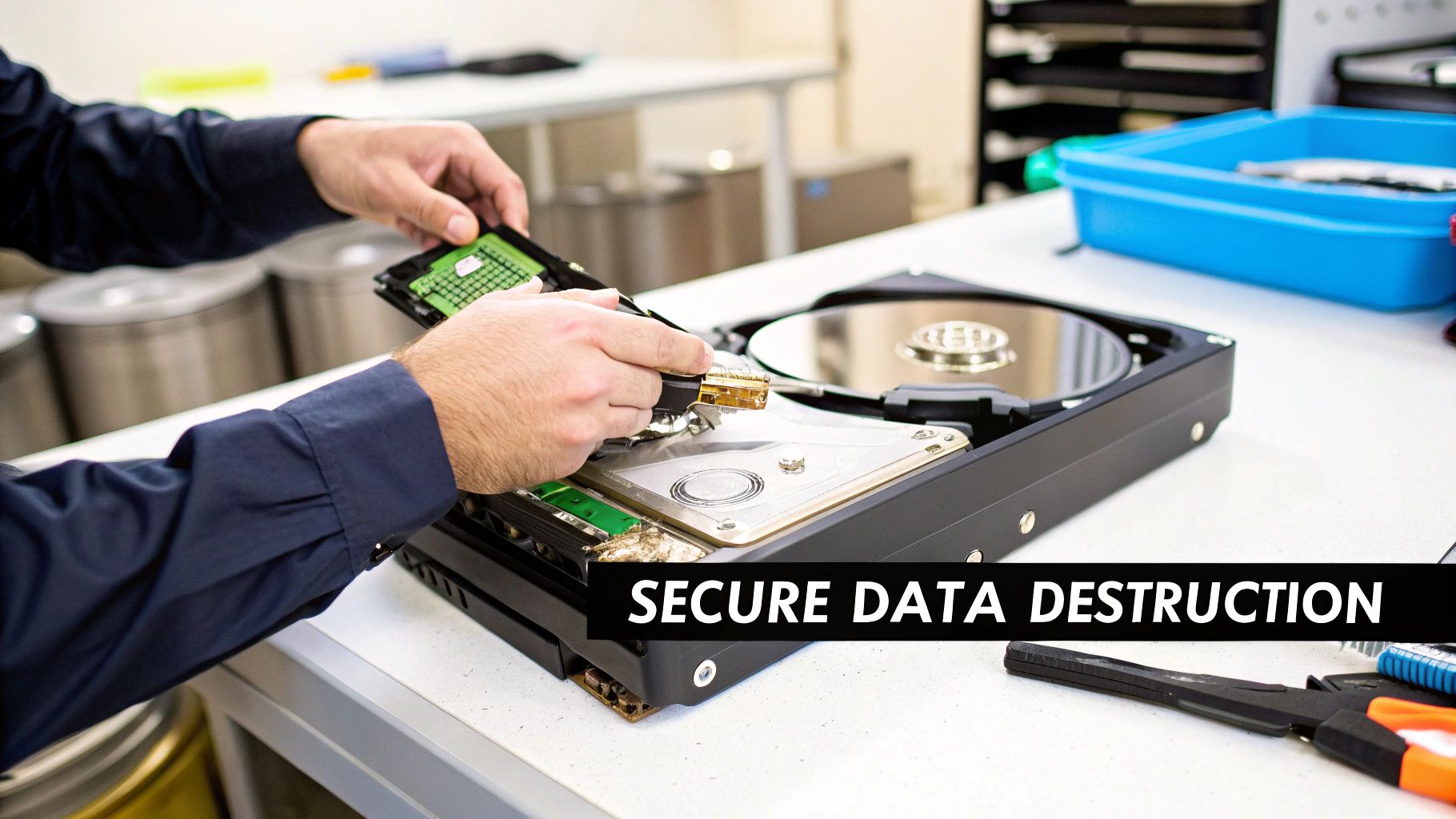
To eliminate the risk of a data breach from retired assets, superficial solutions are insufficient. The only foolproof method is secure data destruction, a process that physically destroys storage media, rendering data completely irrecoverable.
This extends far beyond simple wiping or degaussing. The industry gold standard is defined by the National Institute of Standards and Technology (NIST) in Special Publication 800-88. This framework provides clear guidelines for media sanitization, with physical destruction (shredding, disintegration) being the ultimate form of data elimination. When your ITAD partner adheres to these standards, your data is permanently gone.
The Power of an Auditable Chain of Custody
Partnering with a certified ITAD provider like Reworx Recycling offers more than peace of mind; it provides a concrete, auditable defense against compliance claims. Our process is transparent and secure:
- Chain of Custody: We provide secure, documented tracking of your assets from the moment they leave your facility.
- Physical Destruction: We shred hard drives, solid-state drives, and other storage media into small, unusable fragments.
- Certificate of Data Destruction: You receive a formal document that serves as your legal proof of compliance, detailing what was destroyed and how.
This certificate is your ultimate safeguard. It proves you have met your due diligence obligations under federal data privacy laws, effectively closing the loop on your IT asset's lifecycle. For any Kentucky business, from a manufacturing plant in Bowling Green to a logistics company near the CVG airport, this documentation is essential. It transforms your Kentucky electronics recycling program from a disposal task into a powerful risk management tool.
Blueprints for Success from Local Kentucky Initiatives
How does responsible e-waste management work in practice, especially in a state without a top-down mandate? The most effective strategies are often built from the ground up by forward-thinking organizations that recognize the value in proactive environmental and data stewardship.
Across Kentucky, local initiatives serve as powerful blueprints, demonstrating that successful Kentucky electronics recycling programs can thrive with the right partnerships and commitment. These are not theoretical models; they are real-world examples that offer practical guidance for businesses, schools, and municipalities. They show that the absence of a state law is not a roadblock—it is an opportunity for local leadership.
The Power of Public-Private Partnerships in Covington
One of the most effective models for community-wide electronics recycling is the public-private partnership, and the City of Covington offers a prime example. By collaborating with a certified recycling partner, the city established a year-round e-waste collection program, making it simple for residents and small businesses to responsibly dispose of old electronics.
This model is transformative because it solves the logistical challenges that often hinder recycling efforts. It provides a consistent, reliable destination for old devices, keeping them out of landfills. For businesses, this local infrastructure is a significant asset.
- Accessibility: It offers a dependable outlet for smaller quantities of e-waste that might not warrant a dedicated pickup.
- Community Engagement: It raises local awareness and fosters a culture of recycling that benefits the entire region.
- Scalability: The framework is easily replicable in other cities and counties with a dedicated partner like Reworx Recycling.
Reworx specializes in developing these types of partnerships. We help organizations coordinate everything from large-scale office cleanouts to community e-waste drives, ensuring every device is managed with the highest standards of data security and environmental care.
A Campus Case Study: The University of Louisville
A large university, with its continuous technology refresh cycles, generates e-waste on the scale of a small city. The University of Louisville has emerged as a leader in this area, providing a tangible model for any large corporate or academic campus. Their campus-wide recycling initiatives demonstrate how a voluntary program, driven by a commitment to sustainability, can achieve remarkable results.
The University of Louisville consistently performs well in national recycling competitions. In the 2024 Campus Race to Zero Waste, UofL collected 3,701 lbs of e-waste, placing them 12th nationwide in the electronics category. This is more than just a number; it is proof that dedicated, voluntary programs can divert thousands of pounds of hazardous materials from landfills, offering a clear blueprint for Kentucky's corporate and public sectors.
These local success stories are not just inspiring—they are practical roadmaps. They prove that with the right partner and a clear strategy, any Kentucky organization can implement a successful, secure, and impactful electronics recycling program.
These initiatives confirm that effective IT equipment disposal does not require a state mandate; it requires leadership and the right operational partner. For businesses looking to establish their own programs, from the automotive industry in Georgetown to the bourbon distilleries across the state, these local blueprints offer a proven path to responsible e-waste management that protects both data and the local environment.
Turning Retired IT Assets into Community Impact through Donation
What if your company's retired technology could achieve more than just compliant recycling? The standard approach to IT equipment disposal focuses on secure data destruction and responsible materials handling—both of which are critically important. But a more impactful strategy exists, one that transforms a logistical necessity into a powerful source of community good. This is the core of donation-based IT Asset Disposition (ITAD), the social enterprise model that powers Reworx Recycling.
This approach reframes the question from "How do we dispose of this equipment?" to "How can this asset continue to create value?" For businesses in Kentucky, it's an opportunity to make a tangible, positive impact that extends far beyond environmental compliance.
The Double Bottom Line of Social Enterprise Recycling
A social enterprise measures success with a "double bottom line," tracking both financial sustainability and positive social outcomes. When you partner with a social enterprise recycling firm like Reworx for your Kentucky electronics recycling, your retired assets fuel our mission. Instead of being shredded for raw materials, functional devices are given a second life.
This creates a clear win-win:
- You solve a business need: Securely and efficiently clear out old technology, reclaim valuable office space, and gain peace of mind knowing your data has been completely destroyed.
- You create community value: Your donated equipment becomes a tool that empowers nonprofits, schools, and individuals in underserved communities across the state.
This dual benefit is what sets donation-based recycling apart. It's not just a service; it's a partnership that generates measurable, positive change.
How Retired Technology Gets a Second Life
The journey of a donated device is a powerful one. A laptop that once processed logistics data in a Shepherdsville warehouse can unlock new opportunities for a student in a rural Kentucky town.
By choosing donation-based recycling, you are actively helping to bridge the digital divide. Your old equipment becomes the infrastructure for education, job training, and community connection.
Here’s how we transform your retired technology into a community asset:
- Secure Processing: Every device undergoes rigorous, certified data destruction according to NIST 800-88 standards. Your sensitive information is permanently and verifiably eliminated.
- Expert Refurbishment: Our technicians test, repair, and refurbish functional equipment, including laptops, desktops, and servers, restoring them to excellent working condition.
- Strategic Donation: We then work with our network of vetted nonprofits, schools, and community organizations to place the technology where it will make the greatest impact.
This process ensures your old hardware, whether from medical equipment disposal or a routine office refresh, finds a new and important purpose. Learning how to donate a laptop illustrates how straightforward and impactful this process can be.
Fueling Your Corporate Social Responsibility Story
Modern stakeholders—from customers to employees—expect businesses to be good corporate citizens. Your ITAD program can become a genuine and powerful component of your Corporate Social Responsibility (CSR) narrative. Instead of a sterile line item in your sustainability report about "X tons of e-waste recycled," you can tell a story that resonates.
Imagine reporting that your annual tech upgrade provided 50 laptops to an after-school program, helped a local nonprofit modernize its operations, or supported a workforce development initiative. This isn't just recycling; it's converting a routine business function into a tangible community contribution. Reworx provides the documentation and impact reporting needed to share these successes, making your sustainable recycling efforts a cornerstone of your brand identity.
Your Step-by-Step Plan for E-Waste Management
Implementing a formal e-waste management program transforms a complex challenge into a clear, manageable process. For businesses across Kentucky, this structured approach is key to ensuring compliance, protecting data, and operating sustainably. This roadmap breaks the entire process into actionable steps.
From the initial audit to the final pickup, this is your playbook for turning a potential liability into a simple, secure, and impactful process with a partner like Reworx Recycling.
This simple flow shows how retiring your IT assets can create a positive ripple effect in the community when you choose a donation-based recycling model.
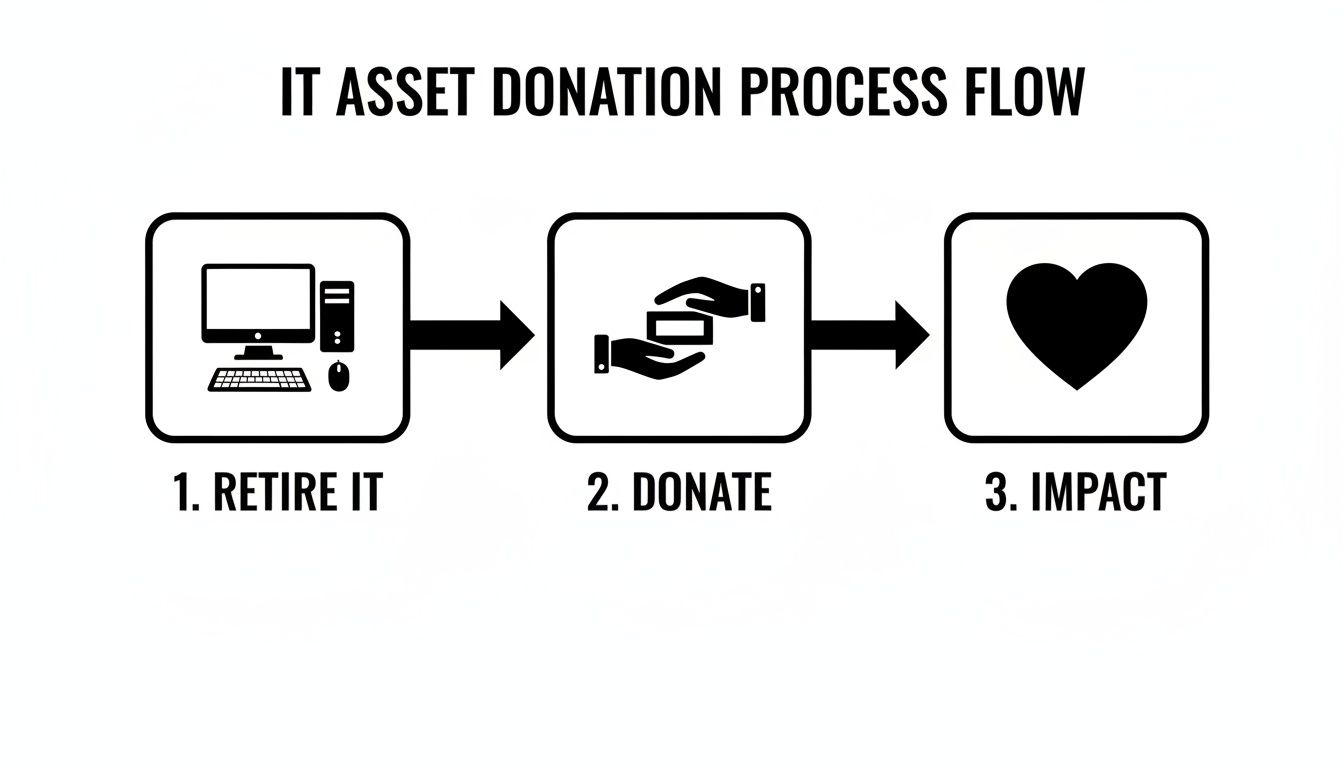
As you can see, responsible IT equipment disposal isn’t an endpoint. It’s a transition—one that transforms retired hardware into a valuable resource for others.
Step 1: Conduct a Comprehensive IT Asset Audit
You cannot manage what you do not measure. The first step is to conduct a thorough inventory of all electronic equipment your organization owns. This goes beyond a simple device count; it's about understanding the complete lifecycle of your technology.
Create a detailed list that includes:
- Device Type: Laptops, desktops, servers, monitors, printers, networking gear, mobile devices, and specialized equipment like laboratory equipment disposal.
- Age and Condition: Note which items are functional, which could be repaired, and which are truly obsolete.
- Data Sensitivity: Flag all devices containing sensitive or proprietary information. This is critical for prioritizing secure data destruction.
- Location: Document where all assets are stored, including main offices, remote sites, and forgotten storage closets.
This audit provides the data needed to build an effective disposition strategy and identify opportunities for refurbishment and donation through a corporate donation program.
Step 2: Establish Clear Data Destruction Protocols
Once you have inventoried your assets, the next step is to protect the data they contain. Simple file deletion is inadequate. Your plan must include a clear, non-negotiable protocol for data sanitization that meets federal standards.
The greatest risk in IT asset disposition (ITAD) isn't the hardware; it’s the data left behind. A single hard drive falling into the wrong hands can lead to devastating financial and reputational damage.
Your protocol should mandate that all storage media undergo certified data destruction following NIST 800-88 guidelines, which typically means physical shredding. Working with a vendor like Reworx Recycling ensures this is handled correctly, and you will receive a Certificate of Data Destruction for your records. This auditable proof is your best defense against future compliance challenges.
Step 3: Plan the Logistics for Your Office or Facility Cleanout
With your inventory complete and data protocols established, it's time to plan the physical removal of the equipment. For a small office, this may be a simple pickup. For a large facility cleanout or data center decommissioning, it requires more detailed coordination.
Consider these logistics:
- Scheduling: Choose a time that minimizes disruption to your daily operations.
- Packing and Palletizing: Determine if your team will prepare the equipment for pickup or if your ITAD partner needs to manage the process.
- Secure Transport: Ensure your partner provides a secure, documented chain of custody from the moment the assets leave your control.
Reworx Recycling simplifies this step by offering flexible, scheduled pickups for businesses across Kentucky. Our logistics team coordinates everything to ensure a secure and efficient removal, whether you’re retiring a few dozen laptops or decommissioning an entire server room.
By following these steps, you can create a robust plan for Kentucky electronics recycling that protects your business, fulfills your compliance obligations, and benefits your community.
Partner with Reworx for Your ITAD Solution
In Kentucky, the absence of a statewide e-waste mandate means the responsibility for compliant and secure electronics disposal rests with your business. Without a clear regulatory roadmap, selecting an IT Asset Disposition (ITAD) partner is not just a vendor choice—it is a critical strategic decision.
This is an opportunity to look beyond risk mitigation and see the value hidden within your retired technology. Every old server, laptop, and piece of medical equipment disposal represents a potential liability if handled incorrectly. But when managed properly, it holds the potential for significant community impact.
Gaining a True Partner in Compliance and Community
Choosing Reworx Recycling means you are not just hiring a disposal service; you are gaining a dedicated partner committed to protecting your data, ensuring environmental compliance, and strengthening your corporate reputation. We make the entire process of responsible Kentucky electronics recycling simple, transparent, and impactful.
With Reworx, you take a definitive step to protect your business while making a tangible difference. Our donation-based recycling model gives functional equipment a second life, supporting local nonprofits and schools right here in Kentucky. This approach turns your routine office cleanout into a powerful story of community support and corporate citizenship.
Choosing a social enterprise partner like Reworx is a conscious decision to reinvest in the community, turning end-of-life assets into valuable resources for those who need them most.
Take the Next Step Today
Protecting your business and contributing to your community has never been more straightforward. Let us demonstrate how a professionally managed IT asset disposition program can benefit your organization.
Ready to get started?
- Schedule your free business pickup and our team will securely collect your retired assets.
- Contact our experts for a custom ITAD consultation to design a plan tailored to your organization’s needs.
Take action today to secure your data, meet your compliance goals, and become a leader in corporate responsibility in Kentucky.
Answering Your Kentucky E-Waste Questions
When it's time to retire old IT equipment, Kentucky businesses often have a few questions. Let's clear up some of the most common ones so you can move forward with a smart, compliant electronics recycling plan.
Is It Illegal to Throw Away Electronics in Kentucky?
While Kentucky does not have a specific statewide law banning businesses from landfilling electronics, that doesn't mean it's without risk.
You are still subject to federal laws, particularly the Resource Conservation and Recovery Act (RCRA). This act governs the disposal of hazardous materials, which are present in most electronics. Components containing lead (from old CRT monitors) or mercury can lead to significant federal fines and long-term environmental liability if disposed of improperly.
The safest and most straightforward way to avoid these risks is to partner with a certified recycler who understands how to manage these materials in full compliance with federal regulations.
How Can I Guarantee My Company Data Is Destroyed?
When it comes to sensitive corporate data, absolute certainty is required. The only way to be 100% certain that your data is irrecoverable is through certified physical destruction.
Software-based wiping can fail, and even a "successful" wipe may leave recoverable data fragments, creating an unacceptable liability.
At Reworx Recycling, we provide on-site and off-site hard drive shredding that adheres to the rigorous NIST 800-88 standards for media sanitization. Following destruction, we issue a formal Certificate of Data Destruction. This document serves as your official, auditable proof that your data has been permanently eliminated, protecting you from the severe consequences of a data breach.
Does Reworx Offer Pickups Outside Major Cities?
Yes. We understand that businesses and organizations operate across the entire Commonwealth, not just in Louisville and Lexington. Reworx Recycling provides scheduled pickup services for businesses, schools, and government agencies throughout Kentucky.
Whether you are conducting an office cleanout in Paducah, retiring a data center in Bowling Green, or managing product destruction in Covington, our logistics team is equipped to help. We will coordinate a secure and efficient pickup directly from your facility, regardless of your location. Our mission is to make responsible Kentucky electronics recycling accessible to every organization in the state.
Ready to put a secure, compliant, and responsible ITAD strategy in place for your Kentucky business? Partner with Reworx Recycling to not only protect your data but also turn your old equipment into a positive force. Schedule your business pickup or request a consultation today, and check out our Recycling Blog to learn more.