For Iowa's business owners, IT managers, and corporate sustainability leaders, managing retired electronics is a critical function fraught with risk. The process of Iowa electronics recycling involves far more than clearing out storage space—it requires navigating data security, environmental compliance, and logistical challenges. A misstep in IT equipment disposal can lead to a costly data breach, significant regulatory fines, or lasting damage to your corporate reputation.
Why a Strategic Approach to Iowa E-Waste Is Crucial for Your Business
Across the Hawkeye State, from the agricultural tech sector in Ames to the manufacturing hubs in Cedar Rapids, businesses are grappling with the rapid pace of technological change. This constant cycle of upgrades generates a significant stream of outdated servers, laptops, and specialized hardware. This is not merely a storage issue; it represents a substantial source of corporate risk and responsibility.
Illegally dumping old equipment is not an option. Modern electronics contain a mix of valuable, recoverable materials and hazardous substances like lead and mercury that require specialized handling. More importantly, every retired hard drive, server, and smartphone holds a digital ghost of your company's most sensitive data. A robust IT Asset Disposition (ITAD) strategy is essential to mitigate these risks.
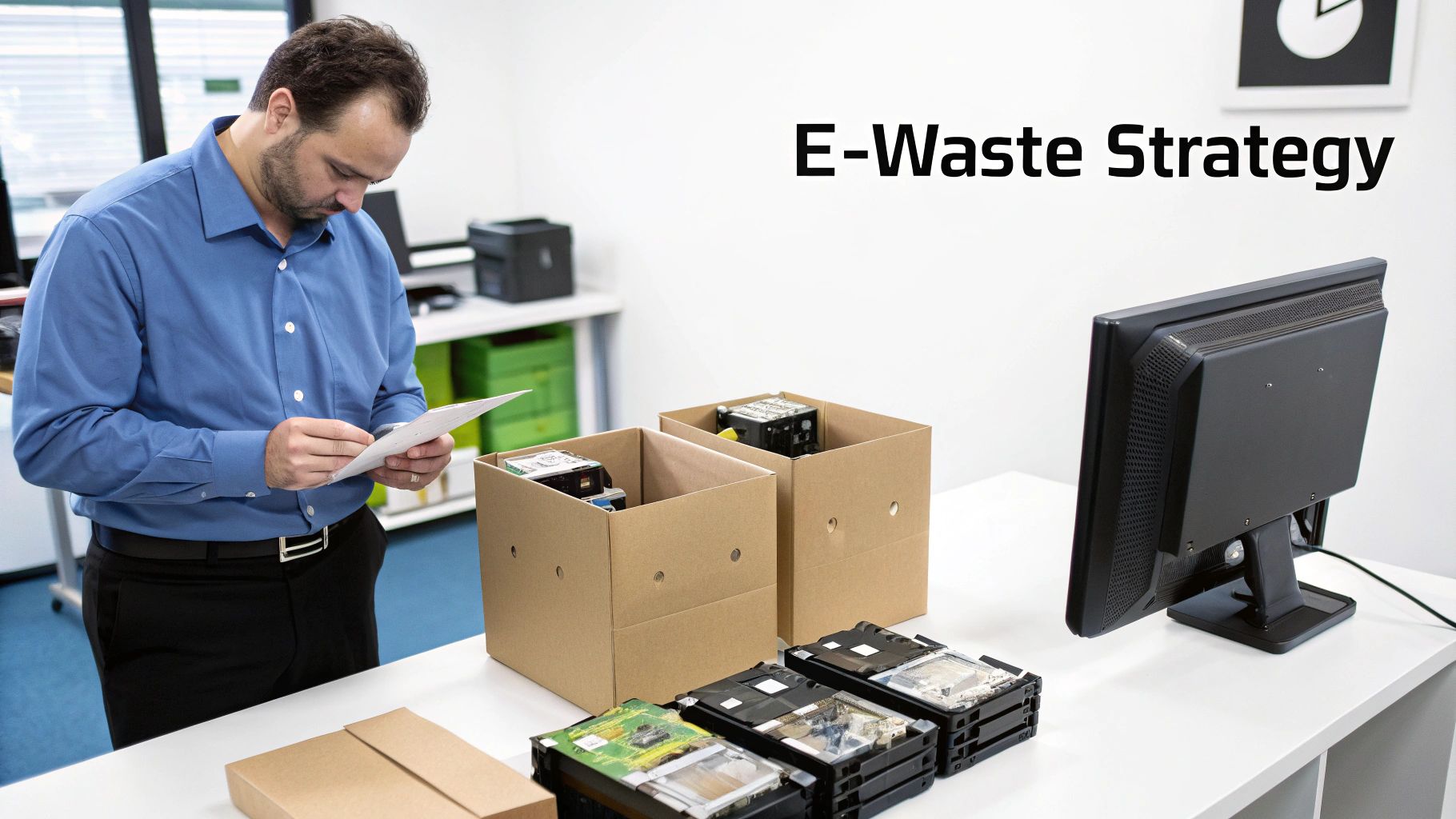
Key Hurdles Iowa Businesses Face
Whether you're managing a data center decommissioning in Des Moines or a facility cleanout in Davenport, a comprehensive ITAD plan must address several core challenges.
Here’s what should be top-of-mind for any Iowa business managing its electronic assets.
Key Considerations For Business E-Waste Management In Iowa
| Consideration Area | Key Objective | Potential Business Impact |
|---|---|---|
| Data Security | Guarantee complete, verifiable destruction of all sensitive data on retired devices. | Prevents costly data breaches, protects customer trust, and avoids reputational damage. |
| Environmental Compliance | Adhere to all federal, state, and local e-waste disposal regulations. | Avoids significant fines, legal trouble, and negative publicity. |
| Logistical Complexity | Efficiently coordinate the pickup and transport of bulky or numerous IT assets. | Frees up valuable internal resources and space, especially during office moves or upgrades. |
| Resource Recovery | Maximize the value recovered from retired assets through resale or parts harvesting. | Creates a revenue stream from old equipment, turning a cost center into a potential profit center. |
Ultimately, a well-executed strategy transforms a potential liability—a storeroom full of old computers—into a secure, compliant, and beneficial process. This requires a partner who understands the nuances of technology, logistics, and responsible corporate stewardship.
From Obligation to Opportunity: The Social Enterprise Model
A modern approach to ITAD reframes these challenges as opportunities. Instead of viewing retired electronics as waste, forward-thinking businesses see them as assets requiring careful management. This mindset is crucial. When you partner with a certified, mission-driven recycler, you're not just fulfilling a compliance requirement—you're enhancing your corporate social responsibility (CSR) profile.
Reworx Recycling is a social enterprise, meaning our process is designed to do more than just recycle materials; it’s built to create a positive community impact. Our unique, donation-based recycling model offers a powerful solution for Iowa businesses. We provide comprehensive services covering the entire ITAD lifecycle, ensuring your IT equipment disposal is handled securely and sustainably.
For organizations needing to streamline efforts across multiple locations, our national reach ensures consistent service. You can learn more about how Reworx supports businesses across all 50 states and discover how we can build a program tailored to your unique operational needs.
Understanding Iowa E-Waste Regulations And Compliance
For any business operating in Iowa, adhering to electronics disposal laws is non-negotiable. The regulatory landscape, a combination of state guidelines and federal EPA regulations, can seem complex. However, mastering these rules is the only way to mitigate serious risks and demonstrate responsible corporate citizenship.
Improperly disposing of old office technology isn't just an environmental misstep; it's a direct threat to your bottom line and reputation. Non-compliance can lead to substantial fines, legal action, and a loss of customer trust. The reality is that the cost of improper disposal will always exceed the investment in a compliant, secure electronics recycling program.
Navigating Hazardous Materials In Common Office Tech
The strict regulations exist because of what’s inside your everyday electronics. While seemingly harmless, many devices contain materials that can cause significant environmental and health damage if they end up in a landfill.
Consider an old CRT monitor or the screen of an older laptop; they often contain mercury and lead, two highly toxic heavy metals. When such equipment is crushed or degrades in a landfill, these toxins can leach into the soil and groundwater, creating a lasting environmental hazard.
Here are the key materials to be aware of:
- Lead: Found in the glass of old CRT monitors and the solder on circuit boards.
- Mercury: Used in the backlights of flat-panel displays, as well as in switches and relays.
- Cadmium: Often present in rechargeable computer batteries and some circuit boards.
- Brominated Flame Retardants (BFRs): Mixed into plastic casings to reduce fire risk, but they can be toxic when released.
Proper Iowa electronics recycling ensures these hazardous materials are carefully extracted and managed safely, preventing contamination of local ecosystems. Partnering with a certified recycler like Reworx Recycling removes the guesswork, providing assurance that every component is handled according to the highest legal and environmental standards.
The Bigger Picture State And Federal Momentum
The movement for smarter e-waste management is gaining momentum, not just in Iowa but nationwide. This reflects a growing awareness of the scale of the e-waste problem. Iowa is part of a broader conversation focused on creating a more sustainable and secure framework for handling end-of-life electronics.
For example, in March 2025, an Iowa lawmaker introduced the Recycling Infrastructure and Accessibility Act, a pivotal piece of legislation aimed at bolstering e-waste recycling nationwide by mandating the EPA to launch programs in underserved communities. This move came amid a July 2025 congressional hearing where U.S. officials spotlighted a United Nations report pegging global e-waste collection at 62 million metric tons in 2022, underscoring the exploding crisis as devices packed with critical minerals fuel a U.S.-China resource race. You can explore more about these legislative efforts and their impact on recycling.
This context demonstrates why proactive compliance is a strategic business move, aligning your company with future policies and evolving customer expectations.
Beyond Compliance The Strategic Advantage
Adhering to e-waste regulations is the baseline. Industry leaders integrate responsible disposal into their core operations and sustainability goals through a formal IT Asset Disposition (ITAD) program. ITAD is more than just recycling; it's a complete strategy that encompasses data security, asset value recovery, and logistical management.
A well-planned ITAD strategy provides a clear, documented chain of custody for every asset that leaves your facility. This documentation is crucial for demonstrating due diligence and protecting your organization from future liability. When you work with a partner that provides detailed reports and Certificates of Destruction, you build an unimpeachable compliance record. Find out more about our approach to comprehensive IT asset disposition services.
Ultimately, being proactive about Iowa electronics recycling regulations signals a well-managed, forward-thinking business. Reworx helps companies transform this legal obligation into a strategic advantage, delivering peace of mind while strengthening your commitment to data security and environmental responsibility.
Why Secure Data Destruction Is Non-Negotiable
When an IT asset—whether a server, laptop, or corporate smartphone—is retired, its most valuable component is not the hardware, but the data it contains. For Iowa businesses, managing the physical disposal of old equipment is only half the task. Ensuring the sensitive information on that equipment is permanently destroyed is what truly protects your organization.
Simply deleting files or reformatting a hard drive is a common and dangerous misconception that creates a significant security vulnerability. Deleting a file is akin to crumpling a confidential document and tossing it in an office wastebasket; the information remains and is easily recoverable by a determined individual.
Professional data destruction, by contrast, is like putting that document through a cross-cut shredder, turning recoverable data into meaningless, permanently unreadable fragments.
The Anatomy of Data Risk
Every device that has connected to your network holds a digital footprint of your operations. This includes not just financial records but a wealth of proprietary data that could be catastrophic in the wrong hands.
What’s really at stake?
- Customer Information: Names, addresses, payment details, and other personally identifiable information (PII) that you are legally required to protect.
- Employee Records: Social Security numbers, payroll information, performance reviews, and other confidential HR data.
- Proprietary Business Data: Your trade secrets, intellectual property, strategic plans, and internal communications—the very things that give your company its competitive edge.
- Financial Documents: Invoices, transaction histories, and corporate financial data that could easily be used for fraud.
A single data breach can trigger devastating consequences, including steep regulatory fines, complex litigation, a complete loss of customer trust, and irreparable brand damage. That's why responsible Iowa electronics recycling must begin with an unwavering commitment to secure data destruction.
Professional Methods for Irrecoverable Data Elimination
To effectively neutralize data threats, businesses must rely on certified, professional methods of data destruction. In the ITAD industry, two techniques are considered the gold standard: multi-pass data wiping and physical destruction.
Data wiping, or sanitization, uses specialized software to overwrite a hard drive's entire surface with random characters. This process is repeated multiple times (in "passes") to ensure the original data is so thoroughly buried that it can never be reconstructed. This is an effective method for devices that may be refurbished and redeployed.
However, for maximum security and for devices at their end-of-life, nothing surpasses physical destruction. This process involves shredding hard drives, solid-state drives, and other storage media into small, confetti-like pieces. This mechanical destruction guarantees that the data is 100% irrecoverable, providing ultimate peace of mind.
"Data doesn’t disappear when devices are deleted, broken, or reset. Intentional sanitization or destruction is the only way to stay secure." This core principle highlights a critical gap in many companies' end-of-life IT policies—a gap that certified partners are equipped to close.
The Importance of a Verifiable Chain of Custody
How can you be certain your data has been truly destroyed? This is where proper documentation is essential. A reputable ITAD partner provides a complete, unbroken chain of custody, from the moment your assets are picked up to the final moment of destruction.
This process is formalized with a Certificate of Destruction. This legal document serves as your official, verifiable proof that your data-bearing devices were destroyed according to industry best practices and regulatory standards. It is an essential component of any compliance or risk management program, providing a clear audit trail that protects your business from liability.
At Reworx Recycling, we make this process seamless and transparent. Our certified procedures ensure every device is handled with the highest level of security. To see how we do it, learn more about Reworx Recycling’s certified secure hard drive shredding services. Partnering with us provides the verifiable proof needed to uphold your legal and ethical obligations.
A Practical Blueprint For Office And Facility Cleanouts
A large-scale IT cleanout can be a daunting project. Whether your Iowa business is relocating, executing a major technology refresh, or decommissioning a facility, the task can quickly become overwhelming. Without a clear plan, the process can become chaotic, inefficient, and risky.
The key is to break the project into a manageable, step-by-step process. This blueprint helps you handle every piece of equipment—from data center servers to specialized lab instruments—securely and sustainably. A structured approach helps avoid common pitfalls, maximize asset value, and maintain operational continuity.
Phase 1: Initial Asset Inventory And Categorization
Before any action is taken, you must know exactly what assets you have. This goes beyond a simple count of computers; it requires a detailed inventory that will inform every subsequent decision.
Start by creating a master list of all IT and electronic assets slated for removal. For each item, record key details to simplify sorting and disposition.
Key Inventory Data Points:
- Asset Type: (e.g., laptop, server, monitor, medical device)
- Brand and Model: (e.g., Dell Latitude 7420, HP ProLiant DL380)
- Serial Number or Asset Tag: This is essential for precise tracking and maintaining a chain of custody.
- Condition: Is it functional, in need of repair, or officially at its end-of-life?
- Data-Bearing Status: A simple "yes" or "no" will flag devices that need secure data destruction.
This initial audit allows for logical segmentation: items with potential resale value, equipment suitable for donation, and devices designated for secure recycling. Proper segmentation is the foundation of an efficient and cost-effective cleanout.
Phase 2: Secure Decommissioning And Data Destruction
With the inventory complete, the next critical step is to take assets offline and ensure all sensitive data is eradicated. For complex environments like data centers, this involves a careful decommissioning process to prevent disruption to ongoing operations.
Data security is the top priority at this stage. Every device flagged as "data-bearing" must undergo certified data destruction before it leaves your premises. Simply deleting files offers no real protection.
This visual illustrates the progression from basic file deletion to complete, irreversible data elimination.
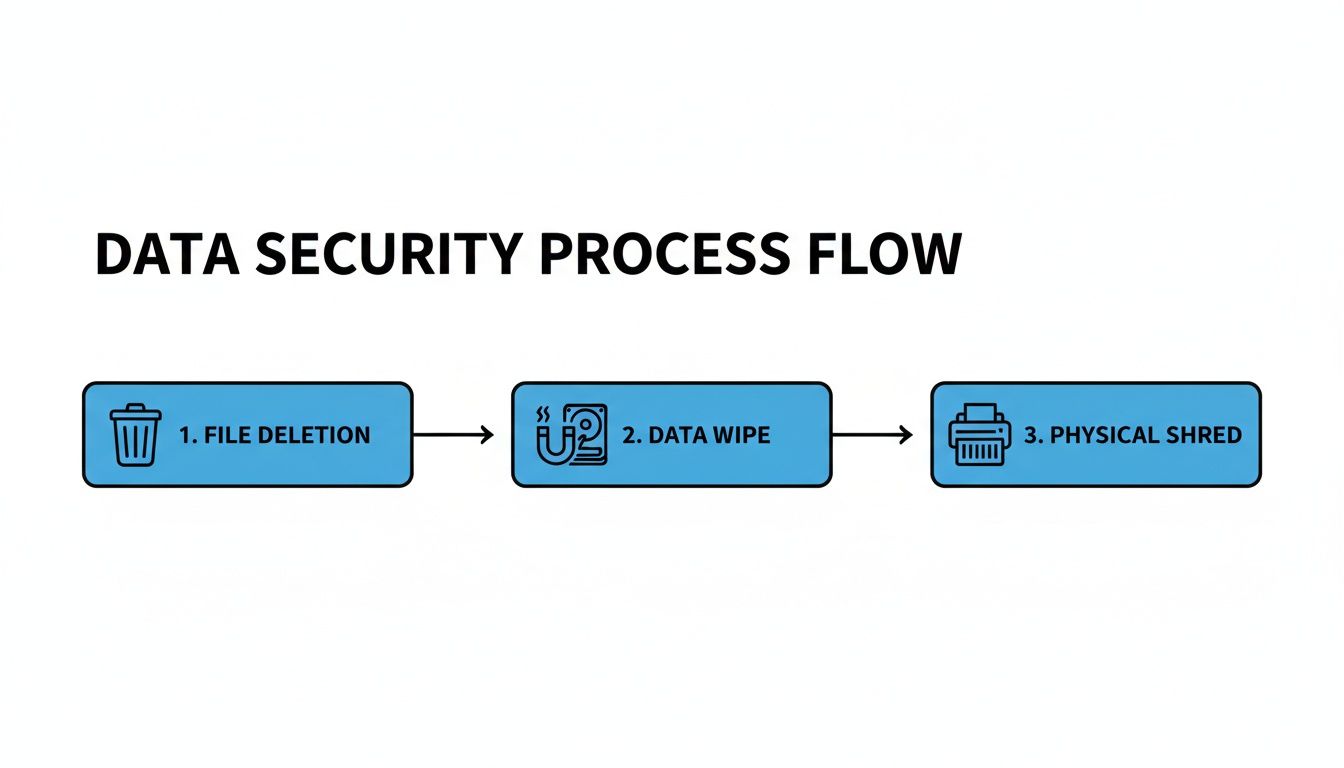
As shown, physical shredding is the ultimate security measure. It is the final, absolute step to guarantee data can never be recovered, providing the highest level of security.
Phase 3: Logistics And Partner Coordination
With assets inventoried and data secured, the final piece is logistics. Coordinating the physical removal of hundreds or thousands of items requires significant planning. When clearing out old equipment and furniture, considering responsible office cleanouts is key to ensuring everything is handled properly and meets environmental standards.
This is where engaging an experienced ITAD provider like Reworx Recycling can alleviate a significant burden from your team. We manage the entire process, from on-site packing and palletizing to secure transportation. Our team is equipped to handle all types of equipment, including heavy data center racks and delicate laboratory equipment, ensuring a seamless pickup.
By partnering with a social enterprise for your Iowa electronics recycling needs, the process extends beyond simple disposal. Functional equipment identified during your cleanout can be refurbished and donated, directly supporting local non-profits and community initiatives.
This approach not only guarantees responsible recycling but also transforms a logistical task into a project with a powerful social impact. For Iowa businesses planning a move or upgrade, discover how Reworx supports free computer and laptop recycling in Des Moines and simplifies the entire cleanout process.
Learning From Iowa State University's Success
Iowa businesses seeking a real-world model of a premier waste diversion strategy need look no further than Iowa State University (ISU). ISU has developed a powerful and highly successful recycling program that serves as an excellent case study for organizations of all sizes.
By analyzing the key components of ISU's model—from its impressive landfill diversion rates to its detailed collection streams—we can extract scalable lessons for corporate sustainability directors and facility managers. ISU's program demonstrates how integrating Iowa electronics recycling into a broader sustainability framework is an intelligent, efficient strategy that enhances corporate reputation.
Building a Multi-Stream System
A cornerstone of ISU's success is its commitment to a multi-stream collection system. While many programs stop at basic materials like paper and plastic, ISU goes further, creating dedicated channels for a wide range of waste types. This meticulous source separation maximizes the value and recyclability of each material.
The lesson for businesses is clear: a single, one-size-fits-all approach is often insufficient, especially when dealing with complex waste streams like electronics.
Key Collection Streams at ISU:
- Single-Stream Recycling: Covers basics like glass, metal, plastic, and paper, making everyday recycling accessible campus-wide.
- Specialized Electronics Recycling: A dedicated stream for e-waste, including computers, cell phones, and other devices, ensures they are handled securely from the point of collection.
- Component and Accessory Disposal: The program also manages items like rechargeable batteries, toner cartridges, and even specialized laboratory equipment disposal, preventing these potentially hazardous items from entering the general waste stream.
This detailed approach ensures that items requiring special handling—especially electronics containing sensitive data or hazardous materials—are managed correctly from the outset.
Leveraging Technology for Efficiency
ISU’s program is not just about more bins; it's about smart management. The university deployed solar-powered compactors across campus, a move that has dramatically improved operational efficiency. These units compress waste, significantly reducing the required number of collection trips.
Iowa State University's recycling program stands as a benchmark for electronics waste management, achieving a 74% landfill diversion rate via single-stream bins and specialized streams, with ambitions to reach 85% by the end of fiscal year 2025. This success, driven by campus-wide solar-powered compactors slashing pickups by a 5:1 ratio and saving on fuel and emissions, mirrors scalable strategies for businesses. You can learn more about ISU's innovative waste management programs and their goals.
This is a prime example of how investing in appropriate technology can lead to substantial cost savings in fuel and labor while reducing the program's carbon footprint—a win-win for any business.
Scalable Lessons for Iowa Businesses
While a university campus operates on a large scale, the principles driving ISU's success are directly applicable to Iowa businesses. The key takeaway is that a successful Iowa electronics recycling program must be an integral part of a holistic waste management strategy, not an afterthought.
By adopting a similar multi-stream approach and seeking efficient logistical solutions, companies can create a system that is both environmentally responsible and economically sound. Partnering with a dedicated ITAD provider like Reworx Recycling helps businesses implement these principles, offering tailored collection programs and ensuring all electronic assets are processed with the same level of care and security demonstrated by leading institutions like ISU.
The Reworx Advantage: A Social Enterprise Partnership
Choosing a partner for Iowa electronics recycling is a decision that reflects your company’s values. While many vendors can dispose of old electronics, partnering with a social enterprise like Reworx Recycling transforms a routine operational task into an initiative with a measurable positive impact.
This approach brings your IT asset disposition full circle, ensuring environmental compliance while generating tangible community benefits.

Unlike a traditional recycler, our mission is twofold. We provide top-tier IT equipment disposal and ironclad data destruction services, and we leverage your retired assets to fuel positive social change. It's a model where your company’s retired technology becomes a source of new opportunities for others.
Turning Retired Assets Into Community Impact
When your business partners with Reworx, you are actively contributing to community well-being. Your old equipment powers tangible initiatives that make a genuine difference.
- Bridging the Digital Divide: We refurbish functional devices like laptops and computers and provide them to non-profits, schools, and families in need. This donation-based recycling provides critical access to educational and employment resources.
- Building a Skilled Workforce: Our operations create valuable training opportunities in technology refurbishment, logistics, and electronics processing, helping individuals develop skills for future employment and supporting workforce development.
This dual-impact model is more critical than ever, especially considering the risks within the e-waste industry. The 2025 Iowa CRT stockpile case—where processors abandoned hazardous waste across Iowa and Nebraska after ceasing operations—was a stark reminder of these risks. That incident, occurring as the global electronic waste recycling market is projected to reach USD 80.8 billion in 2025, highlights the absolute necessity of working with vetted, trustworthy partners. You can read more about the findings from this significant e-waste case.
A Powerful Story for Your Brand
Working with Reworx provides your business with a compelling narrative of social and environmental stewardship that resonates with employees, customers, and stakeholders.
This partnership not only enhances your brand's reputation but also boosts employee morale and provides authentic content for your CSR reports. By choosing Reworx, you can achieve your environmental and social goals through one seamless process.
Learn more about how our social enterprise mission creates a cycle of positive impact, turning your retired technology into a powerful community asset.
Frequently Asked Questions
When it comes to handling old electronics in Iowa, we know IT managers, business owners, and sustainability leaders have a lot on their minds. Here are some straightforward answers to the questions we hear most often.
What Kinds Of Electronics Can My Iowa Business Recycle?
We accept a comprehensive range of business and commercial electronics. This includes everyday office equipment like computers, laptops, monitors, and printers, as well as specialized hardware found in data centers, medical facilities, and research laboratories.
Whether you're managing a small office cleanout or a complete facility decommissioning, our services are equipped to handle all your electronics, ensuring every item is processed securely and responsibly.
How Do You Guarantee Our Company's Data Is Destroyed?
Data security is paramount in our operations. Our process is built around certified, secure data destruction methods that meet or exceed stringent industry and legal standards.
Our primary method is physical shredding of hard drives and other storage media. This mechanical process renders data completely irrecoverable. Upon completion, we issue a formal Certificate of Destruction, providing you with a clear audit trail and absolute assurance that your sensitive information has been permanently eliminated.
Are There Costs For Business Pickup Services In Iowa?
Our mission is to make responsible electronics recycling accessible and affordable. For many business pickups involving qualifying IT equipment, we are able to offer our services at no cost.
Furthermore, for corporate donation programs with newer, high-value assets, we can often implement value recovery strategies, potentially returning revenue to your company. The best way to determine the specifics for your business is to contact us for a custom quote based on your inventory.
As a social enterprise, our mission is baked into everything we do: creating community value from retired technology. This isn't just a tagline; it's a model that lets us offer flexible and often free pickup services, turning what could be an expense for your business into a real benefit for the community.
How Does Donating Equipment Help The Community?
This is the core of our social enterprise mission. When your business participates in our corporate donation programs, functional equipment is given a second life.
We refurbish these devices and distribute them to non-profits, schools, and local families, directly helping to bridge the digital divide in Iowa. This transforms an e-waste liability into a tangible social good, elevating your company's CSR efforts and making a meaningful impact.
Ready to transform your old IT assets into a force for good? Partner with Reworx Recycling for secure, sustainable, and impactful electronics recycling in Iowa. Schedule a pickup or contact us today to build a corporate donation program that aligns with your business goals. Explore our blog for more insights and resources.