For business owners and IT managers in Illinois, that pile of old IT gear isn't just taking up space—it's a legal liability. The state’s regulations for Illinois electronics recycling are strict, transforming what might seem like a simple disposal job into a critical matter of corporate compliance. A misstep can lead to hefty fines and damage your company's reputation. This is where a strategic approach to IT asset disposition (ITAD) becomes essential.
Meeting Corporate Compliance for Illinois E-Waste
Navigating environmental law can be complex. In Illinois, the Electronic Products Recycling and Reuse Act (EPRRA) is the primary regulation governing how businesses must handle their IT assets at the end of their lifecycle. This isn't a suggestion; it's a legal mandate designed to keep hazardous materials out of landfills and recover valuable resources.
For IT managers and sustainability leaders, understanding this legislation is the first step toward building an effective and compliant IT asset disposition (ITAD) program. The law covers a broad range of electronics common in any office—from servers and laptops to printers and medical equipment. Tossing these items into a dumpster is not an option. It’s illegal, and it puts your business at significant risk.
The Foundation of Illinois E-Waste Law
Illinois was a pioneer when it passed the EPRRA, establishing one of the nation's first comprehensive bans on landfilling electronics. This law addresses a critical environmental issue: while e-waste constitutes only about 2% of landfill trash, it accounts for a staggering 70% of toxic waste.
Materials like lead, mercury, and cadmium from old circuit boards can leach into the soil and groundwater, posing long-term environmental hazards. Since 2013, the state has required electronics manufacturers to recycle or reuse a volume equivalent to 50% of the weight of products they sell annually. The program's impact is substantial. For every million cell phones recycled, Illinois recovers approximately 35,000 pounds of copper and 75 pounds of gold, showcasing the value hidden within retired equipment.
By treating this legal obligation as a strategic move, businesses can shield themselves from penalties while demonstrating their commitment to corporate responsibility. A well-managed e-waste program speaks volumes about a company's values and its dedication to sustainability.
To help businesses navigate these regulations, here is a summary of what the EPRRA requires.
Illinois E-Waste Compliance at a Glance for Businesses
| Compliance Area | What Illinois Law Requires | Business Action Item |
|---|---|---|
| Landfill Ban | Prohibits the disposal of 17 categories of electronic devices in landfills. | Do not discard any electronics in standard waste streams. Partner with a certified recycler for your office cleanout. |
| Data Security | While not explicitly mandated by EPRRA, other laws (HIPAA, FACTA) require secure data destruction. | Implement a secure data destruction policy. Obtain Certificates of Data Destruction for all media-bearing devices. |
| Chain of Custody | Businesses are responsible for their e-waste until it is properly recycled. | Work only with certified recyclers (e.g., R2, e-Stewards) who provide clear documentation and tracking for all IT equipment disposal. |
| Manufacturer Responsibility | Manufacturers must fund and manage recycling programs for their products sold in the state. | This primarily affects manufacturers, but ensures recycling options are available to businesses and consumers. |
This table simplifies the key takeaways, but the core message is clear: responsible action is required from start to finish.
Why Compliance Is a Business Imperative
Beyond avoiding fines, a robust electronics recycling program is simply good business. It is your best defense for protecting sensitive company and customer data stored on old hard drives. It also reinforces your brand’s reputation as an environmentally conscious organization and guarantees a secure chain of custody for every retired asset.
This is where partnering with a certified recycling provider like Reworx Recycling becomes critical. We help businesses in cities like Chicago, Aurora, and Peoria manage these regulations seamlessly. We provide all necessary documentation, such as Certificates of Data Destruction and Recycling, serving as official proof of compliance. To understand what distinguishes a reliable partner, it’s worth learning about crucial e-waste certification standards that ensure your assets are handled ethically and securely. A strong partnership transforms a regulatory burden into an opportunity to showcase corporate responsibility and operational excellence.
Understanding Illinois Recycling Infrastructure
Figuring out electronics recycling in Illinois can feel a little complicated at first, mostly because the state’s approach has grown up a lot over the years. We’ve moved past simple, rigid rules and into a more dynamic and sustainable system. This evolution directly changes how your business should think about handling its retired IT gear.
The old way of doing things was all about hitting specific weight-based targets. Now, the state has shifted to a more flexible manufacturer-clearinghouse model. This new framework makes professional recycling more accessible for everyone involved, from the companies that make the electronics to businesses like yours.
This model creates a solid foundation for recycling across the state, but it’s important to see it as two separate tracks: one for the public and one for businesses.
Public vs. Corporate Recycling Options
For individuals and maybe a tiny home office, Illinois has a good network of public recycling options. You’ve probably seen them around:
- Municipal Drop-Off Sites: Designated spots where residents can bring their old electronics.
- Retailer Programs: Big box stores that offer take-back programs for certain devices.
- One-Day Collection Events: Annual or semi-annual events hosted by counties for community e-waste collection.
These programs are great for the general public, but they just aren't designed to handle the scale or security needs of corporate IT equipment disposal. They almost always have strict limits on how much you can bring, their hours are inconvenient for a business, and—most importantly—they offer zero certified data security. You can't just leave a pallet of old servers at a weekend collection event and hope for the best. That’s not a viable or secure plan for any organization.
On top of just disposing of old tech, the real goal is to think ahead. Embracing comprehensive strategies for e-waste reduction is where the real impact is made. This is where professional IT Asset Disposition (ITAD) providers come into the picture.
How Reworx Fills the Corporate Gap
This is exactly the gap Reworx Recycling was built to fill. We deliver the scalable, secure, and fully documented services that businesses need for compliant Illinois electronics recycling. Our entire operation is built around corporate workflows, offering solutions that public programs simply can't.
- Scheduled Pickups: We come right to your door, handling all the logistics so you can get assets out of your facility without any hassle.
- Full Facility Cleanouts: Decommissioning a data center or clearing out an old office? We manage the entire project from start to finish.
- Secure Data Destruction: We provide certified data destruction, making sure your sensitive information is gone for good and giving you the paperwork to prove it for compliance.
Working with an ITAD specialist like Reworx flips the script on your recycling process. What was once a logistical headache becomes a streamlined, secure operation. We provide the professional oversight needed to protect your data, your brand, and your compliance record.
This infographic shows how Illinois law connects compliance, corporate social responsibility, and risk management into one cohesive framework.
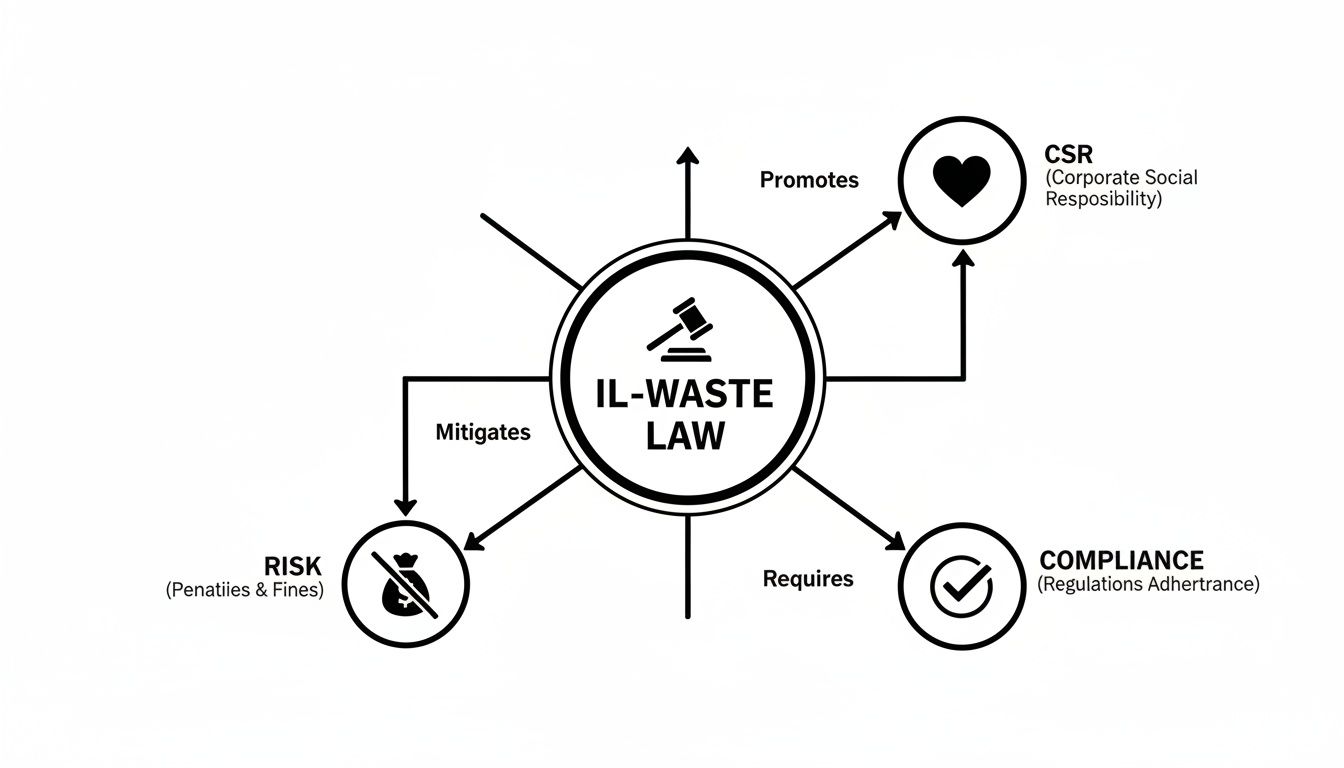
It’s a great visual for understanding that the law isn't just about avoiding fines. It’s about making a positive impact while managing potential liabilities. This modern approach is what has made the state's recycling infrastructure so much more adaptable.
Solving Local Recycling Challenges Across Illinois
If your business operates in more than one Illinois city, you know the headache of navigating local recycling rules. The process for computer recycling in Chicago can be a completely different world from the requirements in Peoria or Springfield. This patchwork of local ordinances creates a logistical nightmare and puts your company at risk of non-compliance.
It’s more than just an inconvenience—it’s a major operational drag. Every time you need to handle IT equipment disposal at a different site, your team is back to square one, researching new local rules, vetting new vendors, and managing separate paperwork. This disjointed approach eats up valuable time and makes it far too easy to miss a crucial step, which can lead to fines and a hit to your company's reputation.
The Problem with Patchwork Regulations
Even with some of the country’s most forward-thinking statewide e-waste laws, Illinois struggles with a disconnect between state-level goals and on-the-ground execution. This gap often leaves businesses guessing about their exact responsibilities.
A 2018 study brought this issue into sharp focus, revealing that some of Illinois's biggest cities had recycling rates lagging far behind the national average. Chicago, for instance, posted a recycling rate of just 9% in 2017, the lowest of any major city in the study. A key reason for these numbers is the tangled web of local rules that confuses everyone and leads to contamination at recycling facilities.
This city-by-city inconsistency highlights why a unified, statewide strategy for your Illinois electronics recycling program isn't just a nice-to-have, it's a necessity.
A Unified Solution for Statewide Operations
Instead of trying to juggle a different vendor and a different set of rules for each of your Illinois locations, imagine this: one partner, one process. Working with a single, statewide provider like Reworx Recycling streamlines everything. You can implement one consistent, secure, and compliant policy for every office, warehouse, or data center you have in the state.
A unified approach brings some serious advantages:
- Operational Simplicity: You get one point of contact, one set of procedures, and one clean invoicing system. The administrative mess of managing multiple local partners disappears.
- Consistent Data Security: Your data destruction protocols are the same everywhere. Every single hard drive and server is handled with the exact same high level of security, no matter which facility it came from.
- Simplified Compliance Reporting: When it’s time to report on your corporate sustainability goals, all your data comes from a single, consolidated source. Tracking your environmental impact becomes straightforward and reliable.
By standardizing your ITAD program with a single partner, you transform a complex logistical challenge into a simple, repeatable process. This not only ensures compliance but also frees up your IT and facilities teams to focus on core business functions.
For any business with a real footprint in Illinois, finding a partner who can cut through the complexity of local rules is key. It’s not just about getting rid of old equipment; it's about building a dependable, secure system to manage your IT assets at the end of their life. For a deeper dive into the specific hurdles businesses face, you might be interested in our guide covering common electronic recycling challenges and their solutions. This strategy ensures your commitment to environmental responsibility is met consistently, no matter where in Illinois your operations take you.
Making Secure Data Destruction Your Top Priority
For any Illinois business, the data sitting on your old devices is infinitely more valuable than the hardware itself. It’s a common mistake to think that just deleting files or doing a quick reformat is enough to protect your company's sensitive information. The truth is, those basic steps leave data wide open for recovery, creating a massive security blind spot for your organization.
This is exactly why professional secure data destruction isn't just a nice-to-have—it's a non-negotiable part of any smart IT asset disposition (ITAD) plan. We're not talking about simply erasing files. We're talking about permanently obliterating data so it can never, ever be retrieved. Skipping this step can lead to devastating data breaches, stiff regulatory fines, and permanent damage to your company’s hard-earned reputation.
Comparing Data Destruction Methods
When it's time to make data disappear for good, there are a few ways to do it. Each method offers a different level of security and works best for certain situations. Understanding these options helps you make the right call for everything from old office laptops to decommissioned data center servers.
- Data Wiping (or Sanitization): Think of this as a digital deep clean. Special software overwrites every bit of your existing data with random gibberish, often in several passes. It's a fantastic way to sanitize drives that might be refurbished and reused, preserving the hardware's value while destroying the old data.
- Degaussing: This technique uses a seriously powerful magnetic field to scramble the magnetic storage on media like traditional hard disk drives (HDDs) and old tapes. In an instant, the drive and all its data become completely unreadable. The downside? The drive itself is rendered useless afterward.
- Physical Shredding: This is the ultimate "no going back" method. The hard drive or solid-state drive (SSD) is fed into an industrial shredder and physically pulverized into tiny, unrecognizable pieces. This method delivers the highest possible level of security, making it perfect for devices that held top-secret intellectual property or classified information.
Choosing the right approach all comes down to your security needs and whether the hardware has a second life ahead of it. For a much more detailed breakdown, our team put together a guide to secure data destruction that gets into the nitty-gritty.
Achieving Verifiable Security and Compliance
The real goal of data destruction isn't just to destroy the data—it's to prove it's gone. For Illinois businesses, this verification is absolutely essential for meeting compliance rules under laws like HIPAA for healthcare records or GDPR for customer data. This is where professional certification makes all the difference.
Reputable partners like Reworx Recycling follow the NIST 800-88 "Guidelines for Media Sanitization," which is the gold standard for data destruction. Adhering to these tough standards is how you know every last bit of data has been irretrievably wiped out. For tips on handling smaller personal devices, you can find great resources explaining how to effectively wipe your data before trading in old phones.
The single most critical document you will get from a recycling partner is the Certificate of Data Destruction. This legal document is your official proof that you took every necessary step to protect sensitive information and fulfill your due diligence.
Without that certificate, your business has no auditable record to defend itself if a data breach investigation ever comes knocking. It's the final, crucial piece of a secure IT equipment disposal process.
At Reworx Recycling, we make this a cornerstone of our service. Our certified data destruction processes provide the peace of mind that comes from knowing your company’s most valuable asset—its data—is completely and verifiably gone. This commitment shields your business from risk while allowing for a truly responsible approach to Illinois electronics recycling.
How to Choose a Responsible Recycling Partner
Picking the right partner for your Illinois electronics recycling needs is a huge decision. It's not just about getting rid of old gear. The wrong choice can leave your business wide open to environmental liability and serious data security risks.
A truly responsible partner doesn’t just haul away your old equipment. They offer a transparent, secure, and ethical process from the moment they pick it up until it's fully processed. Think of it less as a disposal service and more as a critical compliance partnership.
This is where industry certifications become your best friend. They act as a seal of approval, telling you that a vendor meets the highest standards for environmental safety and data security. Vetting potential partners based on these credentials should always be your first step.

The Gold Standard Certifications
When you're looking at ITAD providers, two certifications are the undisputed gold standard for responsible electronics recycling. If a company has these, you know you're dealing with a top-tier operator.
-
R2 (Responsible Recycling): The R2 Standard is incredibly thorough. It covers everything from environmental protection and worker safety to data security and the entire chain of custody. An R2-certified facility is regularly audited to prove it manages materials correctly, destroys data securely, and tracks every single asset.
-
e-Stewards: This is another major global standard, famous for its zero-tolerance policy on exporting hazardous e-waste to developing nations. An e-Stewards certified recycler guarantees your old electronics won't cause environmental damage overseas and that your data is handled with maximum security.
If a potential partner is missing these certifications, that should be a major red flag for any Illinois business. It points to a potential lack of oversight and accountability in how they operate.
Red Flags to Watch For
Beyond certifications, a little common sense goes a long way. If a recycler can't give you straight answers about their process, they probably aren't someone you want to trust with your company's assets and reputation.
Be on high alert for any provider that:
- Is Vague About Downstream Partners: If they can't tell you exactly where your materials end up, that’s a classic sign of a broken chain of custody.
- Cannot Provide a Certificate of Data Destruction: This is non-negotiable. Without this legal document, you have no proof your sensitive data was actually destroyed.
- Lacks Transparent Pricing: Hidden fees or a confusing price list often mean they're cutting corners somewhere else.
A truly responsible recycling partner operates with complete transparency. They should be able to walk you through their entire process, from pickup to final disposition, and provide clear documentation every step of the way.
How Reworx Exceeds the Standard
At Reworx Recycling, our entire model is built on transparency, security, and social impact. We don't just meet the industry's highest standards; we aim to exceed them, offering a partnership that protects your business while making a real difference in the community. For a deeper dive, we've outlined what to look for in our guide on selecting a reliable e-waste recycling partner.
We stand by our core principles. We have a strict zero-landfill policy, which means 100% of the materials we handle are either recycled or refurbished.
Even better, as a donation-based social enterprise, we find value where others just see waste. Usable equipment is carefully refurbished and given a second life supporting digital inclusion programs and empowering local communities. This approach turns your IT asset disposal from a simple compliance checkbox into a powerful act of social good.
Your Illinois E-Waste Program Checklist
Making the leap from understanding Illinois's electronics recycling rules to actually building a program that works requires a solid plan. Think of this as your roadmap. It’s designed for the IT, facilities, and sustainability managers on the ground, guiding your organization step-by-step to launch a secure and responsible ITAD program that’s built to last.
Step 1: Inventory and Categorize Your Assets
You can't manage what you don't measure. Before you can get rid of anything, you need a crystal-clear picture of every piece of equipment you’re dealing with. It's time to roll up your sleeves and conduct a thorough inventory of all outdated, non-functional, or surplus electronics.
- Create a Master List: Get it all down on paper (or a spreadsheet). Document every desktop, laptop, server, monitor, printer, and peripheral. Make sure to note the make, model, and any unique asset tags.
- Segregate by Type: Split your assets into two simple buckets: devices that hold data (like computers, servers, and smartphones) and those that don't (keyboards, monitors, cables). This separation is crucial for the next step.
- Identify Refurbishment Potential: Keep an eye out for equipment that still has some life left in it. Partners like Reworx Recycling can often refurbish these items, giving them a second chance and supporting community programs.
Step 2: Formalize Your Data Destruction Policy
Your absolute top priority has to be making sure no sensitive data walks out the door. A formal, written policy isn't just bureaucracy; it's your best defense. It removes any guesswork and ensures every single employee follows the exact same secure process, every single time.
Clearly define which data destruction method—be it wiping, degaussing, or physical shredding—is required for different types of assets. This policy must insist that you receive a Certificate of Data Destruction for every single device that ever held data. This document is your legal proof that you did everything right. To get a better feel for what this looks like, you can check out a sample destruction certificate template to see exactly what information should be included for solid record-keeping.
Step 3: Schedule Your Secure Pickup
With your inventory complete and a rock-solid data policy in place, the last piece of the puzzle is arranging for the physical removal of the assets. A professional ITAD partner takes all the logistical headaches off your plate.
A successful e-waste program hinges on a seamless and secure chain of custody. Your responsibility for the assets doesn't end until they are confirmed recycled or destroyed by a certified partner.
Just contact a certified partner like Reworx Recycling to get a pickup on the calendar. We’ll work with you to find a time that causes minimal disruption to your day-to-day operations. Our team will show up ready to safely pack and transport all your designated equipment, providing you with a receipt and kicking off the secure, fully documented recycling process. This is the final step that turns your plan into a successful, compliant, and genuinely impactful Illinois electronics recycling initiative.
Actionable E-Waste Program Implementation Checklist
Follow these steps to launch a compliant and responsible electronics recycling program at your Illinois organization.
| Step | Action Item | Key Consideration |
|---|---|---|
| 1. Designate a Program Lead | Assign a point person (e.g., IT Manager, Facilities Director). | A single owner ensures accountability and clear communication. |
| 2. Conduct Full Asset Inventory | Create a detailed list of all electronics for disposal. | Include make, model, serial number, and condition. |
| 3. Draft a Data Destruction Policy | Document procedures for wiping, degaussing, or shredding. | Align methods with data sensitivity (e.g., shredding for PII). |
| 4. Vet and Select a Certified Partner | Research R2v3 or e-Stewards certified recyclers. | Certification is non-negotiable for environmental and data security compliance. |
| 5. Arrange Logistics | Schedule pickup and designate an internal staging area. | A clear staging area prevents accidental disposal of active assets. |
| 6. Execute the Pickup | Oversee the secure packing and transport of materials. | Obtain a receipt or bill of lading from the recycling partner. |
| 7. Obtain and File Documentation | Secure the Certificate of Destruction and recycling reports. | These documents are your proof of compliance for audits. |
| 8. Review and Refine | After the first cycle, gather feedback and adjust the process. | Continuous improvement makes the program more efficient over time. |
By following this checklist, you're not just getting rid of old equipment—you're building a sustainable and secure process that protects your organization and the environment.
A Few Common Questions About Illinois Electronics Recycling
When it comes to corporate Illinois electronics recycling, a few practical questions always seem to pop up. Let's tackle some of the most common ones businesses ask to clear up any confusion about compliance and logistics.
What Electronics Are Actually Banned From Illinois Landfills for Businesses?
Under Illinois's Electronic Products Recycling and Reuse Act, a whole host of electronic devices are officially banned from landfills. For a business, this list includes the obvious stuff like computers, laptops, servers, and monitors, but it also covers printers, scanners, fax machines, TVs, keyboards, mice, and pretty much any other peripheral.
A good rule of thumb is if it plugs in or runs on a battery and was part of your IT setup, you almost certainly can't just toss it in the dumpster. This is exactly why working with a certified recycler like Reworx is so important—we make sure every piece of your old equipment is handled in full compliance with state law.
Can My Company Just Use a Local Municipal Drop-Off Site?
While it's true some Illinois programs are starting to accept a small number of devices from businesses (think seven items or fewer), these sites are really designed for residents, not for large-scale corporate disposals. An office cleanout involving 100 laptops is a completely different ballgame and requires a dedicated ITAD partner.
Reworx Recycling is built for projects of that scale. We handle the secure logistics, schedule pickups that work for you, provide certified data destruction for every single device, and give you all the paperwork you need for your compliance records. You just don't get that level of service from a municipal drop-off.
How Does Donation-Based Recycling Benefit My Business?
Choosing a donation-based social enterprise recycling partner like Reworx Recycling brings a lot more to the table than just getting rid of old gear. First off, it’s a huge boost to your company's Corporate Social Responsibility (CSR) profile, showing a real commitment to making a positive community impact.
Beyond that, you're giving functional equipment a second life, directly supporting digital inclusion efforts and workforce development programs. This kind of sustainable recycling perfectly aligns with corporate environmental goals and gives you a powerful story to share with your customers, employees, and stakeholders.
Choosing a donation-based model transforms a routine operational task into a meaningful contribution. It's a strategic move that shows your company cares about both the planet and its community, which can do wonders for your brand reputation and employee morale.
What Kind of Paperwork Should I Expect From a Recycling Partner?
Any reputable ITAD partner should provide you with thorough documentation. At the bare minimum, you need a Certificate of Recycling, which confirms your equipment was processed according to all environmental standards.
Even more critical, for any device that ever held data, you must get a Certificate of Data Destruction. This document is your legal proof that you took every necessary step to protect sensitive information, which is non-negotiable for complying with data privacy laws like HIPAA and GDPR.
Ready to implement a secure, compliant, and socially responsible electronics recycling program for your Illinois business? Reworx Recycling simplifies the process of IT equipment disposal while maximizing your positive community impact. Contact us today to schedule a pickup or partner with us to turn your retired assets into opportunities for others.