When a business upgrades its technology, the old equipment has to go somewhere. Corporate computer recycling is the professional, secure, and sustainable process for managing this transition. It’s far more than just disposal; it involves secure data destruction, recovering valuable materials, and complying with environmental regulations—all essential for protecting a company from significant financial and reputational risks.
Why Smart Businesses Prioritize Corporate Computer Recycling
That storage closet filled with old laptops, servers, and monitors is more than just clutter; it’s a collection of potential liabilities. For any modern business in industries from healthcare to finance, a strategic approach to corporate computer recycling is not a mere green initiative. It's a critical component of risk management, data security, and financial stewardship. Mishandling IT equipment disposal can lead to severe consequences.
This guide reframes how you should view IT equipment disposal. A single misplaced hard drive can contain enough sensitive information to trigger a major data breach, resulting in hefty fines and lasting brand damage. Every device, from an office PC to a data center server, is a potential security threat if not decommissioned correctly. This is particularly true for businesses in cities with robust tech or healthcare sectors, where data privacy is paramount.
The True Cost of Inaction
Ignoring a formal IT asset disposition (ITAD) plan creates hidden costs and vulnerabilities that can impact every department. The risks associated with stockpiling old computers or improper disposal are multifaceted and very real.
Here’s where you’re exposed:
- Data Security Breaches: Every retired device contains residual data. Without certified data destruction, you leave sensitive client information, financial records, and corporate secrets vulnerable.
- Regulatory Non-Compliance: Laws like HIPAA, GDPR, and various state-level e-waste regulations impose strict rules for handling data and electronics disposal. Violations can trigger steep financial penalties and legal challenges. For instance, our guide to Florida electronics recycling details some of these state-specific requirements.
- Reputational Damage: A public data breach or an environmental misstep can erode customer trust almost instantly. The impact on your bottom line from such an event is far more costly than any recycling program.
A Smarter Path Forward with a Social Enterprise
This is where a strategic partnership can transform a compliance burden into a powerful story of corporate responsibility. Partnering with a social enterprise like Reworx Recycling provides a solution that addresses all these risks while generating a positive community impact. We see old computers not as waste, but as an opportunity to support digital inclusion, workforce development, and local non-profits.
By choosing a donation-based social enterprise, your company's end-of-life IT assets are not just responsibly recycled—they're given a second life. They empower communities and reinforce your commitment to social good. This approach turns a necessary operational task into a cornerstone of your corporate social responsibility (CSR) strategy.
Beyond Compliance: The Real Benefits of Strategic ITAD
A well-executed IT Asset Disposition (ITAD) plan is about more than just checking a compliance box. While adhering to environmental and data security regulations is essential, a strategic approach to corporate computer recycling can provide a significant competitive advantage. It transforms a logistical necessity into a powerful tool for risk management, value recovery, and brand enhancement.
Viewing ITAD as just another operational expense is a missed opportunity. Instead, consider it the final, critical stage in your technology's lifecycle—one that protects your most valuable asset: your reputation. The foundation of this process is certified, secure data destruction. This step guarantees that your sensitive customer data, proprietary information, and financial records are permanently eliminated, not just left on a supposedly "wiped" drive.
Protecting Your Reputation and Ensuring Compliance
In today's digital world, mishandling outdated IT equipment is a direct threat to your business. A single data breach can quickly escalate into a crisis with consequences extending far beyond a simple fine.
- Navigating the Maze of Regulations: A professional ITAD partner is your guide through the complex landscape of regulations like HIPAA for healthcare, GDPR for European customer data, and diverse state-level e-waste laws.
- Preventing Brand Damage: The public fallout from a data leak can shatter customer trust. Repairing that kind of damage is incredibly difficult and, in some cases, impossible.
- Maintaining Stakeholder Confidence: Demonstrating a clear commitment to secure ITAD sends a strong message to investors, partners, and clients that your organization operates with integrity and diligence.
Working with an expert like Reworx Recycling ensures every device is handled according to the highest industry standards. You receive a clear, auditable trail and the peace of mind that comes from knowing your data is verifiably destroyed.
Unlocking Financial Value from Retired Assets
Many businesses are surprised to learn that their old IT gear often retains value. A strategic ITAD program is designed to maximize the return on that equipment, turning depreciated hardware into a new revenue stream through value recovery or asset remarketing.
The financial return can be substantial, especially during an office cleanout or data center decommissioning. A reliable ITAD vendor will assess your entire inventory to identify components and devices that can be resold.
It's a common myth that old computers are just junk. In reality, components like RAM, CPUs, and even complete systems can be refurbished and find a new life on the secondary market. This not only puts money back into your budget but also supports a circular economy by extending the life of usable technology.
Here are the key financial benefits:
- Direct Revenue from Buyback Programs: Your ITAD partner may purchase viable equipment, providing a direct cash infusion.
- Reduced Total Cost of Ownership (TCO): Revenue from selling old assets helps offset the cost of new technology.
- Elimination of Storage Costs: Clearing out closets and warehouses of old hardware frees up valuable space and reduces overhead.
Strengthening Corporate Social Responsibility
Beyond financial returns and compliance, a thoughtful ITAD strategy is an excellent way to demonstrate your commitment to Corporate Social Responsibility (CSR). The way you dispose of electronics reflects your company's values. When you partner with a social enterprise like Reworx Recycling, that impact is amplified.
Instead of being shredded, usable equipment can be refurbished and donated to support community groups, schools, and workforce development programs. This donation-based recycling model transforms your IT refresh cycle into a genuine force for social good. It builds a brand story that resonates with customers, employees, and the community, proving that a responsible business can also make a positive social impact.
Securing Your Data in the Disposal Process
A critical truth: your company’s data doesn't simply vanish when you unplug a server or retire a laptop. Every storage device, from a traditional hard disk drive (HDD) to a modern solid-state drive (SSD), is a potential repository of sensitive information.
This is why secure data destruction is the absolute cornerstone of any responsible corporate computer recycling program. Neglecting this step means you're not just disposing of old hardware; you're gambling with a potentially catastrophic data breach.
The process primarily relies on two industry-gold standards: software-based erasure and physical destruction.
Think of a hard drive as a digital file cabinet. Software erasure is like meticulously emptying every folder and shredding every document inside. Physical destruction is like running the entire cabinet through an industrial shredder. Both achieve the goal, but through different means.
Choosing the right method depends on your security policies, the type of data, and the potential for asset reuse. A certified partner can guide this decision, ensuring your plan is both secure and sustainable.
Comparing Data Destruction Methods
To make the best choice for your organization, it helps to see the methods side-by-side. Each technique has its own strengths and is suited for different scenarios, from maximizing asset value to achieving absolute data security.
| Method | Process | Security Level | Best For | Verification |
|---|---|---|---|---|
| Software Erasure | Uses specialized software to overwrite all data on a drive with random characters, often in multiple passes. | High | Newer, functional assets that can be resold or donated. | Digital report logs confirming successful data wipe. |
| Physical Shredding | The hard drive is fed into an industrial shredder that grinds it into small metal fragments. | Absolute | End-of-life, non-functional, or highly sensitive drives. | Visual confirmation and a Certificate of Destruction. |
Ultimately, the goal is the same: ensuring your data is gone for good. The method you choose simply defines the path you take to get there.
Software Erasure: The Digital Deep Clean
Software-based data erasure, or data wiping, uses specialized programs to systematically overwrite existing data on a hard drive with random binary code. A simple "delete" or even formatting a drive is insufficient. Those actions only remove the pointers to the data, leaving the actual information behind and often recoverable. This is why knowing how to recover deleted files from a computer is a real skill—and a real risk for businesses.
Proper data wiping writes over the entire drive multiple times, following strict standards like those from the National Institute of Standards and Technology (NIST). This process makes the original data completely unrecoverable, even with sophisticated forensic tools.
The biggest advantage here is that the physical drive remains intact. This means the computer or server can be refurbished, resold, or donated, which is great for the circular economy and can even generate a financial return for your company. It's the perfect choice for newer, working equipment that still has value.
Physical Destruction: The Ultimate Failsafe
Sometimes, a drive is too old, broken, or contained such sensitive information that there's no room for error. In these cases, physical destruction is the only answer. This approach guarantees data can never be recovered simply because the storage medium no longer exists in a usable form.
The most common and effective method is industrial shredding. We're talking about a machine that grinds hard drives into a pile of small, unrecognizable metal fragments. It's the definitive end-of-the-line for data.
This is the go-to for industries with strict compliance rules like HIPAA or for getting rid of devices that held priceless intellectual property. While it completely rules out any chance of reuse for that component, its value comes from the absolute peace of mind it provides. Our team provides full details on secure hard drive shredding and why it's the ultimate security measure.
The Non-Negotiable Proof: A Certificate of Destruction
No matter which method you go with, the job isn't done until you have the paperwork to prove it. A Certificate of Destruction (CoD) is a formal, auditable document that serves as your legal proof that your data was destroyed securely and in line with all privacy laws.
This isn't just a receipt. A proper CoD should include:
- A unique serial number for tracking the job.
- The date and method of destruction (e.g., NIST 800-88 compliant wipe, physical shred).
- A detailed list of the serial numbers from every single hard drive that was destroyed.
- The signature of an authorized representative from your recycling partner.
Think of this document as your shield. In the event of an audit, it proves you did your due diligence to protect your company's and your customers' information. A reliable partner makes sure this final step is never missed, giving you verifiable proof that your sensitive data is gone forever.
Your Step-by-Step IT Asset Disposition Roadmap
Transforming a potentially chaotic office cleanout into a smooth, predictable process hinges on a clear plan. An effective IT Asset Disposition (ITAD) strategy isn't a single event; it’s a journey with distinct, manageable stages. This roadmap guides you through handling your end-of-life IT assets, from initial assessment to final certification.
The first step, often overlooked, is a thorough internal inventory and asset valuation. Before any equipment leaves your facility, you need to know exactly what you have. This goes beyond counting laptops and servers; it’s about identifying hidden value in components like CPUs, RAM, and functional servers that could be refurbished and resold.
A detailed inventory lays the groundwork for all subsequent steps. It allows a partner like Reworx Recycling to provide an accurate quote and forecast potential returns from equipment buyback programs.
Kicking Off the Logistics
With a clear inventory, it’s time to get things moving. The next phase focuses on logistics, starting with scheduling a secure pickup that works around your business operations, not against them, ensuring minimal disruption.
For any business handling sensitive data, the security of this reverse logistics chain is non-negotiable. A professional ITAD partner will use GPS-tracked vehicles and secure, sealed containers for transport. This documented chain of custody is your first line of defense, proving that from the moment a device leaves your control, it's accounted for and protected. This step is absolutely critical for compliance and managing risk.
Inside the Recycling Facility
Once your assets are securely transported, they arrive at a certified processing facility. Here, a carefully managed workflow begins, designed to maximize value, guarantee data security, and recover materials responsibly.
The process typically unfolds as follows:
- Receiving and Auditing: Each asset is checked against your original inventory list. Serial numbers are scanned and verified to maintain an airtight chain of custody.
- Sorting and Triage: Skilled technicians evaluate each device to determine its optimal path—resale, refurbishment, donation, or recycling.
- Data Destruction: This is a mandatory step. All data-bearing devices are flagged for either certified software erasure or physical shredding, based on your security policy.
- Testing and Refurbishment: Equipment with remaining useful life is tested, repaired if necessary, and prepared for the secondary market or donation.
- Responsible Recycling: Anything that cannot be reused is carefully de-manufactured. Components are separated into raw material streams—plastics, metals, glass—for responsible recycling.
This infographic breaks down the core data destruction process, which is the heart of any solid ITAD plan.
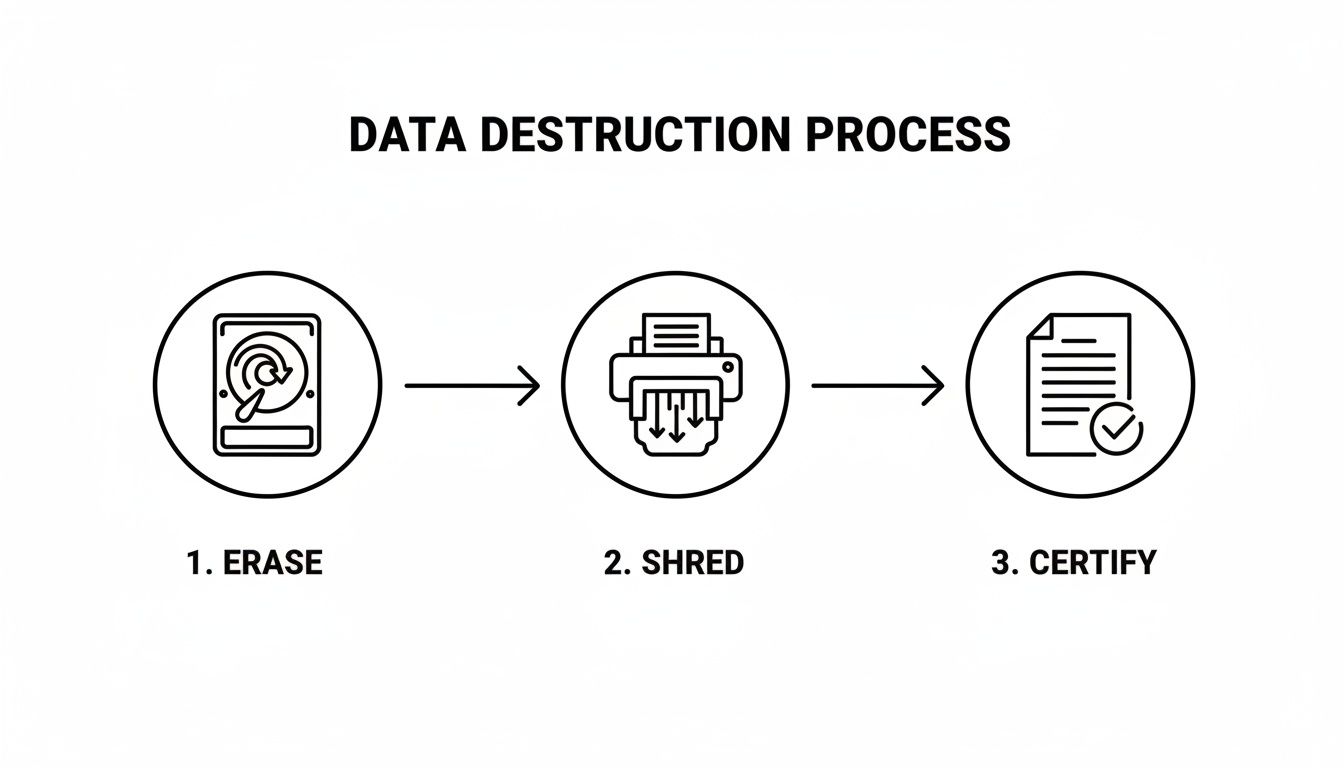
As you can see, whether it's through software erasure or physical shredding, the process always ends with certification. That’s the auditable proof your business needs.
Final Reporting and Certification
The final piece of the puzzle is receiving comprehensive documentation. This is more than a receipt; it’s a detailed report that officially closes the loop on your assets' lifecycle. A full-service partner like Reworx Recycling provides a complete reporting package.
A great ITAD program delivers more than just recycling; it delivers certainty. Your final report should provide complete transparency, including serialized inventory lists, Certificates of Data Destruction, and environmental impact statements detailing the weight of materials diverted from landfills.
This paperwork is essential for internal audits, compliance records, and sustainability reporting. It gives stakeholders tangible proof that your organization handled its old tech securely and responsibly. The global scale of e-waste makes this diligence more important than ever. The world generated a staggering 62 million tonnes of e-waste, yet only 22.3% was properly collected and recycled, leaving $62 billion in recoverable resources lost. This crisis in corporate computer recycling highlights just how crucial documented, responsible disposal really is.
By following this roadmap and working with a trusted partner, you can turn a logistical headache into a streamlined, secure, and valuable business process. For more information on creating a tailored strategy, explore our approach to IT asset management.
How to Choose the Right Recycling Partner
When it comes to corporate computer recycling, not all vendors are created equal. The partner you choose is one of the most critical decisions in your entire IT asset disposition process. A poor choice can expose your business to legal, financial, and reputational risks. The right partner, however, becomes an extension of your risk management and sustainability teams.
It’s tempting to select a vendor based solely on the lowest price, but this is a common and dangerous mistake. A vendor who cuts corners on data security or environmental compliance isn't saving you money; they're transferring risk to you. A valuable partner provides a process that is secure, transparent, and auditable from pickup to final disposition.
This is more important now than ever. The global electronic waste recycling market was recently valued at USD 70.1 billion and is expected to rocket to USD 251.9 billion by 2034. That kind of explosive growth means a lot of new players are jumping in, which makes doing your homework absolutely critical. Learn more about these market trends.
Key Certifications to Look For
Certifications are your first line of defense against irresponsible recyclers. They provide third-party validation that a vendor meets stringent standards for environmental safety, data security, and worker health.
Look for these two key certifications:
- R2v3 (Responsible Recycling): This is the leading standard in the electronics recycling industry. It covers everything from environmental protection and worker safety to data security. An R2v3-certified facility has a proven, secure process for the entire recycling chain.
- e-Stewards: Often considered the most rigorous certification, e-Stewards guarantees that no hazardous e-waste is exported to developing countries and that data security practices are top-tier.
The absence of at least one of these certifications should be a significant red flag. They are your proof that a partner is committed to responsible practices.
Data Security and Chain of Custody
Your data is your most valuable asset. Any potential partner must be able to explain and document exactly how they protect it from the moment it leaves your control.
A secure chain of custody is the unbroken, documented trail of your IT assets from your doorstep to their final disposition. This includes locked trucks, secure facilities with access controls, and vetted personnel. Without it, you have a massive blind spot in your data security.
Ask direct questions about their process:
- How do you transport assets from our location?
- What kind of security measures are in place at your facility?
- Can you provide a detailed, serialized report for every asset?
- Will we receive a Certificate of Data Destruction for every hard drive and data-bearing device?
A reputable partner will have confident, immediate answers and the documentation to back them up.
The Added Value of a Social Enterprise
Once you've addressed compliance and security, consider the partner's mission. When you choose a social enterprise like Reworx Recycling, you add another powerful layer of value to your ITAD program. Your old IT assets are not just recycled—they create a real, positive impact in the community.
Partnering with a social enterprise means your old equipment might be refurbished and donated to support digital inclusion programs, workforce development, or local non-profits. This transforms a routine operational task into something meaningful and a direct contribution to your company's Corporate Social Responsibility (CSR) goals. That’s a powerful story that connects with employees, customers, and stakeholders, showing that you’re committed to doing good while doing business.
When you're vetting potential recycling partners, it can be incredibly helpful to consult with experienced IT Service Providers and MSPs. They often have deep, firsthand knowledge of secure IT asset disposition and can help you scrutinize the technical capabilities and security protocols of different vendors.
Your Corporate Recycling Questions Answered
Even with a solid plan, questions are bound to arise when planning a corporate computer recycling project. Decision-makers often face practical concerns about logistics, eligible equipment, and, most importantly, security. Here are answers to some of the most common questions to help you move forward with confidence.
Addressing these concerns ensures alignment across your organization, from the IT team to the C-suite. It’s about demystifying IT asset disposition and making it a manageable, routine part of your business operations.
What Types of Equipment Can We Recycle?
An effective corporate recycling program should be a comprehensive, one-stop solution. It should cover not only common items like desktops, laptops, monitors, and printers but also heavy-duty data center equipment such as servers, switches, and storage arrays.
Furthermore, a capable partner can manage more specialized hardware, including medical and laboratory equipment or outdated telecommunications systems. A full-service provider like Reworx Recycling is equipped to handle this entire spectrum, from a simple office cleanout to a complex facility decommissioning. This approach saves you from the headache of coordinating multiple vendors.
Is My Business Too Small for a Formal Program?
Not at all. Data security and environmental regulations apply to businesses of all sizes. A data breach or compliance fine can be particularly devastating for a small or mid-sized business (SMB).
Professional ITAD partners like Reworx Recycling offer scalable solutions tailored to any size business. We can manage a scheduled pickup for a handful of devices or oversee a large-scale, multi-location project. Establishing a formal program early instills secure, compliant habits that will protect your business as it grows. Think of it as an essential safety measure, not an enterprise-level luxury.
What Is the Difference Between ITAD and Recycling?
This distinction is crucial and directly affects your security and bottom line. Basic electronics recycling focuses on breaking down equipment to recover raw materials like plastic and metal, diverting it from landfills.
IT Asset Disposition (ITAD), however, is a comprehensive strategy. ITAD covers the entire end-of-life process for your technology, with a strong emphasis on security and value recovery. This includes secure logistics, certified data destruction, testing components for resale or donation, and then recycling the remaining materials.
An ITAD strategy from a partner like Reworx Recycling aims to maximize your financial return while giving you a fully auditable, compliant, and secure disposal process. It turns a potential cost center into a risk management function that can even generate revenue.
The growing mountain of e-waste makes this distinction more important than ever. Globally, annual e-waste has hit a high of 43 million tons, with just 8 million tons—roughly 18.6%—recycled. Projections warn of it climbing to 55.2 million tons if trends persist, making strategic corporate computer recycling a pivotal battleground for environmental stewardship. Businesses generate much of this through frequent device upgrades, discarding hardware loaded with precious metals like gold and rare earths worth billions if recovered properly. You can explore more about the global e-waste challenge.
How Do I Know My Data Is Actually Destroyed?
You should never have to take a vendor's word for it. Verifiable proof is essential. A reputable partner will provide a Certificate of Destruction, a legal document listing every device (by serial number) that was destroyed and the method used.
Demand a transparent chain of custody, including locked vehicles, secure facilities with access control, and fully vetted personnel. For the highest level of assurance, the physical shredding of hard drives and other storage media makes data recovery impossible.
Reworx Recycling provides these exact services, along with all the documentation you need for your compliance records, giving you complete peace of mind. Your ITAD partner should act as a security ally, providing undeniable proof that your sensitive information is gone for good.
If you have more questions, you can also check out our detailed FAQ page for more insights. This resource covers a wide range of topics to help you prepare for a successful IT asset disposition project.