When your Hopkinsville data center reaches its end of life, the task is far more complex than just flipping a switch. A professional data center decommissioning is a critical business process, impacting everything from data security and environmental compliance to asset value recovery. For any IT manager, business owner, or corporate sustainability leader in Christian County, navigating this process means balancing significant risks with valuable opportunities.
A Strategic Look at Decommissioning Your Hopkinsville Data Center
Shutting down a data center is not merely the reverse of setting one up; it's a deliberate, multi-stage project demanding precision. A misstep can expose your organization to severe financial, legal, and reputational damage. For businesses in Hopkinsville, a robust decommissioning plan is the final, critical chapter in the lifecycle of your IT hardware.
The primary goals are threefold: completely securing all company and customer data, ensuring compliance with environmental regulations like Kentucky's Universal Waste Rule, and recovering financial value from retired hardware. A single error could trigger a data breach or environmental fines, making professional oversight from a social enterprise like Reworx Recycling essential.
This flow chart provides a high-level view of how security, compliance, and asset recovery interconnect.
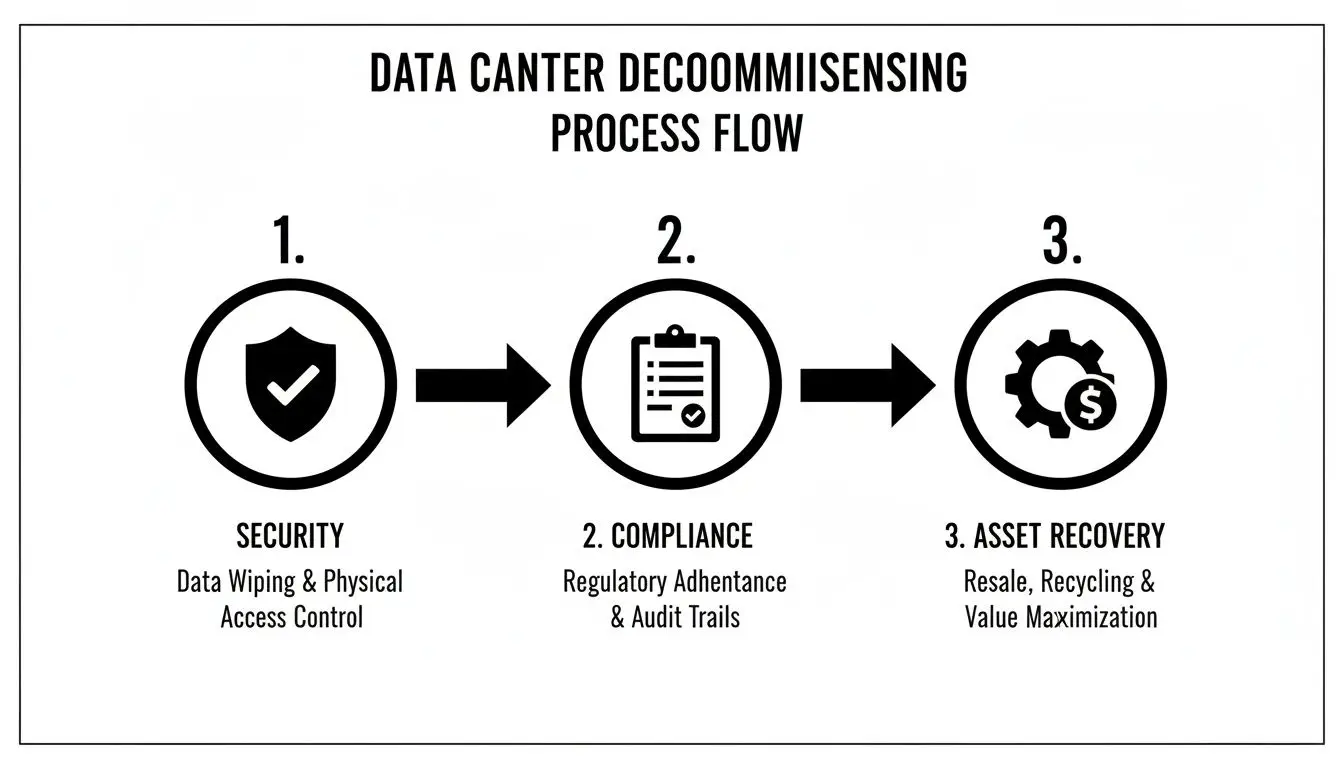
As illustrated, security is the first priority. Only after data is verifiably destroyed and compliance is assured can you focus on recovering value from the equipment itself.
The Phases of a Professional Project
A successful decommissioning project is built on meticulous planning, ironclad data destruction, and the responsible disposal of every single asset. Each stage requires specialized expertise to mitigate risks and achieve the best possible outcome for your business.
This table breaks down the essential stages of a professional decommissioning project.
| Phase | Primary Goal | Key Activities |
|---|---|---|
| Planning & Scoping | Establish a clear project roadmap and budget. | Define scope, identify stakeholders, set timeline, create communication plan. |
| Inventory & Asset Tagging | Create a complete record of every asset. | Physically tag servers, storage, networking gear; build a master inventory list for your office or facility cleanout. |
| Secure Data Destruction | Eradicate all data to prevent breaches. | On-site/off-site data wiping (NIST 800-88), physical shredding of drives. |
| Logistics & Transport | Safely de-install and remove all equipment. | Disconnect and de-rack hardware, palletize for secure transport and laptop disposal. |
| IT Asset Disposition (ITAD) | Maximize value and ensure compliance. | Sort assets for resale, recycling, or donation; provide full documentation through a sustainable recycling partner. |
Each phase builds on the last, creating a documented, secure process from beginning to end.
For IT leaders, the bottom line is clear: decommissioning isn't just about disposal. It's about closing the loop on your IT asset management with a secure, documented, and compliant process. An unbroken chain of custody is non-negotiable.
Finding the Right Partner for the Job
Attempting to manage this complex process internally is a significant undertaking that diverts your team from core business functions. Partnering with a certified specialist for your data center decommissioning in Hopkinsville, Kentucky ensures every step is handled professionally and ethically.
At Reworx Recycling, we view this as more than a logistical challenge—it's an opportunity for community impact. As a donation-based social enterprise, we not only guarantee compliance and secure data destruction but also work to convert your retired equipment into tangible community benefits.
We manage the entire project, providing detailed, audit-ready documentation and Certificates of Data Destruction. This delivers complete peace of mind, allowing your team to focus on moving your business forward. For a detailed breakdown of the steps, use our comprehensive server decommissioning checklist. By choosing a partner focused on both environmental responsibility and social good, you ensure your old hardware supports digital inclusion and local workforce development.
Building Your Decommissioning Blueprint and Asset Inventory
Before a single cable is unplugged in your Hopkinsville data center, the real work begins on paper. A detailed decommissioning blueprint is the single most valuable tool for transforming a high-risk, complex project into a predictable, manageable process.
Without this roadmap, you are inviting scope creep, budget overruns, and logistical nightmares.

This plan is a granular document outlining clear goals, a realistic timeline, and a practical budget. For a business in Hopkinsville, this means factoring in local logistics, vendor travel, and compliance rules specific to your industry, whether it's manufacturing, healthcare, or finance. The entire blueprint rests on one non-negotiable first step: a meticulous, item-by-item asset inventory.
Crafting a Realistic Project Plan
Your project plan must answer the fundamental questions: who, what, when, and how. Its purpose is to align everyone involved, from your internal IT and finance teams to legal counsel and your chosen ITAD partner like Reworx Recycling.
A solid plan must include:
- Defining Clear Objectives: Are you simply emptying the building, or are you migrating services to the cloud or a colocation facility? Defining success from day one prevents confusion later.
- Establishing the Timeline: Start with your facility exit date and work backward. Allocate dedicated time for inventory, data destruction, de-installation, and transportation. A rushed timeline is where the majority of costly mistakes occur.
- Setting the Budget: Account for all costs: labor, data destruction services, transport, recycling fees, and any potential returns from equipment remarketing. A detailed budget prevents unexpected expenses from derailing the project.
Think of the plan as the script for your decommissioning. Every person involved should know their role and the schedule. This structured approach is what separates a successful data center decommissioning in Hopkinsville, Kentucky, from a disaster.
A common pitfall for Hopkinsville businesses is underestimating the time required for the initial inventory. A seemingly small server room can contain hundreds of assets, and each one must be cataloged. Rushing this step almost guarantees errors in financial records and chain-of-custody documentation.
The Cornerstone: An Actionable Asset Inventory
An asset inventory is far more than a simple list; it is a complete record of every piece of hardware in your data center. This granular accounting is the bedrock of data security, financial reconciliation, and a compliant chain of custody for any facility cleanout.
Without it, you cannot prove that every hard drive was properly destroyed or that every asset was disposed of responsibly.
The inventory process involves physically tagging and documenting every component, from large servers and storage arrays to individual switches and power supplies.
Inventory Checklist: What to Document for Each Asset
- Unique Asset Tag: A new, unique ID for this project.
- Serial Number: The original manufacturer's serial number.
- Make and Model: Be specific, like "Dell PowerEdge R740" or "Cisco Catalyst 9300."
- Physical Location: Aisle, rack number, and U-position.
- Data-Bearing Status: A clear "Yes" or "No" to flag assets requiring secure data destruction.
- Intended Disposition: A preliminary decision on whether the asset will be recycled, resold, or donated.
This detailed log becomes the master document for the entire project. It's used by on-site technicians for de-installation, the logistics team for transport, and your ITAD partner, Reworx Recycling, to provide a final, auditable report.
Creating this inventory is a significant task, but its value is immense. Learn more in our guide on why IT inventory audits matter before recycling. This foundational work prevents asset "disappearance" and provides the transparent proof required for modern corporate governance.
Making Sure Your Data Is Gone for Good
After tagging and inventorying every piece of equipment, it’s time to address the most sensitive part of any data center decommissioning in Hopkinsville, Kentucky: ensuring every bit of data is irretrievably destroyed. A single data breach can have devastating consequences, from massive financial penalties to permanent reputational harm.
This process goes far beyond simple file deletion. It involves making information forensically unrecoverable. The decision of how to do this—on-site before anything leaves your building or off-site at a specialized facility—is one of the most critical security choices you will make.
On-Site vs. Off-Site Destruction: A Key Decision
Deciding where data destruction occurs depends on your organization's risk tolerance, budget, and compliance requirements.
On-Site Destruction: This is the gold standard for security. All data is wiped or shredded at your Hopkinsville location, often with your team observing. It eliminates the risk of data loss during transit, a crucial requirement for organizations in healthcare (HIPAA) or finance (SOX). The trade-off is that it can be more disruptive and costly to mobilize equipment to your site.
Off-Site Destruction: This method involves securely transporting your drives and servers to a certified facility like Reworx Recycling for destruction. It's often more budget-friendly and less disruptive to daily operations. The key to this approach is a rock-solid, documented chain of custody. It is a highly secure method when partnering with a vendor holding top-tier certifications like R2v3 and NAID AAA.
To help you decide, here’s a quick comparison. Choosing the right one aligns with your organization's specific security needs.
On-Site vs Off-Site Data Destruction
| Feature | On-Site Destruction | Off-Site Destruction |
|---|---|---|
| Security | Maximum; no transport risk for live data. | High; depends on vendor's chain of custody and security protocols. |
| Cost | Typically higher due to mobile equipment and labor costs. | Generally more cost-effective and scalable. |
| Convenience | Can be disruptive to facility operations. | Minimal disruption; assets are removed and handled elsewhere. |
| Verification | Direct, immediate visual confirmation is possible. | Verification is provided through a Certificate of Destruction and audit reports. |
Ultimately, your security framework and data sensitivity will guide your decision. There's no single "best" way—only what's best for your situation.
Data Sanitization vs. Physical Destruction
Once you decide where, you need to decide how. Your main options are software-based sanitization or physical destruction.
Data sanitization is a software-driven process using specialized tools to overwrite data multiple times, making the original information irrecoverable. The industry benchmark is the NIST 800-88 guideline. This is the ideal choice for newer, valuable drives intended for resale or reuse, as it preserves the hardware.
Physical destruction is brute force. Industrial-grade shredders pulverize hard drives, backup tapes, and other storage media into tiny pieces. This method provides 100% certainty that data is gone forever and is often required for classified or extremely sensitive information. It is the most secure form of data destruction possible, including product destruction for proprietary devices. Explore these methods on our page about secure data destruction services.
Real-World Scenario: HIPAA Compliance in Hopkinsville
A local healthcare provider near Hopkinsville had a small data closet full of servers containing protected health information (PHI). To meet strict HIPAA rules, they chose on-site physical destruction. We brought a mobile shredding truck to their facility. Their IT manager witnessed our team scan every hard drive from their inventory sheet and feed it directly into the shredder. Upon completion, we issued a serialized Certificate of Data Destruction, providing a clear audit trail and undeniable proof for their next HIPAA audit.
Managing De-Installation and Responsible Recycling in Christian County
Once your data is irretrievably destroyed, the focus of your data center decommissioning in Hopkinsville, Kentucky, shifts from digital to physical. This is where the heavy lifting begins: dismantling racks, managing cables, and moving heavy hardware out of your facility. It's a logistical challenge requiring experienced technicians, a focus on safety, and a firm grasp of environmental regulations.
Your detailed asset inventory now becomes the playbook for the technical crew. Every server, switch, and power supply is disconnected, de-racked, and prepared for transport. This task requires technicians experienced with delicate hardware to prevent damage or injury.
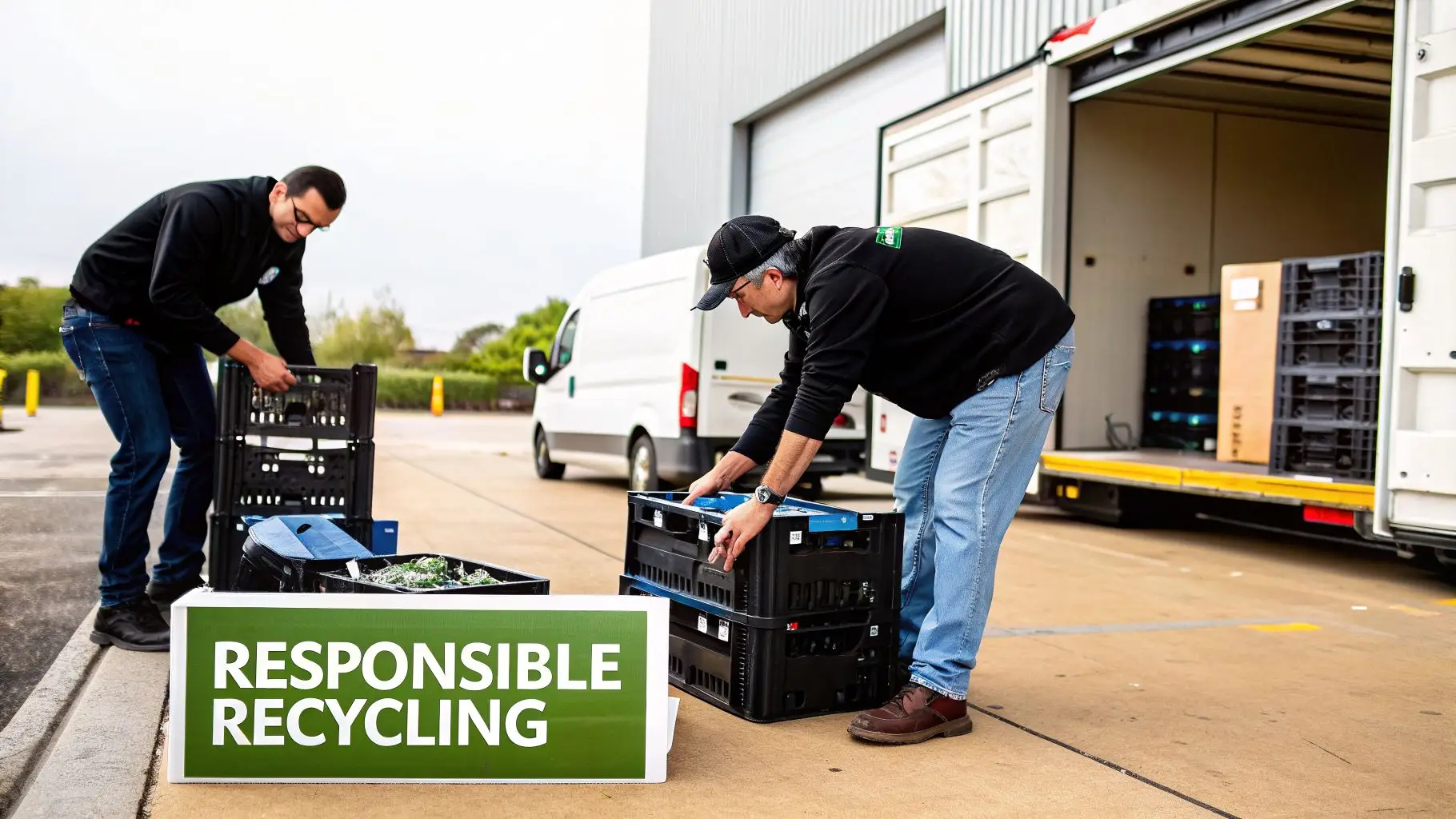
From Your Facility to Certified Recycling
After being palletized and shrink-wrapped, your old assets begin their final journey, governed by strict environmental regulations. The scale of e-waste from a single data center, which can hold thousands of servers, is immense.
Kentucky's Universal Waste Rule and federal EPA regulations mandate proper handling to protect local communities. Professional decommissioning ensures tons of e-waste, including medical and laboratory equipment disposal items, stay out of landfills, protecting groundwater and soil quality in the Hopkinsville area. You can learn more by exploring these regional decommissioning challenges.
This complex regulatory landscape makes your choice of an ITAD partner more critical than ever.
Partnering with a certified R2v3 facility like Reworx Recycling provides peace of mind. The R2v3 standard is the pinnacle for electronics recyclers, ensuring the highest level of environmental protection, worker safety, and data security. It is the proof your organization needs to demonstrate its commitment to sustainable recycling.
What Happens to Your Assets at Reworx
When your equipment arrives at our facility, the IT Asset Disposition (ITAD) process begins. We don’t just see old technology; we see an opportunity for reuse, recovery, and community support. Our team meticulously sorts every item against your inventory list.
Here’s our process:
- Testing and Triage: We test each asset to determine its potential for a second life, checking processors, memory, and overall condition.
- Value Recovery: Hardware with market value is professionally refurbished and prepared for resale. This can offset your project costs, turning retired equipment into a budget credit.
- Responsible Recycling: Assets too old or damaged for reuse are de-manufactured. They are broken down into core components—metals, plastics, circuit boards—which are sent to certified partners for processing.
- Material Recovery: Our commitment is zero-landfill. We ensure hazardous materials like lead and mercury are managed safely and that valuable resources like gold, copper, and aluminum are recovered and returned to the manufacturing supply chain.
Turning Old Tech into Community Opportunity
As a social enterprise, Reworx Recycling's mission is about more than just computer recycling. We seek to give viable technology a second chance to make a difference. Your old laptops, desktops, and monitors can become powerful tools for others.
When you partner with us, you directly support:
- Digital Inclusion: We facilitate corporate donation programs, getting refurbished computers to nonprofits and schools to improve technology access for students and families.
- Workforce Development: Our operations create local jobs and provide valuable training in the growing green-tech sector.
This approach transforms your IT equipment disposal from a cost center into a powerful act of corporate social responsibility. Your Hopkinsville data center decommissioning becomes a story of positive community impact, a core part of our mission detailed in our guide to decommissioning in Bowling Green.
Future-Proofing Your IT Strategy for Kentucky's Tech Expansion
Forward-thinking IT managers and sustainability leaders in Hopkinsville know the technology landscape is rapidly evolving. Today's IT management challenges are quickly giving way to tomorrow's decommissioning needs, driven by a wave of tech development across Kentucky.
Now is the time to start planning for the future.
Kentucky is emerging as a major hub for data infrastructure. This growth is exciting, but it also creates a predictable lifecycle. The state-of-the-art facilities being built today will reach their end-of-life in 10 to 15 years. This is not a distant issue but a future reality you can prepare for now.
The Coming Decommissioning Surge
The scale of this tech expansion is massive. Utilities like Louisville Gas & Electric (LG&E) and Kentucky Utilities (KU) project that new data centers will increase system load by 30% to 45% by 2032.
With new hyperscale facilities scheduled to go live by Q4 2026, the clock on a new generation of IT assets is already ticking. They will all eventually require responsible decommissioning. You can see the full picture in this report on data centers in Kentucky.
This boom guarantees a future surge in demand for professional IT asset disposition (ITAD) services. Companies that delay planning will face a crowded and more expensive market.
Why Planning Ahead Gives You an Edge
Building an end-of-life strategy for a facility that is not yet built may seem premature, but it is one of the smartest corporate decisions. Proactive planning offers key advantages:
- Better Cost Control: Establishing a partnership with an ITAD provider like Reworx Recycling today helps secure favorable terms. You can budget more accurately for future projects and avoid predictable price hikes.
- Reduced Risk: When you establish a compliant process early, you ensure every future decommissioning project meets all security and environmental regulations from day one, avoiding last-minute scrambles.
- Guaranteed Compliance: E-waste and data privacy rules are constantly evolving. A certified partner ensures your compliance framework remains current and ready for any changes.
For businesses in Hopkinsville, the takeaway is simple. The choices you make today directly impact the cost, security, and efficiency of your IT asset disposal a decade from now. Thinking about the end at the beginning is essential for a resilient IT strategy.
Your Long-Term Partner in a Changing Tech World
The coming wave of decommissioning projects will demand more than a one-time vendor. You’ll need a strategic partner who understands the local landscape and can deliver consistent, certified service for years to come.
This is where Reworx Recycling, a social enterprise recycling leader, excels. We don't just handle a single office cleanout; our goal is to build a lasting relationship with your Hopkinsville business, helping you navigate Kentucky’s evolving tech scene.
Our social enterprise model offers a unique benefit. By partnering with us, you build a sustainable ITAD program that secures your data and protects the environment while creating a positive social return. Your old equipment will help support workforce development and digital inclusion in our community.
Let's work together to future-proof your IT strategy and turn the coming decommissioning wave into an opportunity.
Partner with Reworx for Your Hopkinsville Decommissioning Project
A data center decommissioning project can feel like a monumental task. From planning and inventorying assets to securely wiping data and managing old hardware, the details are daunting.
For any business in Hopkinsville, this process is about protecting sensitive information, adhering to compliance laws, and making a responsible environmental choice. The right partner can transform this complex job into a smooth, secure, and beneficial process.
This is where Reworx Recycling comes in. We approach data center decommissioning in Hopkinsville, Kentucky, with a unique model that combines certified security and environmental responsibility with a tangible social mission. We see your retired IT assets not as e-waste, but as an opportunity to create a positive impact in our community.
More Than a Vendor—A Social Enterprise Partner
When you choose Reworx, you are partnering with a donation-based social enterprise designed to create value beyond simple disposal.
Here’s what makes our approach different for your Hopkinsville project:
- Certified Security: We hold premier certifications like R2v3 and NAID AAA. This is your guarantee of secure data destruction and environmentally sound recycling that meets the highest industry standards.
- Community Impact: Your old equipment can have a second life. Through our corporate donation programs, we get viable electronics into the hands of local students and families, helping bridge the digital divide.
- Workforce Development: Our operations create jobs and provide hands-on training in the green-tech industry, building a skilled local workforce.
Working with us transforms the final stage of your IT equipment's lifecycle into a story of genuine social good.
Getting Started Is Simple
Whether you are in the initial planning stages or ready to schedule a full facility cleanout, we make it easy to take the next step. Our services are flexible and scalable to fit your exact needs, from a single server rack to an entire data hall.
Ready to turn a complex task into a powerful opportunity? Here’s how we can help:
- Schedule a Consultation: Let's discuss your project's scope, timeline, and unique challenges. We can help you build a clear blueprint that covers everything from inventory to final compliance reporting.
- Request a Pickup: If you have equipment ready for disposal, our team can coordinate a secure pickup from your Hopkinsville facility. We manage all logistics with a documented chain of custody, perfect for anything from a small office cleanout to large-scale decommissioning.
- Explore Our ITAD Services: For a complete, end-to-end solution, our IT asset disposition (ITAD) services handle everything. We manage asset valuation, responsible remarketing, and certified recycling to maximize your return and guarantee compliance.
The partner you choose for your decommissioning project reflects your company’s values. By partnering with Reworx, you demonstrate a commitment not just to data security and environmental stewardship, but to investing in the Hopkinsville community.
Let us be your trusted guide for your data center decommissioning in Hopkinsville, Kentucky. We'll manage the complexities so you can focus on what's next, knowing your retired assets are handled with the highest standards of security and social responsibility. To see the full scope of what we can do, you can learn more about our comprehensive IT asset disposition services. Let's work together to make your project a success.
Frequently Asked Questions About Data Center Decommissioning
When we talk with Hopkinsville businesses about decommissioning their data centers, a few key questions always come up. It's a complex process, so it's natural to have them. Here are some quick, straightforward answers based on our experience in the field.
How Long Does The Project Take?
The timeline varies significantly. A small server room cleanout might take a few days, while a full-scale facility with hundreds of racks could be a multi-week or even months-long project requiring careful coordination.
The most critical factor influencing the timeline is the initial planning and inventory phase. While it may seem slow, meticulously documenting every asset at this stage is crucial. Rushing this step is the leading cause of project delays and budget overruns. A thorough inventory ensures all subsequent phases—from data destruction to logistics—proceed smoothly.
What Is The Most Important Factor In Choosing A Partner?
Without a doubt, it comes down to security and compliance. When you entrust a partner with your old equipment, you are also transferring a massive responsibility. You need absolute, verifiable proof that your ITAD partner can manage sensitive data and e-waste according to the highest standards.
My best advice? Look for a partner who holds both R2v3 and NAID AAA certifications. R2v3 is the leading global standard for responsible electronics recycling, while NAID AAA is the gold standard for secure data destruction. A company like Reworx Recycling, which holds both, demonstrates a serious commitment to a secure, fully documented, and environmentally sound process from start to finish.
These certifications aren't just badges; they provide the audit-ready documentation and peace of mind modern businesses require.
Can We Recover Value From Old Equipment?
Absolutely. Recovering value from retired hardware is a core component of a smart IT asset disposition (ITAD) strategy. Depending on the age, condition, and specifications of your servers, networking gear, and storage arrays, there can be significant value to unlock.
Value can be recovered in two main ways:
- Resale: Newer or in-demand equipment can be professionally refurbished and sold on the secondary market. This generates a financial return that can directly offset the costs of the decommissioning project.
- Donation: This is where partnering with a social enterprise like Reworx Recycling truly shines. Viable equipment that may not have high resale value can be refurbished and donated to local nonprofits and community programs. This generates a powerful social return, transforming your old tech into a resource for digital inclusion within our community.
Ready to turn your complex decommissioning project into a secure, straightforward, and socially responsible success story? Contact Reworx Recycling today to schedule a consultation and see how we can help your Hopkinsville business. For more tips and insights, check out our articles at the Reworx Recycling blog.