When your organization searches for "electronics recycling near me Connecticut," you're seeking more than a simple drop-off location. For business owners, IT managers, and corporate sustainability leaders, the goal is to find a strategic partner who understands the state's stringent e-waste regulations. In Connecticut, compliance isn't just a best practice—it's a critical component of risk management, data security, and corporate responsibility.
Understanding Connecticut's E-Waste Regulations for Your Business
When it's time for your Connecticut business to retire outdated IT equipment, understanding the state's specific rules is the essential first step. This process goes far beyond clearing out old computers during an office cleanout. It's about protecting your company from significant fines, safeguarding your brand reputation, and ensuring your sensitive data is permanently destroyed.
Connecticut's legal framework for IT equipment disposal sets a high standard, making a compliant partnership non-negotiable. Whether you're an IT manager overseeing a facility cleanout or a sustainability leader building a corporate donation program, mastering these rules is fundamental to a sound IT asset disposition (ITAD) strategy.
The Foundation of Connecticut's E-Waste Laws
Connecticut has long been a leader in managing electronic waste, thanks to a robust framework established years ago. The state's system is built on Extended Producer Responsibility (EPR), a principle that places the financial responsibility for recycling on the manufacturers who produce the electronics. This has significant implications for how your business must manage its end-of-life assets.
This means any electronics recycling provider your organization engages must operate within this state-approved system. You cannot simply hire any disposal service; doing so exposes your business to serious compliance risks.
A cornerstone of this system is Public Act 07-189, which has defined the state's recycling landscape since 2007. This law, along with subsequent updates, created a formal, manufacturer-funded program to ensure covered electronics are managed responsibly.
For businesses, the key takeaway is this: the state has established a system for responsible recycling. Your responsibility is to partner with a certified provider who is authorized to operate within it and can provide the documentation to prove you have met all legal requirements.
What This Means for Your Business Operations
The practical reality for Connecticut businesses is that you cannot simply discard old computers, monitors, or servers in a commercial dumpster. This is not only a violation of state law but also a significant data security risk. Any search for "electronics recycling near me Connecticut" must conclude with a vendor who operates in full compliance with these regulations.
Your business needs to partner with a recycler who can deliver:
- Proof of Compliance: Documentation confirming your assets were managed in accordance with Connecticut Department of Energy and Environmental Protection (DEEP) standards.
- Secure Chain of Custody: A clear, traceable path for your equipment from the moment it leaves your facility to its final disposition, whether recycling, refurbishment, or product destruction.
- Certified Data Destruction: Verifiable proof that all data on hard drives and other storage media has been securely and permanently eliminated.
Connecticut is recognized for having one of the strongest state-run electronics recycling models in the nation, with its e-waste policy and a disposal ban on covered devices in effect since 2011. Under this EPR system, manufacturers register with DEEP and fund approved recyclers to process electronics from municipalities. The impact has been substantial—after the system launched, the state saw a 76% reduction in residential electronics being discarded in regular trash.
For organizations undergoing data center decommissioning or refreshing a fleet of laptops, these rules mandate that your recycling partner is DEEP-approved and can document the entire process.
This table outlines the key compliance areas for businesses handling e-waste in Connecticut.
Key E-Waste Compliance Areas For Connecticut Businesses
| Compliance Area | What Your Business Needs To Know | How Reworx Recycling Provides A Solution |
|---|---|---|
| State Regulatory Compliance | Your business must use a DEEP-approved recycler for covered electronic devices. Non-compliance can lead to fines and legal penalties. | We are a DEEP-approved recycler operating fully within Connecticut's EPR framework, providing all necessary compliance documentation. |
| Data Security & Privacy | State and federal laws (e.g., HIPAA, GLBA) mandate the secure destruction of sensitive data. Simply deleting files is insufficient. | We offer certified data destruction services, including on-site and off-site hard drive shredding, that meet or exceed NIST standards. |
| Environmental Responsibility | Improper disposal can release hazardous materials like lead and mercury into the environment. A documented process is vital. | Our R2v3 certification ensures we adhere to the highest standards for environmentally responsible recycling, preventing toxic materials from entering landfills. |
| Chain of Custody | You need an auditable trail to prove your assets were handled securely from pickup to final disposition. | We provide a secure, documented chain of custody for every asset, offering a transparent and defensible record of your ITAD process. |
Navigating these requirements doesn't have to be a burden. A certified partner can transform a compliance challenge into a secure, streamlined process.
For businesses in Hartford, Stamford, and across the state, working with a social enterprise like Reworx Recycling helps you meet these stringent legal standards and generate a positive community impact. We provide the certified ITAD services and secure data destruction necessary for compliance, turning a regulatory requirement into an opportunity for social good.
You can learn more about our compliant electronics recycling services in Connecticut and see how we can support your organization.
How To Prepare Your IT Assets For Secure Disposal
Before you transfer any IT equipment for recycling, a disciplined internal process is your first line of defense against data breaches and compliance issues. Consider this less as a logistical task and more as a core element of your company’s risk management strategy. A clear, well-defined procedure ensures every device is accounted for and all sensitive data is properly handled before it leaves your premises.
A financial services firm in Greenwich, for example, might be decommissioning servers containing sensitive client data, a scenario demanding the highest level of data destruction. A biotech lab in New Haven, on the other hand, could be retiring specialized laboratory equipment with proprietary research, requiring a different but equally secure sanitization process. The underlying principle remains constant: secure your data and document every step.
Start With A Comprehensive Asset Inventory
The initial step in any responsible IT asset disposition (ITAD) plan is to know precisely what you have. Creating a detailed inventory is more than a simple headcount of laptops; it's a crucial step for accountability, ensuring no device is overlooked.
Your inventory should capture key details for each asset:
- Asset Type: (e.g., laptop, server, desktop, monitor)
- Serial Number: For precise, individual tracking.
- Location: The department or office the asset originated from.
- Data-Bearing Status: A simple "Yes" or "No" to flag which devices require data destruction.
This list forms the basis of your chain-of-custody documentation. It is the master record you will use to verify that every single data-bearing device was properly sanitized or destroyed by your recycling partner. This level of detail is invaluable during internal audits and for demonstrating compliance.
Choose The Right Data Sanitization Method
Once you have identified all data-bearing assets, the next critical decision is how to sanitize them. The method you choose depends on the device type, its potential for reuse, and the sensitivity of the data. There are two primary approaches, each serving a distinct purpose.
Data Wiping (Erasure): This method employs specialized software to overwrite a hard drive’s data multiple times, rendering the original information completely unrecoverable. It is an excellent choice for newer, functional equipment that may be donated or has potential for refurbishment and resale. For instance, laptops from a three-year lease are ideal candidates for secure wiping.
Physical Destruction (Shredding): For older hard drives, damaged storage media, or any device containing highly sensitive information, physical destruction is the only foolproof method of data elimination. A specialized shredder grinds the hard drive into small, unrecognizable pieces, making data recovery impossible.
A common misconception is that a factory reset or simple file deletion is sufficient. These actions often leave data easily recoverable. For corporate ITAD, it is imperative to use methods that meet recognized standards, such as those from the National Institute of Standards and Technology (NIST).
The process for compliant e-waste handling in Connecticut is straightforward, as this infographic illustrates.
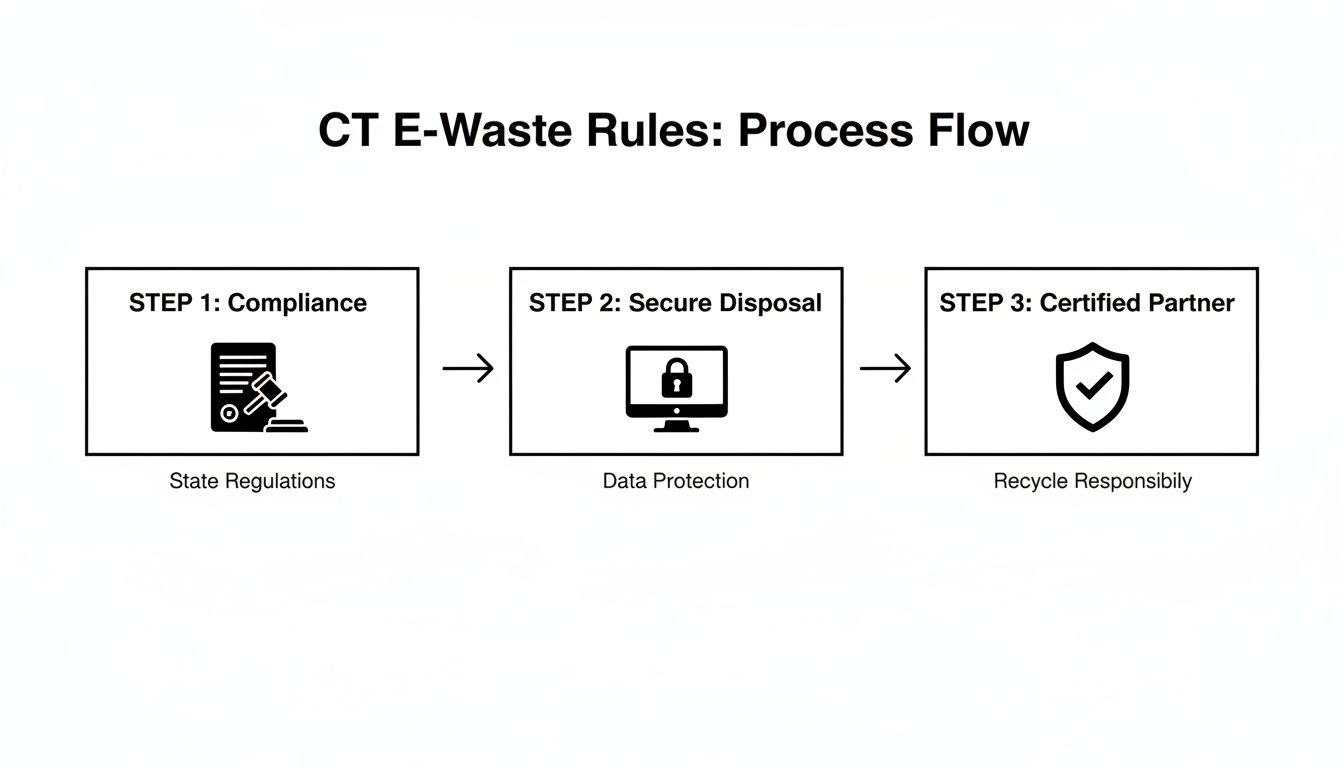
This visual guide emphasizes how secure disposal is a central element of Connecticut's regulatory framework, directly linking your initial compliance efforts to your choice of a certified partner.
Segregate and Secure Your Assets
After completing the inventory and deciding on sanitization methods, it's time to physically separate the assets designated for disposal. Designate a secure, access-controlled area within your facility to store everything awaiting pickup. This simple step prevents equipment from being misplaced, accidentally discarded, or removed without authorization.
Labeling is essential here. Clearly mark pallets or containers with their contents (e.g., "Laptops for Data Wiping," "Hard Drives for Shredding"). This small detail minimizes confusion and ensures a smooth, efficient handover when your electronics recycling partner arrives. Proper organization is a critical part of any successful facility cleanout.
By following these internal preparation steps, you establish a secure and accountable process from the outset. This groundwork makes the transition to an external partner like Reworx Recycling seamless and, most importantly, defensible. Taking these measures seriously is the best way to protect your business when searching for "electronics recycling near me Connecticut."
Why Secure Data Destruction Is Non-Negotiable In Connecticut
When your business retires a server, laptop, or even an office printer, you are managing more than just old hardware. You are overseeing the final, critical stage in your data's lifecycle.
Here in Connecticut, a state with rigorous environmental laws and a high concentration of regulated industries like finance, healthcare, and defense, simply recycling a device is insufficient. That data remains your legal responsibility until it is verifiably and completely destroyed.
Consider this: a single discarded hard drive represents a massive liability. For any business in Stamford or Hartford, the consequences of a data breach from improperly handled equipment can be catastrophic. The fallout extends beyond cleanup costs to include crippling regulatory fines, legal challenges, and the immediate erosion of customer trust—something that takes years to build and moments to destroy.
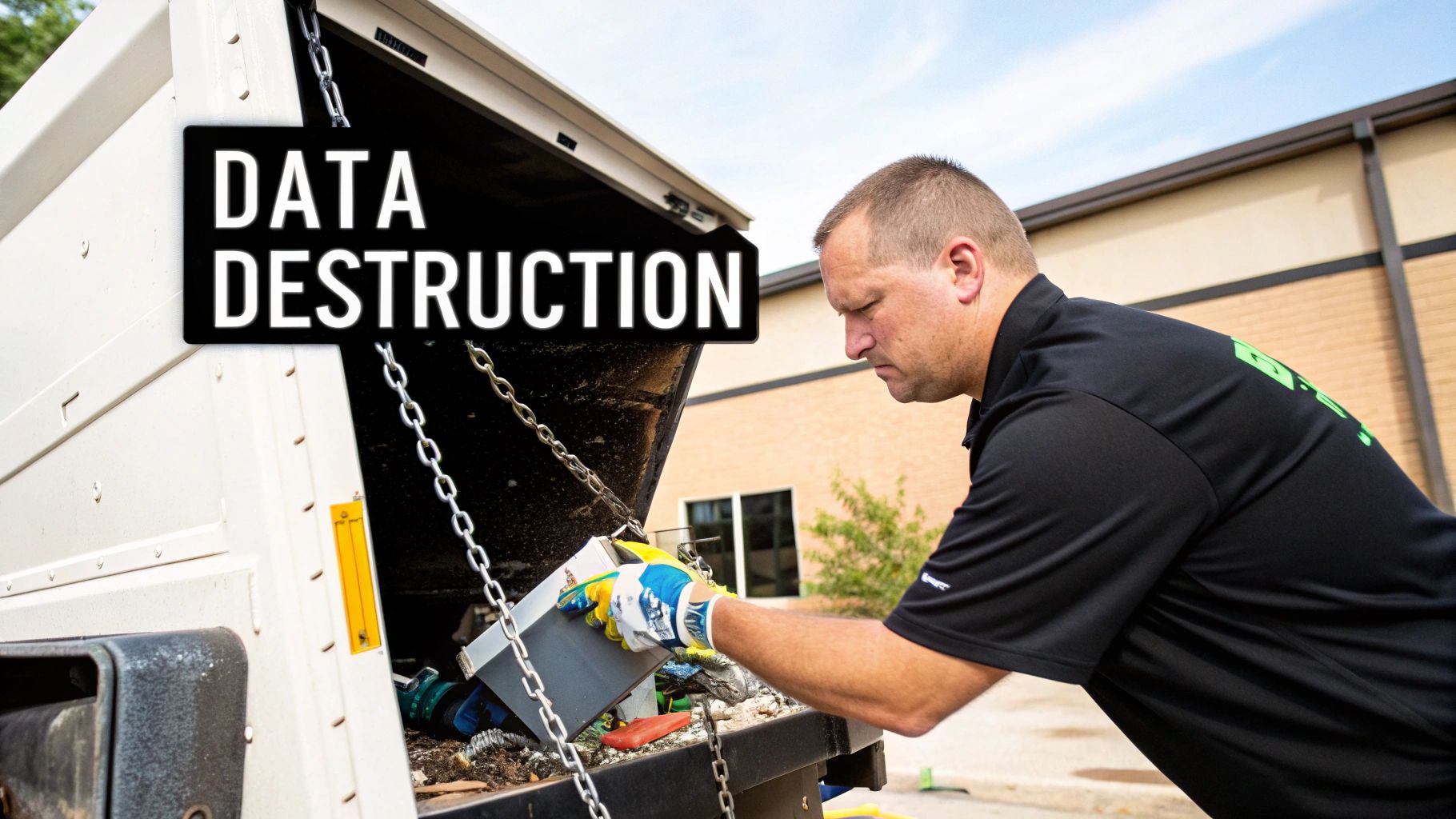
This is why certified data destruction isn't just a best practice; it's a core, non-negotiable component of compliant IT equipment disposal.
Beyond Deletion: The Reality of Data Persistence
Many individuals outside of IT circles believe that formatting a drive or performing a "factory reset" is enough to protect company data. This is a dangerously common misconception.
A standard deletion merely removes the pointers that direct your computer to the data's location. The actual information remains intact and easily recoverable with widely available software. For any business asset containing proprietary information, customer records, or employee details, this poses an unacceptable risk.
True data security demands processes that render data absolutely and permanently unrecoverable. This is where professional secure data destruction services are indispensable. These services utilize methods that adhere to strict industry and government standards, such as those established by the National Institute of Standards and Technology (NIST).
Choosing The Right Destruction Method
The appropriate method often depends on the type of media and its potential for reuse. For newer, functional devices that might be refurbished and donated, software-based data wiping can be effective. This process overwrites the entire drive with random characters, permanently burying the original data.
However, for hardware that is obsolete, damaged, or contained highly sensitive information, physical destruction is the only foolproof solution.
- Hard Drive Shredding: This is the gold standard. Industrial shredders grind hard drives, solid-state drives (SSDs), and other media into small, confetti-like pieces.
- Degaussing: This process employs powerful magnets to erase the magnetic field on traditional hard drives, rendering them useless and the data irrecoverable.
- Crushing/Pulverizing: This involves physically deforming or crushing the drive platters, making it impossible for a read head to ever access them again.
For Connecticut businesses, especially those in sectors governed by HIPAA (healthcare) or GLBA (finance), physical shredding is the most defensible choice.
The Importance of Certified Proof
When you select a partner for electronics recycling in Connecticut, their word is not enough. Your organization requires tangible proof that every single data-bearing device was properly destroyed. A reputable ITAD partner like Reworx Recycling provides this proof through meticulous documentation.
A Certificate of Data Destruction is more than just a piece of paper; it is your legal evidence of due diligence. This document should list the serial numbers of every sanitized or destroyed hard drive, providing a clear and auditable trail that protects your business from liability.
This documentation transforms IT asset disposal from a simple task into a key component of your company's risk management strategy. It demonstrates your commitment to data privacy and provides the concrete evidence needed to satisfy auditors and regulators.
Connecticut's regulatory landscape continues to evolve, strengthening the link between responsible recycling and data security. The state's updated Electronic Recycling Law for 2025 directly connects proper end-of-life handling to secure data destruction, particularly for corporate hard drives and SSDs. State guidance now clarifies that for SSDs, only physical shredding or NSA-approved methods are sufficient, requiring businesses to use DEEP-approved recyclers who can verify this destruction.
At Reworx Recycling, our audited data destruction services, including on-site shredding options, are designed to provide the absolute certainty your business requires. You can learn more by exploring Reworx Recycling's secure data destruction services and how they safeguard your sensitive information. We understand that protecting your data is paramount.
The Community Impact Of Your Recycling Choice
What if your company’s retired IT equipment could achieve more than just responsible recycling? When your Connecticut business partners with a social enterprise, the disposal of old electronics transitions from a simple operational expense into a powerful social investment.
This is the intersection where your IT Asset Disposition (ITAD) strategy directly supports your Environmental, Social, and Governance (ESG) objectives.
Instead of merely becoming shredded materials, retired corporate assets can gain a second life. They can become vital tools for local nonprofits, schools, and workforce development programs right here in Connecticut. This approach transforms the narrative around an office cleanout. It is no longer just about compliance; it's about making a tangible difference where your employees and customers live and work.

Beyond Recycling To Community Empowerment
Choosing a donation-based recycling model means your company’s retired technology becomes a bridge across the digital divide.
Consider a typical scenario: a Hartford-based insurance company needs to refresh 200 employee laptops. Through a standard recycler, those machines are securely wiped and broken down for raw materials—a compliant and environmentally sound choice.
Now, imagine those same 200 laptops are processed by a social enterprise recycling partner like Reworx Recycling. After secure data wiping, a significant portion of those devices are refurbished. They are then donated to a local after-school program in New Haven, giving children access to technology they would not otherwise have. Suddenly, the impact of your decision is multiplied.
This shift in perspective allows your business to generate a powerful social return on investment (SROI) from assets previously deemed to have zero value. Your company's surplus becomes another organization's solution.
How Corporate Donations Drive Digital Inclusion
Digital inclusion is the principle that everyone should have the technological capacity needed for full participation in modern society. Your company's retired IT assets can directly support this mission in several tangible ways.
- Empowering Nonprofits: Many Connecticut nonprofits operate on tight budgets, often using outdated technology that hinders their efficiency. Donated computers and office equipment enable them to better serve their communities and manage operations.
- Supporting Education: Schools and educational programs can use refurbished laptops and tablets to provide students with hands-on tech experience, preparing them for the modern workforce.
- Fueling Workforce Development: Job training centers rely on functional computers to teach essential digital literacy skills, helping individuals re-enter the workforce and secure better-paying jobs.
By directing your surplus IT equipment toward these initiatives, your organization creates a ripple effect of positive change. It is a story of community partnership that your team can be proud to share.
When you partner with a social enterprise, your retired IT equipment doesn’t just avoid a landfill; it actively builds a stronger, more equitable community. This is how a routine operational task becomes a cornerstone of your corporate social responsibility program.
Reworx Recycling's Social Enterprise Model
At Reworx Recycling, our entire mission is built on this foundation of community impact. We are a donation-based social enterprise, meaning our operations are designed to maximize both environmental sustainability and social good.
When you work with us, you are not just hiring a vendor for electronics recycling in Connecticut; you are engaging a partner dedicated to your ESG success.
We manage every step of the ITAD process—from secure logistics and certified data destruction to responsible recycling. Our unique model allows us to identify viable equipment for refurbishment, channeling these resources back into the community. You can see how we build these relationships by reading about partnering for impact with Reworx. It is practical action that turns your sustainability goals into reality.
Finding The Right ITAD Partner In Connecticut
Choosing the right provider to handle your end-of-life electronics is a significant decision. This choice has far-reaching effects, impacting everything from your company's data security and legal compliance to its public reputation. For businesses in Connecticut, this is not about finding the cheapest service to haul away old equipment. It is about identifying a true IT Asset Disposition (ITAD) partner who understands the stakes when corporate technology reaches the end of its lifecycle.
A premier ITAD partner functions as an extension of your own team. They should provide secure pickups, certified data destruction, and clear, transparent reporting that withstands any internal audit or regulatory scrutiny. Distinguishing between a simple pickup service and a professional ITAD firm is the first and most critical step.
Key Questions To Ask Any Potential Vendor
Before signing any agreement, it is essential to vet any potential partner. Their responses to a few direct questions will reveal everything you need to know about their professionalism, security protocols, and environmental commitment.
Here is a practical checklist to guide you:
- What certifications do you hold? Look for certifications like R2 (Responsible Recycling) or e-Stewards. These are not just logos; they prove the vendor has passed rigorous third-party audits on data security, environmental safety, and worker protection.
- Can you provide a complete chain-of-custody document? A true partner offers serialized tracking from the moment your assets leave your facility until they are fully processed. This documentation is your proof of due diligence.
- What are your specific data destruction methods? Do they offer both on-site and off-site shredding? You should also ask how they provide a Certificate of Data Destruction for every single hard drive, SSD, or mobile device.
- Do you have adequate insurance coverage? This is non-negotiable. They must have general liability, pollution liability, and, crucially, data breach/cyber liability insurance. This protects your organization in a worst-case scenario.
The answers you receive will quickly differentiate basic recyclers from professional ITAD firms equipped to handle the needs of Connecticut’s businesses.
Understanding Downstream Transparency
One of the most crucial, yet often overlooked, aspects of this process is downstream transparency. In simple terms, this means you know exactly where your electronics go after your vendor processes them. A certified partner is required to audit their own downstream partners, ensuring nothing is illegally exported or dumped in a landfill.
Your legal and environmental liability does not end when the truck leaves your facility. A certified ITAD partner accepts this responsibility and provides the documentation to prove that every component was handled correctly, down to the last circuit board.
This level of accountability is essential for achieving corporate ESG (Environmental, Social, and Governance) goals and protecting your brand from negative publicity.
The sheer volume of e-waste makes this vetting process more critical than ever. In the U.S. alone, approximately 8 million tons of e-waste are generated annually, yet only 15–20% is properly recycled. A single office refresh of 200 PCs can easily generate 2–3 tons of equipment. These figures underscore why, for managers searching "electronics recycling near me Connecticut," finding a vetted, security-focused provider is a critical operational imperative.
A good partner can also help you find value in retired assets. This extends beyond simple recycling and can include services like programs for reselling unused toners.
At Reworx Recycling, our services are designed to meet these high standards. As a donation-based social enterprise, we deliver the certified reporting, secure logistics, and transparent processes your organization demands. We are here to help you navigate the complexities of ITAD, transforming a potential liability into a secure, compliant, and socially responsible component of your operations. To see how we implement these best practices, explore our detailed Connecticut ITAD services for corporate clients.
Common E-Waste Questions from Connecticut Businesses
When it comes to disposing of old IT assets, businesses across Connecticut often have the same questions regarding security, cost, and logistics. Here are straightforward answers to the most common inquiries from IT managers, facility directors, and business owners.
How Much Will Our Electronics Recycling Project Cost?
This is always a primary question, and the honest answer is: it depends. The final cost of a corporate electronics recycling project is determined by a few key factors.
- Logistics: Are we picking up from a single location or multiple sites? Is the equipment on the ground floor, or does it require navigating a data center on an upper floor? Are the assets already palletized?
- Asset Type: Recycling servers, networking gear, and laptops is a more complex process than handling basic items like monitors or keyboards.
- Data Destruction Needs: On-site hard drive shredding, which offers the highest level of security, has a different cost structure than off-site data wiping services.
- Value Recovery: Here is the positive side. If your equipment includes newer, functional items—such as recent-model laptops or enterprise servers—their potential resale value can significantly offset or even cover the service costs entirely.
Partnering with a social enterprise like Reworx Recycling can be a significant advantage. Our donation-based model often proves to be a highly cost-effective solution, especially when we can refurbish your assets for our community programs.
What Happens To The Data On Our Old Hard Drives?
This is arguably the most critical question. You cannot simply hand over devices and hope for the best. A certified ITAD partner must guarantee that every bit of data is permanently eliminated.
The process begins with a secure and documented chain of custody from the moment we arrive. All data-bearing devices are immediately segregated and transported in locked containers. From there, depending on your security requirements, we use two primary methods:
- Certified Data Wiping: We use software that meets NIST 800-88 standards to completely overwrite all data. This is an excellent option for devices you would like to see refurbished and donated.
- Physical Shredding: This is the ultimate solution for data security. We physically destroy hard drives and SSDs, grinding them into small, unrecognizable fragments. Data recovery is impossible.
Upon completion, you will receive a Certificate of Data Destruction. This document itemizes every drive by its serial number, providing you with a crucial audit trail for compliance and peace of mind.
Can You Handle A Large Office or Facility Cleanout?
Absolutely. We specialize in large-scale projects, including full office cleanouts, data center decommissioning, and clearing out old laboratory equipment. Our team coordinates all logistics, from providing the appropriate bins and pallets to professionally packing and removing every designated asset.
We manage the entire project from start to finish to minimize disruption to your daily operations. This includes handling a wide range of equipment beyond standard IT gear, such as specialized medical instruments or lab equipment, ensuring everything is recycled or disposed of in an environmentally compliant manner.
For a major facility cleanout, planning is paramount. We will work directly with your team to develop a detailed project plan that covers inventory, scheduling, and on-site coordination to ensure a smooth, efficient process.
Do We Need To Sort The Equipment Ourselves?
No, you do not have to. While maintaining an internal inventory is always a good practice for your own records, our team can handle all on-site sorting and categorization.
We will separate items destined for recycling, refurbishment, and secure data destruction on-site as part of our service. This saves your team a significant amount of time and ensures every piece of equipment is processed correctly. For businesses searching for "electronics recycling near me Connecticut," finding a partner that provides this level of full-service support simplifies a complex task.
At Reworx Recycling, our mission is to provide clear answers and transparent solutions for all your ITAD needs. We combine certified data destruction and responsible recycling with a social enterprise model that directly benefits communities here in Connecticut. Whether you're planning an office cleanout or need secure product destruction, we invite you to partner with us. Schedule a pickup or contact us today to learn how we can help your business recycle responsibly while making a lasting impact. Visit our Recycling Blog to see how we help businesses manage end-of-life IT assets securely and sustainably.