For any business operating in Connecticut, managing outdated electronics is more than an environmental best practice—it's a legal mandate. State regulations are explicit on how organizations must handle their end-of-life IT equipment, making compliance a critical component of IT Asset Disposition (ITAD). Disposing of old hardware in a dumpster is not an option and can lead to significant penalties, underscoring the need for a formal IT equipment disposal strategy.
Why Your Business Must Understand Connecticut E-Waste Regulations
In Connecticut, managing electronic waste requires a strategic approach. The state has established a robust legal framework that places the responsibility squarely on businesses to ensure their old computers, monitors, and other devices are handled in an environmentally sound and secure manner. Overlooking these regulations is a direct violation of state law that can result in fines and damage to your corporate reputation.
This legal landscape transforms IT disposal from a routine task into a strategic business decision. Every action, from a data center decommissioning in Hartford to an office cleanout in Stamford, must be viewed through the lens of compliance and risk management. For IT managers and sustainability leaders, mastering these rules is the first step toward developing an e-waste program that is both responsible and legally compliant.
The Foundation of Connecticut's E-Waste Law
Connecticut's approach to e-waste is recognized as one of the most effective in the nation. The state was a pioneer, establishing its E-Waste Recycling Law in 2007. The law is structured around an extended producer responsibility (EPR) model, which strategically shifts the financial burden from businesses and municipalities to the manufacturers themselves.
Under this system, the companies that produce computers, monitors, printers, and TVs are required to fund the collection and recycling of those products. Since 2011, Connecticut has reinforced its commitment by banning these devices from all state solid waste facilities, ensuring they are diverted from landfills. You can discover more insights about this program and how it affects waste management in the state.
This framework directly influences your daily operations.
- No Landfill Disposal: It's illegal to dispose of covered electronics in a dumpster. This applies to everything from a single employee laptop to a full server rack.
- Data Security Implications: The law mandates a formal disposal process, which inherently brings data security to the forefront. You cannot just recycle a device; you must first ensure all sensitive data has been completely destroyed.
- Mandatory Recycling Channels: Businesses are required to use approved recycling channels. This means partnering with a certified and compliant vendor like Reworx Recycling is a necessity, not just a recommendation.
Partnering for Compliance and Peace of Mind
Navigating these regulations independently can be complex and time-consuming. You need a partner who understands the nuances of both state law and secure ITAD. Working with a donation-based social enterprise like Reworx Recycling ensures every piece of equipment is managed in full compliance with Connecticut DEEP standards. This partnership mitigates risk by providing a clear chain of custody and certified data destruction, protecting your organization from potential legal issues and data breaches.
Choosing a certified ITAD partner is the most effective way to ensure your business meets Connecticut's e-waste regulations. It shifts the burden of compliance, logistics, and data security to experts, allowing you to focus on your core operations with confidence.
By building your electronics recycling strategy around compliance, you not only avoid penalties but also strengthen your company's commitment to corporate social responsibility. A partner like Reworx Recycling helps transform a legal requirement into an opportunity to demonstrate your environmental stewardship and community support. This approach ensures your business remains a responsible corporate citizen in Connecticut.
Building Your Corporate E-Waste Management Plan
Transitioning your company from reactive cleanouts to a proactive, secure system for managing old electronics begins with a formal IT asset disposition (ITAD) plan. This plan serves as your internal roadmap, ensuring every piece of equipment—from servers in a Stamford data center to laboratory equipment in New Haven—is managed consistently and responsibly.
The objective is to establish a repeatable process that protects your data, maintains compliance with state and federal laws, and aligns with your company’s sustainability goals.
Conducting a Comprehensive Asset Inventory
Effective management starts with a clear understanding of your assets. The foundation of any robust e-waste plan is a thorough inventory. This process involves more than just counting computers; it requires creating a detailed record of every device, its location, and its potential data risk.
A detailed inventory provides the clarity needed for informed decision-making. For instance, a server rack from a data center decommissioning project requires a higher level of data security than a collection of old office monitors.
Begin by creating a master list using asset management software or a simple spreadsheet. For each device, capture these key details:
- Asset Type: (e.g., laptop, server, monitor, medical device)
- Manufacturer & Model: (e.g., Dell Latitude 7420, HP ProLiant DL380)
- Serial Number: Crucial for unique identification and tracking.
- Physical Location: (e.g., Building A, Floor 3, IT Storage)
- Data-Bearing Status: A "Yes" or "No" to flag any device with storage media.
This initial audit often uncovers a surprising number of "ghost" assets—forgotten equipment in storage closets and under desks. Identifying these is a significant win for both security and compliance.
This flowchart illustrates the efficient journey of e-waste under Connecticut's producer responsibility model.
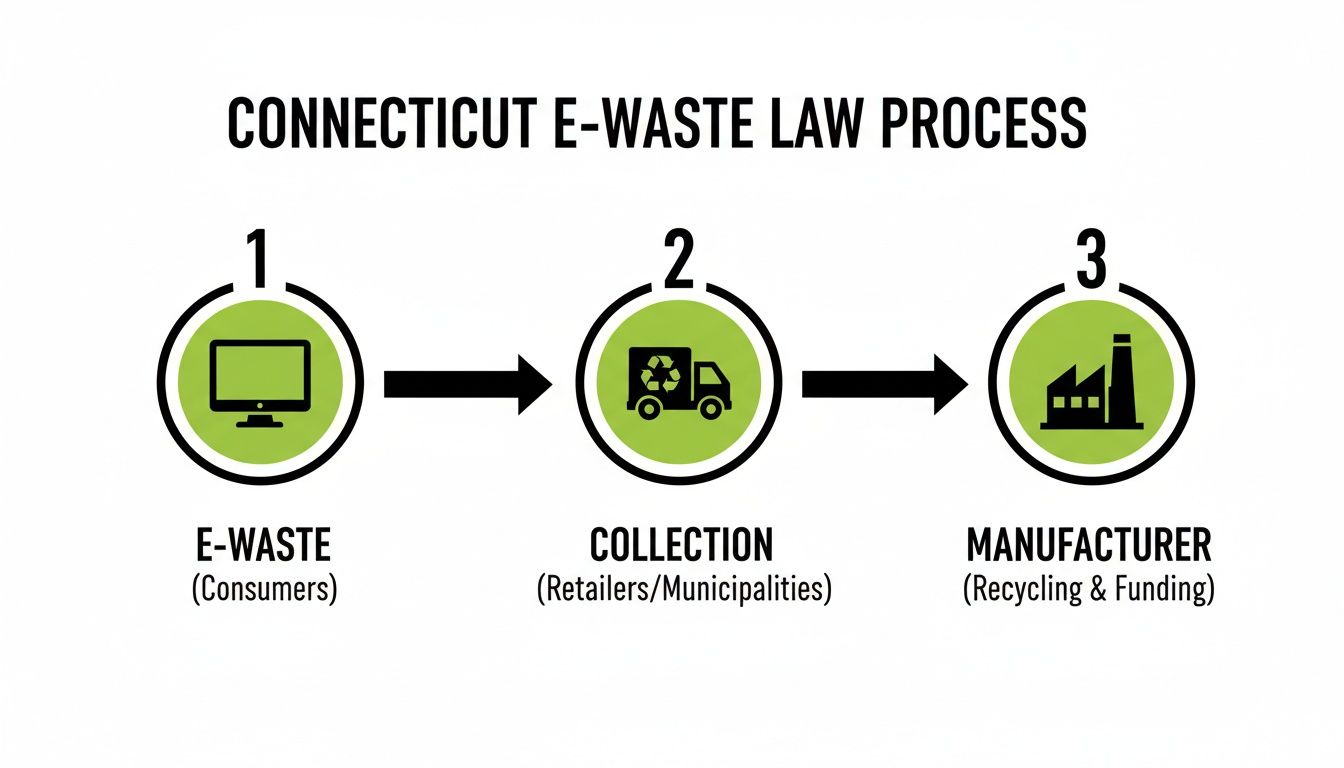
As shown, the state’s system is designed to divert both consumer and business electronics from landfills into proper recycling streams, with manufacturers covering the costs.
Assessing Data Security Risks
With your inventory complete, the next step is risk assessment. Every device marked as "data-bearing" is a potential liability. Categorize these assets based on the sensitivity of the information they held.
A laptop used by your finance department, for example, represents a much higher risk than a kiosk monitor from the lobby. This categorization will determine the necessary level of data destruction.
For high-risk assets, certified physical destruction is the only acceptable method. For lower-risk items, certified data wiping may be an option, but physical shredding remains the gold standard for absolute security. A clear strategy covering the entire lifecycle of your electronics is essential. This guide to IT Asset Lifecycle Management provides an excellent framework.
The single biggest mistake in corporate e-waste management is underestimating the data risk of retired assets. Assume every device that stores data contains sensitive information until it is proven to be physically destroyed or certifiably wiped by a trusted partner.
Scheduling and Documenting the Process
Once your inventory and risk assessment are complete, you can engage a certified partner like Reworx Recycling. Scheduling a pickup is a straightforward process. You will share your inventory list, discuss specific needs (such as on-site hard drive shredding), and arrange a secure collection time.
From the moment our truck leaves your facility, a secure chain of custody begins. This critical documentation tracks your assets to their final disposition. Always ensure your recycling partner provides detailed documentation, including:
- A Bill of Lading: Your receipt confirming the transfer of assets.
- A Certificate of Recycling: Confirms that all non-data-bearing assets were recycled in compliance with environmental regulations.
- A Certificate of Data Destruction: Your most important document, listing the serial numbers of every destroyed hard drive and certifying that your data has been completely and irrecoverably eliminated.
This paperwork is your proof of compliance. In the event of an audit, these documents demonstrate that you have met your legal and ethical obligations for Connecticut electronics recycling. For a deeper dive into developing your internal program, you can optimize your company's e-waste recycling strategy.
To help you organize these steps, here is a simple checklist.
Corporate E-Waste Recycling Checklist
| Phase | Action Item | Key Consideration | Reworx Solution |
|---|---|---|---|
| 1. Inventory | Create a master list of all IT assets. | Note asset type, model, serial number, and if it holds data. | Use our inventory templates or integrate with your existing system. |
| 2. Risk Assessment | Classify data-bearing devices by risk level. | High-risk devices (e.g., finance laptops) need top-tier destruction. | We consult with you to determine the right data destruction method. |
| 3. Scheduling | Contact a certified recycler for pickup. | Discuss needs like on-site shredding or specialized equipment handling. | Flexible scheduling and secure logistics tailored to your business hours. |
| 4. Documentation | Obtain and file all compliance paperwork. | Never proceed without a clear chain of custody and certificates. | We provide a full suite of documentation, including Certificates of Destruction. |
Following these steps transforms IT asset disposition from a complicated chore into a streamlined, secure, and fully compliant part of your business operations.
Making Data Security Your Top Priority
When your company retires a server, laptop, or medical device, the focus is often on the hardware. However, the real risk lies in the vast amount of sensitive data stored on it.
A single discarded hard drive can become your organization's biggest liability, exposing customer information, trade secrets, and financial records. For any business in Connecticut, making data security a non-negotiable part of the electronics recycling process is essential for effective risk management.
Improper IT equipment disposal can lead to devastating consequences, including costly data breaches that erode customer trust and steep financial penalties for non-compliance with regulations like HIPAA or GLBA. The assumption that deleting files or reformatting a drive is sufficient is a dangerous misconception. Data recovery software can easily retrieve information from improperly wiped devices, leaving your company vulnerable.
Understanding Data Destruction Methods
When securing data on old assets, businesses have two primary options: software-based wiping or physical hardware destruction. Both have their applications, but understanding the distinction is crucial for aligning the method with your company's risk profile.
Software wiping, or data sanitization, uses specialized programs to overwrite a hard drive's entire surface with random characters. When performed correctly according to standards like NIST 800-88, this can be effective for lower-risk devices intended for reuse or donation. However, it requires meticulous verification to ensure every sector has been successfully overwritten.
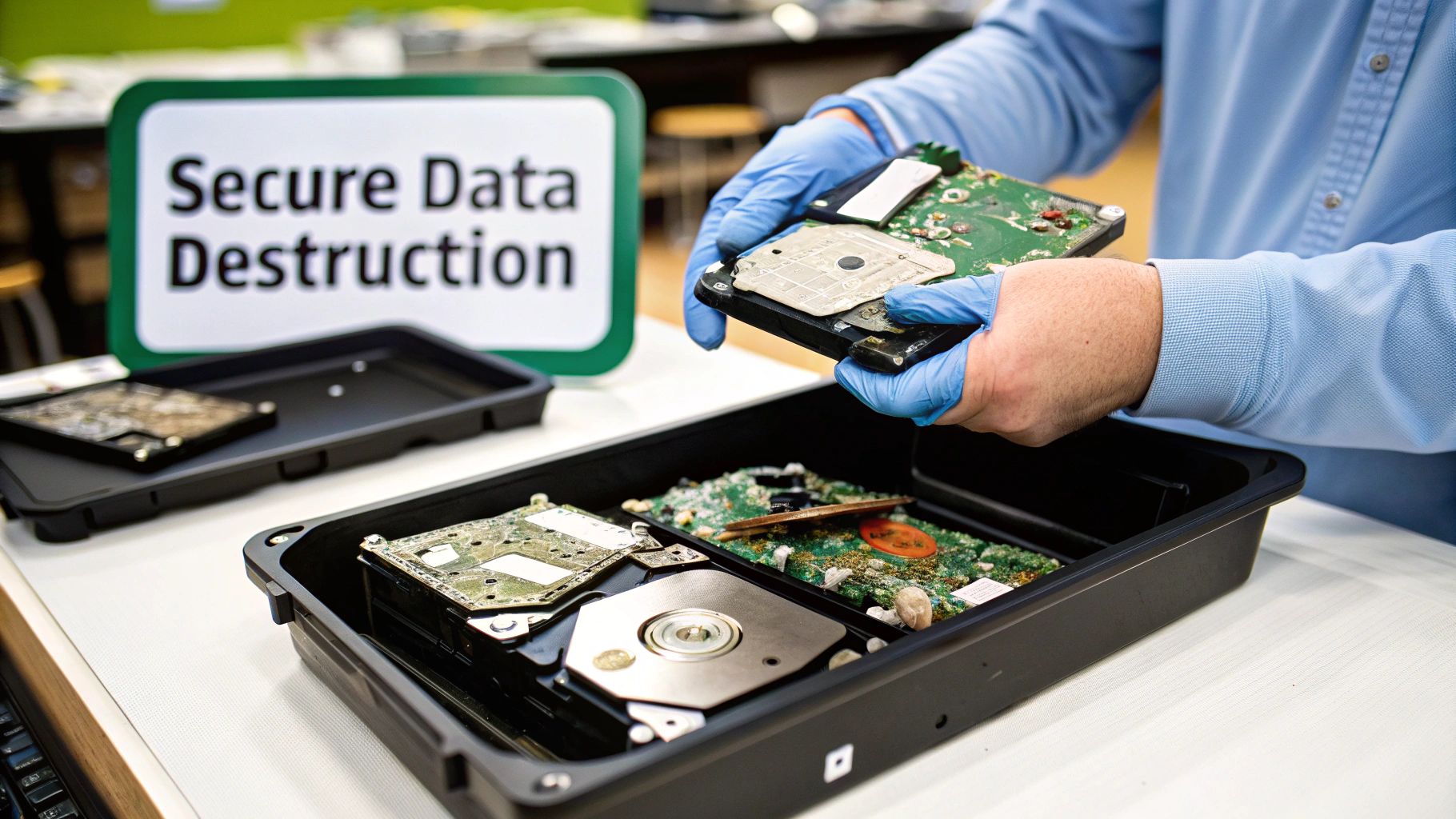
For any device that has handled sensitive corporate, client, or patient information, physical destruction is the only foolproof method. This approach doesn't just erase the data; it obliterates the physical media, making recovery impossible.
The Gold Standard: Physical Shredding
Physical destruction, typically performed with industrial-grade shredders, grinds hard drives, SSDs, and other storage media into small, unrecognizable fragments. This method offers significant advantages for corporate ITAD programs.
- Absolute Certainty: It completely eliminates any possibility of data recovery.
- Compliance Peace of Mind: It provides a clear, defensible audit trail for regulatory purposes.
- Efficiency: It is a fast and effective way to process large volumes of media, especially during office cleanouts or data center decommissioning projects.
"For organizations handling sensitive information, the debate between wiping and shredding is settled. Certified physical destruction is the only method that guarantees data is gone forever, providing the verifiable proof needed to satisfy compliance officers, legal teams, and leadership."
Partnering with a certified provider like Reworx Recycling ensures this entire process is handled securely. We offer both on-site and off-site shredding services, allowing you to witness the destruction firsthand if your protocol requires it. This verifiable, transparent approach is the foundation of a secure Connecticut electronics recycling strategy. You can learn more about our secure data destruction services and how we protect your most critical information.
The Importance of Certified Documentation
A secure process is only as good as its documentation. After your assets are destroyed, you must receive a Certificate of Data Destruction. This legally binding document serves as your official record and proof of compliance.
This certificate should include, at a minimum:
- A unique serial number for tracking.
- The date and location of the destruction.
- The specific method used (e.g., shredding).
- A detailed list of the serial numbers from every individual hard drive destroyed.
This documentation is your shield in an audit or legal inquiry, proving that your organization took deliberate, verifiable steps to protect sensitive data and fulfill its duty of care. By prioritizing certified physical destruction and demanding thorough documentation, Connecticut businesses can transform a potential liability into a securely managed operational component.
Turning E-Waste Into a Community Asset
What if your company's old IT equipment could do more than just be recycled? While responsible disposal is the baseline, forward-thinking Connecticut businesses are realizing their end-of-life assets hold immense potential to create lasting community value. This is where the social enterprise model transforms a routine operational task into a powerful story of corporate citizenship and community impact.
At Reworx Recycling, our entire mission is built on this principle. We integrate responsible ITAD with direct community benefit, viewing retired assets not as waste, but as an opportunity to bridge the digital divide, support local workforce development, and empower nonprofits across Connecticut.

Beyond Compliance to Corporate Social Responsibility
For many organizations, a formal ITAD program is driven by compliance. However, partnering with a social enterprise like Reworx adds a compelling dimension to your strategy. You can transform a cost center into a cornerstone of your Corporate Social Responsibility (CSR) efforts.
Instead of being shredded, functional equipment that meets our refurbishment standards is given a second life. This simple act creates a powerful ripple effect: it extends the lifecycle of valuable electronics—reducing the environmental impact of manufacturing new ones—and places essential technology into the hands of those who need it most.
This approach provides a genuine brand story that resonates with employees, customers, and stakeholders. In an era where businesses are expected to have a purpose beyond profit, this is a tangible way to demonstrate your commitment.
How Donation-Based Recycling Works
We designed our process to be simple and secure, ensuring your data is protected while maximizing the social return on your old equipment. Here is how your retired assets can make a difference:
- Secure Collection: The process begins with the same secure logistics and chain of custody expected from any top-tier ITAD provider. We manage everything from office cleanouts to complex facility decommissioning projects.
- Data Destruction First: This is non-negotiable. Every data-bearing device undergoes our certified data destruction process. Your security is our absolute priority.
- Triage and Refurbishment: Our technicians assess all equipment. Devices viable for reuse are professionally refurbished, tested, and prepared for their new role.
- Community Distribution: The refurbished technology is then distributed to our network of community partners, including schools, nonprofits, and workforce training centers, directly fueling digital inclusion initiatives across the region.
This donation-based recycling model is a tangible way to demonstrate your company’s commitment to sustainability and community building. If you're looking to get involved, you can learn more about our programs and how to donate a laptop or other equipment.
Integrating a social enterprise model into your ITAD strategy is a strategic move that enhances brand reputation. It transforms a routine disposal process into a visible, impactful contribution to the community, making your sustainability claims authentic and measurable.
The Power of Incentives in Driving Participation
Creating positive change often relies on well-structured programs with clear benefits. A powerful parallel can be seen in other successful statewide recycling initiatives. For instance, Connecticut recently demonstrated the effectiveness of strategic program changes when it achieved a 65% redemption rate for beverage containers in 2024—a significant 21% increase from the 44% rate in 2023.
This success followed key updates to its deposit-return system, most notably increasing the container deposit from 5 to 10 cents. As noted by the Container Recycling Institute, this proves that meaningful incentives drive significant behavioral change.
Similarly, the social and brand benefits of donation-based electronics recycling serve as a powerful incentive for corporate partners. By choosing this path, your organization not only ensures compliant Connecticut electronics recycling but also generates a positive impact that can be shared in sustainability reports and marketing materials, turning responsible disposal into a competitive advantage.
Ready to Partner with Reworx Recycling?
Choosing the right partner for electronics recycling in Connecticut is a significant decision that impacts your data security, environmental compliance, and corporate reputation. When you are ready to move forward, Reworx Recycling makes the process clear and straightforward. We are more than just a vendor; we are a dedicated partner committed to helping you achieve your operational and sustainability goals.
Our approach is designed to simplify the IT asset disposition (ITAD) lifecycle. Whether you are managing a standard office cleanout, a large-scale data center decommissioning, or the disposal of specialized medical and laboratory equipment, our team handles all logistics, providing a single, reliable point of contact.
Getting Started is Simple
We believe the process should be seamless. Initiating a partnership with Reworx is easy and tailored to your specific needs. We understand that every organization is different, from the volume of equipment to the specific data security protocols required.
It all begins with a conversation about your goals. We are here to provide solutions, whether you need an immediate equipment pickup or are looking to develop a long-term ITAD program.
Here’s how you can get in touch with our team:
- Schedule a Pickup: If you're ready to dispose of retired assets, our online scheduling system makes it easy to book a secure pickup from your facility.
- Request a Consultation: For more complex projects, like a full facility cleanout or developing a comprehensive ITAD strategy, a no-obligation consultation with our specialists can help create the perfect plan.
- Explore Corporate Donation Programs: Ask us how your old equipment can directly support our mission. We can explain how your e-waste can be transformed into a valuable community asset.
Our Full Suite of Services for Connecticut Businesses
Partnering with Reworx gives you access to a complete set of services designed to cover every aspect of Connecticut electronics recycling. We provide true end-to-end management that guarantees compliance and gives you total peace of mind.
Our core services include:
- Secure Logistics and Transportation from your location.
- Certified On-site and Off-site Data Destruction, with full documentation.
- Sustainable Recycling that meets or exceeds all state and federal environmental standards.
- Detailed Reporting and Certificates of Destruction for your compliance and audit records.
Looking to make an even greater impact? We can help you organize an employee e-waste drive. These events are an excellent way to boost engagement, showcase your company's sustainability values, and help your team responsibly dispose of their personal electronics. We provide the bins and manage all logistics to ensure success.
Partnering with Reworx Recycling turns a compliance headache into a strategic win. You get a bulletproof service that ensures data security and regulatory compliance while boosting your company's social responsibility profile.
Your Partner in Security and Sustainability
Ultimately, working with Reworx is an investment in your security, sustainability goals, and community. We bring the expertise to navigate Connecticut's complex e-waste regulations, the certified processes to guarantee data destruction, and a unique social enterprise model that gives your retired assets a second chance.
Making the right choice is critical, which is why we've created a helpful guide on selecting a reliable e-waste recycling partner to assist in your decision-making process.
By working with us, you are choosing a partner committed to turning your e-waste challenges into positive outcomes for your business and our community. Reach out today, and let's build a custom recycling solution that fits your organization perfectly.
Got questions about handling your old electronics in Connecticut? You're not alone. We get asked these all the time, so let's clear up some of the most common points for businesses and organizations across the state.
Quick Answers to Your E-Waste Questions
| Question | Answer |
|---|---|
| What electronics are covered by Connecticut law? | Officially, the state law targets computers, monitors, printers, and televisions. Any business or resident is legally barred from tossing these in the trash. As a best practice, though, you should be recycling all your electronics—servers, phones, cables, you name it. It's the only way to guarantee data security and environmental responsibility across the board. |
| Is my business actually required to recycle electronics? | Yes, absolutely. It is illegal for any business in Connecticut to dispose of those covered devices in a dumpster or at any solid waste facility. These items contain materials like lead and mercury that we need to keep out of our landfills. This isn't just a suggestion; it’s a legal requirement for every organization in the state. |
| How can I be positive my data is destroyed? | The only real proof is a Certificate of Data Destruction from your recycling partner. This isn't just a receipt. It's an official document that lists the unique serial numbers of every single drive or storage device destroyed and details the method used, like physical shredding. If a recycler can't provide this, walk away. |
| What's the real difference between wiping and shredding a drive? | Think of it this way: Wiping uses software to write over your data, which can work if done perfectly. Physical shredding, however, grinds the drive into small, confetti-like metal pieces. For any business with sensitive client, patient, or internal data, shredding is the only way to go. It offers complete peace of mind because data recovery is physically impossible. It’s the gold standard for a reason. |
| Why should I choose a donation-based recycler like Reworx? | Working with a social enterprise like Reworx Recycling turns a simple compliance task into something much more powerful. Once we’ve guaranteed your data is destroyed, we refurbish the usable equipment and donate it to support community programs focused on digital access and job training. It’s a smart way to hit your Corporate Social Responsibility (CSR) goals and make a real local impact while staying fully compliant with Connecticut electronics recycling laws. |
Hopefully, that clears things up! Navigating e-waste rules and data security doesn't have to be complicated. It’s all about finding a trustworthy partner who understands the process inside and out.
Key Takeaway: The state-mandated disposal ban means your organization must partner with a certified recycler for all covered electronics. This legal obligation is a core component of responsible business operations in Connecticut.
Ready to streamline your company’s IT asset disposition while making a real community impact? Reworx Recycling offers secure, compliant, and socially responsible solutions for businesses across Connecticut. Visit our blog to learn more and schedule your pickup today!